Things to Do in Cairo - Top Attractions, Hidden Gems & Must-See Sights

Discover the best things to do in Cairo. Complete guide to must-see sights, popular attractions, hidden gems, museums, food markets and parks.

25 Attractions 6 Categories Travel Guide

Table of Contents

Cairo Overview

Cairo is a city that operates on a scale most travelers aren't prepared for. Twenty million people share a metropolis that spans millennia: the 4,500-year-old Pyramids of Giza sit at the western edge, a thousand years of Islamic architecture fill the medieval core, and a modern, chaotic, endlessly alive city sprawls around it all. The Nile runs through the middle, and everything from pharaonic tombs to Mamluk mosques to 21st-century art galleries exists within an hour's drive. The Grand Egyptian Museum, which opened in November 2025 near the pyramids, has added a world-class new anchor to an already dense list of attractions.

Cairo rewards patience and planning. The traffic is real, the distances are large, and the heat between May and September can be punishing. But the payoff is immense. No other city on Earth lets you stand in front of the last surviving ancient wonder, walk through a medieval bazaar, and sit in a cafe that has been open since 1797, all in the same day. Travelers who love history, food, and sensory overload will find Cairo inexhaustible. Those who prefer things tidy and predictable will struggle. Come prepared for intensity, and the city will give you more than you expected.

Must-See Attractions in Cairo

  • Pyramids of Giza
  • Grand Egyptian Museum
  • Islamic Cairo
  • Citadel of Saladin
  • Khan El-Khalili Bazaar
  • Cairo Tower
  • Great Sphinx
🏛️ Must-See ⭐ Sights 💎 Hidden Gems 🎨 Museums 🍕 Food & Markets 🌳 Parks & Views

🏛️ Must-See Attractions in Cairo

These iconic landmarks and must-see sights are essential stops for any visitor to Cairo.

Cairo Tower

1. Cairo Tower

Built between 1956 and 1961 on Zamalek Island in the middle of the Nile, Cairo Tower rises 187 meters, which makes it 43 meters taller than the Great Pyramid. The tower is shaped like a lotus flower, designed by architect Naoum Shebib, and sits on a base of Aswan granite, the same stone the ancient Egyptians used for their temples. It has 16 floors, and a 45-second elevator ride takes you to the observation deck at the top. The view from up there is genuinely worth it. On a clear day you can see the Pyramids of Giza to the west, the Citadel of Saladin to the southeast, and Al-Azhar Mosque's minarets poking through the skyline of Islamic Cairo. A rotating restaurant on the 14th floor lets you eat while the city slowly turns around you. The tower is open daily from 9:00 AM all the way to 1:00 AM, which means you can come for sunset or well after dark when Cairo lights up. Among the top sights in Cairo, the tower gives you the single best orientation point. Before diving into the chaotic streets below, come up here first to understand how the city fits together: the Nile cutting through the center, Zamalek Island below your feet, downtown Cairo to the east, and the desert beginning where the pyramids stand.

Hours Daily: 9:00 AM – 1:00 AM
Price 200 EGP
Insider TipGo 30 minutes before sunset to catch daylight views first, then stay for the city lighting up after dark. The elevator queue is shortest on weekday afternoons.
Citadel of Saladin

2. Citadel of Saladin

Saladin laid the foundation stone for this fortress in 1176, perching it on a spur of the Mokattam Hills where it commands a sweeping view over all of Cairo. For roughly 700 years, from the Ayyubid dynasty through the Mamluks and Ottomans, this was the seat of Egyptian power. Rulers only moved out when the Khedive relocated to Abdeen Palace in the 19th century. The compound is massive, containing several mosques, museums, and military buildings within its walls. It's part of the UNESCO-listed Historic Cairo zone. The dominant structure inside is the Muhammad Ali Mosque, whose twin minarets and silvery dome are visible from all over the city. But the Citadel holds more than that: the Al-Nasir Muhammad Mosque from the Mamluk period, a military museum, and a carriage museum are all within the walls. The complex opens daily from 8:00 AM to 4:30 PM. Plan at least 90 minutes to walk the grounds properly. The terrace behind the Muhammad Ali Mosque gives you one of the best panoramic views in Cairo, stretching from the pyramids on clear days to the minarets of Islamic Cairo below. From here you can head downhill to Al-Darb al-Ahmar and on to Khan El-Khalili, covering medieval Cairo in a single half-day loop.

Hours Daily: 8:00 AM – 4:30 PM
Price 550 EGP
Location 30.0294, 31.2614
Insider TipVisit in the late afternoon when the interior cools down and the light on the city turns golden. The terrace behind Muhammad Ali Mosque faces west, perfect for watching the sun drop toward the pyramids.
Grand Egyptian Museum

3. Grand Egyptian Museum

The Grand Egyptian Museum opened on November 1, 2025, and it is now the largest archaeological museum in the world. It sits just 2 km from the Pyramids of Giza, with its main entrance framing a direct view of the pyramids through floor-to-ceiling glass. The collection holds over 100,000 artifacts spanning ancient Egyptian, Greek, and Roman periods. The complete Tutankhamun collection, previously split across the old Egyptian Museum downtown, is now displayed together in one place for the first time. The museum was designed to handle 5 million visitors per year, and the scale of the building matches that ambition. The Grand Staircase alone, lined with massive pharaonic statues, takes your breath away before you even reach the galleries. The building includes conservation labs, a children's museum, gardens, and commercial spaces. It's open daily from 9:00 AM to 4:00 PM. A visit here easily fills 3-4 hours, and rushing through would be a waste. The old Egyptian Museum in Tahrir Square, while still open, now feels like a nostalgic time capsule by comparison. If you only have time for one museum in Cairo, and it's a city with many, this is the one.

Hours Daily: 9:00 AM – 4:00 PM
Price 450 EGP
Website gem.eg/
Insider TipBuy tickets online through the official website (gem.eg) in advance. The museum is newest and most crowded on weekends. Weekday mornings give you the best experience with fewer visitors.
Great Sphinx

4. Great Sphinx

Sitting at the foot of the Giza Plateau, the Great Sphinx is a 73-meter-long limestone figure with the body of a lion and the face believed to be Pharaoh Khafre's. Carved from bedrock around 2500 BCE, it is the oldest known monumental sculpture in Egypt. The head alone is 20 meters high. Its nose has been missing for centuries, and no, Napoleon's troops didn't shoot it off. Drawings from before Napoleon's 1798 campaign already show it gone, and the 15th-century historian al-Maqrizi documented the damage even earlier. The Sphinx sits within the Giza Plateau complex, just a short walk downhill from the Pyramid of Khafre. Your general admission to the Giza Plateau covers access to the Sphinx viewing area. The site opens daily from 7:00 AM to 4:00 PM, closing an hour earlier than the pyramids above. Most visitors spend about 20 minutes here. You can get remarkably close from the lower viewing platform, and the angle from below looking up is far more dramatic than the distant side views. If you're checking off top sights in Cairo, the Sphinx is inseparable from the pyramids. But on its own, it's a 20-minute stop, not a half-day destination. The light and sound show in the evenings uses the Sphinx as its backdrop, which is a different way to experience the plateau after dark.

Hours Daily: 7:00 AM – 4:00 PM
Price 700 EGP (with Giza plateau)
Insider TipThe lower viewing platform on the east side gets you closest to the Sphinx and gives the best angle for photos. Most tour groups stay at the upper terrace.
Islamic Cairo

5. Islamic Cairo

Islamic Cairo is not a single building but an entire district, and it holds one of the densest concentrations of medieval Islamic architecture anywhere on the planet. UNESCO designated Historic Cairo a World Heritage Site in 1979, calling it one of the oldest Islamic cities in the world. The zone stretches from the old walled city around Al-Muizz Street down to the Citadel of Saladin, packed with hundreds of mosques, madrasas, bathhouses, and fountains dating back over a thousand years. The Fatimids founded Cairo here in 969 CE, and layers of Ayyubid, Mamluk, and Ottoman construction piled on top. Al-Muizz Street is the spine of this district. Walking it north to south, you pass Bab al-Futuh gate, Al-Hakim Mosque, dozens of Mamluk-era buildings, and eventually reach Khan El-Khalili bazaar and Al-Azhar Mosque. This walk covers about 1.5 km and takes anywhere from an hour to a full afternoon depending on how often you duck into side alleys. There's no ticket and no closing time for the streets themselves. For anyone compiling things to do in Cairo beyond the pyramids, this district is where the city reveals its true depth. It's loud, crowded, and occasionally overwhelming, but that's the point. The must-see in Cairo is not just the pharaonic past. The medieval Islamic city is just as extraordinary, and most visitors don't give it enough time.

Hours Open 24/7
Price Free
Website Wikipedia
Location 30.046, 31.2627
Insider TipStart at Bab al-Futuh gate and walk south along Al-Muizz Street. This direction puts you at Khan El-Khalili at the end, where you can stop for tea at El-Fishawy Café.
Khan El-Khalili Bazaar

6. Khan El-Khalili Bazaar

Khan El-Khalili has been Cairo's main bazaar for over 600 years. The market sits right next to Al-Azhar Mosque, and its maze of narrow alleys spills into the surrounding streets of Islamic Cairo. Brass lanterns, spices, perfume bottles, leather goods, papyrus, and gold jewelry fill the stalls. The haggling is expected and part of the experience. Nobel Prize-winning novelist Naguib Mahfouz set one of his most famous novels here, and the bazaar named after him still draws writers, locals, and tourists in equal measure. The bazaar stays open from around 9:30 AM until midnight, though individual shops keep their own hours. Late afternoon and evening are when the atmosphere peaks. Brass workers hammer in back alleys, tea sellers weave through the crowds, and the call to prayer from Al-Azhar fills the air every few hours. Unlike the pyramids or the Grand Egyptian Museum, this is not a place you visit for a single object. You come to wander, get a little lost, and absorb the noise and texture of a living market. Start your prices at about a third of what the shopkeeper first quotes. That's not being cheap, that's how the system works.

Hours Daily: 9:30 AM – 12:00 AM
Price Free
Website Wikipedia
Insider TipThe deeper alleys behind the main tourist strip sell the same goods for significantly less. Walk past the first two rows of shops facing the main entrance to find the workshops where artisans actually make the brass and copper work.
Pyramids of Giza

7. Pyramids of Giza

The Pyramids of Giza are the reason Cairo exists on every traveler's map. Built between 2600 and 2500 BCE during the Fourth Dynasty, these three pyramids are the last surviving wonder of the ancient world. The Great Pyramid of Khufu originally stood 146 meters tall and remained the tallest structure on Earth for nearly 4,000 years. It sits on a 13-acre base. Next to it, the Pyramid of Khafre looks taller because of its elevated position, and the smaller Pyramid of Menkaure completes the trio. The entire Giza Plateau, including the Great Sphinx just downhill, is a UNESCO World Heritage Site since 1979. The site opens daily from 7:00 AM to 5:00 PM, and the morning hours are your best window. By 10 AM, tour buses flood the area and the heat becomes punishing. The plateau is about 13 km southwest of downtown Cairo, so plan for a solid 30-60 minutes in traffic each way. You can walk around the exteriors freely with the general admission ticket, but entering the Great Pyramid's narrow passages costs extra and requires bending through low corridors for several minutes. Don't expect a remote desert experience. The city of Giza presses right up against the plateau, and you'll see Pizza Hut from the entrance. That said, walking around to the desert-facing south side gives you a genuinely powerful view of the pyramids stretching toward Saqqara.

Hours Daily: 7:00 AM – 5:00 PM
Price 700 EGP
Insider TipEnter from the back gate near the Mena House hotel to avoid the worst of the tour group congestion at the main entrance. The south side of the plateau, facing the desert, gives you the cleanest photos with no city in the background.
Get Your Own Private Tour with AI Guide
AI Guide
  • Personalized tour tailored to your interests
  • Your AI guide tells stories, shares facts, and cracks jokes
  • Turn-by-turn GPS navigation
  • Available in your language — no download needed
Try for Free

💎 Hidden Gems in Cairo - Off the Beaten Path

Beyond the tourist crowds, Cairo hides remarkable treasures waiting to be discovered.

El Sawy Culture Wheel

1. El Sawy Culture Wheel

Tucked under the 15th of May Bridge on Zamalek Island, El Sawy Culture Wheel is Cairo's first private cultural center and the city's most active independent arts venue. The space opened in 2003 and programs live music, film screenings, art exhibitions, poetry readings, and workshops almost every night. It draws a young, local crowd that you won't find at any of the tourist sites, and the programming ranges from Arabic jazz to indie film to spoken word. The venue is in the northern tip of Zamalek, right on the Nile. Check their website (culturewheel.com) for the current schedule, since events change nightly. Most performances are inexpensive or free. The atmosphere is casual and welcoming, even if your Arabic is limited. Many events are bilingual or primarily musical. As one of the hidden gems in Cairo, El Sawy Culture Wheel gives you something the monuments can't: a window into what contemporary Cairo actually cares about. After days of pharaonic tombs and medieval mosques, spending an evening here watching a local band or a documentary film grounds you in the present-tense city. It pairs naturally with an evening stroll around Zamalek's cafes and restaurants afterward.

Hours Daily: 10:00 AM - 12:00 AM
Price Free
Location 30.0623, 31.2164
Insider TipCheck the schedule on their website the day you arrive. Concerts often start at 8 or 9 PM, and popular acts fill up. Arrive 30 minutes early for a good seat.
Gayer-Anderson Museum

2. Gayer-Anderson Museum

Two adjoining houses from the Mamluk and Ottoman periods, connected by a raised walkway, make up this museum next to the Ibn Tulun Mosque. British officer John Gayer-Anderson lived here from 1935 to 1942 and filled the rooms with his personal collection of Egyptian, Persian, and European art and furniture. The result is less a museum and more a time capsule: you walk through rooms decorated exactly as a wealthy collector arranged them in the 1930s, with mashrabiya screens filtering the light. Admission is 100 EGP, and the museum is open daily from 9:00 AM to 3:00 PM. The house itself is the attraction. A reception hall with a central fountain, an ornate wooden ceiling, and rooms themed by region (the Damascus Room, the Persian Room) give it the feel of a private palace tour. The rooftop terrace overlooks the courtyard of the Ibn Tulun Mosque, which dates to 879 CE and is one of the oldest intact mosques in Cairo. Among the secret spots in Cairo, the Gayer-Anderson Museum rewards visitors who appreciate domestic architecture over pharaonic monuments. It's quiet, small, and personal. Pair it with a visit to the Ibn Tulun Mosque right next door for an hour of calm that contrasts sharply with the intensity of Khan El-Khalili or the Citadel.

Hours Daily: 9:00 AM – 3:00 PM
Price MXN100
Location 30.0284, 31.2507
Insider TipThe rooftop terrace is the highlight. It looks directly into the courtyard of the Ibn Tulun Mosque, giving you one of the best elevated views of any Cairo mosque. Don't skip the climb.
Manshiyat Nasser

3. Manshiyat Nasser

Manshiyat Nasser, also called Garbage City, is an informal settlement on the slopes of the Mokattam Hills where Cairo's Zabbaleen community has handled the city's waste recycling for decades. This is not a conventional tourist attraction. The Zabbaleen, mostly Coptic Christians, sort and recycle an estimated 80% of the waste they collect, far exceeding any municipal recycling program in Egypt. The neighborhood is raw, and the smell of refuse is unavoidable in parts, but the community's self-organized system is genuinely remarkable. The reason travelers come here is the Cave Church of St. Simon, carved directly into the Mokattam cliff face. The main cavern seats around 20,000 people, making it one of the largest church spaces in the Middle East. The walls are carved with biblical scenes, and the scale of the space cut from raw rock is hard to believe until you're standing inside it. There's no admission fee. As one of the hidden gems in Cairo, Manshiyat Nasser asks something of visitors. Come respectfully. This is a working neighborhood, not a spectacle. Hire a local guide or arrange a visit through a community organization. The Cave Church alone justifies the trip, but the real takeaway is seeing how a marginalized community built an entire economy from what the rest of the city threw away.

Hours Open 24/7
Price Free
Website Wikipedia
Location 30.0322, 31.2753
Insider TipThe Cave Church of St. Simon is the main reason to visit. Take a taxi to the church entrance directly rather than walking through the recycling areas. Friday mornings are quietest.
Get Your Own Private Tour with AI Guide
AI Guide
  • Personalized tour tailored to your interests
  • Your AI guide tells stories, shares facts, and cracks jokes
  • Turn-by-turn GPS navigation
  • Available in your language — no download needed
Try for Free

🎨 Best Museums & Galleries in Cairo

World-class museums and galleries that make Cairo a cultural treasure.

Agricultural Museum

1. Agricultural Museum

Egypt's Agricultural Museum in the Dokki district reopened in September 2025 after a nine-year restoration involving UNESCO. The museum was originally established in 1930, making it one of the oldest and largest agricultural museums in the world. It occupies the former palace of Princess Fatma Ismail across a 30-acre campus of gardens, greenhouses, and exhibition halls. The collection contains 1,451 registered archaeological pieces alongside modern exhibits tracing farming in the Nile Valley from pharaonic times to today. The museum is open daily except Fridays, from 9:00 AM to 3:00 PM. Foreign visitor admission is 150 EGP. The campus itself, with its mature gardens and quiet paths, is a welcome break from Cairo's density. Inside, dioramas show ancient irrigation methods, grain storage, and animal husbandry, while taxidermy halls display Egyptian wildlife and cotton exhibits explain the crop that shaped modern Egyptian trade. Among the best museums in Cairo, the Agricultural Museum is an oddball. It won't compete with the Grand Egyptian Museum for drama. But if you're interested in how Egypt actually functioned as a civilization, beyond kings and temples, this museum tells that story. The Nile wasn't just a river; it was the entire economy. This place explains why.

Hours Mon-Thu: 9:00 AM – 3:00 PM | Fri: Closed | Sat-Sun: 9:00 AM – 3:00 PM
Price 50 EGP
Insider TipThe palace gardens alone are worth the visit on a hot day. Bring water and plan a slow walk through the outdoor areas before heading into the exhibition halls.
Mahmoud Mokhtar Museum

2. Mahmoud Mokhtar Museum

Mahmoud Mokhtar (1891-1934) is considered the father of modern Egyptian sculpture, and this museum on Zamalek Island displays 85 of his works in bronze, stone, basalt, marble, granite, and plaster. The building was designed by architect Ramses Wissa Wassef, and it sits near the Nile at the southern end of Gezira Island. Mokhtar's most famous work, the monumental Nahdet Misr (Egypt's Renaissance) statue, stands outside the Cairo University campus, but this museum contains the studies and smaller works that reveal his process. The museum is open Tuesday through Sunday from 10:00 AM to 4:00 PM, closed Mondays and Fridays. The collection is small enough to see in 45 minutes. Mokhtar's sculptures blend pharaonic imagery with early 20th-century nationalism, and pieces like "The Khamaseen Wind" and "Bride of the Nile" capture a moment when Egyptian artists were forging a modern identity rooted in ancient forms. Among the best museums in Cairo for anyone interested in modern Egyptian culture rather than pharaonic antiquities, the Mokhtar Museum is a quiet, contemplative space. Combined with a walk around Zamalek and a stop at Cairo Tower, it rounds out a half-day on the island that shows a completely different side of the city.

Hours Mon: Closed | Tue-Thu: 10:00 AM – 4:00 PM | Fri: Closed | Sat-Sun: 10:00 AM – 4:00 PM
Price 50 EGP
Location 30.0405, 31.2229
Memphis Open Air Museum

3. Memphis Open Air Museum

Memphis was the capital of ancient Egypt for most of the Old Kingdom period, and this small open-air museum in the village of Mit Rahina preserves what remains. The centerpiece is a colossal limestone statue of Ramesses II, lying on its back in a purpose-built shelter. The statue is about 10 meters long, and viewing it from the elevated walkway above gives you a sense of the pharaoh's scale that photographs never capture. Outside, an alabaster sphinx and scattered stone fragments mark what was once the greatest city in the ancient world. The museum is open daily from 8:00 AM to 4:00 PM and sits about 5 km south of Saqqara, making it a natural add-on to a Saqqara day trip. Most visitors spend 30-45 minutes here. The site is small, and beyond the Ramesses statue there isn't much context or explanation. But the statue alone, carved around 1200 BCE and discovered in 1820, is worth the stop. Among the best museums in Cairo's orbit, Memphis is modest but meaningful. Standing over the fallen colossus of Ramesses, you're looking at the same face that once greeted visitors to the most powerful city in the Bronze Age world. Combine this with Saqqara in the morning for a full day exploring ancient sites south of the pyramids.

Hours Daily: 8:00 AM – 4:00 PM
Price 200 EGP
Location 29.8495, 31.2552
Insider TipThe viewing gallery above the Ramesses statue is the only angle that shows the full figure. Take photos from up there, not from ground level.
Get Your Own Private Tour with AI Guide
AI Guide
  • Personalized tour tailored to your interests
  • Your AI guide tells stories, shares facts, and cracks jokes
  • Turn-by-turn GPS navigation
  • Available in your language — no download needed
Try for Free

🍕 Food Markets & Culinary Spots in Cairo

The best food markets, food halls, and culinary destinations in Cairo.

El-Fishawy Café

1. El-Fishawy Café

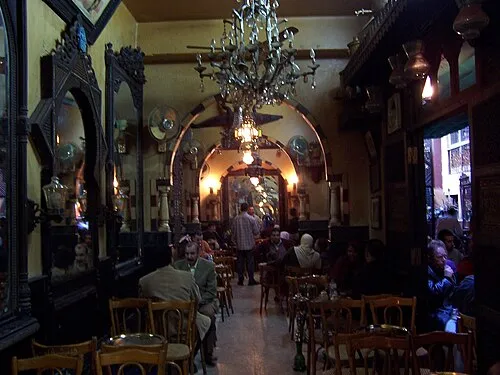
El-Fishawy has been serving tea and shisha since 1797, making it one of the oldest cafes in Cairo. It sits in a narrow alley at the edge of Khan El-Khalili bazaar, with mirrors on the walls, brass tables crowded together, and waiters weaving through with trays of mint tea and Turkish coffee. Nobel laureate Naguib Mahfouz was a regular, and the cafe functioned as his unofficial office for years. Many of his early novel drafts took shape at these tables. The cafe is open daily from 12:30 PM to 1:00 AM. Don't come expecting quiet. The alley is narrow, the chairs spill into the walkway, and vendors pass through constantly. The tea is sweet, the shisha smoke hangs in the air, and the noise of the bazaar bleeds in from every direction. A glass of hibiscus tea (karkade) or sahlab runs a few Egyptian pounds. You're paying for the atmosphere as much as the drink. As a place where to eat in Cairo, El-Fishawy is more about the experience than the menu. The food is simple: nuts, seeds, light snacks. The real draw is sitting in a cafe that hasn't fundamentally changed in over 200 years, watching the bazaar flow past you. After walking through Khan El-Khalili and Islamic Cairo, this is where you sit down, catch your breath, and let the city come to you.

Hours Daily: 12:30 PM – 1:00 AM
Price $$
Website Wikipedia
Insider TipOrder the sahlab in winter or the karkade (hibiscus) in summer. Both are traditional Egyptian drinks you won't find done this well at tourist restaurants. Skip the food; it's not the point.
Get Your Own Private Tour with AI Guide
AI Guide
  • Personalized tour tailored to your interests
  • Your AI guide tells stories, shares facts, and cracks jokes
  • Turn-by-turn GPS navigation
  • Available in your language — no download needed
Try for Free

🌳 Parks & Best Viewpoints in Cairo

Beautiful parks, gardens, and panoramic viewpoints for the best views of Cairo.

Al-Azhar Park

1. Al-Azhar Park

For over a thousand years, this 80-acre hilltop was Cairo's main garbage dump. Then the Aga Khan Trust for Culture spent over $30 million transforming it into one of the finest public parks in the Middle East, opening it to visitors in 2005. The park sits on a ridge between Islamic Cairo and the City of the Dead, and the views from its elevated paths take in the Citadel of Saladin, the minarets of Al-Azhar Mosque, and the Mokattam Hills. During construction, workers uncovered a 12th-century Ayyubid wall that has been restored and is now visible along the park's western edge. Al-Azhar Park is open daily from 9:00 AM to 10:00 PM. The landscaping is immaculate: formal gardens, fountains, lakeside paths, and a hilltop restaurant with panoramic views. After the intensity of Islamic Cairo's streets, which are literally right below the park's western wall, walking into this green space feels like stepping into a parallel dimension. It's the best contrast Cairo offers. Among the best views in Cairo, the park's hilltop lookout at sunset rivals anything from Cairo Tower but feels more intimate. The park also has a good restaurant (the Lakeside Cafe) and a more formal hilltop dining option. For families, couples, or solo travelers who need a break from monument fatigue, this is the answer.

Hours Daily: 9:00 AM – 10:00 PM
Price Free
Location 30.0405, 31.2646
Insider TipCome at sunset. The hilltop terrace faces west toward the Citadel and the old city, and the light on the minarets turns everything golden. Weekday evenings are less crowded than weekends.
Get Your Own Private Tour with AI Guide
AI Guide
  • Personalized tour tailored to your interests
  • Your AI guide tells stories, shares facts, and cracks jokes
  • Turn-by-turn GPS navigation
  • Available in your language — no download needed
Try for Free

Explore with AI Guide

AI Guide App

Get personalized tours with our AI-powered guide. No download needed — works right in your browser.