

1. Hanoi Old Quarter
📍 Nearby: St. Joseph Cathedral (0.1 km) • Hoan Kiem Lake (0.5 km) • Vietnamese Women's Museum (0.7 km)
Discover the best things to do in Hanoi. Complete guide to must-see sights, popular attractions, hidden gems, museums, food markets and parks.
Hanoi is a city that runs on contradictions. A 1,000-year-old capital where French colonial architecture sits next to Buddhist pagodas, where motorbikes weave past incense-filled temples, and where a bowl of the best pho you will ever eat costs less than a dollar. The Old Quarter has been a trading hub since the Ly dynasty, and it still operates at the same chaotic intensity. The Ba Dinh district, with its mausoleum, museums, and shaded parks, tells the political story of modern Vietnam. And West Lake, 500 hectares of water circled by cafes and temples, offers a version of the city that actually breathes.
Hanoi rewards people who are comfortable with sensory overload and curious about history told from a Vietnamese perspective. The museums are opinionated, the street food is extraordinary, and the pace of daily life in the narrow alleys makes most other Asian capitals feel sanitized by comparison. It is not a polished tourist city, and that is exactly what makes it worth the trip. Three or four days is enough to cover the major sights and eat your way through the Old Quarter, but a week lets you reach places like Van Phuc Silk Village and the Red River dike that most visitors never see.
These iconic landmarks and must-see sights are essential stops for any visitor to Hanoi.

On September 2, 1945, Ho Chi Minh read Vietnam's Declaration of Independence on Ba Dinh Square. Today, his embalmed body lies in a massive granite mausoleum built on that same spot, completed in 1975. The building is 21.6 meters tall and 41.2 meters wide, clad in grey granite with a facade of square stone columns. Around it, gardens hold over 250 plant species brought from every region of Vietnam. Love it or find it unsettling, this is where Vietnamese political history is physically concentrated. The visit itself is tightly controlled. You enter in a single-file line that moves slowly through the dimly lit interior. No talking, no hands in pockets, no photography inside. The entire experience takes about 15 to 20 minutes. The mausoleum is only open mornings: Tuesday through Thursday and weekends, 7:30 to 11:30 AM. It closes on Mondays and Fridays. It also shuts entirely for about two months each year (usually October to November) for maintenance of the embalming. As a must-see in Hanoi, this spot anchors the Ba Dinh district cluster. The One Pillar Pagoda, Ho Chi Minh's Stilt House, the Ho Chi Minh Museum, and Bach Thao Park are all within a 10-minute walk. Among things to do in Hanoi, this one is the most solemn.
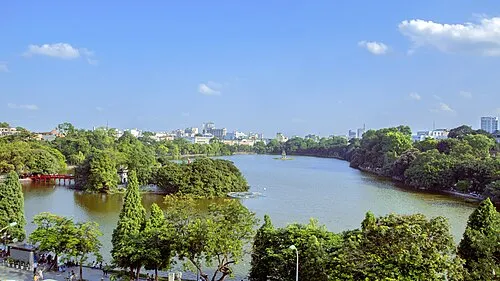
Every city has a center of gravity. For Hanoi, it is Hoan Kiem Lake. This 12-hectare freshwater lake sits right between the chaotic Old Quarter to the north and the French colonial district to the south, and it has been the emotional anchor of the city since at least the 15th century. The name means "Lake of the Returned Sword," tied to a legend about Emperor Le Loi returning a magical sword to a golden turtle after using it to drive out Chinese invaders. The small island in the middle holds the Ngoc Son Temple, reached by a bright red wooden bridge called The Huc ("Sunbeam Bridge"). The temple is modest but worth the walk. Around the lake itself, the promenade is packed every evening with families, couples, elderly people doing tai chi, and kids chasing each other. On weekend evenings, the surrounding streets close to traffic and turn into a pedestrian zone with street performers and food stalls. St. Joseph Cathedral is a 5-minute walk west. The Old Quarter begins at the northern shore.

Built by the French colonial administration in the 1880s and modeled loosely on Notre-Dame de Paris, St. Joseph Cathedral looks wildly out of place in Hanoi, and that is exactly why it works. The neo-Gothic facade with its twin square towers rises above a neighborhood of narrow shop-houses and sidewalk cafes. The exterior stone has weathered to a dark grey-brown that gives it a rougher, more aged look than its European counterparts. Inside, the cathedral is surprisingly quiet given that it sits on Nha Chung Street, one of the busiest intersections near Hoan Kiem Lake. Stained glass windows filter colored light across wooden pews, and the vaulted ceiling creates a sense of height you do not expect from the modest exterior. The cathedral is the seat of the Catholic Archdiocese of Hanoi and still holds regular services. It is open to visitors daily from 8:00 to 11:00 AM and 2:00 to 5:00 PM. Entry is free. Among the top sights in Hanoi, this cathedral is also the social anchor of its surrounding block. The square in front fills up every evening with young locals sitting on low stools drinking egg coffee and lemon tea from the surrounding cafes.

Founded in 1070 under Emperor Ly Thanh Tong, the Temple of Literature is Hanoi's oldest and most peaceful historical site. It was built to honor Confucius and later became Vietnam's first national university, the Quoc Tu Giam, which educated the country's scholars for over 700 years. The complex is divided into five courtyards, each connected by gates with names like Dai Trung and Khuê Van Cac. Walking through them feels like stepping backward through centuries of Vietnamese academic tradition. The third courtyard holds the most famous feature: 82 stone stelae mounted on carved stone turtles, each recording the names and birthplaces of doctoral graduates from the 15th to 18th centuries. Students still come here before exams to rub the turtles' heads for good luck. The Khuê Van Cac pavilion, now a symbol of Hanoi itself, sits between the second and third courtyards. Unlike the chaos of the Old Quarter just 2 km east, this place is calm, almost meditative. This is a must-see in Hanoi, and among the most rewarding things to do in Hanoi for anyone interested in the country's intellectual history. The grounds are open daily from 8:00 AM to 5:00 PM, and free to enter. Give yourself at least an hour to walk through all five courtyards properly.

Well-known landmarks and attractions that are well worth your time in Hanoi.

This is where modern Vietnam began. On September 2, 1945, Ho Chi Minh stood before half a million people on this square and declared independence from France. The space measures 320 meters long and 100 meters wide, laid out in a precise grid of 210 grass plots separated by narrow walkways. A 25-meter flagpole stands at the center. The Ho Chi Minh Mausoleum now dominates the western end. Ba Dinh Square is less a place you visit for its own sake and more the open space that ties together the entire Mausoleum complex. The One Pillar Pagoda, Ho Chi Minh Museum, the Stilt House, and Bach Thao Park all radiate from this square. Early mornings, you can watch the flag-raising ceremony at dawn, which draws both locals and visitors. The square is open daily from 5:00 AM to 10:00 PM and free to enter. As one of the places to visit in Hanoi, Ba Dinh Square is the kind of place where the significance outweighs the visual spectacle. The square itself is flat, open, and plain. But knowing what happened here, and seeing how carefully it is maintained, gives it weight. Among things to do in Hanoi, spending a morning in this district covers more Vietnamese history than most museums.
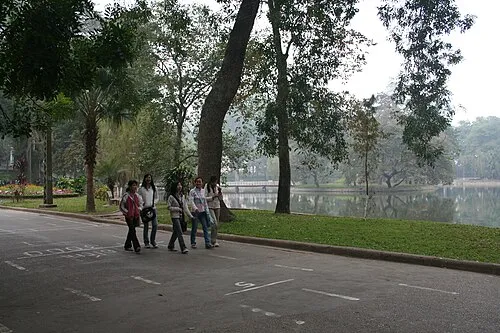
Established during the French colonial period, Bach Thao is Hanoi's botanical garden and one of the city's oldest parks. It sits northwest of Ba Dinh Square, making it an easy addition to a morning at the Mausoleum complex. Ancient trees with trunks so thick it takes several people to wrap their arms around them line the paths. The canopy blocks out sunlight in places, and the temperature drops noticeably inside. Locals call it Hanoi's "green lung." The park is not manicured in the way European botanical gardens are. It feels a bit wild, with overgrown sections and paths that loop without clear signage. That is part of the appeal. It also means fewer tourists. You will mostly see elderly couples walking, parents with children, and the occasional photographer. Open daily from 5:30 AM to 10:00 PM, free entry. The Ho Chi Minh Museum is right next door, and the Mausoleum is a 5-minute walk south.

Directly behind the Mausoleum, this Soviet-designed building opened in 1990 on the centenary of Ho Chi Minh's birth. It is the largest and most modern museum in Vietnam, spread across multiple floors with exhibits on Ho Chi Minh's life, the independence movement, and Vietnam's path through the 20th century. The upper floors get abstract and artistic, with surrealist installations that feel more like a contemporary art gallery than a traditional history museum. The ground floor is the most straightforward: photographs, personal belongings, letters, and documents arranged chronologically. The upper-level exhibits use symbolic sculptures and dioramas that can feel heavy-handed but are unlike anything you will see in a Western museum. Admission is 40,000 VND. Open Tuesday through Thursday and weekends, 8:00 AM to noon and 2:00 to 4:30 PM. Closed Mondays and Fridays. If you are only going to visit one museum in the Ba Dinh complex, the Stilt House across the garden is more interesting for most visitors. But if 20th-century Vietnamese history is your thing, the museum is worth the 40,000 VND.

The concept is simple and strange: a wooden temple built on a single stone pillar rising from a lotus pond, designed to resemble a lotus flower emerging from water. Emperor Ly Thai Tong ordered the original built in 1049 after dreaming of the Bodhisattva of Compassion sitting on a lotus. The current structure is a 1955 reconstruction. French forces destroyed the original when they withdrew from Hanoi in September 1954. The pagoda is tiny. The whole thing takes about 5 minutes to see, which can feel anticlimactic if you expected something grand. But its location makes it easy to include. It sits right next to the Ho Chi Minh Mausoleum complex, a short walk from Ba Dinh Square and the Stilt House. The pillar itself is about 4 meters high, and the wooden temple on top is a small, square room. Open daily from 7:00 AM to 6:00 PM, free entry.

South of Hoan Kiem Lake, Thong Nhat Park is one of Hanoi's largest green spaces, bordered by four streets and anchored by Bay Mau Lake at its center. The park was built by volunteer labor in the late 1950s and named "Reunification Park" after 1975. Despite being surrounded by busy roads, it is remarkably quiet inside once you pass through the gates. Old trees, winding paths, and a lake with pedal boats make it feel removed from the city. This is not a tourist attraction in the traditional sense. It is where Hanoi residents go to escape the noise. Early mornings draw joggers and tai chi groups. Afternoons bring families with kids and students studying on benches. The park has two entrances: one on Le Duan Street near the Central Circus, the other on Dai Co Viet opposite Bach Khoa University. Open daily from 6:00 AM to 10:00 PM. It is about 1.5 km south of Hoan Kiem Lake.

West Lake is Hanoi's largest body of water by a wide margin: over 500 hectares with a shoreline that stretches 14.8 km. It formed as an oxbow lake from an old bend of the Red River, and for centuries it marked the northwestern edge of the city. Today, the Tay Ho district around it is one of Hanoi's most desirable neighborhoods, lined with cafes, restaurants, and the towers of a developing skyline. The lake itself is not a single "sight" but an area. Tran Quoc Pagoda, one of Vietnam's oldest Buddhist temples (founded around the 6th century), sits on a small island connected to the eastern shore by a causeway. The Quan Thanh Temple guards the lake's southeastern corner. In between, you can rent a bicycle and ride the full loop, or stop at one of the lakeside seafood restaurants. The water is not clean enough for swimming, but it is pleasant to be near. The air is fresher, the streets are wider, and the pace slows down.
World-class museums and galleries that make Hanoi a cultural treasure.

If you visit only one museum in Hanoi, make it this one. The Vietnam Museum of Ethnology covers the cultures, rituals, and daily lives of all 54 officially recognized ethnic groups in the country. The indoor galleries display clothing, tools, musical instruments, and ritual objects with clear English-language explanations. But the real draw is the outdoor section: full-scale reconstructions of traditional houses from across Vietnam, including a Bahnar communal house with a soaring thatched roof and a Tay stilt house you can walk through. The museum is in the Cau Giay district, about 7 km west of Hoan Kiem Lake. It is not walkable from the center, so take a taxi or Grab (around 50,000-70,000 VND from the Old Quarter). Open Tuesday through Sunday, 8:30 AM to 5:30 PM. Closed Mondays. Admission is 40,000 VND. Among the best museums in Hanoi, this is the one that most visitors say exceeded their expectations. Unlike the politically focused museums in the Ba Dinh district, the Ethnology Museum is about people: how they build homes, bury their dead, celebrate harvests, and weave cloth. Budget at least 2 hours.

Housed in a French colonial building at 66 Nguyen Thai Hoc Street, directly behind the Temple of Literature, this museum holds the country's most important collection of Vietnamese art. The displays span from prehistoric bronzes and Cham stone carvings through Buddhist sculpture, Dong Ho folk woodcuts, lacquerware, and 20th-century oil paintings influenced by the Ecole des Beaux-Arts de l'Indochine. Three floors, roughly chronological, with enough variety to keep things interesting. The lacquer paintings on the upper floor are the standout. Vietnamese artists adapted the traditional craft of lacquerware into a fine art medium in the 1930s, and the results are unlike anything you will see in Western galleries: deep blacks, reds, and gold leaf layered over wood panels. The Cham sculpture hall on the ground floor is also worth time if you will not be visiting the Cham Museum in Da Nang. Admission is 40,000 VND. Open Tuesday through Sunday, 8:30 AM to 5:00 PM. Among the best museums in Hanoi, this one is consistently underrated. It is quieter than the Ethnology Museum and smaller, so 60 to 90 minutes is enough. Among things to do in Hanoi, pairing it with the Temple of Literature next door makes for a focused morning of art and history in the same block.

On Ly Thuong Kiet Street, a short walk south of Hoan Kiem Lake, this four-story museum covers the roles of women throughout Vietnamese history: in war, in family life, in trade, and in cultural tradition. The displays were redesigned between 2006 and 2010 with modern exhibition techniques, and it shows. Clear English labels, well-lit cases, and multimedia stations make it one of the most visitor-friendly museums in the country. The war section on the upper floors is powerful, with personal stories of women who fought, smuggled supplies, and ran intelligence networks. The ground-floor fashion and textile exhibits are lighter, showing regional variations in traditional dress. Temporary exhibitions rotate regularly and tend to focus on contemporary social issues. Admission is 30,000 VND. Open daily, 8:00 AM to 5:00 PM. Among the best museums in Hanoi, the Women's Museum is the most modern and accessible. It does not require deep knowledge of Vietnamese history to appreciate. The building itself is compact, and 60 to 90 minutes is plenty. Among things to do in Hanoi, it pairs well with a walk around Hoan Kiem Lake or a visit to Hoa Lo Prison, which is about 5 minutes away on foot.
The best food markets, food halls, and culinary destinations in Hanoi.

At the northern edge of the Old Quarter, Dong Xuan is Hanoi's largest covered market and has been operating in some form for hundreds of years under the Nguyen dynasty. The current building dates from a 1994 reconstruction after a fire. Three floors packed with goods: the ground floor is all about fresh produce, meat, dried fish, spices, and bulk ingredients. The upper floors shift to clothing, fabrics, household goods, and electronics. The smell hits you before you step inside. This is a wholesale market first and a tourist destination second. Vendors deal in bulk, and the atmosphere is businesslike rather than performative. If you want to buy small quantities of spices, dried fruits, or Vietnamese coffee to take home, you can, but expect to negotiate. The food stalls at the front and side entrances sell bun cha, banh cuon, and pho for 25,000 to 40,000 VND per bowl. Open daily, roughly 6:00 AM to 7:00 PM. Among the food markets in Hanoi, Dong Xuan is the biggest and the most chaotic. It is the real thing: loud, crowded, slightly overwhelming, and completely genuine.

Ta Hien Street, in the eastern part of the Old Quarter, is where Hanoi's street food culture and its drinking culture crash into each other every evening. Rows of tiny plastic chairs and tables spill onto the street, beers are poured into glasses full of ice, and grilled seafood, pho cuon (fresh pho rolls), and nem chua ran (fried fermented pork sausage) are passed over your head from kitchen windows. By 7:00 PM, the street is impassable. By midnight, it is still going. The beer here is local and cheap. Bia hoi, Hanoi's fresh draft beer brewed daily, goes for about 10,000 VND a glass (less than 50 cents). The atmosphere is equal parts backpacker party and local after-work hangout. Weekends are the busiest, when Ta Hien connects with the night market crowds flowing south from Dong Xuan Market. It is loud, sticky, and fun. Among where to eat in Hanoi, Ta Hien is not the place for a quiet dinner. It is the place for cheap beer, grilled food, and the energy of a city that does not sleep early. It is free to show up, and your total bill for food and drinks will struggle to top 200,000 VND per person.
Beautiful parks, gardens, and panoramic viewpoints for the best views of Hanoi.

Long Bien Bridge was built between 1898 and 1902 by the same company, Dayde and Pille, that worked on the Eiffel Tower's structure. When it opened, it was one of the longest bridges in Asia. During the American bombing campaigns of 1965 to 1972, it was struck repeatedly, and most of the current span is a Vietnamese reconstruction from the 1970s. The original French ironwork survives only in sections, recognizable by its heavier riveted beams. Walking across takes about 20 minutes. The bridge carries a single railway track down the center, flanked by lanes for motorbikes and pedestrians. Trains pass slowly enough that you can watch them approach. Below, the Red River spreads wide, with Banana Island and its green vegetation visible in the middle. The view from the bridge looking back toward the Old Quarter, especially at sunset, is one of the finest in the city. Among the best views in Hanoi, Long Bien Bridge is the most atmospheric. The rusted iron, the passing trains, the wide river below: it all feels like a place where time has slowed down.
Get personalized tours with our AI-powered guide. No download needed — works right in your browser.

