Things to Do in Hiroshima - Top Attractions, Hidden Gems & Must-See Sights

Discover the best things to do in Hiroshima. Complete guide to must-see sights, popular attractions, hidden gems, museums, food markets and parks.

17 Attractions 4 Categories Travel Guide

Table of Contents

Hiroshima Overview

Hiroshima is a city that forces you to reckon with history and then immediately shows you what rebuilding looks like. The Peace Memorial Park and its museum are the reason most people come, and they should be. But Hiroshima is also a working port city on the Seto Inland Sea with a lively food scene, a fanatical baseball culture, and one of Japan's most famous shrines (Itsukushima on Miyajima island) an hour away by ferry. It's a city that handles its past with dignity and doesn't ask you to feel sorry for it.

Two days is the right amount of time. Day one for the peace-related sites and the museum, day two for Miyajima, Hiroshima Castle, Shukkei-en Garden, and an evening at Okonomimura eating the local okonomiyaki. Travelers who appreciate history, Japanese food culture, and cities with genuine character will love Hiroshima. It's smaller than Tokyo or Osaka, easy to navigate, and far less overwhelming for first-time Japan visitors.

The city is compact enough that the streetcar system and walking cover almost everything. People who've been to Hiroshima tend to rank it as a trip highlight, often above flashier destinations. That says something.

Must-See Attractions in Hiroshima

  • Hiroshima Peace Memorial Park
  • Hiroshima Peace Memorial Museum
  • A-Bomb Dome
  • Itsukushima Shrine (Miyajima)
  • Hiroshima Castle
🏛️ Must-See ⭐ Sights 💎 Hidden Gems 🎨 Museums

🏛️ Must-See Attractions in Hiroshima

These iconic landmarks and must-see sights are essential stops for any visitor to Hiroshima.

A-Bomb Dome

1. A-Bomb Dome

The skeleton of this building is the first thing most people see when they arrive at Peace Memorial Park, and it stops you cold. Originally built in 1915 as the Hiroshima Prefectural Industrial Promotion Hall, it was almost directly beneath the bomb's detonation point. The blast came from above, so while the walls partially survived, everything inside was destroyed instantly. It has been preserved exactly as it looked after August 6, 1945. The dome became a UNESCO World Heritage Site in 1996 and is the most recognized symbol of Hiroshima. You can't go inside. There's a fence around it and you view it from the surrounding walkways along the Motoyasu River. At night, it's lit from below, and the effect is striking against the dark sky. It sits at the northern end of the park's central axis, directly across the river from the Cenotaph for A-Bomb Victims. There's no admission, no hours, no ticket. It's just there, 24 hours a day, a building that the city chose to leave standing while everything around it was rebuilt. Among the top sights in Hiroshima, this one needs no explanation. You stand in front of it and you understand.

Hours Open 24/7
Price Free
Insider TipCome back after dark. The dome is floodlit every evening, and the reflection on the Motoyasu River is something you won't forget. Far fewer people are around compared to daytime.
Cenotaph for A-Bomb Victims

2. Cenotaph for A-Bomb Victims

Standing at the center of Peace Memorial Park's main axis, this arched concrete monument frames both the Flame of Peace and the A-Bomb Dome in a single sightline. Architect Kenzo Tange designed it in 1952, shaping it after the clay haniwa houses found in ancient Japanese tombs. The idea was to provide shelter for the souls of the victims. Beneath it sits a stone chest containing the names of every known person killed by the bomb and its aftereffects. The register keeps growing. As of recent years, it holds over 330,000 names. Every year on August 6, new names are added during the Peace Memorial Ceremony. The inscription reads: "Let all the souls here rest in peace, for we shall not repeat the evil." It's directed at everyone, not at any one country. That ambiguity was intentional and remains a point of discussion in Japan. The Cenotaph is free to visit, open around the clock, and sits just steps from the Flame of Peace. Most visitors pause here quietly. Of all the things to do in Hiroshima, this is the moment when the scale of what happened becomes personal, one name at a time.

Hiroshima Castle

3. Hiroshima Castle

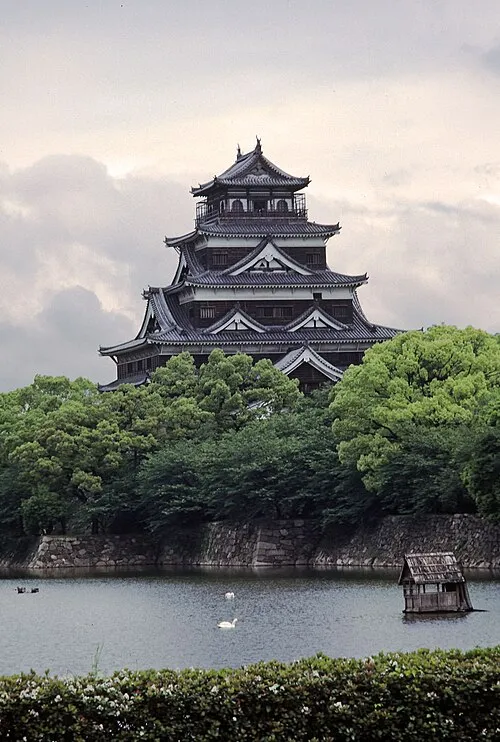
About a 15-minute walk north of Peace Memorial Park, Hiroshima Castle is a different chapter of the city's history. Mori Terumoto built the original in the 1590s on a flat river delta, making it one of Japan's few major flatland castles. It survived earthquakes, fires, and centuries of warfare. It did not survive August 6, 1945. The current structure is a concrete reconstruction completed in 1958, built to look exactly like the original five-story tower. Inside, the castle functions as a history museum focused on pre-war Hiroshima and samurai culture. Exhibits cover the castle's construction, daily life in the feudal era, and armor and sword displays. The top floor has an observation deck with views over the city, the surrounding moat, and on clear days, the mountains to the north. Admission is 370 JPY. The castle grounds themselves are free and worth a walk. The wide moat, stone walls, and reconstructed gates give you a sense of scale that the museum inside can't match. Cherry blossom season in late March and early April fills the grounds with locals picnicking.

Hours Daily: 9:00 AM – 5:00 PM
Price 370 JPY
Insider TipThe combined ticket with Shukkei-en Garden saves you money if you plan to visit both. The garden is a 10-minute walk east from the castle.
Hiroshima Peace Memorial Museum

4. Hiroshima Peace Memorial Museum

After walking through Peace Memorial Park, you arrive at the south end where two long, elevated buildings make up this museum. The building itself was designated an Important Cultural Property by the Japanese government in 2006. Admission is 200 JPY, which feels almost symbolic for what you get. The museum was completely renovated and reopened in 2019, and the new layout is focused, personal, and devastating. The East Building covers the broader history: why the bomb was dropped, the political context, the aftermath. The West Building is the one that stays with you. Personal belongings of victims, a child's melted tricycle, a stopped wristwatch frozen at 8:15 AM. The museum doesn't lecture. It shows you what happened to individual people, and that approach is far more powerful than any statistic. This is the top sight in Hiroshima, and one of the most important museums in Japan. It opens at 7:30 AM, earlier than most museums in the country, and stays open until 7:00 PM. Despite that long window, lines can stretch past 30 minutes during peak season. The audio guide is available in multiple languages and worth getting. Allow at least 90 minutes inside.

Hours Daily: 7:30 AM – 7:00 PM
Price 200 JPY
Website hpmmuseum.jp/
Insider TipArrive right at 7:30 AM opening. By 10 AM, large school groups start arriving and the personal, quiet atmosphere changes completely. The early morning slot gives you space to absorb what you're seeing.
Hiroshima Peace Memorial Park

5. Hiroshima Peace Memorial Park

This 122,000-square-meter park sits on land that was once a busy commercial district, directly beneath the hypocenter of the atomic bomb dropped on August 6, 1945. Today it holds more than 70 monuments, memorials, and buildings related to that single moment. The park is free, open around the clock, and is the place where everything else on this list connects. The layout is deliberate. From the A-Bomb Dome at the north end, a clear sightline runs south through the Flame of Peace, past the Cenotaph, and straight to the Peace Memorial Museum. Walking that axis takes about 10 minutes, and it hits you harder than any museum exhibit. The park is quiet in the mornings, crowded with school groups by midday, and deeply atmospheric at dusk when the trees along the Motoyasu River catch the light. There are no entry fees for the park itself. The museum, monuments, and bells are all within walking distance of each other. Give yourself at least 2 hours here, more if you plan to visit the museum.

Hours Open 24/7
Price Free
Insider TipStart at the north end by the A-Bomb Dome and walk south. The sightline toward the Cenotaph and museum was designed to be experienced in this direction, and arriving at the museum last gives the exhibits far more weight.
Get Your Own Private Tour with AI Guide
AI Guide
  • Personalized tour tailored to your interests
  • Your AI guide tells stories, shares facts, and cracks jokes
  • Turn-by-turn GPS navigation
  • Available in your language — no download needed
Try for Free

💎 Hidden Gems in Hiroshima - Off the Beaten Path

Beyond the tourist crowds, Hiroshima hides remarkable treasures waiting to be discovered.

Hiroshima Botanical Garden

1. Hiroshima Botanical Garden

Way out in the western suburbs, about 40 minutes from the city center by bus, this botanical garden is the kind of place only locals visit. It covers a hillside in the Saeki ward and holds around 10,000 plant species in both outdoor gardens and a large greenhouse complex. If you've spent two days immersed in Hiroshima's peace memorials and need a complete change of scene, this does the job. The greenhouse is the highlight, with a tropical section, a desert section, and a begonia garden that's surprisingly good. Outside, the grounds follow hillside paths through themed gardens: roses, Japanese maples, camellias. It's well maintained and blissfully uncrowded. Free admission makes it even easier to justify the trip out. Open 9:00 AM to 4:30 PM, closed Fridays. This is not a must-do for a short Hiroshima visit. But if you're traveling with kids, spending a full week in the region, or simply want to see what a Japanese botanical garden looks like when it's not packed with tourists, it's one of the secret spots in Hiroshima that rewards the effort of getting there.

Hours Mon-Thu: 9:00 AM – 4:30 PM | Fri: Closed | Sat-Sun: 9:00 AM – 4:30 PM
Price Free
Insider TipTake the direct bus from Itsukaichi Station (JR Sanyo Line). The ride takes about 20 minutes and drops you right at the entrance. Much faster than navigating city buses from downtown.
Hiroshima Carp Stadium

2. Hiroshima Carp Stadium

Hours Daily: 9:00 AM – 5:00 PM
Price Free (exterior)
Location 34.3925, 132.484
Itsukushima Shrine

3. Itsukushima Shrine

On Miyajima island, about an hour from central Hiroshima by train and ferry, stands Japan's most photographed torii gate. The 16-meter vermillion gate appears to float on the water at high tide and sits on exposed sand at low tide. Itsukushima Shrine was first built in 593 AD, expanded to its current form in 1168 by the powerful warlord Taira no Kiyomori, and registered as a UNESCO World Heritage Site in 1996. It's technically not in Hiroshima city, but everyone treats it as part of a Hiroshima trip, and they're right to. The shrine complex itself extends over the water on wooden stilts. You walk through open corridors above the tidal flats, passing through prayer halls and stages used for traditional Noh theater. Admission is 300 JPY. The island around the shrine has wild deer, small shops, and several other temples worth seeing. Most people spend half a day here. This is the kind of place that looks exactly as good in person as it does in photos. At high tide, the gate and shrine seem to hover above the sea. At low tide, you can walk out to the base of the torii. Both are worth seeing. Among the hidden gems in Hiroshima's broader region, this is the one that could justify the entire trip.

Hours Daily: 6:30 AM – 6:00 PM
Price 300 JPY
Insider TipCheck the tide table before you go. High tide (gate reflected in water) and low tide (walk to the gate's base) are both spectacular but completely different experiences. Plan your ferry time around whichever you prefer.
Shukkei-en Garden

4. Shukkei-en Garden

A 10-minute walk east of Hiroshima Castle, this traditional Japanese garden has been here since 1620 when feudal lord Asano Nagaakira had it created. The name means "shrunken scenery garden," and that's exactly what it is: miniature representations of valleys, mountains, forests, and beaches arranged around a central pond. It was designed to compress the landscapes of China's West Lake into a single walk. The bomb destroyed it entirely in 1945. It was painstakingly restored and reopened by 1951. The garden is compact enough to circle in 30 minutes but rewarding enough to linger for an hour. Stone bridges arc over narrow inlets, tea houses sit at the water's edge, and koi the size of your forearm drift through the pond. In early April, the cherry blossoms here are as good as anywhere in the city. In November, the maples turn the garden red and orange. It sits right next to the Hiroshima Prefectural Art Museum, making them an easy pair. Open daily from 9:00 AM to 5:00 PM. Check the website for current admission pricing. After the emotional weight of Peace Memorial Park, this is one of the hidden gems in Hiroshima that gives you space to breathe.

Hours Daily: 9:00 AM – 5:00 PM
Price R$350
Website shukkeien.jp/
Insider TipThe tea house on the central island (Seifukan) serves matcha and a small sweet for around 500 JPY. Sitting there overlooking the pond is one of the most peaceful 20 minutes you'll have in Hiroshima.
Get Your Own Private Tour with AI Guide
AI Guide
  • Personalized tour tailored to your interests
  • Your AI guide tells stories, shares facts, and cracks jokes
  • Turn-by-turn GPS navigation
  • Available in your language — no download needed
Try for Free

🎨 Best Museums & Galleries in Hiroshima

World-class museums and galleries that make Hiroshima a cultural treasure.

Hiroshima Children's Museum

1. Hiroshima Children's Museum

Officially called the Hiroshima Children's Museum of Science and Culture, this is a hands-on science center in Chuo Park, just north of Peace Memorial Park and right next to the Hiroshima Museum of Art. It has a planetarium, interactive physics exhibits, and rotating displays aimed at elementary-school-age kids. Admission to the main exhibits is free. The planetarium costs extra. The building is from 1980 and has that slightly retro Japanese science museum feel, which is part of its charm. Exhibits cover space, weather, sound, light, and basic mechanics. There's nothing here that will surprise adults, but if you're traveling with children under 12, this gives them something active to do after a morning of walking through solemn memorials. The planetarium shows run on a fixed schedule, usually 3 to 4 times per day. Open Tuesday through Sunday, 9:00 AM to 5:00 PM, closed Mondays. Among the best museums in Hiroshima for families, it fills a real gap. The peace-related sites are important, but they're heavy for young children. This provides balance. You can combine it with the nearby art museum and make an easy half-day in the park area.

Hours Mon: Closed | Tue-Sun: 9:00 AM – 5:00 PM
Price Free
Insider TipThe planetarium shows are in Japanese only, but the visual effects are good enough that younger kids enjoy them regardless. Check the schedule at the front desk when you arrive.
Hiroshima Prefectural Art Museum

2. Hiroshima Prefectural Art Museum

Right next to Shukkei-en Garden and a short walk from Hiroshima Castle, this prefectural art museum opened in 1968 and was rebuilt in 1996. The permanent collection covers three areas: art related to Hiroshima, Japanese and Asian art from the 20th century, and Western art including works by Dali, Picasso, and Hirayama Ikuo, a Hiroshima-born painter who survived the bombing as a teenager and spent his career painting scenes along the Silk Road. The Hirayama Ikuo works are the reason to come. His large-scale paintings of Central Asian landscapes carry a quiet intensity that makes more sense when you know his backstory. The rest of the collection is solid if not spectacular. Temporary exhibitions rotate regularly and have included everything from Impressionist loans to contemporary Japanese photography. Admission to the permanent collection is 510 JPY. Open Tuesday through Sunday, 9:00 AM to 5:00 PM, with extended hours until 7:00 PM on Fridays. Closed Mondays. Pairing this with Shukkei-en Garden next door makes a natural afternoon. The museum cafe overlooks the garden, which is a nice touch. Among the best museums in Hiroshima, this one sits in the sweet spot between the peace-focused sites and the broader cultural life of the city.

Hours Mon: Closed | Tue-Thu: 9:00 AM – 5:00 PM | Fri: 9:00 AM – 7:00 PM | Sat-Sun: 9:00 AM – 5:00 PM
Price 510 JPY
Website www.hpam.jp/
Insider TipFriday evenings until 7 PM are the quietest time to visit. Most tourists are gone by late afternoon, and you get the galleries almost to yourself.
Mazda Museum

3. Mazda Museum

Hiroshima is Mazda's hometown. The company was founded here in 1920, and its massive factory complex sits in Aki-gun, east of the city center along the Seto Inland Sea. The museum occupies part of the working factory, and the tour takes you through the actual assembly line where cars are being built as you watch. That's what separates this from a typical car museum. You're not looking at static displays. You're watching robots weld frames and workers install engines in real time. The tour covers Mazda's history, from its origins as a cork manufacturer to the development of the rotary engine (the Cosmo Sport from 1967 is a highlight) to current models. It's free, but you must book in advance through the Mazda website. Tours run Monday through Friday only, with the last one starting at 2:15 PM. No walk-ins. Getting there takes about 30 minutes from Hiroshima Station by train to Mukainada Station, plus a shuttle bus. It's a commitment, and car enthusiasts will get far more out of it than casual visitors. But among the best museums in Hiroshima, this is the one that surprises people. You come for the cars and leave impressed by the factory.

Hours Mon-Fri: 9:00 AM – 2:15 PM | Sat-Sun: Closed
Price Free
Insider TipBook at least 2 weeks ahead, especially for English-language tours. Spots fill up fast. The English tours are offered on specific days only, so check Mazda's website for the current schedule.
Get Your Own Private Tour with AI Guide
AI Guide
  • Personalized tour tailored to your interests
  • Your AI guide tells stories, shares facts, and cracks jokes
  • Turn-by-turn GPS navigation
  • Available in your language — no download needed
Try for Free

Explore with AI Guide

AI Guide App

Get personalized tours with our AI-powered guide. No download needed — works right in your browser.