Discover the best things to do in Marrakech. Complete guide to must-see sights, popular attractions, hidden gems, museums, food markets and parks.
Marrakech is a city that operates on sensory overload. The medina, enclosed by 12th-century walls, is a dense maze of souks, palaces, riads, and mosques where the noise, smells, and visual chaos never fully let up. Jemaa el-Fnaa square is the anchor point: a UNESCO-listed open-air performance space that shifts from snake charmers and orange juice carts by day to a smoke-filled night market with over 100 food stalls after dark. The souks radiate north from the square in a labyrinth of narrow alleys selling everything from hand-stitched leather slippers to saffron by the gram.
What makes Marrakech different from other North African cities is the concentration. In a single day on foot, you can see a 14th-century Quranic school with tilework that took craftsmen decades to complete, a French painter's electric-blue botanical garden, a palace turned museum that most visitors still don't know about, and a food market where a bowl of snail soup costs 5 dirhams. The Atlas Mountains sit on the southern horizon as a constant backdrop. The city is loud, direct, and occasionally exhausting, but it rewards anyone willing to push past the first layer of tourist-facing hustle.
Marrakech works best for travelers who want something different from a European city break. It asks more of you: you negotiate prices, you navigate without street signs, you eat things you cannot identify, and you accept that getting slightly lost is part of the experience. In return, it gives you a city that feels completely alive.
These iconic landmarks and must-see sights are essential stops for any visitor to Marrakech.
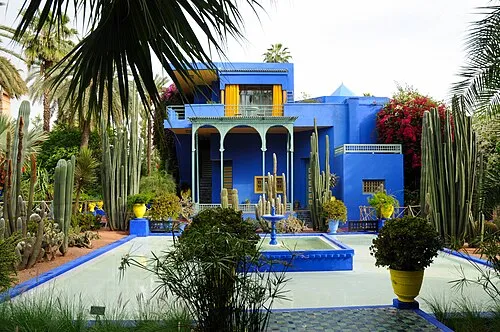
French painter Jacques Majorelle spent 40 years building this garden, starting in the 1920s. Then Yves Saint Laurent and Pierre Berge bought and restored it in 1980. The result is a 10,000-square-meter botanical garden with around 300 plant species from every continent, all arranged around paths, pools, and a villa painted in an electric cobalt blue that Majorelle invented himself. The garden sits in the Gueliz neighborhood, outside the medina walls, which means the taxi or walk to get here is part of the transition from old city chaos to something calmer. The Berber Museum is inside the grounds (separate ticket, 30 MAD), and the Yves Saint Laurent Museum is right next door. The cacti and desert plant collections are particularly impressive. Unlike the flat expanses of Menara Gardens, this is a dense, vertical space where bamboo groves tower overhead and bougainvillea spills over walls. The trade-off: it gets packed. This is by far the most visited garden in Morocco, and by midday you're sharing narrow paths with hundreds of other visitors. The cafe inside is pleasant but overpriced. Open daily from 8:30 AM to 5:00 PM.
Every trip to Marrakech starts and ends here. Jemaa el-Fnaa is a massive open square that UNESCO added to its Intangible Cultural Heritage list in 2001, and for good reason: it is a living performance that changes hour by hour. During the day, you'll find orange juice carts, snake charmers, and henna artists. By late afternoon, the food stalls start rolling in. By nightfall, the entire square is a smoke-filled open-air kitchen with over 100 stalls serving tagines, harira soup, grilled lamb, and snail broth. It is the single most important must-see in Marrakech. The square is free, open 24 hours, and connects directly to the entrance of Souk Semmarine on its north side and Koutoubia Mosque a five-minute walk to the west. It has been the meeting point between the medina, the kasbah, and the Mellah for centuries. The sheer volume of people, noise, and cooking smoke can be overwhelming, especially after dark. That is part of the experience. Honesty check: you will be hassled. Vendors will approach, performers will demand tips after eye contact, and the food stall owners will compete loudly for your attention. None of this is dangerous. It is just Jemaa el-Fnaa being itself. Go at least twice: once during the day to orient yourself, once at night to eat.
Built in 1346 under Sultan Abu al-Hasan, this Islamic school is the most beautiful building in Marrakech. That is not an exaggeration. You walk through an unassuming doorway in the northern medina, and suddenly you're standing in a courtyard covered floor to ceiling in carved cedarwood, zellige tilework, and stucco calligraphy. The level of craftsmanship here makes the nearby Museum of Marrakech look plain by comparison. It is the must-see in Marrakech for anyone interested in Islamic architecture. The medersa functioned as a Quranic school for centuries. Students lived in small cells on the upper floors, arranged around the central courtyard. You can peek into some of these rooms, which are tiny and dim. The scale contrast between the grand courtyard and the modest student quarters tells you everything about what this place valued: communal learning over personal comfort. The building was restored during the Saadian period without changing its original design. Admission is 50 MAD, and the medersa is open daily from 9:00 AM to 4:30 PM. It sits steps from Place Ben Youssef, where you can grab a quick tagine from a street stall afterward. Dar Bellarj, the old stork sanctuary turned art space, is practically next door.
Founded around 1157 by the same Almohad dynasty that built Koutoubia Mosque, the Menara Gardens are one of Marrakech's most recognizable images: a large reflecting pool, a green-roofed pavilion, and the snow-capped Atlas Mountains behind it all. The gardens have been a UNESCO World Heritage Site since 1985. Entry is free, they open at 8:00 AM, and close at 6:00 PM daily. The gardens are about 2 kilometers west of Jemaa el-Fnaa, which puts them outside the usual medina walking circuit. You'll need a taxi or a calèche (horse-drawn carriage) unless you enjoy a 25-minute walk along Avenue de la Menara. The grounds are mostly olive groves surrounding the central basin, which was built as an irrigation reservoir. The pavilion dates from the 19th century, and you can climb to its upper terrace for the postcard view of the Atlas range. Be honest with your expectations. This is a pleasant, quiet place with one great photo opportunity, but it is not a place you'll spend two hours at. The gardens have minimal shade outside the olive groves, and in summer the heat can be brutal.
Well-known landmarks and attractions that are well worth your time in Marrakech.
These royal gardens stretch south of the Royal Palace, covering a vast area planted with fruit trees: oranges, figs, pomegranates, olives, and apricots. They were founded by the same Almohad rulers who built the Menara Gardens and Koutoubia Mosque in the 12th century. Along with those sites, the Agdal Gardens have been a UNESCO World Heritage Site since 1985. Entry is free and the grounds are open around the clock. Locals call these gardens Jnane Salha. They sit about 2 kilometers south of Jemaa el-Fnaa, well outside the tourist circuit. You won't see tour groups here. What you will see: Marrakchi families picnicking under trees, kids playing football, and a stillness that feels almost out of place in a city this loud. The gardens were designed as both decorative and productive, and they still function that way. The fruit trees are tended and harvested. As a place to visit in Marrakech, this is for people who want to see how the city breathes when tourists aren't watching. There's no cafe, no gift shop, no ticket counter. Just centuries-old orchards, irrigation channels, and the city walls in the distance. Pair it with a visit to the Mellah quarter and the Bahia Palace area, both of which are nearby.
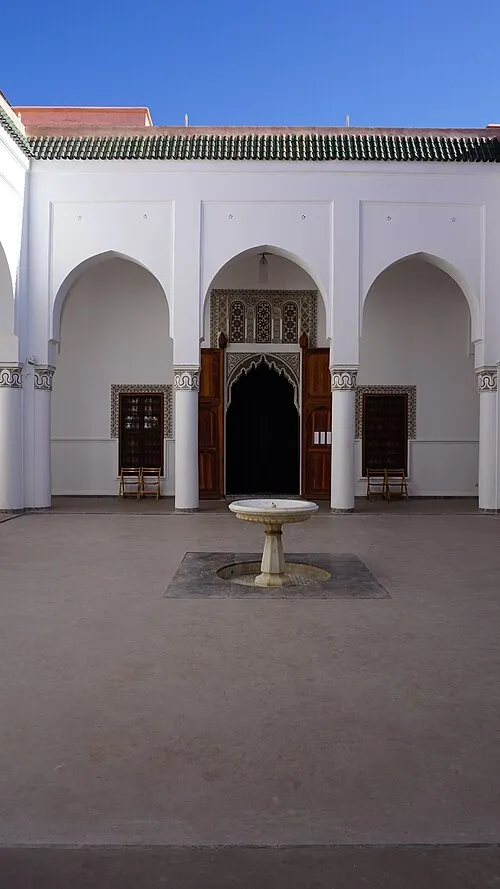
Marrakech's oldest museum occupies a 19th-century palace built by Si Said, who was Minister of War under Sultan Moulay Abdelaziz. The collection spans Moroccan woodwork, jewelry, pottery, weapons, carpets, and musical instruments across two floors. The star piece is an 11th-century marble basin on the ground floor that predates everything else in the building by 800 years. Admission is 30 MAD, and it is open Wednesday through Monday from 9:00 AM to 5:00 PM. The building itself is as much the attraction as the collection. Carved cedarwood doors, painted ceilings, and tiled courtyards give you a sense of how Marrakech's elite lived in the late 1800s. The museum is a five-minute walk south of Jemaa el-Fnaa, on the same street as Tiskiwin Museum. If you're visiting one, do both: the combined walk takes maybe 90 minutes and covers two of the best museums in Marrakech. The displays are not always well labeled, and some rooms can feel underlit. But the building compensates for what the curation lacks. The upstairs rooms have windows overlooking the medina rooftops, and the central courtyard with its fountain is a cool, shaded escape from the heat outside.
Tucked behind a heavy wooden door on a busy medina street, Le Jardin Secret is a restored 19th-century riad garden that reopened to the public in 2016. The contrast between the noisy lane outside and the calm inside is immediate and sharp. Two courtyards hold different garden styles: an Islamic garden with geometric waterways fed by the original khettara irrigation system, and an exotic garden with tropical plants from around the world. The garden sits along the main medina artery between Jemaa el-Fnaa and Medersa Ben Youssef, so it slots easily into any walking route. The tower on site offers a good view over the medina rooftops, though it is not as dramatic as what you'll get from a rooftop cafe on Jemaa el-Fnaa. Open daily from 9:30 AM to 4:30 PM. The space is small compared to Jardin Majorelle, so 30 to 45 minutes is usually enough. It works well as a midday decompression stop between the intensity of the souks and whatever you're doing next. The on-site cafe is good for mint tea and a sit-down.
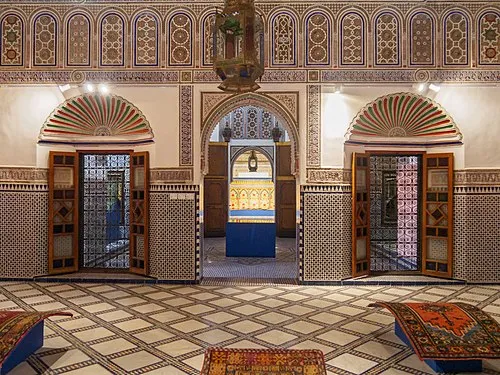
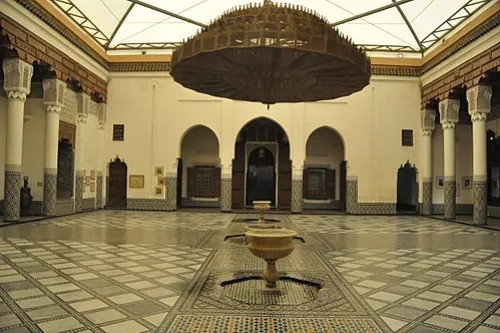
Housed in Dar Menebhi, a palace built at the end of the 19th century, the Museum of Marrakech was restored by the Omar Benjelloun Foundation and opened in 1997. The star of this place is not the collection but the building: a central courtyard with a massive brass chandelier, Andalusian-style carved cedarwood, zellige tiles, and painted doorways. The courtyard alone makes the 50 MAD admission worthwhile. The museum sits right next to Medersa Ben Youssef, so most visitors do both in one visit. The collection mixes modern and traditional Moroccan art with historical books, pottery, and coins. It rotates frequently, which means what you see depends on when you go. The quality is uneven, but the temporary exhibitions can surprise you. The building is the constant, and it is beautiful regardless of what's hanging on the walls. Among the places to visit in Marrakech, this is a solid mid-priority stop. If you've already seen Dar El Bacha and Medersa Ben Youssef, you've experienced finer examples of the same architectural style. But if you're in the neighborhood and have 30 minutes, step inside for the courtyard and the light. The hammam (traditional bath) next to the museum is also worth knowing about.
Dutch anthropologist Bert Flint spent decades collecting artifacts along the ancient Marrakech-to-Timbuktu trade route, and this museum is the result: two conjoined riads filled with rugs, clothing, jewelry, shelters, and household objects that trace the cultural connections between Morocco and sub-Saharan Africa. Admission is 30 MAD. Opening hours are daily from 9:00 AM to 12:30 PM, then 3:00 PM to 6:00 PM (closed for lunch). Each room represents a different stage of the Saharan journey, with displays showing how Berber communities lived, dressed, and crafted objects from raw materials. It is a two-minute walk from Dar Si Said Museum, and the pair makes a satisfying back-to-back visit. Flint's personal touch is everywhere: handwritten labels, objects arranged with care rather than spectacle. This is a quiet alternative to the grander palaces. It has no massive courtyards or towering carved ceilings, but it has something the bigger museums lack: a clear story told through objects. If you're interested in how trade shaped North African culture over centuries, 45 minutes here will teach you more than any guided medina tour.
World-class museums and galleries that make Marrakech a cultural treasure.
Located inside Jardin Majorelle, this museum occupies Jacques Majorelle's original painting studio and houses over 600 artifacts spanning Berber culture from across Morocco: carpets, jewelry, costumes, ceramics, weapons, and tea sets. The collection was assembled by Pierre Berge and Yves Saint Laurent and covers Berber communities from the Rif Mountains in the north to the Sahara in the south. Admission is 30 MAD on top of the garden entry. The museum is compact: around 200 square meters across a handful of rooms. Three sections show how Berber communities transform raw materials into practical and ceremonial objects. The jewelry collection is particularly strong, with silver pieces, amber necklaces, and coral ornaments that explain regional identity through craft. Labels are clear, and the layout tells a story rather than just displaying objects. Over 140,000 people visit each year. As one of the best museums in Marrakech, it works perfectly combined with your Jardin Majorelle visit. The museum is air-conditioned, which matters on a 40-degree summer day. It provides cultural context that the garden itself doesn't: you leave understanding something about the people who have lived in this landscape for millennia, not just the French painter who made it famous.
Officially the Mohammed VI Museum of Water Civilization, this modern museum opened in 2017 in the Palmeraie, about 7 kilometers north of the medina. It spans 2,235 square meters of exhibition space across three levels and explains how Morocco has managed water for centuries: from ancient khettara underground channels to modern dam systems. Admission is 50 MAD, open daily from 9:00 AM to 6:00 PM. The museum is well designed with interactive maps, video installations, and scale models that explain water engineering in arid climates. It is the most modern museum experience in Marrakech, a sharp contrast to the riad-based collections in the medina. For families with children, the interactive elements make this more engaging than the craft-heavy museums downtown. The building itself is striking, surrounded by palm trees in a landscaped park. The catch: the location. You need a taxi to get here, and the Palmeraie is not near anything else on a typical tourist itinerary. If water engineering or environmental science interests you, the trip is worth it. If you only have a few days and are choosing between this and the best museums in Marrakech like Dar El Bacha or Medersa Ben Youssef, those should come first. The Water Museum is a worthwhile detour, not a must-see.
Beautiful parks, gardens, and panoramic viewpoints for the best views of Marrakech.
These public gardens wrap around the south and west sides of Koutoubia Mosque, providing the best views in Marrakech of the 77-meter minaret framed by rose bushes, orange trees, and palm trees. They are free, open 24 hours, and sit exactly between Jemaa el-Fnaa and the new city, making them the most convenient green space in the entire medina area. The gardens are where you go when the square's noise becomes too much. A five-minute walk west from Jemaa el-Fnaa brings you to paths lined with hedges and benches. The atmosphere is calm without being empty: local couples stroll, children play, and the call to prayer from the mosque above becomes the only sound that cuts through. Morning light on the minaret is good. Sunset is better. The gardens face west, so the sky behind the tower turns orange and pink. As parks in Marrakech go, these are small and simple. You won't spend more than 20 to 30 minutes here. But their location makes them perfect as a transition space between the medina and wherever you're heading next, whether that's Menara Gardens to the west, Cyber Park to the north, or back into the souks. There's no entry fee, no closing time, and no agenda. Just sit and look up.
Get personalized tours with our AI-powered guide. No download needed — works right in your browser.