Things to Do in Siem-Reap - Top Attractions, Hidden Gems & Must-See Sights

Discover the best things to do in Siem-Reap. Complete guide to must-see sights, popular attractions, hidden gems, museums, food markets and parks.

11 Attractions 3 Categories Travel Guide

Table of Contents

Siem-Reap Overview

Siem Reap exists because of Angkor, and Angkor alone would justify the trip. The temple complex built by the Khmer Empire between the 9th and 15th centuries is the largest religious site on earth, and spending two or three days exploring it barely scratches the surface. But Siem Reap has grown into more than a temple gateway. The town itself has a compact, walkable center with a lively market district, good food, and a river-fed calm that kicks in once the day's temple visits are done.

The city works for every kind of traveler. History and architecture obsessives can spend a week here and not run out of temples. Families can mix temples with boat trips on Tonle Sap Lake and workshops at Artisans Angkor. Budget travelers will find that Siem Reap remains one of the most affordable destinations in Southeast Asia, with meals under $3 and tuk-tuk transport costing $15 to $20 for a full day at the temples. The combination of world-class archaeology, easy logistics, and low costs makes it hard to beat.

Beyond the temples, the War Museum and Landmine Museum offer sobering context about Cambodia's recent history that deepens your understanding of the country. The floating villages of Tonle Sap and the holy mountain of Phnom Kulen round out a destination that has far more range than most people expect.

Must-See Attractions in Siem-Reap

  • Angkor Wat
  • Bayon Temple
  • Ta Prohm
  • Angkor Thom
  • Tonle Sap Lake
🏛️ Must-See ⭐ Sights 🎨 Museums

🏛️ Must-See Attractions in Siem-Reap

These iconic landmarks and must-see sights are essential stops for any visitor to Siem-Reap.

Angkor Thom

1. Angkor Thom

Angkor Thom was the last and most enduring capital of the Khmer Empire, a walled city covering 9 square kilometers that remained the seat of power until the 15th century. King Jayavarman VII built it in the late 12th century, and the sheer ambition is staggering. Five monumental gates, each topped with four stone faces and flanked by rows of gods and demons pulling a naga serpent, lead into what was once home to an estimated one million people. Bayon Temple sits at its geographic center. Beyond Bayon, the city contains the Terrace of the Elephants (a 300-meter-long platform carved with life-size elephant reliefs), the Terrace of the Leper King, and several smaller temples. Most visitors drive through the South Gate, which is the most photogenic and the most photographed. The road itself runs through dense forest, and the sensation of entering through that carved gate is one of the great arrivals in all of Southeast Asian travel. Unlike the focused experience of a single temple like Ta Prohm, Angkor Thom is a whole city to explore. The compound is open daily 8:00 AM to 9:00 PM.

Hours Daily: 8:00 AM – 9:00 PM
Price Incl. Angkor pass
Website Wikipedia
Insider TipRent a bicycle and enter through the quieter East or North Gate instead of the South Gate. You'll have the gate and its naga-pulling statues almost to yourself.
Angkor Wat

2. Angkor Wat

Angkor Wat is the reason Siem Reap exists as a tourist destination. Built in the early 12th century by King Suryavarman II as a Hindu temple dedicated to Vishnu, then gradually converted to Buddhism, it covers 162.6 hectares and holds the Guinness record as the largest religious structure on earth. The scale is hard to process until you're standing at the western causeway looking across the moat, trying to fit the five towers into a single photo. You can't. It's that big. The temple is designed as a representation of Mount Meru, the cosmic mountain of Hindu mythology. Walking through the outer galleries, you'll find nearly 2,000 square meters of bas-relief carvings depicting scenes from the Ramayana and Mahabharata. The detail is absurd for something carved 900 years ago. The churning of the Sea of Milk on the east gallery is the single most famous panel, stretching almost 50 meters. Unlike the jungle-wrapped atmosphere of Ta Prohm or the eerie faces of Bayon, Angkor Wat's power comes from sheer geometric precision. This is the must-see in Siem Reap that every visitor prioritizes, and rightly so. When planning things to do in Siem Reap, start here. The crowds are real, especially at sunrise, but even packed with people the place is so massive it absorbs them. Budget at least 3 hours for a proper visit.

Hours Daily: 5:00 AM - 5:30 PM
Price 37 USD (1-day)
Insider TipSkip the famous sunrise from the reflecting pool (you'll be fighting 3,000 people for a spot). Instead, enter at 7:30 AM when the sunrise crowds leave and the tour buses haven't arrived yet. You'll have 30 to 45 minutes of relative calm.
Bayon Temple

3. Bayon Temple

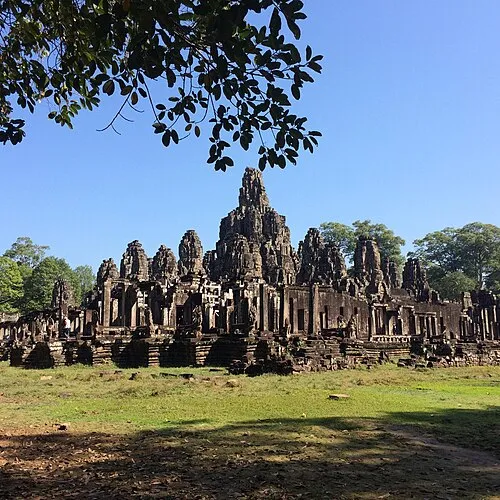
While Angkor Wat impresses through scale and symmetry, Bayon unsettles you. This late 12th-century Buddhist temple sits at the exact center of Angkor Thom, and its 216 massive stone faces stare down from 54 towers with that half-smile that you can't quite read. Serene? Knowing? Slightly unnerving? All three, depending on the light. King Jayavarman VII built it, and the faces are believed to represent either him or the bodhisattva Avalokiteshvara. Nobody is entirely sure. The layout is deliberately disorienting. Three levels of galleries wind through a forest of towers, and you're constantly turning corners to find another face looking straight at you. The outer gallery bas-reliefs are less polished than Angkor Wat's but more interesting in some ways: they show daily life in the Khmer Empire, with market scenes, cockfights, and fishermen. The inner galleries depict Hindu mythology. Bayon is open daily from 7:30 AM to 5:30 PM and is included in the Angkor pass. The upper terrace gets packed mid-morning.

Hours Daily: 7:30 AM – 5:30 PM
Price Incl. Angkor pass
Insider TipLate afternoon light, around 4 PM, makes the stone faces glow golden and the shadows deepen in the carved smiles. Most tour groups come between 9 and 11 AM.
Ta Prohm Temple

4. Ta Prohm Temple

Hours Daily: 7:30 AM – 5:30 PM
Price Incl. Angkor pass
Get Your Own Private Tour with AI Guide
AI Guide
  • Personalized tour tailored to your interests
  • Your AI guide tells stories, shares facts, and cracks jokes
  • Turn-by-turn GPS navigation
  • Available in your language — no download needed
Try for Free

🎨 Best Museums & Galleries in Siem-Reap

World-class museums and galleries that make Siem-Reap a cultural treasure.

Angkor National Museum

1. Angkor National Museum

The Angkor National Museum sits on the road between Siem Reap town and the temples, and visiting before you see the actual ruins makes everything click into place. Eight galleries cover the Khmer Empire from the 9th to the 14th century, displaying statues, carvings, and artifacts from the Angkor archaeological sites. The collection draws from the Conservation d'Angkor, a repository of roughly 6,000 pieces established by the French in 1908, and from the National Museum of Cambodia in Phnom Penh. The museum uses multimedia presentations (audio, video, interactive displays) to explain context that the temples themselves can't give you: who built what, why architectural styles changed, how Hindu and Buddhist iconography evolved over five centuries. Opened in November 2007, it's modern, air-conditioned, and well-organized. Photography is strictly prohibited inside the galleries. The Gallery of a Thousand Buddhas is the most striking room, with rows of seated Buddha statues in various sizes and poses. Among the best museums in Siem Reap, this one is the most useful for first-time visitors who want to understand what they're about to see at Angkor. Open daily 8:30 AM to 6:30 PM. For things to do in Siem Reap, consider this your orientation before the main event. Check their website for current admission prices.

Hours Daily: 8:30 AM – 6:30 PM
Price 12 USD
Location 13.3666, 103.86
Insider TipVisit on your first afternoon in Siem Reap, before hitting the temples. The audio guide is worth the extra cost and takes about 90 minutes to complete.
Cambodian Cultural Village

2. Cambodian Cultural Village

The Cambodian Cultural Village is a 210,000-square-meter theme park on the road between Siem Reap and the airport. Twelve model villages represent the traditions and architecture of Cambodia's 19 ethnic groups, with daily performances of apsara dance, minority folk dances, and traditional wedding ceremonies. There's also a wax museum with historical figures and 1/20-scale replicas of landmarks like Phnom Penh's Royal Palace and Central Market. Let's be honest: this place gets mixed reactions. The cultural performances can be interesting, especially the apsara dance, which traces directly back to the carved dancers you see on Angkor Wat's walls. But the overall presentation feels like a theme park version of Cambodian culture, and many visitors find it dated. It's open weekdays 8:00 AM to 6:30 PM and weekends 8:00 AM to 8:00 PM. Whether the admission price is worth it depends on your tolerance for staged cultural experiences. Among the best museums in Siem Reap (it's more cultural park than museum), this works best for families with children who need a break from temple ruins.

Hours Mon-Fri: 8:00 AM – 6:30 PM | Sat-Sun: 8:00 AM – 8:00 PM
Price 15 USD
Get Your Own Private Tour with AI Guide
AI Guide
  • Personalized tour tailored to your interests
  • Your AI guide tells stories, shares facts, and cracks jokes
  • Turn-by-turn GPS navigation
  • Available in your language — no download needed
Try for Free

Explore with AI Guide

AI Guide App

Get personalized tours with our AI-powered guide. No download needed — works right in your browser.