Self-Guided Walking Tour in Carcassonne

6 Stops 2.5 km ~1.4 hours
Start This Tour Free
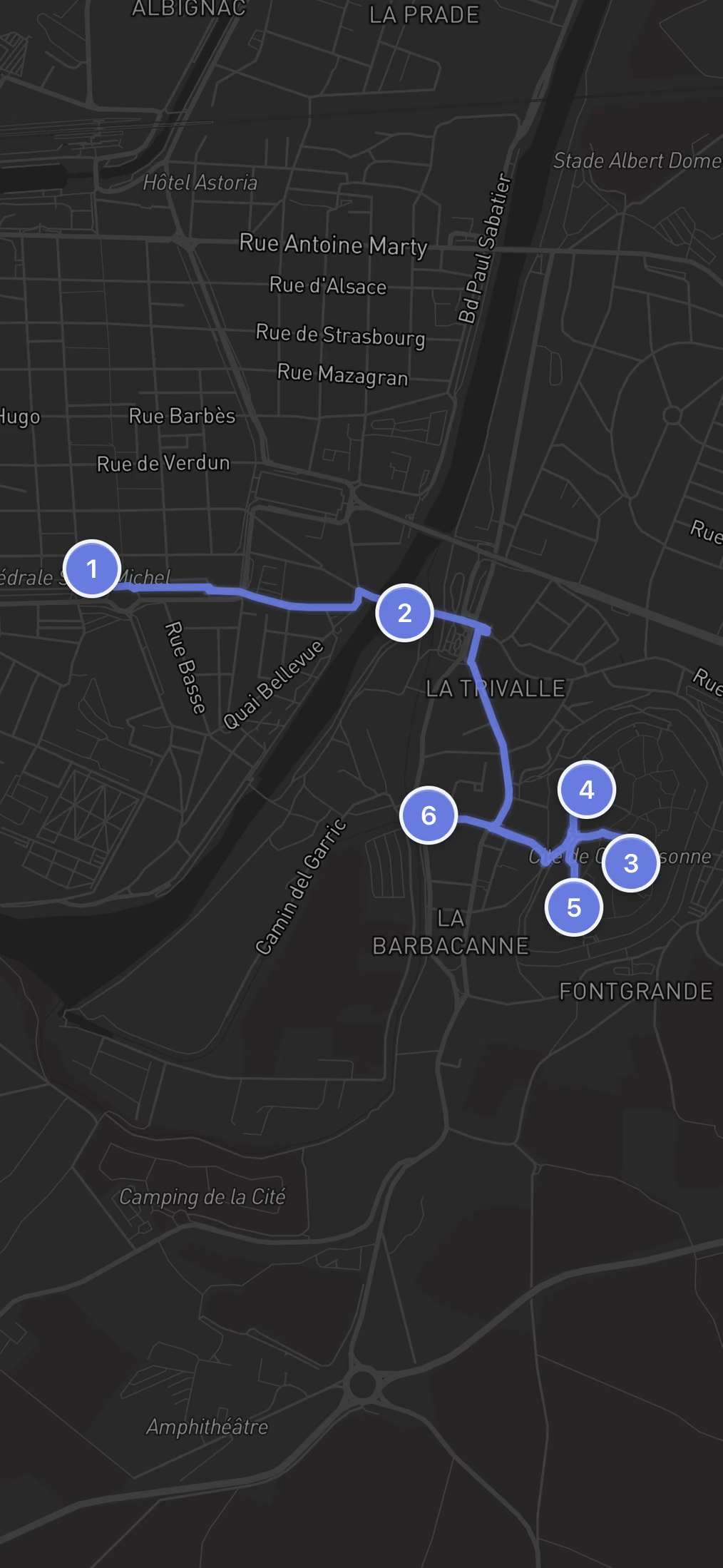
Walking tour route map of Carcassonne
Start This Tour Free

Why Walk Carcassonne? A Self-Guided Tour

Carcassonne is a two-part city, and this walk connects both halves across 6 stops in under 2.5 kilometers, taking about 1.4 hours. You start in the flat, grid-planned lower town where locals actually live, cross a medieval bridge over the Aude River, and climb into the double-walled fortress that pulls three million visitors a year. The route is short but vertical. The uphill section from the river to the fortress gates is steep, and the cobblestones inside the walls are uneven. That said, the total distance is manageable enough that you can take your time at every stop without running out of daylight.

This particular route works because it tells the story in order. Place Carnot gives you the real Carcassonne, the one with coffee and market stalls. Then the Pont Vieux physically transitions you into the medieval world, with the fortress filling the sky ahead. You enter through the Porte Narbonnaise, explore the Chateau Comtal and Basilica, then exit through the Porte d'Aude on the western side with a panorama of vineyards stretching toward the Pyrenees. Most tourists drive straight to the Cite parking lot and miss everything below the hill. This walk makes sure you don't.

The Route: 6 Stops

Swipe through images or scroll names below

Scroll to explore →
1. Place Carnot
2. Pont Vieux
3. Porte Narbonnaise
4. Château Comtal
5. Basilica Saints Nazarius
6. Porte d'Aude

Route Map

Tap to load interactive map
AI Tourguide
Walk this exact route with a private AI guide.
Full GPS navigation, interactive stories, and a guide that answers all your questions. A private guide experience for just €5/hour.
Start This Tour

Your Carcassonne Walking Tour, Stop by Stop

  1. 1

    Place Carnot

    Place Carnot

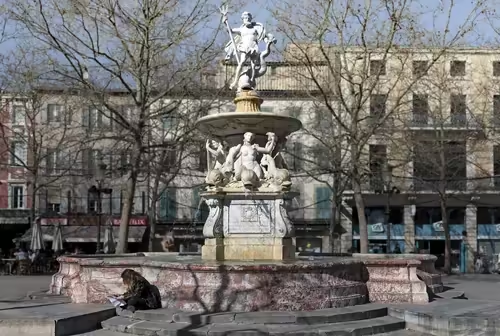
    The shade hits you first. Plane trees form a dense canopy over this square, keeping the cafe terraces cool even when August bakes the surrounding streets. In the center sits the Fountain of Neptune, its marble worn smooth by centuries of weather and hands. This is not a sight to photograph and leave. It is the living room of the lower town, where locals read newspapers, argue about rugby, and let their dogs tangle under chairs. On Tuesday, Thursday, and Saturday mornings, a fruit and vegetable market takes over with stalls selling regional melons, goat cheese, and olives. If your visit falls on a market day, arrive before 10 AM to see it at its best, before the tourist crowd drifts in. Grab a coffee at one of the brasseries lining the perimeter and sit for fifteen minutes. You are in the exact center of the Bastide Saint-Louis, and this calm is about to end. Head east from the square toward the river. Within a few blocks, the medieval Cite will appear on the hill ahead.

    Learn more about Place Carnot →
    Hours
    Open 24/7
    Price
    Free

    6 min walk to next stop

  2. 2

    Pont Vieux

    Pont Vieux

    The street drops toward the Aude River, and then the bridge appears: a low, humble structure of weathered stone arches, entirely pedestrian. This 14th-century crossing was the only link between the lower town and the fortress for hundreds of years. Halfway across, a small chapel niche in the stonework reminds you of the bridge's age. But the real reason to slow down here is the view south. The full silhouette of the Cite rises above the opposite bank, all 52 towers and double walls, a sight that stops conversation. Wind often funnels down the river valley, so hold onto hats and loose papers. If you want a better photo angle, walk down the stairs at the Bastide end to the riverbank path, where the bridge arches frame the fortress above. The crossing itself takes two minutes, but it marks the dividing line between modern Carcassonne and its medieval past. On the far side, the real climb begins. Follow Rue Trivalle uphill toward the Porte Narbonnaise.

    Learn more about Pont Vieux →
    Hours
    Open 24/7
    Price
    Free

    8 min walk uphill to the fortress gate

  3. 3

    Porte Narbonnaise

    Porte Narbonnaise

    The cobblestone path steepens, and then this twin-towered gatehouse swallows you into the fortress. Built in 1280 under Philip III, the Porte Narbonnaise was designed as the main eastern entrance to the Cite, with two massive round towers flanking a narrow passage that could be sealed by a portcullis and defended from murder holes overhead. Once inside, resist the pull of the main commercial street, Rue Cros-Mayrevieille, which is a gauntlet of souvenir shops selling plastic swords. Instead, turn immediately left or right into the lices, the kilometer-long gravel strip between the inner and outer walls. Walking the lices gives you the full scale of the double fortification: 52 towers, 3 km of walls, all without the commercial clutter. The Cite itself is free to enter. The ramparts and Chateau Comtal require a combined ticket at 11 euros.

    Learn more about Porte Narbonnaise →
    Hours
    Check locally
    Price
    Free

    5 min walk through the Cite streets toward the inner citadel

  4. 4

    Château Comtal

    Château Comtal

    A dry moat and a barbican separate this inner citadel from the rest of the Cite, making the military purpose unmistakable. This was the fortress within the fortress, the last refuge of the Vicomtes Trencavel. The combined ticket costs €11 and covers the castle plus the rampart walks, and it is worth it primarily for the wall walk. The interior rooms house Roman artifacts and lapidary stones that can feel dry unless you are into archaeology. But the ramparts are essential. From the top, you see the patchwork of rooftops in the lower town, the Black Mountain in the distance, and the full defensive layout spread below you. The reconstructed wooden hoarding galleries show exactly how archers fired downward on attackers during the 13th-century sieges. It is windy and exposed up there with uneven footing. The castle is open daily from 9:30 AM to 5:00 PM. A useful trick: your ticket allows re-entry, so do the northern rampart first for the views, grab lunch, then return for the western section which has fewer stairs. Allow 60 to 90 minutes total. From here, walk south through the narrow streets to the Basilica.

    Learn more about Château Comtal →
    Hours
    Daily: 9:30 AM – 5:00 PM
    Price
    €11 (Château Comtal + Cité walls)

    3 min walk to next stop

  5. 5

    Basilica Saints Nazarius

    Basilica Saints Nazarius

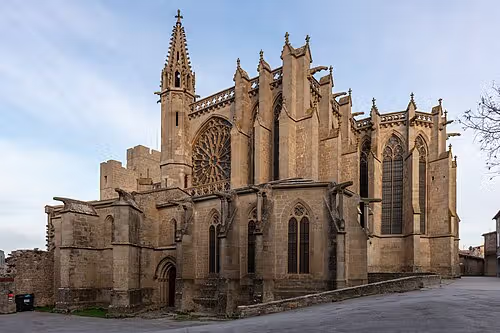
    After the exposed ramparts and wind, stepping through the door here feels like entering a cave. The temperature drops, the noise vanishes, and your eyes need a moment to adjust to the darkness. This former cathedral, a minor basilica since 1898, was built between the 9th and 14th centuries. What makes it extraordinary is the collision point where the heavy Romanesque nave meets a soaring Gothic choir. You can literally see the moment northern French architectural dominance replaced the southern tradition after the Albigensian Crusade. The stained glass, particularly the Tree of Life window, is some of the finest in southern France. Visit when the sun is high to see the glass at full intensity. Entry is free. Hours are Monday to Saturday 9:00 AM to 6:30 PM, with limited Sunday hours from 9:00 to 10:45 AM and again from 12:30 PM. Tour groups can bottleneck near the entrance, so walk straight to the transept for breathing room. If you catch an organ practice, the sound fills the vaulting in a way that feels physical.

    Learn more about Basilica Saints Nazarius →
    Hours
    Mon-Sat: 9:00 AM – 6:30 PM | Sun: 9:00 – 10:45 AM, 12:30 – 6:30 PM
    Price
    Free

    5 min walk west through the Cite to the western gate

  6. 6

    Porte d'Aude

    Porte d'Aude

    The western exit from the Cite delivers you to the best final view of the walk. This gateway opens onto a panorama of vineyards and rolling hills stretching toward the snow-capped Pyrenees in winter, a sight essentially unchanged since the fortress guarded the border between France and the Crown of Aragon. The steep cobbled path descending from the gate passes the small Church of Saint-Gimer, built in 1859 by Viollet-le-Duc during his restoration of the Cite. During medieval sieges, this was the route defenders used to reach the Aude River for water, a desperate dash under fire. From here, you can descend to the Jardin du Calvaire and loop back to the lower town along the riverbank, or simply stand at the gate and absorb the contrast: the fortified medieval world behind you, open countryside ahead.

    Learn more about Porte d'Aude →
    Hours
    Open 24/7
    Price
    Free
AI Tourguide
Walk this exact route with a private AI guide.
Full GPS navigation, interactive stories, and a guide that answers all your questions. A private guide experience for just €5/hour.
Start This Tour

Self-Guided Tour vs. Group Tour in Carcassonne

Guided walking tours of Carcassonne typically cost €12 to €20 per person and last about 90 minutes, focusing almost entirely on the Cite. The Tourist Office on Rue Camille Saint-Saens runs scheduled group tours in French and English. They are decent for the history, but they skip the lower town entirely and move at the group's slowest pace, which means less time on the ramparts where you actually want to linger.

A self-guided walk like this one covers both halves of the city, lets you spend your time where it matters, and costs nothing beyond the €11 Chateau Comtal ticket. The lower town and the bridge are free. The Basilica is free. If you want deeper historical context, pick up the €5 audio guide at the Chateau Comtal entrance rather than paying for a human guide. It covers the same ground. The main advantage of going self-guided in Carcassonne is control over your schedule: the Cite is unbearable at midday in summer, and a guided tour won't let you wait until late afternoon for the best light and smallest crowds.

Group Tour AI Self-Guided
Price €25–€50 per person €5/hour or €20 all-inclusive
Flexibility Fixed schedule Start anytime, skip stops
Languages 1–2 languages 11 languages
Pace Group pace Your own pace

How Long Does This Carcassonne Tour Take?

Our route covers 2.5 km with 6 stops and takes approximately 1.4 hours at a relaxed pace.

The walk itself covers about 2.5 km, but the climb from the river to the Cite adds time, and the Chateau Comtal alone needs 60 to 90 minutes if you do both rampart sections. Plan for 2.5 to 3.5 hours total if you enter the Chateau and spend real time in the Basilica. If you hit a market morning at Place Carnot, add another 30 minutes.

The natural break point is after the Chateau Comtal. There are restaurants inside the Cite walls along Rue Saint-Louis, though they are overpriced. A better option: exit through the Porte d'Aude at the end of the walk, descend to the Jardin du Calvaire, and eat at one of the more reasonably priced spots on Rue Trivalle. If you are doing this walk in July or August, start in the late afternoon. The lower town is pleasant by 4 PM, and reaching the Cite around 5 PM means softer light, thinner crowds, and the chance to see the floodlit walls at dusk.

Tips for Walking in Carcassonne

AI Tourguide
Walk this exact route with a private AI guide.
Full GPS navigation, interactive stories, and a guide that answers all your questions. A private guide experience for just €5/hour.
Start This Tour

AI Audio Guide for This Tour

Standing on the Pont Vieux looking up at the fortress? Open the app and let it guide you stop by stop through both gates and the Cite interior, with offline maps that work inside the thick stone walls where cell signal drops.

AI Audio Guide Stories, history and fun facts narrated as you walk. No earpiece rental needed.
GPS Navigation Turn-by-turn directions so you never get lost between stops.
Ask Anything Curious about a building you pass? Ask your AI guide on the spot.
11 Languages Switch language anytime. No separate tour needed.
Start This Tour Free

Common Questions

Yes, very safe. The lower town and the Cite are both well-lit and well-trafficked. The only real nuisance is pickpockets inside the Cite during peak summer season when the narrow streets get packed. Keep bags zipped and in front of you on Rue Cros-Mayrevieille. The climb from the river to the Cite via Rue Trivalle is steep but paved, and perfectly fine after dark thanks to street lighting.
Rain actually improves the atmosphere inside the Cite walls, and it clears the crowds dramatically. The Basilica Saints Nazarius is entirely indoors and free. The Chateau Comtal has covered sections along the rampart walk, though parts are open to the elements. In the lower town, the Musee des Beaux-Arts near Place Carnot is a good rain shelter, open Tuesday to Saturday with free admission. Bring a jacket rather than canceling.
Late afternoon, starting around 4 PM. The lower town is pleasant in the softening light, and you reach the Cite by 5 PM when the day-trip buses start leaving. Summer evenings are long here, with sunset around 9 PM in July, giving you plenty of time. The Chateau Comtal closes at 5 PM, so if interior access matters, start earlier, around 2 PM. Avoid the 10 AM to 2 PM window in summer: the Cite is at peak capacity and the exposed ramparts are punishingly hot.
Kids will love the fortress, the towers, and the Chateau rampart walks. A stroller, however, is a struggle. The Pont Vieux cobblestones are rough, the climb up Rue Trivalle is steep, and the streets inside the Cite are narrow and uneven. A baby carrier works much better. The Chateau rampart stairs are not stroller-accessible at all.
No. The Chateau Comtal rarely has long queues, even in summer. You buy tickets at the entrance. The only time it gets backed up is when a large tour group arrives, which usually clears in 10 to 15 minutes. Everything else on this route is free and requires no tickets.
No booking needed. This self-guided tour is available anytime. Open the route on your phone and start walking. The AI audio guide works instantly, no reservation required.
The AI audio guide is available in 11 languages: English, German, French, Spanish, Italian, Japanese, Chinese, Portuguese, Danish, Norwegian, and Swedish.
Yes. Skip any stop, spend extra time at places you like, or start the route from any point. You can also ask the AI to suggest a shorter route.
AI Tourguide
Curated by AI Tourguide GPS-verified routes, reviewed and updated regularly.
Last verified March 2026