Self-Guided Walking Tour in Kotor

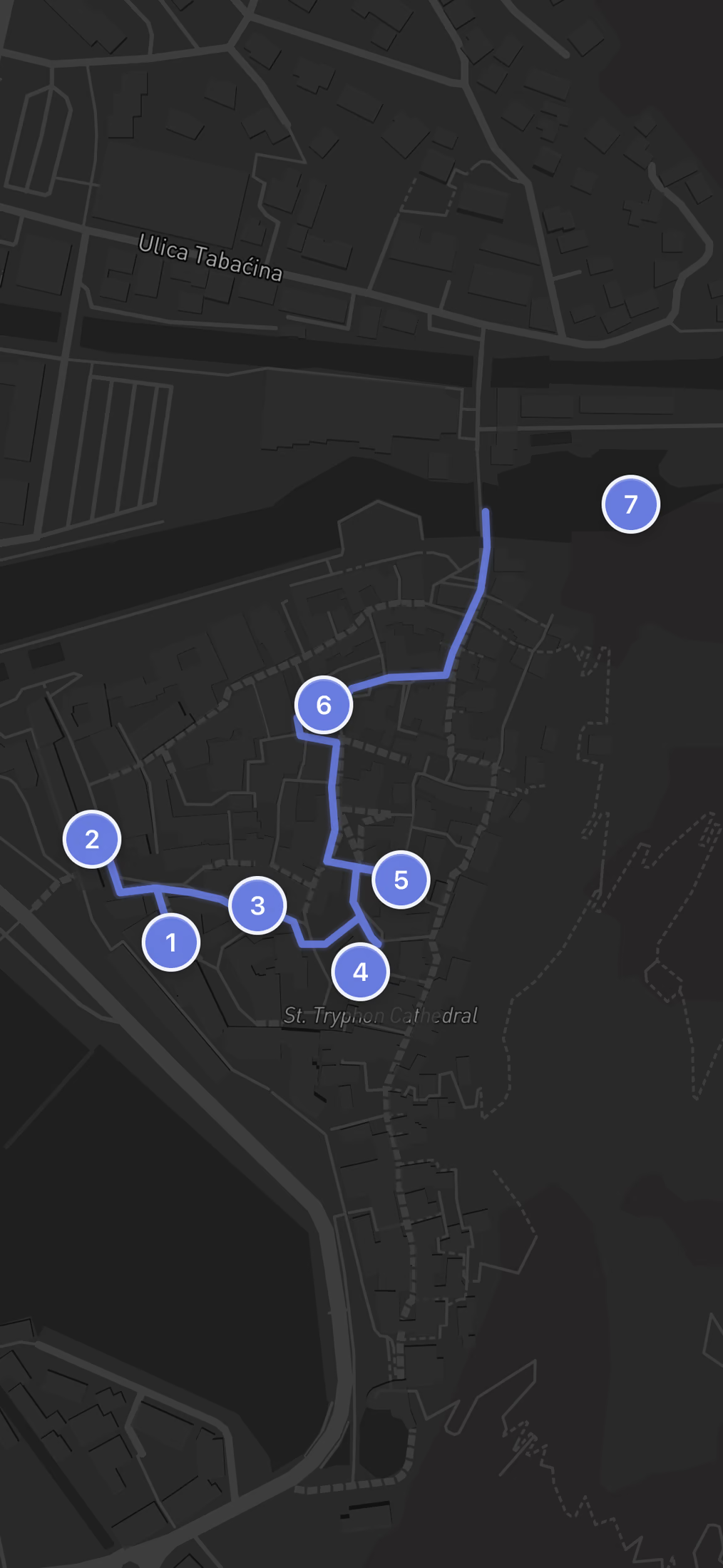
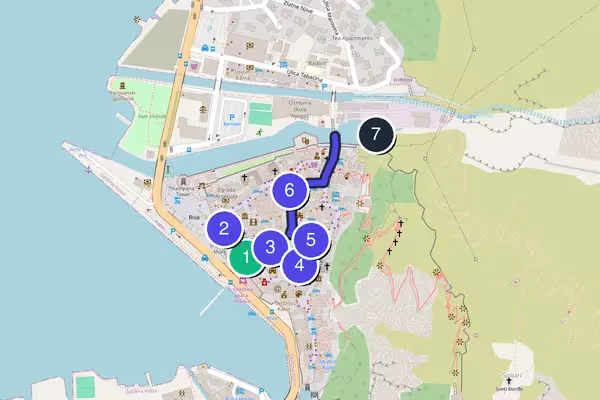
A tight self-guided loop through Kotor's walled Old Town, from the Sea Gate through the squares and churches to the foot of the city walls. Seven stops in 0.6 km. This page gives you the map, the walking time for every leg, real hours and prices for each site, and shorter versions when a cruise ship is in.

7 Stops0.6 km~1 hours walking1–2 hours with stops
What you get with AI Tourguide
Full GPS navigationInteractive AI guidePersonalized to youWorks in your browser
Try this tour with Alex

Kotor Walking Tour at a Glance

This route is for anyone who wants to see Kotor's Old Town properly without a group or a fixed schedule. It threads the 7 key sights in walking order so you never double back through the same lane twice. Every interior is optional: you can follow the whole thing for free from the outside, or pay to step inside the cathedral, the museum and the walls. The order is built so each stop sets up the next.

StartSea Gate
FinishKotor City Walls
Route typeA near-linear thread from south-west to north-east through a tiny walled town, no backtracking. You start at the Sea Gate by the water and end at the foot of the city walls, working steadily inland and uphill.
Realistic timeAbout 10 minutes of pure walking across the 0.6 km, but plan just over an hour once you enter sites and pause at each square. Add 45 to 90 minutes if you climb the walls at the end.
DifficultyEasy and flat inside the walls, on stone-paved alleys and small squares. The only real effort is the optional wall climb at the end, which is a steep haul on uneven stone steps with no shade.
Cost to followThe outdoor route is free to walk. Paid interiors: Cathedral of Saint Tryphon 5 EUR, Maritime Museum 4 EUR, and the city walls 8 EUR in summer or 3 EUR in winter. The Church of St. Luke is free.
Best for:

First-time visitors who want the whole Old Town in geographic order, and anyone dodging the midday cruise crowds by walking early or late.

The Route

Free Walking Tour Map of Kotor

7 stops0.6 kmabout 1 hours
Loading the interactive map…The complete walking route will appear here.
Want the route to guide you while you walk?Open the route with navigation and a personal guide for the history, stories and questions that matter to you.
Open route + AI guide

The 7 stops along this route

  1. Sea Gate in Kotor, stop 1 on the self-guided walking tour
    1Sea Gate
  2. Trg od Oružja in Kotor, stop 2 on the self-guided walking tour
    2Trg od Oružja
  3. Clock Tower in Kotor, stop 3 on the self-guided walking tour
    3Clock Tower
  4. Kotor Cathedral (Катедрала Светог Трипуна) in Kotor, stop 4 on the self-guided walking tour
    4Kotor Cathedral (Катедрала Светог Трипуна)
  5. Maritime Museum of Montenegro (Pomorski muzej) in Kotor, stop 5 on the self-guided walking tour
    5Maritime Museum of Montenegro (Pomorski muzej)
  6. Church of Saint Luke (Црква Светог Луке у Котору) in Kotor, stop 6 on the self-guided walking tour
    6Church of Saint Luke (Црква Светог Луке у Котору)
  7. Missing required field: waypoints[6].image
    7Kotor City Walls
  8. That's the complete route.

    If you want more than the map and text, add live navigation and a conversational AI guide while you walk.

    Open route + AI guide
    You made it
Stop 1 of 7
Swipe →

Your Kotor Walking Tour, Stop by Stop

  1. 1

    Sea Gate

    Sea Gate in Kotor, stop 1 on the self-guided walking tour

    Built in the 16th century during Venetian rule, this is the main entrance to the Old Town and the first thing you walk through. A relief of the Madonna and Child flanked by Saints Tryphon and Bernard sits above the arch, and a 15th-century winged lion of St. Mark on the wall above that announces who was in charge when these stones were laid. The gate opens directly onto the Arms Square, Kotor's largest open space and the social center of the town. Pass through the arch and let your eyes adjust to the sudden shade of the stone walls. The square in front of you is where everything converges: cafes, the clock tower, the tourist office, and the start of every alley worth exploring. Before you walk further, turn around and look at the gate from inside. The thickness of the walls tells you everything about how seriously this town took its defense. The entire Old Town is walled, and this gate was the only way in from the sea for centuries.
    Hours
    Open 24/7
    Price
    Free
  2. 2

    Trg od Oružja

    Trg od Oružja in Kotor, stop 2 on the self-guided walking tour

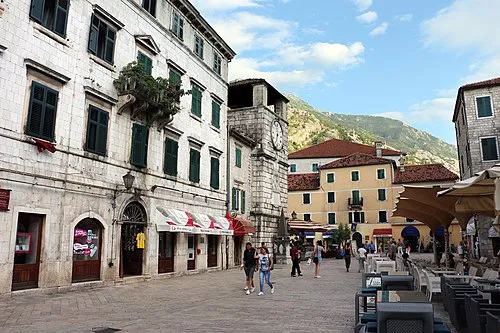
    Arms Square is the largest open space inside the walls, and it functions as the living room of the Old Town. The 17th-century clock tower anchors one end, and the remains of the 50-meter-long 16th-century Prince's Palace line the opposite side. A stone Pillar of Shame still stands here, where criminals were once tied and publicly humiliated before the whole town. Today the square is ringed with cafe terraces, and the pillar is easy to miss between the tables. The square was the seat of Venetian administration for centuries, and the architecture reflects that. Arched loggias, stone balustrades, coats of arms carved into walls. It is the natural meeting point for the town and the spot where you start to feel how compact Kotor really is. From any corner of this square, you can see at least two churches, and the mountains are visible above the roofline in every direction. Walk south from the square to reach the Cathedral of Saint Tryphon, about 30 seconds away through a narrow passage between buildings.

    Hours
    Always open
    Price
    Free
  3. 3

    Clock Tower

    Clock Tower in Kotor, stop 3 on the self-guided walking tour

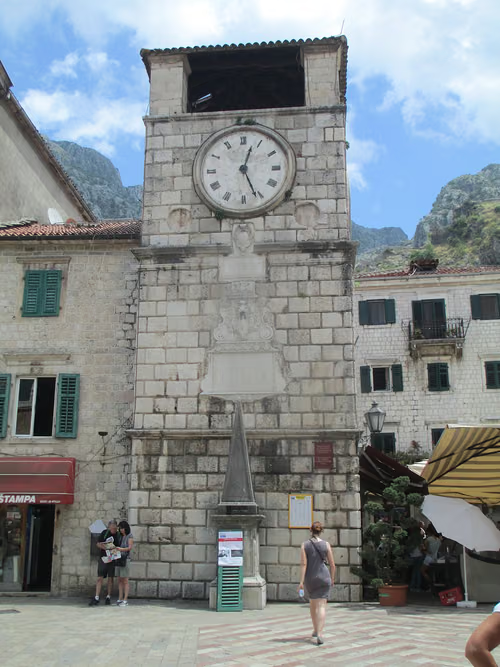
    Standing at the entrance to the Old Town since 1602, this stone tower leans slightly, a result of earthquake damage sustained in 1667 and again in 1979. At its base sits the medieval Pillar of Shame, where convicted criminals were publicly displayed. The tower is one of the first things you see after passing through the Sea Gate, and its leaning silhouette is the most photographed detail on the square. The tilt is subtle enough that you might not notice it at first, but stand back and compare the tower's edge against the straight lines of the buildings behind it. The 1979 earthquake devastated much of Kotor's Old Town, and the reconstruction effort is part of why UNESCO designated the entire area as a World Heritage Site in 1979, the same year. The clock still works. The tower is not open to visitors inside, but it frames the square perfectly and gives you your bearings. From here, the Cathedral of Saint Tryphon is one block south, visible from the square.

    Hours
    Open 24/7
    Price
    Free
  4. 4

    Kotor Cathedral (Катедрала Светог Трипуна)

    Kotor Cathedral (Катедрала Светог Трипуна) in Kotor, stop 4 on the self-guided walking tour

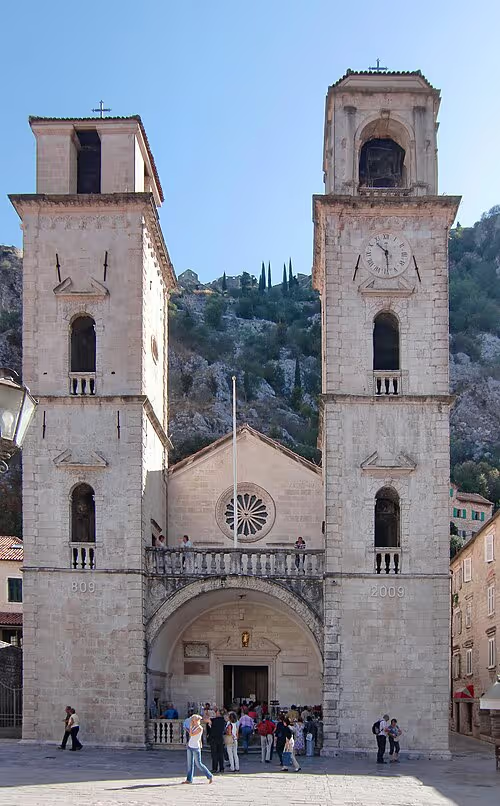
    A church has stood on this spot since 809 AD, though the current Romanesque structure dates to 1166. It has been knocked down by earthquakes in 1537, 1563, 1667, and 1979, and rebuilt every time. The twin bell towers on the facade are not even the same height: the north one is 33 meters, the south one 35. That kind of imperfection tells you everything about this cathedral's stubborn history. Inside, look up. Greek fresco painters decorated the interior in 1331, and the same artists went on to paint the Decani Monastery in Serbia. The cathedral is 35 meters long and 17 meters wide, built as a three-nave basilica. The relics of Saint Tryphon, the city's patron, are kept in a side chapel and are the reason the cathedral exists at all: a local nobleman bought them from Venetian merchants in the 9th century. Admission is 3 EUR and it is open daily from 9:00 AM to 6:00 PM. The cathedral is quietest right at 9:00 AM opening. By 10:30 the cruise ship crowds arrive and the small interior gets packed. Fifteen minutes is enough for a thorough visit.

    Hours
    Daily: 9:00 AM – 6:00 PM
    Price
    5 EUR
  5. 5

    Maritime Museum of Montenegro (Pomorski muzej)

    Maritime Museum of Montenegro (Pomorski muzej) in Kotor, stop 5 on the self-guided walking tour

    Housed inside the 18th-century Grgurina Palace, the Maritime Museum is the only museum of its kind in Montenegro. The collection started around 1880 as a private gathering of seafaring artifacts by the Brotherhood of the Boka Navy, a maritime guild with roots going back centuries. It opened to the public in 1900 and became an official museum in 1938. The collection covers Kotor's deep relationship with the sea: navigation instruments, ship models, weapons, paintings of naval battles, and old photographs of the bay's merchant fleet. The building itself, with its stone staircase and period rooms, is worth seeing even if maritime history is not your thing. The top floor has a small terrace with a partial view over the Old Town rooftops. Ask at the front desk if access is available during your visit. The museum is open Monday through Friday from 8:00 AM to 3:00 PM and Saturday from 9:00 AM to 1:00 PM. Closed on Sundays. Entry is 4 EUR. It is small enough to visit in about 45 minutes and is located just steps from the Arms Square.

    Hours
    Mon-Fri: 8:00 AM – 3:00 PM | Sat: 9:00 AM – 1:00 PM | Sun: Closed
    Price
    4 EUR (Maritime Museum)
  6. 6

    Church of Saint Luke (Црква Светог Луке у Котору)

    Church of Saint Luke (Црква Светог Луке у Котору) in Kotor, stop 6 on the self-guided walking tour

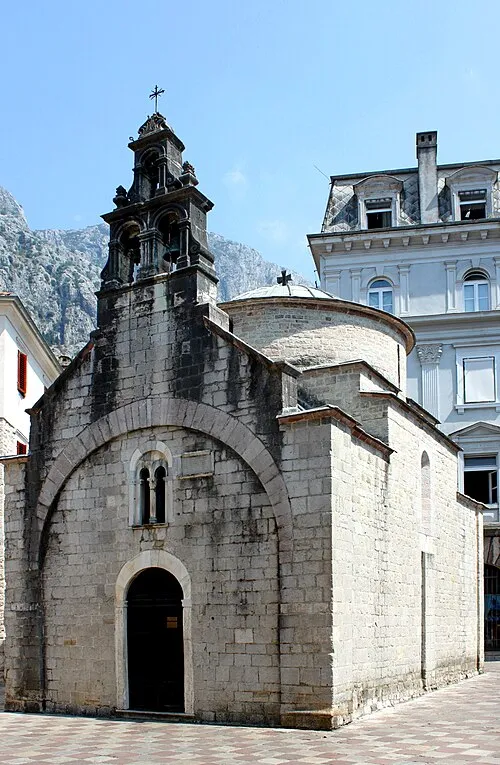
    Tucked into St. Luke's Square inside the Old Town, this small Orthodox church is easy to walk past if you are not paying attention. It was built in 1195, which makes it over 800 years old, and it has barely changed since. The stone exterior is plain, almost austere. That is part of its appeal. While the Cathedral of Saint Tryphon a few minutes' walk away is the city's grand statement, the Church of St. Luke feels personal and quiet. For most of its history, this church served both Catholic and Orthodox congregations at the same time, each using a separate altar. That arrangement lasted over 150 years starting in 1657 and tells you a lot about how Kotor's communities coexisted. Since the 1600s it has been exclusively Orthodox. Inside, the space is small and dim, with a carved wooden iconostasis and faded frescoes. The entire floor is composed of tombstone slabs from local families, worn smooth by centuries of foot traffic. Entry is free. Open Monday through Friday 9:00 AM to 7:00 PM, Saturday from 8:00 AM, and Sunday from 11:00 AM. Five minutes here is enough, but the atmosphere deserves a pause.

    Hours
    Mon-Fri: 9:00 AM – 7:00 PM | Sat: 8:00 AM – 7:00 PM | Sun: 11:00 AM – 7:00 PM
    Price
    Free
  7. 7

    Kotor City Walls

    Missing required field: waypoints[6].image

    These fortifications extend 4.5 kilometers up the steep mountainside to the Castle of San Giovanni at 280 meters elevation. Built between the 9th and 18th centuries, the walls reach up to 20 meters high and 16 meters thick in places. You can see them from everywhere in the Old Town, zigzagging up the cliff like a stone spine. The climb to the top takes about 45 to 60 minutes on uneven stone steps, and the views from every switchback are worth the effort. The bay stretches out below, the cruise ships shrink to toy-boat size, and the red rooftops of the Old Town form a tight jigsaw pattern between the walls. At the top, the ruined fortress offers a 360-degree panorama of the bay, the mountains, and the town you just walked through. If you do not want to do the full climb, the first third gives you the best views for the least effort. Bring water. There is no shade on the climb and the stone radiates heat in summer. The entrance is at the northern edge of the Old Town, near the River Gate. The path is free to access in the off-season. During peak months a small fee may apply.

How Long Does This Walking Tour Really Take?

The walking itself is almost nothing: 0.6 km, roughly 10 minutes end to end. The time goes into the interiors and the squares. Budget a little over an hour to see everything at ground level, then treat the city walls as a separate 45-to-90-minute climb depending on how high you go.

The walking distance inside the Old Town is just 0.6 km, which takes about 10 minutes of pure walking time. But plan for just over an hour if you enter the Cathedral (15 minutes), the Maritime Museum (45 minutes), and pause at each square. If you add the climb to the fortress at the end, that is another 45 to 90 minutes depending on your pace and how often you stop for photos.

The entire route is flat inside the walls, on stone-paved alleys and small squares. The only elevation comes if you choose to climb the city walls at the end. Comfortable walking shoes are enough for the Old Town. For the fortress climb, you want shoes with good grip because the stone steps are uneven and can be slippery. There are cafes on the Arms Square for a break, and a few small restaurants in the side alleys if you want to sit down with a cold drink before tackling the walls.

Full Route, Shorter Walk or Two-Day Version?

Kotor is small enough that you can bend this route to whatever time you have. Here are three ways to walk it, from the full sequence to a quick loop for a crowded cruise-ship day, using the real stop numbers.

Short

Squares and cathedral only

Stops 1 to 4, Sea Gate to the Cathedral, about 30 to 40 minutes

Cut the longest, most northern legs (the 140 m to St. Luke and the 160 m to the walls) and stop at the cathedral. You still get the Venetian gate, both main squares, the leaning clock tower and Kotor's grandest church. Best when a ship is in and you want the highlights before the crowd builds.

Two-part

Town first, walls later

Stops 1 to 6 now, save stop 7 for early morning or late afternoon

Walk the flat Old Town (stops 1 to 6) whenever you like, then break before the climb. Come back for the city walls (7) at first light or after 5 PM, when the stone has cooled and the switchbacks are quiet. This splits the only strenuous part off from the easy stroll.

You can walk it in reverse, coming down from the walls to the Sea Gate, but the given direction is better: you start flat and cool by the water, warm up through the squares, and save the uphill wall climb for last rather than starting with it.

Is This Kotor Walking Tour Right for You?

This is one of the shortest routes we map, but the terrain splits sharply between the flat Old Town and the vertical wall climb. Here is who it suits and how to bend it.

A good fit if you…

  • First-time visitors who want every main sight in walking order across just 0.6 km
  • Travelers off a cruise ship with only a few hours in port
  • Anyone who likes to read the plaques and go at their own pace with no group
  • Photographers chasing the red rooftops and bay from the lower wall switchbacks

Adapt the route if you…

  • You have mobility limits: the Old Town section is flat, but skip stop 7, the wall climb is steep on uneven stone
  • It's a hot July or August midday: do the walls at dawn or after 5 PM and bring at least a liter of water
  • Cruise ships are docked: walk the short version (stops 1 to 4) early, or start after the ships leave in the late afternoon
  • You're short on time: skip the two museums and interiors and follow the free outdoor thread in about 20 minutes

Tickets & Skip-the-Line in Kotor

Most of this route is open-air and free, so there is almost nothing to queue for; only three stops charge admission.

Kotor Cathedral (Катедрала Светог Трипуна)Admission 5 EUR, open daily 9:00 AM to 6:00 PM. Arrive right at 9:00 AM opening, because by 10:30 the cruise crowds pack the small interior.
Maritime Museum of Montenegro (Pomorski muzej)Entry 4 EUR, open Monday to Friday 8:00 AM to 3:00 PM and Saturday 9:00 AM to 1:00 PM, closed Sunday. Bring cash and allow about 45 minutes.
Kotor City Walls8 EUR in summer, 3 EUR in winter, with the ticketed entrance near the River Gate open Saturday and Sunday around the clock. Off-season the path is often free to access.
Everything else is freeThe Sea Gate, Kotor Town Square, the Clock Tower and the Church of St. Luke are all outdoor or free-entry, so you can walk straight in with no ticket.
Optional upgrade
+3
The same 7-stop route,
now with navigation and a guide.
Optional AI experience

You already have the route.
The AI guide brings it to life.

Standing at the Sea Gate or on the Arms Square inside the medieval walls? Open AI Tourguide in your browser, no app and no download, and a voice guide walks you through the narrow alleys from the cathedral to the Church of St. Luke. It greets you, tells the story along the way, then asks what you want to see and adapts as you go. A real conversation woven into the walk, not a recording. Start with 100 free credits.

Livenavigation13languagesAnyquestionYourinterests
Open this route with the AI guide

Try it in your browser · No app or download required

Tips for Walking in Kotor

  • Check the Kotor cruise ship schedule before planning your day. Ships dock between 7:00 AM and 5:00 PM, and the Old Town floods with thousands of visitors. The best times to explore are before 8:00 AM and after 5:00 PM, when the town empties out and feels like a different place entirely.
  • Montenegro uses the euro. Most places in the Old Town accept cards, but smaller restaurants, boat operators, and some entrance fees prefer cash. Have small bills ready for the Cathedral (3 EUR) and the Maritime Museum (4 EUR).
  • If you plan to climb the city walls to the fortress, bring at least a liter of water per person. There is no shade on the climb, and the stone steps radiate heat in summer. Start early in the morning or wait until late afternoon. Midday in July and August can be dangerous.
  • The Old Town has limited public restrooms. Your best options are inside the Maritime Museum (with admission), the cafes on Arms Square (order a coffee), or the public toilet near the River Gate at the north end of the Old Town. Plan accordingly before starting the wall climb.
  • For the best photo of the Old Town and bay together, climb about one-third of the way up the city walls. The full fortress view is dramatic but the town gets small. From the lower switchbacks, you get the red rooftops, the cathedral towers, and the bay in a single frame.

Where to Eat Along the Route

The best food in Kotor is not on the postcard squares. The restaurants ringing Trg od Oružja and the other main plazas inside the walls turn out fast, unimaginative plates for the cruise crowds, so walk at least two to three blocks toward the Skurda River or step outside the walls, where prices drop 20 to 30 percent and the cooking is better.

  • The backstreets toward the fort and the eastern end of the Old Town, away from the big squares, hide the better and less touristy kitchens inside the walls.
  • Just outside the Gurdić Gate at the south entrance, near the start of the fortress climb, sits a cluster of solid value spots including BBQ Tanjga and Restobar Taraca.
  • The Dobrota promenade north of town is the locals' Kotor: bay views, seaside tables and far fewer tourists, best for a slow sunset dinner.
  • Muo, a five-minute drive or fifteen-minute walk across the bay, has waterfront cafes where locals actually eat, with easier parking and no cruise crush.
BBQ Tanjga⌖A no-frills family grill just outside the walls and TripAdvisor's number one in Kotor despite being a cheap eat. Order at the counter, take a number and grab a seat outside; a mixed meat platter starts around 10 EUR and expect a queue of 20 to 30 minutes at peak.
Konoba Scala Santa⌖Kotor's oldest restaurant, open since 1931, on Trg od Salate with an open fireplace and a summer terrace on the plaza. Known for fish stew and squid with Dalmatian stew; pasta and risotto from 10 EUR, seafood from 12 EUR. Book ahead, it fills fast.
La Catedral Pasta Bar⌖A tiny outdoor pasta nook on an Old Town side street, all fresh pasta and friendly service, with carbonara made the proper way with eggs. Most dishes run 15 to 20 EUR; reserve at least two days ahead in peak season and expect a 30 to 60 minute wait otherwise.
Restobar Taraca⌖A riverside terrace on the north side of the walls by the Scurda, one of the few places in Kotor with a real vegan and vegetarian menu (the falafel bowl is the standout) alongside meat dishes. Most meals 15 to 20 EUR, open daily 8am to 11pm.

Skip the square-side places that push a verbal "catch of the day" with no printed menu, sell fish per kilo without stating the portion, or slip in unrequested bread and cover charges; a single fish here can hit 100 EUR when the bill lands.

Tourist Traps to Avoid in Kotor

Kotor is safe, and violent crime against tourists is virtually nonexistent; the risks here are almost entirely about money, so these are overcharging and sales traps rather than dangers.

  • Airport taxis are the biggest drain: the metered Tivat to Kotor fare is 20 to 25 EUR, but unlicensed drivers inside the arrivals hall quote 50 to 70 EUR. Walk past them to the official rank and use a cab whose plate carries the TX code.
  • At square-side restaurants insist on a printed menu with prices before you sit, ask the cost of any "daily special" or per-kilo fish first, and check the bill against the menu before paying.
  • On Blue Cave and Bay boat tours, confirm the full price and what is included before boarding, and ask about waiting times and whether the cave is even open; you often get only 5 to 7 minutes inside.
  • Use only ATMs physically attached to a major bank (Erste, CKB, Lovćen); the unbranded machines near Old Town bars and souvenir shops charge huge fees and are targeted for card skimming.
  • When paying by card, always decline the offer to charge in your home currency and pay in euros instead, or you take a worse rate.
  • Ignore anyone in a hi-vis vest waving you into a public parking spot and demanding 10 EUR cash; real parking is paid by SMS or municipal meter, and the tow truck ("Pauk") recovery fee runs 120 to 150 EUR.
  • Do not pay for "Sveti Stefan beach access"; the island is a private resort, but the public beaches beside the causeway are completely free.

Why Walk This Route?

Kotor's Old Town fits inside a single set of medieval walls, barely 300 meters across at its widest. Every alley dead-ends into a small square with a church or a palazzo, and the mountains press right up against the fortifications, dropping straight into the Bay of Kotor below. This route covers 7 stops across 0.6 km, starting at the Sea Gate and ending at the base of the city walls where the climb to the fortress begins. Plan for just over an hour if you enter the main sites.

The sequence matters because Kotor is small enough that you could wander it randomly in 30 minutes, but you would miss the details that make it extraordinary. This route threads the key sights in geographic order so you never double back through the same lane twice. You start at the Sea Gate where Venetian lions still guard the entrance, work through the religious and civic heart of the town, and end at the walls that protected this place for a thousand years. The entire Old Town is a UNESCO World Heritage Site, and walking it in order reveals how each century left its mark on a town that never had room to sprawl. Check the cruise ship schedule before you come. Ships typically dock between 7:00 AM and 5:00 PM, flooding the Old Town with thousands of visitors. Early mornings and evenings are when Kotor belongs to you.

Common Questions

How long does it take to climb the Kotor city walls to the fortress?

The full climb to the Castle of San Giovanni takes 45 to 60 minutes, depending on your fitness and how often you stop for photos. The path is 1,350 steps on uneven stone, with no shade and no water for sale along the way. You do not need to go all the way to the top. The best views come in the first 15 to 20 minutes of climbing. If you only have limited time or energy, climb to the first major viewpoint and turn around.

Is Kotor too crowded with cruise ship passengers?

On days when multiple ships dock, the Old Town gets genuinely packed. The alleys are narrow and the town is small, so 3,000 extra visitors makes a noticeable difference. Check the cruise schedule online before your visit. Ships arrive between 7:00 and 10:00 AM and leave between 3:00 and 6:00 PM. Plan your Old Town walk for early morning or evening, and use the midday crush for lunch at a waterfront restaurant outside the walls or a boat trip to Perast.

What else can I do near Kotor after the walking tour?

Take a boat from the waterfront to Perast (15 minutes by car, or arrange a water taxi), a tiny Baroque village on the bay, and then continue to Our Lady of the Rocks, a church on a man-made island that sailors built by throwing rocks onto a reef starting in 1452. The boat ride from Perast costs about 5 EUR round trip. If you have a car, drive the bay perimeter road, which takes about 2 hours and passes through Risan, Tivat, and the Verige Strait viewpoint where the bay narrows to just 300 meters.

Take this route with you

Open this exact tour with navigation and your personal AI guide.

Start GPS Navigation + AI Guide
AI Tourguide
Researched and curated by the AI Tourguide teamWe plan and quality-check every route, then research and verify the opening hours, prices, and practical tips for each stop along it.
▶ Open route with AI guideNavigation, stories and your questions