Self-Guided Walking Tour in Kyoto

6 Stops 2.8 km ~1.5 hours
Start This Tour Free
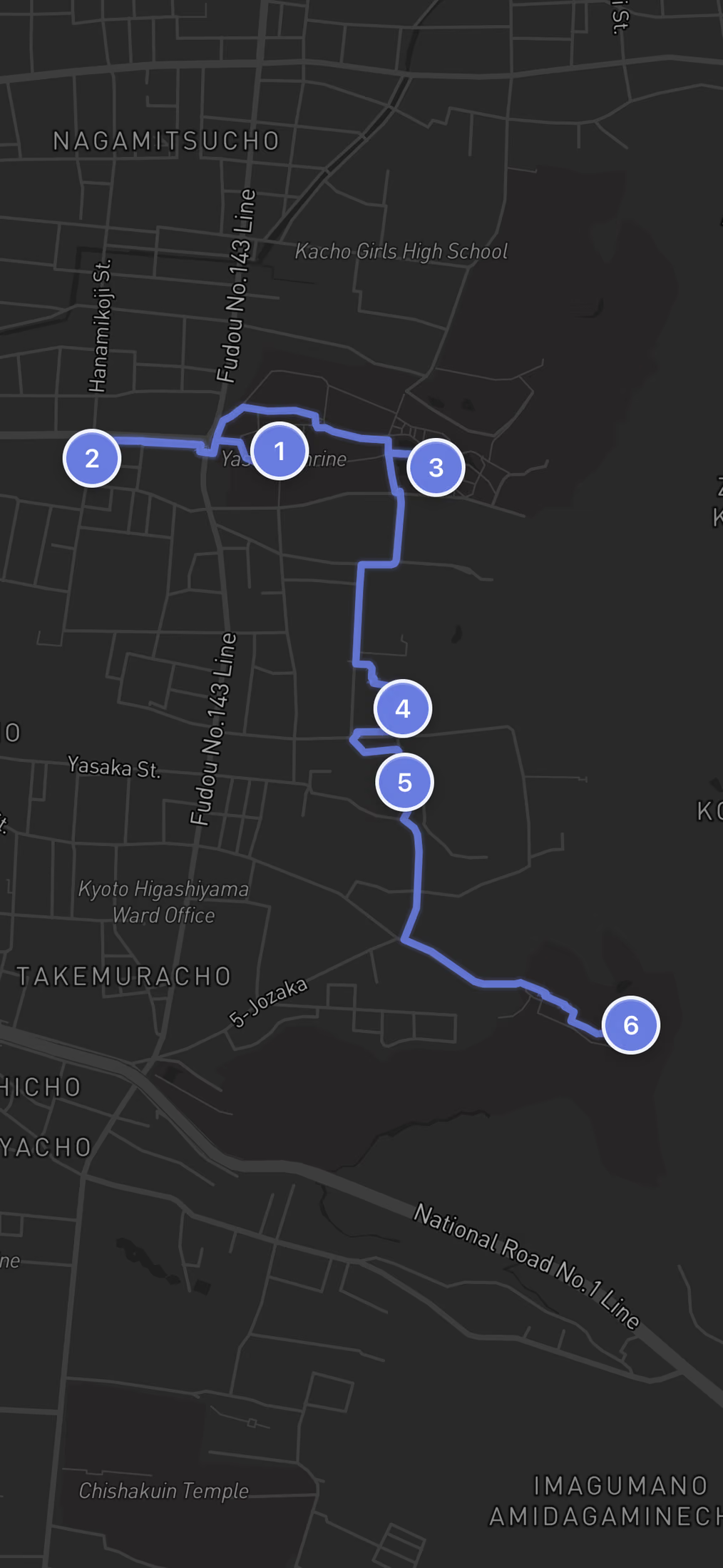
Walking tour route map of Kyoto
Start This Tour Free

Why Walk Kyoto? A Self-Guided Tour

This route follows the eastern hills of Kyoto from Yasaka Shrine through the old geisha quarter, past temples tucked into forested slopes, and down stone-paved lanes that predate the Tokugawa shogunate. At 2.8 km across 6 stops, it is a compact walk through the Higashiyama district, the densest concentration of traditional Kyoto in a single stretch. Plan for about 1.5 hours, longer if you linger in the temple gardens or browse the ceramic shops on Ninenzaka.

What makes this specific route worth following on foot is the way it moves through layers of Kyoto's culture in a single arc. The shrine at the start is Shinto, the temples are Buddhist, the streets between them are Edo-period merchant lanes, and the district where geisha still work sits at the base of it all. Most visitors bus between these sites and miss how they connect. Walking reveals the logic: the entertainment quarter grew around the shrine, the pilgrimage roads linked the temples, and the tea houses and craft shops filled in the spaces between. Every transition happens gradually on foot, from neon-lit Gion to the quiet bamboo at Kodai-ji to the tourist energy at Kiyomizu-dera. Temples close by 5:00 PM, so start in the morning.

The Route: 6 Stops

Swipe through images or scroll names below

Scroll to explore →
1. Yasaka Shrine
2. Gion District
3. Maruyama Park
4. Kodai-ji
5. Ninenzaka Street
6. Kiyomizu-dera

Route Map

Tap to load interactive map
AI Tourguide
Walk this exact route with a private AI guide.
Full GPS navigation, interactive stories, and a guide that answers all your questions. A private guide experience for just €5/hour.
Start This Tour

Your Kyoto Walking Tour, Stop by Stop

  1. 1

    Yasaka Shrine

    Yasaka Shrine

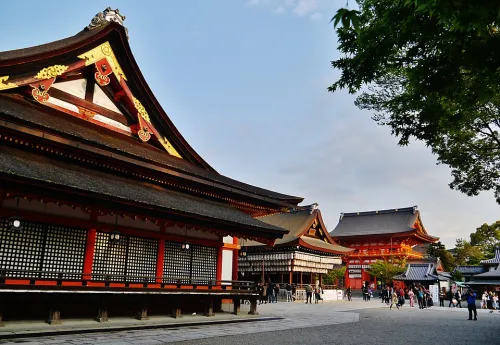
    This Shinto shrine has guarded the eastern end of Shijo-dori and the entrance to the Gion district since 656 AD. It is the starting point for the Gion Matsuri, one of Japan's three greatest festivals, which runs through the entire month of July. The vermilion main gate faces directly down Shijo-dori, one of Kyoto's busiest streets, so the transition from modern city to sacred ground is instant. Walk through the gate and you are in a different world: stone lanterns, gravel paths, and the sound of wooden clapper sticks from morning worshippers. The shrine grounds are free to enter and open 24 hours. The main hall is a National Important Cultural Property, rebuilt in 1654. Visit the small sub-shrines scattered around the edges of the compound. The Utsukushi Gozensha sub-shrine is dedicated to beauty and draws a steady stream of visitors hoping for blessings. In the evening, the lanterns light up and the shrine takes on a completely different character. Walk east through the shrine grounds toward Maruyama Park, which connects directly without crossing a street.

    Learn more about Yasaka Shrine →
    Hours
    Open 24/7
    Price
    Free

    5 min walk to next stop

  2. 2

    Gion District

    Gion District

    Gion is Kyoto's traditional entertainment district and the place most visitors hope to catch a glimpse of a geiko (the Kyoto term for geisha) or maiko (apprentice) walking between teahouses. The best-preserved part is Hanami-koji, a narrow street lined with dark-wood machiya townhouses, lanterns, and the closed doors of exclusive ochaya teahouses. The district developed around Yasaka Shrine in the 1700s, and several traditional teahouses still enforce a centuries-old referral-only policy for entry. Free to walk through at any time, but the liveliest hours are between 5:30 and 8:00 PM when geiko head to evening engagements. Parts of Hanami-koji now have photography restrictions, and for good reason. The respectful thing to do is enjoy the architecture, explore the side alleys, and stop trying to treat working women as photo subjects. Walk the smaller streets off Hanami-koji, especially Shinbashi-dori along the canal, for the most atmospheric views without the main-street crowds. If you want to see a traditional performance, Gion Corner runs short shows combining tea ceremony, flower arranging, and dance. From Gion, walk east back through the shrine grounds and into Maruyama Park.

    Learn more about Gion District →
    Hours
    Daily: 5:30 – 8:00 PM
    Price
    Free (streets); Gion Corner shows 3,150 JPY

    8 min walk to next stop

  3. 3

    Maruyama Park

    Maruyama Park

    Kyoto's oldest public park opened in 1886 and covers nearly 21 acres at the base of the eastern hills. The centerpiece is a massive weeping cherry tree, a second-generation specimen planted in 1949 after the original 200-year-old tree died. During cherry blossom season in late March or early April, this tree is lit up at night and hundreds of people picnic beneath it on blue tarps. It is the biggest and most festive hanami party in the city. Outside cherry season, the park is a pleasant green space connecting Yasaka Shrine to the temple district above. A small pond, food stalls, and winding paths through wooded hillsides fill the interior. The park is free, open 24 hours, and designated a National Place of Scenic Beauty. If cherry blossoms are part of your timing, grab food from the yatai stalls and join the hanami picnic. Bring a plastic sheet to sit on. The illumination runs until midnight during peak bloom. From the park's southern edge, a path leads uphill toward Kodai-ji through a quiet residential area. Follow the signs.

    Learn more about Maruyama Park →
    Hours
    Check locally
    Price
    Free

    5 min walk to next stop

  4. 4

    Kodai-ji

    Kodai-ji

    Built in 1606 by Nene, the widow of the great unifier Toyotomi Hideyoshi, this Zen temple occupies a forested hillside above the Higashiyama district. The gardens were designed by the legendary landscape architect Kobori Enshu, and the contrast between the raked gravel of the front garden and the dense bamboo grove behind the main hall is striking. The temple holds lacquerwork decorations by craftsmen of the Kodaiji maki-e school, some of the finest lacquer art in Japan. In autumn, the temple runs special nighttime illuminations when the maple trees are lit from below and their reflections fill the garden pond. These night visits are among the most popular seasonal events in Kyoto. The temple grounds include a teahouse where Nene reportedly hosted Hideyoshi, and two more teahouses further up the hillside with views over the eastern part of the city. Allow about 30 minutes for the full circuit. Kodai-ji sits between Maruyama Park and Ninenzaka, making it a natural midpoint on this route. From the temple exit, walk south along the narrow lanes. You will see the stone-paved slopes of Ninenzaka within five minutes.

    Learn more about Kodai-ji →
    Hours
    Daily: 9:00 AM – 5:00 PM
    Price
    600 JPY (adults)

    5 min walk to next stop

  5. 5

    Ninenzaka Street

    Ninenzaka Street

    This 150-meter stone-paved slope in Kyoto's Higashiyama district is lined with traditional wooden buildings, ceramic shops, and tea houses. Together with the steeper Sannenzaka just above it, these lanes form the main approach to Kiyomizu-dera and look almost exactly as they did a century ago. The preservation is deliberate, and the effect is immediate: this is the postcard Kyoto that people come looking for. A persistent local superstition claims that anyone who stumbles on these stone steps will have two years of bad luck, so watch your step. The street is free to walk, open all hours, and gets extremely crowded from mid-morning onward. Shops sell Kiyomizu-yaki pottery, matcha sweets, and every Kyoto souvenir imaginable. There is a Starbucks here that operates inside a 100-year-old townhouse, whether that is charming or absurd depends on your outlook. Be here by 8:00 AM for photos without crowds. By afternoon, the lane can feel like a conveyor belt. The architecture is genuinely beautiful, and walking these lanes gives you the clearest sense of what the old merchant city looked like before modernization. Continue uphill on Sannenzaka toward Kiyomizu-dera.

    Learn more about Ninenzaka Street →
    Hours
    Open 24/7
    Price
    Free

    10 min walk to next stop

  6. 6

    Kiyomizu-dera

    Kiyomizu-dera

    Founded in 778, this UNESCO World Heritage temple sits on a hillside and its famous wooden stage juts out 13 meters above the slope, supported by 139 pillars joined without a single nail. The Japanese expression 'jumping off the stage at Kiyomizu' is the equivalent of 'taking the plunge,' and during the Edo period, some people literally did: records show 234 jumps between 1694 and 1864, with a survival rate of about 85 percent. The practice has been banned for over a century. The view from the stage looks out over the forested valley and the Kyoto skyline beyond. In autumn, the maple trees below the stage turn brilliant red and orange, creating one of the most photographed scenes in Japan. The Otowa Waterfall at the base of the main hall channels water into three streams. Visitors use long-handled cups to drink from one stream, each said to grant a different benefit: longevity, academic success, or love. Drinking from all three is considered greedy. The temple grounds are large and include pagodas, sub-temples, and a hillside path that takes 45 to 60 minutes to walk completely. The approach up Sannenzaka and through the Niomon Gate is part of the experience.

    Learn more about Kiyomizu-dera →
    Hours
    Daily: 6:00 AM – 6:00 PM
    Price
    400 JPY (adults), 200 JPY (children)
AI Tourguide
Walk this exact route with a private AI guide.
Full GPS navigation, interactive stories, and a guide that answers all your questions. A private guide experience for just €5/hour.
Start This Tour

Self-Guided Tour vs. Group Tour in Kyoto

Guided walking tours of Higashiyama typically run 3,000 to 5,000 JPY per person for a 2 to 3 hour group tour in English. Private guides charge 15,000 to 25,000 JPY for a half day. Free volunteer guides sometimes operate from the Kyoto Station tourist information center.

The Higashiyama district is well-signposted and the route is straightforward: you walk south from Yasaka Shrine, uphill through the temple district, and finish at Kiyomizu-dera. You cannot get lost. A guide adds value mainly at the temples, where knowing the history of Nene's grief behind Kodai-ji or the structural engineering of Kiyomizu-dera's stageless platform makes the visit richer. But the information is available on English signage at every site. If you are choosing where to spend money, spend it on early morning access or seasonal illumination tickets rather than a guide. The walk itself is the experience, and the transitions between Gion's lantern-lit alleys and the temple forests only work at your own pace.

Group Tour AI Self-Guided
Price €25–€50 per person €5/hour or €20 all-inclusive
Flexibility Fixed schedule Start anytime, skip stops
Languages 1–2 languages 11 languages
Pace Group pace Your own pace

How Long Does This Kyoto Tour Take?

Our route covers 2.8 km with 6 stops and takes approximately 1.5 hours at a relaxed pace.

The walking distance is 2.8 km, mostly uphill, which takes about 35 minutes of pure walking time. Plan for 1.5 to 2.5 hours depending on how long you spend at each stop. Kodai-ji takes about 30 minutes, Kiyomizu-dera can take 45 to 60 minutes for the full grounds, and Ninenzaka is as quick or slow as your interest in ceramics and matcha shops.

The route starts flat at Yasaka Shrine and gains elevation gradually through the temple district. By Ninenzaka, you are climbing stone steps. Comfortable walking shoes are important, because the polished stone lanes can be slippery, especially after rain. The steepest section is the final approach to Kiyomizu-dera through the Niomon Gate. If you need a break, the tea houses on Ninenzaka offer matcha and sweets with a seat. After Kiyomizu-dera, you can walk back down to Gion in about 20 minutes, take a taxi, or catch a bus from the stop on Higashioji-dori at the base of the hill.

Tips for Walking in Kyoto

AI Tourguide
Walk this exact route with a private AI guide.
Full GPS navigation, interactive stories, and a guide that answers all your questions. A private guide experience for just €5/hour.
Start This Tour

AI Audio Guide for This Tour

Standing near Yasaka Shrine or on the stone steps of Ninenzaka right now? Open the app and start the Kyoto Higashiyama walking tour from wherever you are. It tracks your location through the temple district, shows you each stop on the map, and works offline so you do not need data on the hillside paths.

AI Audio Guide Stories, history and fun facts narrated as you walk. No earpiece rental needed.
GPS Navigation Turn-by-turn directions so you never get lost between stops.
Ask Anything Curious about a building you pass? Ask your AI guide on the spot.
11 Languages Switch language anytime. No separate tour needed.
Start This Tour Free

Common Questions

Autumn (mid-November to early December) is the peak for maple colors, and the temples along this route are among the best spots in Kyoto for fall foliage. Cherry blossom season (late March to early April) transforms Maruyama Park. Spring and autumn both bring larger crowds. Summer is hot and humid, with temperatures above 35 degrees Celsius. Winter is quiet and cold, with thin crowds and a different kind of beauty. Any season works, but autumn is when this specific route is at its most dramatic.
Partially. Yasaka Shrine, Gion, Maruyama Park, and Ninenzaka are open 24 hours and are atmospheric after dark, especially when the lanterns are lit. But Kodai-ji and Kiyomizu-dera close by 5:00 PM on regular days. Both temples offer special nighttime illuminations during cherry blossom and autumn foliage seasons, with separate evening admission. Check dates on their websites. If you can only visit in the evening, walk from Yasaka Shrine through Gion and Ninenzaka for the atmosphere, and save the temples for a morning visit.
From Kyoto Station, take bus 206 or 100 to the Gion stop (about 20 minutes). From anywhere on the Keihan Line, get off at Gion-Shijo Station and walk east along Shijo-dori for 5 minutes. The shrine's vermilion gate is visible from the street and impossible to miss. If you are coming from the Hankyu Line, Kawaramachi Station is a 10-minute walk east along Shijo-dori.
No booking needed. This self-guided tour is available anytime. Open the route on your phone and start walking. The AI audio guide works instantly, no reservation required.
The AI audio guide is available in 11 languages: English, German, French, Spanish, Italian, Japanese, Chinese, Portuguese, Danish, Norwegian, and Swedish.
Yes. Skip any stop, spend extra time at places you like, or start the route from any point. You can also ask the AI to suggest a shorter route.
AI Tourguide
Curated by AI Tourguide GPS-verified routes, reviewed and updated regularly.
Last verified March 2026