Self-Guided Walking Tour in Vilnius

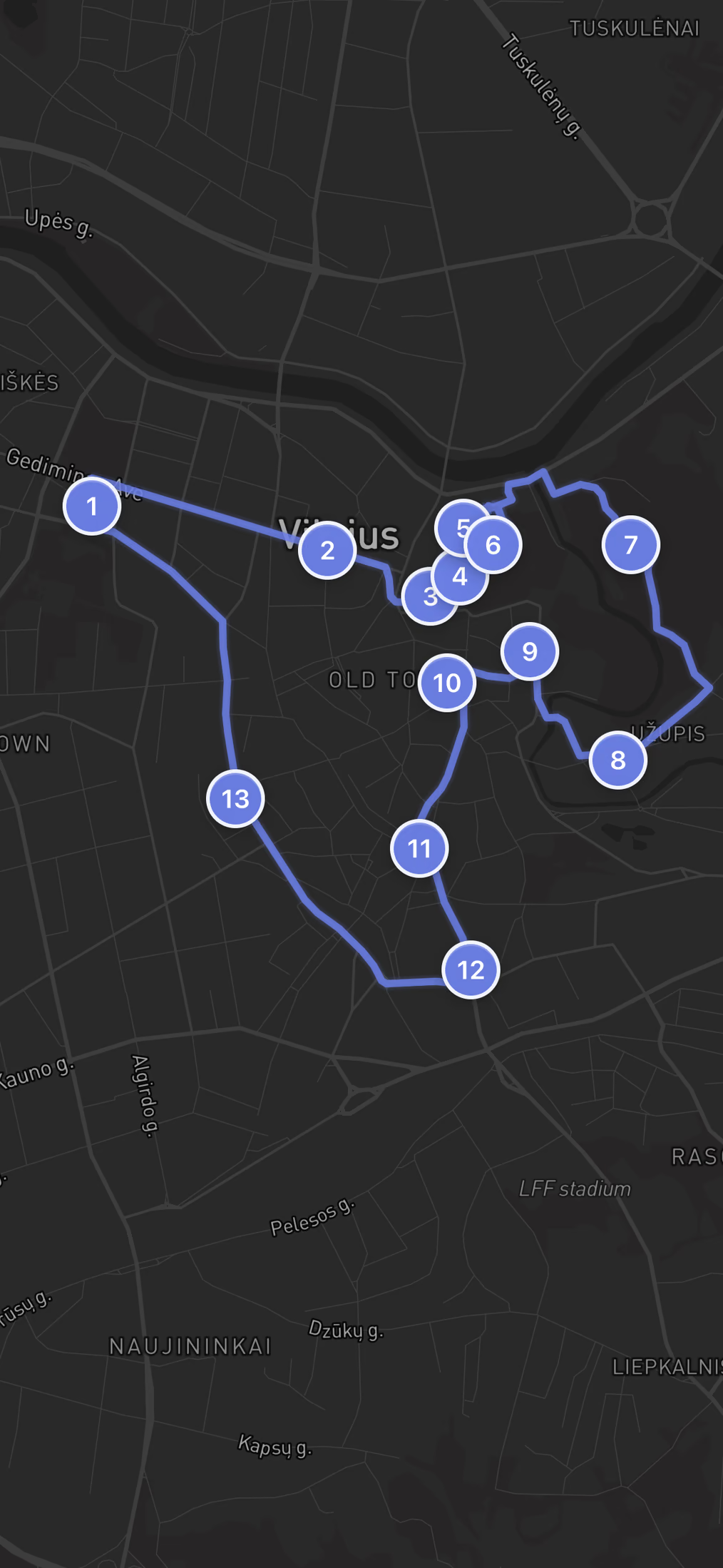
13 Stops 8.4 km ~3.8 hours
Start This Tour Free
Walking tour route map of Vilnius
Start This Tour Free

Why Walk Vilnius? A Self-Guided Tour

This 8.4 km walk through Vilnius connects 13 stops over roughly 4 hours, tracing a wide loop through one of Europe's largest and best-preserved Old Towns. The route starts at a former KGB headquarters, climbs to a hilltop tower with panoramic views, detours through the self-declared republic of Uzupis, and descends through baroque churches and cobblestone squares to the last surviving medieval gate. Vilnius layers its history openly: Soviet repression, medieval Grand Duchy grandeur, baroque church interiors, and a contemporary art scene all sit within walking distance of each other.

The Route: 13 Stops

Swipe through images or scroll names below

Scroll to explore →
1. Museum of Occupations and Freedom Fights
2. Money Museum
3. Cathedral Square
4. Palace of the Grand Dukes of Lithuania
5. National Museum of Lithuania
6. Gediminas Tower
7. Hill of Three Crosses
8. Uzupis
9. Church of St. Anne
10. St. Johns Church
11. Vilnius Town Hall
12. Gates of Dawn
13. MO Museum

Route Map

Tap to load interactive map
AI Tourguide
Walk this exact route with a private AI guide.
Full GPS navigation, interactive stories, and a guide that answers all your questions. A private guide experience for just €5/hour.
Start This Tour

Your Vilnius Walking Tour, Stop by Stop

  1. 1

    Museum of Occupations and Freedom Fights

    Museum of Occupations and Freedom Fights

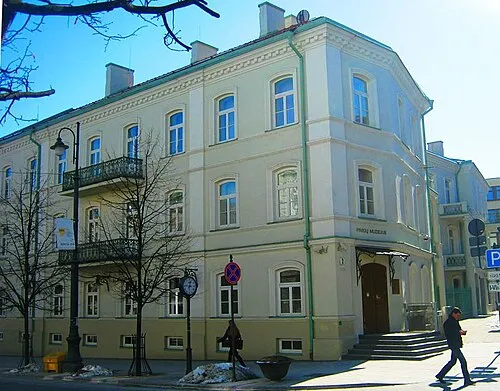
    This museum occupies the building that served as Gestapo headquarters during the Nazi occupation and then as the KGB headquarters from 1940 until Lithuanian independence in 1991. The basement cells where prisoners were interrogated and executed have been preserved exactly as they were, with scratched messages still visible on the walls. The upper floors document the Lithuanian partisan resistance, the mass deportations to Siberia, and the nonviolent independence movement that culminated in the Baltic Way human chain of 1989. It is heavy material, presented without flinching, and it sets the tone for understanding modern Lithuania. Open Wednesday to Saturday from 10:00 AM to 6:00 PM, Sundays until 5:00 PM, closed Monday and Tuesday. Budget at least 45 minutes. The execution chamber in the basement is the most sobering room you will enter on this entire walk.
    Learn more about Museum of Occupations and Freedom Fights →
    Hours
    Mon-Tue: Closed | Wed-Sat: 10:00 AM – 6:00 PM | Sun: 10:00 AM – 5:00 PM
    Price
    6 EUR

    10 min walk

  2. 2

    Money Museum

    Money Museum

    Run by the Bank of Lithuania, this interactive museum traces the history of money from Baltic amber trading through medieval coinage to the adoption of the euro in 2015. The exhibits are surprisingly engaging, with hands-on displays that let you weigh gold bars, try to detect counterfeit banknotes, and mint your own commemorative coin. The building itself, a modern glass-and-steel structure on Gediminas Prospect, is worth noting as part of Vilnius's contemporary architectural push. Open Tuesday to Friday from 9:00 AM to 6:00 PM, Saturdays from 10:00 AM to 5:00 PM, closed Sundays and Mondays. The museum is free-standing from the heavier history of the first stop and provides a lighter transition into the Old Town. The coin-minting station is popular with kids and adults alike.

    Learn more about Money Museum →
    Hours
    Mon: Closed | Tue-Fri: 9:00 AM – 6:00 PM | Sat: 10:00 AM – 5:00 PM | Sun: Closed
    Price
    Free

    6 min walk

  3. 3

    Cathedral Square

    Cathedral Square

    The vast white expanse of Cathedral Square marks the spot where Vilnius began. The neoclassical Cathedral of Vilnius, rebuilt in its current form in the late 18th century, dominates the western edge with a facade of six Doric columns that looks more like a Greek temple than a Catholic church. The freestanding bell tower beside it is a reconstructed remnant of the original defensive walls. Look for the Stebuklas tile embedded in the pavement between the cathedral and the bell tower: local legend says standing on it and spinning clockwise brings good luck. The tile marks the endpoint of the 1989 Baltic Way, a 675-kilometer human chain connecting Vilnius, Riga, and Tallinn. The square is the starting point for most celebrations and protests in Lithuania. It is open at all hours and never charges admission, though the cathedral interior is worth a quick look for the baroque Chapel of St. Casimir.

    Learn more about Cathedral Square →
    Hours
    Check locally
    Price
    Free

    3 min walk

  4. 4

    Palace of the Grand Dukes of Lithuania

    Palace of the Grand Dukes of Lithuania

    This reconstructed palace behind the cathedral was the political center of the Grand Duchy of Lithuania from the 15th century until its destruction by Russian forces in the early 1800s. The current building, completed in 2018 after decades of archaeological work and political debate, is a faithful reconstruction based on historical records and excavation findings. Inside, four routes cover different aspects of life in the Grand Duchy: royal ceremonies, daily court life, archaeological finds, and the reconstruction process itself. Admission is €6. Open Tuesday and Wednesday from 10:00 AM to 6:00 PM, Thursdays until 8:00 PM, Friday and Saturday until 6:00 PM, Sundays until 4:00 PM, closed Mondays. The basement level, where you walk on glass floors above the original foundations, is the most compelling section. Route 1 (history of the palace) takes about 40 minutes and covers the essential story.

    Learn more about Palace of the Grand Dukes of Lithuania →
    Hours
    Mon: Closed | Tue-Wed: 10:00 AM – 6:00 PM | Thu: 10:00 AM – 8:00 PM | Fri-Sat: 10:00 AM – 6:00 PM | Sun: 10:00 AM – 4:00 PM
    Price
    6 EUR

    4 min walk

  5. 5

    National Museum of Lithuania

    National Museum of Lithuania

    Lithuania's oldest and largest cultural heritage museum sits in the Old Arsenal building at the foot of Gediminas Hill. The permanent exhibition covers Lithuanian history from prehistoric times through the medieval Grand Duchy to the 20th-century independence movements. The ethnographic section is particularly strong, with reconstructed village interiors, wooden folk art, and textile traditions that give you a feel for rural Lithuanian life that the city itself cannot provide. The museum's collection of Lithuanian crosses, a unique folk-art tradition of ornate wooden roadside crosses recognized by UNESCO, is displayed in the courtyard and surrounding grounds. Open hours vary seasonally, so check at the entrance. The museum pairs well with the palace next door, and together they provide the full historical context for understanding what Gediminas Tower above you represents.

    Learn more about National Museum of Lithuania →
    Hours
    Check locally
    Price
    5 EUR

    8 min walk

  6. 6

    Gediminas Tower

    Gediminas Tower

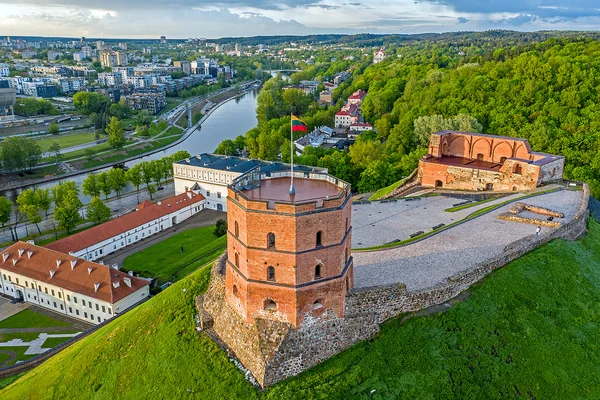
    The iconic red-brick tower crowning Gediminas Hill is the last remaining piece of the Upper Castle that once commanded the confluence of the Vilnia and Neris rivers. A funicular runs from the base to the top of the hill, but the walking path through the wooded slope takes about 10 minutes and is worth the effort for the views that open up gradually as you climb. From the tower's observation platform, Vilnius spreads out below in a panorama that stretches from the Old Town rooftops to the modern skyscrapers of the Snipiskes business district across the river. Inside, a small exhibition covers the castle's construction history. Open daily from 10:00 AM to 8:00 PM. The tower appears on Lithuanian currency, government seals, and the national coat of arms. At sunset, the red brick catches the light and the observation deck empties out, making it the best time to climb.

    Learn more about Gediminas Tower →
    Hours
    Daily: 10:00 AM – 8:00 PM
    Price
    7 EUR

    10 min walk

  7. 7

    Hill of Three Crosses

    Hill of Three Crosses

    Three white concrete crosses stand on a wooded hilltop overlooking the Old Town from the east, visible from nearly every elevated point in the city. The original wooden crosses were erected in the 17th century to commemorate Franciscan friars who were martyred on this hill, according to local tradition. Soviet authorities demolished the crosses in 1950 and filled the site with rubble. The current crosses were rebuilt in 1989, just before independence, in an act of deliberate cultural defiance. The climb from the river valley takes about 10 minutes up a steep forest path with wooden steps. From the top, you get the classic postcard view of Vilnius: the cathedral, Gediminas Tower, and the baroque church spires of the Old Town arrayed below with the Neris River curving behind them. The site is open around the clock and free. Early morning or late afternoon light is best for photographs.

    Learn more about Hill of Three Crosses →
    Hours
    Open 24/7
    Price
    Free

    10 min walk

  8. 8

    Uzupis

    Uzupis

    This small neighborhood on the right bank of the Vilnia River declared itself an independent republic on April 1, 1998, complete with a constitution, flag, president, and an army of approximately twelve people. The constitution is mounted on a mirrored wall on Paupio Street in over 30 languages, and its articles range from the philosophical ("Everyone has the right to be happy") to the absurd ("A cat is not obliged to love its owner, but must help in times of need"). What started as an art-student prank has become a genuine creative district, with galleries, studios, street art, and cafes filling the narrow streets of what was once Vilnius's most neglected quarter. The bronze angel statue at the main intersection watches over everything with an expression of bemused approval. Walk along Uzupio Street and cross the small bridge over the Vilnia for the full experience. There is no admission fee and no closing time. This is Vilnius at its most irreverent.

    Learn more about Uzupis →
    Hours
    Check locally
    Price
    Free

    5 min walk

  9. 9

    Church of St. Anne

    Church of St. Anne

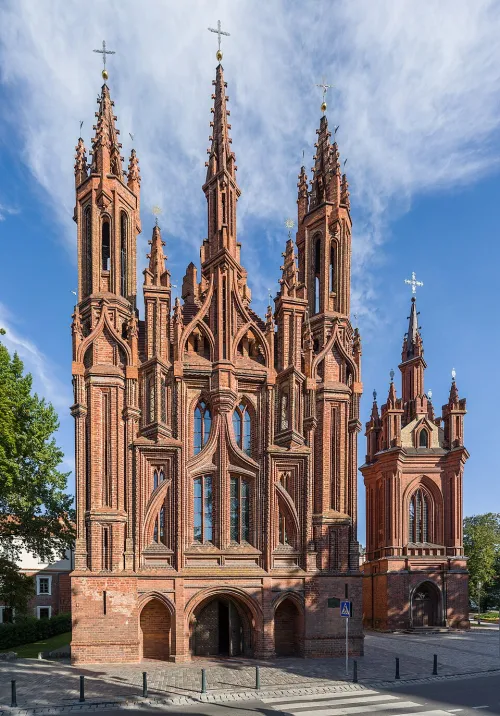
    This late 15th-century masterpiece of Flamboyant Gothic architecture uses 33 different types of clay brick to create a facade so intricate it looks like lacework frozen in stone. Napoleon reportedly said he wanted to carry the church back to Paris on the palm of his hand during his 1812 campaign. Whether or not the quote is genuine, the impulse is understandable: the facade's complexity is extraordinary for a building made entirely of brick, with no decorative stone used anywhere. The interior is comparatively plain, a single nave with whitewashed walls that lets the architecture speak for itself. The church sits beside the much larger Church of St. Francis and Bernardine, and the contrast between the delicate Gothic facade and the massive Bernardine walls next door makes for one of the best architectural compositions in the Baltics. The church is free to enter during services and visiting hours.

    Learn more about Church of St. Anne →
    Hours
    Mon-Fri: 4:45 – 6:00 PM | Sat-Sun: 9:00 AM – 5:00 PM
    Price
    Free

    5 min walk

  10. 10

    St. Johns Church

    St. Johns Church

    Standing within the Vilnius University campus, this church has been rebuilt and restyled so many times that it contains Gothic foundations, a Renaissance layout, and a full baroque interior all in one structure. The 68-meter bell tower, the tallest structure in the Old Town, offers panoramic views from its upper gallery, though access depends on university schedules. Inside, the white-and-gold baroque interior is restrained by Lithuanian standards, with elegant stucco work and a series of side altars that reward slow examination. The church is part of the university ensemble that stretches across an entire city block and includes 13 courtyards, each with its own character. Open Monday to Saturday from 9:00 AM to 6:00 PM, Sundays until 1:00 PM. Walk through the main university gate on Universiteto Street to reach the church, passing through courtyards lined with 16th-century frescoed arcades.

    Learn more about St. Johns Church →
    Hours
    Check locally
    Price
    3 EUR

    6 min walk

  11. 11

    Vilnius Town Hall

    Vilnius Town Hall

    The neoclassical Town Hall at the center of its namesake square has served as a courthouse, theater, museum, and city council chamber across its 500-year history, rebuilt multiple times in styles ranging from Gothic to the current late-18th-century classical design with a pediment supported by Doric columns. The square around it was the commercial heart of medieval Vilnius, where merchants from across the Grand Duchy gathered to trade. Today the square hosts a Christmas market in December, outdoor concerts in summer, and serves as a meeting point year-round. The Town Hall interior now functions as an exhibition and event space, open Monday to Friday from 11:00 AM to 7:00 PM, Saturdays until 5:00 PM, closed Sundays. The surrounding streets, particularly Stikliu (Glass Street) and Vokieciu (German Street), are lined with restaurants and cafes occupying medieval cellars.

    Learn more about Vilnius Town Hall →
    Hours
    Mon-Fri: 11:00 AM – 7:00 PM | Sat: 10:00 AM – 5:00 PM | Sun: Closed
    Price
    Free

    6 min walk

  12. 12

    Gates of Dawn

    Gates of Dawn

    The only surviving gate of the original nine that pierced Vilnius's defensive walls, the Gates of Dawn hold a 17th-century icon of the Blessed Virgin Mary in a chapel above the archway that draws Catholic and Orthodox pilgrims from across Eastern Europe. The icon, covered in a gold and silver riza leaving only the face and hands visible, is credited with miraculous powers and surrounded by hundreds of votive offerings from believers. The chapel is accessed via a narrow staircase on the inner side of the gate. Visitors enter a small, candle-lit room where the icon glows above the altar, and the silence is striking given the busy street below. Open daily from 7:00 AM to 7:00 PM. Walk through the archway first and look up to see the icon through the window, then circle around to the staircase entrance on Ausros Vartu Street. This is the spiritual climax of the Old Town, and the atmosphere in the chapel is genuinely moving regardless of your beliefs.

    Learn more about Gates of Dawn →
    Hours
    Daily: 7:00 AM – 7:00 PM
    Price
    Free

    8 min walk

  13. 13

    MO Museum

    MO Museum

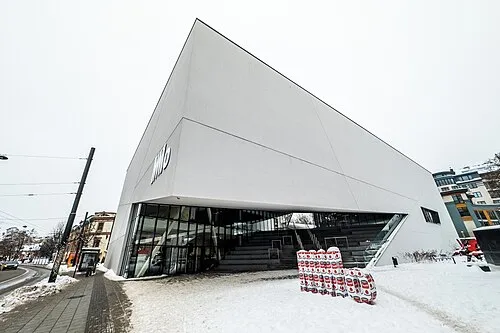
    Vilnius's modern and contemporary art museum, designed by Daniel Libeskind and opened in 2018, provides the final counterpoint to the medieval and baroque architecture that dominates the rest of this walk. The building itself is a sculptural statement: angular white volumes that seem to fold and twist against the older streetscape behind it. Inside, the permanent collection focuses on Lithuanian art from the 1960s to the present, with particular strength in conceptual and performance art from the Soviet era, when artists used abstraction and symbolism to evade censorship. Temporary exhibitions rotate regularly and often feature Baltic and Eastern European artists rarely shown in Western galleries. Open Monday from 10:00 AM to 8:00 PM, Wednesday to Sunday from 10:00 AM to 8:00 PM, closed Tuesdays. The rooftop terrace, accessible without a ticket, offers one last view over the Old Town before you finish the walk. End here with a coffee at the ground-floor cafe and reflect on a city that contains more history per cobblestone than it has any right to.

    Learn more about MO Museum →
    Hours
    Mon: 10:00 AM – 8:00 PM | Tue: Closed | Wed-Sun: 10:00 AM – 8:00 PM
    Price
    12 EUR
AI Tourguide
Walk this exact route with a private AI guide.
Full GPS navigation, interactive stories, and a guide that answers all your questions. A private guide experience for just €5/hour.
Start This Tour

Self-Guided Tour vs. Group Tour in Vilnius

Yes, and it is one of the most underrated walking cities in Europe. Vilnius's Old Town is a UNESCO World Heritage site that covers 3.6 square kilometers of baroque churches, cobblestone lanes, and hidden courtyards, yet it receives a fraction of the visitor traffic of Prague or Krakow. Prices are lower, crowds are thinner, and the mix of medieval Grand Duchy history, Soviet-era scars, and contemporary creativity gives the city a depth that more polished capitals lack. The self-declared republic of Uzupis alone is worth the trip, and the view from the Hill of Three Crosses is one of the finest urban panoramas in the Baltics. Lithuania's food scene has matured considerably in recent years, and the restaurants along Stikliu and Pilies streets now serve modern Lithuanian cuisine that competes with any Baltic capital.

Group Tour AI Self-Guided
Price €25–€50 per person €5/hour or €20 all-inclusive
Flexibility Fixed schedule Start anytime, skip stops
Languages 1–2 languages 11 languages
Pace Group pace Your own pace

How Long Does This Vilnius Tour Take?

Our route covers 8.4 km with 13 stops and takes approximately 3.8 hours at a relaxed pace.

Allow 4 to 4.5 hours including museum visits, hill climbs, and time wandering Uzupis. The walking distance is 8.4 km with two significant hill climbs (Gediminas Tower and the Hill of Three Crosses). If you skip the museum interiors and focus on the churches, squares, and outdoor sites, you can cover the route in about 3 hours.

Tips for Walking in Vilnius

AI Tourguide
Walk this exact route with a private AI guide.
Full GPS navigation, interactive stories, and a guide that answers all your questions. A private guide experience for just €5/hour.
Start This Tour

AI Audio Guide for This Tour

Navigate this Vilnius walk with offline maps and automatic stop detection. The app tracks your position through the narrow Old Town streets and the wooded hill paths where street signs disappear.

AI Audio Guide Stories, history and fun facts narrated as you walk. No earpiece rental needed.
GPS Navigation Turn-by-turn directions so you never get lost between stops.
Ask Anything Curious about a building you pass? Ask your AI guide on the spot.
11 Languages Switch language anytime. No separate tour needed.
Start This Tour Free

Common Questions

Very safe. Vilnius consistently ranks among the safest capitals in Europe. The entire Old Town is well-lit, pedestrian-friendly, and heavily visited at all hours. The hill paths to Gediminas Tower and the Three Crosses are wooded but well-maintained and popular with locals. Standard city awareness applies, but violent crime targeting tourists is extremely rare.
Late May through September offers the best weather, with long daylight hours (sunset after 9:00 PM in June) and temperatures between 15 and 25 degrees Celsius. Winter brings short days and temperatures that can drop to minus 15, but the Christmas market in Town Hall Square and the snow-covered Old Town have their own appeal. Avoid late March and early April when the snow melts into mud on the hill paths.
You can walk the route, but the MO Museum and the Museum of Occupations are both closed on Tuesdays. The Palace of the Grand Dukes, churches, Uzupis, and all outdoor sites remain accessible. For full access to every stop, aim for a Wednesday, Thursday, or Saturday.
No booking needed. This self-guided tour is available anytime. Open the route on your phone and start walking. The AI audio guide works instantly, no reservation required.
The AI audio guide is available in 11 languages: English, German, French, Spanish, Italian, Japanese, Chinese, Portuguese, Danish, Norwegian, and Swedish.
Yes. Skip any stop, spend extra time at places you like, or start the route from any point. You can also ask the AI to suggest a shorter route.
AI Tourguide
Curated by AI Tourguide GPS-verified routes, reviewed and updated regularly.
Last verified March 2026