Self-Guided Walking Tour in Zagreb

A 9-stop route through the heart of Zagreb, starting at the Cathedral and ending under the plane trees of Zrinjevac Park, 2.8 km in all. This page gives you the map, the walking time for every leg, real prices and hours for each stop, and shorter versions when you are short on time.

9 Stops2.8 km~2 hours walking3–4 hours with stops
What you get with AI Tourguide
Full GPS navigationInteractive AI guidePersonalized to youWorks in your browser
Try this tour with Alex

Zagreb Walking Tour at a Glance

This route is built for anyone who wants to see the core of Zagreb on foot without a group or a fixed schedule. It links 9 stops across the Upper and Lower Towns in a sequence that makes sense on the ground, and every interior along the way is optional. You can browse the market, walk through a medieval gate, and sit in a park without paying a cent, and only step inside the paid stops if they appeal to you.

StartZagreb Cathedral (Zagrebačka katedrala)
FinishNikola Šubić Zrinski Square (Zrinjevac)
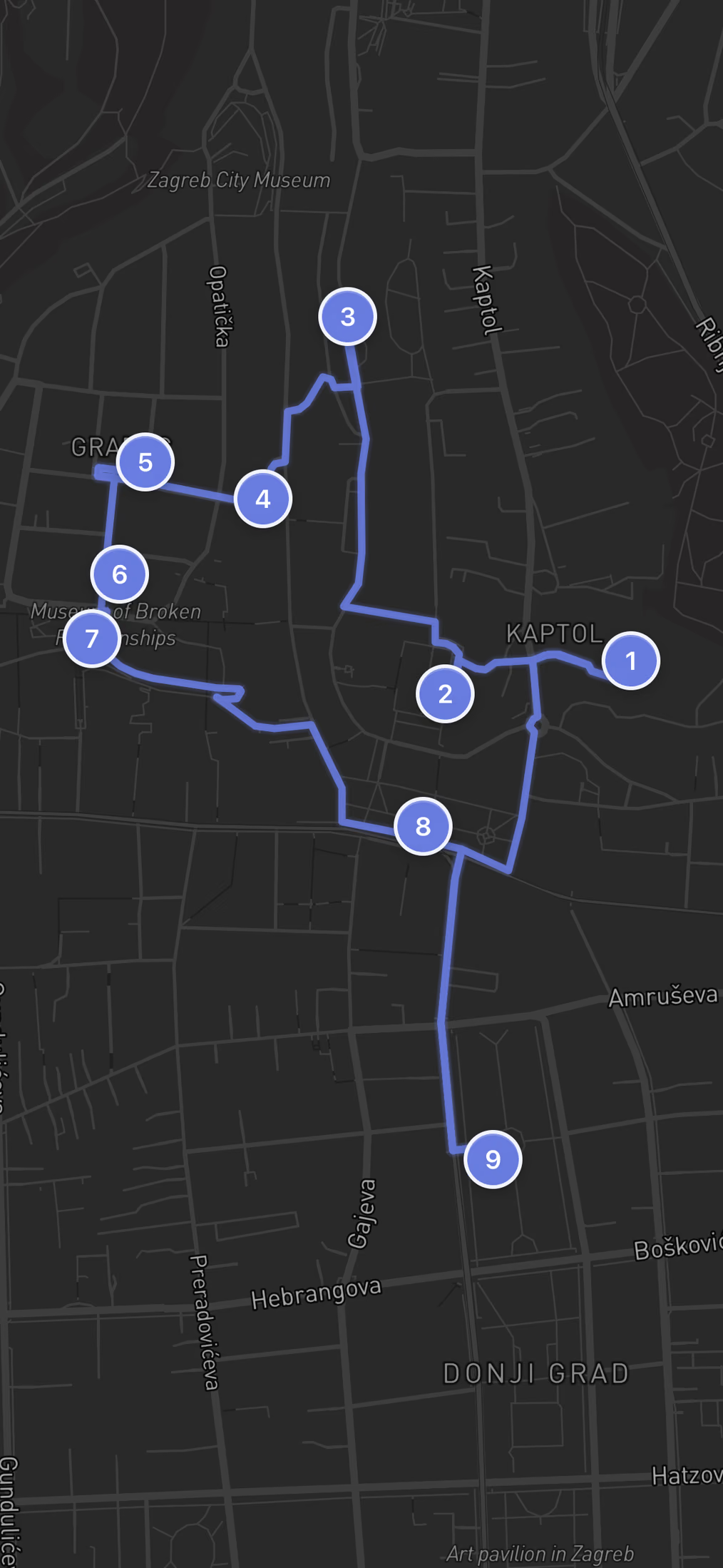
Route typeA point-to-point walk, not a loop. It heads north and uphill from the Cathedral into the Upper Town, then turns back south and downhill into the flat Lower Town, so you end well away from where you started with almost no backtracking.
Realistic timePure walking is under an hour across the 2.8 km. Add short outdoor stops and you are at 2 hours; with the market, the museum and a coffee break, plan on 3 to 4 hours or a relaxed half day.
DifficultyEasy overall at 2.8 km, but not entirely flat. The Lower Town is level, while the Upper Town section brings cobblestone lanes and worn stone steps that turn slippery in the wet, so wear proper shoes.
Cost to followThe walking route itself is free, and more than half the stops are open squares, streets and parks that cost nothing. The paid interiors are the Museum of Broken Relationships at 7 EUR and Lotrščak Tower at 3 EUR, both optional.
Best for:

Travellers who want the compact historic center of a European capital in one flexible walk, mixing a working food market, medieval Upper Town lanes, and leafy Lower Town promenades.

The Route

Free Walking Tour Map of Zagreb

9 stops2.8 kmabout 2 hours
Loading the interactive map…The complete walking route will appear here.
Want the route to guide you while you walk?Open the route with navigation and a personal guide for the history, stories and questions that matter to you.
Open route + AI guide

The 9 stops along this route

  1. Zagreb Cathedral (Zagrebačka katedrala) in Zagreb, stop 1 on the self-guided walking tour
    1Zagreb Cathedral (Zagrebačka katedrala)
  2. Dolac Market (Dolac) in Zagreb, stop 2 on the self-guided walking tour
    2Dolac Market (Dolac)
  3. Tkalčićeva Street (Tkalčićeva ulica) in Zagreb, stop 3 on the self-guided walking tour
    3Tkalčićeva Street (Tkalčićeva ulica)
  4. Stone Gate (Kamenita vrata) in Zagreb, stop 4 on the self-guided walking tour
    4Stone Gate (Kamenita vrata)
  5. St. Mark's Church (Crkva sv. Marka) in Zagreb, stop 5 on the self-guided walking tour
    5St. Mark's Church (Crkva sv. Marka)
  6. Museum of Broken Relationships (Muzej prekinutih veza) in Zagreb, stop 6 on the self-guided walking tour
    6Museum of Broken Relationships (Muzej prekinutih veza)
  7. Lotrščak Tower (Kula Lotrščak) in Zagreb, stop 7 on the self-guided walking tour
    7Lotrščak Tower (Kula Lotrščak)
  8. Ban Jelačić Square (Trg bana Jelačića) in Zagreb, stop 8 on the self-guided walking tour
    8Ban Jelačić Square (Trg bana Jelačića)
  9. Nikola Šubić Zrinski Square (Zrinjevac) in Zagreb, stop 9 on the self-guided walking tour
    9Nikola Šubić Zrinski Square (Zrinjevac)
  10. That's the complete route.

    If you want more than the map and text, add live navigation and a conversational AI guide while you walk.

    Open route + AI guide
    You made it
Stop 1 of 9
Swipe →

Your Zagreb Walking Tour, Stop by Stop

  1. 1

    Zagreb Cathedral (Zagrebačka katedrala)

    Zagreb Cathedral (Zagrebačka katedrala) in Zagreb, stop 1 on the self-guided walking tour

    The twin neo-Gothic spires used to reach 105 meters. The 2020 earthquake knocked the top off one, and scaffolding still wraps parts of the structure. The cathedral has been here in some form since the 11th century, though what you see now is mostly Hermann Bolle's 19th-century reconstruction after the devastating 1880 earthquake. The fortified walls surrounding the building are among the southernmost medieval fortifications in Europe, a reminder that this was once a frontier. Inside, the nave is tall and cool. The tomb of Cardinal Alojzije Stepinac, a controversial figure in Croatian history, sits behind the main altar. Entry is free. The exterior is more interesting than the interior right now, given the ongoing restoration work. Five minutes for the facade, 15 minutes if you go inside. Morning mass around 7:00 AM is the quietest time to see the interior without crowds. Walk west from the cathedral toward Dolac Market, visible from the square by its red parasols.

    Hours
    Daily: 8:00 AM – 7:00 PM
    Price
    Free
  2. 2

    Dolac Market (Dolac)

    Dolac Market (Dolac) in Zagreb, stop 2 on the self-guided walking tour

    You smell Dolac before you see it. The open-air market sits on a raised platform just north of Ban Jelacic Square, and it has been Zagreb's main food market since the 1930s. Red parasols cover the upper terrace where farmers sell seasonal fruit, vegetables, cheese, and honey. The covered lower level handles fish and meat. Come before noon. Vendors start packing up after that, and by early afternoon the energy fades. Saturday morning between 8:00 and 10:00 AM is the busiest and most colorful session. Grab a burek (flaky pastry with cheese or meat, about 2 to 3 EUR) from one of the bakeries lining the square below. Try the fresh cow's cheese (svjezi sir) or a warm strukli, a baked cheese pastry that is as Zagreb as it gets. The market is free to browse. Budget 20 to 30 minutes, more if you want to buy picnic supplies. A public toilet on the lower level costs about 0.50 EUR.

    Hours
    Always open
    Price
    Free (entry)
  3. 3

    Tkalčićeva Street (Tkalčićeva ulica)

    Tkalčićeva Street (Tkalčićeva ulica) in Zagreb, stop 3 on the self-guided walking tour

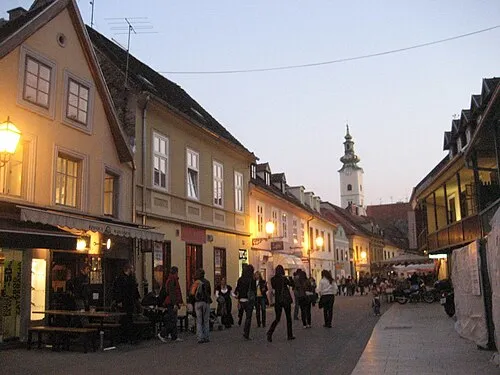
    This narrow pedestrian street runs between the Upper Town ridge and Nova Ves, following what used to be a stream separating the rival medieval settlements of Gradec and Kaptol. Today it is wall-to-wall cafes, bars, and small restaurants, and on any warm afternoon every table is full. The street runs roughly 600 meters. Prices are moderate for a capital city: an espresso costs about 1.50 to 2 EUR, a beer around 3 to 4 EUR. The northern end is quieter and has better food. Walk slowly and look up at the second-floor facades, many still have original 19th-century details. A bronze statue of Marija Juric Zagorka, Croatia's first female journalist, sits at a cafe table near the southern end. No entry fee, no hours. Budget 20 minutes to walk the full length. For local craft beer, look for Pivnica Mali Medo at the northern end, away from the tourist cluster. Then take the stairway east up Opaticka ulica toward the Stone Gate.

    Hours
    Always open
    Price
    Free
  4. 4

    Stone Gate (Kamenita vrata)

    Stone Gate (Kamenita vrata) in Zagreb, stop 4 on the self-guided walking tour

    The only surviving gate from the 13th-century fortifications of Gradec, the medieval Upper Town. The vaulted stone passage is narrow and dark, and as you walk through you will notice candles flickering in a small shrine on the right wall. A painting of the Virgin Mary and Child hangs behind an iron grille. According to local legend, a fire swept through the surrounding wooden buildings in 1731, but this painting survived completely intact. Locals have maintained candles and flowers at the shrine ever since, and people still come to pray throughout the day. The passage is free, open around the clock, and takes only a minute to walk through, but it is one of those places where the weight of centuries is palpable. The worn stone steps can get slippery when wet, so watch your footing. Continue through the gate into the Upper Town toward St. Mark's Church.

    Hours
    Open 24/7
    Price
    Free
  5. 5

    St. Mark's Church (Crkva sv. Marka)

    St. Mark's Church (Crkva sv. Marka) in Zagreb, stop 5 on the self-guided walking tour

    The colorful tiled roof is the icon of Zagreb. Two coats of arms are laid out in glazed tiles: the medieval Kingdom of Croatia, Dalmatia, and Slavonia on the left, and the City of Zagreb on the right. The tiles were added in 1880 by architect Hermann Bolle during his reconstruction campaign. The 13th-century portal below features 15 sculpted figures set into 11 niches, among the finest Gothic sculpture in Croatia. The church sits on St. Mark's Square, flanked by the Croatian Parliament on the east and the Ban's Palace (seat of government) on the west. The interior is usually closed to visitors except during services. The exterior and the square are the main attraction. Free and always accessible. For the best photo, stand on the south side of the square to capture the full tiled roof with both coats of arms. Morning light between 9:00 and 11:00 AM hits the roof directly and makes the colors pop. Budget 10 minutes.

    Hours
    Mon: Closed | Tue: 9:00 AM – 12:00 PM | Wed: 4:30 – 5:30 AM, 9:00 AM – 12:00 PM | Thu: 9:00 AM – 12:00 PM | Fri: 4:30 – 5:30 AM, 9:00 AM – 12:00 PM | Sat-Sun: Closed
    Price
    Free
  6. 6

    Museum of Broken Relationships (Muzej prekinutih veza)

    Museum of Broken Relationships (Muzej prekinutih veza) in Zagreb, stop 6 on the self-guided walking tour

    This one is unlike any museum you have visited. Every object on display was donated by a real person after a breakup, a family split, or a lost friendship. An axe someone used to chop their ex's furniture. A wedding dress never worn. Each item has a handwritten card explaining the story. The European Museum Forum awarded it the Kenneth Hudson Prize for most innovative museum in Europe in 2011. Founded by two Croatian artists after their own breakup, the museum opened in a permanent location in Zagreb's Upper Town in 2010. Open daily 9:00 AM to 9:00 PM, which makes it easy to fit in. Admission is 7 EUR. The space is small, two floors in a baroque palace on Cirilometodska, so 30 to 40 minutes is enough. It can get crowded midday in summer. Early morning or after 5:00 PM is better. You will laugh at some entries, wince at others, and leave feeling oddly grateful. The gift shop sells "bad memories eraser" pencils.

    Hours
    Daily: 9:00 AM – 9:00 PM
    Price
    7 EUR
  7. 7

    Lotrščak Tower (Kula Lotrščak)

    Lotrščak Tower (Kula Lotrščak) in Zagreb, stop 7 on the self-guided walking tour

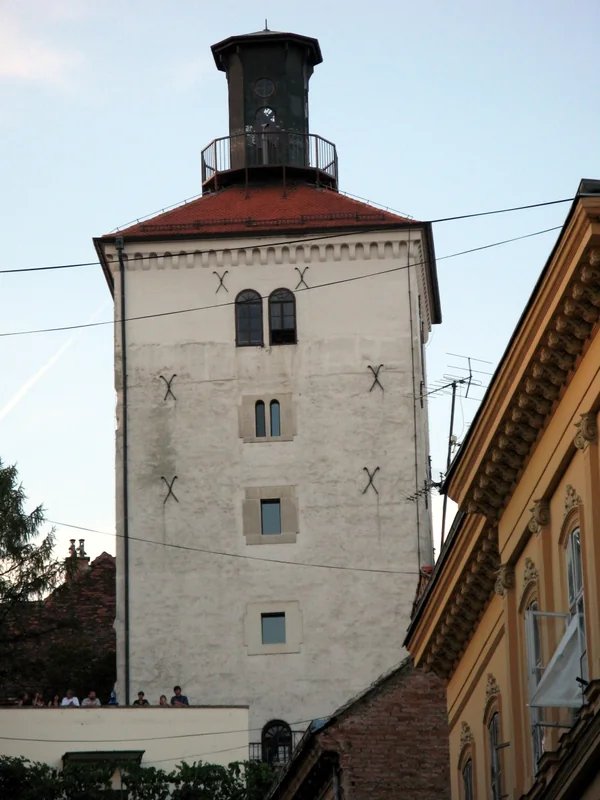
    This 13th-century defensive tower has fired the Gric cannon at exactly noon every day since 1877, originally to synchronize all the church bells in the city. The blast is loud enough to startle anyone standing on the observation platform who did not know it was coming. Arrive a few minutes before noon if you want to witness the daily firing. Visitors can climb the narrow staircase to the top for panoramic views over the Lower Town, the cathedral spires, and the green horseshoe of parks stretching south. The funicular railway connecting the Upper and Lower Towns runs right next to the tower, a 55-second ride for about 0.70 EUR. If your legs need a break, take the funicular down instead of walking the steep path. Budget 15 minutes, more if you time it for the cannon.

    Hours
    Mon: Closed | Tue-Fri: 9:00 AM – 7:00 PM | Sat-Sun: 11:00 AM – 7:00 PM
    Price
    3 EUR
    Website
    gkd.hr ↗
  8. 8

    Ban Jelačić Square (Trg bana Jelačića)

    Ban Jelačić Square (Trg bana Jelačića) in Zagreb, stop 8 on the self-guided walking tour

    This is the center of everything in Zagreb. Every tram line passes through or near it, and every local uses it as a meeting point. The equestrian statue of Ban Josip Jelacic faces south in the middle of the square. The bronze was erected in 1866, removed by the communist government in 1947, stored in pieces for 43 years, and restored in 1990. The Manduševac fountain on the north side marks the spot where, according to legend, a thirsty ban asked a girl named Manda to scoop (zagrabiti) water, giving the city its name. This is not a stop where you linger for an hour. Walk through, take in the energy, grab cash from an ATM if needed. Croatia has used the euro since January 2023, and card payments are accepted almost everywhere, including market stalls. Five to ten minutes. Then head south toward Zrinjevac Park.

    Hours
    Always open
    Price
    Free
  9. 9

    Nikola Šubić Zrinski Square (Zrinjevac)

    Nikola Šubić Zrinski Square (Zrinjevac) in Zagreb, stop 9 on the self-guided walking tour

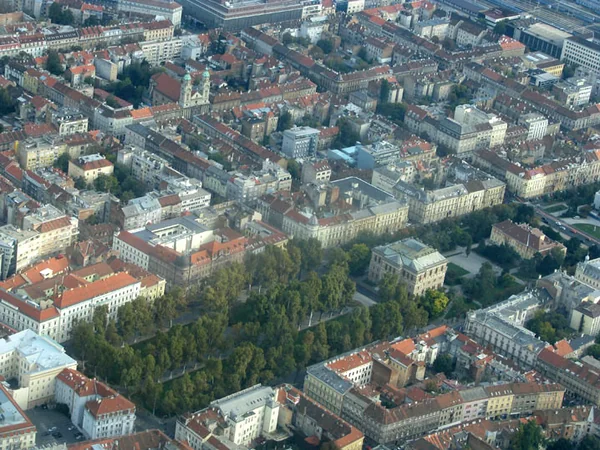
    Step south from Ban Jelacic Square and you are under Zrinjevac's double row of plane trees. This is the oldest and most atmospheric of the seven parks forming the Lenuci Horseshoe, a U-shaped chain of green spaces that 19th-century city planner Milan Lenuci designed to give Zagreb the feel of Vienna or Budapest. Built in 1892 across 12,540 square meters, the park holds a meteorological column from 1884 that still records data, a wrought-iron music pavilion from 1891 that hosts summer concerts, and bronze busts of Croatian historical figures along the southern walkway. Free and open around the clock. In December, the park fills with the Advent market, voted one of the best Christmas markets in Europe multiple years running. On a normal day, 10 to 15 minutes of strolling takes you from one end to the other. This is a good place to end the walk, sitting on a bench under the trees with a coffee from one of the kiosks along the edge.

    Hours
    Open 24/7
    Price
    Free

How Long Does This Walking Tour Really Take?

Across 2.8 km and 9 stops, the walking alone runs under an hour. With brief stops at each sight you land near 2 hours, and once you factor in Dolac Market, the Museum of Broken Relationships and a coffee somewhere along the way, the natural window is 3 to 4 hours, easily a half day with lunch.

The route covers about 2.8 kilometers and 9 stops. Pure walking time is under an hour. At a relaxed pace with time at each stop, plan for roughly 3 to 4 hours. It fits easily into a half day with time left for a proper lunch.

The stops that deserve the most time are the Museum of Broken Relationships (30 to 40 minutes, genuinely unique, do not rush it), Dolac Market (20 to 30 minutes, best before noon), and Lotrscak Tower (15 minutes, time it for the noon cannon if possible). For a coffee break, Tkalciceva Street has dozens of options. Cogito Coffee on Varsavska ulica, a short detour from Zrinjevac, makes some of the best espresso in the city for about 2 EUR. For lunch, Pingvin on Tkalciceva is a standing-room sandwich shop that has been there for decades. A filled sandwich costs 3 to 5 EUR and is large enough for a full meal. Order the one with kulen, a spicy Slavonian sausage.

Full Route, Shorter Walk or Two-Day Version?

The full walk is short and central, so most people do all of it. But the stops fall into a natural order, which makes it easy to trim or split if your day is tight or you are travelling with people who tire quickly.

The Short Version

The Upper Town core, under 2 hours

Stops 1 to 7, about 1.5 km on foot, 1.5 to 2 hours

Keep everything from the Cathedral up to Lotrščak Tower and stop there. This drops the two longer southern legs, the 440 m to Ban Jelačić Square and the 370 m on to Zrinjevac, and delivers the medieval Upper Town, the market and the best viewpoint in the most compact form.

The Easy Split

Two half-days at a natural break

Day one stops 1 to 5, day two stops 6 to 9

Split the walk at St. Mark's Church. Do the Cathedral, Dolac Market, Tkalčićeva and the Stone Gate on one morning, then return another day for the museum, Lotrščak Tower's noon cannon, Ban Jelačić Square and Zrinjevac Park. Ideal with kids or in summer heat, since each half stays under a kilometre and a half.

You can walk it in reverse, starting flat at Zrinjevac Park and climbing to the Cathedral. We recommend the given direction because it puts you at Dolac Market in the busy morning hours, saves the leafy Lower Town parks for a restful finish, and lets gravity work with you as you come down from the Upper Town rather than against you.

Is This Zagreb Walking Tour Right for You?

This is a short, mostly gentle route through a compact city center, but the Upper Town section adds a little climbing and some uneven footing. Here is who it suits and how to adjust it.

A good fit if you…

  • First-time visitors who want Zagreb's essential sights in one logical 2.8 km line
  • Walkers who like mixing a working food market with medieval lanes and city parks
  • Budget travellers, since the route is free to follow and only two interiors cost money
  • Anyone who prefers setting their own pace over joining a fixed-schedule group tour

Adapt the route if you…

  • You have limited time: cut it at Lotrščak Tower and keep the tight Upper Town core
  • You struggle with steps: take the funicular by Lotrščak Tower instead of the steep path
  • You are travelling with children or in the heat: split the walk into two half-days at St. Mark's Church
  • You want the noon cannon: time your arrival at Lotrščak Tower for just before 12:00

Tickets & Skip-the-Line in Zagreb

Most of this route is free outdoor walking, so there are almost no tickets to buy and no lines to skip.

Museum of Broken Relationships (Muzej prekinutih veza)The only real paid stop. Admission is 7 EUR, open daily 9:00 AM to 9:00 PM. It gets crowded midday in summer, so go early or after 5:00 PM.
Lotrščak Tower (Kula Lotrščak)Climbing the tower costs 3 EUR. Open Tuesday to Friday 9:00 AM to 7:00 PM and Saturday to Sunday 11:00 AM to 7:00 PM, closed Mondays. Time it for just before noon to catch the Gric cannon firing.
Funicular (optional)Not a stop, but the 55-second funicular ride beside Lotrščak Tower costs about 0.70 EUR if you want to skip the climb between Upper and Lower Town.
Everything else is freeZagreb Cathedral, Dolac Market, Tkalčićeva Street, the Stone Gate, St. Mark's Church, Ban Jelačić Square and Zrinjevac Park are all free to enter or walk through, most of them open around the clock.
Optional upgrade
+5
The same 9-stop route,
now with navigation and a guide.
Optional AI experience

You already have the route.
The AI guide brings it to life.

Standing on Tkalčićeva right now, trying to figure out where the Stone Gate is? Open AI Tourguide in your browser, no app and no download, and a voice guide walks the whole route with you: it greets you, tells the story from the cathedral spires down through Dolac Market to the Upper Town, asks what you want to see, and remembers your answers as it leads you on. A real conversation built into the walk, not a recording. Start with 100 free credits.

Livenavigation13languagesAnyquestionYourinterests
Open this route with the AI guide

Try it in your browser · No app or download required

Tips for Walking in Zagreb

  • Start at Zagreb Cathedral by 9:00 AM and head straight to Dolac Market while the vendors are still fully stocked. By noon the produce sellers start packing up and the energy fades. Saturday morning is the best market day.
  • Zagreb's Lower Town is flat, but the Upper Town involves cobblestone streets and worn stone steps that get slippery when wet. Wear proper walking shoes, not sandals. The funicular next to Lotrscak Tower saves you the climb between Upper and Lower Town for 0.70 EUR.
  • Public restrooms are scarce. Use the ones in the Museum of Broken Relationships (included with your ticket). Dolac Market has a public toilet on the lower level for about 0.50 EUR. McDonald's on Ilica Street near Ban Jelacic Square is the reliable backup.
  • For lunch, stop at Pingvin on Tkalciceva Street. It is a standing-room sandwich shop that has been there for decades. A filled sandwich costs 3 to 5 EUR and is large enough for a meal. Order the one with kulen, a spicy Slavonian sausage. For a proper sit-down meal, the northern end of Tkalciceva has better restaurants and lower prices than the southern end.
  • The best photo on this route is St. Mark's Church, shot from the south side of the square to capture the full tiled roof with the two coats of arms. Morning light between 9:00 and 11:00 AM hits the roof directly and makes the colors pop. For a panoramic city shot, climb Lotrscak Tower.

Where to Eat Along the Route

Zagreb's best cooking is not on the restaurant strips right around Ban Jelačić Square and the cathedral, where photo menus and staff waving you in usually signal inflated prices and no locals inside. Walk a street or two off the main sightseeing zone and the food gets better and cheaper.

  • Tkalčićeva Street is the real social spine, packed with terraces and restaurants for both locals and visitors. The quieter northern end has the better food and lower prices than the busy southern cluster.
  • Around Dolac Market and Pod Zidom, market-driven kitchens cook with produce from the stalls next door, so this is the freshest, most seasonal eating near the route.
  • The Upper Town (Gornji Grad) hides traditional taverns near St. Mark's Church that still feel authentic rather than staged for tourists.
  • For a bigger detour, working-class Tresnjevka west of the center and the streets around Petrinjska and Vlaška are where locals actually eat, well away from the sightseeing crowds.
La Struk⌖A one-dish spot on Skalinska 5 that does nothing but štrukli, Zagreb's signature cheese pastry, savory or sweet, for around 10 to 12 EUR. Each order is made fresh in 20 to 25 minutes, so do not arrive starving, and note it takes no reservations, so plan for a wait.
Pod Zidom Bistro⌖A seasonal, market-driven bistro steps from Dolac Market with a plant-lined terrace facing the cathedral. Michelin-listed and more refined, so book ahead for dinner.
Gostionica Ficlek⌖Home-style Croatian cooking tucked under Dolac Market next to Pod Zidom, informal high tables inside and a patio with cathedral views. Budget roughly 20 to 30 EUR per person with a drink.
Konoba Didov San⌖A traditional Dalmatian Zagora tavern on Mletacka 11 in the Upper Town near St. Mark's Church, cozy old-Croatia decor and a menu of grilled specialties. Popular with tourists but locals eat here too.

Steer clear of the generic restaurants right on Ban Jelačić Square and around the cathedral that show photos of every dish and station staff on the street to pull you in, and check the bill for padded extras or charged bread and water.

Tourist Traps to Avoid in Zagreb

Zagreb is one of Central Europe's safer capitals, so the real traps here are money and planning mistakes rather than violent crime.

  • Validate your tram ticket the moment you board. Fines are steep and inspectors do check, and "I didn't know" is not accepted as an excuse.
  • Withdraw euros from a reputable bank ATM. Airport counters and tourist-area exchange offices give poor rates and tack on hidden fees.
  • Skip the restaurants near the main square that show photos of every dish and have staff pulling people in from the street, and walk a block or two away for better quality and honest prices.
  • Check the bill before you pay. Some places quietly charge for "complimentary" bread or water or add extra items that never reached your table.
  • Use ride apps like Uber or Bolt instead of flagging a taxi, since some drivers take long routes, claim a broken meter or quote a higher tourist price.
  • Avoid Zagreb's strip clubs entirely. They are notorious for grossly overcharging drinks and sending bouncers to intimidate anyone who disputes the bill.

Why Walk This Route?

Zagreb is a city that keeps changing under your feet as you walk. You start at the twin spires of the cathedral, drop into a noisy open-air market, thread through a cafe-lined pedestrian street, climb through a medieval gate into the Upper Town's cobblestone lanes, then descend to the wide squares and promenades of the Lower Town. Few European capitals pack this much variety into such a compact area. The entire historic center fits inside about two square kilometers, and tram lines fill the gaps when your legs need a rest.

This route connects 9 stops across 2.8 kilometers, moving from the cathedral through the Upper and Lower Towns in a logical sequence. You hit the outdoor market while it is still busy in the morning, reach the Upper Town sights during the quieter midday hours, and finish at the parks and squares that stay open into the evening. The whole walk fits comfortably into about 2 hours at a brisk pace, or you can stretch it into a half day with longer stops at the museum and cafes along the way.

Common Questions

Is Zagreb safe to walk around?

Zagreb is one of the safer European capitals for walking. Violent crime against tourists is extremely rare. Petty pickpocketing happens occasionally on crowded trams and at Dolac Market, so keep your phone and wallet in a front pocket in those spots. The area around the main train station (Glavni kolodvor) can feel rough after dark with some panhandling, but it is not dangerous. At night, stick to lit streets in the center and you will have no issues.

What if it rains during my Zagreb tour?

Zagreb gets rain year-round, so have a plan. The Museum of Broken Relationships fills 30 to 40 minutes indoors. The Stone Gate passage and the churches provide brief shelter. If rain hits while you are in the Lower Town, duck into one of the cafes on Tkalciceva or the Oktogon passage off Ilica Street, a covered shopping arcade that makes a good shelter. Zrinjevac Park is no fun in heavy rain, so save it for a dry window.

What's the best time of day for this walking tour?

Start between 8:30 and 9:00 AM. This gets you to Dolac Market before noon when it is liveliest, and through the Upper Town sights before the afternoon crowds. Time your arrival at Lotrscak Tower for just before noon to hear the cannon fire. Summer evenings are long in Zagreb, with light until 9:00 PM, so you have plenty of buffer if you start late. In December, the Advent markets along Zrinjevac Park make an evening visit worth the cold.

Take this route with you

Open this exact tour with navigation and your personal AI guide.

Start GPS Navigation + AI Guide
AI Tourguide
Researched and curated by the AI Tourguide teamWe plan and quality-check every route, then research and verify the opening hours, prices, and practical tips for each stop along it.
▶ Open route with AI guideNavigation, stories and your questions