Self-Guided Walking Tour in Berlin

13 Stops 9.5 km ~3.9 hours
Start This Tour Free
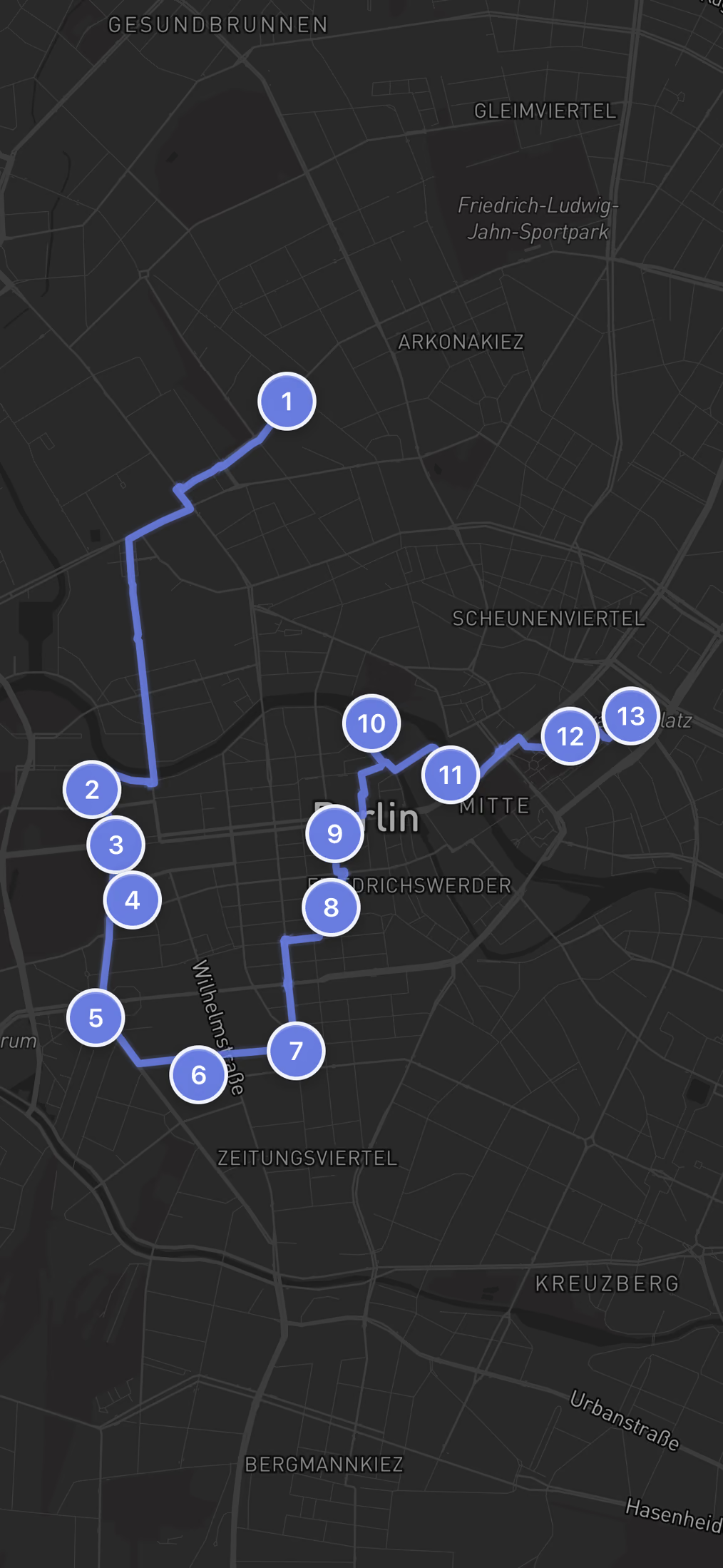
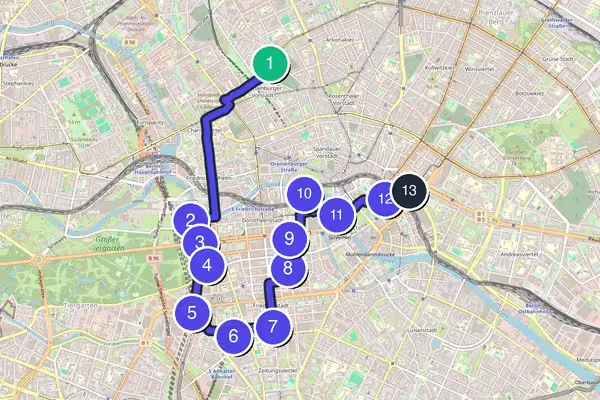
Walking tour route map of Berlin
Start This Tour Free

Why Walk Berlin? A Self-Guided Tour

Berlin's history is written in concrete, bullet holes, and empty spaces where buildings used to stand. This 9.5-kilometer walking tour connects 13 stops over roughly 4 hours of walking, tracing the city from Cold War division to reunification. The route starts at the Berlin Wall Memorial on Bernauer Strasse, cuts through the government quarter and Brandenburg Gate, passes the Holocaust memorial and Checkpoint Charlie, crosses Gendarmenmarkt and Museum Island, and finishes at Alexanderplatz beneath the TV Tower.

The sequence follows a rough chronological arc. You begin with the Wall, move through the Nazi-era and Cold War sites in the center, then arrive at the Prussian splendor of Museum Island before ending in the former East Berlin showpiece of Alexanderplatz. Each stop adds a layer. By the time you stand beneath the TV Tower at the finish, the city's habit of destroying and rebuilding itself makes more sense than it did at the start.

The Route: 13 Stops

Swipe through images or scroll names below

Scroll to explore →
1. Berlin Wall Memorial
2. Reichstag Building
3. Brandenburg Gate
4. Memorial to the Murdered Jews of Europe
5. Potsdamer Platz
6. Topography of Terror
7. Checkpoint Charlie
8. Gendarmenmarkt
9. Bebelplatz
10. Museum Island
11. Berlin Cathedral
12. Berlin TV Tower
13. Alexanderplatz

Route Map

Tap to load interactive map
AI Tourguide
Walk this exact route with a private AI guide.
Full GPS navigation, interactive stories, and a guide that answers all your questions. A private guide experience for just €5/hour.
Start This Tour

Your Berlin Walking Tour, Stop by Stop

  1. 1

    Berlin Wall Memorial

    Berlin Wall Memorial

    The memorial preserves a 1.4-kilometer section of the former border strip along Bernauer Strasse, including the death strip with an original watchtower, patrol road, and two parallel walls. This is the most complete picture of what the divided city actually looked like. The Documentation Center across the street provides photographs, videos, and personal testimonies. An observation platform looks down on the preserved section, showing the full width of the border fortifications. The Window of Remembrance displays portraits of the 140 people who died trying to cross at this location. Free entry, open daily 8:00 AM to 10:00 PM. Start at the Documentation Center for context, then walk the full memorial strip south. The Chapel of Reconciliation stands on the site of a church demolished by East German authorities in 1985 because it blocked border patrol sightlines.

    Learn more about Berlin Wall Memorial →
    Hours
    Daily: 8:00 AM – 10:00 PM
    Price
    Free

    18 min walk to next stop

  2. 2

    Reichstag Building

    Reichstag Building

    The Reichstag houses Germany's parliament, the Bundestag, and draws nearly three million visitors per year, making it the most visited parliamentary building in the world. Built between 1884 and 1894, it was gutted by fire in 1933 and stood largely unused through the Nazi era and German division. After reunification, Norman Foster redesigned the interior and added the glass dome that now crowns the structure. The dome rises 23.5 meters and contains a spiral walkway with a mirrored cone at the center that directs natural light into the parliamentary chamber below. The rooftop terrace offers views across the Tiergarten. Free entry with advance online booking, required at least two weeks ahead. If slots are full, try the visitor center across the street after 8:00 AM for same-day tickets. The interior walls still bear Cyrillic graffiti left by Soviet soldiers in 1945.

    Learn more about Reichstag Building →
    Hours
    Daily: 8:00 AM – 12:00 AM
    Price
    Free (Dome visit, advance booking required)

    5 min walk to next stop

  3. 3

    Brandenburg Gate

    Brandenburg Gate

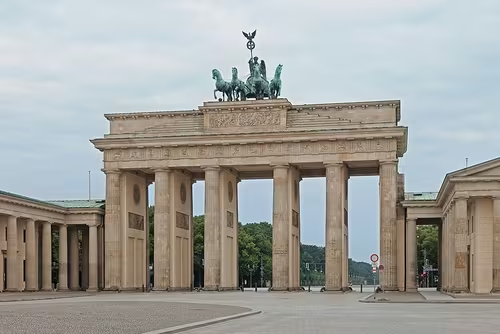
    The 26-meter neoclassical gate, built between 1789 and 1793, is the only surviving city gate of the eighteen that once encircled Berlin. Twelve Doric columns form five passageways, with the central one originally reserved for royal carriages. The Quadriga bronze chariot on top depicts Victoria driving four horses. Napoleon stole it after conquering Berlin in 1806 and displayed it in Paris until Prussian troops reclaimed it in 1814. During the Cold War, the gate sat in no-man's land between East and West, inaccessible to both sides. When the Wall fell in 1989, thousands gathered here. The sandstone surface still bears World War II bullet scars if you look closely. Free and accessible 24 hours. The Pariser Platz in front fills with tour groups by 9:00 AM. Visit at sunrise when the gate faces east and catches golden light on its columns.

    Learn more about Brandenburg Gate →
    Hours
    Daily: 24 Hours (accessible anytime)
    Price
    Free

    3 min walk to next stop

  4. 4

    Memorial to the Murdered Jews of Europe

    Memorial to the Murdered Jews of Europe

    The memorial covers 19,000 square meters near the Brandenburg Gate: 2,711 concrete slabs arranged in a grid on sloping ground. Architect Peter Eisenman designed it without explicit symbolism. The blocks, called stelae, range from 20 centimeters to 4.7 meters tall. Walking among them creates a disorienting effect as the ground dips and the blocks rise, cutting off sightlines and muffling city noise. An underground Information Center documents the Holocaust through personal stories, photographs, and names of the approximately six million victims. Free entry, open 24 hours above ground. Walk deep into the center where the blocks rise highest and the city disappears. The Information Center below adds essential context to the abstract experience above. The memorial sits on the former site of the Nazi propaganda ministry.

    Learn more about Memorial to the Murdered Jews of Europe →
    Hours
    Open 24/7
    Price
    Free

    5 min walk to next stop

  5. 5

    Potsdamer Platz

    Potsdamer Platz

    Before World War II, this was Europe's busiest traffic intersection, home to the continent's first traffic light. The Berlin Wall ran directly through the square from 1961 to 1989, leaving it as a wasteland. After reunification, architects including Renzo Piano, Helmut Jahn, and Richard Rogers built the current glass-and-steel complex. The Sony Center's 4,000-square-meter canopy covers a public plaza. Sections of the Wall remain embedded in the pavement, marked with brass strips showing where the border stood. Free and open 24 hours. The Panoramapunkt viewing platform in the Kollhoff Tower offers views from 100 meters up and has the fastest elevator in Europe. The area feels more commercial than historic, but the contrast between photographs from the 1930s, 1960s, and today makes the transformation tangible.

    Learn more about Potsdamer Platz →
    Hours
    Open 24/7
    Price
    Free

    8 min walk to next stop

  6. 6

    Topography of Terror

    Topography of Terror

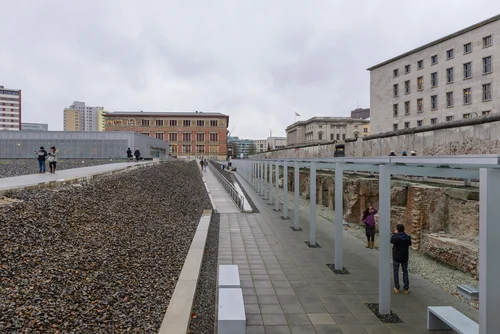
    This documentation center occupies the former site of the Gestapo and SS headquarters where the Nazi regime's terror apparatus was coordinated from 1933 to 1945. A 200-meter segment of the Berlin Wall still stands along the property's south edge, one of the last original sections in central Berlin. The exhibition inside traces the rise of the Nazi party, the mechanics of persecution, and the scale of crimes committed from this location. The outdoor exhibition along the excavated foundations of the former basement cells shows the physical remains of the building. Free entry, open daily 10:00 AM to 8:00 PM. The material is dense and emotionally heavy. Budget at least 45 minutes. The contrast between the mundane office architecture and the crimes organized here is the point.

    Learn more about Topography of Terror →
    Hours
    Daily: 10:00 AM – 8:00 PM
    Price
    Free

    5 min walk to next stop

  7. 7

    Checkpoint Charlie

    Checkpoint Charlie

    The most famous border crossing between East and West Berlin sat at the intersection of Friedrichstrasse, Zimmerstrasse, and Kochstrasse. Established in August 1961, it allowed Allied military personnel and foreigners to pass between sectors. The 1961 tank standoff between American and Soviet forces and the 1962 shooting of Peter Fechter happened here. Today, a replica guardhouse and sandbags mark the site. Free to view at any hour. The Mauermuseum nearby documents escape attempts with homemade hot-air balloons, hidden car compartments, and tunnels dug beneath the Wall. Museum admission is around 15 euros. The area is heavily commercialized. Skip the paid photo with the costumed actors. The information panels on the surrounding streets are more informative and cost nothing.

    Learn more about Checkpoint Charlie →
    Hours
    Open 24/7
    Price
    Free (to view), €15 (Museum)

    7 min walk to next stop

  8. 8

    Gendarmenmarkt

    Gendarmenmarkt

    Berlin's most elegant square is framed by three matching buildings: the German Cathedral, the French Cathedral, and the Konzerthaus concert hall. The square dates to 1688, built for a regiment of French Huguenot refugees who brought their military unit to Berlin. Both cathedrals have identical domes, built in the early 1700s. The Konzerthaus, designed by Karl Friedrich Schinkel in 1821, replaced the National Theatre where Schiller's plays premiered. The square was heavily damaged in World War II and reconstructed between 1976 and 1993. Free and accessible 24 hours. In December, the Christmas market fills the square with craft stalls and Gluhwein. Visit in late afternoon when the setting sun lights the cathedral facades. Both towers have elevator access to viewing platforms.

    Learn more about Gendarmenmarkt →
    Hours
    Daily: 24 Hours (accessible anytime)
    Price
    Free

    4 min walk to next stop

  9. 9

    Bebelplatz

    Bebelplatz

    On May 10, 1933, Nazi students burned over 20,000 books on this square. The event is now marked by Micha Ullman's underground memorial: a glass panel set into the cobblestones, revealing a subterranean room of empty white bookshelves with capacity for exactly 20,000 volumes. The memorial is subtle and easy to miss during the day. It is more visible after dark when internal lights illuminate the empty shelves. The square sits between the Humboldt University and the State Opera House. Free and accessible at any hour. Crouch down over the glass panel for the best view of the shelves below. The surrounding architecture is some of the most formal on Unter den Linden, which makes the quiet memorial in the pavement more striking by contrast.

    Learn more about Bebelplatz →
    Hours
    Check locally
    Price
    Free

    5 min walk to next stop

  10. 10

    Museum Island

    Museum Island

    Five world-class museums sit on an island in the Spree River, a UNESCO World Heritage ensemble spanning 6,000 years of human history. The Pergamon Museum holds the Ishtar Gate of Babylon. The Neues Museum has the 3,300-year-old bust of Nefertiti. The Alte Nationalgalerie focuses on 19th-century painting. The Bode Museum covers Byzantine art. The Altes Museum displays classical Greek and Roman antiquities. The James-Simon Gallery, opened in 2019, is the modern entrance. Note: the Pergamon Altar section is closed for renovation until 2027, but the museum remains partially open. A combined day ticket covers all five museums. Free entry to the grounds and exterior. Seeing everything properly takes multiple days, but even a 90-minute visit to one museum is worthwhile. Start at the James-Simon Gallery for a map and combined ticket.

    Learn more about Museum Island →
    Hours
    Museums typically 10:00 AM – 6:00 PM
    Price
    Free

    3 min walk to next stop

  11. 11

    Berlin Cathedral

    Berlin Cathedral

    The cathedral dominates the northern end of Museum Island with its green copper dome rising 98 meters above the Spree. Built between 1894 and 1905 under Emperor Wilhelm II, it is Germany's largest Protestant church. The Hohenzollern Crypt beneath the main floor holds over 90 sarcophagi of the Prussian royal family. The interior has mosaics, stained glass, and a pipe organ with 7,269 pipes. Admission is 7 euros. Climbing 270 steps leads to the dome walkway with views across Museum Island and the city center. Sunday services feature organ concerts. The dome climb closes 30 minutes before the cathedral. Visit on a Sunday morning to hear the organ, then explore when tourist crowds thin after lunch. The exterior is worth photographing from the Lustgarten park across the street.

    Learn more about Berlin Cathedral →
    Hours
    Mon-Fri: 9:00 AM – 6:00 PM | Sat: 9:00 AM – 5:00 PM | Sun: 12:00 – 5:00 PM
    Price
    €7

    4 min walk to next stop

  12. 12

    Berlin TV Tower

    Berlin TV Tower

    The tallest structure in Germany rises 368 meters from Alexanderplatz, built between 1965 and 1969 by the East German government as a statement of engineering. The sphere at 203 meters contains an observation deck and a revolving restaurant that completes a full rotation every 30 minutes. On clear days, visibility reaches 42 kilometers. Locals call the sphere the Pope's Revenge because sunlight reflecting off the steel creates a cross-shaped glow, a persistent embarrassment for the officially atheist East German state. Free to view from the outside. Lines for the elevator can stretch for hours in summer. Buy tickets online to skip the main queue. Visit just before sunset when the city lights switch on while daylight remains.

    Learn more about Berlin TV Tower →
    Hours
    Daily: 10:00 AM – 11:00 PM
    Price
    Free

    3 min walk to next stop

  13. 13

    Alexanderplatz

    Alexanderplatz

    Berlin's busiest transit hub handles over 360,000 pedestrians daily. The square was named in 1805 after Tsar Alexander I and took its current form in the 1960s when East German planners transformed it into a socialist showpiece. The World Time Clock, a ten-meter installation from 1969, displays the current time in 148 cities. During the 1989 peaceful revolution, over half a million people gathered here to demand the opening of the Berlin Wall. The square hosts a Christmas market in December and political demonstrations year-round. Underground, the U-Bahn and S-Bahn connect to every part of the city. Free and accessible 24 hours. The Neptune Fountain and Marienkirche behind the TV Tower offer more character than the square itself. This is the right place to end the walk: every major transit line passes through here.

    Learn more about Alexanderplatz →
    Hours
    Open 24/7
    Price
    Free
AI Tourguide
Walk this exact route with a private AI guide.
Full GPS navigation, interactive stories, and a guide that answers all your questions. A private guide experience for just €5/hour.
Start This Tour

Self-Guided Tour vs. Group Tour in Berlin

A self-guided walking tour of Berlin is the best way to understand how the city's layers connect. Guided group tours cost 15 to 25 euros per person and typically focus on either the Wall sites or Museum Island, rarely both. This route covers the full arc from Cold War division through reunification in a single walk. You control the pace, which matters because some stops (the Holocaust memorial, Topography of Terror) deserve silence and time, while others (Checkpoint Charlie, Potsdamer Platz) are quick visual stops.

Berlin is one of the cheapest major capitals in Western Europe for eating and drinking. A doner kebab costs 5 to 7 euros, a coffee 3 euros, and many of the most significant sites on this route are free: the Wall Memorial, Brandenburg Gate, Holocaust memorial, Topography of Terror, Bebelplatz, Gendarmenmarkt, and Alexanderplatz all cost nothing. The money you save on a guide pays for a museum ticket on Museum Island and a meal. Public transport fills any gaps: the S-Bahn and U-Bahn run frequently and connect to every stop on this route.

Group Tour AI Self-Guided
Price €25–€50 per person €5/hour or €20 all-inclusive
Flexibility Fixed schedule Start anytime, skip stops
Languages 1–2 languages 11 languages
Pace Group pace Your own pace

How Long Does This Berlin Tour Take?

Our route covers 9.5 km with 13 stops and takes approximately 3.9 hours at a relaxed pace.

This 9.5-kilometer route takes about 4 hours of walking time. Plan for a full day, 7 to 8 hours, if you enter museums, climb the Reichstag dome, and sit down for meals. The Topography of Terror and Museum Island require the most time: budget at least 45 minutes for the Topography exhibition and 90 minutes if you enter one museum on the island. The Reichstag dome visit takes 30 to 45 minutes plus security screening.

Take your main break at Gendarmenmarkt, roughly two-thirds through the route. The restaurants around the square are pricier than average Berlin, but the setting is worth it. For a budget option, grab a currywurst or doner kebab from one of the stands near Checkpoint Charlie. The route is entirely flat. Wear comfortable shoes for the distance, not the terrain. The cobblestones around Museum Island and Gendarmenmarkt are uneven in spots.

Tips for Walking in Berlin

AI Tourguide
Walk this exact route with a private AI guide.
Full GPS navigation, interactive stories, and a guide that answers all your questions. A private guide experience for just €5/hour.
Start This Tour

AI Audio Guide for This Tour

Standing at the Brandenburg Gate? Open this walking tour in the app. GPS tracking keeps you on the right streets through the memorial district and across to Museum Island without stopping to check a map at every intersection.

AI Audio Guide Stories, history and fun facts narrated as you walk. No earpiece rental needed.
GPS Navigation Turn-by-turn directions so you never get lost between stops.
Ask Anything Curious about a building you pass? Ask your AI guide on the spot.
11 Languages Switch language anytime. No separate tour needed.
Start This Tour Free

Common Questions

The 9.5 kilometers are manageable for most people on flat ground. If 13 stops feels like too many, split the tour at Gendarmenmarkt. Do the Wall Memorial through Checkpoint Charlie in the morning and Museum Island through Alexanderplatz in the afternoon.
Wednesday through Saturday. Several museums on Museum Island close on Mondays. The Topography of Terror is open daily. Avoid starting on Sunday if you want to enter the Berlin Cathedral, which opens at noon.
Yes. The entire route follows well-trafficked central streets. Standard urban precautions apply at Alexanderplatz and around Checkpoint Charlie, where pickpockets target distracted tourists. Keep valuables in front pockets in crowded areas.
No booking needed. This self-guided tour is available anytime. Open the route on your phone and start walking. The AI audio guide works instantly, no reservation required.
The AI audio guide is available in 11 languages: English, German, French, Spanish, Italian, Japanese, Chinese, Portuguese, Danish, Norwegian, and Swedish.
Yes. Skip any stop, spend extra time at places you like, or start the route from any point. You can also ask the AI to suggest a shorter route.
AI Tourguide
Curated by AI Tourguide GPS-verified routes, reviewed and updated regularly.
Last verified March 2026