Self-Guided Walking Tour in Bologna

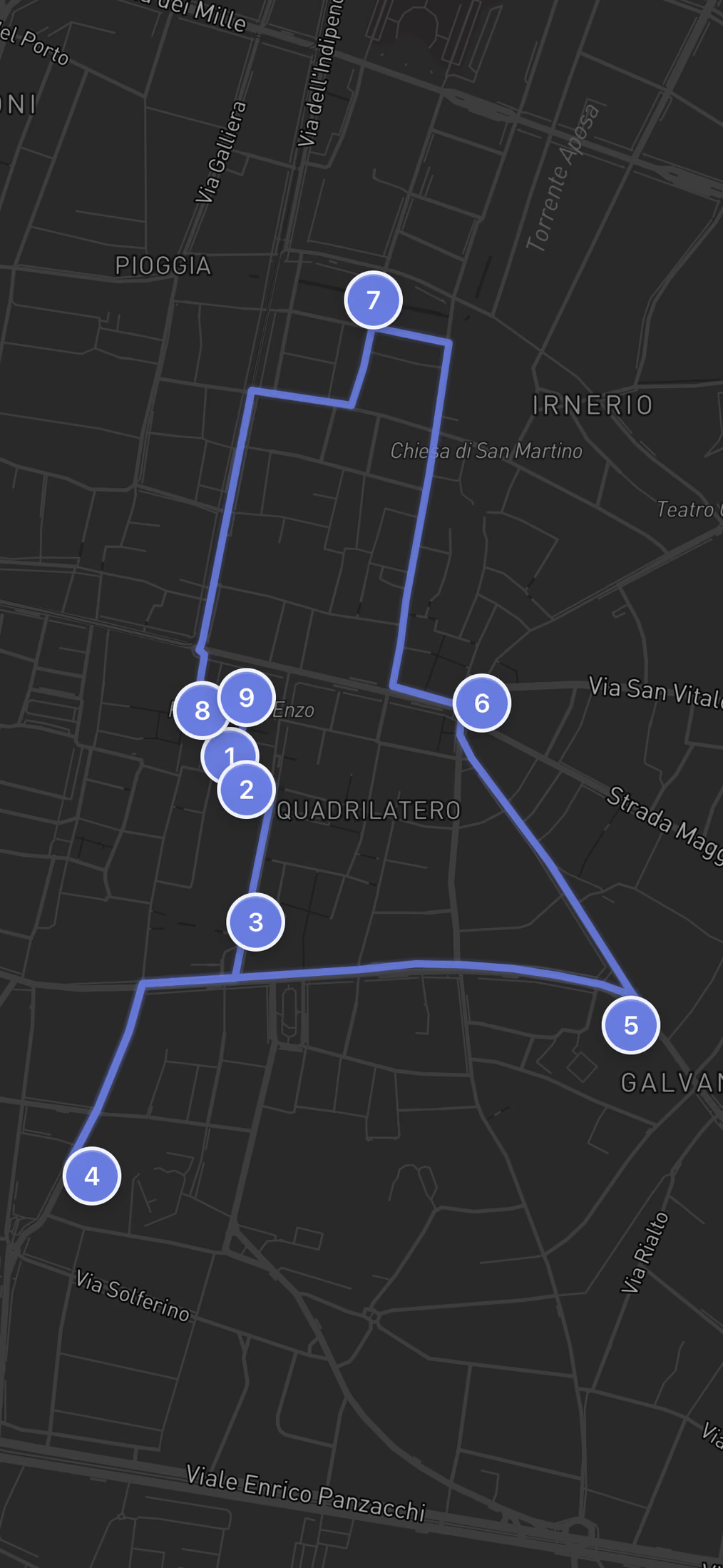
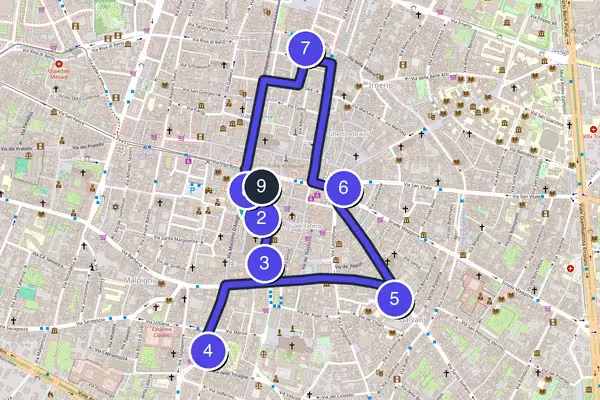
9 Stops 3.4 km ~2.0 hours
Start This Tour Free
Walking tour route map of Bologna
Start This Tour Free

Why Walk Bologna? A Self-Guided Tour

Bologna is flat, compact, and covered in 40 kilometers of porticoes that keep you dry in any weather. This 3.4-kilometer walking tour connects 9 stops in about 2 hours of walking, looping through the medieval core from Piazza Maggiore south to the complex of Santo Stefano and back north past the leaning towers. Every major landmark in the historic center sits within a 15-minute walk of the main square, so the route never requires a bus or taxi.

The sequence matters. Starting at Piazza Maggiore gives you the civic center and the unfinished basilica, then pushes you south through the university quarter and the hidden canal window before circling back to the towers and the Neptune Fountain. You avoid the common mistake of walking the same streets twice around the university buildings. The porticoes connect every stop, so even on a rainy day, you stay mostly covered. Bologna's nickname is La Grassa (the fat one), and the food you pass along the way will make that clear.

The Route: 9 Stops

Swipe through images or scroll names below

Scroll to explore →
1. Piazza Maggiore
2. Basilica of San Petronio
3. Archiginnasio
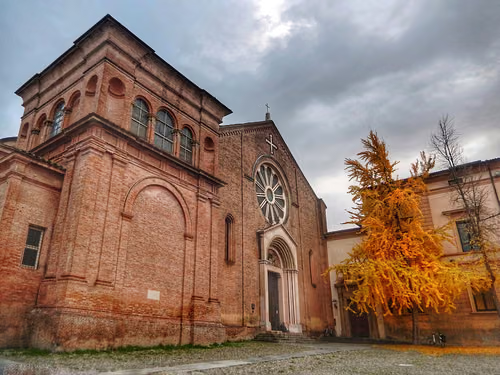
4. Basilica of San Domenico
5. Basilica di Santo Stefano
6. Two Towers
7. Finestrella di via Piella
8. Neptune Fountain
9. Palazzo del Podestà

Route Map

Tap to load interactive map
AI Tourguide
Walk this exact route with a private AI guide.
Full GPS navigation, interactive stories, and a guide that answers all your questions. A private guide experience for just €5/hour.
Start This Tour

Your Bologna Walking Tour, Stop by Stop

  1. 1

    Piazza Maggiore

    Piazza Maggiore

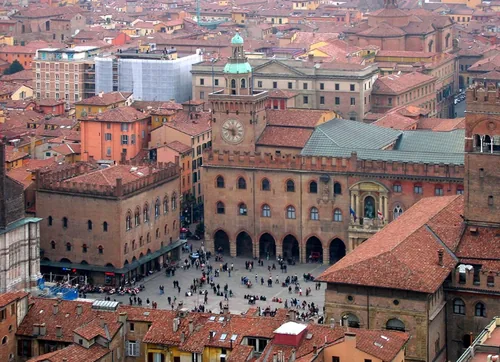
    Bologna's main square has been the center of public life since 1200. It measures 115 by 60 meters, surrounded by the city's most important civic buildings. The Crescentone stone platform in the center still bears a visible scar from an American tank that drove over it at the end of World War II. In summer, the square transforms into a massive open-air cinema with one of the largest screens in Europe. Open 24 hours, free. The buildings around the perimeter span different architectural periods: the Gothic Palazzo dei Banchi, the Renaissance Archiginnasio, the medieval Palazzo del Podesta. This is the right place to orient yourself. Cafes with outdoor seating line the edges, but the prices reflect the location. Spend five to ten minutes here before walking to the massive brick facade on the south side.
    Learn more about Piazza Maggiore →
    Hours
    Open 24/7
    Price
    Free

    1 min walk to next stop

  2. 2

    Basilica of San Petronio

    Basilica of San Petronio

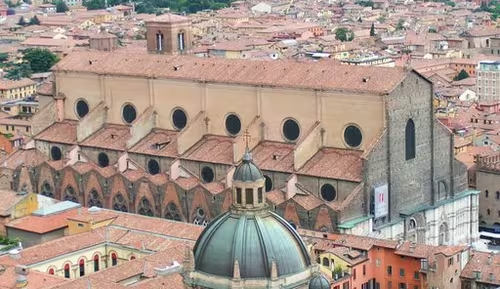
    The largest church in the city sits directly on Piazza Maggiore, and the first thing you notice is the facade: the bottom half is white and red marble, the top half is raw brick, unfinished since the 14th century. The original plan would have made it larger than St. Peter's in Rome, but the Pope blocked the project and built the Archiginnasio next door instead. Inside, the Cassini Meridian runs 66.8 meters along the floor, the longest indoor sundial in the world, still functioning when sunlight enters through a hole in the roof. The basilica is 132 meters long and feels cavernous. Twenty-two side chapels line the nave. Free entry. Open daily 8:30 AM to 1:00 PM and 2:30 to 6:00 PM. There is a strict dress code: cover shoulders and knees. Photos require a 2-euro fee. The terrace offers a small-fee view of the city center.

    Learn more about Basilica of San Petronio →
    Hours
    Daily: 8:30 AM – 1:00 PM, 2:30 – 6:00 PM
    Price
    Free

    1 min walk to next stop

  3. 3

    Archiginnasio

    Archiginnasio

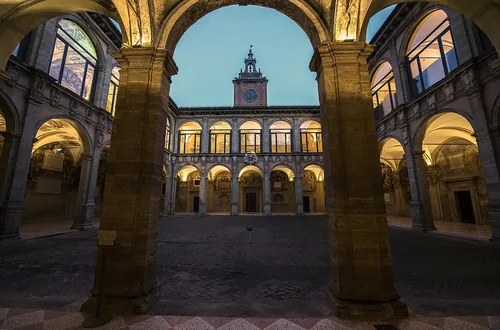
    Commissioned in 1563, this building served as the unified seat of the University of Bologna, the oldest university in the Western world, founded in 1088. The main draw is the 17th-century anatomical theatre on the upper floor. The room is constructed entirely from spruce wood, with carved figures of famous physicians lining the walls. The two most famous statues are the Spellati (Skinned Men) by Ercole Lelli, made in 1734 to show muscles and bones in precise anatomical detail. A bomb hit the building in 1944, but the city rebuilt the theatre using almost all the original wooden pieces. Free entry to the building. Open Monday through Friday 9:00 AM to 7:00 PM, Saturday 9:00 AM to 2:00 PM, closed Sundays. The anatomical theatre is small and can get very quiet inside, which adds to the atmosphere. Look for the small holes in the walls where students used to peek through when the room was full.

    Learn more about Archiginnasio →
    Hours
    Mon-Fri: 9:00 AM – 7:00 PM | Sat: 9:00 AM – 2:00 PM | Sun: Closed
    Price
    Free

    5 min walk to next stop

  4. 4

    Basilica of San Domenico

    Basilica of San Domenico

    This 13th-century church houses the Arca di San Domenico, an elaborate marble sarcophagus containing the remains of the Dominican order's founder. A young Michelangelo contributed three small marble figures to the tomb: an angel and two saints, carved when he was about 20 years old. The church is quieter and less visited than San Petronio, which works in its favor. You can stand directly in front of the Michelangelo sculptures without a crowd. The interior is large, dark, and weighted with centuries of devotion. The choir stalls are carved with exceptional precision. The square outside, Piazza San Domenico, has a calm, residential feel that contrasts with the busy Piazza Maggiore. Check locally for current opening hours and admission, as they vary seasonally. Ten to fifteen minutes is enough to see the tomb and the nave.

    Learn more about Basilica of San Domenico →
    Hours
    Daily: 7:30 AM – 1:00 PM, 3:30 – 8:00 PM
    Price
    Free

    5 min walk to next stop

  5. 5

    Basilica di Santo Stefano

    Basilica di Santo Stefano

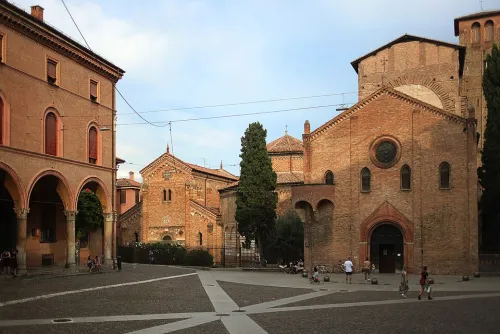
    This is not one church but a complex of interconnected religious buildings, some dating to the 5th century, built on top of a former temple to Isis. The complex is called Sette Chiese (Seven Churches) by locals, though only four remain fully intact. Within the Courtyard of Pilate sits an 8th-century Lombard stone basin. The oldest structure is a small baptistery that feels ancient in a way that most European churches do not. The layering of different centuries and architectural styles within a single compound is unusual. Free entry. The courtyard connects the buildings and creates quiet open-air spaces between the stone walls. Spend 15 to 20 minutes walking through the interconnected rooms. The Piazza Santo Stefano outside is one of the most pleasant squares in the city, triangular and lined with outdoor cafe tables.

    Learn more about Basilica di Santo Stefano →
    Hours
    Mon: 6:00 – 7:30 PM | Tue-Sat: 7:30 AM – 12:30 PM, 2:30 – 7:30 PM | Sun: 8:30 AM – 1:00 PM, 3:00 – 7:30 PM
    Price
    Free

    5 min walk to next stop

  6. 6

    Two Towers

    Two Towers

    Built between 1109 and 1119 by rival noble families, the Two Towers are the most recognizable landmarks in Bologna. The taller Asinelli Tower reaches 97.2 meters and requires climbing 498 narrow wooden steps to the top. The view of the red terracotta rooftops from the summit is the definitive Bologna panorama. The shorter Garisenda Tower leans 3.2 meters off-center and was shortened in the 14th century because the ground was sinking. Garisenda is closed to visitors for safety. Asinelli is open daily 10:00 AM to 6:00 PM (until 5:00 PM October through March). Free entry. Book your time slot in advance online, as there is a strict visitor limit. Legend says university students should not climb the tower until after graduation, or they will never finish their degree. The sunset time slot is worth targeting: the brick city glows in the evening light.

    Learn more about Two Towers →
    Hours
    Daily 10am-6pm (Oct-Mar until 5pm)
    Price
    Free

    5 min walk to next stop

  7. 7

    Finestrella di via Piella

    Finestrella di via Piella

    A small wooden window in a wall on Via Piella opens onto the Canale delle Moline, one of the few visible stretches of Bologna's ancient 60-kilometer hydraulic network. The view through the window shows water flowing between old colorful houses, which is why locals call this spot Little Venice. In the Middle Ages, these canals powered mills and workshops. Most were covered up in the 20th century. Today only a few sections remain visible. The window is free and accessible 24 hours. It is easy to miss: just a small square shutter in an ordinary wall on a quiet street. Open it and look through. The canal view is simple but surprising for a city that hides its waterways behind buildings. If the window is crowded, walk to the other side of the bridge for a similar view without the wait. Five minutes is enough.

    Learn more about Finestrella di via Piella →
    Hours
    Open 24/7
    Price
    Free

    5 min walk to next stop

  8. 8

    Neptune Fountain

    Neptune Fountain

    Completed in 1567 by Flemish sculptor Giambologna, this bronze fountain was commissioned to represent papal authority over the world. The 3.2-meter Neptune stands in the center, surrounded by cherubs representing the four major rivers of the known world. The fountain has 90 water jets feeding the large marble basin. Local legend says students should walk counter-clockwise around the fountain twice before an exam for good luck. In 2016, the fountain underwent a major restoration that cleaned the bronze and repaired the internal plumbing. It now looks close to its 16th-century condition. Free and visible at any hour. The fountain sits right next to Piazza Maggiore and the Sala Borsa library. Stand near the library entrance and look at Neptune from a specific angle to see a famous optical illusion created by his thumb.

    Learn more about Neptune Fountain →
    Hours
    Open 24/7
    Price
    Free

    1 min walk to next stop

  9. 9

    Palazzo del Podestà

    Palazzo del Podestà

    One of the oldest buildings on Piazza Maggiore, rebuilt in 1484 with a facade of over 3,000 diamond-shaped stone bosses. The ground-floor portico connects the main square to the streets behind through arched walkways. The Torre dell'Arengo above was used to call citizens to the square during emergencies. The best feature is hidden in plain sight: the whispering gallery beneath the central vault. Stand in one corner and whisper into the wall. A person in the diagonally opposite corner hears you perfectly. Legend says this acoustic trick was used by lepers during the Middle Ages to confess their sins to a priest without physical contact. Try it with a travel companion. The effect genuinely works. Free and open during the building's hours. The palace is frequently used for art exhibitions and cultural events, so check the schedule for current programming.

    Learn more about Palazzo del Podestà →
    Hours
    Mon-Fri: 9:00 AM – 7:00 PM | Sat: 9:00 AM – 12:00 PM | Sun: 12:00 PM – 7:00 PM
    Price
    Free
AI Tourguide
Walk this exact route with a private AI guide.
Full GPS navigation, interactive stories, and a guide that answers all your questions. A private guide experience for just €5/hour.
Start This Tour

Self-Guided Tour vs. Group Tour in Bologna

A self-guided walking tour of Bologna is the obvious choice for this city. The historic center is so compact that you could throw a stone from Piazza Maggiore and hit three of the stops on this route. Guided group tours cost 15 to 25 euros per person and spend too much time explaining the Basilica of San Petronio's unfinished facade. You can read a plaque and understand the story in two minutes. Walking Bologna independently costs nothing, and the money saved goes further here than in most Italian cities. A plate of fresh tortellini in brodo costs 8 to 12 euros. A mortadella sandwich from a Quadrilatero market stall costs 4 euros.

Bologna's porticoes are the real advantage for a self-guided walk. Forty kilometers of covered walkways mean you never need to check the weather forecast. Rain, sun, or wind, the route stays sheltered. The streets are flat and pedestrianized in the center. Signage is clear. The Two Towers are visible from most of the historic core and function as a natural compass.

Group Tour AI Self-Guided
Price €25–€50 per person €5/hour or €20 all-inclusive
Flexibility Fixed schedule Start anytime, skip stops
Languages 1–2 languages 11 languages
Pace Group pace Your own pace

How Long Does This Bologna Tour Take?

Our route covers 3.4 km with 9 stops and takes approximately 2.0 hours at a relaxed pace.

This 3.4-kilometer route takes about 2 hours of walking time. Plan for 3.5 to 4.5 hours total if you climb the Asinelli Tower, explore the Santo Stefano complex, and stop for a meal. The Asinelli Tower climb takes 20 to 30 minutes including the wait at the top. The Archiginnasio anatomical theatre is a quick 10-minute visit. The Basilica of San Petronio absorbs 15 to 20 minutes if you walk the full nave.

Take your main food break between the Two Towers and the Finestrella, roughly two-thirds through the route. The Quadrilatero market district sits just east of Piazza Maggiore with street food, salumerie, and fresh pasta shops. For a sit-down meal, the trattorias along Via Santo Stefano are excellent and less touristy than those on the main square. The walk is completely flat. Any shoes work.

Tips for Walking in Bologna

AI Tourguide
Walk this exact route with a private AI guide.
Full GPS navigation, interactive stories, and a guide that answers all your questions. A private guide experience for just €5/hour.
Start This Tour

AI Audio Guide for This Tour

Standing in Piazza Maggiore? Open this walking tour in the app. GPS tracking guides you through the portico-covered streets to each stop, so you never lose your way in Bologna's medieval street grid.

AI Audio Guide Stories, history and fun facts narrated as you walk. No earpiece rental needed.
GPS Navigation Turn-by-turn directions so you never get lost between stops.
Ask Anything Curious about a building you pass? Ask your AI guide on the spot.
11 Languages Switch language anytime. No separate tour needed.
Start This Tour Free

Common Questions

Yes. The porticoes provide shade and breeze along nearly the entire route. Temperatures reach 35 degrees Celsius in July and August, but the covered walkways keep you out of direct sun. Carry water and take breaks in the churches, which are cool inside.
Yes. The outdoor stops (Piazza Maggiore, Two Towers, Neptune Fountain, Finestrella) are open every day. The Archiginnasio is closed on Sundays, not Mondays. Check current hours for the churches, as some have afternoon closures.
The 498 wooden steps are steep and narrow. There is no elevator. The climb takes about 10 minutes at a steady pace. Anyone with decent fitness can do it, but it is not suitable for people with severe vertigo or mobility issues. The views from the top are worth the effort.
No booking needed. This self-guided tour is available anytime. Open the route on your phone and start walking. The AI audio guide works instantly, no reservation required.
The AI audio guide is available in 11 languages: English, German, French, Spanish, Italian, Japanese, Chinese, Portuguese, Danish, Norwegian, and Swedish.
Yes. Skip any stop, spend extra time at places you like, or start the route from any point. You can also ask the AI to suggest a shorter route.
AI Tourguide
Curated by AI Tourguide GPS-verified routes, reviewed and updated regularly.
Last verified March 2026