Self-Guided Walking Tour in Rome

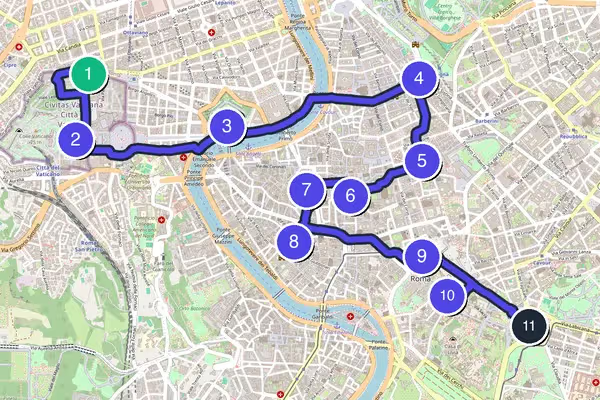
A complete point-to-point route from the Vatican to the Colosseum, with an interactive map, all 11 stops, realistic timings, ticket guidance and practical advice. Use everything on this page to walk the tour yourself.

11 Stops10.1 km~4 hours walking5–6 hours with stops
What you get with AI Tourguide
Full GPS navigationInteractive AI guidePersonalized to youWorks in your browser
Try this tour with Alex

Rome Walking Tour at a Glance

This is a long, point-to-point city walk designed for travellers who want to connect Rome's major sights in one logical route. Every interior visit is optional: you can follow the complete route, see each landmark from outside and use all stop descriptions without opening the optional AI guide.

StartVatican Museums (Musei Vaticani)
FinishColosseum (Colosseo)
Route typePoint to point, west to east, with no major backtracking
Realistic time5–6 hours with outdoor stops; longer with major interiors
Difficulty10.1 km, uneven cobblestones and limited shade later on
Cost to followThe outdoor route is free; tickets are only for interiors you choose
Best for:

First-time visitors who want a complete overview of central Rome and prefer freedom over a fixed group schedule.

The Route

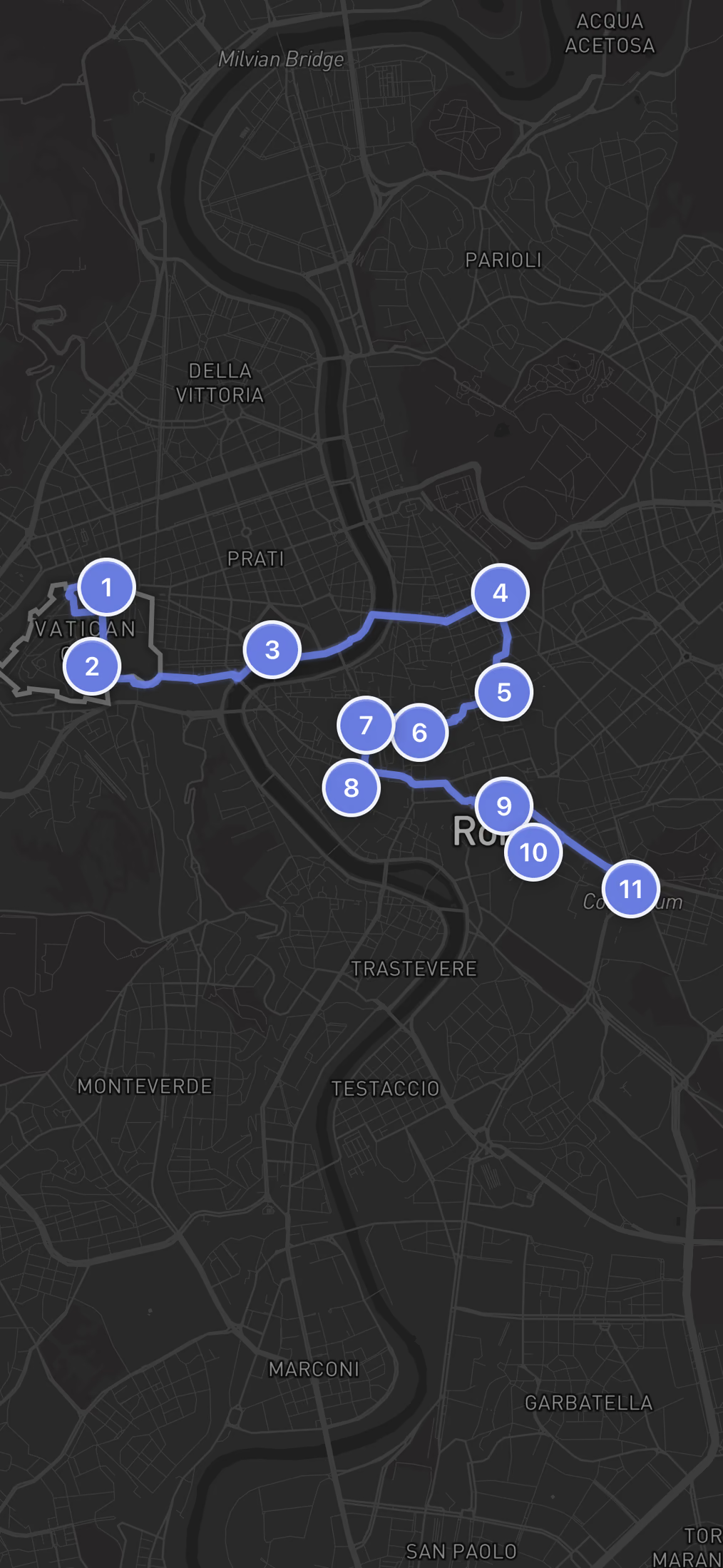
Free Walking Tour Map of Rome

11 stops10.1 kmabout 4 hours
Loading the interactive map…The complete walking route will appear here.
Want the route to guide you while you walk?Open the route with navigation and a personal guide for the history, stories and questions that matter to you.
Open route + AI guide

The 11 stops along this route

  1. Vatican Museums (Musei Vaticani) in Rome, stop 1 on the self-guided walking tour
    1Vatican Museums (Musei Vaticani)
  2. St. Peter's Basilica (Basilica di San Pietro) in Rome, stop 2 on the self-guided walking tour
    2St. Peter's Basilica (Basilica di San Pietro)
  3. Castel Sant'Angelo in Rome, stop 3 on the self-guided walking tour
    3Castel Sant'Angelo
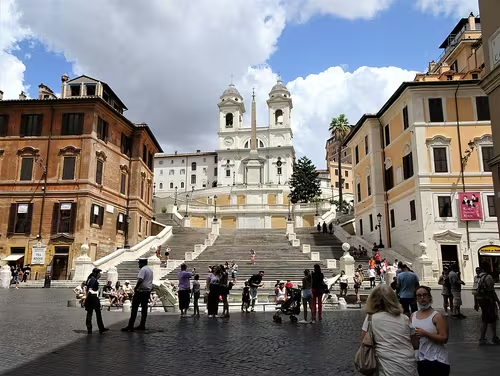
  4. Spanish Steps (Scalinata di Trinità dei Monti) in Rome, stop 4 on the self-guided walking tour
    4Spanish Steps (Scalinata di Trinità dei Monti)
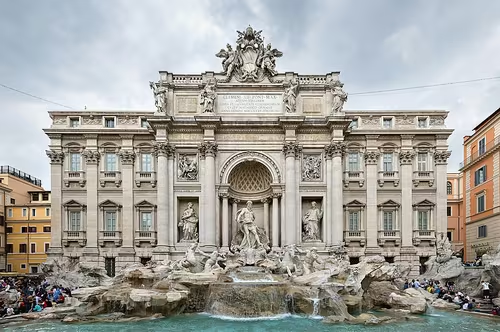
  5. Trevi Fountain (Fontana di Trevi) in Rome, stop 5 on the self-guided walking tour
    5Trevi Fountain (Fontana di Trevi)
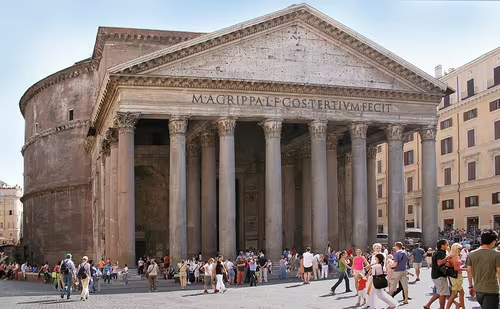
  6. Pantheon in Rome, stop 6 on the self-guided walking tour
    6Pantheon
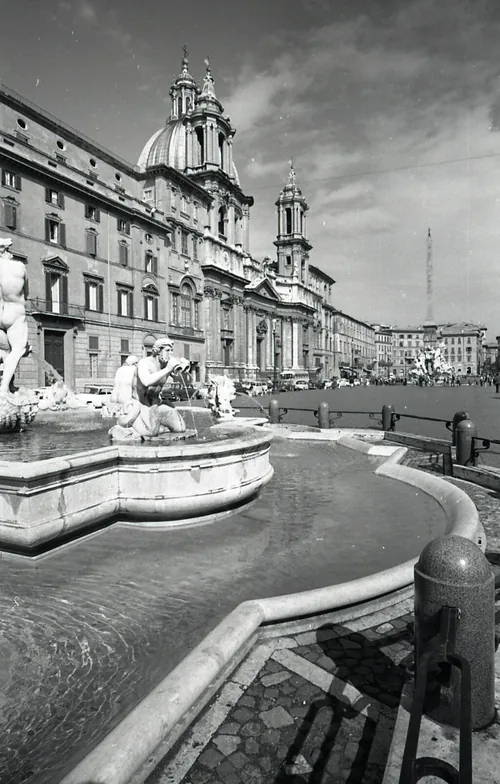
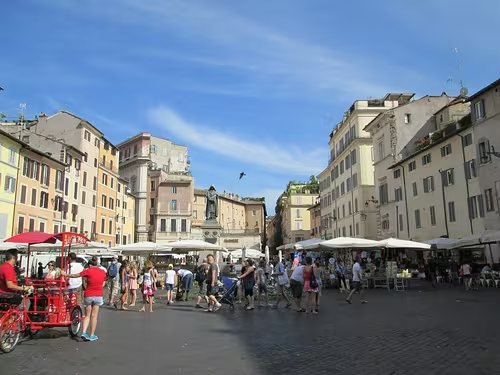
  7. Piazza Navona in Rome, stop 7 on the self-guided walking tour
    7Piazza Navona
  8. Campo de' Fiori in Rome, stop 8 on the self-guided walking tour
    8Campo de' Fiori
  9. Piazza Venezia in Rome, stop 9 on the self-guided walking tour
    9Piazza Venezia
  10. Roman Forum (Foro Romano) in Rome, stop 10 on the self-guided walking tour
    10Roman Forum (Foro Romano)
  11. Colosseum (Colosseo) in Rome, stop 11 on the self-guided walking tour
    11Colosseum (Colosseo)
  12. That's the complete route.

    If you want more than the map and text, add live navigation and a conversational AI guide while you walk.

    Open route + AI guide
    You made it
Stop 1 of 11
Swipe →

Your Rome Walking Tour, Stop by Stop

  1. 1

    Vatican Museums (Musei Vaticani)

    Vatican Museums (Musei Vaticani) in Rome, stop 1 on the self-guided walking tour

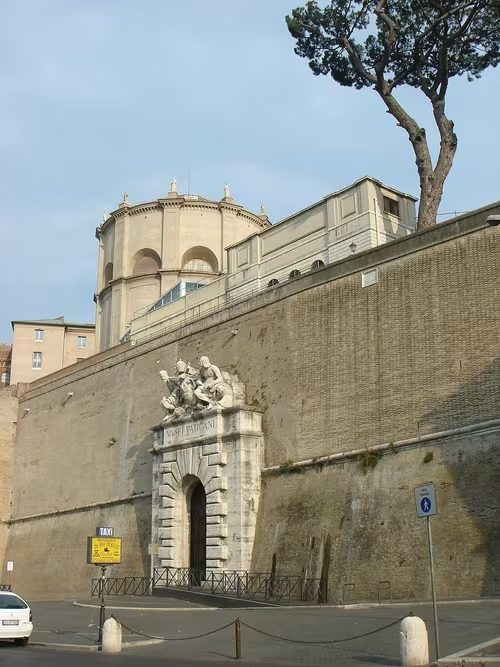
    You approach the Vatican Museums along the high travertine walls of Vatican City on Viale Vaticano. The entrance queue stretches hundreds of meters on busy mornings. Inside, the collection spans 54 galleries over 7 km of corridors. The Gallery of Maps alone is worth 20 minutes: 40 topographical maps of Italian regions painted on the walls of a 120-meter-long hallway. The Raphael Rooms come next, then the Sistine Chapel at the very end, where guards shush the crowd every few seconds. Open Monday through Saturday, 8:00 AM to 8:00 PM. Closed Sundays. Tickets cost €20 and you should book online at least two weeks ahead. Without a reservation, the wait easily exceeds two hours. Allow 90 minutes minimum inside, even moving fast.
    Hours
    Mon-Sat: 8:00 AM – 8:00 PM | Sun: Closed
    Price
    €20
  2. 2

    St. Peter's Basilica (Basilica di San Pietro)

    St. Peter's Basilica (Basilica di San Pietro) in Rome, stop 2 on the self-guided walking tour

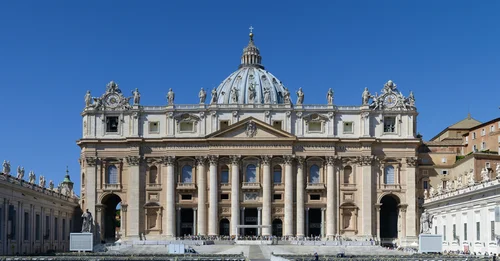
    Walking south from the Vatican Museums, you enter St. Peter's Square through the right arm of Bernini's colonnade: 284 columns arranged in four rows curving around an Egyptian obelisk. The basilica itself is free to enter. Doors open daily from 7:00 AM to 7:10 PM. The security line wraps along the colonnade but moves faster than it looks, typically 15 to 25 minutes. Step inside and the scale hits you immediately. The nave is 186 meters long. Michelangelo's Pieta sits behind glass in the first chapel on the right. Bernini's bronze baldachin rises 29 meters over the main altar. If you want to climb the dome (€8 by stairs, €10 with elevator for the first section), budget an extra 45 minutes. Leave through the square and walk straight down Via della Conciliazione toward the river.

  3. 3

    Castel Sant'Angelo

    Castel Sant'Angelo in Rome, stop 3 on the self-guided walking tour

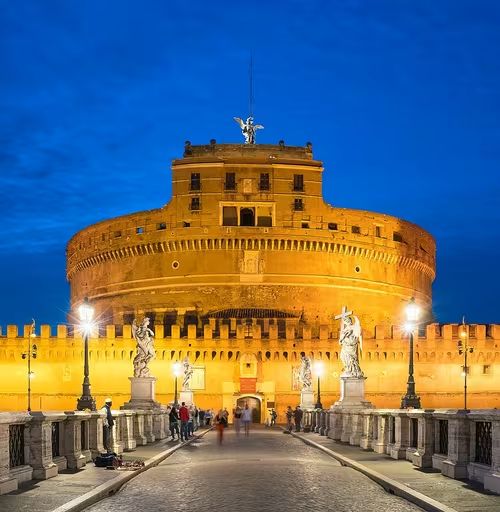
    Via della Conciliazione delivers you straight to the Tiber, where the cylindrical bulk of Castel Sant'Angelo rises on the opposite bank. Emperor Hadrian built it as his family tomb in 139 AD. Popes later converted it into a fortress connected to the Vatican by an elevated passageway called the Passetto di Borgo. The building is open Tuesday through Sunday, 9:00 AM to 7:30 PM, closed Mondays. Admission is €13. The rooftop terrace gives you a 360-degree view across the river to St. Peter's dome and east toward the centro storico. If you skip the interior, at least cross Ponte Sant'Angelo on foot. The bridge has ten angel statues designed by Bernini, each holding an instrument of the Passion. It is one of the best photo spots on the entire route.

    Hours
    Mon: Closed | Tue-Sun: 9:00 AM – 7:30 PM
    Price
    €13
  4. 4

    Spanish Steps (Scalinata di Trinità dei Monti)

    Spanish Steps (Scalinata di Trinità dei Monti) in Rome, stop 4 on the self-guided walking tour

    From Castel Sant'Angelo, you walk east through the grid of streets between Via del Corso and Via del Babuino. The Spanish Steps appear suddenly as you turn onto Piazza di Spagna: 135 travertine steps climbing steeply to the Trinita dei Monti church. Francesco de Sanctis designed them in the 1720s to connect the Spanish embassy below with the French church above. At the base, Bernini's father Pietro carved the Barcaccia fountain in the shape of a leaking boat. The steps are open 24 hours, free to walk. Sitting on them is technically banned and the municipal police do enforce it, especially in summer. Climb to the top for a clear view down Via dei Condotti, Rome's luxury shopping street. The crowd thins out significantly before 9:00 AM.

    Hours
    Open 24/7
    Price
    Free
  5. 5

    Trevi Fountain (Fontana di Trevi)

    Trevi Fountain (Fontana di Trevi) in Rome, stop 5 on the self-guided walking tour

    You hear the water before you see it. The Trevi Fountain fills the entire south wall of Palazzo Poli at the end of a narrow alley, and the effect of stumbling upon it between tight buildings is deliberate. Nicola Salvi designed it in 1762 around a central figure of Neptune riding a shell chariot pulled by sea horses. The fountain runs on specific hours: opening at 9:00 AM most days, but 11:30 AM on Mondays and Fridays, closing at 10:00 PM. About €3,000 in coins gets thrown in daily, all collected for charity. The small piazza is packed from mid-morning onward. Come before 9:00 AM or after 8:00 PM for any chance of getting near the railing without being pressed against 200 other people. Walk south through the alleys toward the Pantheon.

    Hours
    Mon: 11:30 AM – 10:00 PM | Tue-Thu: 9:00 AM – 10:00 PM | Fri: 11:30 AM – 10:00 PM | Sat-Sun: 9:00 AM – 10:00 PM
    Price
    Free to view from the outer perimeter; €2 timed-entry ticket required to access the inner ring closest to the fountain (introduced 2025/2026 for crowd control).
  6. 6

    Pantheon

    Pantheon in Rome, stop 6 on the self-guided walking tour

    The Pantheon appears at the end of a short street and fills Piazza della Rotonda with its 16 granite columns, each 12 meters tall and quarried in Egypt. Hadrian rebuilt this temple around 126 AD. The unreinforced concrete dome has a 9-meter-wide oculus open to the sky: when it rains, water falls through and drains into holes in the slightly convex floor. The dome's diameter of 43.3 meters was not surpassed for over 1,300 years. Open daily from 9:00 AM to 7:00 PM. Admission is €5. Go inside. The interior is genuinely different from anything else you will see in Rome. Raphael's tomb is set into the wall on the left side. The cafe tables surrounding the piazza outside charge €6 or more for an espresso. Walk one block west instead to get a normal price.

    Hours
    Daily: 9:00 AM – 7:00 PM
    Price
    5 EUR
  7. 7

    Piazza Navona

    Piazza Navona in Rome, stop 7 on the self-guided walking tour

    Piazza Navona preserves the exact elongated oval of Emperor Domitian's stadium, which seated 30,000 spectators for athletic contests in the 1st century AD. The ruins sit about 5 meters below today's pavement. Three fountains line the center of the square. Bernini's Fountain of the Four Rivers dominates the middle: four muscular figures represent the Nile, Ganges, Danube, and Rio de la Plata, topped by a 16-meter Egyptian obelisk. Street artists set up easels along the edges. The restaurants with outdoor seating around the perimeter charge tourist prices, around €15 for a plate of pasta that costs €8 two blocks away. The square is open 24 hours. Walk through slowly, look at the water, ignore the menus.

    Hours
    Open 24/7
    Price
    Free
  8. 8

    Campo de' Fiori

    Campo de' Fiori in Rome, stop 8 on the self-guided walking tour

    Campo de' Fiori is the square that feels most like actual Roman daily life rather than a monument. A morning market fills it every day except Sunday: vendors sell artichokes, tomatoes, dried peppers, and cheap kitchen tools. A hooded bronze statue of Giordano Bruno stands at the center, facing the Vatican. He was burned alive on this exact spot in February 1600 for heresy. The square is open 24 hours and free. By evening, the market stalls pack up and the surrounding bars take over. For lunch, skip the square's overpriced restaurants and walk 100 meters south to Antico Forno Roscioli on Via dei Chiavari. A slice of pizza bianca costs about €3. Eat standing outside, Roman style.

    Hours
    Open 24/7
    Price
    Free
  9. 9

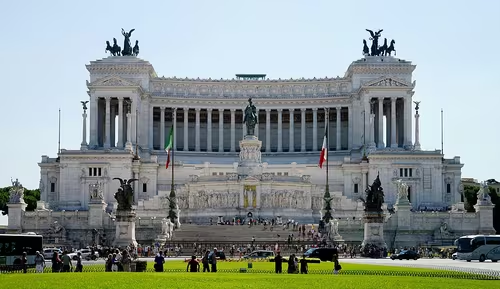
    Piazza Venezia

    Piazza Venezia in Rome, stop 9 on the self-guided walking tour

    Piazza Venezia is the chaotic traffic hub where five major roads converge at the foot of the Capitoline Hill. You will see it before you reach it: the Altare della Patria, a 70-meter-tall white marble monument to King Vittorio Emanuele II, dominates the southern edge. Romans call it the "wedding cake" or the "typewriter" because of its ornate layers. The piazza itself is open 24 hours and free. The rooftop terrace of the Altare della Patria offers a 360-degree panorama of the city. You can reach it by glass elevator for €7. The view from the top looking south over the Roman Forum is the best preview of what comes next. Cross the busy intersection using the pedestrian crossings on the eastern side.

    Hours
    Daily: 9:30 AM – 7:30 PM
    Price
    0
  10. 10

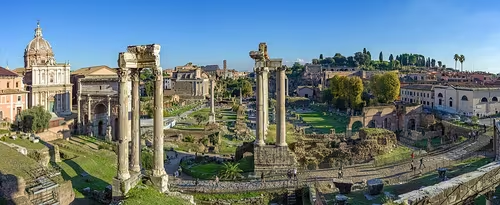
    Roman Forum (Foro Romano)

    Roman Forum (Foro Romano) in Rome, stop 10 on the self-guided walking tour

    From Piazza Venezia, you descend Via dei Fori Imperiali with the Forum spread out in the valley to your right. For over 1,000 years this narrow strip of land between the Palatine and Capitoline hills was the political, religious, and commercial center of the Roman world. What remains are fragments: the three standing columns of the Temple of Castor and Pollux, the Arch of Septimius Severus, the brick skeleton of the Basilica of Maxentius. Open daily from 9:00 AM to 4:30 PM. The combined ticket costs €18 and includes the Colosseum and Palatine Hill, valid for two consecutive days. You can see a lot from the railing along Via dei Fori Imperiali for free, but walking among the ruins at ground level gives a completely different sense of how massive the complex actually was.

    Hours
    Daily: 9:00 AM – 4:30 PM
    Price
    €18 (combined ticket with Colosseum)
  11. 11

    Colosseum (Colosseo)

    Colosseum (Colosseo) in Rome, stop 11 on the self-guided walking tour

    The route ends at the largest amphitheater ever built. The Colosseum's outer wall rises 48 meters in four tiers of arches, and the elliptical floor plan stretches 189 by 156 meters. Vespasian started construction in 70 AD, and his son Titus inaugurated it ten years later with 100 days of games. Up to 50,000 spectators watched gladiatorial combat, animal hunts, and mock naval battles here. Open daily from 8:30 AM to 4:30 PM. Tickets are €18, or use the combined ticket from the Roman Forum. Book online through the official site at least a week ahead: same-day slots sell out by mid-morning. Even if you do not go inside, walk the full perimeter. The best angle is from the slight hill to the northeast in Colle Oppio park, where you can photograph the entire structure without crowds in the foreground.

    Hours
    Daily: 8:30 AM – 4:30 PM
    Price
    €18

How Long Does This Walking Tour Really Take?

Allow about 4 hours for the walking alone, 5–6 hours for the route with outdoor sightseeing and breaks, or 8–9 hours if you add several major interiors.

Pure walking time is about 4 hours for the 10.1 km route. With stops to look around, take photos, and navigate crowds, expect 5 to 6 hours without entering any paid sites. If you go inside the Vatican Museums, St. Peter's Basilica, and the Colosseum, add 3 to 4 hours. A realistic full day is 8 to 9 hours.

The natural break point is around stop 6, the Pantheon. After four stops and roughly 6 km of walking, you will want to sit down. Do not pay €6 for an espresso at the tables in Piazza della Rotonda. Walk two blocks west to Sant'Eustachio Il Caffe on Piazza di Sant'Eustachio and order their signature gran caffe for about €3 at the counter. The second half of the route from Piazza Navona to the Colosseum is more exposed, with less shade and wider streets. Slow down through the alleys around Campo de' Fiori before you hit the open archaeological zones.

Full Route, Shorter Walk or Two-Day Version?

You do not have to complete all 11 stops in one continuous walk. Choose the complete route, remove the Vatican opening section, or divide the same route at the Pantheon.

Shorter half-day

Spanish Steps to Colosseum

Stops 4–11 · allow roughly 2½–3½ hours

Keep Trevi, the Pantheon, Piazza Navona and ancient Rome while removing the long Vatican-to-center opening section.

Easier pace

Split it across two days

Day 1: stops 1–6 · Day 2: stops 7–11

Use the Pantheon as the dividing point, especially when substantial interior visits at the Vatican and Colosseum are part of the plan.

You can reverse the route and start at the Colosseum. The west-to-east direction is recommended because it begins near Ottaviano Metro and finishes beside Colosseo Metro without retracing your steps.

Is This Rome Walking Tour Right for You?

The route is designed to be useful without requiring a particular travel style, but its length and terrain will not suit every day or every visitor.

A good fit if you…

  • You want the major sights connected in one logical route
  • You prefer to choose your own pace, breaks and interior visits
  • You like having practical details and historical context while walking
  • You are comfortable covering around 10 km on cobbled streets

Adapt the route if you…

  • You have limited mobility or find uneven cobblestones difficult
  • You want to visit every major attraction interior in depth
  • You are walking in peak summer heat or with young children
  • You have less than half a day available in Rome

Tickets & Skip-the-Line in Rome

Four of the eleven stops charge admission and reward booking a timed ticket in advance. The rest of the route is free to walk up to and enjoy from outside.

Vatican Museums (Musei Vaticani)Tickets are €20 and should be booked online at least two weeks ahead via the official site museivaticani.va. Without a reservation the queue along the walls easily exceeds two hours on a busy morning. official ticket site ↗
PantheonAdmission is €5. Timed tickets are sold through the official site direzionemuseiroma.cultura.gov.it/pantheon, and buying ahead lets you skip the entrance line straight into the rotunda. official ticket site ↗
Colosseum & Roman ForumA single combined ticket of €18 covers the Colosseum, the Roman Forum and the Palatine Hill and is valid for two consecutive days. Book on the official site colosseo.it at least a week ahead, because same-day slots regularly sell out by mid-morning. official ticket site ↗
Castel Sant'AngeloInterior admission is €13 (official site castelsantangelo.beniculturali.it). This one is optional. If you skip going inside, you can still cross Ponte Sant'Angelo and photograph Bernini's ten angel statues for free. official ticket site ↗
Free from outsideSt. Peter's Basilica is free to enter (only the dome climb and security queue cost time), and the Spanish Steps, Trevi Fountain, Piazza Navona, Campo de' Fiori and Piazza Venezia are all open-air and free to walk up to.
Optional upgrade
+7
The same 11-stop route,
now with navigation and a guide.
Optional AI experience

You already have the route.
The AI guide brings it to life.

Standing on the Spanish Steps or tossing a coin into the Trevi Fountain right now? Open AI Tourguide in your browser, no app and no download, and a voice guide walks the whole arc from the Vatican to the Pantheon with you, greeting you, telling the story along the way and asking what you most want to see so it can adapt the rest of the walk. A real conversation built into the walk, not a recording. Start with 100 free credits.

Livenavigation13languagesAnyquestionYourinterests
Open this route with the AI guide

Try it in your browser · No app or download required

Tips for Walking in Rome

  • Start at 8:00 AM. Take Metro Line A to Ottaviano station and walk south along Viale Vaticano to the Vatican Museums entrance. The first two hours have the lightest crowds of the day.
  • Most of this route is on sampietrini, the small basalt cobblestones that cover Rome's historic center. They are uneven and dangerously slippery when wet. Wear thick-soled walking shoes, not sandals or ballet flats.
  • Public restrooms are scarce. Pay €1 to use the clean underground bathroom near the western edge of Piazza Navona on Via di Lorenesi. The free bathrooms inside the Pantheon and Colosseum are another option if you have tickets.
  • Fill your water bottle at any of Rome's 2,500 public drinking fountains, called nasoni. You will pass several along this route: look for the small cast-iron spouts shaped like a curved nose. The water comes directly from ancient aqueducts and is safe to drink.
  • The best photo of the Colosseum without tourist crowds in the frame is from Colle Oppio park, on the slight hill to the northeast. Face southwest in morning light for the clearest shot of the full exterior.

Where to Eat Along the Route

The best Roman cooking is not next to the monuments. As a rule, avoid any restaurant within roughly 500 meters of the Trevi Fountain, the Colosseum, or the Vatican, where only overpriced tourist traps survive. Plan your meals around the neighborhoods you pass through, not the sights themselves.

  • Testaccio: the working-class birthplace of Roman cuisine and the home of quinto quarto (offal) cooking. The covered Mercato di Testaccio (daily except Sunday, roughly 7am to 3:30pm) is the single best stop for cheap, authentic street food like Mordi e Vai's offal sandwiches.
  • Trastevere: atmospheric cobblestoned lanes across the Tiber, touristy on the main squares but genuine on the side streets. Da Enzo al 29 and Roma Sparita are the real deal here.
  • Monti: a walkable bohemian pocket behind the Forum with solid old-school trattorias, handy after the Colosseum end of the route.
  • Centro Storico, the Pantheon, Navona and Campo de' Fiori zone: a few genuine gems survive among the traps, but you have to choose deliberately and book ahead.
Armando al Pantheon⌖Family-run since 1961, literally beside the Pantheon stop on Salita dei Crescenzi 31, and the one exception to the never-eat-by-a-monument rule. Only 14 tables, so booking is essential and opens about 30 days ahead. Order the gricia and the saltimbocca alla Romana.
Salumeria Roscioli⌖On Via dei Giubbonari, a two-minute walk from Campo de' Fiori. A gourmet deli that turned into a restaurant, famous for one of the best carbonaras in the city plus artisanal cheeses and cured meats. Reserve well ahead, or try the sister wine bar Rimessa Roscioli nearby if it is full.
Forno Campo de' Fiori⌖Right on Campo de' Fiori at number 22, a no-frills bakery selling pizza al taglio by weight. Ask for 200 grams of the pizza bianca or rossa, eat it hot on the street, and you have a proper Roman lunch for a few euros. No seating, expect a lunchtime queue.
Cul de Sac⌖A short stroll from Piazza Navona, an old-school enoteca with street-side tables and a wine list running past 1,500 bottles. Good for a relaxed plate of Roman classics without the Navona-perimeter markup.

Skip any place with a greeter outside waving you in, a menu with photos of the dishes, prices in several currencies, or laminated menus in five languages. These are the surest signs of a tourist trap, especially on the perimeter of Piazza Navona and around the Trevi Fountain.

Tourist Traps to Avoid in Rome

A handful of predictable scams and habits catch tourists in Rome. Knowing them in advance keeps your walk cheap and smooth.

  • Do not sit down to eat at the restaurants ringing the monuments. A plate of pasta on the Piazza Navona perimeter runs about €15 for something that costs €8 two streets away, and the coperto (cover charge) plus a padded tourist menu inflates the bill further.
  • At the Colosseum, ignore the men dressed as gladiators or centurions offering photos. They demand a steep fee, sometimes €20 or more, after the picture is taken. Street sellers pushing selfie sticks and trinkets work the same crowds.
  • Watch for the friendship-bracelet trick near the Spanish Steps and the Colosseum: someone ties a string around your wrist as a gift, then aggressively demands payment. Keep your hands to yourself and walk on.
  • Take taxis only from an official rank or book by phone, and check for the meter. Unofficial drivers hanging around Termini and the sights quote inflated flat fares.
  • Guard against pickpockets on the crowded Metro Line A and on buses 40 and 64 toward the Vatican, and in the press around the Trevi Fountain. They work in pairs, one bumps you while the other lifts your wallet. Keep valuables in a front pocket or a crossbody bag.
  • Do not sit on the Spanish Steps: it is banned and the municipal police fine offenders, especially in summer. Toss your Trevi coin, take the photo, and keep moving.

Why Walk This Route?

Rome's historic center is compact enough to cross on foot, but dense enough to fill a week. This self-guided walking tour covers 11 stops across 10.1 km, connecting the Vatican to the Colosseum through the oldest parts of the city. Plan roughly 4 hours of pure walking time, plus whatever you spend inside each site.

The route follows a logical west-to-east arc: start behind the Vatican walls, cross the Tiber over the angel-lined bridge at Castel Sant'Angelo, thread through the baroque squares and medieval alleys of the centro storico, then finish in the ancient Roman archaeological zone. You will walk on uneven cobblestones for most of the day. The streets between Piazza Navona and Campo de' Fiori are narrow, shaded, and relatively quiet. The final stretch from Piazza Venezia to the Colosseum is wide open with little shade. Carry water.

Common Questions

Is Rome safe to walk around?

Rome is safe for walkers. Pickpockets operate around the Trevi Fountain, Colosseum metro stop, and crowded buses on lines 40 and 64. They work in pairs: one bumps you, the other takes your wallet. Keep valuables in a front pocket or crossbody bag. Violent crime against tourists is extremely rare.

Can I do this tour in winter?

Winter is actually ideal. Rome rarely drops below 5 degrees Celsius, the crowds thin out dramatically from November through February, and you can walk into the Vatican Museums or Colosseum with same-day tickets on most weekdays. The only downside: the Roman Forum and Colosseum close earlier, around 4:30 PM, so start early.

What is the best time of day for this walking tour?

Start by 8:00 AM at the Vatican. You reach the Trevi Fountain and Spanish Steps around midday when they are busiest, but you have already covered the two biggest indoor sites. By late afternoon you are at the Colosseum, where the western light hits the travertine arches at the best angle for photos.

Take this route with you

Open this exact tour with navigation and your personal AI guide.

Start GPS Navigation + AI Guide
AI Tourguide
Researched and curated by the AI Tourguide teamWe plan and quality-check every route, then research and verify the opening hours, prices, and practical tips for each stop along it.
▶ Open route with AI guideNavigation, stories and your questions