Self-Guided Walking Tour in Jaipur

9 Stops 13.6 km ~4.4 hours
Start This Tour Free
Walking tour route map of Jaipur
Start This Tour Free

Why Walk Jaipur? A Self-Guided Tour

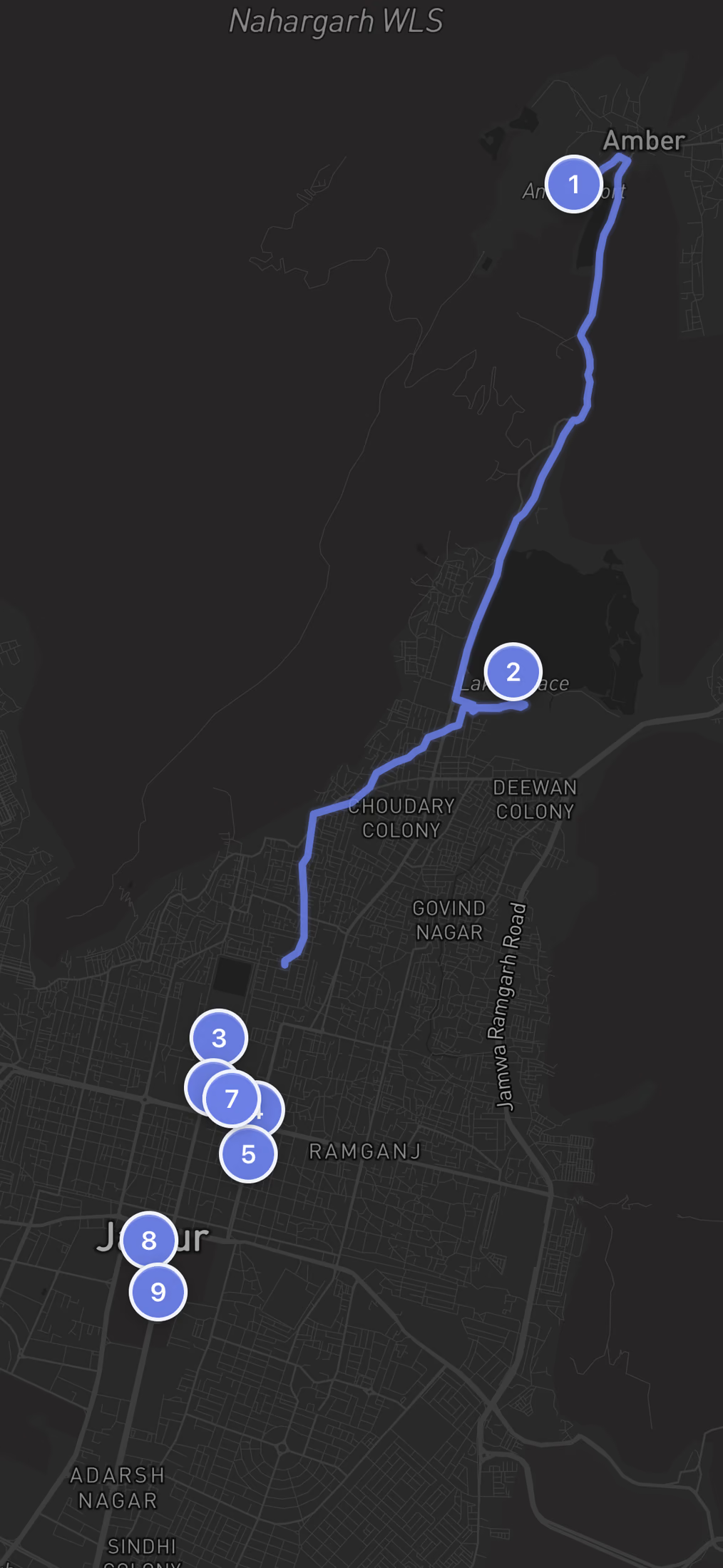
This walk through Jaipur covers 9 stops over 13.6 km, taking about 4 to 4.5 hours. The route starts at Amer Fort north of the city, moves south past Jal Mahal in Man Sagar Lake, enters the walled Pink City through its bazaars and royal compounds, and finishes at the Central Museum in Ram Niwas Garden. This is a long tour that covers the full sweep of Jaipur, from hilltop fortress to city-center garden. You will need a rickshaw or taxi for the 11 km stretch between Amer Fort and the Pink City, then walk the compact inner-city stops.

The Route: 9 Stops

Swipe through images or scroll names below

Scroll to explore →
1. Amer Fort
2. Jal Mahal
3. Govind Dev Ji Temple
4. Hawa Mahal (Palace of the Winds)
5. Johari Bazaar
6. Jantar Mantar
7. City Palace
8. Ram Niwas Garden
9. Central Museum

Route Map

Tap to load interactive map
AI Tourguide
Walk this exact route with a private AI guide.
Full GPS navigation, interactive stories, and a guide that answers all your questions. A private guide experience for just €5/hour.
Start This Tour

Your Jaipur Walking Tour, Stop by Stop

  1. 1

    Amer Fort

    Amer Fort

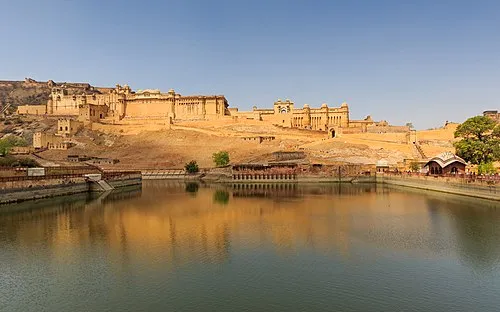
    Start at the sandstone fortress completed in 1592 by Raja Man Singh I, perched on a ridge overlooking Maota Lake. The Sheesh Mahal (Mirror Palace) inside is the highlight: thousands of convex mirror fragments set into the walls and ceiling catch the light of a single candle and scatter it across the entire room. A 2-kilometer underground tunnel connects Amer Fort to Jaigarh Fort on the hill above, originally built as an escape route. Arrive early, before 9 AM, to beat the tour bus crowds. The fort sprawls across four courtyards on multiple levels, so allow at least an hour. Open daily 7 AM to 9 PM. Admission is 550 INR for foreign visitors.

    Learn more about Amer Fort →
    Hours
    Daily: 7:00 AM – 9:00 PM
    Price
    550 INR (foreigners)

    15 min by taxi/rickshaw

  2. 2

    Jal Mahal

    Jal Mahal

    Heading south toward the city, stop at Man Sagar Lake for a view of this five-story palace sitting in the water. Four of its five floors remain submerged when the lake is full. Built in 1799 using red sandstone in the Rajput style, the palace was originally a hunting lodge and duck shooting retreat. You cannot enter the building, but the lakeside walkway gives you a clear view of the facade with the Aravalli hills behind it. The best light for photos is late afternoon when the sandstone turns golden. Open daily 8 AM to 6 PM for the viewing area.

    Learn more about Jal Mahal →
    Hours
    Daily: 8:00 AM – 6:00 PM
    Price
    Free (viewpoint only; no interior access)

    20 min by taxi/rickshaw

  3. 3

    Govind Dev Ji Temple

    Govind Dev Ji Temple

    Enter the walled city and head to this 18th-century temple inside the City Palace compound. The engineering is remarkable: the ceiling spans 119 feet on a single beam with no central pillars, an extraordinary feat for the era. The temple is dedicated to Lord Krishna, and the main idol is said to have been moved here from Vrindavan by Maharaja Sawai Jai Singh II. Services (aartis) happen seven times daily, and the most atmospheric is the evening aarti around 6:30 PM, when hundreds of devotees pack the courtyard. Open daily 4 AM to 12 PM and 4 to 8:30 PM. Remove your shoes before entering.

    Learn more about Govind Dev Ji Temple →
    Hours
    Daily: 4:00 AM – 12:00 PM, 4:00 – 8:30 PM
    Price
    Free

    5 min walk

  4. 4

    Hawa Mahal (Palace of the Winds)

    Hawa Mahal (Palace of the Winds)

    Walk south to Jaipur's most recognizable building. Maharaja Sawai Pratap Singh built this five-story pink sandstone facade in 1799, fitting it with 953 latticed windows. The design uses the Venturi effect to channel breeze through the honeycomb structure, cooling the interior by up to 5 degrees. Royal women used the windows to watch street processions below without being seen. Enter from the back, not the front. The rooftop gives a direct view down the length of Johari Bazaar and across to the City Palace. Open daily 9 AM to 7 PM. Admission is 500 INR for foreign visitors.

    Learn more about Hawa Mahal (Palace of the Winds) →
    Hours
    Daily: 9:00 AM – 7:00 PM
    Price
    500 INR (foreigners)

    3 min walk

  5. 5

    Johari Bazaar

    Johari Bazaar

    Step out of Hawa Mahal's back entrance and you are on Johari Bazaar, Jaipur's gem market and one of the world's largest centers for colored stone processing. Roughly 80% of the world's colored gemstones pass through Jaipur for cutting and polishing. The shops along this street sell everything from loose sapphires to finished Kundan jewelry, a Mughal-era technique of setting uncut gems in gold foil. Walk slowly, look into the upper-floor workshops where cutters work at hand-powered wheels. Do not buy gemstones without knowing what you are doing. The markups for tourists can be extreme. The bazaar is free to walk through and open most days.

    Learn more about Johari Bazaar →
    Hours
    Check locally
    Price
    Free

    4 min walk

  6. 6

    Jantar Mantar

    Jantar Mantar

    Walk north to this astronomical observatory completed in 1734. The Samrat Yantra, a 27-meter-tall stone sundial, is the largest in the world and reads time with a precision of two seconds. The shadow of its gnomon moves visibly across the scale at about 1 mm per second. Maharaja Sawai Jai Singh II built similar observatories in five cities, but Jaipur's is the largest and best preserved. Each of the 19 instruments was designed to measure a specific astronomical value: star position, ecliptic coordinates, altitude of celestial bodies. An on-site guide (hired at the entrance) is worth the cost here, because the instruments are difficult to understand without explanation. Open daily 9 AM to 6:30 PM.

    Learn more about Jantar Mantar →
    Hours
    Daily: 9:00 AM – 6:30 PM
    Price
    200 INR (foreigners), 50 INR (Indians)

    3 min walk

  7. 7

    City Palace

    City Palace

    Enter the palace complex established by Maharaja Sawai Jai Singh II in 1727, which still houses the current royal family in a private wing. The two massive sterling silver vessels in the Diwan-i-Khas hold the Guinness World Record as the largest silver objects in existence: each weighs 340 kg and holds 4,000 liters. Maharaja Madho Singh II had them made to carry Ganges water to London for his 1902 trip. The Textile Gallery and Arms Gallery are worth the time. The palace is a mix of Rajput and Mughal architecture, with courtyards opening into courtyards. Open daily 9:30 AM to 7:30 PM. Admission is 700 INR for foreign visitors.

    Learn more about City Palace →
    Hours
    Daily: 9:30 AM – 7:30 PM
    Price
    700 INR (foreigners)

    10 min walk

  8. 8

    Ram Niwas Garden

    Ram Niwas Garden

    Walk south through the pink-walled streets to reach this 76-acre garden commissioned in 1868 as a famine relief project: the Maharaja paid local workers to build the grounds during a severe drought, providing wages when there was no harvest income. The formal Charbagh layout has wide gravel paths, mature trees, and a small zoo on the eastern side. This is where Jaipur's families come on weekends. After hours of forts and palaces, the shade and quiet are welcome. The garden is a good place to sit and absorb the city before the final museum stop.

    Learn more about Ram Niwas Garden →
    Hours
    Check locally
    Price
    Free (garden); Albert Hall Museum inside charges separately

    5 min walk

  9. 9

    Central Museum

    Central Museum

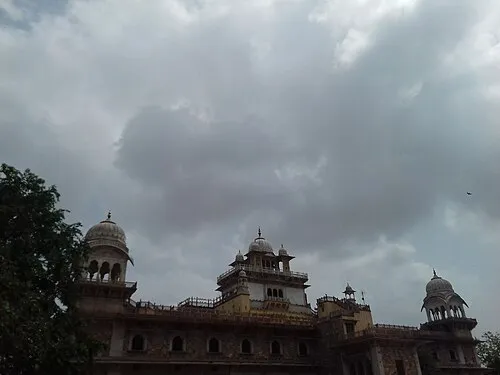
    Finish at the Albert Hall Museum inside Ram Niwas Garden, opened in 1887 in the Indo-Saracenic style. The building's foundation was laid by King Edward VII (then Prince of Wales) in 1876. The standout exhibit is a 2,300-year-old Egyptian mummy named Tutu, gifted to the Maharaja in 1883. The collection spans Rajasthani miniature paintings, metalwork, ivory carvings, and an entire room of traditional Jaipur pottery. The building itself, with its domes, arches, and sandstone detailing, is one of the finest museum buildings in India. At night, the exterior is lit up and reflected in the garden fountains.

    Learn more about Central Museum →
    Hours
    Daily: 9:00 AM – 8:00 PM
    Price
    INR 40 (Indians), INR 300 (foreigners)
AI Tourguide
Walk this exact route with a private AI guide.
Full GPS navigation, interactive stories, and a guide that answers all your questions. A private guide experience for just €5/hour.
Start This Tour

Self-Guided Tour vs. Group Tour in Jaipur

Jaipur packs more per square kilometer than almost any city in India. This route covers three centuries of Rajput ambition: a hilltop fortress with mirror-studded rooms, a palace in a lake, a wind-cooled honeycomb facade, the world's largest stone sundial, and a city palace where the royal family still lives upstairs. The distance is long, but the first two stops (Amer Fort and Jal Mahal) are outside the walled city and require a vehicle. Once you enter the Pink City on foot, everything clusters within a 2 km radius. Start early (7 AM at Amer Fort) to beat the heat and the crowds. By early afternoon, you will be in the shade of Ram Niwas Garden.

Group Tour AI Self-Guided
Price €25–€50 per person €5/hour or €20 all-inclusive
Flexibility Fixed schedule Start anytime, skip stops
Languages 1–2 languages 11 languages
Pace Group pace Your own pace

How Long Does This Jaipur Tour Take?

Our route covers 13.6 km with 9 stops and takes approximately 4.4 hours at a relaxed pace.

About 4 to 4.5 hours including transit between Amer Fort and the Pink City. The walking portion inside the walled city takes about 2.5 hours. Add time for the City Palace and Amer Fort interiors.

Tips for Walking in Jaipur

AI Tourguide
Walk this exact route with a private AI guide.
Full GPS navigation, interactive stories, and a guide that answers all your questions. A private guide experience for just €5/hour.
Start This Tour

AI Audio Guide for This Tour

Navigate Jaipur's forts, palaces, and bazaars with turn-by-turn directions on your phone. The AI Guide app tracks your position across the full 13.6 km route, marks each stop with practical details, and works offline so you can explore the Pink City without needing mobile data.

AI Audio Guide Stories, history and fun facts narrated as you walk. No earpiece rental needed.
GPS Navigation Turn-by-turn directions so you never get lost between stops.
Ask Anything Curious about a building you pass? Ask your AI guide on the spot.
11 Languages Switch language anytime. No separate tour needed.
Start This Tour Free

Common Questions

October to March. Daytime temperatures range from 22 to 30 degrees, cool enough for comfortable walking. Avoid April to June when the city regularly hits 42 to 45 degrees. The monsoon (July to September) brings relief from heat but also heavy rain and humidity.
No advance booking is needed for any stop on this tour. Tickets are sold at each entrance. However, arriving early at Amer Fort (before 9 AM) avoids the worst queues. The City Palace can also have long lines by mid-morning.
The first two stops (Amer Fort and Jal Mahal) are 11 km north of the walled city, so you need a taxi or auto-rickshaw to reach the Pink City. Once inside the walled city, stops 3 through 9 are all within walking distance of each other, spread over about 2.5 km.
No booking needed. This self-guided tour is available anytime. Open the route on your phone and start walking. The AI audio guide works instantly, no reservation required.
The AI audio guide is available in 11 languages: English, German, French, Spanish, Italian, Japanese, Chinese, Portuguese, Danish, Norwegian, and Swedish.
Yes. Skip any stop, spend extra time at places you like, or start the route from any point. You can also ask the AI to suggest a shorter route.
AI Tourguide
Curated by AI Tourguide GPS-verified routes, reviewed and updated regularly.
Last verified March 2026