Self-Guided Walking Tour in Marrakech

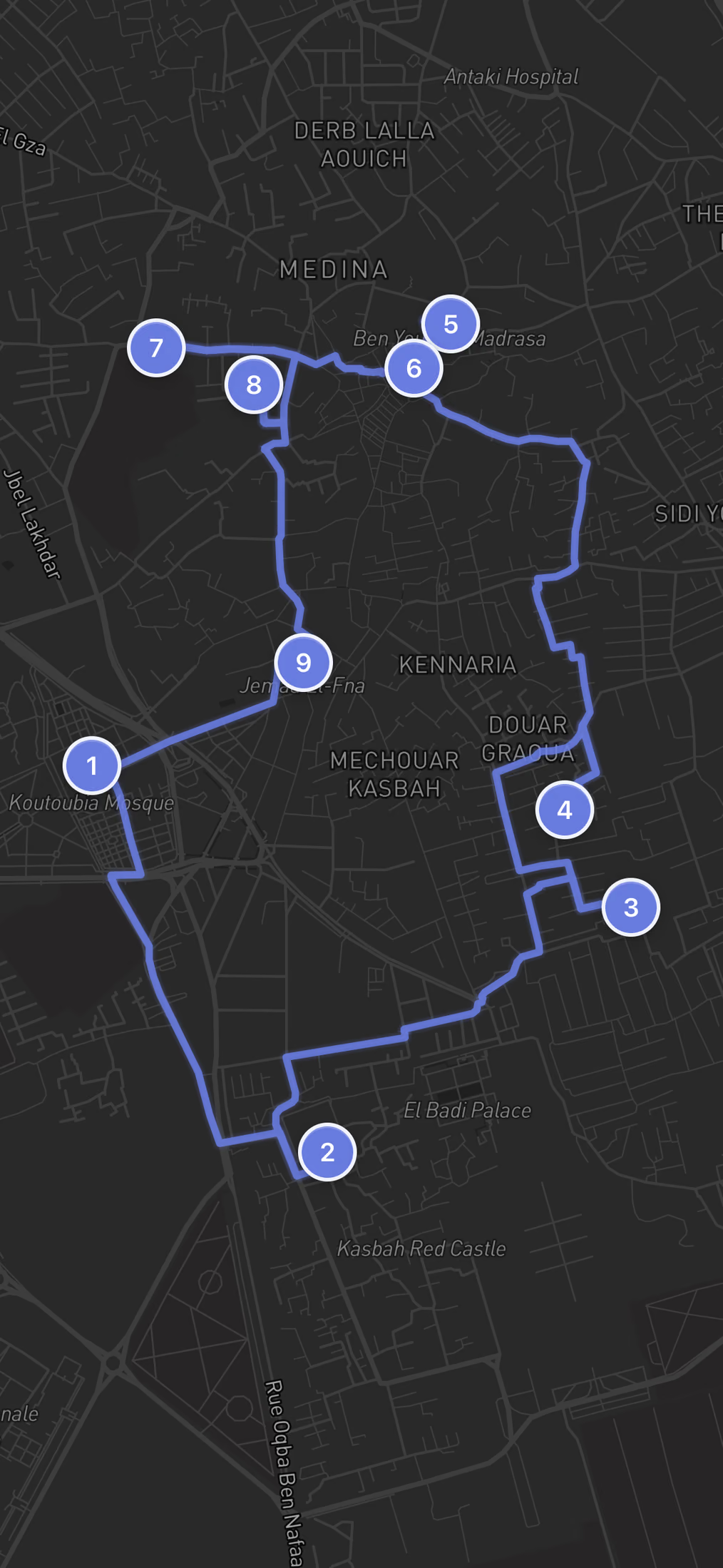
A self-guided walk through the Marrakech medina: 9 stops over 7.2 km, from the Koutoubia Mosque south to the Saadian Tombs, up through the palaces and into Jemaa el-Fnaa at sunset. This page gives you the map, the walking time for every leg, the real ticket prices and opening hours, and shorter versions if you want to trim it.

9 Stops7.2 km~3 hours walking4–5 hours with stops
What you get with AI Tourguide
Full GPS navigationInteractive AI guidePersonalized to youWorks in your browser
Try this tour with Alex

Marrakech Walking Tour at a Glance

This route is built for walking the medina at your own speed, not for ticking off every interior. The outdoor path from the Koutoubia Mosque to Jemaa el-Fnaa is the backbone, and every palace, tomb and museum along it is optional: pay in where you want to linger, walk past the rest. That is the whole point of doing it self-guided.

StartKoutoubia Mosque (Mosquée Koutoubia)
FinishJemaa el-Fnaa (Jemaa el-Fna)
Route typeA near-loop through the medina: you dip south to the Saadian Tombs, then work north through the palace and museum district, then drop back south to finish at Jemaa el-Fnaa, only a few hundred metres from where you started at the Koutoubia.
Realistic timeAround 3 hours of pure walking across the 7.2 km, but the narrow derbs and photo stops will stretch that. Enter every palace and museum and you are looking at a full 4 to 5 hour day.
DifficultyEasy underfoot but disorienting: 7.2 km on flat medina lanes, no hills, but the alleys are narrow, crowded and poorly signed, so navigation is the real effort here, not the distance.
Cost to followThe outdoor walk is free, including the Koutoubia exterior and Jemaa el-Fnaa. Interiors are cheap and pay-as-you-go: the Saadian Tombs, Bahia Palace, Dar Si Said, Medersa Ben Youssef, Museum of Marrakech and Dar El Bacha are 70 MAD each, and Le Jardin Secret is 80 MAD.
Best for:

Travellers who want the medina's key landmarks in a logical order and the freedom to pick which interiors are worth their dirhams, rather than a group tour that rushes every highlight.

The Route

Free Walking Tour Map of Marrakech

9 stops7.2 kmabout 3 hours
Loading the interactive map…The complete walking route will appear here.
Want the route to guide you while you walk?Open the route with navigation and a personal guide for the history, stories and questions that matter to you.
Open route + AI guide

The 9 stops along this route

  1. Koutoubia Mosque (Mosquée Koutoubia) in Marrakech, stop 1 on the self-guided walking tour
    1Koutoubia Mosque (Mosquée Koutoubia)
  2. Saadian Tombs (Tombeaux saadiens) in Marrakech, stop 2 on the self-guided walking tour
    2Saadian Tombs (Tombeaux saadiens)
  3. Bahia Palace (Palais El Bahia) in Marrakech, stop 3 on the self-guided walking tour
    3Bahia Palace (Palais El Bahia)
  4. Dar Si Said Museum (Musée Dar Si Said) in Marrakech, stop 4 on the self-guided walking tour
    4Dar Si Said Museum (Musée Dar Si Said)
  5. Ben Youssef Madrasa (Médersa Ben Youssef) in Marrakech, stop 5 on the self-guided walking tour
    5Ben Youssef Madrasa (Médersa Ben Youssef)
  6. Marrakech Museum (Musée de Marrakech) in Marrakech, stop 6 on the self-guided walking tour
    6Marrakech Museum (Musée de Marrakech)
  7. Dar el Bacha in Marrakech, stop 7 on the self-guided walking tour
    7Dar el Bacha
  8. Le Jardin Secret in Marrakech, stop 8 on the self-guided walking tour
    8Le Jardin Secret
  9. Jemaa el-Fnaa (Jemaa el-Fna) in Marrakech, stop 9 on the self-guided walking tour
    9Jemaa el-Fnaa (Jemaa el-Fna)
  10. That's the complete route.

    If you want more than the map and text, add live navigation and a conversational AI guide while you walk.

    Open route + AI guide
    You made it
Stop 1 of 9
Swipe →

Your Marrakech Walking Tour, Stop by Stop

  1. 1

    Koutoubia Mosque (Mosquée Koutoubia)

    Koutoubia Mosque (Mosquée Koutoubia) in Marrakech, stop 1 on the self-guided walking tour

    The Koutoubia Mosque's 77-meter minaret has dominated Marrakech's skyline since the 12th century, when the Almohad dynasty built it as a deliberate architectural statement. The minaret served as the direct model for the Giralda in Seville and the Hassan Tower in Rabat, making it one of the most influential buildings in Islamic architecture. Non-Muslims cannot enter the mosque, but the exterior is the point here. The proportions are extraordinary: the tower's height is exactly five times its width, a ratio the Almohads considered mathematically perfect. The surrounding gardens are a calm starting point before the medina's intensity. Early morning light on the pink sandstone is best for photographs.

    Price
    Free (exterior only, non-Muslims cannot enter)
  2. 2

    Saadian Tombs (Tombeaux saadiens)

    Saadian Tombs (Tombeaux saadiens) in Marrakech, stop 2 on the self-guided walking tour

    The Saadian Tombs were sealed by the Alaouite dynasty in the 18th century and forgotten for nearly 200 years until a 1917 aerial survey revealed their existence behind a wall in the Kasbah Mosque. The Hall of Twelve Columns contains the tomb of Sultan Ahmad al-Mansur, whose 25-year reign (1578 to 1603) made Marrakech one of the wealthiest cities in Africa. Italian Carrara marble columns support a cedarwood ceiling carved with honeycomb muqarnas that look impossibly intricate for a room this size. Over 60 members of the Saadian royal family are buried here. The narrow entrance passage creates bottlenecks, so arriving early in the morning is worth the effort.

    Hours
    Daily: 9:00 AM – 5:00 PM
    Price
    70 MAD
  3. 3

    Bahia Palace (Palais El Bahia)

    Bahia Palace (Palais El Bahia) in Marrakech, stop 3 on the self-guided walking tour

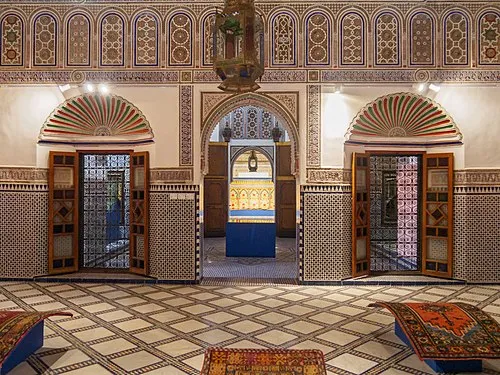
    Bahia Palace covers 8,000 square meters and took two generations to build, from 1866 to 1900. Grand Vizier Si Moussa began the project, and his son Ba Ahmed brought the finest craftsmen from Fes to create the zellij tilework, carved stucco, and painted cedarwood ceilings that cover virtually every surface. The name means "Palace of the Beautiful" and the ambition was straightforward: to build the greatest palace of its time. The sprawling layout of 150 rooms around interconnected courtyards and gardens was intentionally maze-like, designed to impress and disorient visitors. The Marble Court, with its central fountain surrounded by rooms for each of Ba Ahmed's four wives, is the architectural highlight.

    Hours
    Daily: 9:00 AM – 5:00 PM
    Price
    70 MAD
  4. 4

    Dar Si Said Museum (Musée Dar Si Said)

    Dar Si Said Museum (Musée Dar Si Said) in Marrakech, stop 4 on the self-guided walking tour

    Dar Si Said sits just minutes from the Bahia Palace because it was built by Ba Ahmed's brother, Si Said, in the same period and by some of the same craftsmen. The palace is smaller but equally refined, and now houses the Museum of Moroccan Arts, specializing in woodcraft, textiles, carpets, and jewelry from across the country. The central courtyard features an ornate marble fountain shaded by fruit trees. The collection of Berber doors and window screens from the High Atlas villages gives you context for the craftsmanship you see throughout the medina. The museum is quieter than the Bahia Palace and worth the stop for anyone interested in traditional Moroccan artisanship.

    Hours
    70 MAD
    Price
    70 MAD
  5. 5

    Ben Youssef Madrasa (Médersa Ben Youssef)

    Ben Youssef Madrasa (Médersa Ben Youssef) in Marrakech, stop 5 on the self-guided walking tour

    Founded in the 14th century and rebuilt under the Saadians in the 1560s, the Medersa Ben Youssef was the largest Islamic college in Morocco, with 132 dormitory rooms housing up to 900 students. The courtyard is the masterpiece: a rectangular pool reflects the surrounding walls, which are covered floor to ceiling in carved stucco, zellij mosaics, and cedarwood calligraphy. The marble basin at the center came from Almeria in Spain. Opening hours are daily 9:00 AM to 4:30 PM. Peek into the tiny student cells on the upper floors, each barely large enough for a sleeping mat and a pile of books, to understand the austere discipline that coexisted with this lavish decoration.

    Hours
    Daily: 9:00 AM – 4:30 PM
    Price
    70 MAD
  6. 6

    Marrakech Museum (Musée de Marrakech)

    Marrakech Museum (Musée de Marrakech) in Marrakech, stop 6 on the self-guided walking tour

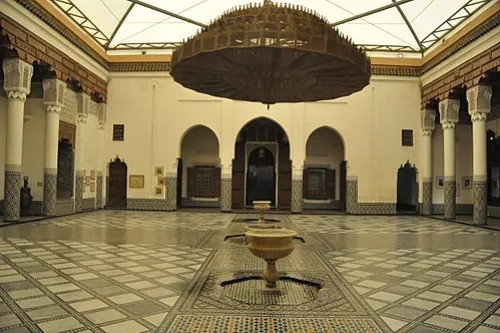
    The Museum of Marrakech occupies the 19th-century Dar Menebhi Palace, built for defense minister Mehdi Menebhi. The central courtyard is dominated by a massive brass lantern that hangs from the ceiling like a chandelier from another scale. The museum displays Moroccan art, historical artifacts, and rotating contemporary exhibitions. Opening hours are daily 9:30 AM to 6:00 PM. The building itself is the main attraction: the restored hammam, the carved plasterwork, and the tiled courtyard are among the finest examples of palatial architecture open to the public in Marrakech. The location next to the Medersa Ben Youssef makes visiting both sites back to back effortless.

    Hours
    Daily: 9:30 AM – 6:00 PM
    Price
    70 MAD
  7. 7

    Dar el Bacha

    Dar el Bacha in Marrakech, stop 7 on the self-guided walking tour

    Dar El Bacha was built in the 1910s for Pasha Thami El Glaoui, the controversial "Lord of the Atlas" who controlled Marrakech for decades and hosted guests including Winston Churchill and Charlie Chaplin. The palace now houses the Musee des Confluences, focusing on Moroccan cultural exchanges, and a branch of the Bacha Coffee house where you can sit in a tiled courtyard and drink single-origin coffee from around the world. The painted ceilings in the reception halls rival anything in the Bahia Palace. The Bacha Coffee stop is one of the best pauses on this route: excellent coffee, stunning architecture, and a chance to rest your feet in genuine palatial surroundings before the next stretch.

    Hours
    70 MAD
    Price
    70 MAD
  8. 8

    Le Jardin Secret

    Le Jardin Secret in Marrakech, stop 8 on the self-guided walking tour

    Le Jardin Secret reopened in 2016 after decades of abandonment, restoring a traditional riad garden that dates back over 400 years. The Islamic garden uses a centuries-old khettara (underground irrigation) system that channels water from the Atlas Mountains through clay pipes to feed the central basins and planting beds. Admission is 80 MAD. Opening hours are daily 9:30 AM to 4:30 PM. The garden is divided into an exotic garden with tropical plants and an Islamic garden with traditional geometric plantings. Climb to the tower for a rooftop view over the medina. This is one of the few green, quiet spaces in the densely packed medina, and the contrast with the noisy streets outside is striking.

    Hours
    Daily: 9:30 AM – 4:30 PM
    Price
    80 MAD
  9. 9

    Jemaa el-Fnaa (Jemaa el-Fna)

    Jemaa el-Fnaa (Jemaa el-Fna) in Marrakech, stop 9 on the self-guided walking tour

    Jemaa el-Fnaa is recognized by UNESCO as a Masterpiece of Oral and Intangible Heritage, and it transforms completely between day and night. By late afternoon, storytellers, musicians, and henna artists begin setting up. By evening, over 100 food stalls assemble across the plaza, filling the air with smoke from grilled meats, snail soup, and fresh orange juice. The square is free to walk through and open around the clock. For the best overview, grab a seat at one of the rooftop terraces on the south side (Cafe de France or Cafe Glacier) and watch the square come alive as the sun sets. The energy here is unlike anything else in Morocco. End your tour here and stay for dinner.

    Price
    Free

How Long Does This Walking Tour Really Take?

The walking alone is about 3 hours. Add the outdoor stops and photo time and it's closer to 4. Go inside the tombs, both palaces, the medersa and the museums and you'll spend 4 to 5 hours, which is why the smart move is to start around 9:00 AM and time your arrival at Jemaa el-Fnaa for late afternoon.

Plan for 3 hours of walking, though the medina's narrow streets and frequent stops for photographs will slow you down. If you enter every palace and museum along the route, budget 4 to 5 hours. The best strategy is to start at 9:00 AM to visit the Saadian Tombs and palaces before midday heat, then reach Jemaa el-Fnaa by late afternoon when the square begins its evening transformation.

Full Route, Shorter Walk or Two-Day Version?

The full route is one continuous walk, but it splits cleanly if you have less time or less appetite for a marathon medina day. Here are three ways to run it, all using the same 9 stops and the same start and end points.

Short version

The four essentials in half a day

Stops 1, 3, 5 and 9, roughly 4 km, about 3 hours.

For a compact morning, keep the Koutoubia Mosque (1), Bahia Palace (3), Medersa Ben Youssef (5) and Jemaa el-Fnaa (9). This drops the long southern detour to the Saadian Tombs and the northern museum cluster, giving you the single best palace, the single best medersa and the two free landmarks.

Two-day split

South one day, north the next

Day one stops 1 to 4, day two stops 5 to 9, splitting at the 1.5 km leg north to the Medersa.

Break at the longest leg (Dar Si Said to Medersa Ben Youssef, 1.5 km). Day one covers the southern half: Koutoubia, Saadian Tombs, Bahia Palace and Dar Si Said. Day two picks up in the north with the Medersa, Museum of Marrakech, Dar El Bacha and Le Jardin Secret, ending at Jemaa el-Fnaa at sunset.

You can run it backwards, starting at Jemaa el-Fnaa and finishing at the Koutoubia, but the direction given here is the better one: it saves the square for late afternoon, when the storytellers, musicians and food stalls take over and the place is at its most alive.

Is This Marrakech Walking Tour Right for You?

This is a flat but demanding walk through one of the densest old cities in the world. It suits some travellers far better than others, so here is who it is built for and how to bend it if that is not quite you.

A good fit if you…

  • Walkers comfortable with 7.2 km on foot over a half or full day
  • Anyone drawn to Islamic architecture, zellij tilework and palace courtyards
  • Independent travellers who want to choose their own interiors rather than follow a group
  • People happy to navigate crowded, narrow, poorly signed medina alleys with an offline map

Adapt the route if you…

  • Short on time: take the four-essentials version and skip the museum cluster
  • Travelling with kids or tired legs: split it across two days at the Medersa leg
  • On a tight budget: walk the free outdoor route and pay into only one or two interiors
  • Avoiding heat: start at 9:00 AM and reach Jemaa el-Fnaa in the cooler late afternoon

Tickets & Skip-the-Line in Marrakech

Most stops on this route are small ticketed monuments with cheap cash entry and no online fast-track, so the real trick is arriving early to beat the bottlenecks rather than buying a queue-jump pass.

Saadian Tombs (Tombeaux saadiens)70 MAD entry, open daily 9:00 AM to 5:00 PM. The narrow entrance passage creates a real bottleneck, so come right at opening.
Bahia Palace (Palais El Bahia)70 MAD entry, open daily 9:00 AM to 5:00 PM. Tour groups fill the corridors by late morning, so aim for before 11:00 AM.
Dar Si Said Museum (Musée Dar Si Said)70 MAD entry. Quieter than the Bahia Palace next door, so no queue to worry about here.
Ben Youssef Madrasa (Médersa Ben Youssef)70 MAD entry, open daily 9:00 AM to 4:30 PM.
Marrakech Museum (Musée de Marrakech)70 MAD entry, open daily 9:30 AM to 6:00 PM, right next to the Medersa so you can do both back to back.
Dar el Bacha70 MAD entry to the Musee des Confluences. The Bacha Coffee house inside is a good paid pause for a drink in the tiled courtyard.
Le Jardin Secret80 MAD entry, open daily 9:30 AM to 4:30 PM.
Everything else is freeThe Koutoubia Mosque is viewed from outside only (non-Muslims cannot enter) and costs nothing, and Jemaa el-Fnaa is an open public square you can walk through around the clock for free.
Optional upgrade
+5
The same 9-stop route,
now with navigation and a guide.
Optional AI experience

You already have the route.
The AI guide brings it to life.

Standing under the towering Koutoubia Mosque, or already deep in the medina derbs? Open AI Tourguide right in your browser, no app to download, and a voice guide leads the whole route with you to Jemaa el-Fnaa: it greets you, tells the story along the way, and asks what you want to see so it adapts as you go. A real conversation, not a recording. Start with 100 free credits.

Livenavigation13languagesAnyquestionYourinterests
Open this route with the AI guide

Try it in your browser · No app or download required

Tips for Walking in Marrakech

  • Start early. The Saadian Tombs and Bahia Palace are significantly more pleasant before 11:00 AM, when tour groups fill the narrow corridors. Morning light also penetrates the palace courtyards at a lower angle, which makes the carved stucco and zellij patterns far more photogenic.
  • Carry small denominations of dirhams. Many medina interactions, from buying bottled water to tipping someone who points you in the right direction, work on cash in the 5 to 20 MAD range. ATMs are available near Jemaa el-Fnaa but rare deeper in the medina.
  • Navigation in the medina can be confusing. Download an offline map (Google Maps or Maps.me) before you start. The derbs (alleyways) are poorly signed, and asking directions will often result in someone offering to guide you for a tip.
  • Dress modestly out of respect for local customs. Shoulders and knees covered is the practical minimum. The medina is conservative, and you will feel more comfortable blending in. A light scarf is useful for sun protection and for covering shoulders when entering religious sites.
  • End your tour at Jemaa el-Fnaa at sunset for the full experience. The food stalls are freshest when they first open around 6:00 PM. Stick to stalls with visible flames and high turnover. Fresh orange juice is sold everywhere for about 5 MAD per glass.

Where to Eat Along the Route

The route runs straight through the medina, but that is exactly where the food is weakest. The restaurants ringing Jemaa el-Fnaa are built for tourist churn, not care, and locals rarely eat inside the old town at all. The genuinely good meals sit either on the medina's spice-market rooftops or a short taxi ride away in Guéliz, the new town where Moroccans actually eat.

  • Place des Epices in the heart of the medina, where the best rooftop cafes cluster with views over the spice market, a five-minute detour from the Medersa Ben Youssef leg of the route.
  • Mechoui Alley, hidden just behind Jemaa el-Fnaa, a no-sign row of vendors slow-roasting whole lamb in underground ovens. Go just before 1pm, because when the lamb runs out it is gone.
  • Guéliz, the modern new town, specifically Rue Ibn Aicha and Rue Mohammed el Beqal, where cheap grilled-meat spots pack out with locals at lunch. This is where Moroccans go, not the square.
  • Deeper in the souks away from the main square, where street food (sardine sandwiches, bean-and-lentil breakfasts, m'smen) is cheap and consistently better than a standard medina cafe.
Cafe des Epices⌖The consensus best cafe in the medina, right on Place des Epices with the finest rooftop views of any spice-market cafe. Affordable tagines, sandwiches and Moroccan breakfast. Open 9am to 11pm daily.
Mechoui Alley⌖The best lamb in Marrakech, sold by weight and served with bread, salt and cumin. Skip the famous Chez Lamine and pick any vendor in the alley, the lamb is the same. Arrive before 1pm.
Amal Women's Training Center⌖A non-profit in Guéliz training disadvantaged women, and one of the best lunches in the city. Legendary Friday couscous around 50 MAD. Open 12:00 to 15:30 Mon to Sat, and worth booking ahead for Fridays.
Dabachi Chez Cherif⌖A budget favourite hidden in the medina with set menus (soup, salads, grilled brochettes, olives, bread and a drink) that are among the best value in town. Closed Fridays.

Skip the restaurants in the immediate Jemaa el-Fnaa square (mediocre food, small portions and frequent overcharging) and do not buy cookies from the carts on the square, where the quality is far below the medina patisseries.

Tourist Traps to Avoid in Marrakech

Marrakech runs on tourist scams more than almost anywhere, and the medina and Jemaa el-Fnaa are the epicentre, so keep your guard up on this route.

  • Fake guides ("faux guides") are the dominant scam. Someone friendly offers a shortcut or a "market only today," walks you to a shop for commission, then demands 150 to 200 MAD. A polite firm "la, shukran" and walking on is the answer.
  • The "it's closed" line. If anyone tells you Bahia Palace, the Saadian Tombs or your riad is closed or flooded and offers somewhere better, ignore it and keep walking to the real entrance.
  • Snake and monkey photo scams on Jemaa el-Fnaa. Handlers drape an animal on you unasked, then demand 100 to 300 MAD, and the distraction is also used for pickpocketing. Hand it back firmly and leave.
  • Henna bait-and-switch. Women quote a tiny price, cover your arm in an elaborate design, then demand ten times more, and street "black henna" can contain PPD that burns. Agree price and design in writing, or go to a dedicated henna cafe.
  • Square restaurant tricks. Bread and small appetiser dishes brought unasked are not free, and a cheap menu at the door can switch to an inflated one at the bill. Confirm prices before you order.
  • Taxi meter games. Petit taxis must run the meter, so if a driver says it is broken or quotes a flat rate it is an overcharge. A cross-town trip is 10 to 20 MAD, and the airport should be around 70 to 100 MAD.
  • Souk pricing. The first price is often five to seven times the real value, so start low and be ready to walk away, which drops the price fast.

Why Walk This Route?

This 7.2 km walking tour through Marrakech covers 9 stops in roughly 3 hours, threading through the medina from the towering Koutoubia Mosque to the royal Saadian Tombs, through palatial courtyards, past the oldest Islamic college in Morocco, and ending at the sensory overload of Jemaa el-Fnaa square at sunset. You will navigate narrow derbs (alleyways) where donkey carts share space with motorbikes, duck through carved cedar doorways into palaces that took decades to build, and walk through garden riads where centuries-old irrigation channels still feed fountains. The medina can feel disorienting, but this route follows a logical loop that keeps you moving through its most important landmarks.

Common Questions

Is the medina safe to walk through?

Yes. Marrakech's medina is heavily touristed and generally safe during daytime. The main risk is persistent touts offering guide services or directing you to shops for a commission. A polite but firm "la shukran" (no thank you) works. Avoid poorly lit side streets late at night and keep valuables in a front pocket or crossbody bag.

Can I enter the mosques on this tour?

Non-Muslims cannot enter the Koutoubia Mosque or any active mosque in Morocco. The Medersa Ben Youssef, which is no longer a functioning school, is open to all visitors and gives you the closest experience to mosque-style Islamic architecture. The Saadian Tombs, though attached to the Kasbah Mosque, have a separate visitor entrance.

What is the best day to do this tour?

Any day works, but Friday is prayer day and some sites may have adjusted hours. The medina itself is most active on weekday mornings when locals are shopping. Avoid the hottest months (July and August) if possible, when midday temperatures regularly exceed 40 degrees Celsius.

Take this route with you

Open this exact tour with navigation and your personal AI guide.

Start GPS Navigation + AI Guide
AI Tourguide
Researched and curated by the AI Tourguide teamWe plan and quality-check every route, then research and verify the opening hours, prices, and practical tips for each stop along it.
▶ Open route with AI guideNavigation, stories and your questions