Self-Guided Walking Tour in Montreal

10 Stops 11.2 km ~4.0 hours
Start This Tour Free
Walking tour route map of Montreal
Start This Tour Free

Why Walk Montreal? A Self-Guided Tour

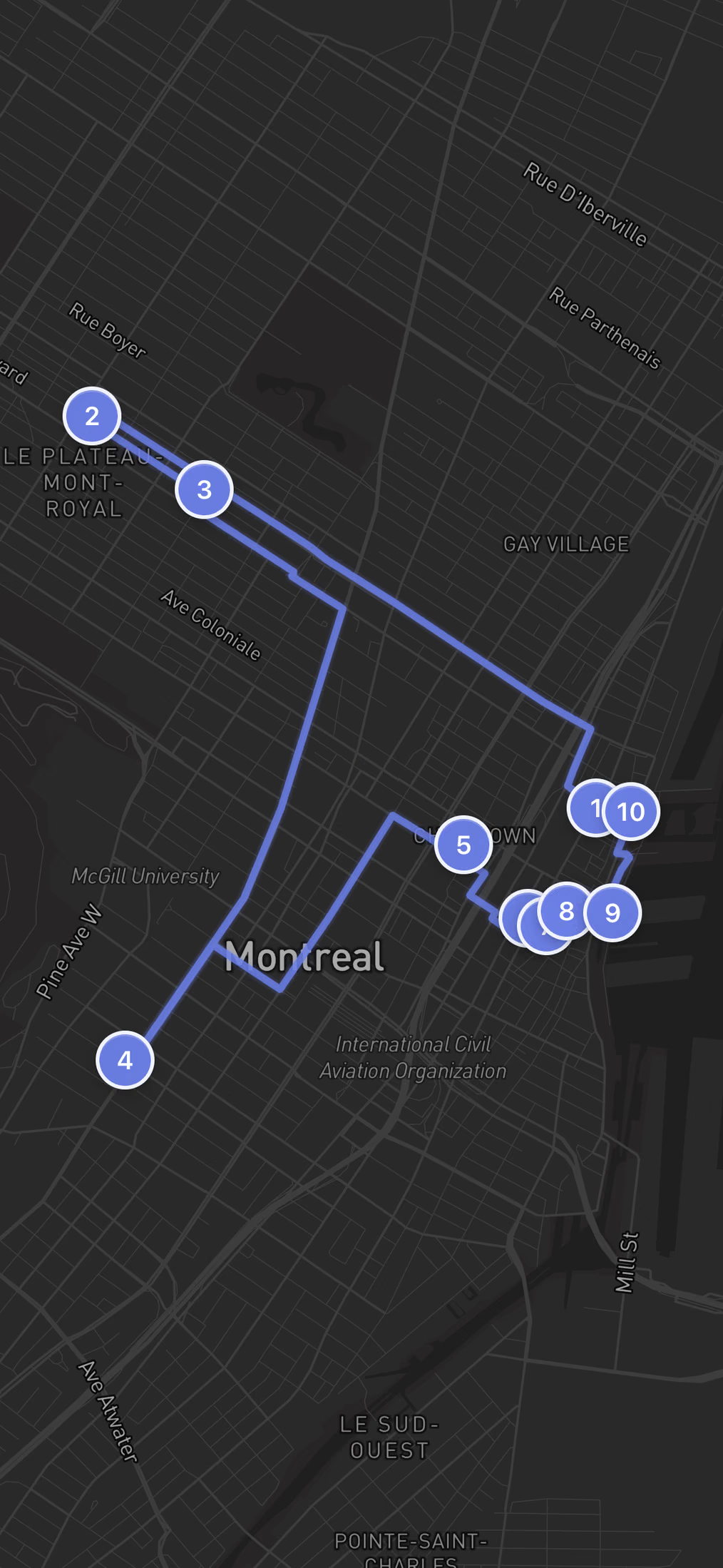
Montreal is a city that rewards walking like few others in North America. The grid bends around the mountain, neighborhoods shift language and culture every few blocks, and the whole place sits on an island in the St. Lawrence River. This self-guided walking tour covers 11.2 kilometers across 10 stops in about 4 hours, starting in 18th-century Old Montreal, climbing Mount Royal for the defining city view, cutting through the colorful Plateau neighborhood, and finishing at the Museum of Fine Arts.

What makes this specific route work is that it follows the city's actual timeline. You begin at Chateau Ramezay, where Benjamin Franklin once tried to convince Quebecers to join the American Revolution, then walk through the waterfront district, climb the mountain designed by the same architect behind Central Park, and end at Canada's oldest art museum. Most guided group tours cover Old Montreal and nothing else. This route gives you the Montreal that locals actually live in.

The Route: 10 Stops

Swipe through images or scroll names below

Scroll to explore →
1. Château Ramezay
2. Mount Royal
3. The Plateau
4. Montreal Museum of Fine Arts
5. Chinatown
6. Place d'Armes
7. Notre-Dame Basilica
8. Old Montreal
9. Old Port of Montreal
10. Marché Bonsecours

Route Map

Tap to load interactive map
AI Tourguide
Walk this exact route with a private AI guide.
Full GPS navigation, interactive stories, and a guide that answers all your questions. A private guide experience for just €5/hour.
Start This Tour

Your Montreal Walking Tour, Stop by Stop

  1. 1

    Château Ramezay

    Château Ramezay

    Start at the oldest private museum in Quebec. This stone building from 1706 has served as a governor's residence, a fur trading headquarters, a courthouse, and the seat of government during the brief American occupation of Montreal in 1775-1776, when Benjamin Franklin stayed here trying to convince Quebecers to join the revolution. Today the museum covers Montreal's history from Indigenous peoples through the French regime to the British era and beyond. The rooms are small and period-furnished, and the thick stone walls keep the interior cool even in August. Behind the building, a restored 18th-century governor's garden is planted with herbs, vegetables, and flowers from the colonial period. The garden is free and is one of the quietest spots in Old Montreal. Admission is 16 CAD. Open daily 10:00 AM to 5:00 PM. Allow about an hour for the museum and garden together. Exit and walk west on Rue Notre-Dame toward the square.
    Learn more about Château Ramezay →
    Hours
    Daily: 10:00 AM – 5:00 PM
    Price
    14 CAD

    5 min walk to next stop

  2. 2

    Mount Royal

    Mount Royal

    Montreal literally gets its name from this mountain. Mont Royal rises 233 meters above sea level, and Frederick Law Olmsted, the architect behind Central Park, designed the park in 1876. The climb from the Plateau side takes about 20 minutes on foot. In winter, locals cross-country ski and toboggan here. In summer, the tam-tams drum circle takes over the base of the mountain every Sunday afternoon from roughly May through October, drawing hundreds of people who sit on the grass, dance, and picnic at the George-Etienne Cartier Monument. The real payoff is the Kondiaronk Lookout at the summit: the downtown skyline, the St. Lawrence River, and on clear days, the Monteregian Hills spread out below you. Sunset from here is the single best free experience in the city. Free, open daily 6:00 AM to midnight. Bring a blanket and something to eat if you catch the Sunday drum circle.

    Learn more about Mount Royal →
    Hours
    Free
    Price
    Free

    20 min walk to next stop

  3. 3

    The Plateau

    The Plateau

    This is where Montreal feels most like itself. The neighborhood of 104,000 residents sits on the eastern slope of Mount Royal, and it has the highest concentration of artists, musicians, and creative spaces in the country. The streets are lined with the colorful outdoor staircases that define Montreal's visual identity. Boulevard Saint-Laurent ("The Main") has been the dividing line between English and French Montreal since the 19th century and is packed with restaurants, bars, vintage shops, and live music venues. So many French expats have settled here since the 2000s that locals call it "Petit-Paris." Avenue Duluth between Saint-Laurent and Saint-Denis is restaurant row, and most places are BYOB: grab a bottle from a depanneur and save on the markup. Free to wander, always accessible. Unlike tourist-focused Old Montreal, this is a working neighborhood where people actually live.

    Learn more about The Plateau →
    Hours
    Free
    Price
    Free

    15 min walk to next stop

  4. 4

    Montreal Museum of Fine Arts

    Montreal Museum of Fine Arts

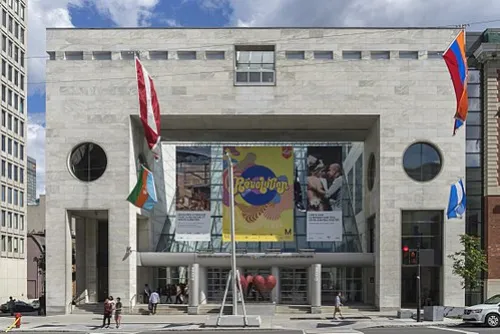
    Founded in 1860, this is the oldest and largest art museum in Canada. The collection spans over 43,000 works across 5 connected buildings that straddle both sides of Rue Sherbrooke Ouest: Rembrandt to Warhol, Inuit sculpture to contemporary Quebec art, Japanese prints to Art Deco furniture. The Claire and Marc Bourgie Pavilion, inside a converted church, houses Quebec and Canadian art in one of the most striking exhibition spaces in the city. An underground tunnel connects the neoclassical Hornstein Pavilion to the modernist Desmarais Pavilion across the street. Admission is 24 CAD. Open Tuesday through Sunday 10:00 AM to 5:00 PM, extended to 9:00 PM on Wednesdays. Closed Mondays. Wednesday evenings after 5:00 PM are quieter, without the school groups that fill galleries during the day. Budget at least 2 hours.

    Learn more about Montreal Museum of Fine Arts →
    Hours
    Mon: Closed | Tue: 10:00 AM – 5:00 PM | Wed: 10:00 AM – 9:00 PM | Thu-Sun: 10:00 AM – 5:00 PM
    Price
    24 CAD

    20 min walk to next stop

  5. 5

    Chinatown

    Chinatown

    Montreal's Chinatown is small but packed: roughly 4 blocks centered on Rue de la Gauchetiere between Rue Saint-Urbain and Boulevard Saint-Laurent. Ornamental gates mark the boundaries, and the pedestrianized section gives the street a market feel, especially on weekends. This is where you come for inexpensive, filling meals. Pho, dim sum, Cantonese barbecue, bubble tea, and Chinese bakery items are all within a few steps. The restaurants are no-frills and fast. Prices are lower than almost anywhere else in central Montreal. The dim sum restaurants on the upper floors along Rue de la Gauchetiere are consistently better than the ground-floor spots; look for the ones with lines of Chinese families on weekend mornings. Chinatown sits just north of Old Montreal, so you can walk here from Place d'Armes in about 5 minutes. A practical lunch stop if you are hungry and moving between neighborhoods.

    Learn more about Chinatown →
    Hours
    Free
    Price
    Free

    8 min walk to next stop

  6. 6

    Place d'Armes

    Place d'Armes

    Three centuries of architecture face each other across a single small square. Notre-Dame Basilica dominates one side. Across from it, the 1888 New York Life Building (Montreal's first skyscraper) shares the view with the Art Deco Aldred Building from 1931 and the Bank of Montreal headquarters from 1847. Very few places in North America pack this much architectural range into such a compact area. A statue of Paul de Chomedey de Maisonneuve, Montreal's founder, stands in the center. The square was originally a military parade ground, and today it is where walking tours begin, tourists photograph the basilica, and office workers eat lunch. Free, always open. Stand on the south side facing north for the best photo angle: you get the basilica, the Aldred Building, and the Bank of Montreal in a single frame. Walk east toward the basilica entrance.

    Learn more about Place d'Armes →
    Hours
    Free
    Price
    Free

    1 min walk to next stop

  7. 7

    Notre-Dame Basilica

    Notre-Dame Basilica

    Walking into Notre-Dame, your eyes need a moment to adjust. The interior is dark, then suddenly electric blue and gold explode across your vision. This is the largest church in Montreal, and the neo-Gothic interior completed in the 1880s has no equal in the city. The vaulted ceiling, carved wood, stained glass, and thousands of gold-leaf stars make it feel like stepping inside a jewel box. Irish-American architect James O'Donnell designed it and was so moved by the project that he converted to Catholicism to be buried inside. The 69-meter twin towers dominated the city skyline for decades after completion in 1829. Admission is 16 CAD. Open Monday through Friday 9:00 AM to 4:30 PM, Saturday until 4:00 PM, Sunday 12:30 to 4:00 PM. The AURA light show runs evenings and transforms the interior with projections and music. Book the last showing for smaller crowds. Walk east into the surrounding streets of Old Montreal.

    Learn more about Notre-Dame Basilica →
    Hours
    Mon-Fri: 9:00 AM – 4:30 PM | Sat: 9:00 AM – 4:00 PM | Sun: 12:30 – 4:00 PM
    Price
    18 CAD

    3 min walk to next stop

  8. 8

    Old Montreal

    Old Montreal

    This is where the city started, and it still feels that way. Cobblestone streets, 17th-century stone buildings, and horse-drawn carriages give the quarter a European atmosphere rare in North America. The area covers roughly 20 blocks between the waterfront and Rue Saint-Antoine. Rue Saint-Paul, the oldest street in the city, runs the full length and is lined with galleries, restaurants, and small shops. French colonial stone walls sit next to Victorian-era banks, and 1960s Brutalism lurks at the edges. On summer evenings, street performers take over the squares and the quarter stays alive past midnight. In winter, the crowds thin and the atmosphere becomes more atmospheric. Rue Saint-Paul between Place Jacques-Cartier and Place d'Armes has the best concentration of galleries and independent shops. Walk it heading west for the best afternoon light. Free to wander, always open. Head south toward the water.

    Learn more about Old Montreal →
    Hours
    Free
    Price
    Free

    5 min walk to next stop

  9. 9

    Old Port of Montreal

    Old Port of Montreal

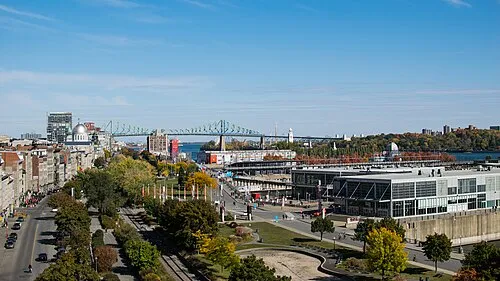
    The Old Port stretches over 2 kilometers along the St. Lawrence River, directly south of Old Montreal. Commercial shipping moved east in 1976, and a 1990s redevelopment turned the waterfront into a public space that now draws more than 6 million visitors per year. In summer, you can rent paddleboats, ride the Grande Roue observation wheel, cycle the promenade, or sit on the quays watching container ships pass. The Clock Tower at the eastern end, built in 1922, has a free observation deck reached by a 192-step climb with rarely a line. Clock Tower Beach opens in summer and feels like a small urban seaside. In winter, the port becomes an outdoor skating area. Free to walk, always accessible. The path connects west to the Lachine Canal for extended waterfront walking. Head northeast along Rue Saint-Paul toward the final stop.

    Learn more about Old Port of Montreal →
    Hours
    Free
    Price
    Free

    8 min walk to next stop

  10. 10

    Marché Bonsecours

    Marché Bonsecours

    The neoclassical facade with its distinctive silver dome is one of Old Montreal's most recognizable buildings. Built in 1847 as a public market, it later served as Montreal's city hall and a concert venue before settling into its current role as a boutique shopping hall. The cast-iron columns imported from England support an exterior that is the real draw. Inside, shops lean toward Quebec designer clothing, jewelry, leather goods, and crafts. This is no longer a food market despite the name. It is pleasant to browse, but not a budget destination. If you want actual food markets, Jean-Talon or Atwater are your targets. Open Monday through Wednesday and Sunday 10:00 AM to 6:00 PM, Thursday through Saturday until 7:00 PM. Free entry. The upper level has a balcony with a view toward the port that most visitors miss. Ask at any shop and they will point you to the stairs.

    Learn more about Marché Bonsecours →
    Hours
    Mon-Wed: 10:00 AM – 6:00 PM | Thu-Sat: 10:00 AM – 7:00 PM | Sun: 10:00 AM – 6:00 PM
    Price
    Free (entry)
AI Tourguide
Walk this exact route with a private AI guide.
Full GPS navigation, interactive stories, and a guide that answers all your questions. A private guide experience for just €5/hour.
Start This Tour

Self-Guided Tour vs. Group Tour in Montreal

This route covers the full sweep of Montreal, from 18th-century colonial stone to the summit of the mountain that gave the city its name to the creative neighborhoods where locals actually spend their time. Most visitors stay in Old Montreal and miss the residential character that makes the city special. The climb up Mount Royal is the physical centerpiece, and the view from the Kondiaronk Lookout earns every step. The contrast between the cobblestones of Old Montreal and the colorful staircases of The Plateau shows two completely different cities within walking distance of each other.

Group Tour AI Self-Guided
Price €25–€50 per person €5/hour or €20 all-inclusive
Flexibility Fixed schedule Start anytime, skip stops
Languages 1–2 languages 11 languages
Pace Group pace Your own pace

How Long Does This Montreal Tour Take?

Our route covers 11.2 km with 10 stops and takes approximately 4.0 hours at a relaxed pace.

About 4 hours of walking at a comfortable pace. Add time for stops: 60 minutes at Chateau Ramezay, 30 minutes on Mount Royal summit, 2 hours at the Museum of Fine Arts, and 45 minutes at Notre-Dame Basilica. A thorough visit with museum time fills a full day.

Tips for Walking in Montreal

AI Tourguide
Walk this exact route with a private AI guide.
Full GPS navigation, interactive stories, and a guide that answers all your questions. A private guide experience for just €5/hour.
Start This Tour

AI Audio Guide for This Tour

Follow the complete Montreal walking tour with offline maps and automatic navigation in the AI Guide app. The app tracks your position from Old Montreal through Mount Royal to The Plateau and guides you turn by turn, so you can focus on the cobblestones, the mountain views, and the best bagels in North America.

AI Audio Guide Stories, history and fun facts narrated as you walk. No earpiece rental needed.
GPS Navigation Turn-by-turn directions so you never get lost between stops.
Ask Anything Curious about a building you pass? Ask your AI guide on the spot.
11 Languages Switch language anytime. No separate tour needed.
Start This Tour Free

Common Questions

Yes, but Montreal winters are serious: temperatures drop to minus 20 Celsius in January, and sidewalks can be icy. Dress in layers, wear insulated boots with grip, and allow extra time. Mount Royal in snow is genuinely beautiful, and winter thins the crowds everywhere on the route. The Museum of Fine Arts and Notre-Dame Basilica are warm refuges.
Chateau Ramezay is 16 CAD, Notre-Dame Basilica is 16 CAD, and the Museum of Fine Arts is 24 CAD. Total for all three paid sites is 56 CAD. Mount Royal, The Plateau, Chinatown, Place d'Armes, Old Montreal, Old Port, and Marche Bonsecours are all free. The MBAM is free for visitors under 21 and free on the first Sunday of each month.
Montreal is officially bilingual. Most people in the service industry speak both French and English, especially in Old Montreal, The Plateau, and along Sherbrooke. Starting with a "bonjour" is appreciated and expected. Menus, signs, and museum labels are typically in both languages.
No booking needed. This self-guided tour is available anytime. Open the route on your phone and start walking. The AI audio guide works instantly, no reservation required.
The AI audio guide is available in 11 languages: English, German, French, Spanish, Italian, Japanese, Chinese, Portuguese, Danish, Norwegian, and Swedish.
Yes. Skip any stop, spend extra time at places you like, or start the route from any point. You can also ask the AI to suggest a shorter route.
AI Tourguide
Curated by AI Tourguide GPS-verified routes, reviewed and updated regularly.
Last verified March 2026