Self-Guided Walking Tour in Palma

9 Stops 4.2 km ~2.2 hours
Start This Tour Free
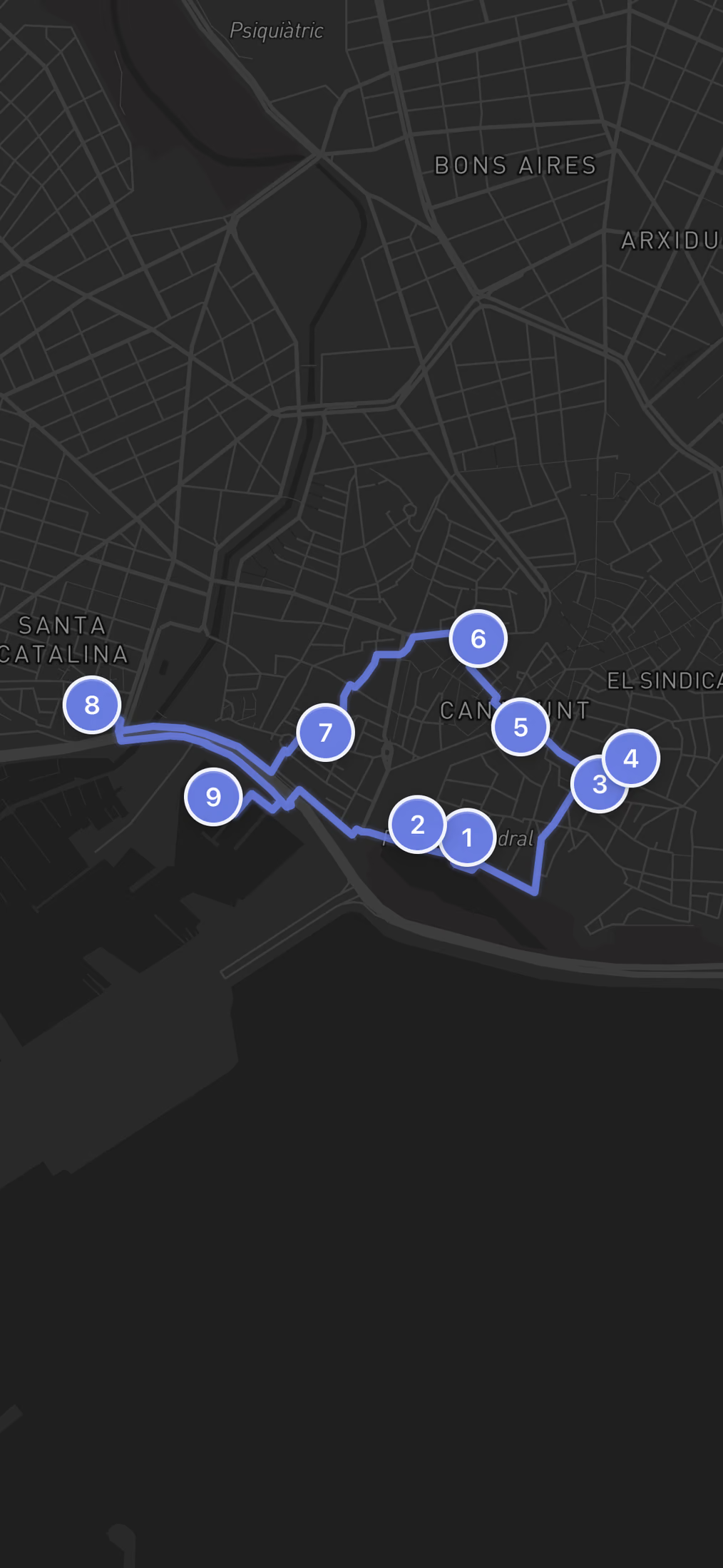
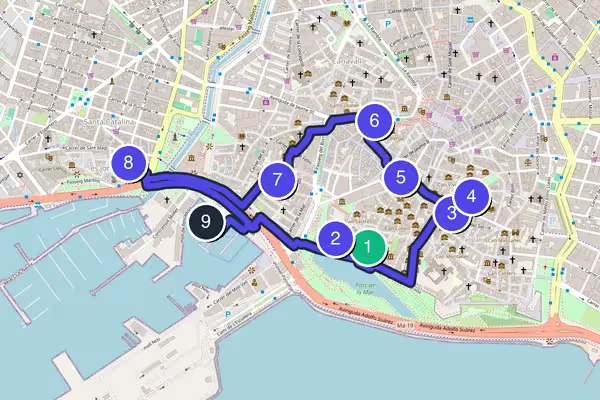
Walking tour route map of Palma
Start This Tour Free

Why Walk Palma? A Self-Guided Tour

Palma de Mallorca rewards walking in a way that most resort cities do not. Behind the beach-holiday facade sits a proper Gothic old town with a cathedral that rivals Barcelona's, aristocratic mansions hiding Renaissance courtyards, and a trade hall that has been standing since 1452. The streets are narrow enough to stay shaded for most of the day, which matters on an island where summer temperatures regularly clear 35 degrees.

This 4.2 km route connects nine stops through the heart of the old town, from the waterfront cathedral up through the medieval core and back down to the western fortifications. It takes roughly 2 hours at a comfortable pace, longer if you enter the museums and churches along the way. The route works as a morning walk before the heat builds, or as a late afternoon stroll when the sandstone turns golden. Every stop is within five minutes of the next, and the terrain is flat once you are past the initial climb from the cathedral to the upper town.

The Route: 9 Stops

Swipe through images or scroll names below

Scroll to explore →
1. Palma Cathedral
2. Royal Palace of La Almudaina
3. Arab Baths
4. Basilica of Sant Francesc
5. Plaça de Cort
6. Plaça Major
7. Passeig des Born
8. Es Baluard
9. Lonja de Palma

Route Map

Tap to load interactive map
AI Tourguide
Walk this exact route with a private AI guide.
Full GPS navigation, interactive stories, and a guide that answers all your questions. A private guide experience for just €5/hour.
Start This Tour

Your Palma Walking Tour, Stop by Stop

  1. 1

    Palma Cathedral

    Palma Cathedral

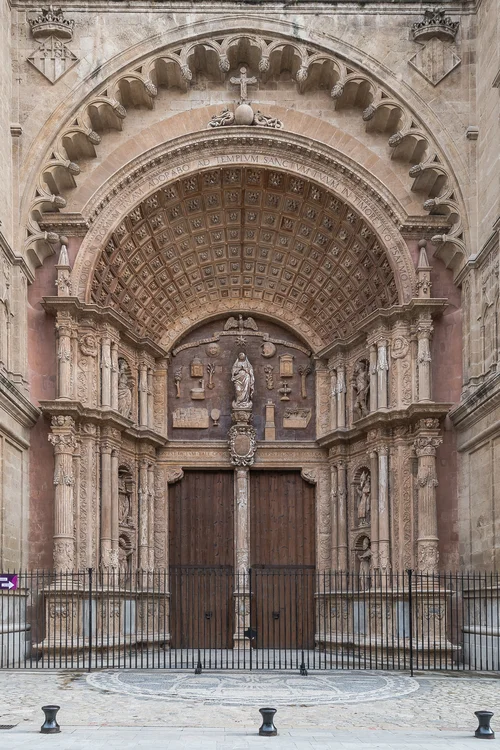
    Construction began in 1229 on the site of a mosque, and the central nave reaches 44 meters, making it one of the tallest Gothic interiors in Europe. The building took nearly 400 years to complete, and Antoni Gaudi added his touch during a 1904 restoration, designing a crown-of-thorns chandelier that hangs above the altar. The best-known phenomenon happens on February 2nd and November 11th, when the morning sun projects a figure-eight light pattern through the main rose window onto the interior wall opposite. The exterior is most photogenic from Parc de la Mar below, where the cathedral and the Almudaina Palace reflect in an artificial saltwater lake. Morning light is best for that shot. The south-facing facade dominates the harbor skyline, and you can appreciate it without paying for entry. If you do go inside, plan 30 to 45 minutes for the nave, the chapels, and the small museum.

    Learn more about Palma Cathedral →
    Hours
    Mon-Fri: 10:00 AM – 5:15 PM | Sat: 10:00 AM – 2:15 PM | Sun: Closed
    Price
    €8

    2 min walk

  2. 2

    Royal Palace of La Almudaina

    Royal Palace of La Almudaina

    Right next to the cathedral, this palace started as a Roman fortification, became an Arab alcazar, and was rebuilt as a Gothic royal residence by King James II between 1305 and 1314. A bronze weather vane of the Archangel Gabriel stands atop the Angel Tower as a protective symbol. Today it remains an official royal residence managed by Patrimonio Nacional, though the Spanish royal family rarely uses it. The interior is grand but relatively sparse. The Gothic Throne Room (Salo del Tinell) and the Chapel of Santa Ana are the standout spaces. Admission is 7 EUR. Open Monday to Saturday 10:00 AM to 6:00 PM, Sunday until 3:00 PM. The view from the gardens is excellent: you look across to the cathedral on one side and down to the port on the other. Combine it with the cathedral since they are literally next door.

    Learn more about Royal Palace of La Almudaina →
    Hours
    Open 24/7
    Price
    Free

    4 min walk

  3. 3

    Arab Baths

    Arab Baths

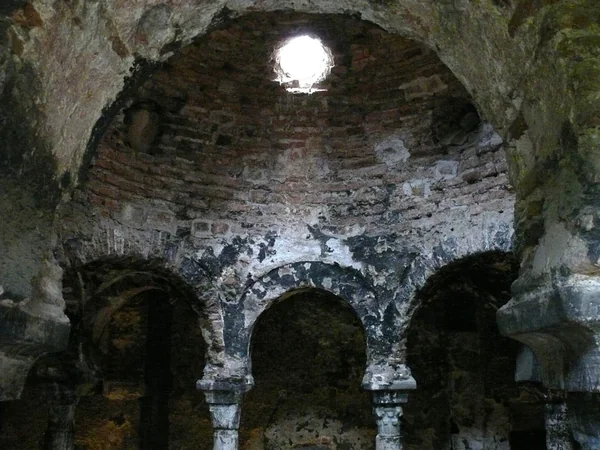
    These 10th-century hammams are tucked into a courtyard garden a few minutes uphill from the cathedral, and most visitors walk right past the entrance without noticing it. The central Caldarium is supported by 12 columns salvaged from older Roman and Byzantine structures, no two exactly alike. Twenty-five circular skylights in the domed ceiling allowed steam to circulate while filtering in shafts of sunlight. The room is small, you can see everything in 10 minutes, but the atmosphere is dense with history. This is one of the few surviving structures from the Islamic period on Mallorca, predating the Christian conquest by over two centuries. The garden surrounding the baths is a quiet spot to sit among palm trees and bougainvillea before continuing into the old town.

    Learn more about Arab Baths →
    Hours
    Daily: 10:00 AM – 6:00 PM
    Price
    3 EUR

    2 min walk

  4. 4

    Basilica of Sant Francesc

    Basilica of Sant Francesc

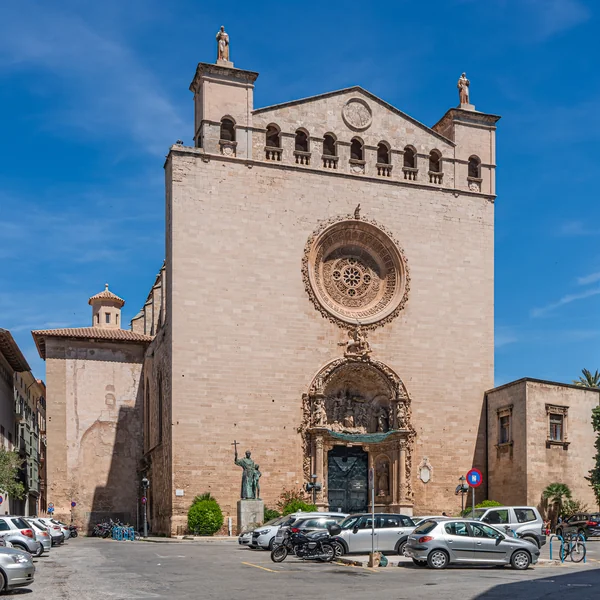
    While everyone files into the cathedral, this Franciscan church sits quietly a few blocks northeast, getting a fraction of the visitors. That is a mistake. Founded in 1278, it has a two-story Gothic cloister surrounded by slender columns and lemon trees that ranks among the most beautiful in Spain. The church itself is large and austere, with a single nave and a massive rose window above the entrance. Inside you will find the tomb of Ramon Llull, the 13th-century Mallorcan philosopher and writer. The baroque facade was added in the late 17th century after a lightning strike destroyed the original. The upper gallery of the cloister is often empty even when the ground level has visitors. Take the stairs in the corner for a better view of the courtyard and near-total quiet. Open Monday to Saturday 9:30 AM to 1:00 PM and 3:30 to 6:00 PM, Sundays until 1:00 PM.

    Learn more about Basilica of Sant Francesc →
    Hours
    Mon-Sat: 9:30 AM - 1:00 PM, 3:30 - 6:00 PM | Sun: 9:30 AM - 1:00 PM
    Price
    Free

    2 min walk

  5. 5

    Plaça de Cort

    Plaça de Cort

    The civic heart of Palma is home to the Ajuntament (city hall) with its distinctive overhanging wooden eave, one of the most photographed architectural details in the city. The carved wooden roof projection over the entrance dates to the 17th century, and in front of the building an ancient olive tree, reportedly over 800 years old, sits in a raised planter. Its gnarled trunk contains a natural wood formation that locals call "the face." The square is compact, more of a widened intersection than a grand plaza. From here you are equidistant to most of the old town's sights: 3 minutes to Sant Francesc, 5 minutes to the cathedral, 2 minutes to Passeig des Born. Step inside the city hall lobby during office hours (free) to see the collection of gegants, the giant painted figures paraded through the streets during Palma's fiestas. Sit at one of the terrace bars under the olive tree and watch the city go about its business.

    Learn more about Plaça de Cort →
    Hours
    Daily: 24 hours (public square)
    Price
    Free

    3 min walk

  6. 6

    Plaça Major

    Plaça Major

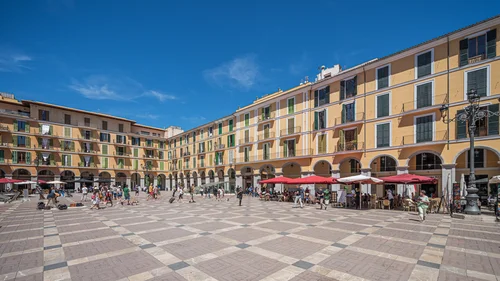
    This arcaded square occupies the former site of the Spanish Inquisition headquarters, a building demolished in 1823 after the institution's abolition. The current square was built above underground commercial galleries and a parking structure, giving it a raised, platform-like feel. The surrounding buildings have uniform green shuttered facades and colonnaded ground floors where restaurants set up terrace seating. Monday, Friday, and Saturday mornings bring a craft and artisan market to the center of the square. Outside of market days, the space is open and airy, a good place to pause and orient yourself. The stairways at each corner connect down to the streets below and up to the surrounding shopping district. From here, Carrer de Sant Miquel leads north to the shopping streets, and heading west brings you toward Passeig des Born.

    Learn more about Plaça Major →
    Hours
    Check locally
    Price
    Free

    4 min walk

  7. 7

    Passeig des Born

    Passeig des Born

    This promenade sits on the former bed of the Sa Riera river, which was diverted after a catastrophic 1403 flood that killed thousands. The wide, tree-lined boulevard is now flanked by aristocratic townhouses, high-end boutiques, and a few gallery spaces. It functions as the social spine of the city, connecting the upper old town with the waterfront. The benches under the plane trees are occupied at all hours by locals reading newspapers, couples meeting for an aperitif, and tourists resting their feet. Halfway down at number 27, Casal Solleric is a free exhibition space inside a 1764 mansion worth ducking into. The Italianate staircase and baroque courtyard are exhibits in themselves, regardless of whatever contemporary show is hanging. The Born flows naturally down toward the harbor, and you can feel the temperature drop slightly as the sea breeze reaches the lower end.

    Learn more about Passeig des Born →
    Hours
    Check locally
    Price
    Free

    5 min walk

  8. 8

    Es Baluard

    Es Baluard

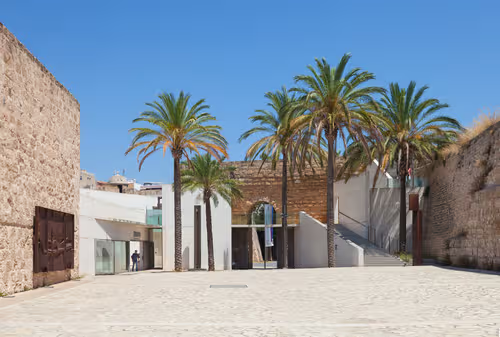
    This contemporary art museum opened in 2004 within the walls of a 16th-century Renaissance bastion designed by Giacomo Palearo Fratin. The contrast between the military stonework and the modern gallery spaces is the first exhibit. The basement contains a massive 17th-century freshwater cistern that now serves as an atmospheric event space. The permanent collection includes works by Miro, Picasso, and Barcelo, with rotating contemporary exhibitions that change several times a year. The rooftop terrace offers one of the best views in Palma: a panorama from the cathedral to the harbor to the Serra de Tramuntana mountains in the distance. The museum connects the old town with the Santa Catalina neighborhood to the west, so you naturally pass through this area on the way to the final stop.

    Learn more about Es Baluard →
    Hours
    Mon: Closed | Tue-Sat: 10:00 AM – 8:00 PM | Sun: 10:00 AM – 3:00 PM
    Price
    €6

    4 min walk

  9. 9

    Lonja de Palma

    Lonja de Palma

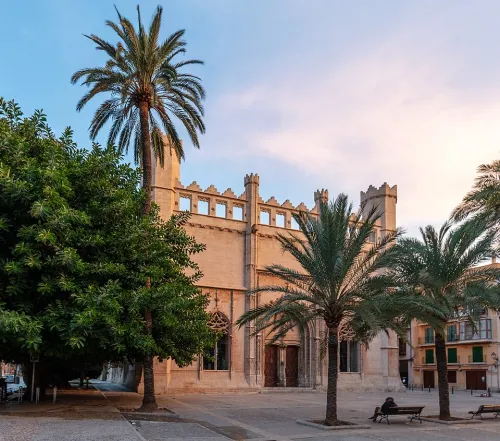
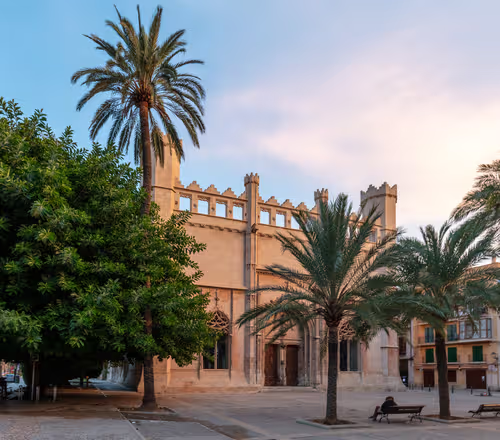
    Architect Guillem Sagrera completed this maritime exchange in 1452 after thirty-two years of construction. Six helical columns twist from floor to ceiling, supporting a ribbed vault without traditional bases or capitals. The effect is organic, almost biological, as if the stone columns grew from the floor rather than being carved. Sagrera also built the Castel Nuovo in Naples, and his Palma trade hall is considered his masterpiece. The building now functions as an exhibition space, and when no show is installed you can still enter to appreciate the architecture. It sits on the waterfront near the old fishermen's quarter of El Jonquet, just west of where you started at the cathedral. The exterior is best seen from the harbor side, where the ornate Gothic windows face the masts of the marina. This is the right place to finish the walk, standing where Palma's merchant wealth was counted and traded for centuries.

    Learn more about Lonja de Palma →
    Hours
    Mon: Closed | Tue-Sun: 10:30 AM – 1:30 PM, 5:30 – 9:00 PM
    Price
    €5
AI Tourguide
Walk this exact route with a private AI guide.
Full GPS navigation, interactive stories, and a guide that answers all your questions. A private guide experience for just €5/hour.
Start This Tour

Self-Guided Tour vs. Group Tour in Palma

Palma has a healthy walking tour industry, with free (tips-based) tours departing daily from Placa de la Reina, and paid options ranging from 15 to 40 EUR per person for themed routes covering food, architecture, or Jewish history. Private guides charge 80 to 150 EUR for 2 to 3 hours. For this specific route through the Gothic old town, a guide adds the most value inside the cathedral and at the Almudaina Palace, where the layers of Roman, Arab, and Gothic construction are not obvious without context.

For the streets and squares (Placa de Cort, Placa Major, Passeig des Born), you do not need a guide. The architecture speaks for itself, and the pleasure is in the walking, not the narration. If you are deciding between paying for a guided tour and spending that money on a meal in Santa Catalina or a coffee at Can Joan de s'Aigo (open since 1700, five minutes from Placa de Cort), go with the meal. The food tells you more about Palma than a two-hour group walk can.

Group Tour AI Self-Guided
Price €25–€50 per person €5/hour or €20 all-inclusive
Flexibility Fixed schedule Start anytime, skip stops
Languages 1–2 languages 11 languages
Pace Group pace Your own pace

How Long Does This Palma Tour Take?

Our route covers 4.2 km with 9 stops and takes approximately 2.2 hours at a relaxed pace.

Pure walking time for this 4.2 km route is about 50 minutes if you did not stop at all. With visits to the interiors, plan for 2 to 3 hours. The cathedral takes 30 to 45 minutes inside. The Almudaina Palace (7 EUR) is a 30-minute visit. The Arab Baths take 10 minutes. Sant Francesc with its cloister adds 20 minutes. The squares (Placa de Cort, Placa Major) are 5-minute pauses each. Passeig des Born is a 10-minute stroll.

The natural split point is at Placa de Cort, roughly the midpoint. You can do the cathedral, palace, baths, and Sant Francesc in the morning, break for coffee or lunch at one of the terrace bars on Placa de Cort, then continue to Placa Major, the Born, Es Baluard, and Lonja in the afternoon. The late afternoon light is best for Passeig des Born and the waterfront section near Lonja. If you start at 10:00 AM, you will finish by early afternoon with time for the beach or Santa Catalina for dinner.

Tips for Walking in Palma

AI Tourguide
Walk this exact route with a private AI guide.
Full GPS navigation, interactive stories, and a guide that answers all your questions. A private guide experience for just €5/hour.
Start This Tour

AI Audio Guide for This Tour

Walking through Palma's Gothic quarter and want to know what is behind that carved stone doorway? The app has this entire 4.2 km route with turn-by-turn navigation, offline maps, and every opening hour updated. Just open it and walk.

AI Audio Guide Stories, history and fun facts narrated as you walk. No earpiece rental needed.
GPS Navigation Turn-by-turn directions so you never get lost between stops.
Ask Anything Curious about a building you pass? Ask your AI guide on the spot.
11 Languages Switch language anytime. No separate tour needed.
Start This Tour Free

Common Questions

The old town is very safe during the day and well-lit at night. The streets are pedestrianized in the historic core, so there is no traffic to worry about. Petty pickpocketing can occur in crowded spots like Placa Major and around the cathedral, but it is less common than in Barcelona or Madrid. Normal city awareness is sufficient. The side streets are quiet but not sketchy, even after dark.
Yes, with planning. Start early, ideally by 9:30 AM, and finish the outdoor sections before 1:00 PM. The narrow old town streets provide natural shade for most of the route. Carry water. The indoor stops (cathedral, Almudaina, Es Baluard) are air-conditioned. Save the exposed waterfront section near Lonja for the late afternoon when the sea breeze picks up. July and August midday temperatures regularly hit 35 degrees, so the siesta break is not optional.
Tuesday through Saturday gives you access to everything on the route. Most churches and museums are open those days. Sundays work but with reduced hours (Almudaina closes at 3:00 PM, Sant Francesc at 1:00 PM). Mondays are the worst day because Es Baluard and several museums are closed. If you want the Placa Major craft market, aim for Monday, Friday, or Saturday morning.
No booking needed. This self-guided tour is available anytime. Open the route on your phone and start walking. The AI audio guide works instantly, no reservation required.
The AI audio guide is available in 11 languages: English, German, French, Spanish, Italian, Japanese, Chinese, Portuguese, Danish, Norwegian, and Swedish.
Yes. Skip any stop, spend extra time at places you like, or start the route from any point. You can also ask the AI to suggest a shorter route.
AI Tourguide
Curated by AI Tourguide GPS-verified routes, reviewed and updated regularly.
Last verified April 2026