Self-Guided Walking Tour in Burgos

A compact 7-stop route through the old heart of Burgos, running 1.9 km from the medieval Arco de Santa María to the El Cid statue on the Puente de San Pablo. This page gives you the map, the walking time for every leg, and the real prices and opening hours for the cathedral, the Museum of Human Evolution and the other stops, plus shorter versions.

7 Stops1.9 km~1 hours walking3–3.5 hours with the two big interiors
What you get with AI Tourguide
Full GPS navigationInteractive AI guidePersonalized to youWorks in your browser
Try this tour with Alex

Burgos Walking Tour at a Glance

This route is built for anyone who wants the essential Burgos without a tour group or a fixed clock. Every interior along the way is optional: you can walk the whole thing as a free outdoor stroll, or step inside the cathedral and the Museum of Human Evolution when you feel like it. The old center is barely a kilometer end to end, so you spend your time looking at things rather than walking between them.

StartArco de Santa María
FinishEl Cid Statue
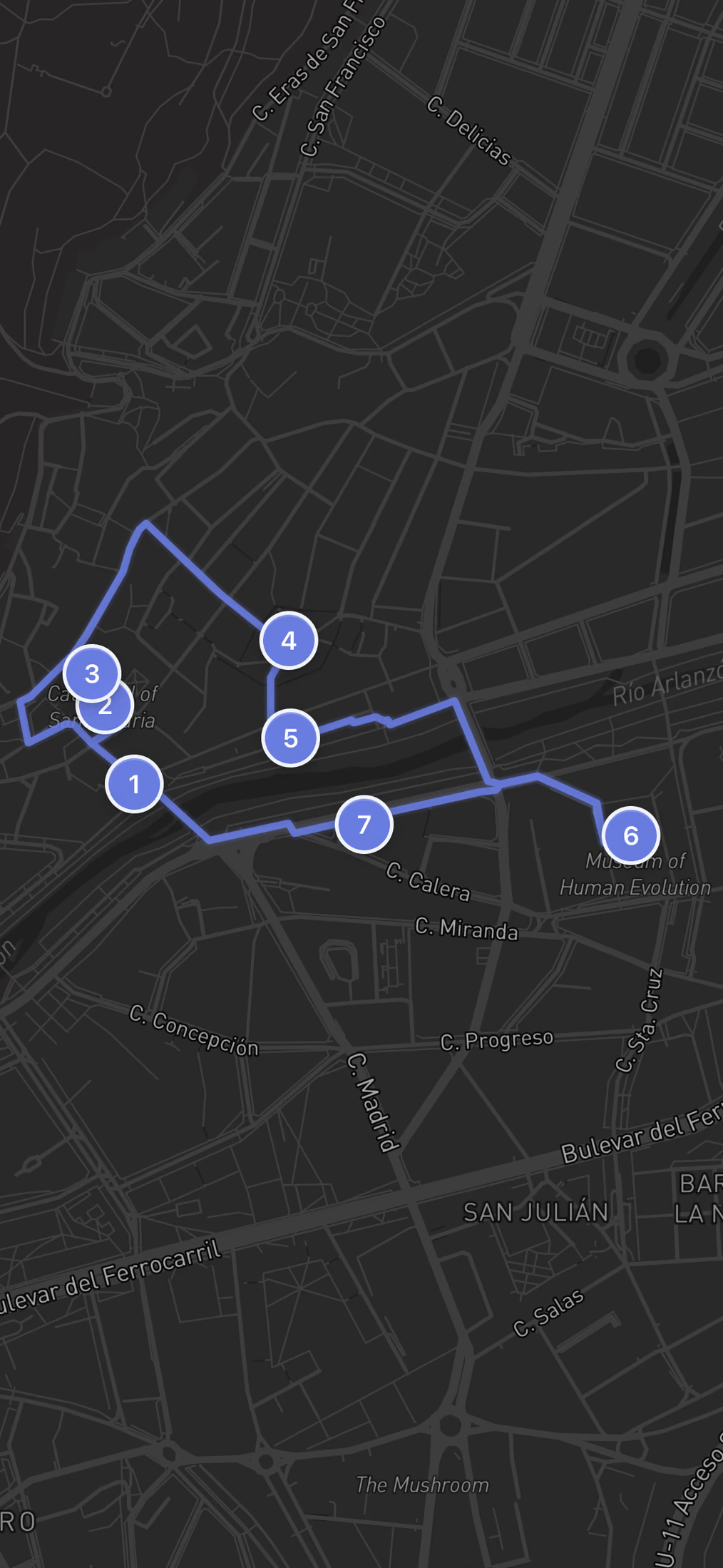
Route typeA tight near-loop through the old town: you start at the Arco de Santa María, work north to the cathedral, then swing east to the Plaza Mayor, the riverside promenade and the museum, before doubling back west to the El Cid statue, finishing only a couple of hundred meters from where you began.
Realistic timeThe 1.9 km walk alone takes about 30 minutes. Add brief pauses at each stop and you are at roughly 1.4 hours. Go inside the cathedral and the museum and you should plan a full 3 to 3.5 hour morning or afternoon.
DifficultyEasy and almost entirely flat, following the line of the Arlanzón River. The promenade and squares are smooth and paved; only the lanes between the Arco de Santa María and the cathedral are narrow with uneven cobblestones.
Cost to followThe walking route itself is free. Paid interiors are the cathedral at €7.50 adults and €5 reduced, the Museum of Human Evolution at €9 adults and €4.50 students, and the Church of San Nicolás de Bari at €2. The Arco exhibition, Plaza Mayor, the Espolón and the El Cid statue are all free.
Best for:

Culture-minded travelers and day-trippers from Madrid who want Castile's history compressed into one short, walkable loop, from medieval gate to Gothic cathedral to the oldest human bones in Western Europe.

The Route

Free Walking Tour Map of Burgos

7 stops1.9 kmabout 1 hours
Loading the interactive map…The complete walking route will appear here.
Want the route to guide you while you walk?Open the route with navigation and a personal guide for the history, stories and questions that matter to you.
Open route + AI guide

The 7 stops along this route

  1. Arco de Santa María in Burgos, stop 1 on the self-guided walking tour
    1Arco de Santa María
  2. Missing required field: waypoints[1].image
    2Church of San Nicolás de Bari
  3. Burgos Cathedral (Catedral de Burgos) in Burgos, stop 3 on the self-guided walking tour
    3Burgos Cathedral (Catedral de Burgos)
  4. Plaza Mayor (Plaza Mayor de Burgos) in Burgos, stop 4 on the self-guided walking tour
    4Plaza Mayor (Plaza Mayor de Burgos)
  5. Paseo del Espolón in Burgos, stop 5 on the self-guided walking tour
    5Paseo del Espolón
  6. Museum of Human Evolution (Museo de la Evolución Humana) in Burgos, stop 6 on the self-guided walking tour
    6Museum of Human Evolution (Museo de la Evolución Humana)
  7. El Cid Statue in Burgos, stop 7 on the self-guided walking tour
    7El Cid Statue
  8. That's the complete route.

    If you want more than the map and text, add live navigation and a conversational AI guide while you walk.

    Open route + AI guide
    You made it
Stop 1 of 7
Swipe →

Your Burgos Walking Tour, Stop by Stop

  1. 1

    Arco de Santa María

    Arco de Santa María in Burgos, stop 1 on the self-guided walking tour

    This 14th-century gateway is your formal entrance to the old city. Remodeled in the 16th century to honor Emperor Charles V, the facade displays stone statues of the Emperor alongside El Cid, Fernan Gonzalez, and other Castilian heroes who shaped the region's history. The gateway was originally one of twelve entrances through the medieval walls, and its ceremonial scale tells you exactly how important Burgos considered itself during the Reconquista. The interior functions as a free exhibition space with rotating displays on local history. Open Tuesday through Saturday 11:00 AM to 2:00 PM and 5:00 to 9:00 PM, Sundays 11:00 AM to 2:00 PM, closed Mondays. Walk through the archway and look up at the vaulted stone ceiling before continuing into the old town.
    Hours
    Mon: Closed | Tue-Sat: 11:00 AM – 2:00 PM, 5:00 – 9:00 PM | Sun: 11:00 AM – 2:00 PM
    Price
    Free
  2. 2

    Church of San Nicolás de Bari

    Missing required field: waypoints[1].image

    This 15th-century church sits directly behind the cathedral and is consistently overlooked by visitors who rush straight to the bigger building. That is a mistake. Inside you will find one of Spain's finest Renaissance altarpieces: a monumental stone retable carved by Simon de Colonia around 1505, featuring over 465 individual figures arranged in a towering composition that fills the entire east wall. The level of detail in each carved figure is astonishing, from individual facial expressions to the folds of fabric on every robe. The church is small enough to see everything in ten minutes, and the contrast between this intimate space and the cathedral next door makes both buildings more interesting.

  3. 3

    Burgos Cathedral (Catedral de Burgos)

    Burgos Cathedral (Catedral de Burgos) in Burgos, stop 3 on the self-guided walking tour

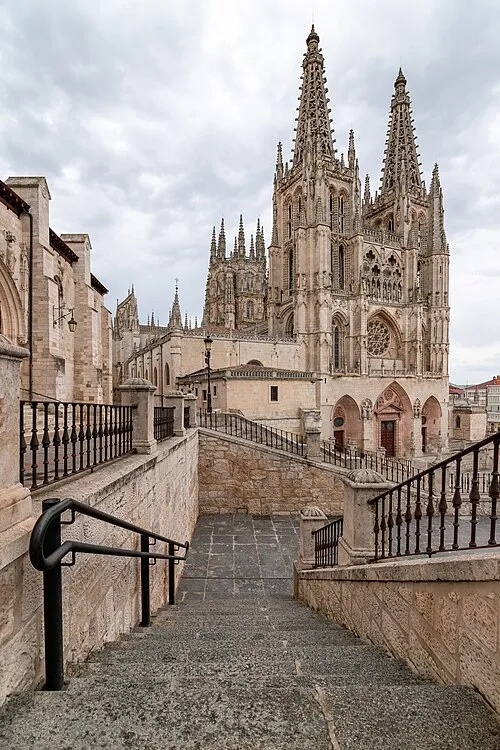
    The centerpiece of the city and a UNESCO World Heritage Site in its own right. Gothic construction began in 1221 and was not finished until 1567, a 300-year project that produced one of the most complex cathedrals in Spain. El Cid and his wife Dona Jimena are buried beneath the central crossing. The octagonal Chapel of the Condestable at the east end, with its star-shaped vault, is the single most impressive interior space. Admission is €7.50 for adults and €5 reduced, which includes an audioguide. Open daily 9:30 AM to 6:00 PM. Budget at least 45 minutes inside. The exterior is equally worth studying: the twin openwork spires on the west facade are visible from every approach to the city and are the defining image of Burgos.

    Hours
    Daily: 9:30 AM – 6:00 PM
    Price
    €7.50 adults, €5 reduced (includes audioguide)
  4. 4

    Plaza Mayor (Plaza Mayor de Burgos)

    Plaza Mayor (Plaza Mayor de Burgos) in Burgos, stop 4 on the self-guided walking tour

    Burgos' main square is a straightforward, porticoed rectangle surrounded by 18th-century arcaded buildings housing shops and cafes. The statue of Charles III stands at the center. On Saturday mornings the square hosts the city's main outdoor market, with stalls selling local cheese, morcilla (Burgos blood sausage, the city's signature food), and seasonal produce. This is the social center of the city, and at paseo time (early evening) the arcades fill with families walking in slow circles. Grab a table under the arches, order a cafe con leche, and watch the locals. Free and open around the clock. The square is modest by Spanish standards, which is part of its appeal.

    Hours
    Open 24/7
    Price
    Free
  5. 5

    Paseo del Espolón

    Paseo del Espolón in Burgos, stop 5 on the self-guided walking tour

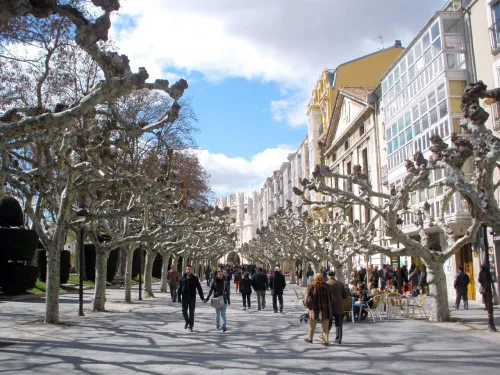
    This tree-lined riverside promenade runs along the Arlanzon River beneath the cathedral's silhouette and is the traditional evening stroll route for Burgos residents. The walkway is shaded by massive plane trees, flanked by ornamental hedges, and dotted with benches that fill up as the afternoon fades. The Arco de Santa Maria bookends the north end of the promenade, and from several points along the path you get a postcard view of the cathedral spires framed by branches. Free and open at all hours. Walk the full length slowly. This is where Burgos feels most like a living city rather than a museum piece, especially on warm evenings when every bench is occupied and children run between the trees.

    Hours
    Open 24/7
    Price
    Free
  6. 6

    Museum of Human Evolution (Museo de la Evolución Humana)

    Museum of Human Evolution (Museo de la Evolución Humana) in Burgos, stop 6 on the self-guided walking tour

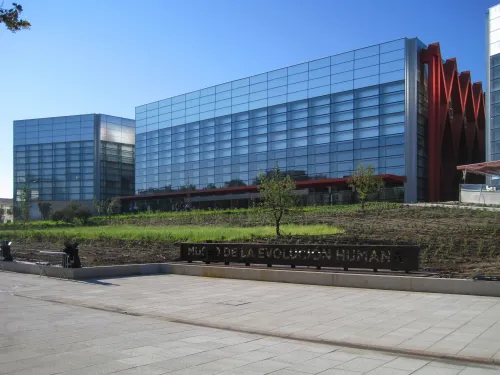
    This glass-and-steel building designed by Juan Navarro Baldeweg is the modern counterweight to the medieval city around it. Inside, it houses fossils from the nearby Atapuerca archaeological sites, including the oldest known human remains in Western Europe, dating back 800,000 years. The displays are organized around the story of human evolution in Europe, using original fossils, replicas, and interactive exhibits that make the science accessible without dumbing it down. Admission is €9 for adults and €4.50 for students. Open Tuesday through Friday 10:00 AM to 2:30 PM and 4:30 to 8:00 PM, Saturday 10:00 AM to 8:00 PM, Sunday 10:00 AM to 3:00 PM, closed Mondays. Allow at least an hour here. The Atapuerca connection makes this museum unique in Spain.

    Hours
    Mon: Closed | Tue-Fri: 10:00 AM – 2:30 PM, 4:30 – 8:00 PM | Sat: 10:00 AM – 8:00 PM | Sun: 10:00 AM – 3:00 PM
    Price
    €9 adults, €4.50 students
  7. 7

    El Cid Statue

    El Cid Statue in Burgos, stop 7 on the self-guided walking tour

    The tour ends at this commanding bronze equestrian statue of Rodrigo Diaz de Vivar, sculpted by Juan Cristobal Gonzalez Quesada in 1955. El Cid charges forward with sword raised on the Puente de San Pablo, the bridge that carries you across the Arlanzon River. The bridge itself is lined with eight additional statues of figures from El Cid's life, creating an open-air gallery of medieval Castilian history. This is the most photographed spot in Burgos, and for good reason: the proportions of the horse and rider against the open sky are genuinely dramatic. Stand on the far side of the bridge for the best angle, with the cathedral spires rising behind the statue. The bridge is free and open at all hours.

How Long Does This Walking Tour Really Take?

Pure walking is about 30 minutes across 1.9 km. With short stops at all seven sights you are near 1.4 hours. The two interiors dominate the day: budget at least 45 minutes inside the cathedral and a full hour at the Museum of Human Evolution, which pushes a complete visit to 3 to 3.5 hours.

The 1.9 km walk itself takes about 30 minutes without stops. Allow 1.4 hours including brief pauses at each site. If you enter the cathedral (45 minutes minimum) and the Museum of Human Evolution (1 hour), plan for a full 3 to 3.5 hour morning or afternoon. A morcilla tasting at Plaza Mayor adds another pleasant 20 minutes.

Full Route, Shorter Walk or Two-Day Version?

The full walk is only 1.9 km, so most people do all seven stops in one go. But the two ticketed interiors are what eat the hours, so here are three ways to run it depending on how much time you have and how deep you want to go.

The short version

Old-town core without the museum

Stops 1–5 then straight to stop 7, skipping the Museum of Human Evolution, about 1.2 km, roughly 2 hours

Cut the eastern leg out to the museum (the two longest walking segments) and go from the Espolón directly to the El Cid statue. You keep the gate, both churches, the square and the river, and still finish at the famous bridge. Ideal for a tight day trip.

The two-visit split

Medieval core, then the museum

Visit 1: stops 1–5 around the cathedral (about 1 km). Visit 2: stops 6–7, the museum plus El Cid (about 0.8 km)

Do the medieval old town on one visit and save the Museum of Human Evolution and the river bridge for a fresh session, since the museum alone deserves an unhurried hour. A good split if you are staying overnight or want to pace things with kids.

You can walk it in reverse from the El Cid statue back to the Arco de Santa María, but the given direction is the better story: you enter through the historic city gate, build up to the cathedral, and end on the dramatic bridge statue by the river with the spires rising behind it.

Is This Burgos Walking Tour Right for You?

This is a short, flat, information-dense route through a compact historic center, so it suits a wide range of travelers. Here is who it fits best and how to bend it if your day looks different.

A good fit if you…

  • Day-trippers from Madrid who want the essentials in a single morning before an afternoon train back
  • History and architecture lovers, from Gothic cathedrals to the Atapuerca fossils at the Museum of Human Evolution
  • Walkers who prefer a tight 1.9 km loop over long distances between sights
  • Travelers who want to decide interior by interior how much to spend, since the outdoor route is entirely free

Adapt the route if you…

  • Visiting on a Monday: the Arco exhibition and the Museum of Human Evolution are closed, so lean on the cathedral and the outdoor stops
  • Traveling with a stroller or wheels: stick to the flat Espolón and Plaza Mayor and take the cobbled cathedral lanes slowly
  • Short on time: run the short version and drop the museum excursion out east
  • Visiting in the cooler months or evening: Burgos sits at 860 m on the meseta and gets chilly, so bring a jacket for the paseo along the Espolón

Tickets & Skip-the-Line in Burgos

Burgos is small and rarely overwhelmed, so there is no formal skip-the-line system. What matters here is getting the opening hours and prices right so you don't arrive at a closed door. Here is the ticket picture for the paid stops on this route.

Burgos Cathedral (Catedral de Burgos)€7.50 adults, €5 reduced, and the price includes an recorded commentary. Open daily 9:30 AM to 6:00 PM. Arrive at 9:30 opening to beat the Madrid day-trip groups; budget at least 45 minutes inside.
Museum of Human Evolution (Museo de la Evolución Humana)€9 adults, €4.50 students. Open Tuesday to Friday 10:00 AM to 2:30 PM and 4:30 to 8:00 PM, Saturday 10:00 AM to 8:00 PM, Sunday 10:00 AM to 3:00 PM, closed Mondays. Allow at least an hour; combined tickets to the Atapuerca excavation sites are available at the desk. official ticket site ↗
Church of San Nicolás de Bari€2 entry to see the monumental Renaissance altarpiece. Open Monday and Wednesday to Saturday 11:30 AM to 1:30 PM and 5:30 to 7:30 PM, Sunday 11:30 AM to 1:30 PM, closed Tuesdays. official ticket site ↗
Arco de Santa MaríaFree to enter the exhibition space inside the gate. Open Tuesday to Saturday 11:00 AM to 2:00 PM and 5:00 to 9:00 PM, Sunday 11:00 AM to 2:00 PM, closed Mondays. official ticket site ↗
Everything elsePlaza Mayor, the Paseo del Espolón and the El Cid statue are all free, open outdoor spaces you can visit at any hour with no ticket.
Optional upgrade
+3
The same 7-stop route,
now with navigation and a guide.
Optional AI experience

You already have the route.
The AI guide brings it to life.

Standing under the 14th-century Arco de Santa María, or in front of Burgos Cathedral right now? Open AI Tourguide in your browser, no app and no download, and a voice guide walks the whole route with you, greeting you, telling the story through the cathedral quarter to the El Cid statue and asking what you want to see so it shapes the walk around you. A real conversation, not a recorded narration. Start with 100 free credits.

Livenavigation13languagesAnyquestionYourinterests
Open this route with the AI guide

Try it in your browser · No app or download required

Tips for Walking in Burgos

  • Try morcilla de Burgos at one of the tapas bars around Plaza Mayor. Burgos blood sausage is made with rice instead of breadcrumbs, giving it a distinctive texture. It is served sliced and fried as a tapa, and locals consider it the defining food of the city.
  • Visit the cathedral first thing in the morning at 9:30 AM opening. The light through the stained glass windows is best in the morning, and by midday the interior fills with tour groups arriving from Madrid day trips.
  • The Museum of Human Evolution offers combined tickets that include bus transport to the actual Atapuerca excavation sites outside the city. If you have a full day, the site visit adds remarkable context to what you see in the museum.
  • Burgos is significantly colder than most Spanish cities, sitting at 860 meters elevation on the Castilian meseta. Even in summer, mornings and evenings can be cool. Bring a light jacket for the evening paseo along the Espolon.
  • The Church of San Nicolas de Bari is easy to miss because it sits behind the cathedral. Do not skip it. The Renaissance altarpiece inside is one of the most detailed stone carvings in Spain and you will likely have the place almost to yourself.

Why Walk This Route?

This self-guided walking tour covers 7 stops across 1.9 km through the historic heart of Burgos, taking roughly 1.4 hours at a comfortable pace. The route starts at the 14th-century Arco de Santa Maria, passes through the cathedral quarter, crosses the Plaza Mayor and the riverside promenade, visits the Museum of Human Evolution, and finishes at the El Cid statue on the Puente de San Pablo. Burgos is a city built for walking: the historic center is barely a kilometer from end to end, the whole place follows the line of the Arlanzon River, and the cathedral spires pull you forward like a compass needle. The walking itself is effortless. The time you spend depends entirely on whether you go inside the cathedral and the museum, which you should.

Common Questions

How does this tour work on a Monday?

The Arco de Santa Maria exhibition space and the Museum of Human Evolution are both closed on Mondays. The cathedral is open daily. All outdoor stops including Plaza Mayor, Paseo del Espolon, and the El Cid Statue are accessible every day. For full access to all interiors, visit Tuesday through Saturday.

Is Burgos worth a day trip from Madrid?

Yes, the high-speed train from Madrid takes about 1.5 hours. With this compact 1.9 km route, you can see the essential sights in a morning, have lunch at Plaza Mayor, and catch an afternoon train back. The city is small enough that a day trip covers the highlights thoroughly. If you can stay overnight, the evening paseo along the Espolon and dinner in the old town are worth experiencing.

Is the route stroller and wheelchair accessible?

Mostly yes. The Paseo del Espolon and Plaza Mayor are flat and paved. The streets between the Arco de Santa Maria and the cathedral are narrow with uneven cobblestones, which can be challenging for wheels. The Museum of Human Evolution is fully accessible. The cathedral interior has some steps between chapels but the main nave is level. The Puente de San Pablo bridge is flat with wide sidewalks.

Take this route with you

Open this exact tour with navigation and your personal AI guide.

Start GPS Navigation + AI Guide
AI Tourguide
Researched and curated by the AI Tourguide teamWe plan and quality-check every route, then research and verify the opening hours, prices, and practical tips for each stop along it.
▶ Open route with AI guideNavigation, stories and your questions