Self-Guided Walking Tour in Girona

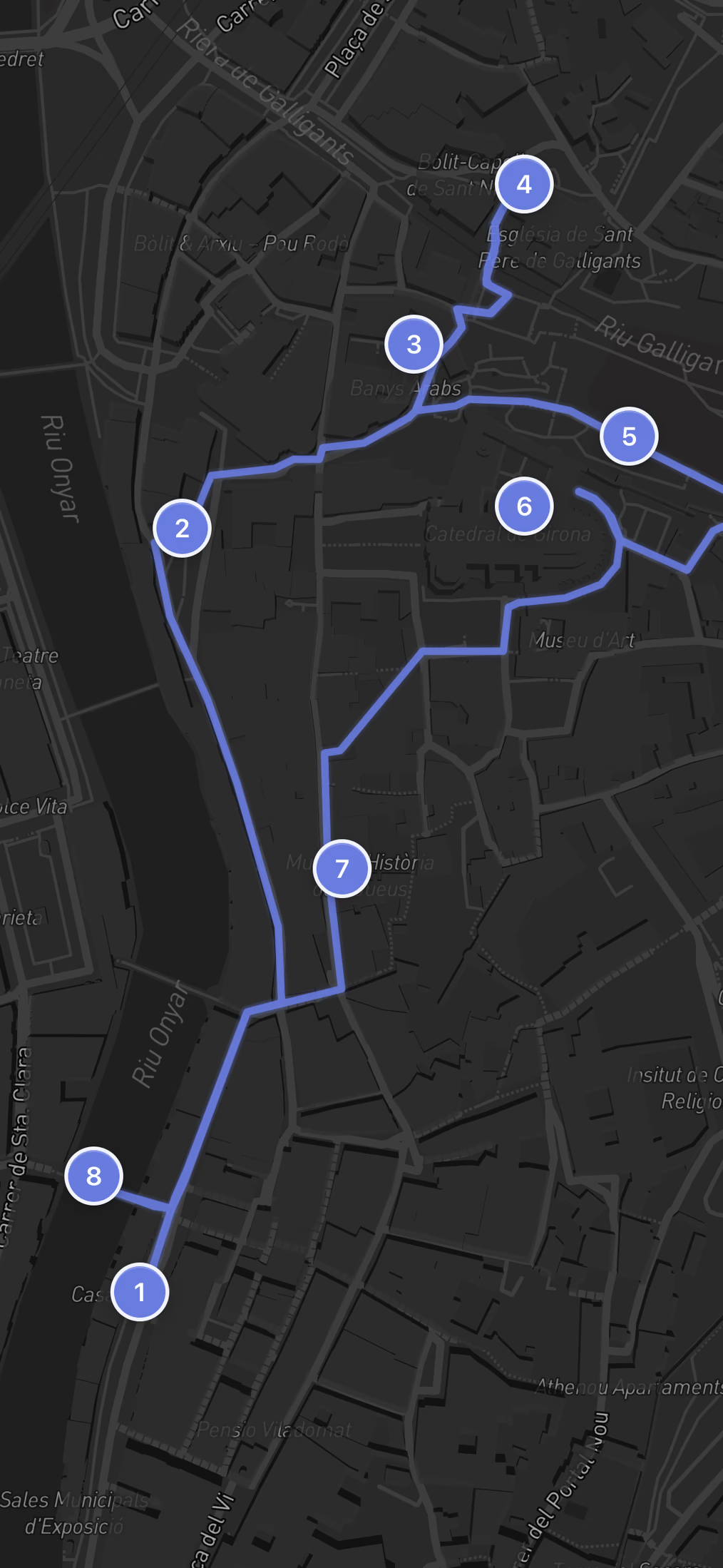
This self-guided route links 8 stops across 1.8 km, starting on the flat riverside Rambla and climbing through the Jewish Quarter to the Cathedral before descending to the Eiffel Bridge. The page gives you a map, per-leg walking times, real admission prices and opening hours, and shorter versions if you have less time.

8 Stops1.8 km~2 hours walking3–3.5 hours with stops
What you get with AI Tourguide
Full GPS navigationInteractive AI guidePersonalized to youWorks in your browser
Try this tour with Alex

Girona Walking Tour at a Glance

This route is built for anyone who wants to see Girona's old town in one unhurried loop without a group or a fixed schedule. It strings together eight stops in a deliberate order, warming up on flat ground before the climb, and every interior along the way is optional. Skip the paid sites entirely and you still get a complete walk through streets that predate the printing press.

StartRambla de la Llibertat
FinishPont Palanques Vermelles
Route typeA compact loop that climbs north from the river up through the old town, then swings back south-west downhill to finish near where you started, with no real backtracking.
Realistic timeWalking alone is about 25 minutes; with the outdoor stops figure roughly two hours, and 3 to 3.5 hours if you go inside every paid site.
DifficultyShort at 1.8 km, but genuinely steep in places: cobbled lanes, the roughly 90 baroque steps up to the Cathedral, and polished stone that turns slippery after rain.
Cost to followThe walk itself is free. Interiors cost money: Arab Baths €3.50, Girona Cathedral €4, Basilica de Sant Feliu €4, the Monastery €4.50, and the Museum of Jewish History €4.
Best for:

Day-trippers from Barcelona, history and architecture lovers, and photographers chasing the painted river houses, who want depth without a long march.

The Route

Free Walking Tour Map of Girona

8 stops1.8 kmabout 2 hours
Loading the interactive map…The complete walking route will appear here.
Want the route to guide you while you walk?Open the route with navigation and a personal guide for the history, stories and questions that matter to you.
Open route + AI guide

The 8 stops along this route

  1. Rambla de la Llibertat in Girona, stop 1 on the self-guided walking tour
    1Rambla de la Llibertat
  2. Basilica of St. Felix (Església de Sant Feliu de Girona) in Girona, stop 2 on the self-guided walking tour
    2Basilica of St. Felix (Església de Sant Feliu de Girona)
  3. Arab Baths of Girona (Banys àrabs de Girona) in Girona, stop 3 on the self-guided walking tour
    3Arab Baths of Girona (Banys àrabs de Girona)
  4. Sant Pere de Galligants in Girona, stop 4 on the self-guided walking tour
    4Sant Pere de Galligants
  5. Muralles de Girona in Girona, stop 5 on the self-guided walking tour
    5Muralles de Girona
  6. Girona Cathedral (Catedral de Girona) in Girona, stop 6 on the self-guided walking tour
    6Girona Cathedral (Catedral de Girona)
  7. Museo de Historia de los Judíos (Museu d'Història dels Jueus) in Girona, stop 7 on the self-guided walking tour
    7Museo de Historia de los Judíos (Museu d'Història dels Jueus)
  8. Pont Palanques Vermelles in Girona, stop 8 on the self-guided walking tour
    8Pont Palanques Vermelles
  9. That's the complete route.

    If you want more than the map and text, add live navigation and a conversational AI guide while you walk.

    Open route + AI guide
    You made it
Stop 1 of 8
Swipe →

Your Girona Walking Tour, Stop by Stop

  1. 1

    Rambla de la Llibertat

    Rambla de la Llibertat in Girona, stop 1 on the self-guided walking tour

    This arcaded promenade runs parallel to the Onyar River and has served as Girona's main social corridor since the medieval market era. Heavy stone arches line both sides, with dates carved into the lintels above them going back centuries. The street is pedestrianized, flat, and shaded, which makes it the gentlest possible start. Free and open around the clock. On weekends, families and street musicians fill the strip and the sound bounces off the stonework. Do not eat at the restaurants directly on the Rambla. They are overpriced and aimed at the tour bus crowd. Walk one block inland to Placa del Vi for better food at local prices. From the southern end of the Rambla, cross the river toward the old town.

    Hours
    Open 24/7 (free main street)
    Price
    Free
  2. 2

    Basilica of St. Felix (Església de Sant Feliu de Girona)

    Basilica of St. Felix (Església de Sant Feliu de Girona) in Girona, stop 2 on the self-guided walking tour

    This Gothic-Romanesque basilica dedicated to Girona's patron saint sits at the base of the old town's hill, its distinctive truncated bell tower visible from across the river. Lightning struck the top of the tower in 1581 and it was never fully repaired, giving it a rough, unfinished look that has become part of the city's identity. Outside the entrance, look for the Lleona, a small medieval lioness sculpture climbing a stone column. Locals and visitors rub the animal's rear end for good luck and to guarantee a return to the city. The tradition is centuries old and the stone is worn smooth from the contact. Give it ten minutes before heading uphill toward the Arab Baths.

    Hours
    Mon-Sat: 10:00 AM – 5:00 PM, Sun: 12:00 – 5:00 PM
    Price
    €4 adults, €2 students/reduced, free under 10
  3. 3

    Arab Baths of Girona (Banys àrabs de Girona)

    Arab Baths of Girona (Banys àrabs de Girona) in Girona, stop 3 on the self-guided walking tour

    Despite the name, these 12th-century baths were built by Christians who admired Islamic bathing customs. The central changing room is the highlight: an octagonal pool surrounded by slender columns, with a lantern dome above that channels light down into the stone chamber. You can walk through the whole site in ten minutes if you rush, but slow down and look at the underfloor heating systems still visible in the tepidarium and caldarium. Admission is €3.50 for adults, €2.50 for students, free for children under 7. Open Monday to Saturday 10:00 AM to 6:00 PM, Sunday 10:00 AM to 2:00 PM. Come at midday if you can: the sun beam hits the center of the octagonal pool perfectly when it is directly overhead. The silence here is heavy after the street noise outside. When you exit, the grand baroque staircase to the Cathedral is right in front of you. Ninety steps up.

    Hours
    Mon-Sat: 10:00 AM – 6:00 PM | Sun: 10:00 AM – 2:00 PM
    Price
    €3.50 adults, €2.50 students, free under 7
  4. 4

    Sant Pere de Galligants

    Sant Pere de Galligants in Girona, stop 4 on the self-guided walking tour

    The walk from the Cathedral area takes you downhill past quiet residential streets, and the octagonal bell tower of this 12th-century Benedictine abbey appears through the trees as you descend. After the overwhelming scale of the Cathedral, this place feels intimate and human. The building now houses the Archaeology Museum of Catalonia, but the architecture overshadows the exhibits. The cloister is the reason to come. Small and enclosed, its carved capitals show fantastical beasts, mermaids, and biblical scenes with surprising humor. Look carefully for the two-tailed siren on one of the columns, a pagan symbol that somehow survived centuries of religious scrutiny. The afternoon light on the rough stone is particularly good for photography.

    Hours
    Mon: Closed | Tue-Sat: 10:00 AM – 6:00 PM | Sun: 10:00 AM – 2:00 PM
    Price
    €4.50 adults, €3 students/seniors, free under 16
  5. 5

    Muralles de Girona

    Muralles de Girona in Girona, stop 5 on the self-guided walking tour

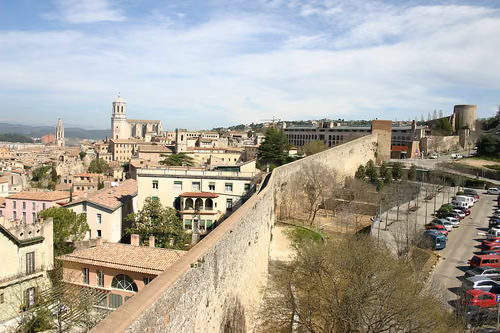
    From the monastery area, stairs lead up to these remarkably intact medieval city walls that date back to Carolingian times. The walkable rampart circuit offers sweeping panoramic views over the terracotta rooftops of the old town and the Pyrenean foothills in the distance. Several defensive towers along the route have been restored with observation platforms where you can climb for even wider vistas. The elevated pathway is free, open during daylight hours, and rarely crowded outside of summer weekends. Budget 20 to 30 minutes for the most scenic southern stretch. The walls connect back to the old town near the Cathedral area, making this a natural loop before heading downhill.

    Hours
    Daily: 8:00 AM – 9:00 PM
    Price
    Free
  6. 6

    Girona Cathedral (Catedral de Girona)

    Girona Cathedral (Catedral de Girona) in Girona, stop 6 on the self-guided walking tour

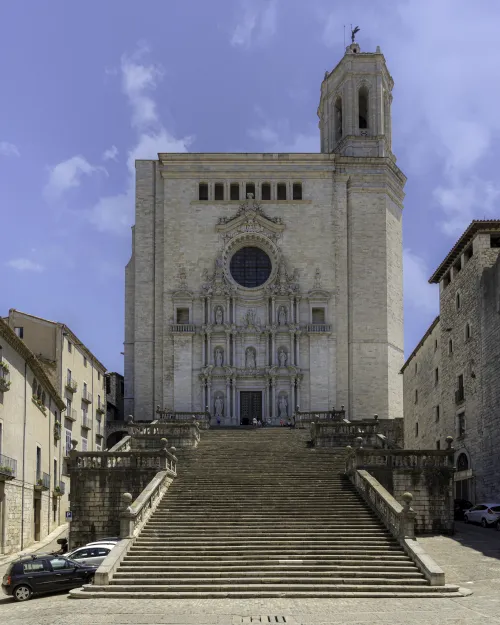
    Those 90 stone steps are the approach, and they are meant to impress. At the top, the facade fills your vision, but the real shock is inside. The Cathedral of Saint Mary holds the widest Gothic nave in the world at 23 meters across, a single massive vault with no supporting columns. Medieval architects debated for decades whether this design would hold. It did. The treasury contains the 11th-century Tapestry of Creation, an embroidered textile as historically significant as the Bayeux Tapestry. Admission is €4 for adults, €2 for students, free for children under 10. Hours run Monday to Friday 10:00 AM to 4:30 PM, Saturday 10:00 AM to 5:00 PM, Sunday 12:00 to 4:30 PM. Do not skip the cloister, which has carved capitals that tell biblical stories with unexpected humor. From the Cathedral, walk downhill through the narrow streets of the Jewish Quarter.

    Hours
    Mon-Fri: 10:00 AM – 4:30 PM | Sat: 10:00 AM – 5:00 PM | Sun: 12:00 – 4:30 PM
    Price
    €4 adults, €2 students, free under 10
  7. 7

    Museo de Historia de los Judíos (Museu d'Història dels Jueus)

    Museo de Historia de los Judíos (Museu d'Història dels Jueus) in Girona, stop 7 on the self-guided walking tour

    The streets narrow suddenly. You are in the Call, and some passages here are barely wide enough for two people to squeeze past each other. The museum sits on the site of the former synagogue and documents 600 years of Sephardic life in Girona from the 9th century to the 1492 expulsion. Admission is 4 EUR. The exhibits are text-heavy and somber, covering theology, daily life, and the contributions of Jewish scholars to science and astronomy. Give it at least 30 minutes. The courtyard with its Star of David inlay is the quietest spot on this entire route. Hours run Monday 10:00 AM to 2:00 PM, Tuesday to Saturday 10:00 AM to 6:00 PM, Sunday 10:00 AM to 2:00 PM. Head downhill toward the river for the final stop.

    Hours
    Mon: 10:00 AM – 2:00 PM | Tue-Sat: 10:00 AM – 6:00 PM | Sun: 10:00 AM – 2:00 PM
    Price
    4 EUR
  8. 8

    Pont Palanques Vermelles

    Pont Palanques Vermelles in Girona, stop 8 on the self-guided walking tour

    Red iron lattice cuts a sharp line across the Onyar, and this is the same company that built the Paris tower. Gustave Eiffel's firm constructed this bridge in 1877, officially the Pont de les Peixateries Velles (Old Fishmongers' Bridge). It is narrow enough that only two people can walk side by side. The wooden plank floor vibrates underfoot, and the open mesh sides give you a direct view down to the water and up to the Cathedral on the hill. Free and open around the clock. This is the classic photo spot for Girona's trademark: the ochre, sienna, and copper painted houses hanging over the river with no bank or walkway below. But here is the trick: the Eiffel Bridge faces west, so sunset is when the light turns everything gold. For the better composition that includes the Cathedral tower in the background, walk one bridge south to the Pont de Sant Agusti and face north.

    Hours
    Open 24/7
    Price
    Free

How Long Does This Walking Tour Really Take?

The walking between stops totals only about 25 minutes, so the time is all in the sights: budget two hours for the outdoor stops and viewpoints, or 3 to 3.5 hours if you step inside the Cathedral, Arab Baths, Monastery and the Museum of Jewish History.

The walking time between stops is about 25 minutes total, but budget 3 to 3.5 hours for the full experience. The Museum of Jewish History needs 30 minutes minimum if you read the exhibits. The Cathedral deserves 30 to 40 minutes including the cloister and treasury. The Arab Baths take 15 to 20 minutes. The Monastery cloister is another 20 minutes. The Passeig de la Muralla walk adds 20 to 30 minutes but the views are worth every step.

If you need a break, the small square outside the Basilica de Sant Feliu has benches in the shade. The cafe terrace on Placa de la Independencia, a five-minute walk west from any point on the route, is the local go-to for a proper coffee break.

Full Route, Shorter Walk or Two-Day Version?

The full walk suits an unrushed half-day, but the compact layout makes it easy to trim or split. Here are three ways to run it depending on how much time you have and whether you want every interior.

The Short Loop

Highlights without the northern detour

Stops 1, 2, 3, 6 and 8, skipping the Monastery and Museum, about 2 hours

For a tighter visit, cut the Monastery of Sant Pere de Galligants (stop 4) and the Museum of Jewish History (stop 7), the two most time-heavy interiors. You still hit the Rambla, Sant Feliu, the Arab Baths, the Cathedral and the Eiffel Bridge, the essential spine of the old town.

Two-Part Split

Break at the Cathedral

Part one stops 1 to 6, part two stops 7 to 8, split at Girona Cathedral

Do stops 1 to 6 in the morning while the light is soft and the paid sites have just opened, pause for lunch near the Cathedral, then walk stops 7 and 8 through the Call and down to the river in the late afternoon when the western sun lights the painted houses.

You can walk it in reverse from the Eiffel Bridge, but the given direction is better: it starts flat on the Rambla, saves the roughly 90 baroque steps to the Cathedral for when you are warmed up, and finishes downhill at the river. The Girona RENFE station is a 15-minute walk south of the Rambla, so the start is the natural arrival point.

Is This Girona Walking Tour Right for You?

Girona rewards a slow walk, but the terrain and the day-trip crowds mean it fits some travellers better than others. Here is who this route is built for and how to bend it to your situation.

A good fit if you…

  • Day-trippers from Barcelona, since the AVE reaches Girona in 38 minutes and the whole route is under 2 km
  • History and architecture fans who want Roman foundations, medieval walls and the Call layered in one hill
  • Photographers after the painted houses over the Onyar and the iron Eiffel Bridge
  • Walkers who prefer a short, dense circuit over a long march across a big city

Adapt the route if you…

  • You have limited mobility: the steep steps to the Cathedral and cobbled lanes are demanding, so use the short loop and skip the wall walk
  • You visit in summer: start early or after 16:00, because the climb through the Call between 13:00 and 16:00 is punishing in the heat
  • It rains: lean on the indoor stops, the Cathedral, Arab Baths, Monastery and Museum, and save the exposed city walls for clearer weather
  • You are short on time: run the short loop and see the essential five stops in about two hours

Tickets & Skip-the-Line in Girona

Girona's paid sights are small and rarely have long timed queues, so you can usually buy at the door. Tickets are cheap and the main thing to plan around is opening hours, since a couple of sites close early or on Mondays. Where an official ticket page exists, it is linked below.

Basilica of St. Felix (Església de Sant Feliu de Girona)€4 adults, €2 students/reduced, free for under 10. Open Mon-Sat 10:00 to 17:00, Sun 12:00 to 17:00. Sold through the cathedral cultural-visit page. official ticket site ↗
Arab Baths of Girona (Banys àrabs de Girona)€3.50 adults, €2.50 students, free for under 7. Open Mon-Sat 10:00 to 18:00, Sun 10:00 to 14:00. Come near midday when the sunbeam drops straight into the octagonal pool. official ticket site ↗
Sant Pere de Galligants€4.50 adults, €3 students/seniors, free for under 16. Closed Mondays; open Tue-Sat 10:00 to 18:00, Sun 10:00 to 14:00. Tickets are bought on site.
Girona Cathedral (Catedral de Girona)€4 adults, €2 students, free for under 10. Open Mon-Fri 10:00 to 16:30, Sat 10:00 to 17:00, Sun 12:00 to 16:30. Buy through the official cathedral site. official ticket site ↗
Museo de Historia de los Judíos (Museu d'Història dels Jueus)€4. Open Mon 10:00 to 14:00, Tue-Sat 10:00 to 18:00, Sun 10:00 to 14:00. Tickets are bought at the entrance; allow at least 30 minutes for the text-heavy exhibits.
Everything elseThe Rambla de la Llibertat, Passeig de la Muralla and the Eiffel Bridge are free public spaces you can walk at any time, no ticket needed.
Optional upgrade
+4
The same 8-stop route,
now with navigation and a guide.
Optional AI experience

You already have the route.
The AI guide brings it to life.

Standing near the Eiffel Bridge watching the colourful houses reflect in the Onyar? Open AI Tourguide in your browser, nothing to download, and a voice guide walks the whole route with you, up through the Call to the Cathedral, along the medieval walls and down to the monastery, telling the story along the way, asking what you want to see and adapting as you climb. A real conversation that walks with you, not a recording. Start with 100 free credits.

Livenavigation13languagesAnyquestionYourinterests
Open this route with the AI guide

Try it in your browser · No app or download required

Tips for Walking in Girona

  • The closest train station is Girona (RENFE), about a 15-minute walk south of the Rambla. High-speed AVE trains from Barcelona Sants take 38 minutes. Start the walk before 10:00 to reach the paid sights when they open.
  • The route is mostly cobblestone, with steep stone steps between the Arab Baths and the Cathedral. Flat-soled shoes will slip on the polished stone in the Call after rain. Wear shoes with grip and expect to climb the equivalent of several flights of stairs.
  • Public restrooms are scarce in the old town. The cleanest free option on this route is inside the Museum of Jewish History (stop 7). The Arab Baths and Cathedral also have facilities for ticket holders.
  • Skip the Rambla restaurants. At Mercat del Lleo, 10 minutes south of stop 1 and open Monday to Saturday 7:00 to 14:00, grab fuet sausage, local cheese, and bread for under 8 EUR. The stall El Petit Obrador sells ready-to-eat croquettes for a walking snack.
  • For the classic Girona postcard shot of colorful houses reflected in the Onyar, stand on the Pont de Sant Agusti (one bridge south of the Eiffel Bridge), face north, and shoot in the late afternoon when the western sun lights up the facades.

Why Walk This Route?

This walking tour covers 8 stops across 1.8 km in about 1.5 hours, starting on the flat riverside promenade and climbing steadily through the Jewish Quarter and up to the Cathedral, then descending north to the Monastery of Sant Pere de Galligants with a walk along the medieval ramparts. The sequence is deliberate: you warm up on easy ground, hit the major sights at peak elevation, and finish downhill. Most day-trippers from Barcelona make the mistake of heading straight for the Cathedral, arriving sweaty and overwhelmed. This route builds up to it.

Girona is a city you can cross in under an hour, but you will want to spend all day doing it. The old quarter sits on a hill east of the Onyar River, layered with Roman foundations, medieval walls, and baroque facades stacked on top of each other. Everything is close, everything is steep, and every alley leads to something worth pausing for. Eight stops, no backtracking, and every meter on foot is through streets that predate the printing press.

Common Questions

Can I do this tour as a day trip from Barcelona?

Yes, and most people do. Take the 8:30 or 9:00 AVE from Barcelona Sants, which takes 38 minutes. You arrive with time to walk the full route, eat lunch, and catch a return train by mid-afternoon. The last trains back run past 21:00, so there is no rush. Girona station is a flat 15-minute walk south of the starting point.

What if it rains during my Girona tour?

Rain actually helps this route. The Museum of Jewish History, Arab Baths, Girona Cathedral, and the Monastery are all indoor stops. The Rambla has stone arcades for shelter. The polished cobblestones in the Call get slippery when wet, so watch your step on the steep sections. Save the city walls walk for clearer weather if possible.

What is the best time of day for this walking tour?

Start at 9:30 and walk the outdoor stops first while the light is soft and the streets are empty. Reach the Cathedral around 10:30 when it opens. In summer, avoid starting after noon because the climb through the Call between 13:00 and 16:00 is punishing in the heat, and the Cathedral steps have zero shade. Late afternoon from 16:00 onward works well too, with golden light on the river houses.

Take this route with you

Open this exact tour with navigation and your personal AI guide.

Start GPS Navigation + AI Guide
AI Tourguide
Researched and curated by the AI Tourguide teamWe plan and quality-check every route, then research and verify the opening hours, prices, and practical tips for each stop along it.
▶ Open route with AI guideNavigation, stories and your questions