Self-Guided Walking Tour in Tbilisi

12 Stops 7.4 km ~3.5 hours
Start This Tour Free
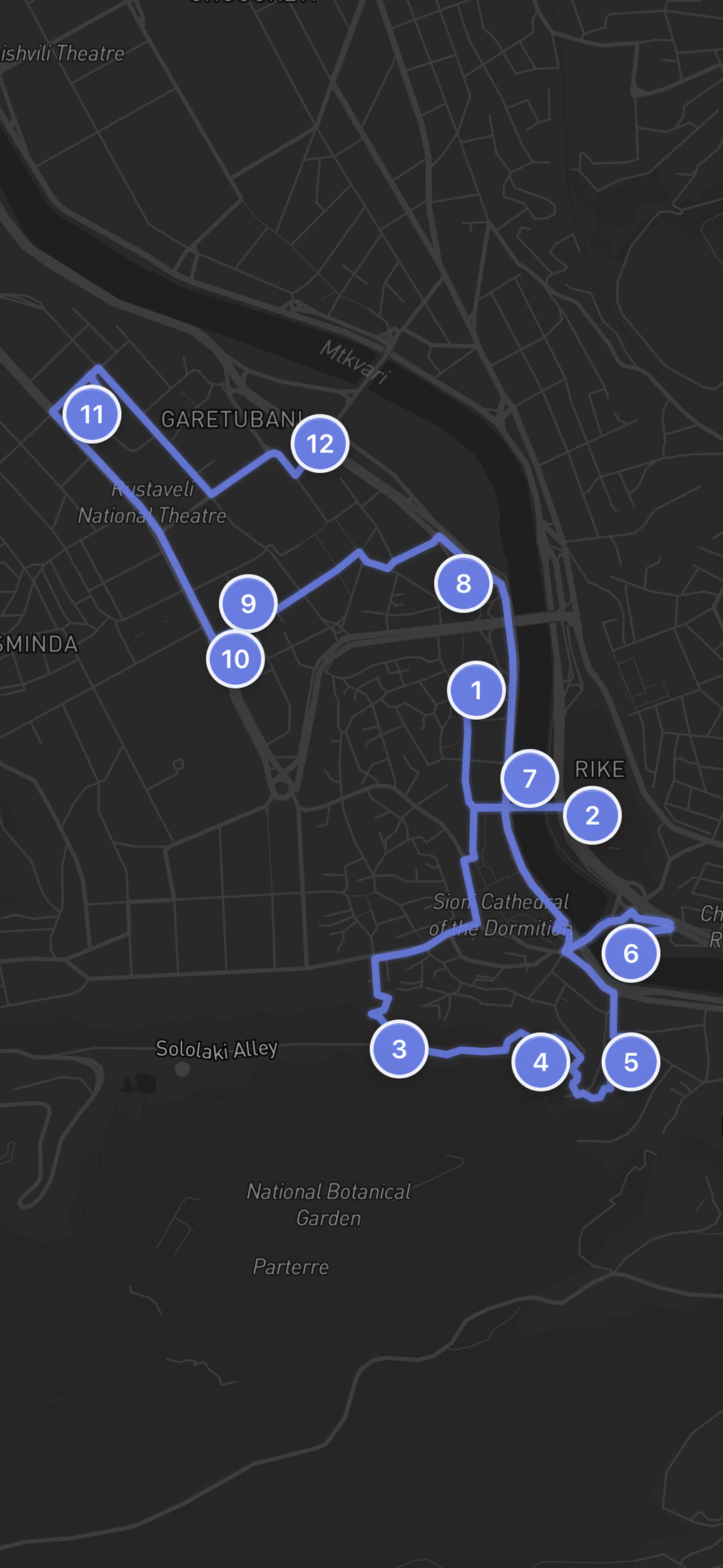
Walking tour route map of Tbilisi
Start This Tour Free

Why Walk Tbilisi? A Self-Guided Tour

Tbilisi wraps around a river gorge, climbs steep hillsides, and folds back on itself in ways that no bus or metro can properly trace. This route covers 12 stops across 7.4 kilometers in roughly 3.5 hours, starting in the quiet lanes near the oldest church in the city and working south through the sulfur bath district, up to the fortress ridge, then back through the grand 19th-century boulevard to end at a flea market where Soviet officers' medals sell for less than a coffee.

The sequencing follows the city's actual history in geographic layers. A 6th-century basilica, a medieval cliff church, Persian-era baths, a 4th-century fortress, a modern glass bridge, the largest cathedral in the Caucasus, the Russian Imperial boulevard, a Soviet parliament building, and a post-Soviet flea market. Each stop sits in its historical stratum, and you walk the transitions between them. The route forms a rough loop covering both sides of the Mtkvari River and both the hilltop and the valley, so you see every angle of the city without retracing your steps.

The Route: 12 Stops

Swipe through images or scroll names below

Scroll to explore →
1. Anchiskhati Basilica
2. Rike Park
3. Mother of Georgia Monument
4. Narikala Fortress
5. Sulfur Baths
6. Metekhi Church
7. Bridge of Peace
8. Holy Trinity Cathedral (Sameba)
9. Parliament of Georgia
10. Georgian National Museum
11. Georgian National Opera
12. Dry Bridge Market

Route Map

Tap to load interactive map
AI Tourguide
Walk this exact route with a private AI guide.
Full GPS navigation, interactive stories, and a guide that answers all your questions. A private guide experience for just €5/hour.
Start This Tour

Your Tbilisi Walking Tour, Stop by Stop

  1. 1

    Anchiskhati Basilica

    Anchiskhati Basilica

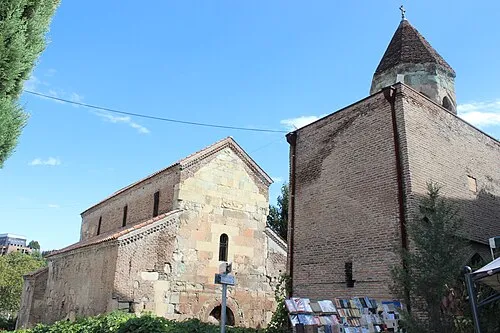
    Tucked behind a small courtyard on Shavteli Street, easy to walk past if you are not paying attention. This is the oldest surviving church in Tbilisi, built in the 6th century by King Dachi of Iberia. The stone facade is plain, almost barn-like. Inside, the three-nave layout is small and dark, with fragments of medieval frescoes barely visible on the upper walls. Entry is free. Open Monday through Friday 9 AM to 6 PM, weekends until 7 PM. Most tourists walk right past, which is exactly why it is worth stopping. The bell tower dates to 1675, and if you hear polyphonic singing from inside, go in: the church occasionally hosts rehearsals of traditional Georgian choral music, and the acoustics in this intimate space are extraordinary. Ten minutes here is enough.

    Learn more about Anchiskhati Basilica →
    Hours
    Mon-Fri: 9:00 AM – 6:00 PM | Sat-Sun: 9:00 AM – 7:00 PM
    Price
    Free

    5 min walk

  2. 2

    Rike Park

    Rike Park

    A modern green space on the left bank of the Mtkvari, rebuilt in the 2010s as part of Tbilisi's modernization push. The park is open around the clock, free to enter. Two large silver metallic tubes near the center were meant to become a concert hall and exhibition space but were never finished, which feels very Tbilisi. A statue of Ronald Reagan stands near the middle, surprising most visitors. The cable car station at the park's south end takes you up to Narikala Fortress for about 2 GEL, but this route visits the fortress on foot later, so save the cable car for the return trip if your legs are tired. Lines are shortest in the first hour after it opens. The park itself is pleasant rather than essential, but its location between the Bridge of Peace and the cable car station means you will pass through it regardless.

    Learn more about Rike Park →
    Hours
    Open 24/7
    Price
    Free

    8 min walk

  3. 3

    Mother of Georgia Monument

    Mother of Georgia Monument

    Kartlis Deda stands 20 meters tall on Sololaki Ridge, holding a bowl of wine in one hand for friends and a sword in the other for enemies. Sculptor Elguja Amashukeli created the original in wood for Tbilisi's 1,500th anniversary in 1958. It was covered in aluminum in 1963 and replaced entirely with a new aluminum version in 1997. The monument is accessible around the clock, free. The platform at the base gives you a different angle than Narikala: you look straight down into the Botanical Garden gorge on one side and across the old town rooftops on the other. Take the cable car up from Rike Park, walk to the statue, then continue along the ridge to the fortress. This connects three attractions in one downhill route.

    Learn more about Mother of Georgia Monument →
    Hours
    Open 24/7
    Price
    Free

    5 min walk

  4. 4

    Narikala Fortress

    Narikala Fortress

    The skeleton of Tbilisi's entire history sits on the ridge between the sulfur baths district and the Botanical Garden. A fortress has stood here since the 4th century, expanded by Arab rulers in the 7th century, rebuilt by David the Builder in the 12th century, and named 'Narin Qala' (little fortress) by the Mongols. An earthquake in 1827 destroyed most of the inner structures, and a gunpowder explosion finished the job. The ruins are open daily from 8 AM to 8 PM, free to explore. Crumbling walls, unguarded narrow paths, and panoramic views of the river bending through the valley below. Inside the lower courtyard, the rebuilt Church of St. Nicholas has simple frescoes worth a quick look. Go in late afternoon when the light is warm and the crowds thin. The walls face west, so sunset turns the stone golden. Watch your footing on the upper sections.

    Learn more about Narikala Fortress →
    Hours
    Daily: 8:00 AM – 8:00 PM
    Price
    Free

    8 min walk

  5. 5

    Sulfur Baths

    Sulfur Baths

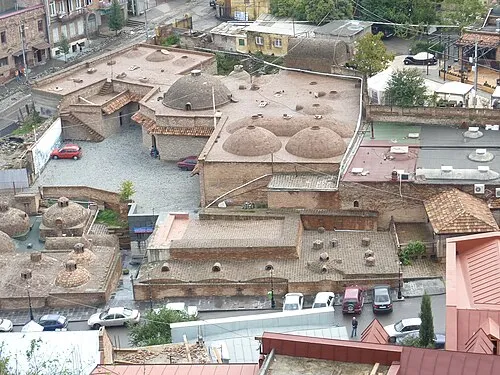
    You will smell the hydrogen sulfide before you see the brick domes. Abanotubani, the bath district at the foot of Narikala, is where Tbilisi got its name: 'tbili' means warm in Georgian. Natural springs push water at 35 to 40 degrees Celsius to the surface here and have done so for at least 1,500 years. The squat brick buildings with rounded domes look like they belong in a Persian miniature painting. Several bathhouses operate daily from 9 AM to 11 PM. Public pools start at about 5 GEL. Private rooms for two run 50 to 80 GEL depending on the season and bathhouse. The most photographed is the Orbeliani Bathhouse (Chreli Abano) with its blue-tiled Islamic facade, but Bath No. 5 often has quieter private rooms at lower prices. Go on a weekday morning right at 9 AM for the most peaceful experience.

    Learn more about Sulfur Baths →
    Hours
    Daily: 9:00 AM – 11:00 PM
    Price
    GEL 30–150 (depending on bath type)

    5 min walk

  6. 6

    Metekhi Church

    Metekhi Church

    The 13th-century church sits on a limestone cliff 20 meters above the Mtkvari, and the approach gives you the classic Tbilisi postcard: the equestrian statue of King Vakhtang Gorgasali in front, the church dome behind, the river below. Open Monday through Saturday 9 AM to 8 PM, Sundays from 8:30 AM. Entry is free. Inside, the space is austere with thick stone columns and minimal decoration. This building has survived Mongol invasions, conversion to Russian military barracks, and Beria's attempt to demolish it entirely in the 1930s. Georgian intellectuals resisted so fiercely that it was saved. The church returned to active worship in 1988. Come at dusk when the fortress and church are lit up. The cliff edge behind the statue gives you the best panorama shot in the city.

    Learn more about Metekhi Church →
    Hours
    Mon-Sat: 9:00 AM – 8:00 PM | Sun: 8:30 AM – 8:00 PM
    Price
    Free

    3 min walk

  7. 7

    Bridge of Peace

    Bridge of Peace

    The glass-and-steel canopy curves over the Mtkvari River like a caterpillar frozen mid-crawl. Designed by Italian architect Michele De Lucchi and opened in 2010, the 150-meter pedestrian bridge cost 12.5 million Georgian lari and divided local opinion completely. It is open around the clock, free to cross, and takes about two minutes to walk. 1,208 LED lamps embedded in the canopy put on a slow-shifting color display at night that is genuinely impressive from either bank. The best photo angle is not from the bridge itself but from the riverside walkway on the old town side, looking east with Metekhi Church on its cliff behind it. Looking upstream you see Metekhi, downstream the old town cascades up toward Narikala. Cross to the east bank and head north toward the hill of Elia.

    Learn more about Bridge of Peace →
    Hours
    Open 24/7
    Price
    Free

    8 min walk

  8. 8

    Holy Trinity Cathedral (Sameba)

    Holy Trinity Cathedral (Sameba)

    The largest cathedral in the Caucasus rises 101 meters above the hill of St. Elia, its gold dome visible from nearly every point in the city. Completed in 2004 after more than a decade of construction, the complex covers over 5,000 square meters and houses nine chapels, five of them underground. The interior is vast and deliberately austere, with high ceilings that amplify every footstep into an echo. Entry is free. Dress modestly: women should cover their heads and shorts are not allowed for anyone. Scarves are available at the entrance. The terrace outside offers sweeping views south across the river to Narikala Fortress. Budget 20 minutes for the interior and the grounds.

    Learn more about Holy Trinity Cathedral (Sameba) →
    Hours
    Mon-Fri: 7:00 AM – 10:00 PM | Sat-Sun: 7:00 AM – 9:00 PM
    Price
    Free

    5 min walk

  9. 9

    Parliament of Georgia

    Parliament of Georgia

    The massive Soviet-era building was constructed between 1938 and 1953 on the site of a former Russian military cathedral. The facade is heavy stone with oversized arches, typical Stalinist civic architecture designed to project authority. You cannot enter without an advance-booked tour (Monday to Friday 9 AM to 6 PM, closed weekends). The exterior and the wide plaza in front are worth the stop. This is where the Rose Revolution played out in November 2003, when protesters stormed the building holding roses. It is also the site of the April 9, 1989 tragedy, when Soviet troops attacked peaceful demonstrators. A small memorial stands nearby. Five minutes here is enough before continuing up Rustaveli Avenue.

    Learn more about Parliament of Georgia →
    Hours
    Mon-Fri: 9:00 AM – 6:00 PM | Sat-Sun: Closed
    Price
    Free (exterior)

    3 min walk

  10. 10

    Georgian National Museum

    Georgian National Museum

    The Simon Janashia Museum of Georgia sits on Rustaveli Avenue and holds the country's most important collections. The ground floor Treasury contains gold artifacts from the Kingdom of Colchis dating to the 3rd millennium BC: tiny, detailed goldwork that rivals anything in the British Museum. Head straight there. Most visitors wander the upper floors first and miss the best collection. The top floor houses the Museum of Soviet Occupation, documenting 70 years of Soviet rule through photographs, personal letters, and deportation records. It is small, blunt, and takes about 30 minutes. Open Tuesday through Sunday 10 AM to 6 PM, closed Mondays. Admission is 15 GEL. Budget 45 minutes to an hour. The museum provides the historical context for everything else you see in the city.

    Learn more about Georgian National Museum →
    Hours
    Mon: Closed | Tue-Sun: 10:00 AM – 6:00 PM
    Price
    GEL 15

    3 min walk

  11. 11

    Georgian National Opera

    Georgian National Opera

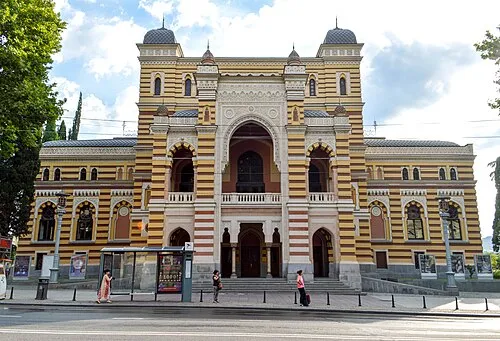
    The Paliashvili Opera and Ballet Theatre sits at the upper end of Rustaveli Avenue in a Neo-Moorish building that opened in 1851. The facade mixes arched windows with Islamic-inspired decoration, a style that feels distinctly Caucasian. The building survived fires in 1874 and 1973 and was rebuilt both times. The 1,065-seat auditorium has acoustics that are warm rather than precise. Box office hours run daily from 11 AM to 7 PM. Tickets for performances start around 20 GEL and rarely exceed 80 GEL, making this one of the cheapest opera houses in Europe. Even without attending a show, the facade is worth photographing from the small park across the street. Check the schedule at opera.ge for Georgian-language operas by Paliashvili, especially 'Abesalom and Eteri,' which is rarely performed outside the country.

    Learn more about Georgian National Opera →
    Hours
    Daily: 11:00 AM – 7:00 PM
    Price
    GEL 25–50 (varies by show)

    5 min walk

  12. 12

    Dry Bridge Market

    Dry Bridge Market

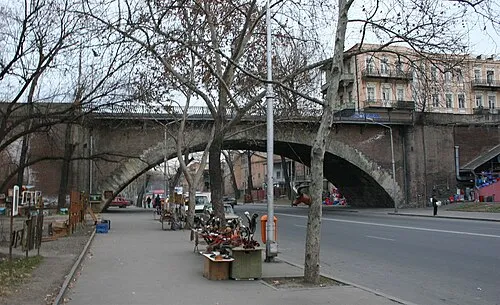
    The last stop sits on and around a bridge built by Italian architect Giovanni Scudieri in 1881 over a branch of the Mtkvari that has since dried up. Vendors spread Soviet military medals, old paintings, antique daggers, vinyl records, jewelry, cameras, and hand-knitted socks across blankets and folding tables. The market runs daily from roughly 11 AM to 6 PM, with Saturday and Sunday mornings offering the best selection and most vendors. Haggling is expected, and most sellers come down 20 to 30 percent from their first offer. The paintings section on the bridge itself has the best finds for Georgian and Soviet-era art. In the 1990s, during the post-Soviet economic collapse, Tbilisi residents sold their personal possessions here to survive. That history gives the market a weight other flea markets lack. A small oil painting might go for 20 to 50 GEL. Soviet pins and medals start at 2 to 5 GEL. This is a good place to end the walk and find a nearby cafe on Dedaena Park.

    Learn more about Dry Bridge Market →
    Hours
    Daily: 11:00 AM – 6:00 PM
    Price
    Free (entry)
AI Tourguide
Walk this exact route with a private AI guide.
Full GPS navigation, interactive stories, and a guide that answers all your questions. A private guide experience for just €5/hour.
Start This Tour

Self-Guided Tour vs. Group Tour in Tbilisi

Guided walking tours in Tbilisi typically cost $25 to $60 per person and cover roughly the same ground. Free tip-based tours exist but move at the group's pace and linger too long at some stops while skipping others. With this self-guided route, you control the timing. You can spend an hour soaking in the sulfur baths and five minutes at the Parliament, or skip the museum entirely and sit on the Narikala walls watching the sunset.

Tbilisi is also remarkably cheap. A full day of walking, a private sulfur bath session (50 to 80 GEL), museum entry (15 GEL), a khachapuri lunch, and a couple of beers will cost under $30 total. A guided tour eats a third of that budget before you start spending. Street signs are in Georgian and Latin script, Google Maps works accurately, and the route follows obvious landmarks that are impossible to lose: the river, the fortress ridge, the boulevard.

Group Tour AI Self-Guided
Price €25–€50 per person €5/hour or €20 all-inclusive
Flexibility Fixed schedule Start anytime, skip stops
Languages 1–2 languages 11 languages
Pace Group pace Your own pace

How Long Does This Tbilisi Tour Take?

Our route covers 7.4 km with 12 stops and takes approximately 3.5 hours at a relaxed pace.

The raw walking time for 7.4 kilometers is about 90 minutes, but plan for 3.5 to 4 hours with stops. The climb from the sulfur baths to Narikala takes 15 minutes at a moderate pace, and you will want at least 20 minutes on the fortress walls. The Georgian National Museum deserves 45 minutes minimum. The Dry Bridge Market is where time vanishes without warning.

For a break, the small cafe in Narikala's lower courtyard sells Turkish coffee and lemonade with views over the entire river valley. If you need a longer rest, Cafe Gabriadze on Shavteli Street near Stop 1 has a shaded terrace and serves Georgian wine by the glass for about 12 GEL. Morning is best for the old town and fortress (cooler, fewer people), late afternoon works well for Rustaveli Avenue and the flea market.

Tips for Walking in Tbilisi

AI Tourguide
Walk this exact route with a private AI guide.
Full GPS navigation, interactive stories, and a guide that answers all your questions. A private guide experience for just €5/hour.
Start This Tour

AI Audio Guide for This Tour

Standing near Freedom Square or Rustaveli Avenue? Your first stop is a five-minute walk from Avlabari metro. Open the app, tap the Tbilisi tour, and follow offline maps with GPS tracking at each stop. Download the route before you head into the old town where signal can drop in the narrow lanes.

AI Audio Guide Stories, history and fun facts narrated as you walk. No earpiece rental needed.
GPS Navigation Turn-by-turn directions so you never get lost between stops.
Ask Anything Curious about a building you pass? Ask your AI guide on the spot.
11 Languages Switch language anytime. No separate tour needed.
Start This Tour Free

Common Questions

Very safe for walking, including at night in the central areas on this route. Violent crime against tourists is rare. The most common annoyance is aggressive taxi drivers near Freedom Square quoting inflated prices. Use the Bolt app instead. At the Dry Bridge Market, keep your phone and wallet in a front pocket as you would at any open-air market. The police presence in the old town is visible and responsive.
The Georgian National Museum (stop 10) and the Sulfur Baths (stop 5) are both fully indoor options where you can wait out a shower. The Narikala climb becomes difficult in rain because the stone steps get very slick. If heavy rain starts before you reach the fortress, take the cable car from Rike Park instead (about 2 GEL each way). Carry a light rain jacket. Tbilisi showers tend to be short and intense, passing within 20 to 30 minutes.
Spring (April to May) and autumn (September to October) are ideal. Temperatures sit between 15 and 25 degrees, the light is warm, and the fortress climb is comfortable. Summer (June to August) brings temperatures above 35 degrees and makes the midday stretch brutal. Winter is mild by Eastern European standards but can be grey and wet. If you visit in summer, start at 8:30 AM and plan to be off the fortress ridge by 11 AM.
No booking needed. This self-guided tour is available anytime. Open the route on your phone and start walking. The AI audio guide works instantly, no reservation required.
The AI audio guide is available in 11 languages: English, German, French, Spanish, Italian, Japanese, Chinese, Portuguese, Danish, Norwegian, and Swedish.
Yes. Skip any stop, spend extra time at places you like, or start the route from any point. You can also ask the AI to suggest a shorter route.
AI Tourguide
Curated by AI Tourguide GPS-verified routes, reviewed and updated regularly.
Last verified March 2026