Self-Guided Walking Tour in Valletta

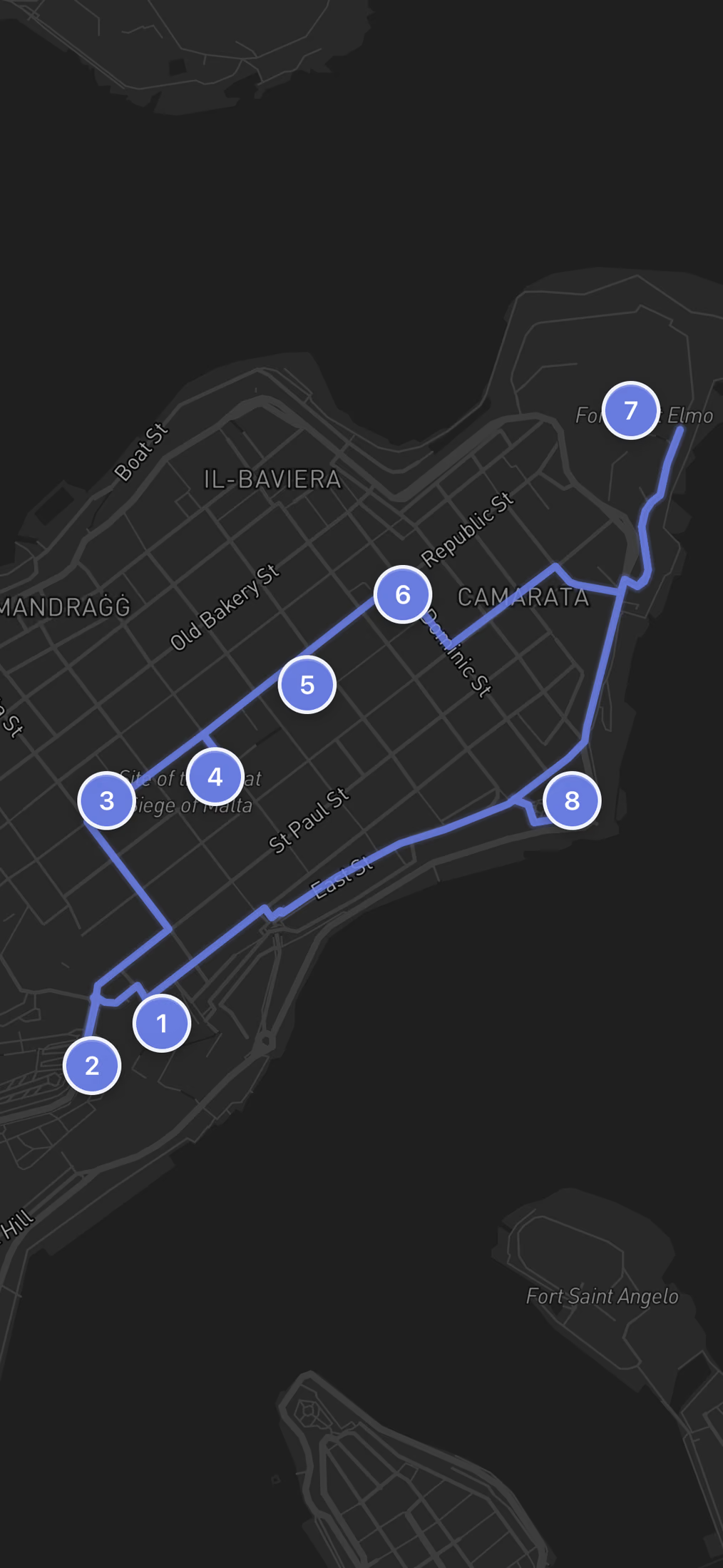
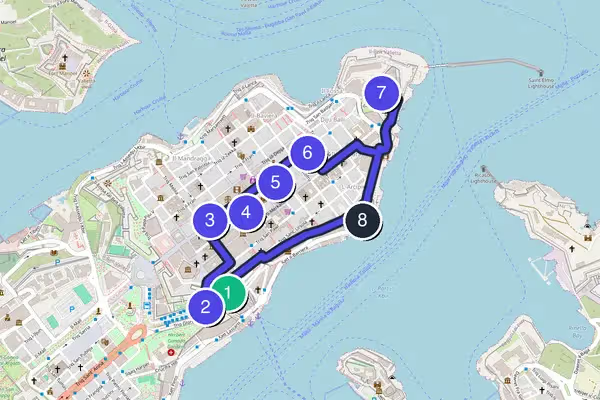
A 3.3 km point-to-point route through Europe's smallest capital, running the length of the peninsula from the Upper Barrakka Gardens to Fort St. Elmo across 8 stops. This page gives you the map, walking time for every leg, current hours and admission prices for each interior, and shorter versions if your day is tight.
8 Stops3.3 km~2 hours walking2–3.5 hours with stops
What you get with AI Tourguide
Full GPS navigationInteractive AI guidePersonalized to youWorks in your browser
Try this tour with Alex

Valletta Walking Tour at a Glance

This route is built for travellers who want the whole sweep of Valletta in a single, unhurried walk, from the knights and Caravaggio to the George Cross and 5,000-year-old Neolithic figurines. Every interior along the way is optional. You decide which doors to open and which to admire from the street, and the outdoor line from garden to fort works on its own.

StartUpper Barrakka Gardens
FinishLower Barrakka Gardens
Route typeA point-to-point walk, not a loop. It runs roughly south-west to north-east up the spine of the peninsula, then drops south to the water, so you finish at a different place than you started with almost no backtracking.
Realistic timeThe 3.3 km of walking alone takes about an hour. Add the outdoor stops and the two gardens and you are at two hours; open the major interiors and it stretches to three or three and a half.
DifficultyEasy in distance at just 3.3 km, but Valletta sits on a ridge. The main streets are flat, while the cross-streets drop and climb in steep limestone staircases, so grippy flat shoes beat sandals here.
Cost to followThe outdoor route and both Barrakka Gardens are free. The paid interiors are the War Rooms (€10), Archaeology Museum (€5), St. John's Co-Cathedral (€10), Grandmaster's Palace (€10), Casa Rocca Piccola (€9) and Fort St. Elmo (€10).
Best for:

First-time visitors who want history stacked densely, harbour views at both ends, and a walk short enough to leave energy for the interiors that matter most.

The Route

Free Walking Tour Map of Valletta

8 stops3.3 kmabout 2 hours
Loading the interactive map…The complete walking route will appear here.
Want the route to guide you while you walk?Open the route with navigation and a personal guide for the history, stories and questions that matter to you.
Open route + AI guide

The 8 stops along this route

  1. Upper Barrakka Gardens in Valletta, stop 1 on the self-guided walking tour
    1Upper Barrakka Gardens
  2. Lascaris War Rooms in Valletta, stop 2 on the self-guided walking tour
    2Lascaris War Rooms
  3. National Museum of Archaeology in Valletta, stop 3 on the self-guided walking tour
    3National Museum of Archaeology
  4. St. John's Co-Cathedral in Valletta, stop 4 on the self-guided walking tour
    4St. John's Co-Cathedral
  5. Grandmaster's Palace in Valletta, stop 5 on the self-guided walking tour
    5Grandmaster's Palace
  6. Casa Rocca Piccola in Valletta, stop 6 on the self-guided walking tour
    6Casa Rocca Piccola
  7. Fort Saint Elmo in Valletta, stop 7 on the self-guided walking tour
    7Fort Saint Elmo
  8. Lower Barrakka Gardens in Valletta, stop 8 on the self-guided walking tour
    8Lower Barrakka Gardens
  9. That's the complete route.

    If you want more than the map and text, add live navigation and a conversational AI guide while you walk.

    Open route + AI guide
    You made it
Stop 1 of 8
Swipe →

Your Valletta Walking Tour, Stop by Stop

  1. 1

    Upper Barrakka Gardens

    Upper Barrakka Gardens in Valletta, stop 1 on the self-guided walking tour

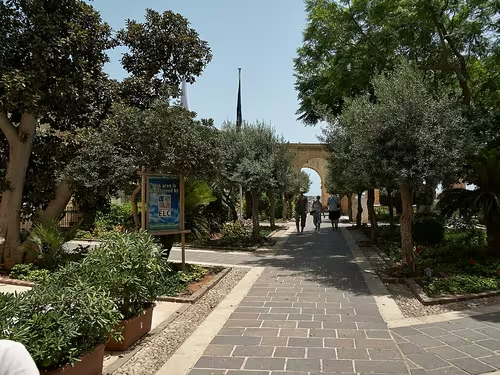
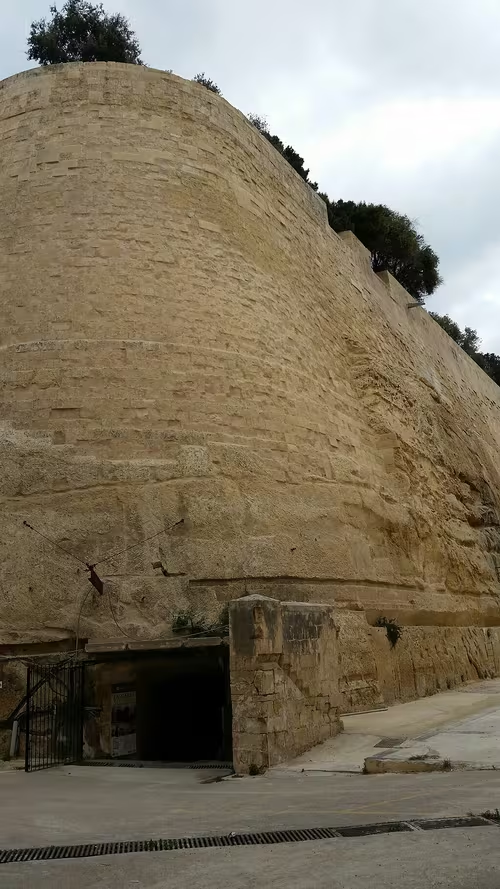
    The Knights of Italy built this elevated terrace in 1661 as a private exercise ground, and it remains the finest viewpoint in Malta. The Grand Harbour spreads below with the Three Cities across the water, and on a clear day the scale of the fortifications is staggering: millions of tons of limestone carved into bastions, curtain walls, and docks that sheltered the fleet of the Order of St. John. Come at noon sharp to witness the Saluting Battery directly below fire its daily cannon salute, a tradition that has marked midday since the British era. The gardens are free, open daily from 8:00 AM to 10:00 PM with seasonal variations. Arrive 15 minutes before noon to claim a spot along the upper railing with an unobstructed view of the cannons. The colonnaded terrace on the upper level provides shade and a perfect frame for photographs of the harbor.
    Hours
    Daily 8:00 AM – 10:00 PM (seasonal variations)
    Price
    Free
  2. 2

    Lascaris War Rooms

    Lascaris War Rooms in Valletta, stop 2 on the self-guided walking tour

    Located 45 meters below the Upper Barrakka Gardens, this underground bunker served as the nerve center for Allied operations in the Mediterranean during World War II. General Eisenhower directed the 1943 invasion of Sicily from these rooms, and the original map tables, communication equipment, and plotting boards remain exactly where they were left. The narrow tunnels carved into the limestone are cool even in August, and the audio guide walks you through the tense decision-making that happened here while Malta endured 154 days of continuous bombing. Admission is €10 for adults, €5 for students, €3 for children aged 5 to 11. Open Monday to Saturday from 10:00 AM to 4:30 PM, closed Sundays. The descent from the gardens is via a steep staircase, so keep that in mind if mobility is a concern. Budget 45 minutes for the full audio tour.

    Hours
    Mon-Sat: 10:00 AM – 4:30 PM | Sun: Closed
    Price
    €10 adults, €5 reduced (students), €3 children (5-11)
  3. 3

    National Museum of Archaeology

    National Museum of Archaeology in Valletta, stop 3 on the self-guided walking tour

    Housed in the Auberge de Provence, a refined 1571 building designed by Girolamo Cassar for the Knights of St. John, this museum holds artifacts that predate the Pyramids by a thousand years. The star exhibit is the Sleeping Lady, a 5,000-year-old terracotta figurine from the Hal Saflieni Hypogeum that has become Malta's most recognized ancient artifact. The Neolithic temple builders of Malta left behind carved stone altars, pottery, and the mysterious "fat lady" figurines that fill several rooms on the ground floor. The upper hall, originally the knights' banqueting room, retains its painted wooden ceiling and is worth seeing for the architecture alone. Admission is €5. Open Monday and Wednesday to Sunday from 9:00 AM to 5:00 PM, closed Tuesdays. The museum is small enough to cover in 30 to 40 minutes, and the Neolithic collection is genuinely world-class.

    Hours
    Mon: 9:00 AM – 5:00 PM | Tue: Closed | Wed-Sun: 9:00 AM – 5:00 PM
    Price
    €5.00
  4. 4

    St. John's Co-Cathedral

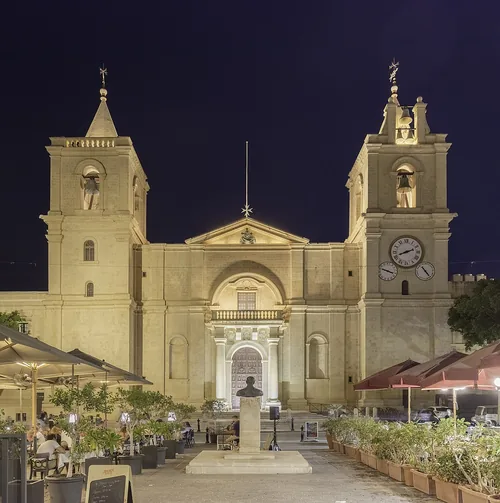
    St. John's Co-Cathedral in Valletta, stop 4 on the self-guided walking tour

    From the outside, this 1577 fortress-church looks deliberately plain, its limestone facade blending with the fortified walls around it. Step inside and the contrast is violent: every surface explodes with gilded carvings, painted vaults, and inlaid marble. The floor is paved with nearly 400 marble tombstones of individual knights, each one a work of art in colored stone marquetry depicting coats of arms, skeletons, and battle scenes. In the oratory hangs Caravaggio's largest painting, The Beheading of St. John the Baptist, the only work he ever signed (his name is written in the blood flowing from the saint's neck). Admission is €10 for adults, €5 for students, free for children under 6. Open Monday to Saturday 9:00 AM to 4:15 PM, closed Sundays. Go first thing in the morning: by 11:00 AM tour groups fill the nave and you cannot appreciate the floor tombs properly. This is the single most important interior in Malta.

    Hours
    Mon-Sat: 9:00 AM – 4:15 PM | Sun: Closed
    Price
    €10 adults, €5 reduced (students), Free under 6
  5. 5

    Grandmaster's Palace

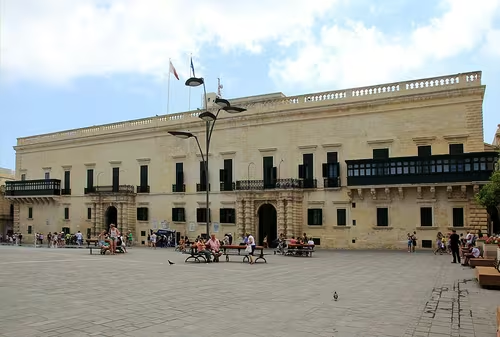
    Grandmaster's Palace in Valletta, stop 5 on the self-guided walking tour

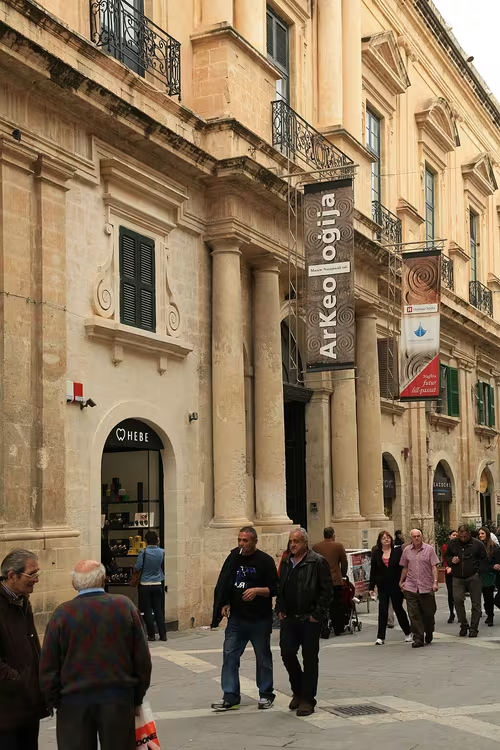
    This massive 1571 limestone complex served as the seat of power for the Knights of Malta and later as the residence of British governors. The State Rooms occupy the upper floor, including the 580-square-meter Grand Council Chamber hung with Gobelins tapestries depicting Caribbean and African scenes, and the even larger Throne Room. The Palace Armoury on the ground floor holds one of the world's largest collections of arms and armor, with over 5,000 pieces including full suits of parade armor worn by individual Grand Masters. Admission is €10. Open daily from 9:00 AM to 5:00 PM. The armoury alone is worth an hour: the sheer quantity of engraved breastplates, swords, and crossbows packed into one long hall gives you a visceral sense of how seriously these knights took their military mission. The inner courtyard, called Neptune's Courtyard for its bronze statue, is free to enter even without a ticket.

    Hours
    Daily: 9:00 AM – 5:00 PM
    Price
    10 EUR
  6. 6

    Casa Rocca Piccola

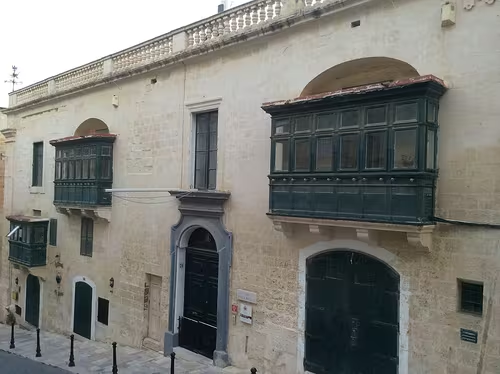
    Casa Rocca Piccola in Valletta, stop 6 on the self-guided walking tour

    While every other palace in Valletta has been turned into a museum or government office, Casa Rocca Piccola remains a lived-in family home. Built in the 16th century for Don Pietro La Rocca, the palazzo has been in the de Piro family for nine generations and contains 50 rooms that mix antique furniture, family portraits, and personal belongings in a way that feels refreshingly unscripted. The guided tour takes you through drawing rooms, a private chapel, and a network of rock-cut tunnels carved during World War II as air-raid shelters. The shelters still have their original wooden bunks and ventilation systems intact. Admission is €9. Open Monday to Saturday from 10:00 AM to 5:00 PM, closed Sundays. The personal touch makes this the most memorable house visit in Valletta: the family still uses many of the rooms, and the guide tells stories that no museum placard could convey.

    Hours
    Mon-Sat: 10:00 AM – 5:00 PM | Sun: Closed
    Price
    €9
  7. 7

    Fort Saint Elmo

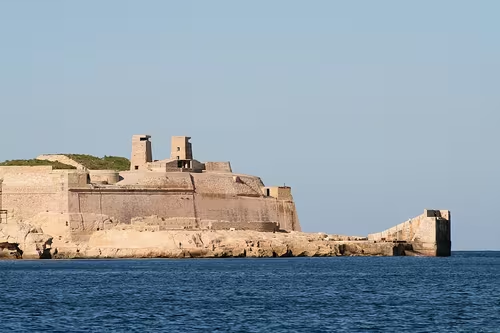
    Fort Saint Elmo in Valletta, stop 7 on the self-guided walking tour

    This star-shaped fortress at the tip of the Sciberras Peninsula was built in 1552 and famously withstood 28 days of relentless bombardment during the Great Siege of 1565, when the entire Ottoman fleet focused its firepower on this single point. Every defender was killed, but the delay gave the rest of Malta time to organize its defense. The fort now houses the National War Museum, where the original George Cross awarded to Malta by King George VI in 1942 is on display, along with the Gloster Sea Gladiator biplane "Faith" that helped defend the island. Admission is €10 for adults, €6 for students, €5 for children aged 5 to 11. Open Monday and Wednesday to Sunday from 9:00 AM to 5:00 PM, closed Tuesdays. Walk the ramparts for views of both harbors simultaneously: the Grand Harbour to the south and Marsamxett to the north.

    Hours
    Mon: 9:00 AM – 5:00 PM | Tue: Closed | Wed-Sun: 9:00 AM – 5:00 PM
    Price
    €10 adults, €6 reduced (students), €5 children (5-11)
  8. 8

    Lower Barrakka Gardens

    Lower Barrakka Gardens in Valletta, stop 8 on the self-guided walking tour

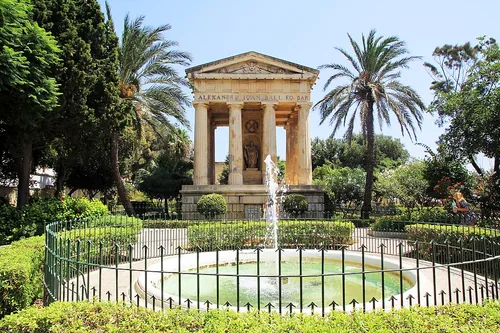
    Smaller and quieter than its upper counterpart, the Lower Barrakka Gardens offer a neoclassical temple dedicated to Sir Alexander Ball, the British naval officer who led the 1798 blockade against the French. The terrace looks east across the harbor mouth toward the Ricasoli breakwater and the open Mediterranean beyond, a view that is less dramatic than the Upper Barrakka but more peaceful. On warm evenings the gardens are almost empty, making them the ideal endpoint for this walk: find a bench under the trees, watch the cargo ships enter the harbor, and let the scale of Valletta's fortified walls sink in from below. The gardens are free, open daily from 7:00 AM to 10:00 PM. From here you can descend to the waterfront for dinner at one of the restored warehouse restaurants along the quay, or walk back up to Republic Street in about ten minutes.

    Hours
    Daily: 7:00 AM – 10:00 PM
    Price
    Free

How Long Does This Walking Tour Really Take?

Plan on two to two and a half hours for the walk with its key interiors. The 3.3 km covers quickly, but the eight stops are dense: entering the War Rooms, Co-Cathedral and Grandmaster's Palace adds roughly another hour, pushing the full day toward three and a half.

Allow 2 to 2.5 hours for the walk including key interiors. The distance is only 3.3 km, but the stops are dense with content. If you visit the War Rooms, Co-Cathedral, and Grandmaster's Palace interiors, add another hour for a total of about 3.5 hours. The terrain involves some steep descents and one climb back up, typical for Valletta's ridge topography.

Full Route, Shorter Walk or Two-Day Version?

The full walk runs all 8 stops from the Upper Barrakka Gardens to the Lower Barrakka. If you have less time or want to split the interiors across two visits, here are three ways to shape it, each with real stop numbers and timings.

The Short Version

The dense historic core

Stops 1 to 5, Upper Barrakka Gardens to Grandmaster's Palace, about 1 km of walking and 1.5 to 2 hours

Keeps the tightest cluster and cuts the two longest legs at the far end. You skip Casa Rocca Piccola and the 600 m and 710 m walks out to Fort St. Elmo and back, but still get the viewpoint, the Co-Cathedral and the palace.

The Two-Part Split

Two easy half-days

Day one stops 1 to 4, day two stops 5 to 8, split at St. John's Co-Cathedral

For a slower pace or travelling with kids: do the viewpoint, War Rooms, museum and cathedral one morning, then the palace, palazzo, Fort St. Elmo and Lower Barrakka the next. Each half is short and never rushed.

You can walk it in reverse from the Lower Barrakka Gardens up to the Upper Barrakka, but the given direction is recommended. Starting high at the Upper Barrakka means you head downhill toward the water and finish at sea level rather than climbing the ridge at the end.

Is This Valletta Walking Tour Right for You?

A short, history-dense walk on a compact grid, with steep cross-streets and two harbour viewpoints. Here is who it suits best and how to bend it to your day.

A good fit if you…

  • First-time visitors who want the knights, World War II and Neolithic Malta in one 3.3 km line
  • Anyone who values a compact route where you are never more than two minutes from getting back on track
  • Travellers who want to pick and choose paid interiors rather than commit to every ticket
  • Photographers chasing the Grand Harbour from the Upper Barrakka and the harbour mouth from the Lower Barrakka

Adapt the route if you…

  • If mobility is a concern, the cross-street staircases are steep; stick to Republic and Merchant's Streets and use the Barrakka Lift
  • If you have half a day only, run the Short Version through stop 5 and drop the walk out to Fort St. Elmo
  • If you visit on a Tuesday or Sunday, check closures first, since several stops shut on one of those days
  • If it is peak summer, start at 9:00 AM or after 3:00 PM to slip between the cruise-ship crowds

Tickets & Skip-the-Line in Valletta

Six of the eight stops charge admission and two are free open-air gardens; none use timed tickets, so you just turn up, but a couple of opening-day quirks are worth planning around.

Lascaris War Rooms10 euros adults, 5 students, 3 children aged 5 to 11. Open Mon-Sat 10:00 to 16:30, closed Sunday. Pay at the door and budget about 45 minutes for the audio tour.
National Museum of Archaeology5 euros flat. Open daily except Tuesday, 9:00 to 17:00. Small enough to see in 30 to 40 minutes, and rarely any queue.
St. John's Co-Cathedral10 euros adults, 5 students, free under 6. Mon-Sat 9:00 to 16:15, closed Sunday. This is the one stop where timing matters: come at 9:00 or after 15:00, because tour groups fill the nave by 11:00 and you cannot appreciate the marble floor tombs. Tickets at stjohnscocathedral.com.
Grandmaster's Palace10 euros, open daily 9:00 to 17:00. Neptune's Courtyard is free to walk into even without a ticket.
Casa Rocca Piccola9 euros, Mon-Sat 10:00 to 17:00, closed Sunday. Entry is by guided tour of a still-lived-in family palazzo, so times are fixed to the tour schedule.
Fort Saint Elmo10 euros adults, 6 students, 5 children aged 5 to 11. Open daily except Tuesday, 9:00 to 17:00. Houses the National War Museum and Malta's original George Cross.
Everything else is freeBoth the Upper and Lower Barrakka Gardens are free, open-air and need no ticket. Time the Upper Barrakka for the noon cannon salute from the Saluting Battery below.
Optional upgrade
+4
The same 8-stop route,
now with navigation and a guide.
Optional AI experience

You already have the route.
The AI guide brings it to life.

Standing at the Upper Barrakka Gardens looking out over the Grand Harbour? Open AI Tourguide right in your browser, no app and no download, and a voice guide walks the grid down to Fort St. Elmo with you, greeting you, telling the story of the Knights at St. John's Co-Cathedral and the War Rooms, and asking what you want to know so it can adapt as you go. A real conversation, not a recording. Start with 100 free credits.

Livenavigation13languagesAnyquestionYourinterests
Open this route with the AI guide

Try it in your browser · No app or download required

Tips for Walking in Valletta

  • Time your start to arrive at the Upper Barrakka Gardens by 11:45 AM for the noon cannon salute. Stand at the upper railing for the best view, and arrive early because the spot fills up by 11:50.
  • St. John's Co-Cathedral is the most popular attraction in Valletta. Go first thing at 9:00 AM or after 3:00 PM to avoid the worst tour-group congestion. The floor tombs are impossible to appreciate when the nave is packed.
  • Valletta's streets run on a strict grid, but the cross-streets involve steep staircases. Wear shoes with good grip, especially if the limestone is wet. Flat shoes beat sandals here.
  • Most museums close on either Tuesdays or Sundays. Check your target day: Tuesday closes the Archaeology Museum and Fort St. Elmo, Sunday closes the War Rooms, Co-Cathedral, and Casa Rocca Piccola. Wednesday through Saturday gives you access to everything.
  • After finishing at the Lower Barrakka, walk down to the Valletta Waterfront for dinner. The restored 18th-century warehouses along the quay have outdoor seating facing the harbor, and the seafood is excellent.

Where to Eat Along the Route

Valletta's best cooking is never on Republic Street, the 500-metre pedestrian corridor that runs down the spine of the city. Walk one block off it in any direction and prices drop while authenticity rises. Skip the laminated-menu places near the main sights and head for the parallel streets instead.

  • Old Bakery Street (Triq il-Forn), one block west of Republic: the most consistent run of genuine Maltese restaurants and traditional bakeries in the city.
  • Strait Street (Triq id-Dejqa), the old red-light lane now revived with wine bars and small kitchens, and the closest thing Valletta has to real nightlife.
  • Merchants Street (Triq il-Merkanti), parallel to Republic on the east side: less tourist-facing, home to the daily market and the Is-Suq Tal-Belt food hall.
  • St Lucia Street and St Paul Street, quieter cross-streets just off the main drag with solid mid-range options and far fewer crowds.
Rubino⌖The oldest restaurant in Valletta (1906) at 53 Old Bakery Street, and the most authentic mid-range Maltese meal in the city. Order the rabbit stew (around 16 euros) at lunch. It keeps Maltese hours and closes Sunday evening and Monday, so check before going.
Legligin⌖A tiny wine-cellar bistro on Santa Lucia Street with no set menu and a five-course tasting lunch around 30 euros; the owner pulls your bottle straight out of the wall. Book ahead, it seats very few, and it works equally as a dinner and a drinking destination.
Noni⌖The one Republic Street address worth the price: a Michelin-starred basement from Valletta native Jonathan Brincat, around 70 to 90 euros for three courses. Book a minimum of three weeks ahead from April to October. Open Tue-Sat evenings, closed Sunday and Monday.
Cafe Jubilee⌖A 1920s-style cafe on Independence Square and the most reliable budget sit-down option, with pasta at 9 to 12 euros and the most consistent vegetarian choices in Valletta. Unlike many traditional spots it happily takes evening diners.

A pizza on Republic Street runs 18 to 22 euros; the same pizza one street over on Old Bakery Street is 12 to 15, and 7 to 9 from a bakery to take away, so treat laminated six-language menus, menu photos and anyone beckoning you in from the pavement as a signal to keep walking.

Tourist Traps to Avoid in Valletta

Valletta is one of Europe's safest capitals, so the real traps here are financial rather than criminal: hidden charges and overcharging packed into a small, cruise-heavy footprint.

  • The coperto (cover charge) of 1.50 to 4 euros per person is standard and legal, but printed in small type at the bottom of the menu and never mentioned aloud. Check the fine print before ordering.
  • Bread often arrives automatically at 2 to 3 euros a head. If you don't want it, say so when it lands on the table.
  • Some bills add a discretionary service charge of 10 to 12.5 percent on top of VAT, sometimes even for perfunctory service. Read the bill line by line; a discretionary charge can be questioned.
  • Airport taxis frequently quote 30 to 40 euros to Valletta without running a meter; the fair rate is 15 to 22, and a Bolt is 12 to 16. Ignore the touts at arrivals and use the app or the fixed-price desk.
  • Horse-carriage (karozzin) drivers may quote a low figure and then charge per person at the end. Agree a total price for the whole group and journey up front.
  • So-called handmade Maltese lace in Republic Street and Marsaxlokk stalls is often machine-made abroad; genuine bizzilla comes from craft workshops with visible weavers.
  • Valletta's free walking tours end with an expected 20-euro tip and social pressure. A self-guided or upfront-priced tour costs about the same with none of the awkwardness.

Why Walk This Route?

This 3.3 km walk through Valletta connects 8 stops in roughly 2 hours, covering the entire length of Europe's smallest capital from the Upper Barrakka Gardens to Fort St. Elmo at the peninsula's tip. The route follows the Knights of Malta through four centuries: from the war rooms where Eisenhower planned the invasion of Sicily to the co-cathedral where Caravaggio painted his largest canvas. Valletta is built on a grid, every street either climbs uphill or drops toward the harbor, and this walk uses that slope to your advantage, starting high and finishing at sea level.

Common Questions

How much does it cost to enter all the sites?

If you enter every paid site on this walk, the total is approximately €54 for an adult: War Rooms (€10), Archaeology Museum (€5), Co-Cathedral (€10), Grandmaster's Palace (€10), Casa Rocca Piccola (€9), and Fort St. Elmo (€10). The two Barrakka Gardens are free. If budget is tight, prioritize the Co-Cathedral and the War Rooms. They offer the most impact for the price.

Is Valletta accessible for people with mobility issues?

Partially. The main streets (Republic Street and Merchant's Street) are flat and pedestrianized, but the cross-streets involve steep staircases with no ramps. The Barrakka Lift connects the waterfront to the Upper Barrakka Gardens and costs €1 each way. The War Rooms require descending steep stairs. The Co-Cathedral and Grandmaster's Palace are on the main level and accessible.

What is the best day to do this walk?

Wednesday through Saturday. All sites are open, foot traffic is manageable, and you avoid the Tuesday and Sunday closures that affect multiple stops. In summer, cruise ships dock on most mornings, flooding the city with day-trippers between 10:00 AM and 3:00 PM. Starting at 9:00 AM or after 3:00 PM avoids the worst of it.

Take this route with you

Open this exact tour with navigation and your personal AI guide.

Start GPS Navigation + AI Guide
AI Tourguide
Researched and curated by the AI Tourguide teamWe plan and quality-check every route, then research and verify the opening hours, prices, and practical tips for each stop along it.
▶ Open route with AI guideNavigation, stories and your questions