Self-Guided Walking Tour in Zaragoza

8 Stops 5.0 km ~2.2 hours
Start This Tour Free
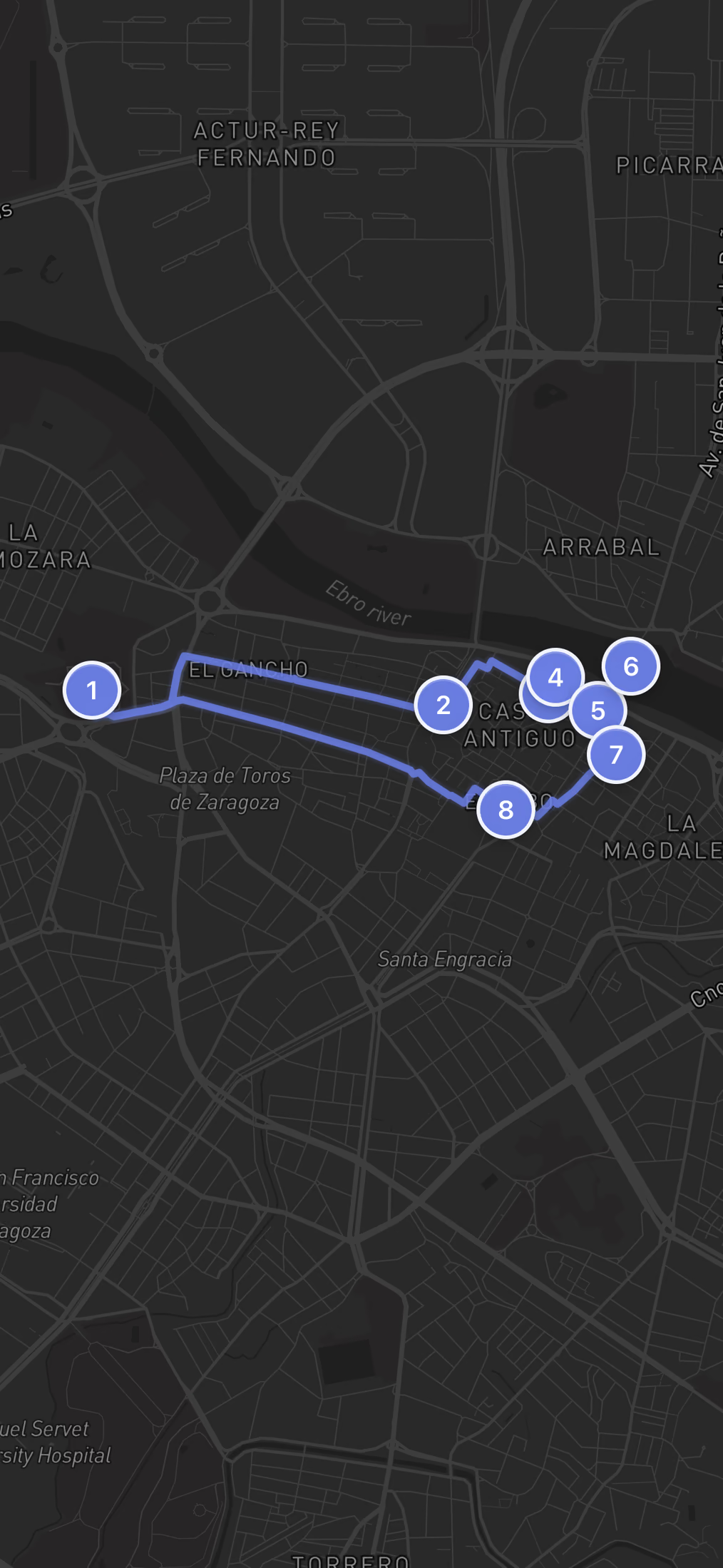
Walking tour route map of Zaragoza
Start This Tour Free

Why Walk Zaragoza? A Self-Guided Tour

Zaragoza is one of those rare cities where 2,000 years of history fit inside a 5-kilometer walk. Roman walls sit beneath medieval squares, an 11th-century Islamic palace anchors the western edge of town, and two cathedrals face each other across one of the largest pedestrian plazas in Europe. Most visitors blow through on the AVE train between Madrid and Barcelona, which is exactly why the ones who stop have the city almost to themselves.

This route starts at the Aljaferia Palace on the western fringe and walks you steadily east through the old town, hitting the market, the tapas alleys, both cathedrals, the Renaissance merchants' hall, and finishing on a 15th-century bridge over the Ebro. Eight stops across 5 kilometers, roughly 2 to 3 hours with stops. Each stop sets up the next, and you never double back. The walking itself is easy on flat, paved ground. The challenge is not covering the distance. It is pulling yourself away from each stop.

The Route: 8 Stops

Swipe through images or scroll names below

Scroll to explore →
1. Aljafería Palace
2. Mercado Central
3. Plaza del Pilar
4. Basilica del Pilar
5. Palacio de la Lonja
6. Puente de Piedra
7. La Seo Cathedral
8. El Tubo

Route Map

Tap to load interactive map
AI Tourguide
Walk this exact route with a private AI guide.
Full GPS navigation, interactive stories, and a guide that answers all your questions. A private guide experience for just €5/hour.
Start This Tour

Your Zaragoza Walking Tour, Stop by Stop

  1. 1

    Aljafería Palace

    Aljafería Palace

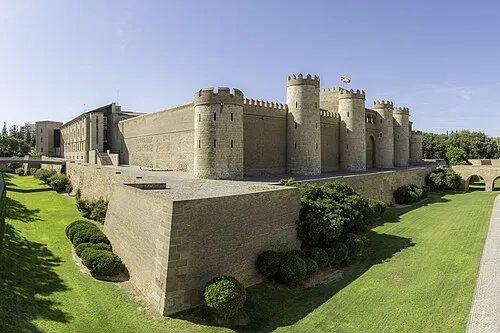
    Thick fortress walls and squat towers rise from a landscaped moat, looking more military barracks than royal palace. Do not be fooled. Once you pass through the entrance, the courtyard opens onto orange trees, horseshoe arches, and stucco so fine it looks like lace. This is the northernmost Islamic palace in Europe, built between 1065 and 1081 for the Hudid kings of the Taifa of Zaragoza. Architecturally, it sits between the Cordoba Mosque and the Alhambra, filling the gap between the 10th and 14th centuries. The mosque oratory with its small mihrab and interlaced arches is the single room most worth your time. Entry costs 5 EUR. Open Monday to Saturday 10:00 AM to 6:00 PM, Sunday 10:00 AM to 2:00 PM. The palace now houses the Aragonese Parliament, so some rooms close during sessions. The nearest tram stop is "Aljaferia" on Line 1, about 100 meters from the entrance. Budget 30 to 45 minutes. Book your entry slot online, as capacity is limited.
    Learn more about Aljafería Palace →
    Hours
    Mon-Sat: 10:00 AM – 6:00 PM | Sun: 10:00 AM – 2:00 PM
    Price
    5 EUR

    15 min walk to next stop

  2. 2

    Mercado Central

    Mercado Central

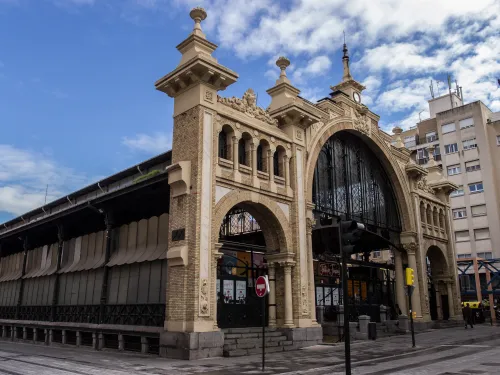
    You will hear the market before you see it. Vendors calling out prices, the clatter of ham slicers. Felix Navarro designed this iron-and-glass hall in 1895 after seeing Les Halles in Paris, and it was completed in 1903. A major renovation in 2018 to 2019 cleared the clutter and exposed the original metal columns and neoclassical stone portals. The stalls sell Teruel jamon, borage (a local vegetable you will see everywhere in Aragon), Calatayud peaches, and Aragonese lamb. A central gastronomic area lets you eat prepared food and drink vermouth at the counter. Open Monday to Friday 9:00 AM to 2:00 PM and 5:30 to 8:00 PM, Saturday until 2:30 PM, closed Sunday. Free to enter. Morning is best, when the produce stalls are fully stocked and the vendors are in good humor. The restrooms here are the cleanest on the route. When you leave, head east toward Plaza del Pilar.

    Learn more about Mercado Central →
    Hours
    Mon-Fri: 9:00 AM – 2:00 PM, 5:30 – 8:00 PM | Sat: 9:00 AM – 2:30 PM | Sun: Closed
    Price
    Free

    3 min walk to next stop

  3. 3

    Plaza del Pilar

    Plaza del Pilar

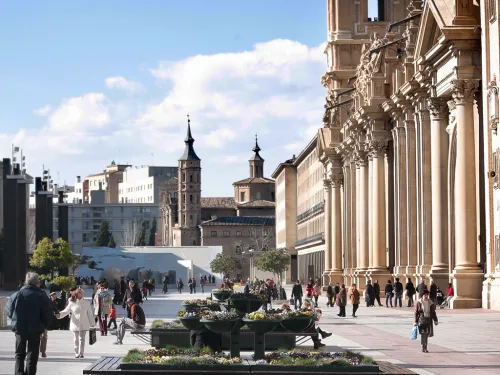
    After the tight alleys around the market, the scale change is almost violent. You step out onto a rectangle of open stone so large it has its own weather. This is one of the biggest pedestrian squares in Europe. The Basilica fills the north side with its cluster of tiled domes. La Seo anchors the east end. The Lonja and City Hall line up between them. At the western end, the Fountain of Hispanidad pours water over a fractured globe shaped like Latin America. The Goya monument sits nearby, a cenotaph to the painter who was born in the village of Fuendetodos, about an hour south. Walk the full length of the plaza from west to east. The angles on the Basilica shift with every step, and you will want photos from multiple points. Free and open 24 hours. At night the domes are lit and the crowds thin. The Basilica entrance is on the north side of the square.

    Learn more about Plaza del Pilar →
    Hours
    Open 24/7
    Price
    Free

    1 min walk to next stop

  4. 4

    Basilica del Pilar

    Basilica del Pilar

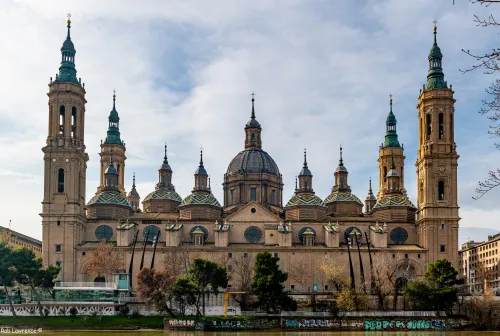
    The interior swallows you. Eleven domes, three naves of equal height, and a darkness that takes a full minute for your eyes to adjust. Most people head straight for the Holy Chapel to see the small wooden statue of the Virgin on her jasper pillar. Line up, touch the pillar, and move on. But look up first. Two of the dome frescoes were painted by a young Francisco de Goya, and they are the artistic reason to be here. Near the Holy Chapel, two unexploded bombs from the Spanish Civil War hang on a column. They were dropped through the roof in 1936 and never detonated. Entry is free. The Basilica opens daily at 6:15 AM and closes at 8:30 PM. The elevator to the Torre de San Francisco costs a few euros and gives you the only aerial view that captures the Ebro, the rooftops, and the Pyrenean foothills in a single frame. Go early to skip the line. Budget 30 to 45 minutes.

    Learn more about Basilica del Pilar →
    Hours
    Daily 6:15 AM – 8:30 PM
    Price
    0

    2 min walk to next stop

  5. 5

    Palacio de la Lonja

    Palacio de la Lonja

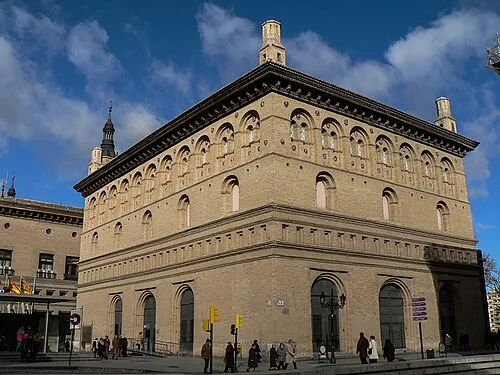
    Compared to the Basilica, this building looks modest from outside. Brick facade, three stories, a gallery of arched windows along the top. Step inside and the ceiling takes over. A single vast hall unfolds, with ringed columns that branch into ribbed vaults like stone palm trees. Juan de Sarinena built it between 1541 and 1551 as a merchants' exchange so grain traders could work without disturbing mass next door. It is the most important Renaissance building in Aragon, built from brick in the Aragonese tradition rather than stone, with polychrome plaster medallions of kings and coats of arms pressed into the vaults. Entry is free. Closed Mondays. Open Tuesday to Saturday 10:00 AM to 2:00 PM and 5:00 to 9:00 PM, Sunday 10:00 AM to 2:30 PM. Whatever temporary exhibition is up is a bonus, but the architecture is the point. Ten minutes is enough to appreciate the space.

    Learn more about Palacio de la Lonja →
    Hours
    Mon: Closed | Tue-Sat: 10:00 AM – 2:00 PM, 5:00 – 9:00 PM | Sun: 10:00 AM – 2:30 PM
    Price
    Free

    2 min walk to next stop

  6. 6

    Puente de Piedra

    Puente de Piedra

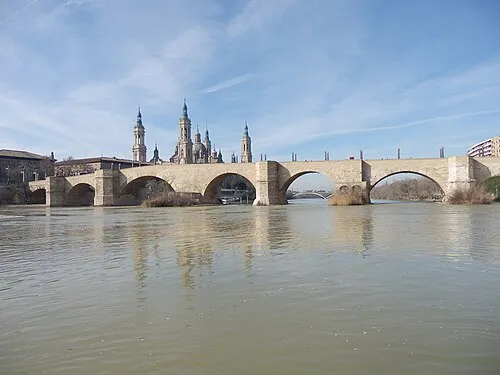
    The bridge appears at the end of a short downhill walk from the plaza, and with it, the view that defines Zaragoza. The Basilica del Pilar rises directly from the riverbank, its tiled domes reflected in the Ebro when the water is calm. Construction of the current bridge started in 1401 under Gil de Menestral and took forty years. Four bronze lions, symbols of the city, guard the ends. They were added in 1991. Walk to the middle and stop. If the cierzo is blowing (and in Zaragoza it often is), hold on to your hat. This cold, dry wind funnels down the Ebro valley and hits the bridge hard. Cross all the way to the north bank and look back from the Balcon de San Lazaro for the best photo angle: the full length of the Basilica, the bridge arches, and the water. Blue hour, about 30 minutes after sunset, is the ideal moment. Free, open 24 hours.

    Learn more about Puente de Piedra →
    Hours
    Open 24/7
    Price
    Free

    3 min walk to next stop

  7. 7

    La Seo Cathedral

    La Seo Cathedral

    The Basilica gets the crowds. La Seo gets the architecture. This cathedral was built on the site of the Roman forum and later a mosque, whose minaret left its imprint on the current tower. Walk around the outside first. The Mudejar wall of the Parroquieta on the southeast corner is a geometric composition of brick and glazed ceramic tiles that belongs in an art book. Inside, five naves of equal height create a hall-like space where you jump two centuries in style every ten meters: Romanesque foundations, Gothic vaults, a Mudejar crossing dome, Baroque chapels. The main altarpiece is an enormous Gothic work in alabaster. Your 3 EUR ticket includes the Tapestry Museum, which holds one of the finest collections of 15th-century Flemish tapestries in the world. Do not skip it. Closed Monday. Open Tuesday to Saturday 10:00 AM to 2:00 PM and 5:00 to 9:00 PM, Sunday 10:00 AM to 2:30 PM. Allow 30 to 40 minutes.

    Learn more about La Seo Cathedral →
    Hours
    Tue-Sat 10 AM – 2 PM, 5 PM – 9 PM; Sun 10 AM – 2:30 PM; Closed Mon
    Price
    €3

    3 min walk to next stop

  8. 8

    El Tubo

    El Tubo

    The noise shifts from cathedral solemnity to bar culture within two blocks. El Tubo is a web of narrow streets between El Coso, Calle Alfonso I, and Calle Don Jaime I, and every bar in it specializes in one thing. El Champi does mushrooms topped with shrimp. Dona Casta does croquettes. Casa Lac, open since 1825, is one of the oldest restaurants in Spain. The system works like this: order one tapa (3 to 8 EUR), eat it standing at the counter, finish your small beer or glass of Somontano wine, and move to the next place. Repeat. Weekday afternoons are manageable. Weekend nights are chaos, with people spilling into alleys so narrow that two people cannot pass without turning sideways. If you are walking this tour during the day, save El Tubo for dinner later. But walk through it now to get your bearings and pick your evening targets. The alleys are free to explore at any hour.

    Learn more about El Tubo →
    Hours
    Variable (bars/restaurants open 10 AM – 11 PM typically)
    Price
    Free to explore; tapas €3–8 per piece
AI Tourguide
Walk this exact route with a private AI guide.
Full GPS navigation, interactive stories, and a guide that answers all your questions. A private guide experience for just €5/hour.
Start This Tour

Self-Guided Tour vs. Group Tour in Zaragoza

Zaragoza does not have the massive guided walking tour industry of Barcelona or Seville. A few companies run free tours (tip-based, usually 5 to 10 EUR per person) that cover Plaza del Pilar, the Basilica, and La Seo in about two hours. Paid guided tours from local operators typically cost 15 to 25 EUR per person and sometimes add the Aljaferia or the Roman ruins. The free tours are decent introductions, but they skip the Aljaferia and the market entirely, which cuts out two of the best stops.

Self-guided works well here because the route is simple and linear. You do not need someone to navigate you through Zaragoza the way you might in the winding streets of Fes or Venice. What a guide does add is historical context, particularly inside the Aljaferia and La Seo, where the layering of Islamic, Gothic, and Renaissance elements can be hard to read without explanation. If you pick one guided tour, book a paid one that includes interior commentary at those two sites. Otherwise, this page and a good pair of shoes will get you through the whole route in under two hours of walking.

The total cost for this route: 5 EUR for the Aljaferia, 3 EUR for La Seo (including the Tapestry Museum), and whatever you spend on tapas in El Tubo. Everything else is free.

Group Tour AI Self-Guided
Price €25–€50 per person €5/hour or €20 all-inclusive
Flexibility Fixed schedule Start anytime, skip stops
Languages 1–2 languages 11 languages
Pace Group pace Your own pace

How Long Does This Zaragoza Tour Take?

Our route covers 5.0 km with 8 stops and takes approximately 2.2 hours at a relaxed pace.

The walking itself takes just over an hour at a comfortable pace. With stops, plan for 2.5 to 3.5 hours depending on how deep you go. The Aljaferia Palace needs the most time: 30 to 45 minutes minimum. The Basilica del Pilar is another 30 to 45 minutes if you include the tower elevator. La Seo with its Tapestry Museum runs 30 to 40 minutes. The Lonja and Plaza del Pilar are quick, 10 to 15 minutes each. El Tubo is a walk-through on a daytime tour but becomes a full evening destination if you return for tapas.

A natural break point is Mercado Central. Grab a coffee or a vermouth at one of the counter seats in the gastronomic area before heading into the plaza. If you want a proper sit-down rest, the cafe terraces on the south edge of Plaza del Pilar face the Basilica and make a good 15-minute pause midway through the route.

Tips for Walking in Zaragoza

AI Tourguide
Walk this exact route with a private AI guide.
Full GPS navigation, interactive stories, and a guide that answers all your questions. A private guide experience for just €5/hour.
Start This Tour

AI Audio Guide for This Tour

Standing in Plaza del Pilar right now, wondering whether to head for La Seo or the bridge first? Open the AI Tour Guide app and the GPS-guided route walks you through every stop in the right order with turn-by-turn directions. Works offline, so the cierzo wind cannot blow away your signal.

AI Audio Guide Stories, history and fun facts narrated as you walk. No earpiece rental needed.
GPS Navigation Turn-by-turn directions so you never get lost between stops.
Ask Anything Curious about a building you pass? Ask your AI guide on the spot.
11 Languages Switch language anytime. No separate tour needed.
Start This Tour Free

Common Questions

Yes. The entire route runs through well-trafficked areas and the historic center is safe day and night. El Tubo gets rowdy on weekend nights with people drinking in the streets, but it is festive noise, not dangerous. Standard pickpocket awareness applies at the Basilica and in crowded tapas bars. There are no specific tourist scams to watch for in Zaragoza.
This route handles rain well. The Aljaferia Palace, Mercado Central, Basilica del Pilar, Palacio de la Lonja, and La Seo Cathedral are all indoor stops. El Tubo has covered bar entrances where you can duck inside. The only truly outdoor moments are the Plaza del Pilar crossing and Puente de Piedra. If it is pouring, add the Forum of Caesaraugusta Museum (3 EUR, directly under the Plaza de la Seo) or the Goya Museum (3 EUR, on Calle Espoz y Mina) as indoor detours.
Start at 10:00 AM when the Aljaferia opens. You finish at Puente de Piedra around 1:00 PM, well before the afternoon heat in summer. Avoid starting after 2:00 PM because both La Seo and the Lonja close for siesta until 5:00 PM. If you are visiting in summer, an alternative is to start at 5:00 PM when the afternoon sites reopen and finish at the bridge for sunset. Return to El Tubo around 8:30 PM when the tapas bars hit their stride.
No booking needed. This self-guided tour is available anytime. Open the route on your phone and start walking. The AI audio guide works instantly, no reservation required.
The AI audio guide is available in 11 languages: English, German, French, Spanish, Italian, Japanese, Chinese, Portuguese, Danish, Norwegian, and Swedish.
Yes. Skip any stop, spend extra time at places you like, or start the route from any point. You can also ask the AI to suggest a shorter route.
AI Tourguide
Curated by AI Tourguide GPS-verified routes, reviewed and updated regularly.
Last verified March 2026