Things to Do in Arles - Top Attractions, Hidden Gems & Must-See Sights

Discover the best things to do in Arles. Complete guide to must-see sights, popular attractions, hidden gems, museums, food markets and parks.

16 Attractions 5 Categories Travel Guide

Table of Contents

Arles Overview

Arles functions as a dense archive of Roman power and 19th-century light, where the massive Arles Amphitheatre still anchors the town center. Walking through the narrow streets leads you past the intricate portal of the Church of Saint-Trophime to the Place du Forum, where the ghost of Van Gogh’s Yellow Café remains a primary draw. It is a compact, highly walkable city that feels more like a lived-in museum than a staged tourist site.

The contrast defines the experience. You can spend a morning among the sarcophagi of the Alyscamps and an afternoon at the Foundation Vincent van Gogh Arles or the gleaming tower of LUMA Arles. To catch your breath, the Jardin d'Été provides a shaded respite before heading toward the Museum of Ancient Arles to see the world's oldest Roman river boat.

Must-See Attractions in Arles

  • Arles Amphitheatre — A massive Roman arena from the 1st century that still hosts public events and offers views over the clay-tiled rooftops
  • Church of Saint-Trophime — Features a Romanesque portal with exceptionally detailed stone carvings depicting the Last Judgment
  • LUMA Arles — A futuristic arts campus centered around Frank Gehry’s twisting metal tower, marking the city's shift toward contemporary culture
  • Alyscamps — A Roman necropolis lined with stone sarcophagi that inspired both Van Gogh and Gauguin to paint on-site
  • Museum of Ancient Arles — Houses a remarkably preserved 31-meter Roman barge recovered from the Rhône river
🏛️ Must-See ⭐ Sights 💎 Hidden Gems 🎨 Museums 🌳 Parks & Views

🏛️ Must-See Attractions in Arles

These iconic landmarks and must-see sights are essential stops for any visitor to Arles.

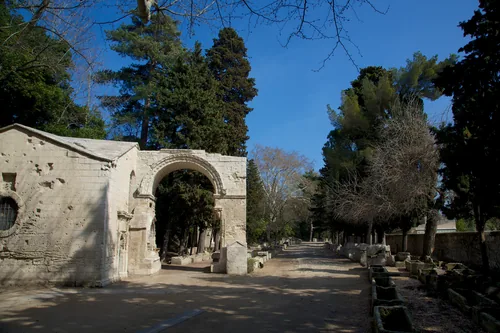
Alyscamps

1. Alyscamps

Walking down this tree-lined avenue feels less like visiting a cemetery and more like stepping into a painting. The rows of sarcophagi, mostly empty and weathered by centuries of Provençal sun, line the path leading to the church of Saint-Honorarat. It is a quiet, almost melancholic space that captivated Van Gogh and Gauguin, who set up their easels here to capture the golden autumn light. The noise of the city fades away as you walk deeper into the necropolis, leaving only the sound of gravel underfoot and the wind in the poplar trees.

While many travelers prioritize the Roman arena, this site offers a different kind of history—one that feels intimate and slightly abandoned. It is not manicured to perfection; the grass grows long around the tombs, and the stones are covered in moss. This lack of polish is exactly why it works. You can sit on a bench and watch the light shift through the leaves without the pressure of a guided tour or the jostle of crowds. It is a place for slow walking and thinking, rather than checking a box off a list.

If you have already seen the major Roman monuments, this provides a necessary counterpoint. It shows the medieval layer of the city that often gets overshadowed by imperial ruins. Unlike the grander Arles attractions that demand your attention with sheer size, the Alyscamps asks for a bit of patience. The church at the end is often locked or under renovation, but the walk itself is the point, offering a rare pocket of silence just outside the old city walls.

Hours Daily: 8:30 AM – 6:30 PM
Price €4
Insider TipVisit in late October or November if you can; the autumn foliage matches exactly what Van Gogh painted, and the light is softer for photography.
Ancient Theatre of Arles

2. Ancient Theatre of Arles

Only two slender Corinthian columns—locally known as the "Two Widows"—remain standing from the original stage wall, but they give you a sense of the scale this venue once held. Built under Augustus, it predates the famous amphitheater nearby and served a very different purpose: plays, pantomimes, and civic gatherings rather than violent spectacles. Today, it feels more like a garden of ruins than a structure, with scattered stones and broken arches resting among the grass where cats often sleep in the sun.

During the day, it can seem underwhelming if you compare it directly to the massive arena just around the corner. The preservation is spotty, and much of the stone was pillaged centuries ago to build local churches and houses. However, the semicircular seating area is still intact enough to climb, offering a solid vantage point over the site. It is less enclosed than other monuments, so on a hot summer afternoon, the lack of shade can be brutal; bring water and a hat if you plan to linger.

The theatre truly wakes up in the evening during the summer festivals. Seeing a performance here, with the night sky overhead and the illuminated stones as a backdrop, changes your perspective entirely. It transforms from a static archaeological site into a living venue, just as it was intended two thousand years ago. Among the various Arles attractions, this is the one that requires a bit of imagination to appreciate fully during the day, but delivers undeniable magic after dark.

Hours Daily: 10:30 AM – 4:00 PM
Price €4
Insider TipYou can see about 80% of the interior through the fence from the public garden next door (Jardin d'Été) for free, which is enough if you're short on time or budget.
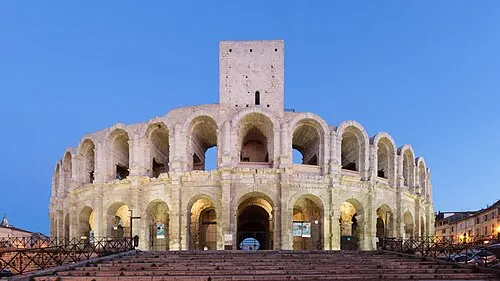
Arles Amphitheatre

3. Arles Amphitheatre

This massive stone oval dominates the city skyline and serves as the primary orientation point for anyone navigating the streets. Built in the first century, it is a raw display of Roman power, designed to hold 20,000 spectators screaming for gladiators and wild beasts. The architecture is heavy and imposing, with two tiers of 60 arches that have survived wars, the fall of the empire, and a period where the arena was literally filled with houses and turned into a fortress. You can still see the medieval watchtowers built right into the Roman stonework, a strange hybrid of eras.

Climbing to the top of the towers is non-negotiable. The wind can be fierce, but the view over the terracotta roofs towards the Rhône and the Alpilles mountains is the best in town. Inside, the metal bleachers installed for modern bullfights detract slightly from the ancient atmosphere, but they allow the space to still function as a venue. Be prepared for steep, uneven stairs; the Romans did not care about safety codes, and the restoration has kept that authenticity intact.

Crowds here are inevitable, especially when tour buses arrive in the morning. To feel the weight of the place, come right when it opens or late in the afternoon when the shadows lengthen across the sand. While many Arles attractions focus on art or religion, this building is about spectacle and survival. Even empty, it feels loud. It is the one site you genuinely cannot skip, even if you usually avoid the big tourist draws.

Hours Daily: 10:30 AM – 4:00 PM
Price €9
Insider TipThe ticket also covers the Ancient Theatre; keep it safe. If you visit during the Feria (Easter or September), check the schedule—bullfights will close the monument to regular visits.
Church of Saint-Trophime

4. Church of Saint-Trophime

The facade of this church is a masterclass in Romanesque sculpture, a stone bible carved with terrifying detail. Saints and sinners are separated at the Last Judgment above the door, their expressions still sharp despite centuries of erosion. Inside, the nave is tall, narrow, and severe, a stark contrast to the busy square outside. The air is always cool and smells faintly of incense and old stone. Banners and tapestries hanging from the walls add a touch of color to the grey limestone, but the overall feeling is one of solemn antiquity.

The real reason to visit, however, is the cloister next door. Accessed via a separate entrance, it is widely considered one of the most beautiful in Provence. The galleries mix Romanesque and Gothic styles, showing how construction evolved over the decades. The carvings on the corner pillars are intricate, depicting biblical stories with a depth that demands you stop and look closely. It is incredibly quiet here, a walled garden of silence in the middle of the city.

Walking the upper level of the cloister gives you a different angle, looking down into the courtyard and up at the church tower. It connects physically to the Roman theatre's exterior wall, showing how Arles recycles its history. Among the religious Arles attractions, this one stands out for the sheer quality of its stonework. It is not just a church; it is a gallery of medieval art that happens to be a building.

Hours Mon-Fri: 9:00 AM – 12:00 PM, 4:00 – 6:00 PM | Sat-Sun: Closed
Price Free
Insider TipDon't miss the staircase in the cloister leading to the roof terrace. It's often overlooked but offers a close-up view of the bell tower and the surrounding rooftops.
Get Your Own Private Tour with AI Guide
AI Guide
  • Personalized tour tailored to your interests
  • Your AI guide tells stories, shares facts, and cracks jokes
  • Turn-by-turn GPS navigation
  • Available in your language — no download needed
Try for Free

💎 Hidden Gems in Arles - Off the Beaten Path

Beyond the tourist crowds, Arles hides remarkable treasures waiting to be discovered.

Barbegal Aqueduct

1. Barbegal Aqueduct

A short drive from the city center, these ruins sit quietly in the countryside, often completely empty of visitors. The Barbegal complex was once a massive Roman flour mill, powered by water cascading down a steep hillside. Today, you see the remains of the aqueduct arches marching across the fields and the foundations of the milling chambers cut into the rock. It is an industrial ruin rather than a temple or palace, offering a glimpse into the working life of the ancient world that downtown monuments rarely provide.

The site is split into two parts: the bridge spanning the road and the mill complex on the slope. You can hike up along the remains of the channel, where the limestone has been encrusted with thick deposits from centuries of flowing water. The view from the top, looking out over the plains toward the Abbey of Montmajour, is wide and flat. It is exposed and dusty, with the sound of cicadas filling the air in summer, far removed from the polished presentation of the city museums.

This is not a site with ticket booths or audio guides; you are on your own here. The lack of infrastructure means you need to be careful with your footing, but it also allows for genuine exploration. For those working through the list of Arles attractions, this outlier requires a car or a dedicated hike, but it rewards you with a sense of discovery that the crowded center cannot match.

Hours 9:00-18:00 daily
Price Free
Website N/A
Insider TipPark at the small lot on the D82 road (Route de Fontvieille). The path to the aqueduct bridge is easy, but wear sturdy shoes if you want to climb the hill to see the mill basins.
Cryptoportiques

2. Cryptoportiques

Beneath the sunny Town Hall square lies a dark, damp double-horseshoe tunnel that once supported the Roman Forum. These underground galleries were never meant to be seen; they were purely structural foundations designed to level the sloping ground for the marketplace above. Descending the stairs, the temperature drops and the air grows heavy with humidity. It is a stark, eerie space, lit by dim electric lights that cast long shadows against the massive stone arches.

There is very little to "see" in terms of statues or mosaics. The attraction is the architecture itself and the oppressive, silent atmosphere. You are walking through the guts of the ancient city. Water often drips from the ceiling, and the floor can be slippery. It feels like a secret passage, completely removed from the noise of the cafes just a few meters above your head. In the height of summer, it is the best place in town to escape the heat, providing a natural air-conditioned respite.

Because it is empty and repetitive, it can be disorienting. It does not take long to walk the circuit, but the experience sticks with you. It is the invisible skeleton of the city made visible. If you are grouping Arles attractions by type, this is the "hidden infrastructure" category. It is not pretty, but it is impressive engineering that has held up the city center for two thousand years.

Hours Daily: 10:30 AM – 4:00 PM
Price €4
Insider TipThere is a small chapel carved into the rock at one end that was used during WWII as a shelter. It's easy to miss in the gloom, so keep an eye out for the altar.
Get Your Own Private Tour with AI Guide
AI Guide
  • Personalized tour tailored to your interests
  • Your AI guide tells stories, shares facts, and cracks jokes
  • Turn-by-turn GPS navigation
  • Available in your language — no download needed
Try for Free

🎨 Best Museums & Galleries in Arles

World-class museums and galleries that make Arles a cultural treasure.

Camargue Museum

1. Camargue Museum

Located halfway between Arles and the sea, this museum serves as the essential primer for understanding the strange, salty delta region known as the Camargue. Housed in a former sheep barn (a "mas"), the exhibition is grounded and rustic, focusing on the interplay between humans and this harsh landscape. You learn about rice cultivation, salt harvesting, and the specific cowboy culture of the "gardians" that defines the area. It avoids being dry by including plenty of physical objects, from saddles to agricultural tools.

The museum is not just an indoor experience. A discovery trail loops out from the building into the landscape, taking you past irrigation canals, reed beds, and grazing lands. It is a flat, easy walk that puts the theory inside the museum into immediate context. You will likely see the famous white horses and perhaps some local birdlife without needing to venture deep into the wilderness. It is approachable and manageable, unlike the vast park itself which can be intimidating to navigate.

If you have a car, this is the logical first stop before driving down to Saintes-Maries-de-la-Mer. It frames the scenery you are about to drive through, turning a flat landscape into a complex engineered system in your eyes. Unlike the Roman-focused Arles attractions in the center, this connects you to the living, agricultural reality of the region.

Hours Daily: 10:00 AM – 5:00 PM
Price €5
Insider TipThe 3.5km discovery trail is free even if you don't buy a ticket for the museum. It's flat and perfect for families, but bring mosquito repellent in summer.
Museon Arlaten

2. Museon Arlaten

After a massive, decade-long renovation, this museum of Provençal life has reopened with a stunning mix of old tradition and modern presentation. Founded by the poet Frédéric Mistral, it was originally a shrine to a dying culture, packed with costumes, furniture, and tools. Today, a sleek, floating glass staircase takes you through the history of the region, from Roman times to the present day. It manages to be nostalgic without being dusty, treating folklore with serious academic respect.

The collection is incredibly specific: you will see exactly how a bride dressed in the 19th century, how shepherds carved their tools, and how the local language was preserved. The famous "diorama" rooms have been kept, offering life-sized snapshots of domestic life that are charmingly retro. It explains the "why" behind the festivals and costumes you might see on the streets outside. It grounds the local identity in physical objects.

This is the place to go if you want to understand the people of Arles, not just the buildings. It tells the story of daily survival, celebration, and identity. While other Arles attractions focus on dead emperors or foreign painters, this one is strictly for and about the locals. The contrast between the ancient Roman ruins in the basement (visible through the floor) and the 19th-century textiles upstairs is brilliant.

Hours Mon: Closed | Tue-Sun: 9:30 AM – 5:30 PM
Price €7
Location 43.6764, 4.62575
Insider TipThe museum entrance is in the courtyard; don't be fooled by the modest street frontage. The audio guide is excellent and necessary to understand the context of the objects.
Museum of Ancient Arles

3. Museum of Ancient Arles

Known locally as the "Blue Museum" due to its modern cobalt glass exterior, this building sits on a peninsula by the river, a short walk from the center. It houses the archaeological treasures found in and around the city, and the collection is world-class. The star of the show is a Roman barge, lifted intact from the mud of the Rhône river. Seeing this massive wooden ship, complete with its cargo, gives you a tangible sense of the river trade that made the city rich.

The space is open and bright, a welcome change from the dark crypts and churches of the old town. Mosaics are displayed on the floor so you can look down at them from walkways, simulating the original viewing angle. The collection of sarcophagi is incredibly dense, showing the shift from pagan to Christian burial customs. It connects the dots between all the ruined monuments you have seen outside, filling in the details of how the people actually lived.

It is a bit of a trek to get here, but absolutely worth it. The layout is chronological and easy to follow. Unlike the fragmented ruins in the city center, here you get the complete picture. It is the intellectual anchor of all Arles attractions, providing the context that makes the amphitheatre and theatre make sense.

Hours Mon: 9:30 AM – 6:00 PM | Tue: Closed | Wed-Sun: 9:30 AM – 6:00 PM
Price €4
Location 43.6725, 4.61639
Insider TipThe walk along the river to get here can be hot and shadeless. There is a free shuttle bus (Navette) from the center if you want to save your energy for the museum.
Musée Réattu

4. Musée Réattu

Perched on a bend in the Rhône river, this museum occupies the former Grand Priory of the Knights of Malta. The building is a fortress-like structure that feels impenetrable from the outside but opens up into light-filled courtyards and galleries within. It is best known for its collection of Picasso drawings, which the artist donated directly to the city, and for its strong focus on photography. The art here feels personal and connected to the region, rather than a random assortment of acquisitions.

The layout is labyrinthine, with rooms that look out over the rushing grey water of the river. The juxtaposition of contemporary photography hanging on ancient stone walls is effective, creating a bridge between the medieval setting and modern vision. It is rarely crowded, allowing you to get up close to the Picassos and the works of Jacques Réattu, the local painter who lived here. The vibe is quiet, scholarly, and artistic.

It is often skipped by day-trippers rushing to the amphitheater, which is a mistake. It offers one of the most scenic windows in Arles—literally. Standing at a window watching the river flow by is as much a part of the experience as the art. Among Arles attractions, this acts as the artistic soul of the city, honoring the light and landscape that have drawn painters here for centuries.

Hours Mon: Closed | Tue-Sun: 10:00 AM – 5:00 PM
Price €7
Insider TipLook for the room with the 'ear' of Van Gogh—not the real one, but a quirky conceptual piece. Also, the views of the river from the back windows are the best in town.
Get Your Own Private Tour with AI Guide
AI Guide
  • Personalized tour tailored to your interests
  • Your AI guide tells stories, shares facts, and cracks jokes
  • Turn-by-turn GPS navigation
  • Available in your language — no download needed
Try for Free

🌳 Parks & Best Viewpoints in Arles

Beautiful parks, gardens, and panoramic viewpoints for the best views of Arles.

Camargue Regional Nature Park

1. Camargue Regional Nature Park

This is not a park in the sense of manicured lawns and swing sets; it is a vast, untamed wetland where the Rhône river fights its way into the Mediterranean. The landscape is flat, watery, and endless, dominated by salt lagoons and reed marshes. It feels like the end of the world, with a horizon that blurs between grey water and blue sky. Pink flamingos are the headline act here, standing in the shallow brackish water by the hundreds, their color startling against the muted palette of the marsh.

Accessing the park requires a vehicle or a strong pair of legs for cycling. The roads are narrow causeways with water on both sides, passing black bulls grazing in fields that look too salty to grow anything. It is a harsh environment—windy, sun-baked, and teeming with mosquitoes in the warm months. Do not expect visitor centers at every turn; you are observing a fragile ecosystem that tolerates visitors rather than catering to them.

To truly see it, you need to get off the main road. The Ornithological Park of Pont de Gau is the most accessible entry point for birdwatching, but simply driving the D36 towards the Salin de Giraud salt pans offers spectacular, alien views. While most Arles attractions are about human history, this is about raw nature. It is beautiful, but it requires preparation and a willingness to get a little dusty and bitten.

Hours Daily: 8:00 AM – 4:30 PM
Price Free
Location 43.57147, 4.5638
Insider TipHead to the Fangassier pond (Étang de Fangassier) for the best chance to see flamingos in the wild without paying an entrance fee. Binoculars are essential.
Jardin d'Été

2. Jardin d'Été

This park is the green lung of the city center, wrapping around the Ancient Theatre and offering a soft place to land after walking on hard cobblestones. It is a classic French public garden, with gravel paths, manicured lawns that you are mostly not allowed to sit on, and old trees providing deep, cooling shade. Statues of local poets and figures dot the landscape, including a bust of Van Gogh that looks intensely at the passersby. It is dignified but used heavily by locals for dog walking and after-school play.

Its location makes it a strategic waypoint. You will likely pass through it when moving between the Boulevard des Lices and the Roman monuments. It serves as a connector, but it is also a destination for a sandwich lunch on a bench. The playground is a lifesaver if you are traveling with children who are tired of looking at old stones. The atmosphere is relaxed and distinctly local, removed from the high-intensity tourism of the arena nearby.

Unlike many paid Arles attractions, this space is free and open long hours. In the summer, the cicadas here are deafening, creating a wall of sound that feels quintessentially Provençal. It is not a place you plan a day around, but it is a place you will be grateful for when your feet start to hurt and you need five minutes of green tranquility.

Hours Daily: 7:00 AM – 8:30 PM
Price Free
Insider TipThe cleanest public toilets in the city center are located here, near the entrance closest to the theatre. They cost a small fee but are worth it.
Get Your Own Private Tour with AI Guide
AI Guide
  • Personalized tour tailored to your interests
  • Your AI guide tells stories, shares facts, and cracks jokes
  • Turn-by-turn GPS navigation
  • Available in your language — no download needed
Try for Free

Explore with AI Guide

AI Guide App

Get personalized tours with our AI-powered guide. No download needed — works right in your browser.