Self-Guided Walking Tour in Antibes

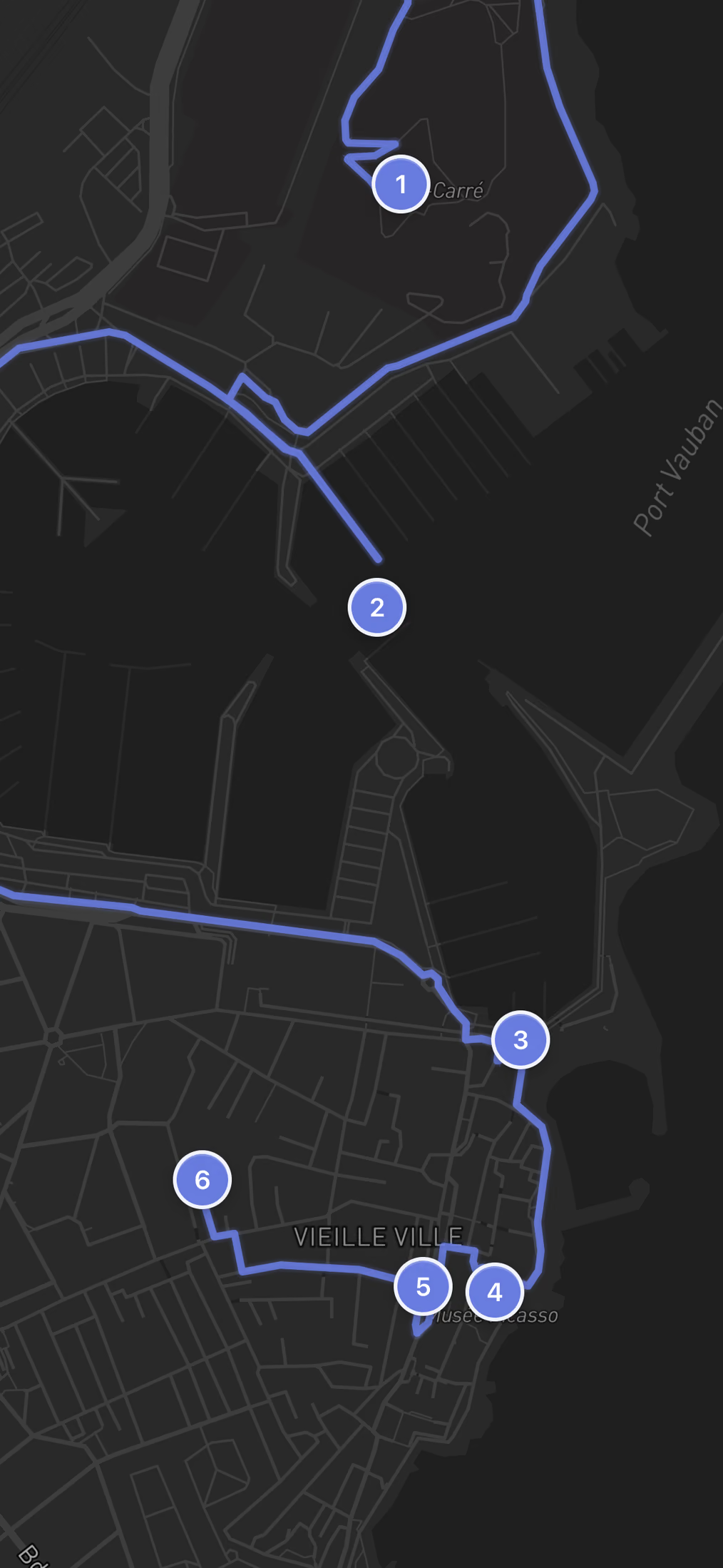
A self-guided walk along the sea edge of Antibes: 6 stops over 3.8 km, running north to south from the 16th-century Fort Carré, past Europe's biggest marina and the ramparts, to the Picasso Museum, the Provençal market and a baroque chapel. This page gives you the map, the walking time for every leg, and the real prices and hours for each stop.

6 Stops3.8 km~2 hours walkingAbout 3 hours with stops
What you get with AI Tourguide
Full GPS navigationInteractive AI guidePersonalized to youWorks in your browser
Try this tour with Alex

Antibes Walking Tour at a Glance

This route is built for anyone who wants to see the best of Antibes in one continuous line instead of a scattered day. It threads the two big-hitters, Fort Carré and the Picasso Museum, onto the same seafront ribbon as the marina and the market, so you never double back. Every interior is optional: you can walk the whole 3.8 km for free and pay only for the stops you actually want to go inside.

StartFort Carré
FinishChapelle Saint-Bernardin d'Antibes
Route typeA point-to-point walk, not a loop. It runs north to south down the Saint-Roch peninsula and along the seafront ramparts into the old town, with no real backtracking.
Realistic timeAbout 3 hours at an unhurried pace with both ticketed interiors. The walking alone is roughly 50 minutes; the rest is time spent inside the fort and the museum.
DifficultyEasy. 3.8 km of flat ground, but surfaces switch between exposed concrete breakwater, gravel at the fort, and worn, uneven cobbles in the old-town lanes.
Cost to followThe route itself is free. Two stops charge admission: Fort Carré at €3.50 and the Picasso Museum at €8. The marina, the ramparts, the market and the chapel cost nothing.
Best for:

First-time visitors who want the fort, the yachts, the Picasso collection and the Provençal market lined up in a single flat walk along the sea.

The Route

Free Walking Tour Map of Antibes

6 stops3.8 kmabout 2 hours
Loading the interactive map…The complete walking route will appear here.
Want the route to guide you while you walk?Open the route with navigation and a personal guide for the history, stories and questions that matter to you.
Open route + AI guide

The 6 stops along this route

  1. Fort Carré in Antibes, stop 1 on the self-guided walking tour
    1Fort Carré
  2. Port Vauban in Antibes, stop 2 on the self-guided walking tour
    2Port Vauban
  3. Antibes Ramparts in Antibes, stop 3 on the self-guided walking tour
    3Antibes Ramparts
  4. Picasso Museum (Musée Picasso) in Antibes, stop 4 on the self-guided walking tour
    4Picasso Museum (Musée Picasso)
  5. Cours Masséna in Antibes, stop 5 on the self-guided walking tour
    5Cours Masséna
  6. Chapelle Saint-Bernardin d'Antibes in Antibes, stop 6 on the self-guided walking tour
    6Chapelle Saint-Bernardin d'Antibes
  7. That's the complete route.

    If you want more than the map and text, add live navigation and a conversational AI guide while you walk.

    Open route + AI guide
    You made it
Stop 1 of 6
Swipe →

Your Antibes Walking Tour, Stop by Stop

  1. 1

    Fort Carré

    Fort Carré in Antibes, stop 1 on the self-guided walking tour

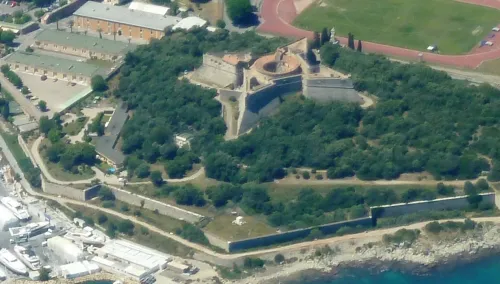
    You see it long before you reach it: a four-pointed star fort sitting alone on a rock 26 metres above the sea, on the Saint-Roch peninsula north of the harbour. It was built in the 16th century under Henri II, and for a long time this was the French border post facing the Duchy of Savoy. The walk out along the breakwater from the marina is part of the experience, exposed and breezy with the whole Baie des Anges opening up. Entry is €3.50, open Tuesday to Sunday 10:00 to 17:00, closed Mondays, and you go up with a guide on a short rotation. Honest verdict: the interior is modest, but you come for the rampart walk and the 360-degree panorama over the old town, the bay, and the snow on the Alps behind. Worth the climb. Allow 45 minutes including the walk out.
    Hours
    Mon: Closed | Tue-Sun: 10:00 AM – 5:00 PM
    Price
    €3.50
  2. 2

    Port Vauban

    Port Vauban in Antibes, stop 2 on the self-guided walking tour

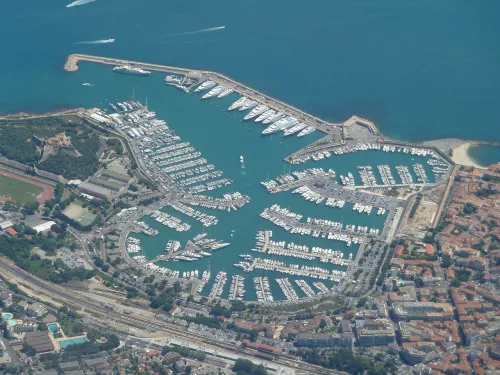
    Back along the breakwater and the masts start. Port Vauban is the largest marina in Europe by tonnage, 25 hectares with around 1,500 berths, and the eastern row known as the Quai des Milliardaires is where the genuinely enormous yachts tie up. You don't pay to walk it, it's open all day every day, and the contrast is the draw: gangplanks of glass and steel with the medieval ramparts and Fort Carré framing them behind. Stroll the public quays, gawk a little, nobody minds. Skip any urge to find a café right here, prices on the waterfront are aimed at the boat owners, not you. Keep the fort at your back and follow the water south toward the old-town walls rising ahead. This stretch is the visual link between military Antibes and the lived-in town.

    Hours
    Open 24/7
    Price
    Free
  3. 3

    Antibes Ramparts

    Antibes Ramparts in Antibes, stop 3 on the self-guided walking tour

    The town wall meets the sea here, and the Bastion Saint-André juts out as the first big seafront defence you pass. These are the Vauban-era ramparts, free and open day and night, and the path along the top is the postcard frame of Antibes: stone on one side, open Mediterranean on the other, the old roofs and the cathedral tower piling up behind. Time it for late afternoon and the wall glows gold. There's no ticket, no gate, you just walk up onto it. The Bastion building itself houses an archaeology museum if you want a detour, but the wall is the real reason to stop. Lean on the parapet, let the spray come up, then carry on south. Just past the next bastion the seafront château appears, and that is where Picasso worked.

  4. 4

    Picasso Museum (Musée Picasso)

    Picasso Museum (Musée Picasso) in Antibes, stop 4 on the self-guided walking tour

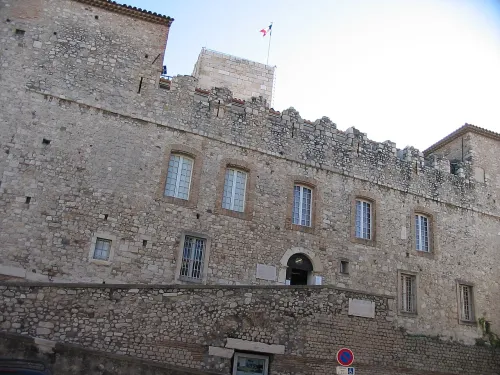
    The Château Grimaldi sits right on the ramparts, and in 1946 the curator handed Picasso the top floor as a studio. He painted there for a few intense months and left much of the work behind, which is why this became the first museum dedicated to him in his lifetime. It opened as the Musée Picasso in 1966. The collection is compact, you can see it properly in an hour, and the setting does half the job: paintings and ceramics in stone rooms with the sea filling every window, plus a sculpture terrace over the water. Entry is €8, open Tuesday to Sunday 10:00 to 18:00 with a lunch break from 13:00 to 14:00, closed Mondays. This is the one indoor stop worth committing to. Buy your ticket and go up; the terrace alone justifies it.

    Hours
    Mon: Closed | Tue-Sun: 10:00 AM – 1:00 PM, 2:00 – 6:00 PM
    Price
    €8
  5. 5

    Cours Masséna

    Cours Masséna in Antibes, stop 5 on the self-guided walking tour

    Step off the ramparts into the old town and you land on Cours Masséna almost at once, the long covered hall that holds the Marché Provençal. This is the sensory heart of Vieil Antibes: stalls of tomatoes, olives, lavender, socca, cheese and cut flowers under an iron roof, loud and crowded and worth every elbow. The market runs Tuesday to Sunday from early morning until about 13:00 and is closed Mondays, so come before lunch or you'll find traders packing up. It's free to wander, obviously, but bring a few euros: a paper cone of olives or a wedge of fresh socca eaten standing up is the cheapest good meal on the Riviera. After 13:00 in summer the same hall turns into an artisan craft market. Eat something, then duck west into the narrow lanes.

  6. 6

    Chapelle Saint-Bernardin d'Antibes

    Chapelle Saint-Bernardin d'Antibes in Antibes, stop 6 on the self-guided walking tour

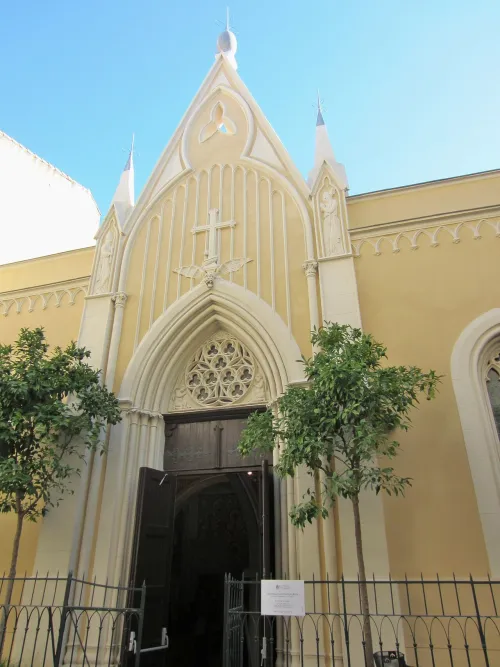
    The lanes west of the market go quiet fast, and the Chapelle Saint-Bernardin is the reward for following them. This was the chapel of the White Penitents, a lay brotherhood, with its main door at 14 rue du Docteur-Rostan and a side door on rue Saint-Bernardin. It has been a listed historic monument since 1995. The plain façade hides a richly decorated baroque interior, and because almost nobody walks this far it's usually empty and silent, a complete reset after the market noise. Entry is free, open Tuesday to Saturday 9:30 to 13:00 and 14:00 to 17:30, closed Sunday and Monday, so it only works on a weekday afternoon. If the door is shut, the walk through the lanes to reach it is still the calm end the route is built for. From here you're a two-minute stroll back to the cathedral square.

    Hours
    Mon: Closed | Tue-Sat: 9:30 AM – 1:00 PM, 2:00 – 5:30 PM | Sun: Closed
    Price
    Free

How Long Does This Walking Tour Really Take?

Plan on roughly three hours at an easy pace including both interiors. The walking is only about 50 minutes across 3.8 km; Fort Carré takes the biggest single chunk at around 45 minutes with the breakwater walk, and the Picasso Museum wants a full hour. Everything else is open-air and as quick or slow as you like.

Plan on roughly three hours at an unhurried pace, including both ticketed interiors. The walking itself is only about 50 minutes; the rest is time inside. Fort Carré takes the biggest single chunk, around 45 minutes once you count the breakwater walk out and back and the short guided visit. The Picasso Museum wants a full hour. Everything else is open-air and as quick or slow as you like.

If you need a break, the market hall on Cours Masséna is the obvious one: grab socca or a sandwich from a stall and eat it on a bench under the iron roof, or carry it the few steps onto the ramparts and sit on the wall facing the sea. For a proper coffee sit-down, the cafés around Place Nationale just inland from Cours Masséna are calmer and cheaper than anything on the waterfront. Morning is the sweet spot for the whole walk, market alive and museums quiet, so start by 9:30 and you'll be finishing the chapel before the afternoon heat.

Full Route, Shorter Walk or Two-Day Version?

The full walk is short and flat, but you can trim or split it depending on your time and what you came for. Here are three ways to run the same six stops, each with realistic timings.

The Short Version

Old town and museum only

Stops 3 to 6, Antibes Ramparts to the chapel, about 1.5 hours

Skip the two longest legs out to the Saint-Roch peninsula (the 1400 m breakwater to Fort Carré and the 1630 m back to the ramparts) and start on the town wall instead. You keep the Picasso Museum, the market and the chapel, all packed into under 800 m of walking.

The Relaxed Split

Two easy halves around the museum

Stops 1 to 4 first, then 5 to 6 later, split at the Picasso Museum

Do the seafront half in the morning, Fort Carré through to the Picasso Museum, then break for lunch at the market. Return in the afternoon for Cours Masséna as an artisan craft market and the quiet chapel, checking the Picasso lunch closure from 13:00 to 14:00 if you go inside.

You can walk it the other way, chapel to Fort Carré, but the given direction is better: starting high at Fort Carré gives you the aerial view of everything you're about to see at street level, and finishing in the quiet lanes at the Chapelle Saint-Bernardin is the calm end the route is built for.

Is This Antibes Walking Tour Right for You?

This is a short, flat coastal walk with two optional interiors, so it suits most people. Here is who it fits best, and how to adjust it if your day looks different.

A good fit if you…

  • First-time visitors who want the fort, the marina, the Picasso collection and the market in one line
  • Walkers who prefer flat, sea-level ground over hills and stairs
  • Art lovers, since the Picasso Museum sits right on the ramparts halfway along
  • Foodies who want to hit the Marché Provençal on Cours Masséna before it packs up at 13:00

Adapt the route if you…

  • You're short on time: start at stop 3 on the ramparts and skip the two long legs out to Fort Carré
  • You want the market: go on a weekday morning, Tuesday to Sunday, since it closes around 13:00 and Mondays entirely
  • It's raining: lean on the covered market hall and the indoor Picasso Museum, and save the open-air Fort Carré for a clear spell
  • You dislike uneven ground: the old-town cobbles are worn and slick after rain, so wear flat shoes with grip

Tickets & Skip-the-Line in Antibes

Only two stops on this route charge admission, and both are cheap and rarely have long queues. Here is what you pay, when they're open, and where to check details before you go.

Fort CarréEntry is €3.50. Open Tuesday to Sunday 10:00 to 17:00, closed Mondays. You go up with a guide on a short rotation, so factor in the breakwater walk out and a little waiting. official ticket site ↗
Picasso Museum (Musée Picasso)Entry is €8. Open Tuesday to Sunday 10:00 to 18:00 with a lunch closure from 13:00 to 14:00, closed Mondays. The compact collection takes about an hour, and the sea-facing sculpture terrace is included. official ticket site ↗
Chapelle Saint-Bernardin d'AntibesFree entry. Open Tuesday to Saturday 9:30 to 13:00 and 14:00 to 17:30, closed Sunday and Monday, so it only works on a weekday. If the door is shut, the walk through the quiet lanes is still worth it.
Everything elsePort Vauban, the Antibes Ramparts and the Cours Masséna market are all free, open public spaces with no ticket needed. The market itself runs Tuesday to Sunday from early morning until about 13:00, closed Mondays.
Optional upgrade
+2
The same 6-stop route,
now with navigation and a guide.
Optional AI experience

You already have the route.
The AI guide brings it to life.

Standing on the Antibes ramparts with the marina in front of you? Open AI Tourguide in your browser, nothing to install, and a voice guide walks the sea edge with you from Fort Carré to the Picasso Museum to the Cours Masséna market. It greets you, tells the story along the way and remembers what you want to see, a real conversation built into the walk rather than a recording. Start with 100 free credits.

Livenavigation13languagesAnyquestionYourinterests
Open this route with the AI guide

Try it in your browser · No app or download required

Tips for Walking in Antibes

  • Start at Fort Carré by 10:00 when it opens, then walk south so the sun is behind you on the ramparts and the market is still in full swing before its 13:00 close. The bus 14 from the centre drops near the fort if you don't want to walk the breakwater both ways.
  • Surfaces switch between exposed concrete breakwater, gravel around the fort, and worn cobbles in the old-town lanes. Flat shoes with grip beat sandals; the cobbles are uneven and slick after rain.
  • Public toilets are scarce in the old town. The most reliable stop is by Port Vauban near the marina office, so use it before you head into the lanes toward the chapel.
  • Eat at the Marché Provençal on Cours Masséna: a hot wedge of socca (chickpea pancake) runs about €3, a cone of marinated olives a couple of euros. Cash is easiest at the stalls. It closes around 13:00 Tuesday to Sunday, closed Monday.
  • Best photo is from the Bastion Saint-André on the ramparts in late afternoon: face north back along the wall and you get the golden stone, the marina masts, and Fort Carré lined up in one frame.

Why Walk This Route?

Antibes is small, flat, and built for walking. The old town sits on a peninsula between two harbours, the whole thing wrapped in honey-coloured ramparts, and you can cross it on foot in fifteen minutes. That compactness is the point. Most Riviera towns spread you thin between train stations and beaches and bus stops. Here the best of it lines up in a single ribbon along the sea, so you walk one continuous edge from a 16th-century fort to a Picasso collection to a Provençal market without ever needing a map app open.

This route runs north to south, starting at Fort Carré on the Saint-Roch peninsula and finishing in the quiet lanes of Vieil Antibes at a 17th-century chapel. It deliberately strings the two big-hitters (the fort and the Picasso Museum) onto the same seafront line as the marina and the market, so you never double back. Do it in the morning if you want the market alive and the museums uncrowded.

Why walk it rather than wander? Because the order matters. The fort gives you the aerial view of everything you are about to see at street level. By the time you reach the market you already understand how the town is shaped. Wandering Antibes is pleasant, but it leaves the fort and the superyachts as a separate trip you probably won't bother making. This way they are stop one.

Common Questions

Is Antibes safe to walk around?

Yes, it's one of the calmer Riviera towns and the old town feels safe day and night. Normal precautions only: watch your bag in the crowded market crush on Cours Masséna, where pickpockets work tight spaces, and don't leave anything visible in a parked car. The breakwater out to Fort Carré is exposed and windy but not dangerous; just mind footing near the edge.

What if it rains during my Antibes tour?

The route has two solid indoor anchors. Spend longer in the Picasso Museum (€8, the stone rooms and ceramics easily fill 90 minutes) and detour into the archaeology museum inside the Bastion Saint-André on the ramparts. The Marché Provençal is covered, so the market still works in rain. Fort Carré is mostly open-air, so save it for a clear spell or skip it.

What's the best time of day for this walking tour?

Morning, starting around 9:30 to 10:00. The market is fully alive and packs up by 13:00, both museums are quietest early, and the south-facing ramparts aren't yet baking. An alternative is mid-to-late afternoon when the stone walls turn gold for photos, but you'll miss the market and need to check the Picasso lunch closure from 13:00 to 14:00.

Take this route with you

Open this exact tour with navigation and your personal AI guide.

Start GPS Navigation + AI Guide
AI Tourguide
Researched and curated by the AI Tourguide teamWe plan and quality-check every route, then research and verify the opening hours, prices, and practical tips for each stop along it.
▶ Open route with AI guideNavigation, stories and your questions