Self-Guided Walking Tour in Aosta

8 Stops 4.5 km ~2.1 hours
Start This Tour Free
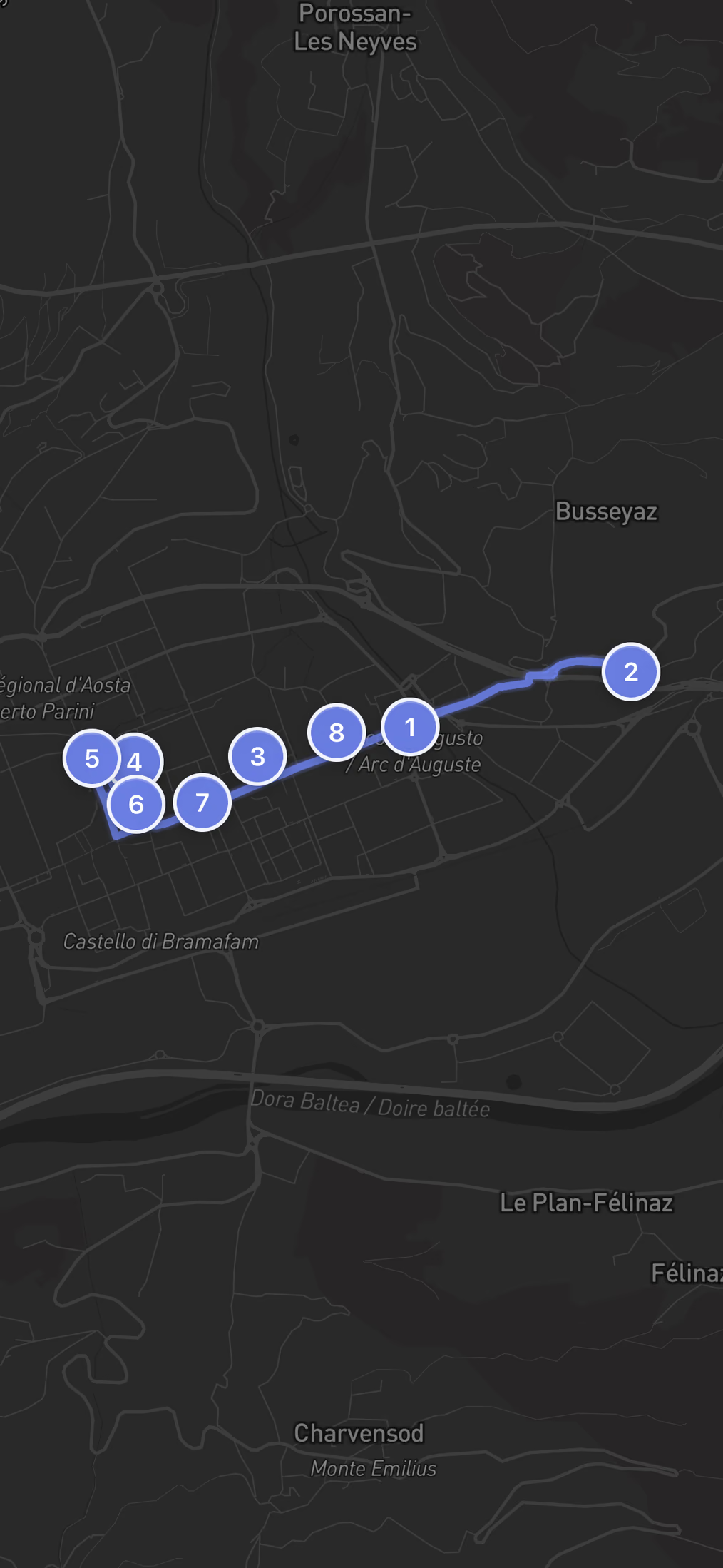
Walking tour route map of Aosta
Start This Tour Free

Why Walk Aosta? A Self-Guided Tour

Aosta is a walking town by accident of geography. Tucked into a flat Alpine valley with mountains on every side, the old centre is small, gridded, and almost entirely closed to traffic, which means you can cross the whole historic core in about fifteen minutes on foot. What makes it unusual is what sits inside that grid: a Roman city, Augusta Prætoria, founded in 25 BC and still legible street by street. The arch, the gate, the theatre and the forum gallery are all originals, not reconstructions, and they sit a few hundred metres apart.

This route is a loop. It starts and ends at the Arch of Augustus on the eastern edge, runs west along the line of the old Roman main street (the decumanus) through the gate and into the centre, then circles back. You hit the Roman monuments and the two great churches in a logical order without doubling back much, and the total walking is around 4.5 km.

Wandering Aosta works fine because it is so compact, but you will miss the underground sites and the sequence of the Roman city if you just drift. Following the decumanus the way the Romans laid it out, east to west, is the point. Do the loop, and the city reads as one continuous story instead of a scatter of old stones.

The Route: 8 Stops

Swipe through images or scroll names below

Scroll to explore →
1. Arch of Augustus
2. Porta Praetoria
3. Roman Theatre
4. Aosta Cathedral
5. Regional Archaeological Museum
6. Roman Forum Cryptoporticus
7. Piazza Émile Chanoux
8. Collegiate Church of Sant'Orso

Route Map

Tap to load interactive map
AI Tourguide
Walk this exact route with a private AI guide.
Full GPS navigation, interactive stories, and a guide that answers all your questions. A private guide experience for just €5/hour.
Start This Tour

Your Aosta Walking Tour, Stop by Stop

  1. 1

    Arch of Augustus

    Arch of Augustus in Aosta, stop 1 on the self-guided walking tour

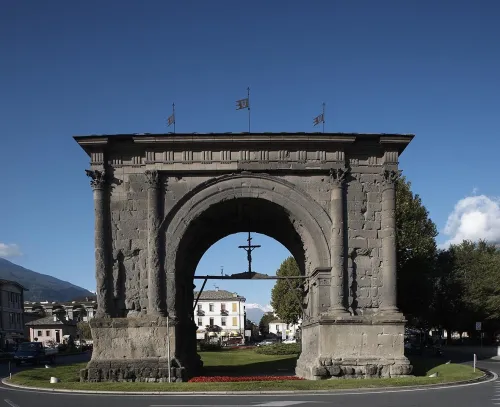
    Start here, on the eastern edge of the old town, where the arch stands alone on a small traffic island over the Buthier stream. It went up in 25 BC to mark Rome's victory over the Salassi tribe and the founding of the city. Single span, weathered stone, a wooden crucifix hung underneath in the medieval period and still there. It is free and open 24/7, and there is no interior to enter, so a few minutes is enough. Walk around it, look at how the cornice has worn, and note the line of the road running west: that is the decumanus, the Roman main street you are about to follow into the centre. From here, head straight up Via Sant'Anselmo, a pedestrian shopping street, toward the city gate ahead.
    Hours
    Open 24/7
    Price
    Free

    9 min walk to next stop

  2. 2

    Porta Praetoria

    Porta Praetoria in Aosta, stop 2 on the self-guided walking tour

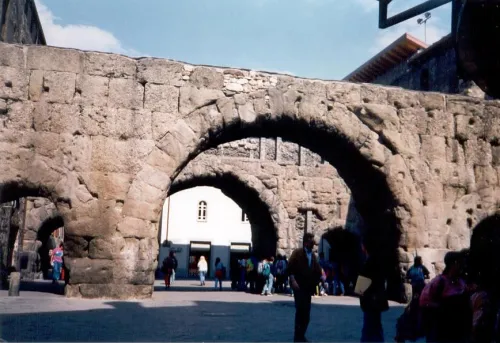
    After a few minutes up Via Sant'Anselmo the street funnels into the Porta Praetoria, the eastern gate of the Roman city, still standing nearly full height. This is the real thing: two parallel walls of grey stone forming a courtyard between an outer and inner gate, with three archways. The Romans built it this way as a defensive trap, holding attackers in the middle space. It is free and open all the time, and you walk straight through it, which is the best part. Look up at the upper arcades and the darker original stone against later repairs. The marble facing it once had is long gone. Pass through and you are inside the ancient walls. Bear left and a short detour north brings you to the theatre.

    Hours
    Open 24/7
    Price
    Free

    5 min walk to next stop

  3. 3

    Roman Theatre

    Roman Theatre in Aosta, stop 3 on the self-guided walking tour

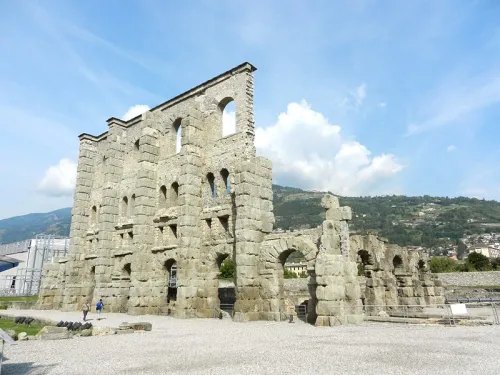
    Just north of the gate, the theatre announces itself with a wall that climbs 22 metres, the surviving stage facade pierced with rows of arched windows. It is the signature monument of Roman Aosta and the one image people carry home. Built in the late first century BC, it once seated several thousand. Entry is €10. Hours run 9:00 to 19:00 daily April through September, and a shorter 10:00 to 13:00 then 14:00 to 17:00 in winter. The ticket is worth it: you walk down among the lower seating tiers and stand directly under that towering wall, which you cannot really feel from the street. Budget twenty to thirty minutes. From here, head west along the streets back toward the centre, aiming for the cathedral a few blocks on.

    Hours
    Apr-Sep Daily: 9:00 AM – 7:00 PM | Oct-Mar Daily: 10:00 AM – 1:00 PM, 2:00 PM – 5:00 PM
    Price
    €10

    8 min walk to next stop

  4. 4

    Aosta Cathedral

    Aosta Cathedral, stop 4 on the self-guided walking tour

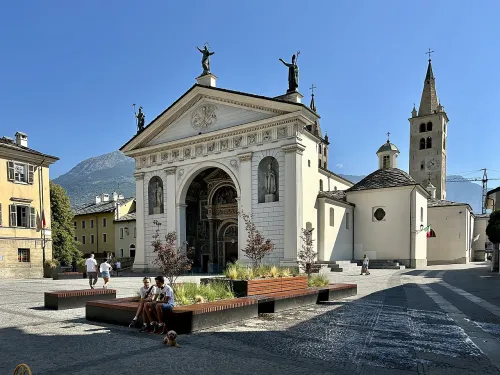
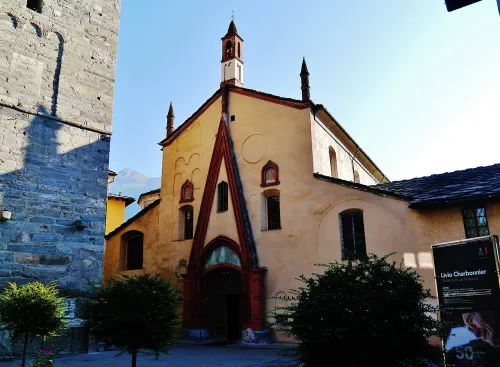
    The cathedral hides behind a plain Renaissance facade on the north side of the old centre, which undersells what is inside. Dedicated to Santa Maria Assunta, it carries over a thousand years of building layered on top of itself, with a Gothic interior, carved wooden choir stalls, and rare 11th-century floor mosaics in the presbytery. It has been an Italian national monument since 1940. Entry to the church is free. Hours are roughly 6:30 to 12:00 and 15:00 to 19:00 Monday to Saturday, opening at 7:00 on Sunday, so plan around the midday closure. Quiet, dim, and worth ten minutes. The treasury and the mosaics may require a small separate ticket, so ask at the entrance. Step out and the Archaeological Museum is barely a minute away on Piazza Roncas to the west.

    Hours
    Mon-Sat: 6:30 AM – 12:00 PM, 3:00 – 7:00 PM | Sun: 7:00 AM – 12:00 PM, 3:00 – 7:00 PM
    Price
    Free

    2 min walk to next stop

  5. 5

    Regional Archaeological Museum

    Regional Archaeological Museum in Aosta, stop 5 on the self-guided walking tour

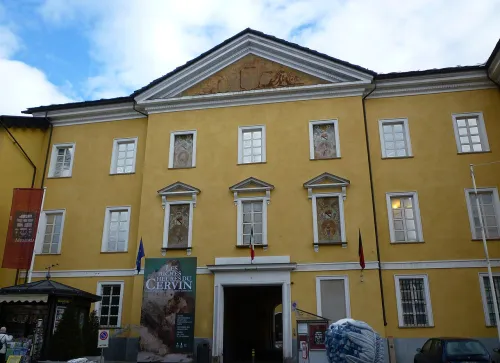
    A minute from the cathedral, the MAR sits on Piazza Roncas inside an old barracks, built directly over a Roman gate whose foundations you can see in the basement. This is where the Roman story ties together: coins, bronzes, glass, inscriptions and a scale model of Augusta Prætoria that makes the street grid you have been walking suddenly obvious. Entry is €7 and it is open daily 9:00 to 19:00. Allow forty-five minutes if you like context, less if you just want the highlights. If you only have time for one indoor stop on this loop, this is the most useful, because it explains everything else outside. From Piazza Roncas, walk a couple of minutes south toward the cathedral square again to reach the forum gallery entrance.

    Hours
    Daily: 9:00 AM – 7:00 PM
    Price
    €7

    2 min walk to next stop

  6. 6

    Roman Forum Cryptoporticus

    Roman Forum Cryptoporticus in Aosta, stop 6 on the self-guided walking tour

    This is the one most visitors walk past without knowing it is there. Beside the cathedral, a stairway drops into the cryptoporticus, an underground gallery of horseshoe-shaped vaults that once framed the Roman forum on three sides above ground. Down here it is cool, lit low, and genuinely atmospheric: a double row of stone arches running off into the dark, almost entirely intact after two thousand years. Nobody is certain whether it was used for storage or as a structural support for the forum platform, which adds to the strangeness. Entry is €10. It is the single most underrated site on this walk and worth the ticket for the few minutes underground alone. Climb back up and head east toward the open expanse of the main square.

    Hours
    Open 24/7
    Price
    €10

    3 min walk to next stop

  7. 7

    Piazza Émile Chanoux

    Piazza Émile Chanoux in Aosta, stop 7 on the self-guided walking tour

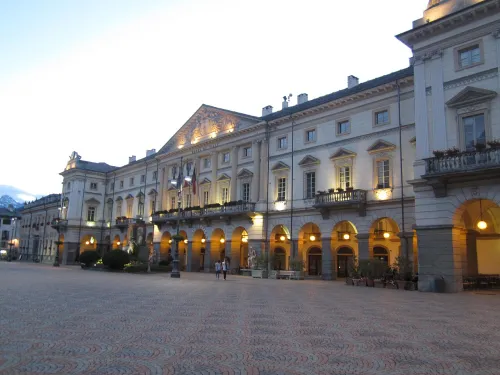
    After the tight medieval lanes and the dark of the cryptoporticus, the main square opens wide and bright. This is Aosta's living room, a long rectangle framed by the grand town hall with its arcades and twin fountains. The old Roman decumanus streets, Via de Tillier and Via Porta Praetoria, feed into it, so it has been the crossroads of the city for two millennia. It was renamed for Émile Chanoux, a notary and Resistance leader from the valley. Free and always open. Grab a coffee at one of the cafe terraces under the arcades and watch the mountains close off the end of every street. This is the natural pause point on the loop. When you are ready, head east on Via Sant'Anselmo, then cut north toward the bell tower of Sant'Orso.

    Hours
    Open 24/7
    Price
    Free

    5 min walk to next stop

  8. 8

    Collegiate Church of Sant'Orso

    Collegiate Church of Sant'Orso in Aosta, stop 8 on the self-guided walking tour

    The last stop sits in its own quiet quarter on the eastern side, marked by a tall Romanesque bell tower. The Collegiate Church of Sant'Orso is, with the cathedral, one of the two greatest sacred sites in the whole Aosta Valley. Two things make it special. Hidden in the roof space above the nave are 11th-century Ottonian frescoes, sealed away when the Gothic vault was added, which you can sometimes see on a guided walkway. And the medieval cloister beside the church has carved capitals telling biblical scenes in stone, the finest of their kind in the region. The church is free and open daily 9:00 to 18:00; the cloister may carry a small fee. Allow twenty minutes. From here it is a two-minute walk back south to the Arch of Augustus where you began.

    Hours
    Daily: 9:00 AM – 6:00 PM
    Price
    Free
AI Tourguide
Walk this exact route with a private AI guide.
Full GPS navigation, interactive stories, and a guide that answers all your questions. A private guide experience for just €5/hour.
Start This Tour

Self-Guided Tour vs. Group Tour in Aosta

You do not need a guide for Aosta. The centre is small enough that you cannot really get lost, the monuments are clearly signed, and the most important context is delivered inside the Archaeological Museum for €7. A self-guided loop like this one, plus tickets to the sites you choose, is the sensible way to do it. The Roman Theatre is €10, the cryptoporticus is €10, the museum €7, and the two churches are free. Skip nothing you are curious about, but you genuinely do not have to pay for all the ticketed sites to get the picture.

Guided walking tours of Roman Aosta do exist, usually run through the regional heritage service or local operators, and typically land in the €10 to €20 range per person for a couple of hours, sometimes with combined site entry bundled in. They are worth it if you want the archaeology explained on the spot or if the underground sites are only opening for a scheduled group. For most people on a half-day, the free loop plus a couple of self-bought tickets covers it.

One practical money note: the region sometimes sells a combined ticket covering the theatre, museum and other Roman sites, which beats paying each €10 entry separately. Ask at the theatre or museum desk before buying single tickets if you plan to see three or more paid sites.

Group Tour AI Self-Guided
Price €25–€50 per person €5/hour or €20 all-inclusive
Flexibility Fixed schedule Start anytime, skip stops
Languages 1–2 languages 11 languages
Pace Group pace Your own pace

How Long Does This Aosta Tour Take?

Our route covers 4.5 km with 8 stops and takes approximately 2.1 hours at a relaxed pace.

The walking itself is only about 4.5 km and well under an hour of actual movement. The time goes into the stops. Budget two to two and a half hours for the full loop if you go inside the theatre, the museum and the cryptoporticus. Cut that to about ninety minutes if you stick to the free outdoor monuments and the two churches.

The stops that reward extra time are the Roman Theatre, where standing under the 22-metre wall takes a while to absorb, and the Archaeological Museum, which is easy to spend forty-five minutes in. The cryptoporticus is short but unmissable. For a break, Piazza Émile Chanoux is the obvious spot: take a table under the town-hall arcades, order a coffee, and you have a fountain, the square, and a wall of Alps to look at. If you would rather sit quietly, the cloister at Sant'Orso has stone benches and shade.

Tips for Walking in Aosta

AI Tourguide
Walk this exact route with a private AI guide.
Full GPS navigation, interactive stories, and a guide that answers all your questions. A private guide experience for just €5/hour.
Start This Tour

AI Audio Guide for This Tour

Standing under the Arch of Augustus or somewhere along Via Sant'Anselmo right now? Open the app and it will place you on the Roman loop, point you to the next gate or theatre, and tell you the opening hours and ticket price before you walk over. No need to guess which underground sites are open today.

AI Audio Guide Stories, history and fun facts narrated as you walk. No earpiece rental needed.
GPS Navigation Turn-by-turn directions so you never get lost between stops.
Ask Anything Curious about a building you pass? Ask your AI guide on the spot.
11 Languages Switch language anytime. No separate tour needed.
Start This Tour Free

Common Questions

Yes, very. Aosta is a small Alpine valley town with low crime and a quiet, pedestrianised centre. There are no rough areas on this route and no common tourist scams to watch for. The usual sense around your bag in busy cafes is enough. The main hazard is cobbles and the underground stairs at the cryptoporticus, so watch your footing.
This route has good indoor cover. The Archaeological Museum, the cathedral, the Collegiate Church of Sant'Orso and especially the cryptoporticus are all enclosed. The cryptoporticus is underground and completely dry, making it a good rainy-hour stop. The arcades around Piazza Émile Chanoux keep you covered between sites, and the old town distances are short enough to dash between doorways.
Start around 9:00 in the morning. That is when the Roman Theatre and the Archaeological Museum open, the churches are accessible before their midday close, and the streets are empty. You will have the monuments largely to yourself for the first hour. Late afternoon also works well for photography, with warm light on the theatre wall, but you risk the winter sites closing at 17:00.
No booking needed. This self-guided tour is available anytime. Open the route on your phone and start walking. The AI audio guide works instantly, no reservation required.
The AI audio guide is available in 11 languages: English, German, French, Spanish, Italian, Japanese, Chinese, Portuguese, Danish, Norwegian, and Swedish.
Yes. Skip any stop, spend extra time at places you like, or start the route from any point. You can also ask the AI to suggest a shorter route.
AI Tourguide
Curated by AI Tourguide GPS-verified routes, reviewed and updated regularly.
Last verified June 2026