Self-Guided Walking Tour in Augsburg

13 Stops 5.2 km ~2.9 hours
Start This Tour Free
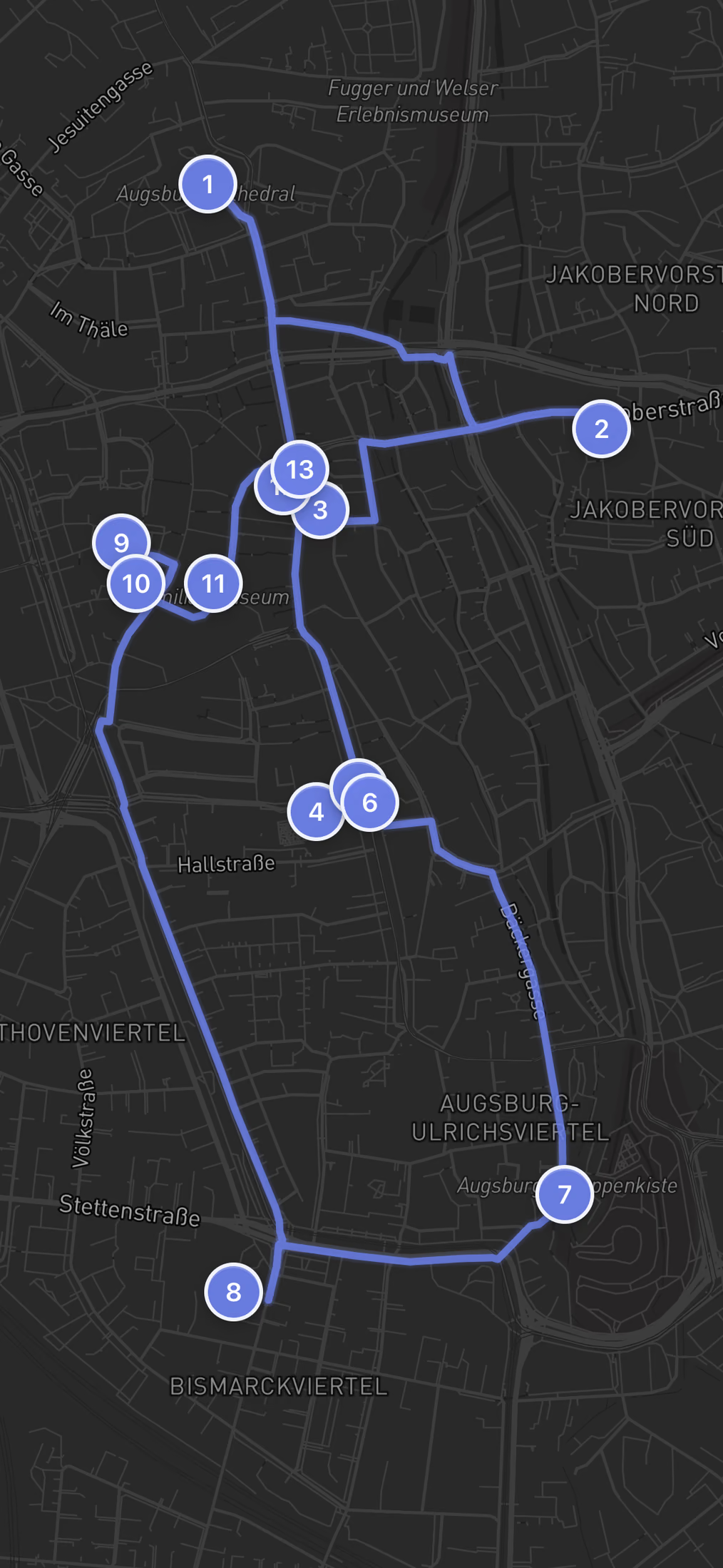
Walking tour route map of Augsburg
Start This Tour Free

Why Walk Augsburg? A Self-Guided Tour

Augsburg gets skipped by people racing between Munich and the Romantic Road, and that is exactly why it works so well on foot. The old town is flat, compact, and stuffed with more than two thousand years of history that you can actually walk through in an afternoon. This was a Roman colony, then one of the richest cities in Renaissance Europe thanks to the Fugger banking family, and it carries that wealth in stone: golden halls, marble fountains, merchant palaces lined up along one absurdly wide boulevard.

This route is built around that boulevard, the Maximilianstraße, and the Rathausplatz at its northern end. You start at the cathedral, swing east to the Fuggerei, then drop south down the grand spine of the city before looping back through the market and the churches. Most of it is a tight 5.2 kilometers, and almost nothing on it requires a long ticket queue.

Wandering Augsburg blind, you would miss the connections that make it click: why three of the fountains are UNESCO World Heritage, why a Protestant and a Catholic church stand wall to wall, why the world's oldest social housing still charges less than one euro a year. This walk strings those threads together in the order they make sense.

The Route: 13 Stops

Swipe through images or scroll names below

Scroll to explore →
1. Augsburger Dom
2. Fuggerei
3. Augsburger Rathaus
4. Schaezlerpalais
5. Maximilianstraße
6. Herkulesbrunnen
7. Augsburger Puppenkiste
8. St. Ulrich und Afra
9. Stadtmarkt
10. St. Anna-Kirche
11. Maximilianmuseum
12. Augustusbrunnen
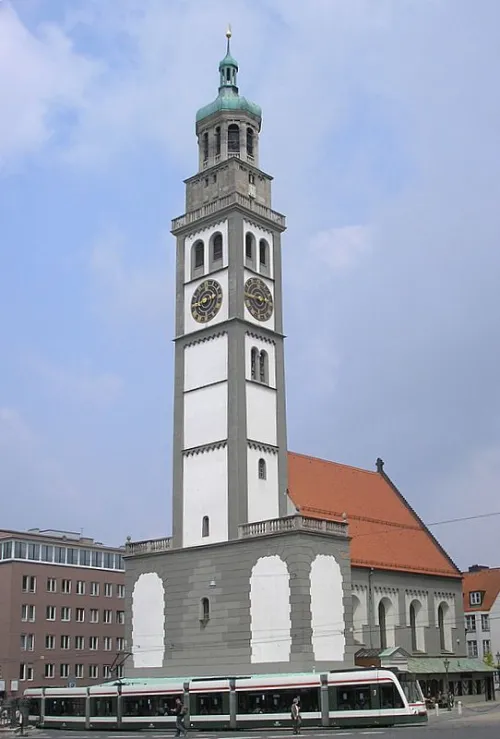
13. Perlachturm

Route Map

Tap to load interactive map
AI Tourguide
Walk this exact route with a private AI guide.
Full GPS navigation, interactive stories, and a guide that answers all your questions. A private guide experience for just €5/hour.
Start This Tour

Your Augsburg Walking Tour, Stop by Stop

  1. 1

    Augsburger Dom

    Augsburger Dom, stop 1 on the self-guided walking tour

    Start at the cathedral, the northern anchor of the old town. From the outside it looks stitched together, and it is: a Romanesque core begun around 995 with a Gothic high choir bolted on in the 14th century. This is the only surviving Ottonian bishop's church in Germany. Walk inside and look up at the south side of the nave for the prophet windows, the oldest figurative stained glass in the world still in its original place. The bronze door panels are Romanesque too. Entry is free, daily 7:00 to 18:00, so there is no reason to rush past it. Guided tours run €2 if you want the detail. Give it twenty minutes, longer if the light is catching the glass. When you leave, head east toward Frauentorstraße and the quieter streets that lead to the Fuggerei.
    Hours
    Daily: 7:00 AM – 6:00 PM
    Price
    Free (guided tours €2)

    10 min walk to next stop

  2. 2

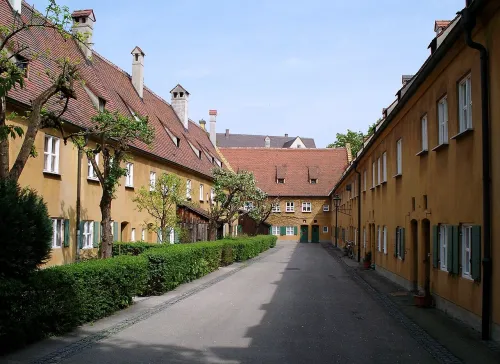
    Fuggerei

    Fuggerei in Augsburg, stop 2 on the self-guided walking tour

    After the cathedral district the streets narrow, and then you pass through a gate into what feels like a separate village inside the city. The Fuggerei is the oldest social housing settlement still in use anywhere in the world. Jakob Fugger the Rich founded it in 1521, and the deal he set then still holds: residents pay an annual rent of 0.88 euro, the modern equivalent of one Rhenish guilder, plus three daily prayers for the founder. People live here now, so keep your voice down in the lanes. Entry is €8, reduced €7, children 8 to 17 €4, under 8 free, family ticket €18, open daily 9:00 to 20:00. The ticket includes a show apartment and a museum, and it is genuinely worth the money. From here you double back west toward the Rathausplatz.

    Hours
    Daily: 9:00 AM – 8:00 PM
    Price
    €8 (reduced €7, children 8-17 €4, under 8 free, family ticket €18)

    10 min walk to next stop

  3. 3

    Augsburger Rathaus

    Augsburger Rathaus, stop 3 on the self-guided walking tour

    The square opens up and the town hall fills the east side of it. Elias Holl built it between 1615 and 1624, 57 meters tall, and it is held up as one of the most important secular Renaissance buildings north of the Alps. The reason to go inside is upstairs: the Goldener Saal, a festival hall coated in gold leaf with a coffered ceiling that survived the war by a margin. Tickets are just €2.50, students and pupils €1, open daily 10:00 to 18:00. It takes ten minutes to see and it is one of the cheapest jaw-drop moments in Bavaria. The Perlachturm next door is your last stop, currently closed, so do not expect to climb it today. From the Rathausplatz, walk south to start down the Maximilianstraße past the Schaezlerpalais.

    Hours
    Daily: 10:00 AM – 6:00 PM
    Price
    €2.50 Goldener Saal (students/pupils €1)

    8 min walk to next stop

  4. 4

    Schaezlerpalais

    Schaezlerpalais in Augsburg, stop 4 on the self-guided walking tour

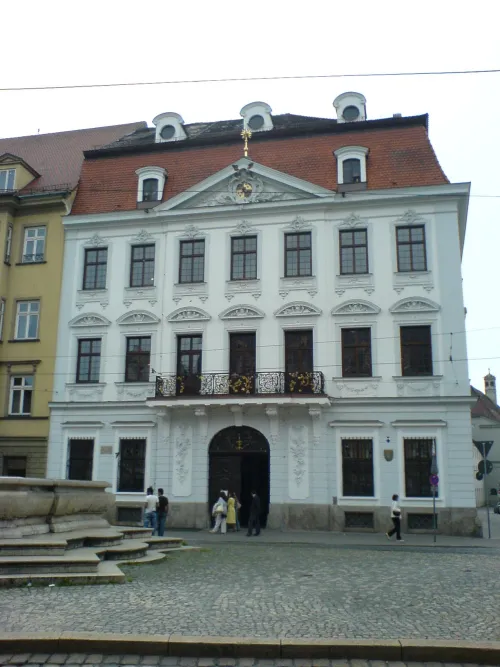
    Halfway down the boulevard, a narrow Rococo facade hides something much bigger. The front on the Maximilianstraße is only 19 meters wide; the building runs 107 meters back along the side street. Inside is the mirrored Festsaal, a banquet hall where Marie Antoinette danced on her way through in 1770, and a serious painting gallery with Dürer and other German masters. Entry is €7, reduced €5.50, and free if you are under 27. Closed Mondays, otherwise open Tuesday to Sunday 10:00 to 17:00. If you only have time for one indoor museum on this walk, this is the one with the most wow per euro. Step back out onto the boulevard, because the next two stops are right in front of you on the street itself.

    Hours
    Mon: Closed | Tue-Sun: 10:00 AM – 5:00 PM
    Price
    €7 (reduced €5.50, under 27 free)

    2 min walk to next stop

  5. 5

    Maximilianstraße

    Maximilianstraße in Augsburg, stop 5 on the self-guided walking tour

    You are already standing on it, but pause and take in the width. The Maximilianstraße is one of the most significant streets in Germany for art history, lined with merchant palaces in Gothic, Renaissance, Rococo and neoclassical styles. It took its broad shape in 1809 when buildings were torn down to open up the view. This was the old wine market, the showpiece of a city that wanted everyone to see how rich it was. It is free and always open, obviously, so use it as a spine: cafes spill onto the pavement, and the three Renaissance fountains punctuate its length. Walk a little further south and you reach the first of them.

    Hours
    Always open
    Price
    Free

    1 min walk to next stop

  6. 6

    Herkulesbrunnen

    Herkulesbrunnen in Augsburg, stop 6 on the self-guided walking tour

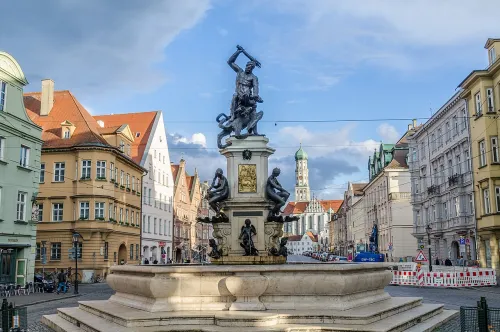
    A few steps on, the Hercules fountain rises out of the boulevard. Adriaen de Vries cast it between 1596 and 1600, and the bronze hero clubbing the many-headed Hydra is the centerpiece. This is not just street decoration: it is one of three monumental fountains that earned Augsburg's water management system a place on the UNESCO World Heritage list in July 2019. The city built canals and waterworks centuries before most of Europe, and these fountains were the proud public face of that engineering. Free, open all day, every day. Photograph it with the merchant houses behind, then keep heading south. The boulevard runs on toward the Puppenkiste and the great basilica that closes the street.

    Hours
    Open 24/7
    Price
    Free

    10 min walk to next stop

  7. 7

    Augsburger Puppenkiste

    Augsburger Puppenkiste, stop 7 on the self-guided walking tour

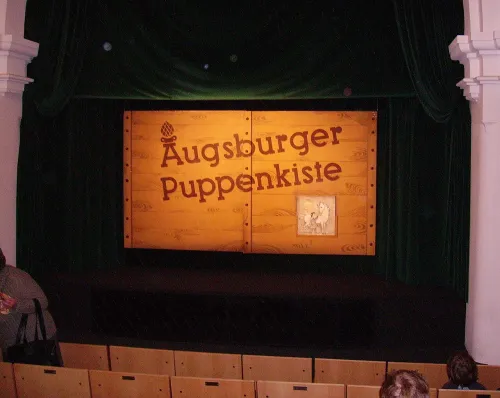
    Near the southern end you reach the old Heilig-Geist-Spital, a former hospital, now home to the most famous marionette theatre in Germany. The Augsburger Puppenkiste has performed here since 1948, and its televised puppet shows from the 1950s onward, Jim Knopf and Urmel among them, are childhood for generations of Germans. There is a small museum, the Die Kiste, with €5 entry, children 4 to 12 €3.30, family ticket €12.90, open Wednesday to Sunday 12:00 to 18:00 and closed Monday and Tuesday. Theatre performances cost more and need booking ahead. If you are travelling without kids and the German nostalgia means nothing to you, the museum is skippable, but it is a charming pause. From here cut west toward St. Ulrich und Afra.

    Hours
    Mon-Tue: Closed | Wed-Sun: 12:00 – 6:00 PM
    Price
    €5 (museum; children 4-12 €3.30, family ticket €12.90). Theatre tickets vary by performance

    5 min walk to next stop

  8. 8

    St. Ulrich und Afra

    St. Ulrich und Afra in Augsburg, stop 8 on the self-guided walking tour

    The basilica seals off the south end of the Maximilianstraße, its tall onion-domed tower visible the whole way down. What makes this spot tell Augsburg's whole story is the arrangement: the large Catholic basilica stands right beside a smaller Protestant church, St. Ulrich, wall to wall. That pairing is a monument to the Religious Peace of Augsburg in 1555, when the city formalised Catholics and Protestants living side by side. Step into the basilica, free, open daily 7:30 to 18:45, and look at the Baroque interior and the saints' tombs in the crypt. Quiet, often nearly empty, a good cool-down after the busy boulevard. This is the turning point of the walk. Now you head back north toward the market for a break.

    Hours
    Daily: 7:30 AM – 6:45 PM
    Price
    Free

    12 min walk to next stop

  9. 9

    Stadtmarkt

    Stadtmarkt in Augsburg, stop 9 on the self-guided walking tour

    After all the marble and gold, the Stadtmarkt is where Augsburg eats. Two large covered halls plus open stalls, over 10,000 square meters and 104 businesses, from fishmongers and butchers to a farmers' market on the western side. This is your natural lunch stop. Grab a Leberkäse roll, a plate of fish, or a glass of wine at one of the standing counters and watch locals do their shopping. It is free to wander and always there during market days, but note it runs on weekday and Saturday rhythms: do not arrive on a Sunday expecting it open. Budget at least half an hour here, more if you sit down. When you have eaten, it is a short walk to St. Anna just to the south.

    Hours
    Always open
    Price
    Free

    3 min walk to next stop

  10. 10

    St. Anna-Kirche

    St. Anna-Kirche in Augsburg, stop 10 on the self-guided walking tour

    Tucked just off the market, St. Anna looks plain from the alley and hides one of the most important rooms of the Reformation. Martin Luther stayed in the attached monastery in 1518 when he was summoned to face Cardinal Cajetan, and the church became Protestant in 1548. Built by Carmelites in 1321, it mixes Gothic through to neoclassical, but the showpiece is the Fugger funerary chapel at the west end, one of the earliest Renaissance structures north of the Alps. The Fugger chapel stayed Catholic even after the church turned Protestant, and they never built the dividing screen they once planned. Free entry, open Monday 12:00 to 18:00, Tuesday to Saturday 10:00 to 18:00, Sunday with a midday break. Underrated and quiet. From here walk a couple of minutes west to the Maximilianmuseum.

    Hours
    Mon: 12:00 – 6:00 PM | Tue-Sat: 10:00 AM – 6:00 PM | Sun: 10:00 AM – 12:30 PM, 3:00 – 5:00 PM
    Price
    Free

    3 min walk to next stop

  11. 11

    Maximilianmuseum

    Maximilianmuseum in Augsburg, stop 11 on the self-guided walking tour

    The city's oldest museum, opened in 1854, sits inside a 15th-century patrician house just off the pedestrian zone. This is where Augsburg's reputation as a goldsmithing capital gets its due: silver, bronze sculpture, and the craftwork that made the city's name across Europe, alongside the history of the free imperial city up to 1805. Entry is €7, reduced €5.50, family €14, free under 27, and a flat €1 on the first Sunday of the month if you can time it. Closed Monday, open Tuesday to Sunday 10:00 to 17:00. The glass-roofed courtyard alone is worth a look even if you do not pay in. It is a focused visit, forty-five minutes is plenty. Now head the last short stretch back to the Rathausplatz for the final two stops.

    Hours
    Mon: Closed | Tue-Sun: 10:00 AM – 5:00 PM
    Price
    €7 (reduced €5.50, family €14, under 27 free, 1st Sunday of month €1)

    4 min walk to next stop

  12. 12

    Augustusbrunnen

    Augustusbrunnen in Augsburg, stop 12 on the self-guided walking tour

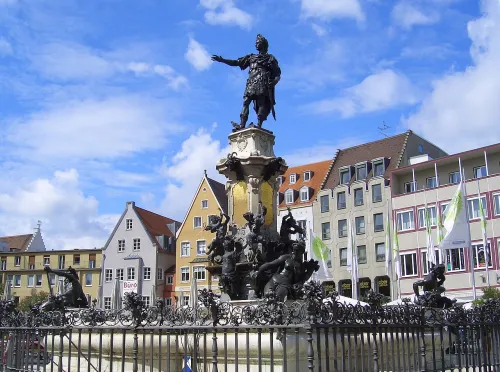
    Back on the Rathausplatz, the Augustusbrunnen stands in front of the town hall. Hubert Gerhard cast it between 1589 and 1594, and the figure on top is Emperor Augustus, the Roman who gave the city its name when it was the colony Augusta Vindelicorum. The four reclining bronze figures around the base represent the rivers and streams that fed Augsburg's water system, which is the point: like the Hercules fountain, this is part of the UNESCO-listed water management heritage from 2019. Free, day or night. It is also the best vantage point for the whole square, with the Rathaus and the Perlachturm framed behind it. One stop left, right beside the town hall.

    Hours
    Open 24/7
    Price
    Free

    2 min walk to next stop

  13. 13

    Perlachturm

    Perlachturm in Augsburg, stop 13 on the self-guided walking tour

    The walk ends at the tower that, with the Rathaus beside it, forms Augsburg's emblem. The Perlachturm rises 70 meters and began life as a watchtower back in the 10th century before becoming the city's lookout. On a clear day the climb gives you the old town spread below and, if you are lucky with the weather, the Alps on the horizon. Here is the honest part: it is closed for renovation until autumn 2027, so you cannot go up right now. Normal entry, when it reopens, is €2 for adults and €1 for children. For today, stand at its foot, look back across the Augustusbrunnen and the golden facade of the Rathaus, and that is your tour. The cafes around the square are the obvious place to finish.

    Hours
    Closed for renovation until autumn 2027
    Price
    €2 (Erwachsene), €1 (Kinder)
AI Tourguide
Walk this exact route with a private AI guide.
Full GPS navigation, interactive stories, and a guide that answers all your questions. A private guide experience for just €5/hour.
Start This Tour

Self-Guided Tour vs. Group Tour in Augsburg

Augsburg is one of the easier cities to do without a guide. The old town is flat and small, the stops are close together, and almost everything here is either free or a couple of euros. The cathedral, all three UNESCO fountains, the Maximilianstraße, St. Ulrich und Afra and St. Anna cost nothing. The Goldener Saal in the town hall is €2.50. You could do this entire walk and see the interiors that matter for under €20 in tickets, including the Fuggerei at €8 and the Schaezlerpalais at €7.

Guided walking tours of the old town through the tourist office and private operators typically run around €10 to €15 per person for a roughly 90-minute group walk, and that buys you a knowledgeable local and the stories that bring the Fugger family and the Reformation peace to life. If history is your reason for coming and you want the Roman-to-Renaissance arc explained properly, that is fair value. A private guide will cost considerably more.

For most first-time visitors, self-guided is the better call here. The distances are short, signage in the old town is decent, and the savings are real. Put the few euros you save toward the Goldener Saal and the Fuggerei, which are the two paid stops genuinely worth the entry.

Group Tour AI Self-Guided
Price €25–€50 per person €5/hour or €20 all-inclusive
Flexibility Fixed schedule Start anytime, skip stops
Languages 1–2 languages 11 languages
Pace Group pace Your own pace

How Long Does This Augsburg Tour Take?

Our route covers 5.2 km with 13 stops and takes approximately 2.9 hours at a relaxed pace.

Walking time alone is a little over an hour and a half across 5.2 kilometers, but you would not actually do it that fast. Plan on a relaxed half day, four to five hours, if you go inside the Dom, the Goldener Saal, the Fuggerei and one museum. The Fuggerei eats the most time and deserves it, so leave forty-five minutes to an hour there. The Schaezlerpalais and Maximilianmuseum each want a focused half hour to forty-five minutes if you go in.

The obvious place to break is the Stadtmarkt, roughly the southern-loop midpoint, where you can sit at a standing counter with food and a drink. If you want a proper sit-down, the cafes along the Maximilianstraße near the Herkulesbrunnen put you on the boulevard with the fountains in view. Finish on the Rathausplatz: grab a coffee at one of the terraces facing the town hall, since the Perlachturm climb is off the table until 2027.

Tips for Walking in Augsburg

AI Tourguide
Walk this exact route with a private AI guide.
Full GPS navigation, interactive stories, and a guide that answers all your questions. A private guide experience for just €5/hour.
Start This Tour

AI Audio Guide for This Tour

Standing on the Rathausplatz looking up at the golden town hall and the Perlachturm? Open the app and let it walk you stop by stop from here down the Maximilianstraße to the Fuggerei, with the history, prices and timing for each one read out as you go. No queues, no guidebook, just hit play and start walking.

AI Audio Guide Stories, history and fun facts narrated as you walk. No earpiece rental needed.
GPS Navigation Turn-by-turn directions so you never get lost between stops.
Ask Anything Curious about a building you pass? Ask your AI guide on the spot.
11 Languages Switch language anytime. No separate tour needed.
Start This Tour Free

Common Questions

Yes, Augsburg is a calm mid-sized Bavarian city and the old-town route here is safe day and night. There are no tourist-scam hotspots to speak of. The area around the Hauptbahnhof can feel a bit rougher late at night, as in most German cities, but the walking route itself stays in the well-kept historic center. Normal city sense with your bag in the Stadtmarkt crowd is all you need.
This route has plenty of indoor cover. The Dom, St. Ulrich und Afra and St. Anna are all free and dry, the Goldener Saal in the Rathaus is €2.50, and the Schaezlerpalais and Maximilianmuseum are full indoor museums. The Stadtmarkt halls are roofed too. You can string the indoor stops together and treat the fountains and boulevard as quick dashes between them.
Start mid-morning, around 9:30 to 10:00, so the cathedral, the Goldener Saal and the Fuggerei are all open by the time you arrive at each. That timing also lands you at the Stadtmarkt for lunch and brings you back to the Rathausplatz in late afternoon, when the light is best on the town hall facade for photos. Avoid Mondays if you want the Schaezlerpalais and Maximilianmuseum, both closed that day.
No booking needed. This self-guided tour is available anytime. Open the route on your phone and start walking. The AI audio guide works instantly, no reservation required.
The AI audio guide is available in 11 languages: English, German, French, Spanish, Italian, Japanese, Chinese, Portuguese, Danish, Norwegian, and Swedish.
Yes. Skip any stop, spend extra time at places you like, or start the route from any point. You can also ask the AI to suggest a shorter route.
AI Tourguide
Curated by AI Tourguide GPS-verified routes, reviewed and updated regularly.
Last verified May 2026