
Self-Guided Walking Tour in Austin

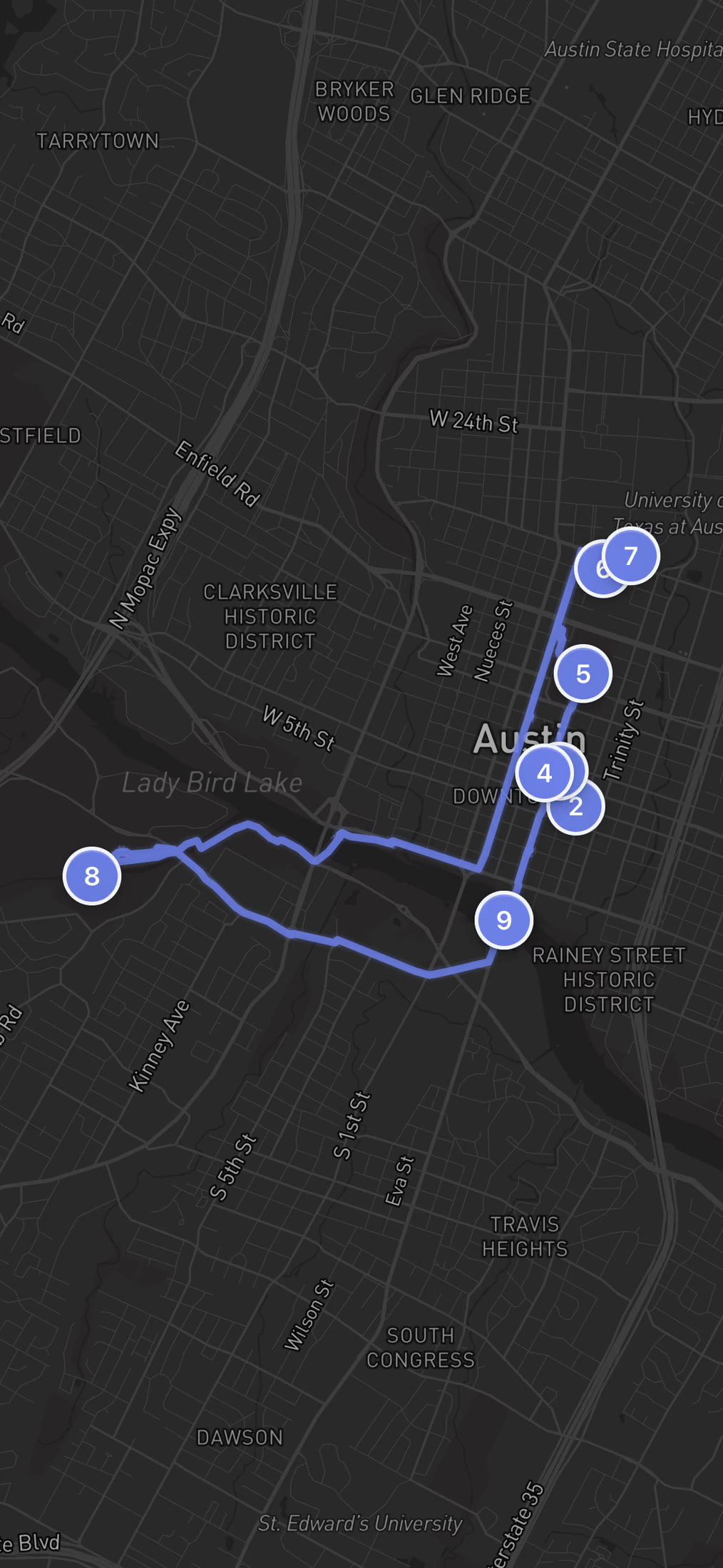
A 9-stop loop up the Congress Avenue spine from the Bat Bridge to the Texas Capitol, the Bullock and Blanton museums, then west to Barton Springs and back for the dusk bat flight. This page gives you the map, per-leg walking times, real hours and prices, and shorter versions.

9 Stops11.9 km~4 hours walking6–7 hours with stops
What you get with AI Tourguide
Full GPS navigationInteractive AI guidePersonalized to youWorks in your browser
Try this tour with Alex

Austin Walking Tour at a Glance

This route is built for travelers who want the signature sights of Austin in one connected day and like reading a street rather than staring at a phone. Almost everything sits on or just off Congress Avenue, so navigation is simple. Every interior is optional: you can do the whole loop for almost nothing and duck into museums only if you want them.

StartAnn W. Richards Congress Avenue Bridge
FinishAnn W. Richards Congress Avenue Bridge
Route typeA point-to-point spine that becomes a loop: you climb Congress Avenue roughly north from the Bat Bridge to the university museums, then swing south-west to Barton Springs and walk back east along the lake to the same bridge, so you finish where you started.
Realistic timePure walking is about 2.5 to 3 hours across 11.9 km, but with the Capitol, a museum and a swim it becomes a comfortable full day of 6 to 7 hours including the wait for the bat emergence.
DifficultyModerate mainly for length. Congress Avenue is a gentle uphill on good sidewalks, but the Blanton-to-Barton-Springs stretch is a long dirt-and-gravel trail with thin shade in Texas heat.
Cost to followThe walk itself is free. Paid interiors are the Bullock ($15 adult), the Blanton ($15 adult, free Tuesdays) and a swim at Barton Springs ($9 non-resident adult, March to October only). The Capitol, Paramount lobby, Contemporary and bat bridge cost nothing.
Best for:

First-time visitors who want the Capitol, the museums, a spring-fed swim and the famous bat flight in one well-sequenced day rather than a fixed-schedule bus tour.

The Route

Free Walking Tour Map of Austin

9 stops11.9 kmabout 4 hours
Loading the interactive map…The complete walking route will appear here.
Want the route to guide you while you walk?Open the route with navigation and a personal guide for the history, stories and questions that matter to you.
Open route + AI guide

The 9 stops along this route

  1. Ann W. Richards Congress Avenue Bridge in Austin, stop 1 on the self-guided walking tour
    1Ann W. Richards Congress Avenue Bridge
  2. Sixth Street in Austin, stop 2 on the self-guided walking tour
    2Sixth Street
  3. Paramount Theatre in Austin, stop 3 on the self-guided walking tour
    3Paramount Theatre
  4. The Contemporary Austin - Jones Center on Congress Avenue in Austin, stop 4 on the self-guided walking tour
    4The Contemporary Austin - Jones Center on Congress Avenue
  5. Texas State Capitol in Austin, stop 5 on the self-guided walking tour
    5Texas State Capitol
  6. Bullock Texas State History Museum in Austin, stop 6 on the self-guided walking tour
    6Bullock Texas State History Museum
  7. Blanton Museum of Art in Austin, stop 7 on the self-guided walking tour
    7Blanton Museum of Art
  8. Barton Springs Pool in Austin, stop 8 on the self-guided walking tour
    8Barton Springs Pool
  9. Ann W. Richards Congress Avenue Bridge in Austin, stop 9 on the self-guided walking tour
    9Ann W. Richards Congress Avenue Bridge
  10. That's the complete route.

    If you want more than the map and text, add live navigation and a conversational AI guide while you walk.

    Open route + AI guide
    You made it
Stop 1 of 9
Swipe →

Your Austin Walking Tour, Stop by Stop

  1. 1

    Ann W. Richards Congress Avenue Bridge

    Ann W. Richards Congress Avenue Bridge in Austin, stop 1 on the self-guided walking tour

    Start where the city's strangest attraction lives under your feet. The Ann W. Richards Congress Avenue Bridge carries six lanes over Lady Bird Lake, but the draw is the roughly 1.5 million Mexican free-tailed bats roosting in the expansion joints beneath it, the largest urban bat colony in the world. The bridge is open access and free, always. In the morning when you begin the walk it is just a calm river crossing with kayakers below and the downtown skyline ahead, which is the point: you scout it now and return at the end for the dusk emergence. The colony is a maternity colony, so peak numbers run mid-summer into fall. The free viewing trick is to stand on the southeast bank lawn (the Statesman Bat Observation Center side) rather than fighting for rail space on the bridge deck itself. Note the wind direction; on a north wind the smell drifts to you. Walk north up Congress, cross the lake, and the Victorian storefronts of Sixth Street appear two blocks up on your right.

    Hours
    Always open
    Price
    Free
  2. 2

    Sixth Street

    Sixth Street in Austin, stop 2 on the self-guided walking tour

    Turn east off Congress and the street changes character fast. Sixth Street is nine blocks of late-19th-century Victorian commercial buildings on the National Register of Historic Places, and it is free to walk any time. By day it is quiet and a little battered, good for photographing the cast-iron facades and reading the painted ghost signs without crowds. By night it becomes the loud, sticky live-music strip Austin is famous for, with most bars running 11:00 to 02:00. Doing it now, in daylight, is the smart move: you see the architecture, skip the cover charges, and avoid the weekend chaos when the eastern blocks close to traffic. Look for the historic markers on the brick buildings between Brazos and Red River. If you want a coffee or a breakfast taco before the climb, the cross streets here have plenty. When you are ready, head back to Congress Avenue and continue two blocks north to the columned theater on the west side.

  3. 3

    Paramount Theatre

    Paramount Theatre in Austin, stop 3 on the self-guided walking tour

    Back on Congress, the classical-revival facade with its vertical PARAMOUNT sign marks Austin's grandest old movie house. Built in 1915 and on the National Register since 1976, it has hosted vaudeville, Broadway tours, and film premieres, including the 1966 Batman movie. The lobby and box office are free to enter; the auditorium itself you only see with a ticket to a show or a scheduled tour, so check austintheatre.org for what is playing. Verdict: worth five minutes for the gilded lobby and the marquee photo even if you do not catch a film, but do not plan your day around getting inside the house unless there is an evening screening you want. The summer classic film series here is a genuine local tradition if your trip lines up with it. Step out, and the next stop is essentially next door: the Contemporary Austin's Jones Center is a few steps north on the same block of Congress.

    Hours
    Always open
    Price
    Free
  4. 4

    The Contemporary Austin - Jones Center on Congress Avenue

    The Contemporary Austin - Jones Center on Congress Avenue in Austin, stop 4 on the self-guided walking tour

    A few doors up the same side of Congress, the glass-and-light facade of the Jones Center is a jolt after all the Victorian brick. This is one of two sites of the Contemporary Austin and the downtown one, and admission is free. Hours are the catch: it opens Wednesday 12:00 to 21:00 and Thursday through Sunday 12:00 to 18:00, and it is closed Monday and Tuesday, so morning walkers will find the doors locked. If your timing works, it is a quick, focused contemporary-art stop, usually one or two changing exhibitions across a couple of floors, twenty to thirty minutes. The rooftop installation is the thing locals point out, so ask at the desk whether it is accessible during your visit. Even closed, the building is a good street-level photo. From here Congress runs straight uphill, and the dome you have been glimpsing now fills the view: keep walking north and the Texas State Capitol grounds open up ahead.

    Hours
    Wed: 12:00 PM - 9:00 PM | Thu-Sun: 12:00 PM - 6:00 PM | Mo-Tu off
    Price
    Free
  5. 5

    Texas State Capitol

    Texas State Capitol in Austin, stop 5 on the self-guided walking tour

    Congress Avenue dead-ends at the building it was designed to frame, and the approach is the best in the city: the 1888 pink-granite Renaissance Revival capitol grows in front of you, deliberately built taller than the U.S. Capitol in Washington. Entry and tours are free. The grounds are open daily, and the building runs Monday to Friday 07:00 to 22:00 and weekends 09:00 to 20:00. Go inside. The rotunda with its star-studded dome and the whisper-gallery acoustics under the cupola are the single best free thing on this walk, and the free guided tours (sign up at the visitors center) are genuinely good. Budget 45 minutes to an hour. The money-and-comfort tip: the Capitol is air-conditioned, so this is your mid-walk cool-down on a hot day, and there are clean public restrooms and water fountains inside. Lay claim to a bench under the live oaks on the south lawn for a rest. Leaving the north door, walk down the extension plaza; the museums are two blocks ahead.

  6. 6

    Bullock Texas State History Museum

    Bullock Texas State History Museum in Austin, stop 6 on the self-guided walking tour

    Two blocks north of the Capitol at 1800 North Congress, the Bullock announces itself with a 35-foot bronze Texas star out front, free to photograph and a required selfie for most visitors. Inside, this is the state's official history museum, three floors telling the Story of Texas, and it is the most family-friendly indoor stop on the route. Open daily 10:00 to 17:00. Admission is $15 for adults, $11 for seniors, military, and students, $9 for ages 4 to 17, and free under 4. There is an IMAX theater on top of that ($10 to $9 for documentaries, $15 to $12 for features). The real hack: admission is free on the first Sunday of every month, and also free for active military families, SNAP/WIC participants, and Bank of America cardholders. Budget 60 to 90 minutes if you go in, less if history museums are not your thing. Next door, a short stroll east across the plaza, sits the Blanton.

    Hours
    Daily: 10:00 AM - 5:00 PM
    Price
    $15 (adults), $11 (seniors/military/students), $9 (ages 4–17), free (children under 4). IMAX documentaries: $10–$9; IMAX feature films: $15–$12. Free admission first Sunday of month and for active military families, SNAP/WIC participants, Bank of America cardholders.
  7. 7

    Blanton Museum of Art

    Blanton Museum of Art in Austin, stop 7 on the self-guided walking tour

    Cross the plaza onto the University of Texas edge and the Blanton's redesigned grounds, with their petal-shaped sun canopies, signal a change of pace. This is one of the largest university art museums in the country, with more than 22,000 works and particular depth in Latin American art, Old Masters, and prints. The Washington Post named it one of the five best college art museums in 2024. Hours: closed Monday, Tuesday to Friday and Sunday 10:00 to 17:00, Saturday 10:00 to 20:00. Admission is $15 for adults, $12 for seniors 65+, and $8 for youth and non-UT students. The big money tip: it is free every Tuesday and the first Thursday of each month, and always free for kids 5 and under and K-12 teachers with ID. Do not skip Ellsworth Kelly's standalone chapel-like building, Austin, on the grounds; it is the reason many people come. Give the collection an hour. After this the route turns west and gets greener: head toward Zilker Park and Barton Springs.

    Hours
    Mon: Closed | Tue-Fri: 10:00 AM – 5:00 PM | Sat: 10:00 AM – 8:00 PM | Sun: 10:00 AM – 5:00 PM
    Price
    $15 (adults), $12 (seniors 65+), $8 (non-UT college students with ID, youth 6–17). Free: UT-Austin staff/students, children 0–5, K–12 teachers with ID. Free admission every Tuesday and first Thursday of month.
  8. 8

    Barton Springs Pool

    Barton Springs Pool in Austin, stop 8 on the self-guided walking tour

    This is the longest leg, and honestly the stretch most people split with a rideshare or a CapMetro bus, since it runs roughly 4 kilometers southwest from campus to Zilker Park. The reward is Austin's heart: a three-acre, spring-fed swimming pool fed entirely by the Edwards Aquifer, sitting in the channel of Barton Creek, holding steady between 68 and 74 degrees Fahrenheit all year. Bring a swimsuit and do not just look. Hours run Friday to Wednesday 05:00 to 22:00, with Thursday cut short to 05:00 to 09:00 for cleaning. The fee applies March through October only, and it is cheap: non-residents pay $9 for adults, $5 for teens, $4 for children, and $5 for seniors, free for infants under 1 and honorably discharged veterans. Buy tickets at the kiosk or the ATXSwims app. Tip: the grassy hills above the pool are free to lie on year-round, so even in winter you can watch swimmers from the shade trees. From here it is a walk back east along the lake trail to the bridge.

    Hours
    Fri-Wed: 5:00 AM - 10:00 PM | Thu: 5:00 AM - 9:00 AM
    Price
    Free for infants (under 1) and honorably discharged veterans. Residents: $2 (children 1–11), $3 (teens 12–17), $5 (adults 18–62), $2 (seniors 65+). Non-residents: $4 (children), $5 (teens), $9 (adults), $5 (seniors). Fee applies from March through October only. Tickets available online via ATXSwims app or at ticket kiosks (cash/card).
  9. 9

    Ann W. Richards Congress Avenue Bridge

    Ann W. Richards Congress Avenue Bridge in Austin, stop 9 on the self-guided walking tour

    You end where you started, but the bridge is a completely different experience now. Time this final leg so you arrive 20 to 30 minutes before sunset between roughly March and early November, because that is when the bats stream out from under the deck in a dark ribbon over Lady Bird Lake. It is free, it is open access, and on a good summer evening the emergence lasts up to 45 minutes. Best free vantage: the lawn at the Statesman Bat Observation Center on the southeast bank, where you look up at the underside of the bridge against the dusk sky rather than peering straight down from the rail. Get there early; the spot fills up. Call the Bat Hotline or check the city's bat info before you commit, since cold fronts and rain can keep them in. If you miss the emergence, the bridge at night still gives you the skyline reflected on the water, which is a fine last photo to close the loop.

    Hours
    Always open
    Price
    Free

How Long Does This Walking Tour Really Take?

Walking the 11.9 km alone takes about 2.5 to 3 hours. Add the Capitol (45 to 60 minutes), one museum (about an hour) and a swim at Barton Springs, plus the wait for the bats, and it becomes a full day of 6 to 7 hours. The two western legs total roughly 8 km, so many people ride one of them.

The full loop is about 11.9 km. Pure walking time is roughly 2.5 to 3 hours, but nobody does this as a march. With the Capitol (45 to 60 minutes), one of the two museums (an hour), and a swim at Barton Springs, plan a comfortable full day, 6 to 7 hours including the wait for the bat emergence at the end. The two long legs (Blanton to Barton Springs, then Barton Springs back to the bridge) total about 8 km of the distance, so many people shorten the day by taking a rideshare or a CapMetro bus for one of those two stretches. Natural break points: a shaded bench on the Capitol's south lawn for a mid-morning rest, the cafe inside the Blanton for lunch and air conditioning, and the grassy hill above Barton Springs to lie down before the final push. If you only have a half day, do the Congress Avenue spine (bridge up to the Bullock) and skip the Barton Springs leg.

Full Route, Shorter Walk or Two-Day Version?

The Congress Avenue core is short and dense; the length comes from the two western legs out to Barton Springs and back. That gives you three sensible ways to run the day depending on how much time and heat you want to take on.

Downtown spine

Congress corridor without Barton Springs

Stops 1 to 7, then back to stop 9, roughly 3 to 4 hours

The strongest half-day: bridge up through Sixth Street, the Paramount, the Contemporary, the Capitol and the Bullock or Blanton, then back to the bridge for dusk. This cuts the two long western legs (about 8 km to and from Barton Springs) and still hits the landmarks plus the bat emergence.

Two-part split

Downtown by day, springs by ride

Stops 1 to 7 on foot, then rideshare or CapMetro bus to stops 8 and 9

Best on a hot day or with tired legs. Walk the Congress spine from the bridge to the Blanton (stops 1 to 7), then take a rideshare or a CapMetro bus for the long 5.3 km leg out to Barton Springs, swim, and ride or walk back east to the bridge in time for the bats. You keep every sight and skip the two hottest, least scenic stretches.

You can reverse it, but the given direction is better. Starting at the Bat Bridge and climbing north puts the air-conditioned Capitol and museums at midday when the sun is highest, and it lands you back at the bridge exactly at dusk for the bat emergence, the one thing you cannot reschedule.

Is This Austin Walking Tour Right for You?

This is a long, varied downtown loop with a real swim at the end and a dusk finale, so it rewards some planning around heat and hours. Here is who it suits and how to bend it to your day.

A good fit if you…

  • First-time visitors who want the Capitol, Sixth Street, two museums, a spring-fed swim and the bat flight in one connected route
  • Walkers comfortable with 11.9 km, including a long dirt-and-gravel trail leg out to Barton Springs
  • People who want to swim in a 68-degree natural pool and watch the largest urban bat colony in the world
  • Budget travelers, since the Capitol, Paramount lobby, Contemporary, Sixth Street and bat bridge are all free

Adapt the route if you…

  • Short on time: do the Congress spine (stops 1 to 7) and skip the two western legs to Barton Springs
  • Traveling in heat: ride the 5.3 km leg to Barton Springs and save your legs for the swim
  • Not into art: swap one museum for the free Capitol tour and spend the saved time by the water
  • Visiting in winter: the bats are gone November to March, so build the day around the Capitol and museums instead of the dusk flight

Tickets & Skip-the-Line in Austin

Most of this route is free open space with no ticket needed. Only three stops charge admission, and each has a cheaper or free path if you plan around its hours. Here is what to book or time.

Bullock Texas State History MuseumOpen daily 10:00 to 17:00. Admission is $15 for adults, $11 for seniors, military and students, $9 for ages 4 to 17, and free under 4; IMAX is $10 to $9 for documentaries and $15 to $12 for features. Free on the first Sunday of each month, and for active military families, SNAP/WIC participants and Bank of America cardholders. Buy timed tickets online to skip the desk line. official ticket site ↗
Blanton Museum of ArtClosed Monday; open Tuesday to Friday and Sunday 10:00 to 17:00, Saturday 10:00 to 20:00. Admission is $15 for adults, $12 for seniors 65+, and $8 for youth 6 to 17 and non-UT students. Free every Tuesday and the first Thursday of the month, and always free for children under 6 and K-12 teachers with ID. Line your visit up with a free day and save $15. official ticket site ↗
Barton Springs PoolOpen Friday to Wednesday 05:00 to 22:00, Thursday only 05:00 to 09:00 for cleaning. The fee applies March through October only: non-residents pay $9 (adults), $5 (teens), $4 (children) and $5 (seniors); free for infants under 1 and honorably discharged veterans. Pay at the kiosk or via the ATXSwims app; outside those months entry is free. official ticket site ↗
Everything elseThe Congress Avenue Bat Bridge, Sixth Street, the Paramount Theatre lobby, the Contemporary Austin Jones Center and the Texas State Capitol are all free to enter, so no ticket or booking is needed for the rest of the loop.
Optional upgrade
+5
The same 9-stop route,
now with navigation and a guide.
Optional AI experience

You already have the route.
The AI guide brings it to life.

Standing on the Congress Avenue Bridge or climbing the avenue toward the pink dome of the Capitol? Start the AI Tourguide and it walks every step with you, greeting you, telling the story of each building as you reach it, answering what you ask, and timing the loop so you hit Barton Springs and the dusk bat flight at exactly the right moment.

Livenavigation13languagesAnyquestionYourinterests
Open this route with the AI guide

Try it in your browser · No app or download required

Tips for Walking in Austin

  • Timing: start at the bridge around 09:00 to beat the heat, do the indoor air-conditioned stops (Capitol, Bullock, Blanton) at midday, and return to the bridge 20 to 30 minutes before sunset for the bat flight (March to early November).
  • Bats are not guaranteed. Check the Austin bat info or hotline before sunset; rain and cold fronts keep them roosting, and they are most reliable on warm, still summer evenings.
  • Terrain and shoes: Congress Avenue is a gentle uphill climb on good sidewalks, but the Barton Springs leg uses the dirt-and-gravel Lady Bird Lake trail. Wear closed shoes you can also walk into the pool area with, and bring a swimsuit and towel.
  • Restrooms: the cleanest free public restrooms on the route are inside the Texas State Capitol (open Mon-Fri 07:00-22:00, weekends 09:00-20:00), with water fountains to refill a bottle. Barton Springs has changing rooms for swimmers.
  • Free-museum days: the Blanton is free every Tuesday and first Thursday; the Bullock is free the first Sunday of the month. Line your visit up with one of these and save $15 a head.
  • Food: grab breakfast tacos near Sixth Street before the climb, and budget for Barton Springs after a swim. Carry water; Texas heat from June through September is no joke and shade is thin on the avenue.
  • Photo: for the bats, stand on the southeast bank lawn at the Statesman Bat Observation Center and face up at the bridge underside against the sunset, not down from the rail. Arrive 30 minutes early to claim the spot.

Why Walk This Route?

Austin is a walking city if you stick to the right corridor, and Congress Avenue is that corridor. This route runs the spine of downtown from Lady Bird Lake up to the University of Texas, then loops west to the spring-fed pool that locals treat as a religion. Almost everything sits along or just off one straight avenue, so you can navigate without staring at your phone, and the payoff is unusually varied: a bat colony, a honky-tonk strip, a 1915 movie palace, a pink-granite capitol taller than the one in Washington, two serious art museums, and a 68-degree natural swimming hole. Few American cities pack that range into 12 kilometers.

The reason to do this as a structured walk rather than wandering is sequencing. The avenue climbs gently north and the museums cluster at the top near campus, so you tackle the indoor, ticketed places when your legs are tired and the Texas sun is highest, then finish with a swim at Barton Springs and a sunset bat flight back at the bridge. Done in the wrong order, you fight the heat and miss the bats entirely.

A word on Austin reality: it gets hot, the bats only emerge at dusk in warm months, and Sixth Street is a different planet by day versus night. This route is built around those facts. Read the timing notes before you start and you will see most of the city's signature sights for very little money, since the Capitol, the Paramount lobby, the Contemporary, and the bat bridge are all free.

Common Questions

Is Austin safe to walk around?

The Congress Avenue corridor, the Capitol grounds, the university area, and Zilker Park are all comfortable to walk by day. The main caution is Sixth Street late at night on weekends, which gets crowded and rowdy after bars fill up around 22:00; that is why this route covers it in daylight. Standard city sense applies: watch your belongings in the dense Sixth Street and bat-bridge crowds, and use a rideshare after dark rather than walking the long, dim trail stretches alone.

What if it rains during my Austin tour?

Austin has plenty of indoor escapes right on this route. The Texas State Capitol (free), the Bullock Texas State History Museum ($15, with an IMAX), the Blanton Museum of Art ($15, free Tuesdays), and the Contemporary Austin's Jones Center (free, Wed-Sun) are all air-conditioned and on or near Congress Avenue. Rain also cancels the bat flight, so on a wet evening swap the dusk finale for the Bullock's IMAX or a film at the Paramount instead.

What's the best time of day for this walking tour?

Start by 09:00 and finish at dusk. Mornings are cooler for the uphill avenue and outdoor stops, midday is best spent inside the air-conditioned Capitol and museums, and the whole point of ending at the bridge is the bat emergence at sunset (roughly March to early November). On a hot summer day, the late-afternoon swim at Barton Springs is the perfect cool-down before the bats.

How much does this walking tour cost?

Going self-guided, the route is mostly free. The Capitol, Paramount lobby, Contemporary, Sixth Street, and the bat bridge cost nothing. Optional tickets are the Bullock ($15 adult), the Blanton ($15 adult, or free Tuesdays), and a swim at Barton Springs ($9 non-resident adult, charged March to October only). A typical full day with both museums and a swim runs under $40 a person.

Can I shorten the Austin walk if I do not have a full day?

Yes. The strongest compact version is the Congress Avenue spine: start at the bat bridge, walk up through Sixth Street, the Paramount, and the Contemporary to the Texas State Capitol and the Bullock, then return to the bridge for sunset. That cuts the two long western legs (about 8 km to and from Barton Springs) and still hits the landmarks plus the bat flight in roughly 3 to 4 hours.

Do I need to book the Texas State Capitol tour in advance?

No. Entry to the Texas State Capitol and its guided tours are free, and you sign up in person at the visitors center on the day. Tours leave regularly during open hours (Mon-Fri 07:00-22:00, weekends 09:00-20:00). Self-guided visits are fine too if you prefer to roam the rotunda and dome on your own.

Take this route with you

Open this exact tour with navigation and your personal AI guide.

Start GPS Navigation + AI Guide
AI Tourguide
Researched and curated by the AI Tourguide teamWe plan and quality-check every route, then research and verify the opening hours, prices, and practical tips for each stop along it.
▶ Open route with AI guideNavigation, stories and your questions