Self-Guided Walking Tour in Bari

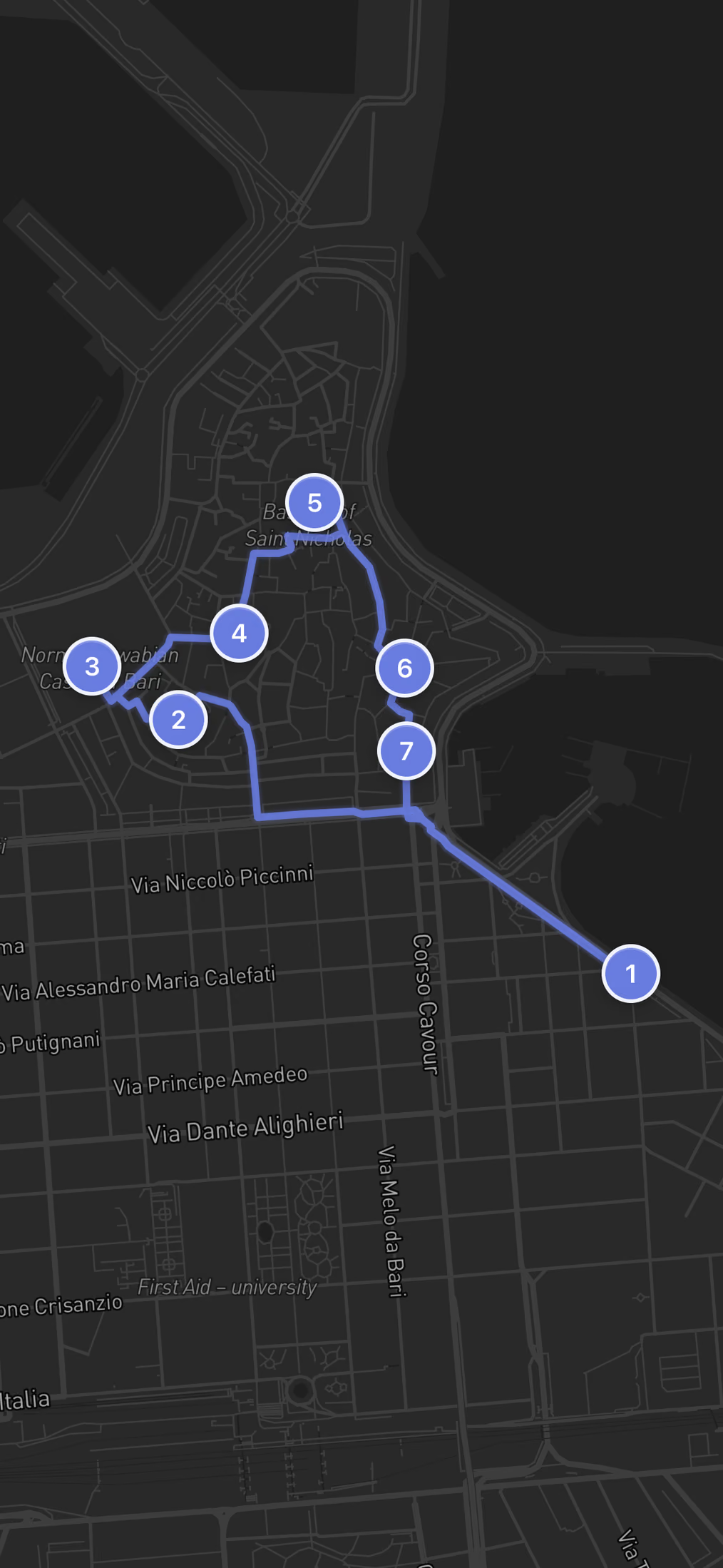
A compact 2.7 km loop through Bari Vecchia, from the wide Lungomare seafront to the aperitivo squares at Piazza del Ferrarese. Seven stops take in the orecchiette street, the Castello Svevo and both great Romanesque churches. This page gives you the map, the walking time for every leg, real hours and prices, and shorter versions.

7 Stops2.7 km~2 hours walkingAbout 90 minutes with stops
What you get with AI Tourguide
Full GPS navigationInteractive AI guidePersonalized to youWorks in your browser
Try this tour with Alex

Bari Walking Tour at a Glance

This route is built for anyone who wants to see the real Bari Vecchia on foot without a car, a plan, or a guide walking two steps ahead. Every interior on the loop is optional: the whole outdoor walk is free, and you decide at each stop whether to go in. It is self-guided from start to finish, so you set the pace and skip whatever does not interest you.

StartLungomare Araldo di Crollalanza
FinishPiazza del Ferrarese
Route typeA tight loop around the old-town peninsula. You start on the seafront, cut north-west into the lanes, swing past the castle on the western edge, then circle back south-east through the churches and squares to finish a few streets from where you began. Almost no backtracking.
Realistic timeThe walking alone is barely 35 minutes across 2.7 km. Add the outdoor stops and you are at roughly 90 minutes. Go inside the basilica crypt and the castle and it stretches past two hours comfortably.
DifficultyEasy and flat throughout, no hills or steps of note. The one thing to respect is the surface: Bari Vecchia is paved in worn, uneven stone that turns slick when wet, so flat shoes with grip beat anything with a heel.
Cost to followFollowing the route costs nothing. Six of the seven stops are free open spaces or free-entry churches. The only paid interior is the Castello Svevo at €4, and even there the walk around the walls and moat is free.
Best for:

First-time visitors who want the four things that matter in Bari Vecchia, in the order that makes geographic sense, finishing exactly where the evening aperitivo happens.

The Route

Free Walking Tour Map of Bari

7 stops2.7 kmabout 2 hours
Loading the interactive map…The complete walking route will appear here.
Want the route to guide you while you walk?Open the route with navigation and a personal guide for the history, stories and questions that matter to you.
Open route + AI guide

The 7 stops along this route

  1. Lungomare Araldo di Crollalanza in Bari, stop 1 on the self-guided walking tour
    1Lungomare Araldo di Crollalanza
  2. Strada delle Orecchiette in Bari, stop 2 on the self-guided walking tour
    2Strada delle Orecchiette
  3. Castello Normanno-Svevo in Bari, stop 3 on the self-guided walking tour
    3Castello Normanno-Svevo
  4. Cathedral of Santa Maria Assunta (Cattedrale di Santa Maria Assunta) in Bari, stop 4 on the self-guided walking tour
    4Cathedral of Santa Maria Assunta (Cattedrale di Santa Maria Assunta)
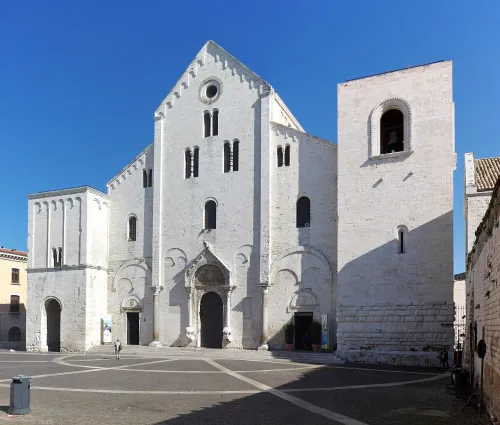
  5. Basilica of Saint Nicholas (Basilica di San Nicola) in Bari, stop 5 on the self-guided walking tour
    5Basilica of Saint Nicholas (Basilica di San Nicola)
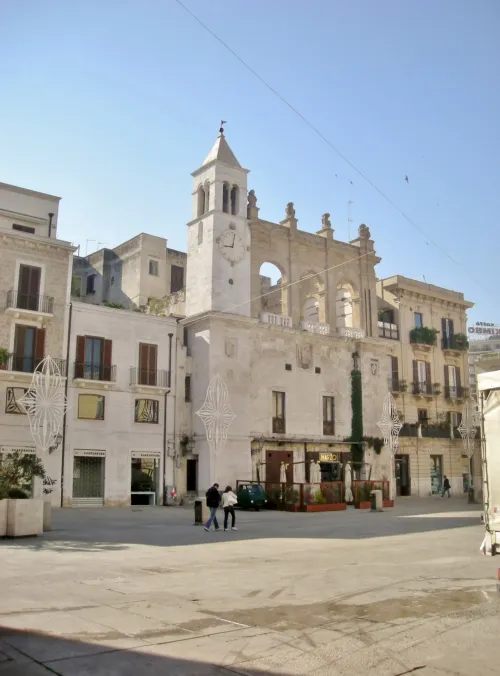
  6. Piazza Mercantile in Bari, stop 6 on the self-guided walking tour
    6Piazza Mercantile
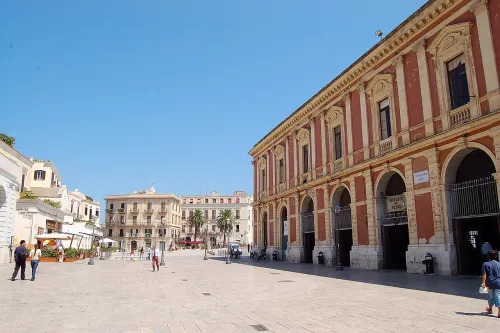
  7. Piazza del Ferrarese in Bari, stop 7 on the self-guided walking tour
    7Piazza del Ferrarese
  8. That's the complete route.

    If you want more than the map and text, add live navigation and a conversational AI guide while you walk.

    Open route + AI guide
    You made it
Stop 1 of 7
Swipe →

Your Bari Walking Tour, Stop by Stop

  1. 1

    Lungomare Araldo di Crollalanza

    Lungomare Araldo di Crollalanza in Bari, stop 1 on the self-guided walking tour

    Start here, on the wide stone seafront where the Adriatic opens up on your right and the old town rises on your left. This is the monumental promenade built in the 1920s and 30s, all balustrades and palm trees, and it is the best place to get your bearings before the lanes swallow you. It is open around the clock and costs nothing. Locals jog and cycle here in the early morning and pass the evening here in summer, so the mood changes completely depending on when you come. Walk it for a few minutes to feel the scale of the place, then look for the gap where the modern grid meets the medieval wall. That edge, where the smooth promenade turns into rough stone alleys, is your way in. Head toward the castle, inland and slightly north.
  2. 2

    Strada delle Orecchiette

    Strada delle Orecchiette in Bari, stop 2 on the self-guided walking tour

    This is the reason a lot of people come to Bari, and it is exactly as advertised. Officially Arco Basso, this short lane in Bari Vecchia is where local women sit at wooden tables outside their homes and shape orecchiette, the little ear-shaped pasta, by hand. The pasta dries on screens in the doorways. It is free to watch and open whenever the women decide to work, usually mornings into early afternoon. You can buy a bag of fresh or dried orecchiette directly from them, often a few euros, and it is the real thing, not a souvenir. Be respectful: these are working homes, not a film set, so ask before pointing a camera at someone's face. After the noise and salt of the seafront, this narrow lane feels intimate and a little chaotic. From here, head west toward the bulk of the castle.

  3. 3

    Castello Normanno-Svevo

    Castello Normanno-Svevo in Bari, stop 3 on the self-guided walking tour

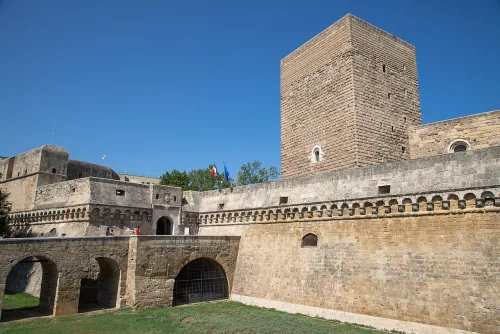
    The castle sits on the western edge of the old town and it does not try to charm you. This is a heavy Norman-Swabian fortress, the one locals call u Castídde, built to guard the city and looking every bit the part with its squat towers and dry moat. The exterior is the main event for most visitors, and walking the perimeter is free. If you want inside, entry is €4 and it opens Tuesday to Sunday, 9:00 AM to 6:00 PM, closed Mondays. The interior holds a cast gallery and rotating exhibitions; worth it if you like fortifications or want a break from the heat, skippable if your time is tight. Honestly, the walls and the moat tell most of the story from outside. When you are done circling it, walk east into the lanes toward the cathedral, two minutes away.

    Hours
    Mon: Closed | Tue-Sun: 9:00 AM – 6:00 PM
    Price
    €4
  4. 4

    Cathedral of Santa Maria Assunta (Cattedrale di Santa Maria Assunta)

    Cathedral of Santa Maria Assunta (Cattedrale di Santa Maria Assunta) in Bari, stop 4 on the self-guided walking tour

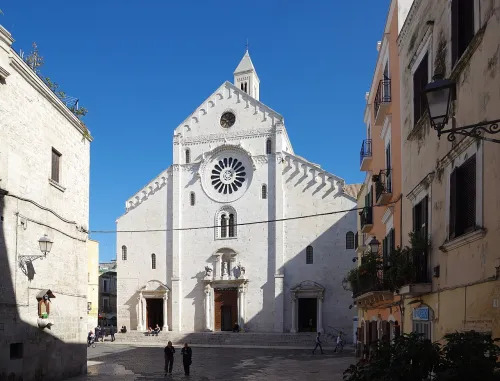
    Bari has two great Romanesque churches, and this is the quieter one. The Cattedrale di San Sabino, the actual seat of the city's archbishop, is a clean, austere example of Apulian Romanesque: pale stone, a rose window, and an interior stripped of clutter. It is free to enter. Hours are generous, 8:30 AM to 9:00 PM most days, though it closes early at 4:00 PM on Wednesdays, so plan around that. Step down into the crypt and the excavations below the floor to see remains of earlier churches and a Roman-era mosaic. After the crowds at the next stop, you may appreciate that this one is usually calm and you can hear your own footsteps. It sits just a short walk from its more famous neighbour. Head north now toward the basilica, the high point of the whole loop.

    Hours
    Mon-Tue: 8:30 AM – 9:00 PM | Wed: 8:30 AM – 4:00 PM | Thu-Sun: 8:30 AM – 9:00 PM
    Price
    Free
  5. 5

    Basilica of Saint Nicholas (Basilica di San Nicola)

    Basilica of Saint Nicholas (Basilica di San Nicola) in Bari, stop 5 on the self-guided walking tour

    This is the one. The Basilica di San Nicola holds the relics of Saint Nicholas, brought here from Myra in 1087, which makes it a pilgrimage site for both Catholic and Orthodox Christians. You will often hear services in Italian and in Slavic languages under the same roof. The building is one of the most important pieces of Apulian Romanesque, a fortress-like façade hiding a wide, bright nave. Go down to the crypt, where the relics are kept beneath a forest of stone columns; this is the spiritual core and it is genuinely moving even if you are not religious. Entry is free. It opens early, 6:30 AM, and stays open late, to 8:30 PM most days and 10:30 PM on Sundays. Dress modestly, shoulders and knees covered, or you may be turned away. From here, drop back down toward the merchants' square.

    Hours
    Mon-Sat: 6:30 AM – 8:30 PM | Sun: 6:30 AM – 10:30 PM
    Price
    Free
  6. 6

    Piazza Mercantile

    Piazza Mercantile in Bari, stop 6 on the self-guided walking tour

    Now the walk changes gear. Piazza Mercantile was the old commercial heart of Bari and today it is where the city comes out to drink and talk, especially after dark. The square is ringed with bars and the tables spill across the stone. Look for the Colonna della Giustizia, the Column of Justice, in one corner: debtors were once tied to it and publicly shamed, which is a grim backstory for what is now a cheerful aperitivo spot. It is open day and night and free to stand around in. This is a good place to stop for a spritz or a Peroni and watch the evening build. After the hush of the churches, the noise is welcome. The square sits right beside the next and final stop, less than a minute on foot.

    Hours
    Open 24/7
    Price
    Free
  7. 7

    Piazza del Ferrarese

    Piazza del Ferrarese in Bari, stop 7 on the self-guided walking tour

    You finish where many people begin, at the grand square that acts as the hinge between the modern Murat district and old Bari. Piazza del Ferrarese is wide, paved, and busy, lined with cafés and the old covered market building. The detail worth crouching for: a glassed-over section of the original Via Traiana, the ancient Roman road, exposed below the square's level. You can look straight down at the paving the Romans walked on. The square is open all hours and free. From here the lanes funnel you back out to the seafront, closing the loop where you started. Grab a panzerotto from one of the stalls nearby, a fried half-moon of dough filled with tomato and mozzarella, usually under two euros, and eat it on the move as you head back to the Lungomare.

    Hours
    Open 24/7
    Price
    Free

How Long Does This Walking Tour Really Take?

Do not judge this walk by the 2.7 km distance. The pure walking is about 35 minutes, but the value is in the stops: budget around 90 minutes at a steady pace, and closer to two hours if you go down into the Basilica di San Nicola crypt and pause at the orecchiette street to watch the pasta being shaped.

Walking time between all seven stops is barely 35 minutes; the route is only about 2.7 km. The time goes into the stops. Budget the whole thing at around 90 minutes if you move steadily, longer if you linger. The Basilica di San Nicola deserves the most time, maybe 20 to 30 minutes once you include the crypt. The orecchiette street rewards slowing down too, so leave a margin there.

The natural break is at the end, in Piazza Mercantile or Piazza del Ferrarese, where the bars are. Take a table at one of the cafés on Piazza del Ferrarese and have a coffee or a spritz while you watch the two worlds, old town and new town, meet in the square. If you want to sit earlier and cheaper, the steps and low walls around the basilica are fine for a five-minute breather out of the sun.

Full Route, Shorter Walk or Two-Day Version?

The full loop is short and every leg is a few minutes at most, so most people simply do all seven stops. But if you are pressed for time or travelling with someone who tires quickly, here are three ways to run it, each using the real stop numbers and distances from the route.

The Old-Town Core

Skip the long seafront leg

Stops 2 to 7, about 1.3 km, roughly 60 to 75 minutes

The single longest leg is the 920 m from the Lungomare into the lanes. Cut it by starting straight at the orecchiette street (stop 2) and doing everything from there: castle, Cattedrale di San Sabino, Basilica di San Nicola, then the two squares. You lose the seafront orientation but keep all four landmarks and every food stop, in a compact 1.3 km.

The Easy Split

Two short halves with a break between

Half one: stops 1 to 3. Half two: stops 4 to 7. About 45 minutes each

Ideal with kids or in high summer heat. Do the seafront, orecchiette street and castle first (stops 1 to 3), break for lunch or a rest, then pick up at the Cattedrale di San Sabino (stop 4) and finish through the basilica and both squares. The churches and squares sit within 300 m of each other, so the second half is almost all indoors and shade.

You can run this loop in reverse, starting at Piazza del Ferrarese and ending on the Lungomare, and it works because the peninsula is so small. The order given is recommended for one reason: it saves the aperitivo squares of Piazza Mercantile and Piazza del Ferrarese for the end, so you finish exactly where the bars and food stalls are as the evening builds.

Is This Bari Walking Tour Right for You?

This is one of the gentlest city walks in Puglia: short, flat, and dense with sights that sit almost on top of each other. Here is who it suits best and how to bend it to your own day.

A good fit if you…

  • First-time visitors who want the essential Bari Vecchia landmarks without guessing which lanes to follow in the maze
  • Anyone travelling on foot from Bari Centrale station, a 12 to 15 minute walk down Via Sparano to the start
  • Food-curious travellers who want to watch orecchiette shaped by hand and end at the aperitivo squares
  • People with limited time who want four major sights and two atmospheric squares inside a 2.7 km loop

Adapt the route if you…

  • Travelling with kids or in the summer heat: use the Easy Split and break between the castle and the cathedral
  • Short on time: start at the orecchiette street to skip the 920 m seafront leg and keep every landmark
  • You want the pasta women at work: go mid to late morning, roughly 10 AM, when they are usually shaping orecchiette
  • You want the city at its liveliest: start late afternoon so you finish in Piazza Mercantile as the aperitivo crowd arrives

Tickets & Skip-the-Line in Bari

There is almost nothing to pre-book on this route. Six of the seven stops are free open squares, churches, or the seafront, with no ticket and no queue. Only the Castello Svevo has a paid interior, and even that rarely has a real line. Here is what to know before you go.

Castello Normanno-SvevoInterior entry is €4. Open Tuesday to Sunday, 9:00 AM to 6:00 PM, closed Mondays. Walking the perimeter of the walls and moat is free, so you only pay if you want the cast gallery and rotating exhibitions inside. No pre-booking needed for individuals. official ticket site ↗
Cathedral of Santa Maria Assunta (Cattedrale di Santa Maria Assunta)Free to enter, no ticket. Open 8:30 AM to 9:00 PM most days, but it closes early at 4:00 PM on Wednesdays, so plan around that. Step down into the crypt and excavations below the floor while you are there.
Basilica of Saint Nicholas (Basilica di San Nicola)Free to enter, no ticket. Open early at 6:30 AM and late, to 8:30 PM Monday to Saturday and 10:30 PM on Sundays. Dress modestly, shoulders and knees covered, or you may be turned away. The crypt holding the relics is the reason to go down.
Everything elseThe Lungomare Araldo di Crollalanza, Strada delle Orecchiette, Piazza Mercantile and Piazza del Ferrarese are all free open spaces, open around the clock, with nothing to book.
Optional upgrade
+3
The same 7-stop route,
now with navigation and a guide.
Optional AI experience

You already have the route.
The AI guide brings it to life.

Standing on the Lungomare with the old town walls in front of you? Open AI Tourguide in your browser, no app and no download, and a voice guide walks Bari Vecchia with you from the orecchiette street past the Castello Svevo to the Basilica di San Nicola. It greets you, tells the story along the way and asks what you want to see, a real conversation rather than a recording. Start with 100 free credits.

Livenavigation13languagesAnyquestionYourinterests
Open this route with the AI guide

Try it in your browser · No app or download required

Tips for Walking in Bari

  • Bari Centrale station is a 12 to 15 minute walk from the start of this loop, straight down Via Sparano toward the sea. Trains from across Puglia arrive here, so it is the easiest arrival point. Do the walk in the morning if you want the orecchiette women at work, or in the early evening for the aperitivo crowds in the squares.
  • The lanes of Bari Vecchia are paved with worn, uneven stone, sometimes polished slick by centuries of feet. Skip the heels. Flat shoes with grip are the right call, especially if it has rained.
  • Public toilets are scarce in the old town. Your safest bet is to order a coffee at a café on Piazza del Ferrarese or Piazza Mercantile and use theirs; both squares are at the end of the loop, so plan accordingly before you head back to the seafront.
  • Buy a panzerotto from a stall near Piazza del Ferrarese, a fried pocket of dough with tomato and mozzarella, usually under €2. For the local pasta, buy a bag of dried orecchiette straight from the women on Arco Basso for a few euros and take it home.
  • For the best photo, stand on the Lungomare Araldo di Crollalanza in the early morning with the sun coming off the Adriatic behind the old town walls. For the basilica, shoot the fortress-like façade from the small square in front, in flat midday light that fills the pale stone.

Why Walk This Route?

Bari is a port city in Puglia that most people pass through on their way to a ferry or a beach further south. That is a mistake. The old town, Bari Vecchia, is one of the few historic centres in Italy where you can still walk in on a normal afternoon and watch women making pasta on the street outside their front doors. It is small, dense, and completely walkable. You do not need a car, a bus, or much of a plan. You need about two hours and decent shoes.

This loop works because everything sits inside a peninsula a few hundred metres across, wedged between two harbours. You start on the wide seafront for orientation, cut into the tangle of lanes for the pasta street, hit the castle and the two great Romanesque churches, then drop back out through the social squares where the city eats and drinks. No stop is more than a five-minute walk from the next. The whole thing is flat.

Doing it on foot beats wandering blind because Bari Vecchia is a maze on purpose. The lanes were built to confuse invaders and they still confuse tourists. Follow this order and you see the four things that matter, in the order that makes geographic sense, and you finish where the aperitivo is.

Common Questions

Is Bari safe to walk around?

Yes, Bari Vecchia is busy and lived-in, which keeps it safe by day and well into the evening when the squares fill up. Use normal city sense: keep your bag zipped and in front of you in the tighter lanes, and do not flash a phone or wallet in quiet corners. Petty pickpocketing, not violence, is the main risk. The area around Bari Centrale station can feel scruffier at night, so keep your wits there after dark.

What if it rains during my Bari tour?

The two churches on this route, the Cattedrale di San Sabino and the Basilica di San Nicola, are both free and indoors, and their crypts make for atmospheric shelter. The Castello Svevo interior is a dry option for €4. The lanes of Bari Vecchia are narrow enough that buildings give some cover, and the cafés on Piazza del Ferrarese have you sorted for a long coffee while it passes.

What's the best time of day for this walking tour?

Mid to late morning, roughly 10 AM, is ideal. The orecchiette women on Arco Basso are usually at work, the churches are open, and the light is good for photos before the midday heat. If you would rather catch the city at its liveliest, start late afternoon so you finish in Piazza Mercantile as the aperitivo crowd arrives.

Take this route with you

Open this exact tour with navigation and your personal AI guide.

Start GPS Navigation + AI Guide
AI Tourguide
Researched and curated by the AI Tourguide teamWe plan and quality-check every route, then research and verify the opening hours, prices, and practical tips for each stop along it.
▶ Open route with AI guideNavigation, stories and your questions