Self-Guided Walking Tour in Bariloche

A compact walk through Bariloche's stone-built core, starting at the Centro Cívico, dropping to the in-town shoreline of Lago Nahuel Huapi, and finishing at the neo-Gothic cathedral. Four stops, all in the historic center. This page gives you the map, the walking time for every leg, real opening hours and prices, and shorter versions if you want to trim the long lake stretch.

4 Stops8.9 km~3 hours walking3–4 hours with stops
What you get with AI Tourguide
Full GPS navigationInteractive AI guidePersonalized to youWorks in your browser
Try this tour with Alex

Bariloche Walking Tour at a Glance

This route is built for anyone who wants Bariloche's historic center on foot without a fixed-time group or a guide reading dates at them. It links four stops in the stone-built core, and every interior is optional: the two open spaces and the cathedral cost nothing, the museum takes a donation, and you decide how long to linger at each. Walk it your way, at your pace.

StartCentro Cívico de San Carlos de Bariloche (Centro Cívico Bariloche)
FinishCathedral of Our Lady of Nahuel Huapi (Catedral de San Carlos de Bariloche)
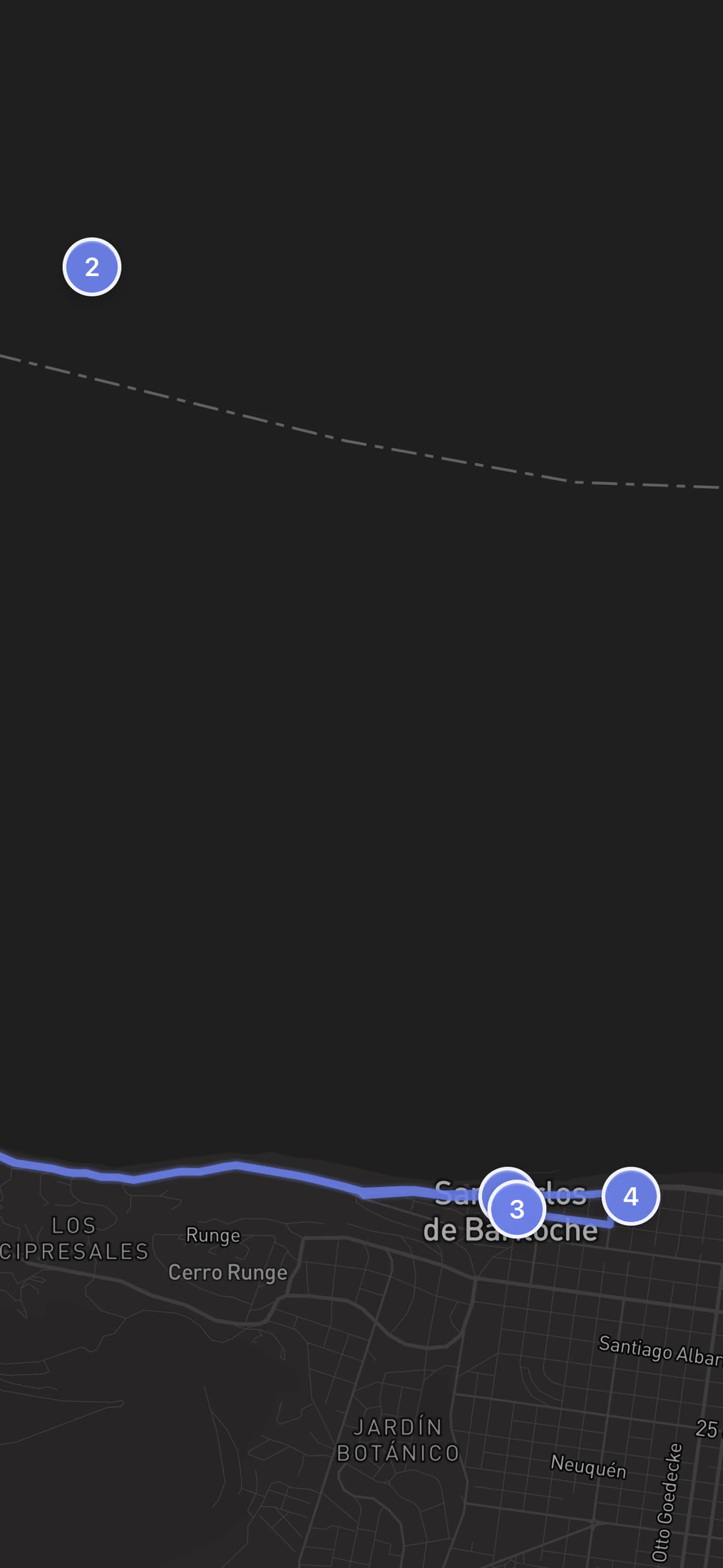
Route typeA there-and-back to the lakeshore with a short eastern tail. It runs north-west from the Centro Cívico down to the Costanera, back south-east to the museum in the same civic complex, then a few blocks east to the cathedral.
Realistic timeWalking alone is about two and a half hours across the roughly 8.9 km. With outdoor pauses figure closer to three hours, and add about 45 minutes if the museum pulls you in.
DifficultyModerate. The distance is 8.9 km and the square sits about 50 meters above the lake, so the shoreline leg is a genuine downhill and back uphill on stone slabs that turn slick when wet or icy.
Cost to followThe outdoor route is free. The Centro Cívico, the Costanera shoreline, and the cathedral cost nothing to enter; only the Museo de la Patagonia asks for a voluntary donation.
Best for:

Travelers who want the history and the signature lake-and-Andes view on their own clock, on foot, without paying a group tour for a walk they can easily do themselves.

The Route

Free Walking Tour Map of Bariloche

4 stops8.9 kmabout 3 hours
Loading the interactive map…The complete walking route will appear here.
Want the route to guide you while you walk?Open the route with navigation and a personal guide for the history, stories and questions that matter to you.
Open route + AI guide

The 4 stops along this route

  1. Centro Cívico de San Carlos de Bariloche (Centro Cívico Bariloche) in Bariloche, stop 1 on the self-guided walking tour
    1Centro Cívico de San Carlos de Bariloche (Centro Cívico Bariloche)
  2. Nahuel Huapi Lake (Lago Nahuel Huapi) in Bariloche, stop 2 on the self-guided walking tour
    2Nahuel Huapi Lake (Lago Nahuel Huapi)
  3. Francisco P. Moreno Museum of Patagonia (Museo de la Patagonia Francisco P. Moreno) in Bariloche, stop 3 on the self-guided walking tour
    3Francisco P. Moreno Museum of Patagonia (Museo de la Patagonia Francisco P. Moreno)
  4. Cathedral of Our Lady of Nahuel Huapi (Catedral de San Carlos de Bariloche) in Bariloche, stop 4 on the self-guided walking tour
    4Cathedral of Our Lady of Nahuel Huapi (Catedral de San Carlos de Bariloche)
  5. That's the complete route.

    If you want more than the map and text, add live navigation and a conversational AI guide while you walk.

    Open route + AI guide
    You made it
Stop 1 of 4
Swipe →

Your Bariloche Walking Tour, Stop by Stop

  1. 1

    Centro Cívico de San Carlos de Bariloche (Centro Cívico Bariloche)

    Centro Cívico de San Carlos de Bariloche (Centro Cívico Bariloche) in Bariloche, stop 1 on the self-guided walking tour

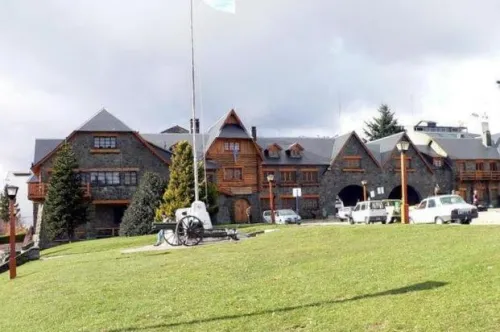
    This is where you start, and it is the first thing that tells you Bariloche is not a normal Argentine town. The square is paved end to end in stone slabs, ringed on three sides by gray-green alpine buildings with steep slate roofs, open on the north side to a clean drop toward the lake. Architect Ernesto de Estrada designed the complex and it was inaugurated on 17 March 1940. It became a national historic monument in 1987. In the middle sits an equestrian statue of General Julio A. Roca. You will see the St Bernard dogs here too, posed for paid photos, and the clock tower above the main building. It is free and open all the time, so there is no ticket and no rush. Give it ten minutes, get your bearings, then take the open north side and walk downhill toward the water along the lake.
    Hours
    Open 24/7
    Price
    Free (open-air public plaza; source: deterministic shortcut, plaza)
  2. 2

    Nahuel Huapi Lake (Lago Nahuel Huapi)

    Nahuel Huapi Lake (Lago Nahuel Huapi) in Bariloche, stop 2 on the self-guided walking tour

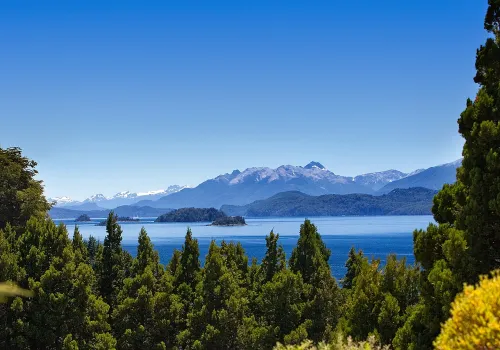
    The lake hits you the second the buildings clear. This is the view people fly across the world for: deep blue water with the Andes stacked behind it, and from the in-town Costanera you get it without paying for a single thing. Nahuel Huapi is glacial, 557 square kilometers, sitting at 764 meters above sea level, and it goes deep, up to 464 meters at its lowest point. It splits into eight arms and feeds the Río Limay at its outflow. Out on the water is Isla Victoria, the largest island at 31 square kilometers, where the boat tours go. You do not need a boat for this stop though. Just walk the shoreline, look across, and understand why the whole town exists. When you are done, head back uphill and east toward the civic complex, because the regional museum is tucked right into the same stone buildings you started from.

    Hours
    Open 24/7 (natural lake)
    Price
    Free (natural lake, public access)
  3. 3

    Francisco P. Moreno Museum of Patagonia (Museo de la Patagonia Francisco P. Moreno)

    Francisco P. Moreno Museum of Patagonia (Museo de la Patagonia Francisco P. Moreno) in Bariloche, stop 3 on the self-guided walking tour

    Back up at the square, this one is easy to miss because it lives inside the Centro Cívico itself, in the same stone the rest of the complex is made of. Its full name is the Museo de la Patagonia Francisco P. Moreno, a museum of natural sciences and cultural anthropology run by the Nahuel Huapi National Park administration. Inside you get stuffed native wildlife, old photographs, and a genuinely good section on the pre-Hispanic indigenous peoples of the region, which is the part worth slowing down for. Entry is by voluntary donation, so give what feels fair. Hours are tight: Tuesday to Friday 10:00 to 12:30 and 14:00 to 19:00, Saturday 10:00 to 17:00, and it is shut Sunday and Monday, so plan around that. Forty-five minutes covers it. When you leave, walk east out of the square along the streets toward Almirante O'Connor, heading for the cathedral spire you can already see.

    Hours
    Tu-F 10:00-12:30 and 14:00-19:00, Sa 10:00-17:00
    Price
    Entrance on voluntary donation
  4. 4

    Cathedral of Our Lady of Nahuel Huapi (Catedral de San Carlos de Bariloche)

    Cathedral of Our Lady of Nahuel Huapi (Catedral de San Carlos de Bariloche) in Bariloche, stop 4 on the self-guided walking tour

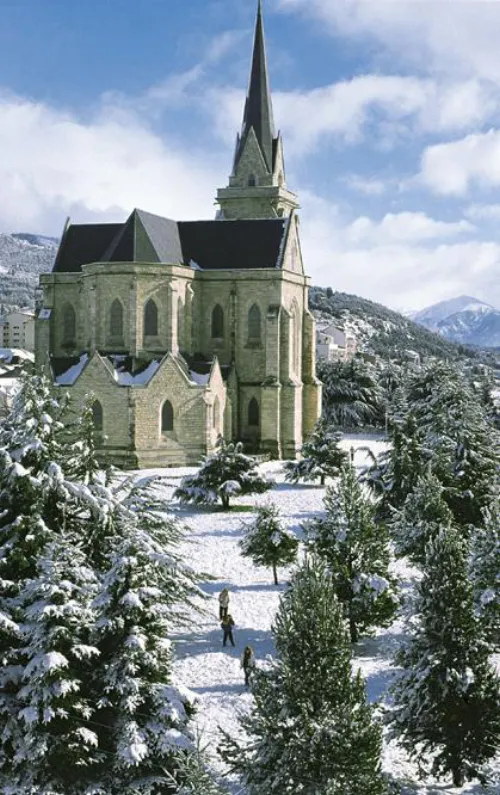
    The spire gives it away before you reach it: 69 meters of stone needle topped with black slate, rising over two garden plazas a few blocks east of the square. This is the main Catholic church in town, and the architect was Alejandro Bustillo, who offered the project for free. He built it in a neo-Gothic style with French echoes, out of white stone, in the shape of a Latin cross. The head of the church points exactly east, so morning sun pours straight through the windows and lights the inside first thing in the day. It sits at the corner of Almirante O'Connor and Beschtedt streets. Entry is free, the doors are open daily 10:00 to 13:00 and 17:00 to 22:00, with Mass at 11:00 and 20:00. Go in, look up, and if you can swing it, come in the morning for the light. This is the end of the loop, and the cathedral is the right place to finish it.

    Hours
    Daily 10:00-13:00, 17:00-22:00 (Mass Mon-Sun 11:00 & 20:00)
    Price
    Free

How Long Does This Walking Tour Really Take?

Plan three to four hours with stops. The two long legs to and from the shoreline are most of the walking, the Costanera deserves the longest open-air pause because it is the view, the museum eats about 45 minutes, and the cathedral is a 15-minute interior look.

The walking itself is quick, but the lake and the museum are where time goes. The full loop covers a little under nine kilometers if you do the shoreline stretch properly, so budget two to three hours at an easy pace with stops. The Centro Cívico is a ten minute look unless you sit a while, which you might, because the benches face the lake. The Costanera deserves the longest open-air pause: this is the view, so do not rush it. The Museo de la Patagonia eats about forty-five minutes if the indigenous history section pulls you in, and the cathedral is a fifteen minute interior look.

If you need a break, the Centro Cívico is the natural spot. The benches on the open north side of the square look straight down toward Nahuel Huapi, and the cafes and chocolate shops along Calle Mitre, the main street running off the square, are a half block away. Bariloche is chocolate country, so a hot chocolate and a sit on the square between the museum and the cathedral is the move.

Full Route, Shorter Walk or Two-Day Version?

The full loop is short but it includes a real out-and-back to the lake. Depending on your time, your legs, and the weather, here are three ways to walk it, using the exact stop numbers and the per-leg distances from the map.

Short core

The compact center without the lake leg

Stops 1, 3 and 4, about 1 hour

Skip the two long 5 km shoreline legs and stay in the historic core. Do the Centro Cívico (1), the Museo de la Patagonia (3) in the same stone complex, and the cathedral (4) a few blocks east. Ideal on a cold or wet day, or when you only have an hour and want the buildings and the museum.

Two halves

Split the walk at the square

Stops 1–2, then 3–4 later, about 1.5 hours per half

Break the loop into two easy outings using the Centro Cívico as the hinge. First half: the square (1) and the shoreline (2), the long downhill-and-back leg on a clear day. Second half, whenever you circle back: the museum (3) and the cathedral (4). Good if the 50-meter climb or the distance is a lot in one go.

You can reverse it, but the recommended direction earns its logic. Starting at the Centro Cívico lets you get your bearings, drop to the Costanera while you are fresh, then climb back and finish indoors at the museum and the cathedral, which is where you want to be if the weather turns.

Is This Bariloche Walking Tour Right for You?

This is an easy-to-moderate town walk, not a mountain hike, but the 50-meter drop to the lake and the stone paving mean it is not flat and not always sure-footed. Here is who it suits and how to adjust it.

A good fit if you…

  • Travelers who want the classic Nahuel Huapi lake-and-Andes view from town, for free, without a boat
  • Anyone curious about Bariloche's Andean-Swiss stone architecture and Patagonian regional history
  • Self-guided walkers who prefer their own pace over a fixed-time paid group tour
  • Visitors with a half day in the center before or after a Circuito Chico or Isla Victoria excursion

Adapt the route if you…

  • Short on time or energy: use the short-core version and skip the two 5 km shoreline legs
  • Walking in winter or rain: wear shoes with grip for the slick stone slabs and save the open Costanera for a clear window
  • Traveling midweek: time the museum, which is closed Sunday and Monday and shuts midday from 12:30 to 14:00
  • Chasing the best light: do the loop in the morning, when sun pours east through the cathedral windows

Tickets & Skip-the-Line in Bariloche

There are no ticket lines to skip on this route. Only one stop takes any money at all, and it is a donation. Here is the practical rundown of hours and cost for the center's stops.

Francisco P. Moreno Museum of Patagonia (Museo de la Patagonia Francisco P. Moreno)Entry is by voluntary donation, so give what feels fair. Hours are tight and it is closed Sunday and Monday: Tuesday to Friday 10:00 to 12:30 and 14:00 to 19:00, Saturday 10:00 to 17:00. Arrive before 12:30 or after 14:00 to dodge the midday closure. official ticket site ↗
Cathedral of Our Lady of Nahuel Huapi (Catedral de San Carlos de Bariloche)Free to enter, no ticket. The temple is open to the public daily 10:00 to 13:00 and 17:00 to 22:00, with Mass at 11:00 and 20:00. Come in the morning for the best light through the east-facing windows.
Everything elseThe Centro Cívico and the Lago Nahuel Huapi Costanera are free, open-air public spaces you can enter any time, 24/7. No tickets, no bookings.
Optional upgrade
The same 4-stop route,
now with navigation and a guide.
Optional AI experience

You already have the route.
The AI guide brings it to life.

Standing on the Centro Cívico right now with the lake below you? Open the AI Tourguide in your browser and it will walk you through all four stops, from this square down to the Costanera and over to the cathedral spire, with the dates and stories along the way. Free to try, self-guided, no booking and no fixed start time.

Livenavigation13languagesAnyquestionYourinterests
Open this route with the AI guide

Try it in your browser · No app or download required

Tips for Walking in Bariloche

  • The museum is the only stop with fixed hours: Tuesday to Friday 10:00 to 12:30 and 14:00 to 19:00, Saturday 10:00 to 17:00, closed Sunday and Monday. Do this walk midweek and arrive at the museum before 12:30 or after 14:00 to avoid the midday closure.
  • The Centro Cívico is paved entirely in stone slabs that get slick when wet or icy, and the square drops about 50 meters to the lake, so the shoreline leg is a real downhill and back uphill. Wear shoes with grip, not smooth soles, especially in winter.
  • There are no public restrooms on the square itself worth relying on. Use a cafe along Calle Mitre, a half block off the Centro Cívico, by buying a coffee, before you head down to the Costanera and back.
  • Calle Mitre off the square is the chocolate street. Stop in for a hot chocolate or a bar of local chocolate between the museum and the cathedral. It is the regional thing to order and it is everywhere on this block.
  • For the signature photo, stand on the open north side of the Centro Cívico and face north toward the lake so you get the stone buildings, the statue, and Nahuel Huapi behind. For the cathedral, the windows face east, so morning light through the interior is best.

Why Walk This Route?

Most people come to Bariloche for the mountains and the lake, then realize the town itself is built out of the same gray-green Andean stone and slate, all of it laid out in the 1930s and 40s to look like a Swiss village that floated across the Atlantic. That is the surprise of this walk. You think you are just passing through the urban part to get to a chairlift, and instead you find a compact core of stone buildings, garden plazas, and one long shoreline that frames the Andes for you for free.

This route is short on purpose and it loops. It starts at the Centro Cívico, the stone square that is the obvious anchor of any town walk, swings up to the in-town shoreline of Lago Nahuel Huapi where the signature water-and-mountain view sits, ducks into the regional museum that lives inside the civic complex, and finishes at the neo-Gothic cathedral a few blocks east. Four stops, all walkable, all in the historic center.

Walking beats wandering here because the good stuff is dense and the distances between sights are small, but the elevation is not. The square drops about 50 meters to the lake, so the order matters and the legs matter. Do it on foot and you catch the small things: the equestrian statue in the middle of the plaza, the slate roofs, the way the light hits white stone. Drive it and you miss all of that and spend the whole time looking for parking that does not exist.

Common Questions

Is Bariloche safe to walk around?

The historic center on this route, the Centro Cívico, the Costanera, and the cathedral, is fine to walk in daylight and busy with visitors. Normal city sense applies: watch your bag in crowds on the square and along Calle Mitre, and the main thing to skip is paying tourist-trap prices for the St Bernard dog photos on the square unless you really want one. Stick to the well-trafficked center and you are in good shape.

What if it rains during my Bariloche tour?

Two stops on this route are indoors or near enough. The Museo de la Patagonia inside the Centro Cívico is a full dry stop on voluntary donation, and the cathedral is open daily 10:00 to 13:00 and 17:00 to 22:00 for shelter and a long interior look. The cafes and chocolate shops on Calle Mitre, a half block off the square, are the other rain plan. Save the open Costanera shoreline leg for a clear-sky window.

What's the best time of day for this walking tour?

Morning. The cathedral points its head exactly east, so morning sun fills the interior with the best light. Doing the loop in the morning also lets you hit the museum inside its 10:00 opening and finish at the cathedral while the light is still coming through the windows. Late afternoon works too if you skip the museum, but morning gives you the church at its best.

Take this route with you

Open this exact tour with navigation and your personal AI guide.

Start GPS Navigation + AI Guide
AI Tourguide
Researched and curated by the AI Tourguide teamWe plan and quality-check every route, then research and verify the opening hours, prices, and practical tips for each stop along it.
▶ Open route with AI guideNavigation, stories and your questions