Self-Guided Walking Tour in Bogotá

A 9-stop, 5.9 km walk through Bogotá's historic core, starting high at Plazoleta del Chorro de Quevedo and finishing at the Monserrate cable car. This page gives you the map, the walking time for every leg, real prices and opening hours for each museum, and shorter versions if your legs or the altitude give out.

9 Stops5.9 km~3 hours walking4–5 hours with stops
What you get with AI Tourguide
Full GPS navigationInteractive AI guidePersonalized to youWorks in your browser
Try this tour with Alex

Bogotá Walking Tour at a Glance

This route is built for anyone who wants to see the real heart of Bogotá on foot without getting lost in the maze of La Candelaria. It threads nine genuine sights in the order that makes geographic sense, starting at the top of the hill so gravity does the work. Every interior is optional: you can admire the plazas and facades for free and only pay for the museums you actually want to enter.

StartChorro de Quevedo
FinishMonserrate
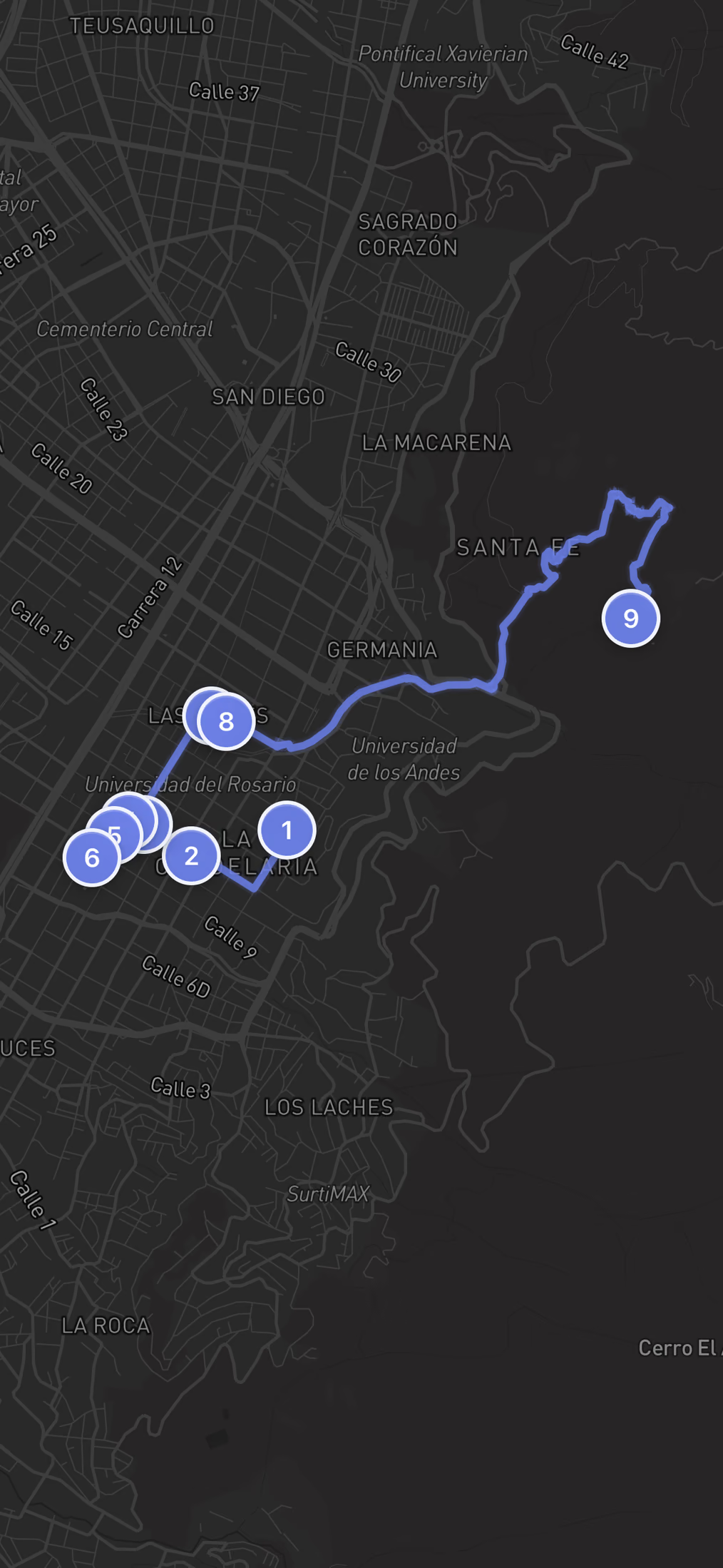
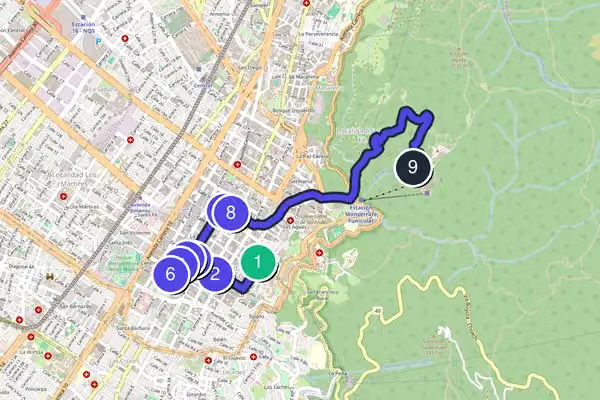
Route typeA point-to-point walk, not a loop. It runs broadly downhill and north through La Candelaria, then makes one long eastward push to the mountain base, so there is almost no backtracking.
Realistic timeWalking alone is under two hours across 5.9 km, but budget four to five hours with the museums, and closer to six if you linger in the Gold Museum and stay for sunset on Monserrate.
DifficultyModerate. The 5.9 km itself is gentle and mostly downhill, but it is real colonial cobblestone, uneven and slick when wet, and the thin air at 2,640 meters tires you faster than you expect.
Cost to followThe outdoor route is free to walk. Only two interiors cost money: Museo Iglesia de Santa Clara at COP$15,000 and the Gold Museum at COP$21,000 for foreign tourists. The Botero, the cathedral and the plazas are all free.
Best for:

First-time visitors who want the founding plazas, the Botero, the Gold Museum and the Monserrate view in one logical, mostly downhill line through the old town.

The Route

Free Walking Tour Map of Bogotá

9 stops5.9 kmabout 3 hours
Loading the interactive map…The complete walking route will appear here.
Want the route to guide you while you walk?Open the route with navigation and a personal guide for the history, stories and questions that matter to you.
Open route + AI guide

The 9 stops along this route

  1. Chorro de Quevedo in Bogotá, stop 1 on the self-guided walking tour
    1Chorro de Quevedo
  2. Botero Museum (Museo Botero) in Bogotá, stop 2 on the self-guided walking tour
    2Botero Museum (Museo Botero)
  3. Primary Cathedral of Bogotá (Catedral Primada de Colombia) in Bogotá, stop 3 on the self-guided walking tour
    3Primary Cathedral of Bogotá (Catedral Primada de Colombia)
  4. Plaza de Bolívar in Bogotá, stop 4 on the self-guided walking tour
    4Plaza de Bolívar
  5. National Capitol (Capitolio Nacional de Colombia) in Bogotá, stop 5 on the self-guided walking tour
    5National Capitol (Capitolio Nacional de Colombia)
  6. Santa Clara Church Museum (Museo Santa Clara) in Bogotá, stop 6 on the self-guided walking tour
    6Santa Clara Church Museum (Museo Santa Clara)
  7. Parque Santander in Bogotá, stop 7 on the self-guided walking tour
    7Parque Santander
  8. Gold Museum (Museo del Oro) in Bogotá, stop 8 on the self-guided walking tour
    8Gold Museum (Museo del Oro)
  9. Monserrate in Bogotá, stop 9 on the self-guided walking tour
    9Monserrate
  10. That's the complete route.

    If you want more than the map and text, add live navigation and a conversational AI guide while you walk.

    Open route + AI guide
    You made it
Stop 1 of 9
Swipe →

Your Bogotá Walking Tour, Stop by Stop

  1. 1

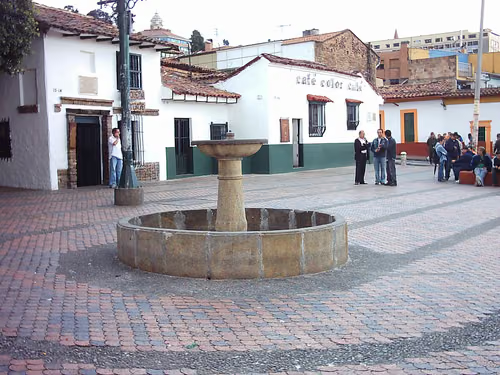
    Chorro de Quevedo

    Chorro de Quevedo in Bogotá, stop 1 on the self-guided walking tour

    You start at the traditional birthplace of the city. This little cobbled triangle is where Gonzalo Jiménez de Quesada set up camp before founding Bogotá in 1538, and it has aged into the bohemian heart of upper La Candelaria. The plaza itself is tiny, framed by crooked colonial walls and a small chapel, and it fills up with buskers, students and people sipping chicha, the fermented corn drink sold from the bars around the edge. Look for the narrow alley called Callejón del Embudo running off the square, every wall painted. It is free and open around the clock, but come by day. Give it fifteen minutes, soak up the street art, and resist the chicha if you have a full walk ahead of you. From here, head downhill along Calle 12B and the cobbled side streets toward Carrera 4, following the slope toward the museum cluster below.
    Hours
    Open 24/7
    Price
    Free (public plaza)
  2. 2

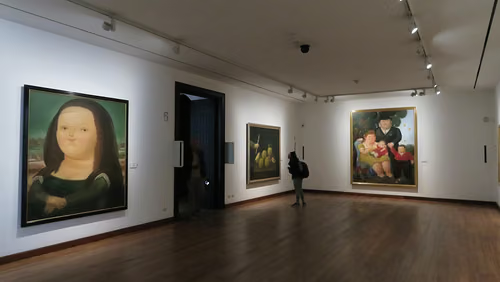
    Botero Museum (Museo Botero)

    Botero Museum (Museo Botero) in Bogotá, stop 2 on the self-guided walking tour

    A few blocks down the hill, behind a quiet colonial facade with a leafy interior courtyard, sits the best free thing in Bogotá. Fernando Botero donated his personal collection to the country, and it lives here: 123 of his own fat, swollen figures, plus 87 works from his private collection that include Picasso, Monet and Dalí. Yes, the Mona Lisa here is plump. The galleries wrap around the courtyard, and you can move through at your own pace in under an hour. It is genuinely free every single day, which still surprises people. The one catch: it closes on Tuesdays. Open Mon and Wed to Sat 9 to 7, Sun 10 to 5. Do not rush it, the Picasso and Dalí rooms are easy to miss near the back. Leaving the museum, walk west along Calle 11 toward the spires you can already see rising over the rooftops.

    Hours
    Mon: 9:00 AM – 7:00 PM | Tue: Closed | Wed-Sat: 9:00 AM – 7:00 PM | Sun: 10:00 AM – 5:00 PM
    Price
    Free every day (closed Tuesdays; source: bogota.gov.co + banrepcultural.org 2026)
  3. 3

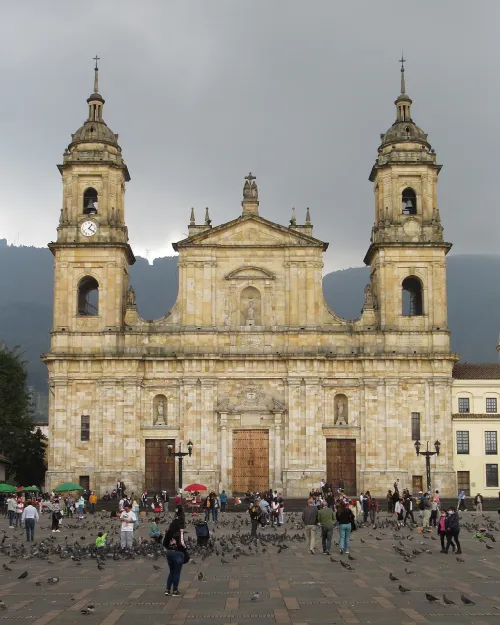
    Primary Cathedral of Bogotá (Catedral Primada de Colombia)

    Primary Cathedral of Bogotá (Catedral Primada de Colombia) in Bogotá, stop 3 on the self-guided walking tour

    Turn the last corner and the neoclassical bulk of the cathedral closes off the whole eastern side of the main square. This is the fourth church to stand on this exact spot, designed by the Capuchin friar Domingo de Petrés between 1807 and 1823, and it was declared a national monument in 1975. The scale is the point: pale stone, two square bell towers, a flat dignified front facing the plaza. Inside it is calmer and plainer than the gilded colonial churches you will see later, but entry is free, a donation appreciated. There is also a mirador, a viewpoint, you can visit at no cost. Open weekdays 10 to 1 and 2 to 4, weekends 10 to 4. Ten minutes inside is plenty unless mass is on. Step back out and you are already standing on the edge of the great square.

    Hours
    Mon-Fri: 10:00 AM – 1:00 PM, 2:00 – 4:00 PM | Sat-Sun: 10:00 AM – 4:00 PM
    Price
    Free (donation appreciated; mirador viewpoint visits also free)
  4. 4

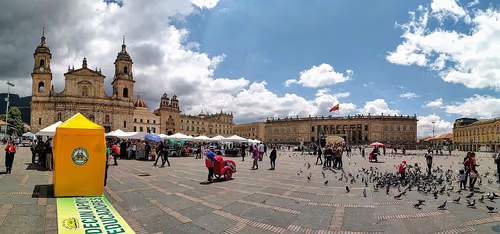
    Plaza de Bolívar

    Plaza de Bolívar in Bogotá, stop 4 on the self-guided walking tour

    Walk out from under the cathedral and the city's main square opens flat and enormous in front of you. A study by the Universidad de los Andes puts it at 13,903 square meters with room for over 55,000 people, and on a quiet morning it can feel that empty, just pigeons, a few llamas for photos, and the bronze Bolívar in the center. The buildings around you are the country's seat of power: the Palace of Justice to the north, the Capitol to the south, the cathedral behind you to the east, and the Palacio Liévano, city hall, to the west. The ground was a Muisca ceremonial site long before any of it. It is free and open all day. This is the spot to slow down, do a full slow turn, and get your bearings before the rest of the walk. Cross toward the columned building filling the south side.

    Hours
    Open 24/7
    Price
    Free
  5. 5

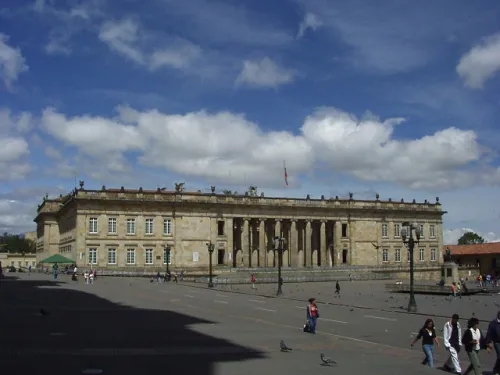
    National Capitol (Capitolio Nacional de Colombia)

    National Capitol (Capitolio Nacional de Colombia) in Bogotá, stop 5 on the self-guided walking tour

    The long colonnade along the south edge of the square is the seat of Colombia's Congress. It has a comic backstory: Thomas Reed designed it for President Mosquera, construction began in 1848, and it was not finished until 1926, passing through a string of architects who each left a mark. The result is the city's signature piece of republican neoclassical architecture, a row of heavy stone columns running the full width of the plaza. From the square you mostly admire the facade, and honestly that is enough for most visitors. If you want inside, the guided visit is free but requires advance registration online, and it only runs weekdays 8 to 5, closed weekends. For a walking tour, the exterior does the job. Head off the southwest corner of the plaza down Carrera 8 to find a barrel-vaulted church a block away.

    Hours
    Mon-Fri: 8:00 AM – 5:00 PM | Sat-Sun: Closed
    Price
    Free (visita guiada gratuita con registro previo en visitas.presidencia.gov.co)
  6. 6

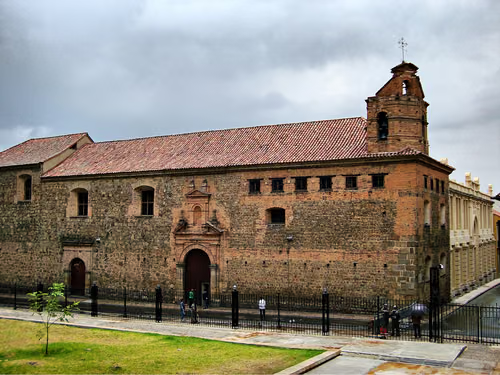
    Santa Clara Church Museum (Museo Santa Clara)

    Santa Clara Church Museum (Museo Santa Clara) in Bogotá, stop 6 on the self-guided walking tour

    A block off the square, an unremarkable door opens into one of the most overwhelming interiors in the city. This was the church of the Real Convento de Santa Clara, built in 1647 and now run as a museum. Step in and look up: the single barrel vault is painted edge to edge, gold leaf everywhere, hundreds of saints and angels covering the walls and ceiling. It holds colonial paintings by Gregorio Vásquez de Arce y Ceballos and the Figueroa family, plus murals tucked into the choir and sacristy. After three free stops, this is the one with a ticket: COP$15,000 for adults, $5,000 for children 6 to 12, free under 6. Open Tue to Sun 9 to 4:30, closed Mondays. Worth the price if you like the baroque, fifteen minutes inside. Now the walk turns north. Head up Carrera 7, the main pedestrian artery, toward the busier modern center.

    Hours
    Mon: Closed | Tue-Sun: 9:00 AM – 4:30 PM
    Price
    COP$15.000 (adult; children 6-12 COP$5.000; under 6 free)
  7. 7

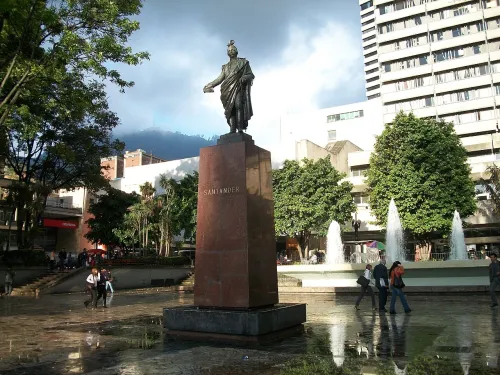
    Parque Santander

    Parque Santander in Bogotá, stop 7 on the self-guided walking tour

    The long stretch up Carrera 7 trades cobbles for crowds, street vendors and emerald sellers, and deposits you at a shaded square at the corner of Calle 16. After the tight colonial grid, the trees and benches of Parque Santander feel like room to breathe. Some sources even cite this as the city's founding spot. The statue of Francisco de Paula Santander stands over a fountain, and the square is bordered by the Avianca tower and, more importantly for you, the Gold Museum. It is free and open all the time. Use it for what it is: a rest and orientation point. Sit for five minutes, drink some water, the altitude is still working on you. When you are ready, the entrance to the next stop is right on the square's eastern edge.

    Hours
    Open 24/7
    Price
    Free
  8. 8

    Gold Museum (Museo del Oro)

    Gold Museum (Museo del Oro) in Bogotá, stop 8 on the self-guided walking tour

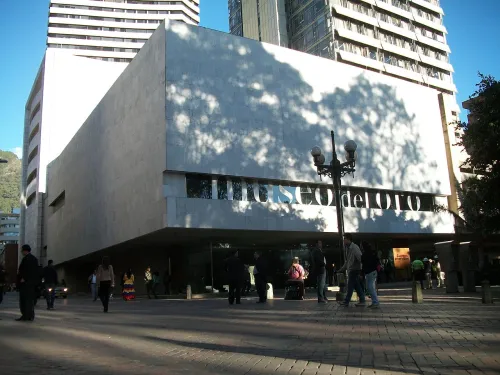
    On the eastern side of the park stands the reason a lot of people come to Bogotá at all. The Gold Museum holds over 34,000 pieces of pre-Hispanic goldwork, the largest such collection on earth, drawn from the Muisca, Quimbaya, Calima, Zenú, Tayrona and Tairona cultures. The star is the small Muisca raft, a tiny golden boat that gave rise to the legend of El Dorado. The dark top-floor room where hundreds of gold pieces glow at once is the moment everyone remembers. Give it a solid 90 minutes, more if you read the panels. Tickets are COP$21,000 for foreign tourists, $10,000 for Colombians and residents, $5,000 for students, and it is free every Sunday, plus always free for children under 12 and adults 60 and over. Open Tue to Sat 9 to 6, Sun 10 to 4, closed Mondays. From here it is a longer walk east toward the green wall of the mountains and the cable car station at their base.

    Hours
    Mon: Closed | Tue-Sat: 9:00 AM – 6:00 PM | Sun: 10:00 AM – 4:00 PM
    Price
    COP $21.000 (foreign tourists) / $10.000 (Colombians & foreign residents) / $5.000 (students); free every Sunday, children under 12 and adults 60+
  9. 9

    Monserrate

    Monserrate in Bogotá, stop 9 on the self-guided walking tour

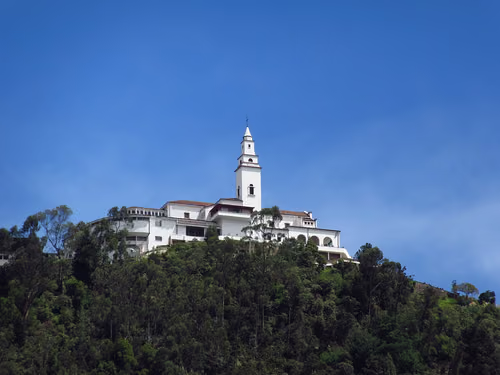
    The finish. The whole walk has been creeping toward this green mountain at the eastern edge of the city, and now you ride up it. Monserrate rises to 3,152 meters, crowned by the white Basílica del Señor Caído, a pilgrimage church since colonial times. From the top the entire city spreads out below in one enormous grid, framed by the mountains, best in the late afternoon as the light goes gold. Two ways up: the funicular, running on rails since 1929, or the cable car, opened in 1955. There is also a steep pedestrian trail if your legs and lungs are willing. The funicular and cable car run Mon to Sat 6:30 to 22:00 and Sun 5:30 into the evening; the walking trail opens for ascent 5:00 to 13:00 with descent until 16:00. Time your arrival for sunset, stay for the lit-up city after dark, then ride back down. This is where the walk ends and the photo everyone takes of Bogotá begins.

    Hours
    Funicular/cable car Mon-Sat 6:30-22:00, Sun 5:30-17:00/18:00; pedestrian trail (IDRD) ascent 5:00-13:00, descent until 16:00
    Price
    Free

How Long Does This Walking Tour Really Take?

Pure walking is well under two hours, but the two big time sinks reshape the day: give the Gold Museum at least 90 minutes and leave a clear two hours for Monserrate counting the cable car queue, the summit and the ride down. Add a relaxed hour for the Botero and you land at four to five hours total.

Budget a full half-day, roughly four to five hours, and more if you are a museum person. The two big time sinks are the Gold Museum and Monserrate. Give the Gold Museum at least 90 minutes, it earns it, and leave a clear two hours for Monserrate counting the cable car queue, the time at the top, and the ride down. The Botero deserves a relaxed hour. Everything else is quick: the plazas and the cathedral are ten to fifteen minutes each.

The natural break is Parque Santander, right before the Gold Museum. Grab a bench under the trees, drink water, and let the altitude settle before the big museum. For a longer pause, La Puerta Falsa on Calle 11, a tiny historic eatery near the cathedral that has been serving since the early 1800s, is the place to stop for a tamal and a hot chocolate with cheese, the Bogotá way. It is cramped and famous and exactly the kind of break this walk needs. If you would rather coffee, the cafes lining the upper part of Carrera 7 between Santa Clara and Parque Santander all do a solid tinto.

Full Route, Shorter Walk or Two-Day Version?

The same nine stops flex into three versions depending on how much time you have, how the altitude is treating you, and whether the museums or the mountain matter more to you. Each one uses the real stop numbers and the per-leg distances below.

The Candelaria Core

Stops 1 to 8, skip the Monserrate leg

Stops 1 to 8, about 2.3 km and 3 hours

Cut the single longest leg, the 3.5 km / 45 min push from the Gold Museum out to Monserrate (stop 9). You still get the founding plaza, both great museums and the whole colonial center, and you finish at the Gold Museum on Carrera 7 with a TransMilenio station right there. Save Monserrate for another afternoon when the sky is clear.

The Easy Two-Part Split

Museums first day, mountain second day

Day one stops 1 to 8; day two stop 9 at sunset

Best if the altitude is hitting hard or you want unhurried museum time. Do stops 1 to 8 on day one at your own pace, breaking at Parque Santander (stop 7). On day two, ride up Monserrate (stop 9) in the late afternoon so you catch the golden light and the city lighting up after dark, without rushing the Gold Museum earlier.

You can walk it in reverse from Monserrate down to Chorro de Quevedo, but the given direction is better: starting high at the founding plaza means you drift downhill through the plazas and museums, and you reach Monserrate last, timed for the late-afternoon light everyone photographs the city in.

Is This Bogotá Walking Tour Right for You?

This is a short, dense, mostly downhill walk through a living historic center, not a manicured old town. It suits some travellers perfectly and asks others to adapt, so here is the honest split before you set out.

A good fit if you…

  • First-time visitors who want the founding plazas, the Botero and the Gold Museum in one logical line
  • Museum lovers, since two of the best collections in Latin America sit back to back on the route
  • Walkers happy with 5.9 km of gentle, mostly downhill ground at their own pace
  • Anyone who wants the classic Monserrate sunset view as a natural finish to the day

Adapt the route if you…

  • You struggle at altitude: 2,640 meters tires you fast, so slow down, drink water and use the split version
  • You have mobility limits: the cobblestones are uneven and slick when wet, so wear closed shoes with grip
  • You are short on time: stop at the Gold Museum (stop 8) and skip the long leg to Monserrate
  • You are walking after dark: do not do La Candelaria on foot at night, take the cable car and registered taxis instead

Tickets & Skip-the-Line in Bogotá

Most of this route is free open space, so there is little to pre-book. Only two stops charge admission, and neither usually needs a timed ticket. Here is what each interior actually costs in 2026 and when it is open, plus the one place a free guided visit needs advance registration.

Botero Museum (Museo Botero)Free every single day, no ticket needed. Open Mon and Wed to Sat 9:00 AM to 7:00 PM, Sun 10:00 AM to 5:00 PM, closed Tuesdays.
Primary Cathedral of Bogotá (Catedral Primada de Colombia)Free entry, a donation is appreciated, and the mirador viewpoint is also free. Open weekdays 10:00 AM to 1:00 PM and 2:00 to 4:00 PM, weekends 10:00 AM to 4:00 PM.
National Capitol (Capitolio Nacional de Colombia)The facade is free to admire from Plaza de Bolívar. The inside is only accessible on a free guided visit that requires advance online registration at visitas.presidencia.gov.co, weekdays 8:00 AM to 5:00 PM, closed weekends.
Santa Clara Church Museum (Museo Santa Clara)COP$15,000 for adults, COP$5,000 for children 6 to 12, free under 6. Buy at the door, no pre-booking needed. Open Tue to Sun 9:00 AM to 4:30 PM, closed Mondays.
Gold Museum (Museo del Oro)COP$21,000 for foreign tourists, COP$10,000 for Colombians and residents, COP$5,000 for students. Free every Sunday, and always free for children under 12 and adults 60 and over. Open Tue to Sat 9:00 AM to 6:00 PM, Sun 10:00 AM to 4:00 PM, closed Mondays. Sundays are busiest because entry is free.
MonserrateThe summit itself is free, but you pay for the funicular or cable car up. Funicular and cable car run Mon to Sat 6:30 AM to 10:00 PM and Sun from 5:30 AM; the pedestrian trail opens for ascent 5:00 AM to 1:00 PM with descent until 4:00 PM.
Everything elsePlazoleta del Chorro de Quevedo, Plaza de Bolívar and Parque Santander are free public open spaces, open 24/7, with nothing to book.
Optional upgrade
+5
The same 9-stop route,
now with navigation and a guide.
Optional AI experience

You already have the route.
The AI guide brings it to life.

Standing in Plaza de Bolívar with the cathedral on one side and the Capitol on the other? Let the AI guide walk you through it, telling you what each building is and where to head next as you go. It picks up wherever you are on the route, so you can start at Chorro de Quevedo or jump in right here and keep both hands free for the cobblestones.

Livenavigation13languagesAnyquestionYourinterests
Open this route with the AI guide

Try it in your browser · No app or download required

Tips for Walking in Bogotá

  • Start by 9 to 9:30 AM at Chorro de Quevedo so you reach the Gold Museum mid-morning and the Monserrate cable car for late-afternoon light. The nearest TransMilenio is Museo del Oro station on Carrera 7, then walk uphill into La Candelaria. Avoid the area after dark on foot.
  • The streets in La Candelaria are real colonial cobblestone, uneven and slick when wet, and the whole walk trends uphill at the end to Monserrate. Wear proper closed shoes with grip, not sandals. At 2,640 meters you tire fast, so pace yourself and drink water.
  • Clean public restrooms are easiest inside the Gold Museum and the Botero, both free to enter, so use them while you are there. There are also facilities at the top of Monserrate. The plazas have none worth using.
  • Stop at La Puerta Falsa on Calle 11 near the cathedral for the classic Bogotá combo: a tamal and a thick hot chocolate served with a chunk of cheese to melt in. Expect to pay a few thousand pesos; it is small, historic and almost always busy.
  • The best photo is from the top of Monserrate in the late afternoon, facing west over the city grid as the light turns gold and the streetlights start coming on. For street art, the Callejón del Embudo alley off Chorro de Quevedo shoots well any time of day.

Why Walk This Route?

Bogotá sits at 2,640 meters, so the first thing the walk does is humble your lungs. Start high, in La Candelaria, the colonial core where the city was founded in 1538, and you spend the next few hours drifting gently downhill through the dense knot of plazas, churches and museums that the rest of the city grew out of. This is the one part of Bogotá you can genuinely do on foot. Everything is within a few cobbled blocks, and the route is laid out so you finish at the cable car for the climb to Monserrate, the peak everyone photographs the city from.

Why this route and not just wandering? Because La Candelaria is a maze. The streets bend, change names, and dump you in front of the same chicha bar three times. This walk threads the real sights in the order that makes geographic sense, starts you at the founding plaza at the top of the hill so gravity does the work, and saves Monserrate for last when the afternoon light is best. You also hit two of the best free museums in Latin America back to back, the Botero and the Gold Museum, without backtracking.

One honest warning up front: this is the historic center, not a manicured old town. It is alive, scruffy, full of students, street performers and the occasional hustler. Keep your phone in your pocket between photos and you will love it. The walk runs about 5.9 km in total, most of it flat or downhill until the very end.

Common Questions

Is Bogotá safe to walk around?

La Candelaria is fine to walk by day with normal city sense, and this whole route is busy with students, tourists and police. Keep your phone and camera put away between shots, do not flash valuables, and stick to the main streets like Carrera 7. The honest risk is petty theft and the occasional distraction scam, not violence. Do not walk the area alone after dark, and take the cable car up Monserrate rather than the pedestrian trail if you are not in a group. Use registered taxis or apps, not street hails.

What if it rains during my Bogotá tour?

Bogotá rain comes and goes fast, usually short afternoon bursts. This route is built for it because so much of it is indoors: duck into the Botero, the Gold Museum, Santa Clara or the cathedral and wait it out. The cobblestones get slippery, so slow down. If it is pouring at the end, the cable car up Monserrate still runs, though the view at the top depends on the clouds, so check before you ride up.

What's the best time of day for this walking tour?

Start around 9 AM. Mornings in the old town are quieter and the light on the plazas is good, museums open at 9, and starting early means you reach Monserrate for the late-afternoon and sunset window, which is when the city view is at its best. Avoid starting late, both because the museums close in the early evening and because you do not want to be finishing in La Candelaria after dark.

Take this route with you

Open this exact tour with navigation and your personal AI guide.

Start GPS Navigation + AI Guide
AI Tourguide
Researched and curated by the AI Tourguide teamWe plan and quality-check every route, then research and verify the opening hours, prices, and practical tips for each stop along it.
▶ Open route with AI guideNavigation, stories and your questions