Self-Guided Walking Tour in Cartagena de Indias

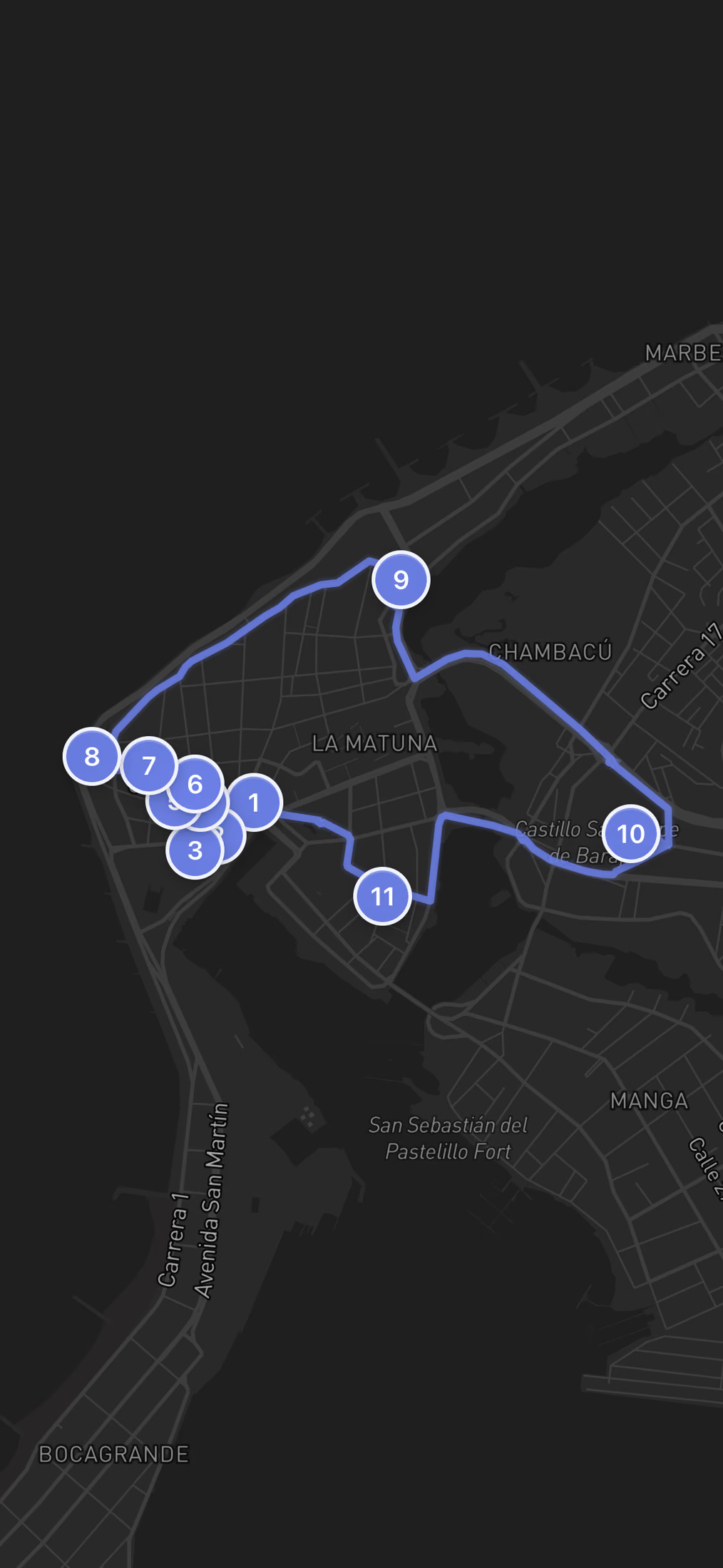
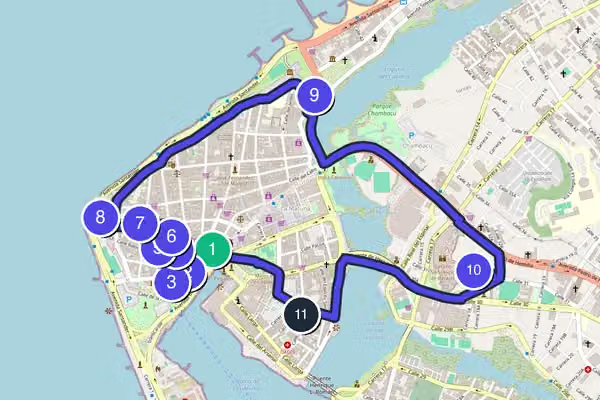
A 6.2 km loop through the walled city of Cartagena, from the yellow Torre del Reloj through Parque de Bolívar and the cathedral plazas, up onto the sea walls, out to Castillo San Felipe, and finishing in Getsemaní. Eleven stops in all. This page gives you the map, per-leg walking times, real prices and opening hours, and shorter versions.

11 Stops6.2 km~3 hours walking4–5 hours with stops
What you get with AI Tourguide
Full GPS navigationInteractive AI guidePersonalized to youWorks in your browser
Try this tour with Alex

Cartagena de Indias Walking Tour at a Glance

This route is built for anyone who wants the walled city in a sensible order instead of wandering it at random in the heat. It strings together 11 stops, and every interior along the way is optional: you can walk the whole thing for almost nothing, or pay for the two or three museums that are genuinely worth a ticket. You set the pace, linger where you want, and skip what you don't.

StartPuerta del Reloj, Cartagena (Puerta del Reloj)
FinishChurch of la Trinidad
Route typeA point-to-point loop that starts at the Torre del Reloj, winds west and north through the old town and along the walls, swings south-east out to Castillo San Felipe, then doubles back west to finish in Getsemaní, close to where you began.
Realistic timeRoughly two and a half hours if you only walk and photograph, or four to five hours once you factor in the museums, the fortress, and a slow stretch on the walls at sunset.
DifficultyEasy underfoot but hot. The 6.2 km is flat across cobblestones and uneven colonial paving, with stone ramps on the walls and a real climb up Castillo San Felipe. The distance is nothing, the midday sun is the real challenge.
Cost to followThe outdoor route is completely free: every plaza, the Torre del Reloj, the walls, and Getsemaní cost nothing. Paid interiors are San Pedro Claver (COP $30,000 foreign adults), the Palacio de la Inquisición (COP $24,000), and Castillo San Felipe (COP $38,000 foreigners). The cathedral and the Museo del Oro Zenú are free.
Best for:

Travellers who want to see the whole walled city on foot in the right order, mixing free plazas and walls with a couple of paid museums, and who would rather manage the heat than a tour group's schedule.

The Route

Free Walking Tour Map of Cartagena de Indias

11 stops6.2 kmabout 3 hours
Loading the interactive map…The complete walking route will appear here.
Want the route to guide you while you walk?Open the route with navigation and a personal guide for the history, stories and questions that matter to you.
Open route + AI guide

The 11 stops along this route

  1. Puerta del Reloj, Cartagena (Puerta del Reloj) in Cartagena de Indias, stop 1 on the self-guided walking tour
    1Puerta del Reloj, Cartagena (Puerta del Reloj)
  2. Bolivar Park (Parque de Bolívar) in Cartagena de Indias, stop 2 on the self-guided walking tour
    2Bolivar Park (Parque de Bolívar)
  3. Iglesia de San Pedro Claver, Cartagena (Iglesia de San Pedro Claver) in Cartagena de Indias, stop 3 on the self-guided walking tour
    3Iglesia de San Pedro Claver, Cartagena (Iglesia de San Pedro Claver)
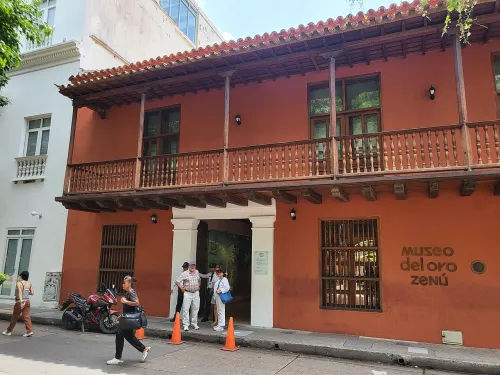
  4. Zenú Gold Museum (Museo del Oro Zenú) in Cartagena de Indias, stop 4 on the self-guided walking tour
    4Zenú Gold Museum (Museo del Oro Zenú)
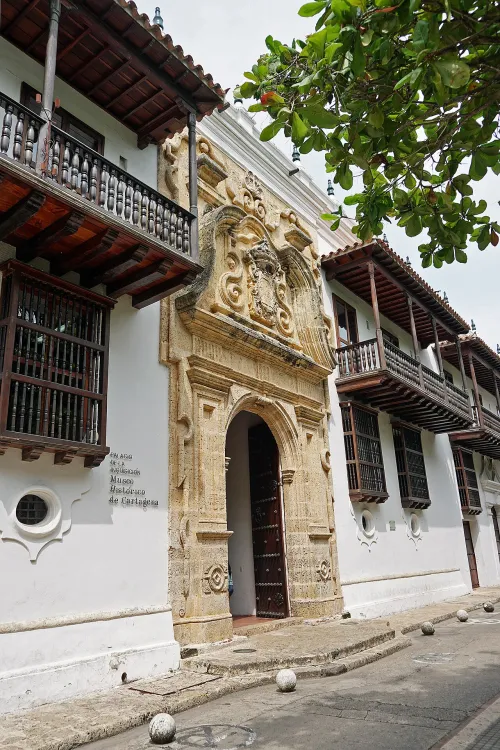
  5. Palace of Inquisition (Palacio de la Inquisición) in Cartagena de Indias, stop 5 on the self-guided walking tour
    5Palace of Inquisition (Palacio de la Inquisición)
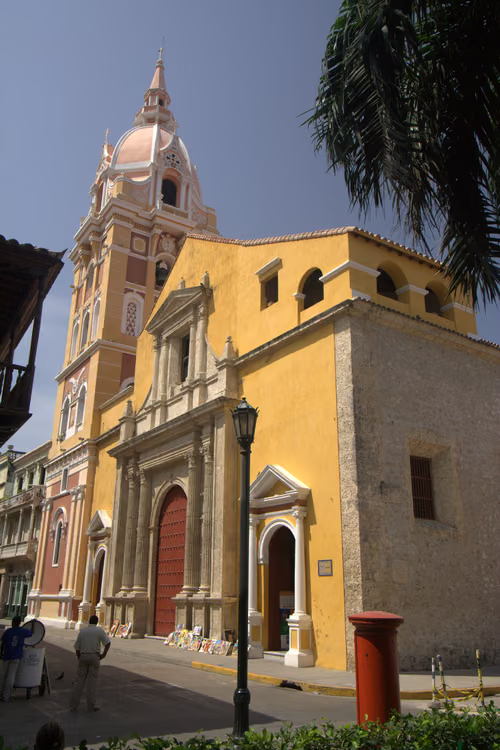
  6. Cartagena Cathedral, Colombia (Catedral de Santa Catalina de Alejandría de Cartagena de Indias) in Cartagena de Indias, stop 6 on the self-guided walking tour
    6Cartagena Cathedral, Colombia (Catedral de Santa Catalina de Alejandría de Cartagena de Indias)
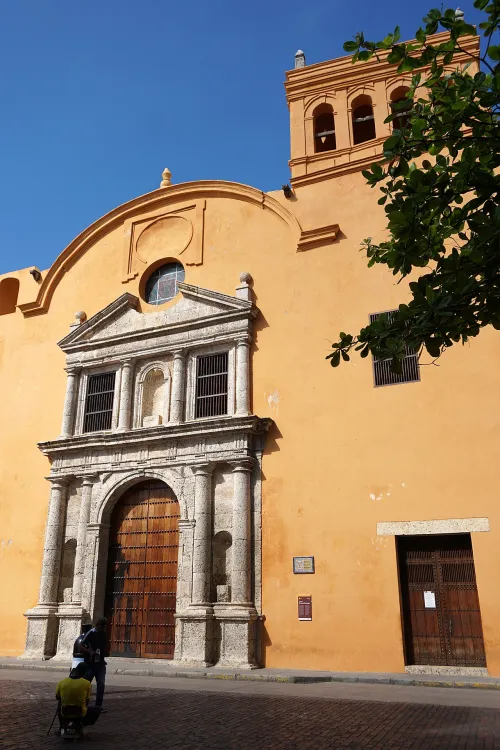
  7. Convento de Santo Domingo, Cartagena (Convento de Santo Domingo) in Cartagena de Indias, stop 7 on the self-guided walking tour
    7Convento de Santo Domingo, Cartagena (Convento de Santo Domingo)
  8. Bastion of Santo Domingo, Cartagena (Baluarte de Santo Domingo) in Cartagena de Indias, stop 8 on the self-guided walking tour
    8Bastion of Santo Domingo, Cartagena (Baluarte de Santo Domingo)
  9. Cartagena Fortifications in Cartagena de Indias, stop 9 on the self-guided walking tour
    9Cartagena Fortifications
  10. Castillo de San Felipe de Barajas (Castillo San Felipe) in Cartagena de Indias, stop 10 on the self-guided walking tour
    10Castillo de San Felipe de Barajas (Castillo San Felipe)
  11. Church of la Trinidad in Cartagena de Indias, stop 11 on the self-guided walking tour
    11Church of la Trinidad
  12. That's the complete route.

    If you want more than the map and text, add live navigation and a conversational AI guide while you walk.

    Open route + AI guide
    You made it
Stop 1 of 11
Swipe →

Your Cartagena de Indias Walking Tour, Stop by Stop

  1. 1

    Puerta del Reloj, Cartagena (Puerta del Reloj)

    Puerta del Reloj, Cartagena (Puerta del Reloj) in Cartagena de Indias, stop 1 on the self-guided walking tour

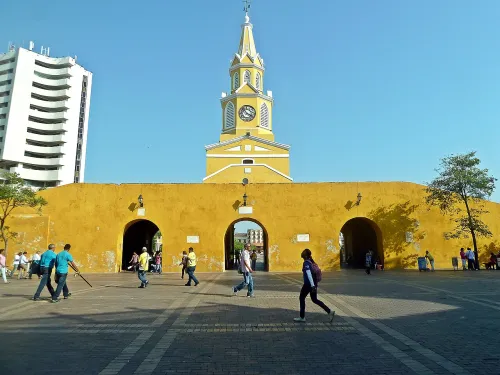
    The yellow tower is the first thing you see and the thing every taxi driver, every friend, every map will point you to. This is the original main gate into the walled city, built by military engineer Juan de Herrera y Sotomayor, with the clock added to the top in the early 1700s. Locals call it Boca del Puente, because a drawbridge once crossed the canal here and was raised whenever pirates showed up. You walk straight through the arched passage, no ticket, open day and night. Do not linger long under the arch itself, it is a chokepoint of selfie sticks and fruit vendors selling overpriced mango. Step through into Plaza de los Coches on the far side, get your bearings, then keep moving inward. From here you head one block southwest along the old streets toward the trees and benches of Parque de Bolívar.
    Hours
    Open 24/7
    Price
    Free (open-air city gate/monument, walk-through passage)
  2. 2

    Bolivar Park (Parque de Bolívar)

    Bolivar Park (Parque de Bolívar) in Cartagena de Indias, stop 2 on the self-guided walking tour

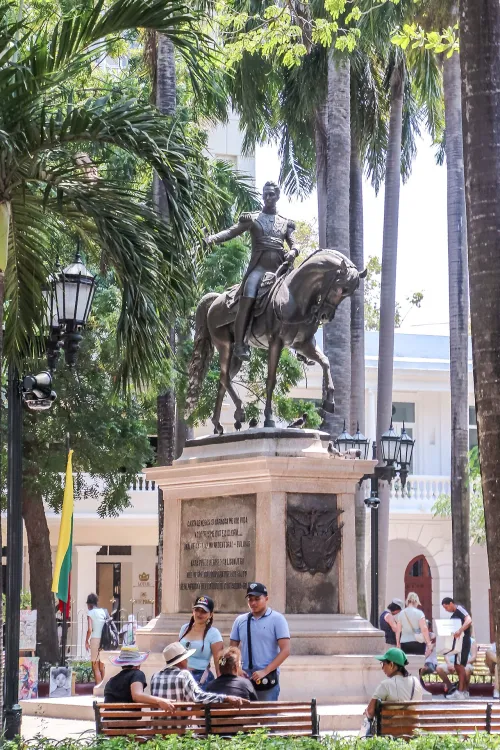
    After the crush at the gate, this square is where you finally exhale. Big shade trees, benches, a bronze statue of Simón Bolívar on horseback in the middle, cast in Munich and standing here since 1896. The park was reopened in November 2023 after a full remodel, so the paving and fountains are fresh. This is the postcard center of the walled city, ringed by the cathedral, the Inquisition palace, and the gold museum, all coming up next. Come back in the late afternoon and you will often catch palenqueras in white-and-fruit dresses and sometimes mapalé dancers. It is free and open around the clock. Grab a bench, watch the square work for a few minutes, and notice the small Gabriel García Márquez statue tucked in the northeast corner. The church facing you across the park is San Pedro Claver, so head to its door first.

    Hours
    Open 24/7
    Price
    Free (open-air public park/plaza)
  3. 3

    Iglesia de San Pedro Claver, Cartagena (Iglesia de San Pedro Claver)

    Iglesia de San Pedro Claver, Cartagena (Iglesia de San Pedro Claver) in Cartagena de Indias, stop 3 on the self-guided walking tour

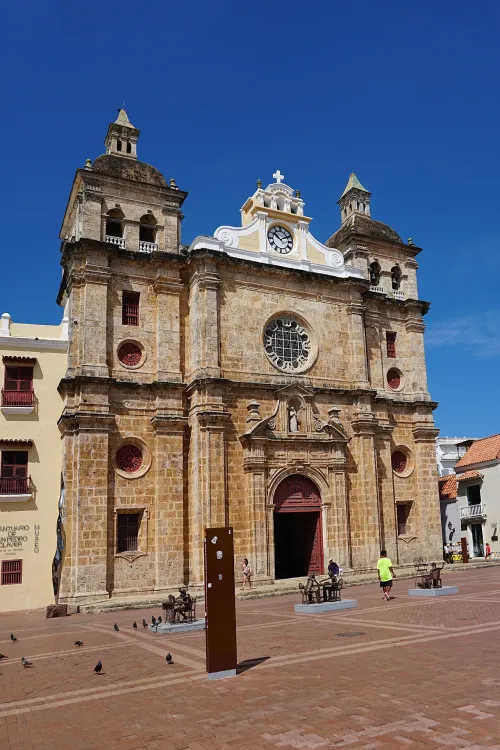
    The stone facade looms over a quiet corner just off the park. Inside lies Pedro Claver himself, the Jesuit priest who ministered to enslaved Africans arriving at the port and is now remembered as the patron of human rights. His remains are set in the main altar. The church was built between 1580 and 1654 and sits next to a beautiful two-story cloister you can walk. Worth knowing before you commit: entering the temple to pray is free, but the museum and cloister cost COP $30,000 for foreign adults (COP $21,000 for Colombians, COP $13,000 reduced). Hours are 9:00 AM to 4:30 PM weekdays, 10:00 AM to 4:00 PM weekends. The cloister is genuinely lovely and the visit is short, maybe 30 minutes, so I think it is worth the ticket if churches interest you at all. From the church door, cut back across the park toward its northwest corner, where the gold museum sits.

    Hours
    Mon-Fri: 9:00 AM – 4:30 PM | Sat-Sun: 10:00 AM – 4:00 PM
    Price
    Temple free; Museum & cloister COP $21.000 (Colombian adults) / $30.000 (foreign adults); $13.000 reduced (children/students/seniors)
  4. 4

    Zenú Gold Museum (Museo del Oro Zenú)

    Zenú Gold Museum (Museo del Oro Zenú) in Cartagena de Indias, stop 4 on the self-guided walking tour

    This one is easy to walk straight past, and that would be a mistake, because it is free and it is air-conditioned. The Banco de la República runs it, and entry costs nothing. Inside is pre-Columbian goldwork from the Zenú people, who engineered an enormous canal system across the floodplains of the Caribbean coast long before the Spanish arrived. The pieces are small and intricate, the labeling is good, and the whole thing takes maybe 30 to 40 minutes. Practically speaking, this is your free cooldown stop in the middle of the day, a chance to get out of the sun without spending a peso. Hours are Tuesday to Saturday 9:00 AM to 5:00 PM and Sunday 10:00 AM to 3:00 PM, so note it is closed Mondays. When you come out, the heavy ochre building on the same side of the park is the Inquisition palace, a few steps along.

    Hours
    Tu-Sa 09:00-17:00; Su 10:00-15:00
    Price
    Free
  5. 5

    Palace of Inquisition (Palacio de la Inquisición)

    Palace of Inquisition (Palacio de la Inquisición) in Cartagena de Indias, stop 5 on the self-guided walking tour

    The baroque stone doorway and the long carved balcony give this one away before you read the sign. Built in 1770, this was the seat of the Spanish Inquisition's tribunal in Cartagena, and since 1953 it has held the city's history museum. The displays cover the colonial port, the slave trade, and the instruments the tribunal actually used, which is grim but honest about what happened here. Entry is COP $24,000 for adults, COP $20,000 for children and seniors, free for under-fives. Open Monday to Saturday 9:00 AM to 6:00 PM, Sunday 10:00 AM to 4:00 PM. The building itself, the courtyard and the balcony, is arguably the best part, and if you have already paid for San Pedro Claver you can skip the interior and just admire the facade. From here, walk the short block to the eastern corner of the park, where the cathedral tower rises.

    Hours
    Mon-Sat: 9:00 AM – 6:00 PM | Sun: 10:00 AM – 4:00 PM
    Price
    COP $24.000 adults; $20.000 children/seniors; free under 5
  6. 6

    Cartagena Cathedral, Colombia (Catedral de Santa Catalina de Alejandría de Cartagena de Indias)

    Cartagena Cathedral, Colombia (Catedral de Santa Catalina de Alejandría de Cartagena de Indias) in Cartagena de Indias, stop 6 on the self-guided walking tour

    The coral-stone bell tower is the landmark you have been using to navigate without realizing it. This is one of the oldest cathedrals in the Americas, begun in 1577 and finished in 1612 after the pirate Francis Drake's 1586 raid damaged the half-built structure and set the work back decades. The current tower is a French addition from the early 1900s by architect Gastón Lelarge, which is why it looks a touch fancier than the rest. Pope Pius XII gave it the title of minor basilica in 1953. Entry for a visit or for mass is free. Inside it is calm and high-ceilinged, a good five-minute pause out of the sun. Step back outside and the tower is your best daytime photo, shot from across Plaza de la Proclamación. From the cathedral, head northwest down the narrow streets toward Plaza Santo Domingo and its leaning church.

    Hours
    Tu-Su 08:00-15:00; Sa 08:00-12:00
    Price
    Free
  7. 7

    Convento de Santo Domingo, Cartagena (Convento de Santo Domingo)

    Convento de Santo Domingo, Cartagena (Convento de Santo Domingo) in Cartagena de Indias, stop 7 on the self-guided walking tour

    You will hear this plaza before you reach it. Music, restaurant touts, and the chatter of one of the busiest squares in the old town. The church anchoring it is the oldest in Cartagena, and locals love telling you the bell tower leans because the devil tried to twist it down. Out front sits Fernando Botero's bronze reclining woman, La Gorda Gertrudis, and rubbing her is the local good-luck move, which is why parts of her are polished bright. The church itself is free to enter and open daily 9:00 AM to 5:00 PM, though the interior is plainer than the cathedral. Honest warning: the restaurants ringing this plaza are the priciest and most aggressively touristy in the city, so enjoy the atmosphere but eat elsewhere. From the plaza, walk west toward the sea and climb the ramp onto the city walls at the Baluarte de Santo Domingo.

    Hours
    Mon-Sun 9:00-17:00 (masses separate; source: viajandox.com.co, horariodemisas.co 2026)
    Price
    Free entry (doors open for visits; suggested donation COP $25,000 for guided tour)
  8. 8

    Bastion of Santo Domingo, Cartagena (Baluarte de Santo Domingo)

    Bastion of Santo Domingo, Cartagena (Baluarte de Santo Domingo) in Cartagena de Indias, stop 8 on the self-guided walking tour

    Up the ramp and suddenly there is wind, open sky, and the Caribbean spread out in front of you. This seaward bastion is where the murallas actually began, designed around 1602 by engineer Bautista Antonelli and his nephew Cristóbal de Roda, built on the very avenue where Drake's men had broken into the city. It became the main bastion guarding the approach from Bocagrande. These days it is one of the best free spots in Cartagena to catch the sunset, and the famous Café del Mar sits right on top, charging serious money for a cocktail with that view. You do not have to buy anything to stand on the wall beside it. The bastion is open daily from 4:00 PM to 11:00 PM and walking it is free. Time your loop so you reach here as the light goes gold. From the bastion, turn right and follow the top of the wall north along the Murallas de Cartagena.

    Hours
    Daily: 4:00 – 11:00 PM
    Price
    Free (part of the Murallas, free to walk; source: fortificacionescartagena.com.co, donde.co 2026)
  9. 9

    Cartagena Fortifications

    Cartagena Fortifications in Cartagena de Indias, stop 9 on the self-guided walking tour

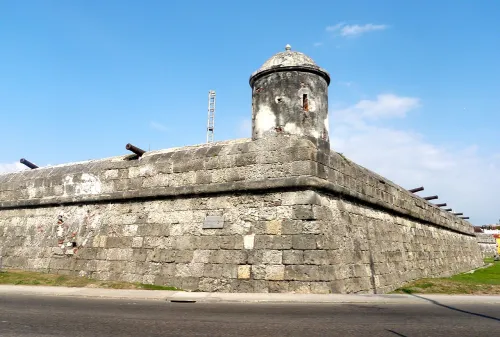
    This is the part of the walk people remember. You are now on top of the walls themselves, the UNESCO-listed ring of 16th-century fortifications that defines the whole walled city, added to the World Heritage list in 1984 along with the rest of Cartagena's defenses. Walking the wall is completely free and the path is open day and night, though the lit evening stretch with the sea breeze is the one to do. As you go north you pass Las Bóvedas, a row of arched colonial vaults that once stored weapons and held prisoners and now sell crafts and hammocks, open daily 8:50 AM to 7:00 PM. The stone underfoot is uneven, so watch your step rather than your phone. Stick to the wall until you reach the northern end, then come down and reorient. The next stop, the giant fortress on the hill, sits about 1.4 km east, so this is the point where most people grab a quick taxi for the heat-saving shortcut.

  10. 10

    Castillo de San Felipe de Barajas (Castillo San Felipe)

    Castillo de San Felipe de Barajas (Castillo San Felipe) in Cartagena de Indias, stop 10 on the self-guided walking tour

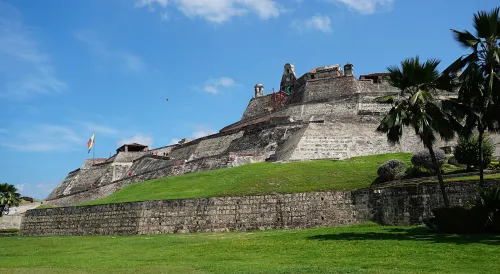
    It dominates the skyline long before you reach it, a brown mountain of stone and ramps rising off the Cerro San Lázaro. This is the largest Spanish fortress in the Americas, first built in 1536 and massively expanded in 1639 and 1657. It was besieged again and again by the English and French, and the network of tunnels inside was engineered so defenders could hear attackers approaching through the stone. Climbing the ramps to the top gives you the best panorama of the whole city, walls, sea, and the modern towers of Bocagrande beyond. Entry is COP $38,000 for foreigners, COP $33,000 for Colombians, COP $16,000 reduced, open daily 9:00 AM to 6:00 PM. This is the one ticket I would not skip. Go early or near closing, because there is almost no shade on the ramps and the midday sun is punishing. Bring water. From the fortress, head back west toward the old city and into the Getsemaní barrio for the final stop.

    Hours
    Mo-Su 09:00-18:00
    Price
    COP $38.000 (foreigners); $33.000 (Colombian nationals); $16.000 reduced (children/students/seniors)
  11. 11

    Church of la Trinidad

    Church of la Trinidad in Cartagena de Indias, stop 11 on the self-guided walking tour

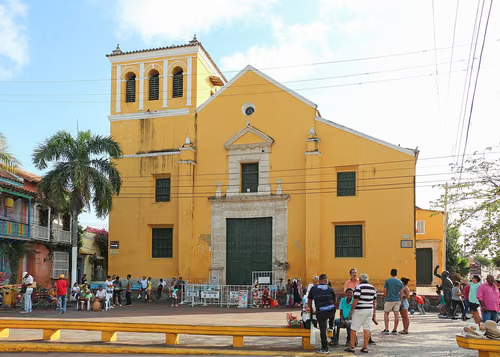
    After the grandeur of the fortress and the polished plazas, Getsemaní feels real. Murals on every wall, washing strung overhead, kids playing football in the street. This square in front of the old Santísima Trinidad church is the social heart of the barrio, and it is where the city actually gathers after dark. By day it is sleepy. By night it fills with locals, street food carts, beer from the corner shop, buskers, and dancers, all of it free to just sit and watch from the church steps. It is open around the clock. This is the place to end the walk, buy a cold beer from a tienda, and let the evening happen around you instead of paying restaurant prices on Santo Domingo. The lanes radiating off the plaza, especially Calle de la Sierpe and Callejón Angosto, are the ones to wander for the best murals before you call it a night.

    Hours
    Open 24/7
    Price
    Free (open-air public plaza)

How Long Does This Walking Tour Really Take?

Six kilometres sounds like a short walk, and the walking alone is under two hours. But the old-town core from the Torre del Reloj to Santo Domingo is dense with stops a minute or two apart, the walls beg for a slow sunset stretch, and Castillo San Felipe needs a solid hour on its own. Budget four to five hours to do it properly.

Plan on four to five hours if you go into the museums, or about two and a half hours if you just walk and photograph. The old-town section from the Torre del Reloj through Santo Domingo is dense and slow, lots of small stops close together, so give it two hours minimum. The walls are where you want to slow down, especially the stretch from the Baluarte de Santo Domingo toward Las Bóvedas, so leave 45 minutes there alone. Castillo San Felipe needs a solid hour on its own and a taxi each way unless you enjoy a sweaty 20-minute road walk.

For a real break, the gold museum is your best free, cool sit-down in the middle of the loop. For a coffee with a view, climb onto the wall at the Baluarte de Santo Domingo and use the benches up top rather than paying Café del Mar prices. And save your appetite for Getsemaní at the end: skip the Plaza Santo Domingo restaurants and eat at a cart or a small spot off Plaza de la Trinidad, where a plate and a beer cost a fraction of the walled-city tourist rates.

Full Route, Shorter Walk or Two-Day Version?

The full loop is 11 stops over 6.2 km, but the last three legs out to Castillo San Felipe and back are long and exposed. Here are three ways to run it depending on your time, your energy, and how hard the sun is hitting.

Walled City Only

The old town without the fortress detour

Stops 1–9, then straight to stop 11, skipping the 1.6 km fortress legs, about 2.5–3 hours

Cuts the two longest, most exposed legs: the 1.61 km out to Castillo San Felipe and the 1.33 km back. You keep the entire walled city, plazas, museums, and the wall walk, then drop down into Getsemaní. The tightest, most walkable version, ideal on a brutally hot day.

Two Halves

Split the loop at the walls

Day one stops 1–9 (old town and walls); day two stops 10–11 (fortress and Getsemaní), each half 2–3 hours

For a relaxed pace or two shorter outings. Do the walled-city plazas and finish on the walls at the Baluarte de Santo Domingo for sunset on the first day. Save Castillo San Felipe for a cooler early morning on the second, then wind down in Getsemaní that evening.

You can run this in reverse, starting in Getsemaní and ending at the Torre del Reloj, but the given direction is better: it saves the walls and the sunset at the Baluarte de Santo Domingo for late in the day, and leaves the lively evening in Getsemaní as your natural finish rather than your start.

Is This Cartagena de Indias Walking Tour Right for You?

This is a flat, short walk over historic paving, easy for most people in terms of distance but demanding in the heat. Here is who it suits and how to bend it to your day.

A good fit if you…

  • Walkers who want the whole walled city in a logical order rather than backtracking through the same plazas
  • History travellers drawn to sieges, the Inquisition, the slave trade, and 16th-century fortifications
  • Anyone who wants a mostly free day out, paying only for the two or three interiors that earn it
  • Photographers chasing soft morning light in the plazas and the golden sunset over the sea walls

Adapt the route if you…

  • It's brutally hot: run the Walled City Only version and skip the two long fortress legs
  • You have limited energy or two evenings: split the loop at the walls across two days
  • You want the museums: go early so you clear San Pedro Claver, the gold museum, and the Inquisition before noon
  • You're on a tight budget: skip every paid interior except Castillo San Felipe and do the rest for free

Tickets & Skip-the-Line in Cartagena de Indias

Most of this route is free open-air space, so there is very little to book. Only three interiors charge admission, and none of them needs a timed ticket in advance. Here is what each one actually costs and when it's open, so you can plan the paid stops around the morning cool and buy at the door.

Iglesia de San Pedro Claver, Cartagena (Iglesia de San Pedro Claver)Entering the temple to pray is free. The museum and cloister cost COP $30,000 for foreign adults, COP $21,000 for Colombian adults, and COP $13,000 reduced (children, students, seniors). Open Mon to Fri 9:00 AM–4:30 PM and Sat to Sun 10:00 AM–4:00 PM. Buy at the door; the visit takes about 30 minutes.
Palace of Inquisition (Palacio de la Inquisición)Admission is COP $24,000 for adults, COP $20,000 for children and seniors, free for under-fives. Open Mon to Sat 9:00 AM–6:00 PM and Sun 10:00 AM–4:00 PM. No advance booking needed. If you've already paid for San Pedro Claver, you can skip the interior and just admire the baroque facade and balcony for free.
Castillo de San Felipe de Barajas (Castillo San Felipe)The one ticket worth not skipping. Admission is COP $38,000 for foreigners, COP $33,000 for Colombian nationals, and COP $16,000 reduced (children, students, seniors), per Resolución 005 of 9 Jan 2026. Open daily 9:00 AM–6:00 PM. Go early or near closing, since the ramps have almost no shade. Bring water.
Zenú Gold Museum (Museo del Oro Zenú)Free entry, run by the Banco de la República, and air-conditioned, making it the best free cooldown stop mid-walk. Open Tue to Sat 9:00 AM–5:00 PM and Sun 10:00 AM–3:00 PM, closed Mondays. No ticket needed. official ticket site ↗
Everything elseThe Torre del Reloj, Parque de Bolívar, the Catedral de Santa Catalina, Santo Domingo, the Baluarte de Santo Domingo, the Murallas, and Plaza de la Trinidad are all free open-air spaces or free-entry churches. Nothing to book, walk straight in.
Optional upgrade
+7
The same 11-stop route,
now with navigation and a guide.
Optional AI experience

You already have the route.
The AI guide brings it to life.

Standing under the yellow Torre del Reloj or already on the walls? Open the AI Tourguide and it picks up the route from wherever you are, walking you stop by stop through the old town to Getsemaní. Ask it anything, the Inquisition, the sieges, where to eat in Getsemaní, and it answers as you walk, so you never have to stop and dig through a guidebook in the heat.

Livenavigation13languagesAnyquestionYourinterests
Open this route with the AI guide

Try it in your browser · No app or download required

Tips for Walking in Cartagena de Indias

  • Start the walk by 7:30 or 8:00 AM. The old town is empty and cool early, the light is soft for photos, and you will have cleared the indoor museums before the worst heat hits around noon. If mornings are impossible, start at 4:00 PM and aim to be on the walls for sunset.
  • These are cobblestones and uneven colonial paving the entire way, plus stone ramps on the walls and at San Felipe. Flat sneakers or proper sandals only. Heels and flip-flops will punish you, and the wall stones get slick near the sea.
  • Clean public restrooms are scarce inside the walls. Use the ones at Castillo San Felipe (with your ticket) or duck into a café and buy a drink. The Museo del Oro Zenú is a reliable free option mid-walk.
  • Buy a fresh fruit cup or a cold agua de coco from a street cart for a few thousand pesos, but agree the price before you take it. For a proper meal, eat in Getsemaní near Plaza de la Trinidad rather than on Plaza Santo Domingo, where the same plate costs two or three times more.
  • Best photo: the cathedral's coral-stone tower shot from across Plaza de la Proclamación in the morning. For the postcard sunset, stand on the wall at the Baluarte de Santo Domingo facing west over the Caribbean in the last hour before dark.

Why Walk This Route?

Cartagena's old town is small, flat, and walled, which makes it close to perfect for walking. The whole historic core fits inside a ring of 16th-century stone, so you are never more than a few minutes from the next plaza, the next church tower, the next balcony dripping with bougainvillea. Cars barely fit down some of these streets, so most of the time you have the cobbles to yourself and a few horse carriages. The catch is the heat. Cartagena sits just north of the equator and the midday sun is brutal, so the trick is not which route you take but when you walk it.

This loop is built the way locals and repeat visitors actually move through the city. You start at the Torre del Reloj, the yellow clock gate everyone uses as the front door, then thread through the main plazas (Bolívar, the cathedral, Santo Domingo) before climbing onto the walls themselves for the sea breeze. From there it pushes out to Castillo San Felipe, the giant fortress on the hill that is the one stop worth leaving the walled city for, and finishes in Getsemaní, the old working-class barrio that is now where the night actually happens.

Wandering Cartagena is lovely, but you will miss things and you will overpay. Without a plan you walk past the free gold museum, you queue at San Felipe in the worst heat of the day, and you eat at the first tourist-trap on Plaza Santo Domingo. This route fixes the order, tells you what is free, what is worth a ticket, and where to sit down before your shirt is soaked through.

Common Questions

Is Cartagena de Indias safe to walk around?

The walled city and Getsemaní are heavily touristed and generally fine to walk, including after dark on the main streets and plazas. Stay alert with your phone and camera, keep bags zipped, and do not flash cash. The most common annoyance is persistent vendors and the occasional overcharge, so agree prices before you buy fruit, water, photos with costumed palenqueras, or a hat. At night, stick to the lit, busy lanes of Getsemaní and the old town and take a taxi or app ride for anything farther out.

What if it rains during my Cartagena de Indias tour?

Rain here usually comes as a short, heavy afternoon downpour rather than an all-day soak, so duck into a café and wait it out. For a longer wet-weather plan, this route already has indoor anchors: the Museo del Oro Zenú (free), the San Pedro Claver cloister and museum, the Palacio de la Inquisición, and the covered vaults at Las Bóvedas. Save Castillo San Felipe and the open walls for when it clears, since both are fully exposed.

What's the best time of day for this walking tour?

Early morning, starting around 7:30 to 8:00 AM, for the old-town section. The streets are quiet, the air is bearable, and you beat the cruise-ship crowds and the midday heat. Then plan to be on the walls and at the Baluarte de Santo Domingo for sunset in the last hour before dark, which is the single best light of the day in Cartagena. Avoid doing the exposed parts, the walls and San Felipe, between noon and 3:00 PM.

Take this route with you

Open this exact tour with navigation and your personal AI guide.

Start GPS Navigation + AI Guide
AI Tourguide
Researched and curated by the AI Tourguide teamWe plan and quality-check every route, then research and verify the opening hours, prices, and practical tips for each stop along it.
▶ Open route with AI guideNavigation, stories and your questions