Self-Guided Walking Tour in Chur

14 Stops 3.9 km ~2.8 hours
Try This Tour
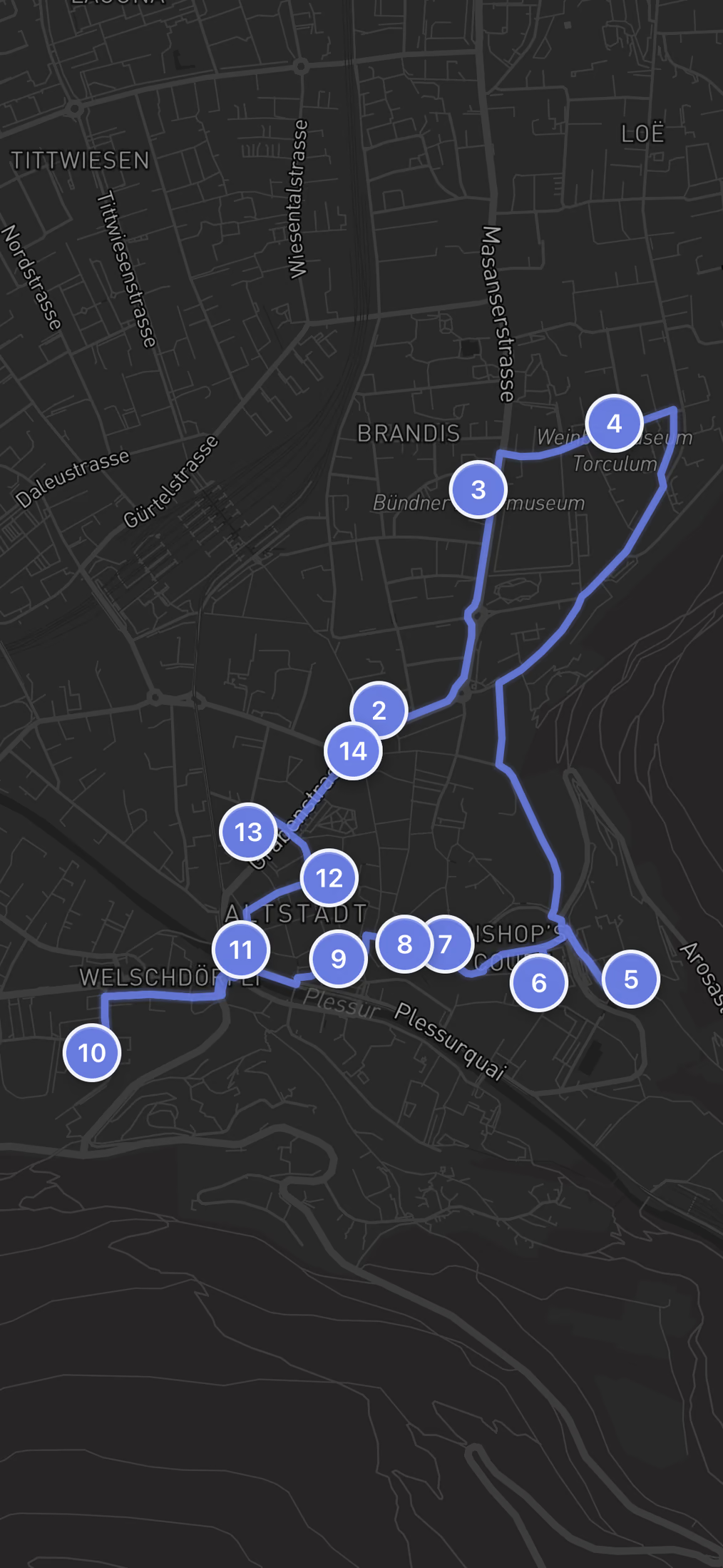
Walking tour route map of Chur
Try This Tour

Why Walk Chur? A Self-Guided Tour

Chur calls itself the oldest city in Switzerland, and the proof is underfoot. People have lived on this spot for around 5,000 years, and the old town packs Roman walls, a medieval bishop's court, a late-Gothic landmark church and a row of modern museums into a few hundred metres. You can cross the whole centre in fifteen minutes, which is exactly why a planned loop beats aimless wandering here. The streets twist, dead-end and double back, and the best things sit one alley off the obvious route.

This walk is a 3.9 km round trip that starts and ends at Postplatz, so you never have to backtrack to a station or a parked car. It climbs gently north to the three museums first while your legs are fresh, then drops into the Hof, the walled bishop's court that most day-trippers miss entirely. From there it threads the car-free old town past Martinskirche and the Arcas, out to the Roman Welschdörfli with Peter Zumthor's plywood shelters, and back through the Obertor gate. One route, every layer of the city, in order.

Chur also works as a base. It is the railway hub for the Glacier Express and the Bernina line, so plenty of people pass through with a few free hours between trains. This loop is built for exactly that: short enough to do in a morning, dense enough that you leave understanding why the place matters.

The Route: 14 Stops

Swipe through images or scroll names below

Scroll to explore →
1. Postplatz
2. Buendner Kunstmuseum
3. Buendner Naturmuseum
4. Weinbaumuseum Torculum
5. St. Luzius Church
6. Cathedral of the Assumption of Mary
7. Raetisches Museum
8. Martinskirche
9. Arcas Square
10. Welschdoerfli
11. Obertor Gate
12. Kornplatz
13. Stadtgarten
14. Postplatz

Route Map

Tap to load interactive map
AI Tourguide
Walk this exact route with a private AI guide.
Full GPS navigation, interactive stories, and a guide that answers all your questions. A private guide experience for just €5/hour.
Try This Tour

Your Chur Walking Tour, Stop by Stop

  1. 1

    Postplatz

    Postplatz in Chur, stop 1 on the self-guided walking tour

    The loop closes back at Postplatz, where you started. From here the station is a couple of minutes away, which matters if you are connecting onward to the Glacier Express, the Bernina line toward Italy, or the Arosa railway that climbs up beside the Schanfiggerstrasse near the Obertor. Open access and free. Take a last look back at the old town climbing the slope behind you and you can mentally retrace the whole sequence: museums, bishop's court, medieval lanes, Roman ruins, the gate. If you still have time and energy, the cafe terraces on the Arcas are a short walk back for a glass of the local Pinot Noir, the proper way to end a walk through Switzerland's oldest city. Otherwise, the buses and trains are right here to take you on.

    Hours
    Always open
    Price
    Free

    Tour complete

  2. 2

    Buendner Kunstmuseum

    Buendner Kunstmuseum in Chur, stop 2 on the self-guided walking tour

    A few steps from Postplatz the Villa Planta appears, an 1870s merchant's mansion with a strict symmetrical facade, now the public face of the cantonal art collection. Behind it sits a windowless concrete extension from 2016 that doubled the gallery space and pulls the daylight in from above instead of the sides. The collection leans heavily on artists tied to Graubünden, including Giovanni, Augusto and Alberto Giacometti, Angelika Kauffmann and the Symbolist Ferdinand Hodler. Open Tuesday to Sunday 10:00 to 17:00, Thursday until 20:00, closed Monday. Admission is CHF 15, reduced CHF 12, and under-16s go free. Give it about an hour if you go in; the Thursday late opening is the quiet slot if you want the rooms mostly to yourself. If museums are not your thing, the building is worth a slow look from the street alone for the old-versus-new contrast. Continue north toward the Naturmuseum.

    Hours
    Tue,Wed,Fri-Sun: 10:00 AM - 5:00 PM | Thu: 10:00 AM - 8:00 PM
    Price
    CHF 15 adults | CHF 12 students | Under 16 free

    5 min walk to next stop

  3. 3

    Buendner Naturmuseum

    Buendner Naturmuseum in Chur, stop 3 on the self-guided walking tour

    About 360 metres north of the art museum, the natural history museum makes sense of the mountains you have been staring at. This is the place to understand Graubünden's geology, the way the Alps folded up over millions of years, and the animals that live in them now, from ibex and chamois to the bears and wolves slowly returning to the canton. It is compact and genuinely good for kids, with mounted specimens and habitat dioramas rather than endless text panels. Open Tuesday to Sunday 10:00 to 17:00, closed Monday. Admission is CHF 6, reduced CHF 4, and under-16s free, which makes it one of the cheapest indoor stops on the walk. Budget 45 minutes. If you only have time for one museum and you came for the scenery rather than the art, this is the one that explains what you are looking at. From here, carry on a short way east to the Weinbaumuseum.

    Hours
    Tu-Su 10:00-17:00
    Price
    CHF 6 adults | CHF 4 students | Under 16 free

    3 min walk to next stop

  4. 4

    Weinbaumuseum Torculum

    Weinbaumuseum Torculum in Chur, stop 4 on the self-guided walking tour

    Roughly 220 metres on, the Torculum is a small wine-growing museum built around an old torcular, the big timber wine press that gives the place its name. Chur sits at the edge of the Bündner Herrschaft, the canton's wine country, where the steep slopes produce some of Switzerland's best Pinot Noir (known locally as Blauburgunder). The museum lays out how the grapes were pressed and the wine made before machinery took over. It is free and listed as always open, though as a small site it is worth checking the city tourism page before you go since staffing can be limited. The visit is quick, fifteen to twenty minutes, and it is more about context than spectacle. Think of it as the appetiser before you taste the region's reds later. After this you turn and head south, leaving the museum quarter for the older, walled part of town: the bishop's court, where the next two stops sit side by side.

    Hours
    Always open
    Price
    Free

    9 min walk to next stop

  5. 5

    St. Luzius Church

    St. Luzius Church, stop 5 on the self-guided walking tour

    The walk now climbs into the Hof, the bishop's court, entered from the east. St. Luzius is the seminary church, dedicated to Lucius, the figure traditionally honoured as the apostle who brought Christianity to Graubünden. The current building sits on much older foundations, and a crypt below holds early Christian remains tied to the saint's cult. It is a quieter, plainer space than the cathedral next door, which is part of the appeal after the bustle of the centre. Open daily 9:00 to 17:00, free to enter. Step inside for five minutes, then take the stairs down to the crypt if it is open, since that is the genuinely old part. The whole Hof is a walled enclave that feels separate from the rest of Chur, with the bishop's residence directly opposite. Walk the short distance across the courtyard to the cathedral.

    Hours
    Daily 9 AM - 5 PM
    Price
    Free

    2 min walk to next stop

  6. 6

    Cathedral of the Assumption of Mary

    Cathedral of the Assumption of Mary in Chur, stop 6 on the self-guided walking tour

    Across the Hof stands the cathedral of St. Mariä Himmelfahrt, the seat of the Bishop of Chur and the architectural heart of the court. The Romanesque core went up in the 12th and 13th centuries, and the interior is darker and more austere than a Gothic cathedral, with a famous carved high altar by Jakob Russ from around 1492, one of the largest late-Gothic winged altars in the country. Look for the crypt and the capitals carved with strange beasts and figures. Opening hours run Monday 7:00 to 19:00, Tuesday from 8:00, and Wednesday to Sunday 7:00 to 19:00; entry is free. Services and the occasional event can close it, so a weekday morning is the safest bet for a calm visit. Give it twenty minutes. The bishop's residence, the Bischöfliches Schloss, faces the cathedral directly across the courtyard. Leave the Hof on the west side and drop back down into the old town toward the Rätisches Museum.

    Hours
    Mon: 7:00 AM – 7:00 PM | Tue: 8:00 AM – 7:00 PM | Wed-Sun: 7:00 AM – 7:00 PM
    Price
    Free

    3 min walk to next stop

  7. 7

    Raetisches Museum

    Raetisches Museum in Chur, stop 7 on the self-guided walking tour

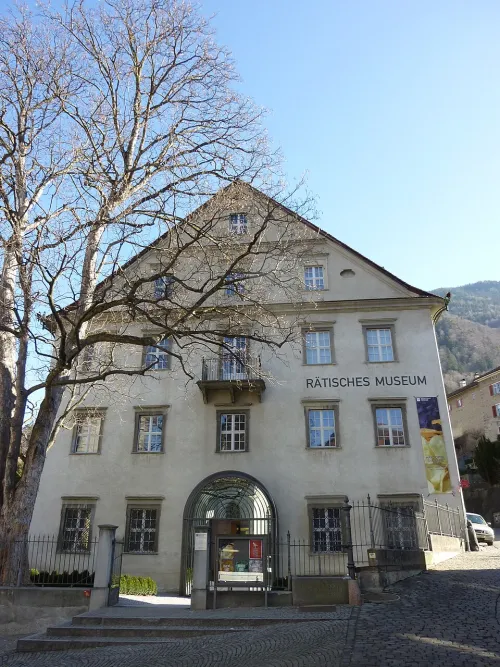
    Just below the Hof, the Rätisches Museum tells the human story of Graubünden inside the Buolsches Haus, a grand 17th-century patrician mansion that is half the attraction. Also called the Bündner Historisches Museum, it runs from prehistoric finds and Roman artefacts up through the canton's three languages, its emigration history and its alpine culture. This is the single best stop on the walk for understanding how this corner of the Alps became what it is. Open Tuesday to Sunday 10:00 to 17:00, closed Monday. Admission is CHF 6, reduced CHF 4, under-16s free, the same gentle price as the Naturmuseum. Allow an hour. The Roman section pairs neatly with the Welschdörfli excavations you will reach later, so it is worth doing in this order. From the museum you step straight into the medieval old town. Martinskirche, the church with the tall pointed spire, is barely a minute away.

    Hours
    Tu-Su 10:00-17:00
    Price
    CHF 6 adults | CHF 4 students | Under 16 free

    1 min walk to next stop

  8. 8

    Martinskirche

    Martinskirche in Chur, stop 8 on the self-guided walking tour

    The pointed late-Gothic spire of the Martinskirche is the landmark of the old town, visible from almost every alley. This is the largest late-Gothic structure in Graubünden and the biggest Protestant church in the canton, dedicated to Martin of Tours. The plain whitewashed interior is the result of the Reformation, but it holds a real surprise: three stained-glass windows in the choir designed by Augusto Giacometti in 1919, glowing deep blues and reds against the bare walls. Open daily 9:00 to 17:00, free. Step in to see the Giacometti glass, which catches the light best in the morning, and skip the tower unless climbs are your thing. The square outside, Martinsplatz, is one of the prettiest in town with its painted houses and the old fountain. From here it is a short stroll downhill to the Arcas, the broad square pressed against the medieval wall.

    Hours
    Daily 9:00 AM - 5:00 PM
    Price
    Free

    2 min walk to next stop

  9. 9

    Arcas Square

    Arcas Square in Chur, stop 9 on the self-guided walking tour

    The Arcas opens up where the old town meets the Plessur river, a wide square ringed by tall painted townhouses that are built directly onto the 13th-century city wall. The name comes from the Romansh word for an embankment dam, a reminder that this edge of town once held back the river. It is the social centre of the old town now, lined with cafe terraces that fill up the moment the sun is out, and it makes the obvious mid-walk coffee stop. Open access and free. Grab a table, look up at the way the houses sit on top of the medieval masonry, and notice the Bärenloch passage leading back up toward Martinsplatz. The square was controversially rebuilt in 1971 with an underground car park beneath it, which is why the surface feels so clean and open. When you are ready, head west out of the centre toward the river and the Roman quarter of Welschdörfli.

    Hours
    Always open
    Price
    Free

    7 min walk to next stop

  10. 10

    Welschdoerfli

    Welschdoerfli in Chur, stop 10 on the self-guided walking tour

    Cross toward the river and the streets change character. The Welschdörfli is Chur's nightlife strip by evening, but the reason to come in daylight sits on Seilerbahnweg: two long, low shelters built in 1986 by Peter Zumthor early in his career, before he became one of the most celebrated architects alive. Their plain plywood-and-timber skins protect the excavated remains of the Roman settlement Curia Raetorum, with layers beneath reaching back to the Neolithic. Inside you can see Roman walls, wall paintings and finds spanning thousands of years. The site is free and the outdoor quarter is open around the clock, with the excavation shelters accessible during daytime hours. It is an unexpected pairing, raw archaeology under quietly brilliant modern architecture, and it ties directly back to the Roman rooms in the Rätisches Museum. Give it fifteen minutes. Then loop back toward the old town wall and the Obertor, the surviving medieval gate.

    Hours
    Always open (outdoor archaeological site)
    Price
    Free

    5 min walk to next stop

  11. 11

    Obertor Gate

    Obertor Gate in Chur, stop 11 on the self-guided walking tour

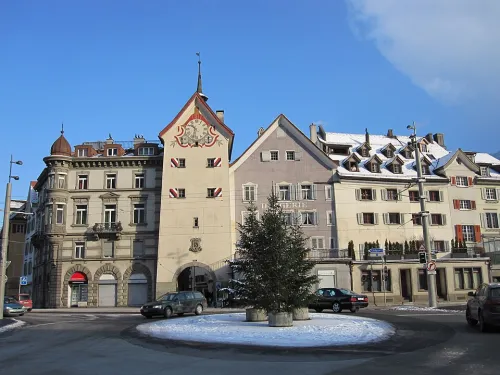
    Walking back from the river you meet the Obertor, the four-storey gate tower that marks the south-western entrance to the old town. It is the main surviving piece of the high-medieval fortifications that went up in the first half of the 13th century, most of which were torn down in the 1800s. The tower tapers as it rises and carries the colours of the Chur coat of arms, topped by a 17th-century roof turret added purely for show. It stands right by the Plessur bridge, and since 1854 it has been the starting point of the city's traditional Maiensäss procession. Always open and free, since you view it from the street rather than going in. This is the classic postcard shot of Chur, so frame the tower with the old houses behind it. From the gate, walk up into the lanes toward Kornplatz, one of the main squares of the old town.

    Hours
    Always open
    Price
    Free

    3 min walk to next stop

  12. 12

    Kornplatz

    Kornplatz in Chur, stop 12 on the self-guided walking tour

    Kornplatz is a large car-free square just south of the post office, once a grain market and before that the site of the Dominican monastery of St. Nicolai. The monastery was dissolved around 1672 and grain stores took its place, which is where the name comes from, though the granaries themselves vanished by 1840. Look at house number 2 for facade paintings made in 1955 by Alois Carigiet, the illustrator behind the beloved Swiss children's book Schellen-Ursli. Open access and free. There is a fun bit of trivia locals enjoy: in the Swiss edition of Monopoly, Kornplatz is the cheapest property on the board. The square works as a relaxed transition space between the old town and the newer districts, with benches and a few places to sit. Spend a few minutes spotting the Carigiet murals, then continue the short way to the Stadtgarten for a green pause before closing the loop.

    Hours
    Always open
    Price
    Free

    3 min walk to next stop

  13. 13

    Stadtgarten

    Stadtgarten in Chur, stop 13 on the self-guided walking tour

    About 170 metres on, the Stadtgarten is a small public park at the northern edge of the old town, the natural place to slow down before the walk ends. It is nothing grand, a patch of lawn, trees and benches, but after a morning of stone alleys and church interiors it is exactly the breather you want. Always open and free. Find a bench in the shade, rest your feet, and let the route settle before you head back. If you have snacks or something picked up at the Wochenmarkt earlier, this is the spot to eat them. The park sits within easy reach of both the old town and the station, so it doubles as a soft landing if you have a train to catch. When you are ready, it is a short walk back to where you began.

    Hours
    Always open
    Price
    Free

    2 min walk to finish

  14. 14

    Postplatz

    The loop closes back at Postplatz, where you started. From here the station is a couple of minutes away, which matters if you are connecting onward to the Glacier Express, the Bernina line toward Italy, or the Arosa railway that climbs up beside the Schanfiggerstrasse near the Obertor. Open access and free. Take a last look back at the old town climbing the slope behind you and you can mentally retrace the whole sequence: museums, bishop's court, medieval lanes, Roman ruins, the gate. If you still have time and energy, the cafe terraces on the Arcas are a short walk back for a glass of the local Pinot Noir, the proper way to end a walk through Switzerland's oldest city. Otherwise, the buses and trains are right here to take you on.

    Hours
    Always open
    Price
    Free
AI Tourguide
Walk this exact route with a private AI guide.
Full GPS navigation, interactive stories, and a guide that answers all your questions. A private guide experience for just €5/hour.
Try This Tour

Self-Guided Tour vs. Group Tour in Chur

Chur is the rare city where self-guided wins easily. The whole loop is 3.9 km, the old town is car-free and tiny, and every outdoor stop is free, so there is no line to skip and no ticket to game. Organised group tours of Chur do exist through the local tourist office, usually as scheduled or private guided old-town walks billed per group or per person, but for a centre this compact they are hard to justify unless you specifically want a live local telling the stories. The museum entries are modest too: the Naturmuseum and Rätisches Museum are CHF 6 each, and even the Kunstmuseum tops out at CHF 15, with under-16s free everywhere. Doing it yourself with this route costs you nothing beyond whatever museums you choose to enter, and you set your own pace. Where guiding earns its keep is the narrative thread, the why behind the Roman ruins and the bishop's court, which is precisely the gap a good audio companion can fill without the cost or fixed timing of a group.

Group Tour AI Self-Guided
Price €25–€50 per person €5/hour or €20 all-inclusive
Flexibility Fixed schedule Start anytime, skip stops
Languages 1–2 languages 11 languages
Pace Group pace Your own pace

How Long Does This Chur Tour Take?

Our route covers 3.9 km with 14 stops and takes approximately 2.8 hours at a relaxed pace.

The pure walking distance is 3.9 km, about 50 to 60 minutes of actual movement spread across the loop. Add stops and the realistic total is 2.5 to 4 hours depending on how many museums you enter. If you go inside all three museums you are looking at the longer end, since the Kunstmuseum and Rätisches Museum each deserve roughly an hour. The two stops that reward extra time are the Hof, where St. Luzius and the cathedral sit together in a walled court that feels separate from the city, and the Welschdörfli, where the Zumthor shelters and Roman ruins are easy to rush but better savoured. The obvious break is mid-walk on the Arcas: pick a terrace cafe on the square against the medieval wall, order a coffee or a glass of Bündner Pinot Noir, and watch the old town go by. Near the end, the bench under the trees in the Stadtgarten is the quiet alternative if you want to rest before the station.

Tips for Walking in Chur

  • Arrive by train: Chur is the regional rail hub and Postplatz, the start, is a two-minute walk from the main station, so this loop is ideal for a half-day stopover between Glacier Express or Bernina connections.
  • Plan around Mondays: all three museums (Kunstmuseum, Naturmuseum, Rätisches Museum) are closed on Mondays, so if museums matter to you, walk this Tuesday to Sunday instead.
  • Shoes: the old town is cobbled and the route through the Hof and toward the Welschdörfli has gentle slopes, so flat comfortable shoes beat anything with a thin sole or heel.
  • Restrooms: the Bündner Kunstmuseum and Rätisches Museum have public toilets for visitors, and there are facilities near Postplatz by the station, the most reliable options on the loop.
  • Food and drink: stop at a terrace on the Arcas for a glass of local Blauburgunder (Pinot Noir) from the nearby Bündner Herrschaft, the regional speciality, or hit the Wochenmarkt near Postplatz in the morning for cheese and bread to eat on the go.
  • Best photo: frame the Obertor gate tower from the Plessur bridge with the old houses behind it, the classic shot, and the Martinskirche spire catches morning light beautifully from Martinsplatz.
  • Cheap museum combo: the Naturmuseum and Rätisches Museum are only CHF 6 each (under-16s free), so even on a budget the two that best explain Graubünden cost little.
AI Tourguide
Walk this exact route with a private AI guide.
Full GPS navigation, interactive stories, and a guide that answers all your questions. A private guide experience for just €5/hour.
Try This Tour

AI Audio Guide for This Tour

Standing on the Arcas or under the Obertor right now? Let the AI Tourguide walk Chur with you. It talks you through each stop in a real back-and-forth, telling the story of the bishop's court and Zumthor's Roman shelters, answering what you ask and picking up where you left off as you move. Press start and the conversation begins.

AI Audio Guide Stories, history and fun facts narrated as you walk. No earpiece rental needed.
GPS Navigation Turn-by-turn directions so you never get lost between stops.
Ask Anything Curious about a building you pass? Ask your AI guide on the spot.
11 Languages Switch language anytime. No separate tour needed.
Try This Tour

Common Questions

Is Chur safe to walk around?

Yes, very. Chur is a small, calm Swiss cantonal capital with low crime, and the old-town loop is comfortable day and evening. The Welschdörfli turns into the nightlife quarter after dark and can get lively on weekend nights, but it is fine in daylight when you visit the Roman shelters. There are no tourist scams of note. Normal city sense is all you need.

What if it rains during my Chur tour?

The route has good wet-weather fallbacks. Cluster the indoor stops: the Bündner Kunstmuseum (CHF 15), Naturmuseum (CHF 6) and Rätisches Museum (CHF 6) can fill a rainy half-day, and the Cathedral, St. Luzius and Martinskirche are all free and covered. The Welschdörfli excavation shelters are also roofed. Save the open squares like the Arcas and Kornplatz for any dry spells.

What's the best time of day for this walking tour?

Start mid-morning, around 10:00, which is when the museums open. That gives you the quiet church interiors and the Giacometti glass in Martinskirche in good morning light, lets you reach the Arcas for a midday coffee in the sun, and finishes before the evening crowds gather in the Welschdörfli. A weekday is calmer than Saturday.

How long does the Chur walking tour take?

The walking itself is about 50 to 60 minutes over 3.9 km. With stops, plan 2.5 to 4 hours. If you skip the museum interiors and just see the squares, churches and Roman ruins, you can do the loop comfortably in around two hours.

Do I need to book the museums in advance?

No. The Kunstmuseum, Naturmuseum and Rätisches Museum all sell tickets at the door and rarely have queues. Just remember all three close on Mondays. Check the Kunstmuseum website if you specifically want a current special exhibition, since those can affect the price and hours.

Is Chur worth visiting as a day trip?

Yes, especially as a stopover. As Switzerland's oldest city it packs Roman ruins, a medieval bishop's court and a car-free old town into a space you can cover in a morning, and it sits at the junction of the Glacier Express and Bernina lines. A half day is enough to see the whole loop properly.

Do I need to book the walking tour in advance?

No booking needed. This self-guided tour is available anytime. Open the route on your phone and start walking. The AI audio guide works instantly, no reservation required.

What languages is the audio guide available in?

The AI audio guide is available in 11 languages: English, German, French, Spanish, Italian, Japanese, Chinese, Portuguese, Danish, Norwegian, and Swedish.

Can I skip stops or change the route?

Yes. Skip any stop, spend extra time at places you like, or start the route from any point. You can also ask the AI to suggest a shorter route.
AI Tourguide
Curated by AI Tourguide GPS-verified routes, reviewed and updated regularly.
Last verified June 2026
▶ Try This Tour No app · try it instantly from your couch