Self-Guided Walking Tour in Copacabana

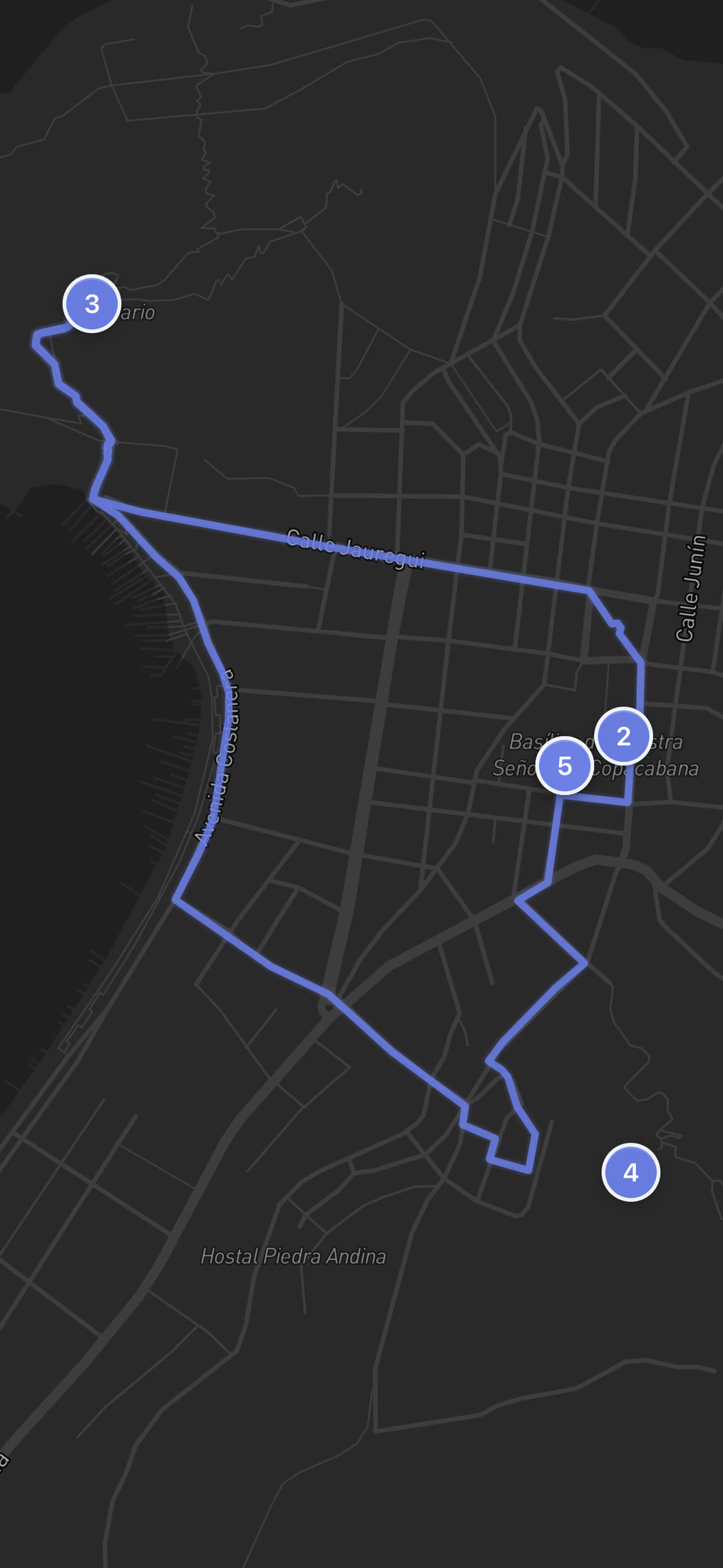
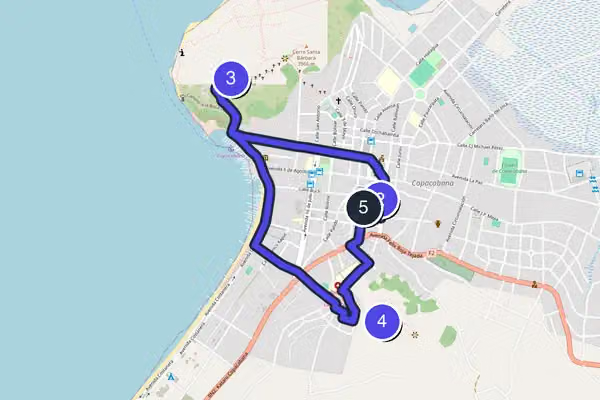
A compact 5-stop loop through Copacabana on the Bolivian shore of Lake Titicaca, from Plaza 2 de Febrero and its white basilica up Cerro Calvario, across to the pre-Inca observatory at Horca del Inca, and back to the Museo del Poncho. This page gives you the map, per-leg walking times, real prices and hours, and shorter versions.

5 Stops3.6 km~2 hours walking3–4 hours with stops
What you get with AI Tourguide
Full GPS navigationInteractive AI guidePersonalized to youWorks in your browser
Try this tour with Alex

Copacabana Walking Tour at a Glance

This route is built for the traveller who has a few hours in Copacabana between buses or before the boat to Isla del Sol and wants more than the church. It links the plaza, the basilica, two hills and a small museum in one thin loop. Every interior is optional: you can skip any paid stop and the walk still holds together, and you set the pace your lungs allow.

StartPlaza 2 de Febrero
FinishMuseo del Poncho
Route typeA tight loop, not a straight line: you start on Plaza 2 de Febrero, step north-east to the basilica, climb north-west to Cerro Calvario, cross south-east to Horca del Inca, then return north to the museum a two-minute stroll from where you began.
Realistic timeThe walking is only about 3.6 km, but plan on three to four hours because the two climbs and the thin air slow everyone down. Cerro Calvario alone is a full hour if you linger at the top for the view.
DifficultyShort in distance but genuinely demanding underfoot: rough stone stairs on the Calvario, a loose rocky scramble up to Horca del Inca, and everything at 3,812 meters where a single staircase leaves you breathing hard.
Cost to followThe outdoor route is free. Plaza 2 de Febrero, the basilica (voluntary donation) and Cerro Calvario cost nothing; only Horca del Inca (around Bs 10) and the Museo del Poncho (Bs 15) charge a small entry.
Best for:

Independent travellers who want the town itself, the pilgrim energy, the miniature houses on the Calvario steps and lakeside trout, not just a quick photo of the church.

The Route

Free Walking Tour Map of Copacabana

5 stops3.6 kmabout 2 hours
Loading the interactive map…The complete walking route will appear here.
Want the route to guide you while you walk?Open the route with navigation and a personal guide for the history, stories and questions that matter to you.
Open route + AI guide

The 5 stops along this route

  1. Missing required field: waypoints[0].image
    1Plaza 2 de Febrero
  2. Basilica of Our Lady of Copacabana (Basílica de Nuestra Señora de Copacabana) in Copacabana, stop 2 on the self-guided walking tour
    2Basilica of Our Lady of Copacabana (Basílica de Nuestra Señora de Copacabana)
  3. Cerro del Calvario (Cerro El Calvario) in Copacabana, stop 3 on the self-guided walking tour
    3Cerro del Calvario (Cerro El Calvario)
  4. Pachat'aqa (Pachataka) in Copacabana, stop 4 on the self-guided walking tour
    4Pachat'aqa (Pachataka)
  5. Missing required field: waypoints[4].image
    5Museo del Poncho
  6. That's the complete route.

    If you want more than the map and text, add live navigation and a conversational AI guide while you walk.

    Open route + AI guide
    You made it
Stop 1 of 5
Swipe →

Your Copacabana Walking Tour, Stop by Stop

  1. 1

    Plaza 2 de Febrero

    Missing required field: waypoints[0].image

    Start here, on the wide square right in front of the basilica. This is the civic center of the town, free and open all day, and on weekends it fills with vendors, pilgrims, and rows of cars and minibuses parked nose-in, draped in flower garlands and confetti. That is the ch'alla, the car-blessing ceremony: owners drive in from across Bolivia and Peru to have a new vehicle splashed with beer and blessed by a priest on the steps. If you catch one, watch it. It tells you more about this town than any plaque. Otherwise, use the plaza to acclimatize. You are at 3,812 meters and you just arrived, so sit on a bench, drink water, and let your heart rate settle before you start climbing anything. From here the white facade of the basilica is straight ahead across the square, so walk toward it.
  2. 2

    Basilica of Our Lady of Copacabana (Basílica de Nuestra Señora de Copacabana)

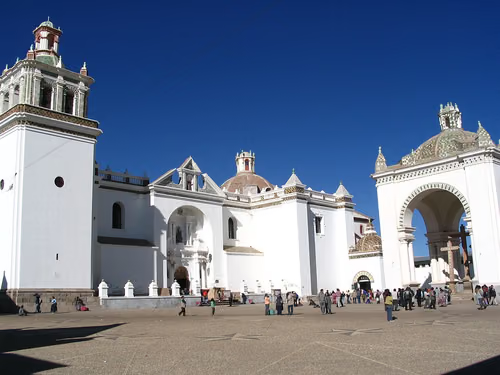
    Basilica of Our Lady of Copacabana (Basílica de Nuestra Señora de Copacabana) in Copacabana, stop 2 on the self-guided walking tour

    The basilica hits you white and bright, all Moorish arches and tiled domes, more North African than Andean. It was first built in 1550, then rebuilt between 1610 and 1651, and parts of that second structure are what you stand in front of today. Inside is the Virgen de Copacabana, the most venerated Marian image in Bolivia and the patroness of the country, a dark carved figure that pilgrims travel days to see. Entry is free, a donation is the polite move, and the church is open daily 07:00 to 18:00. One thing to know: the chapel with the exvotos and the original image upstairs usually only opens from around 14:00, so a morning visit gets you the nave but not the full thing. Come quiet, hats off, and do not photograph the Virgin during a service. Leaving the church, head left and uphill toward the obvious green hill northwest of the plaza, following the lampposts and stalls that mark the start of the Calvario climb.

    Hours
    Daily 07:00-18:00 (museum/exvotos open from ~14:00; source: santuario Facebook + pilgrimaps + tripadvisor 2026)
    Price
    Free (basílica and museum, voluntary donation; source: santuario + travel guides 2026)
  3. 3

    Cerro del Calvario (Cerro El Calvario)

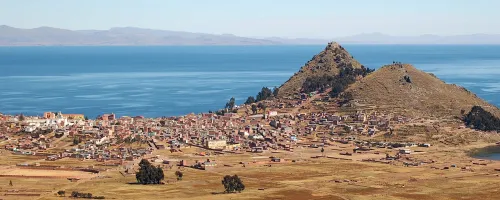
    Cerro del Calvario (Cerro El Calvario) in Copacabana, stop 3 on the self-guided walking tour

    This is the climb, and this is the payoff. A stone stairway runs up the hill following the fourteen Stations of the Cross, and it is steep enough at this altitude that you will stop to breathe more than once. No shame in it, everyone does. On the way up, vendors sell tiny plaster and plastic houses, trucks, and stacks of fake money: pilgrims buy them, place them at the top, and pray to the Virgin for the real version. Buy a miniature if you want, it costs a few bolivianos and it is the local thing to do. The summit gives you the whole view at once: the white basilica below, the red-tiled roofs of the town, and the deep blue of Lake Titicaca stretching to the horizon. It is free and open at all hours. Local advice is to climb in the late afternoon and watch the sun drop into the lake from up here. To continue, come back down the stairs and walk south through town toward the Kesanani hill on the far side.

    Hours
    Open 24/7
    Price
    Free
  4. 4

    Pachat'aqa (Pachataka)

    Pachat'aqa (Pachataka) in Copacabana, stop 4 on the self-guided walking tour

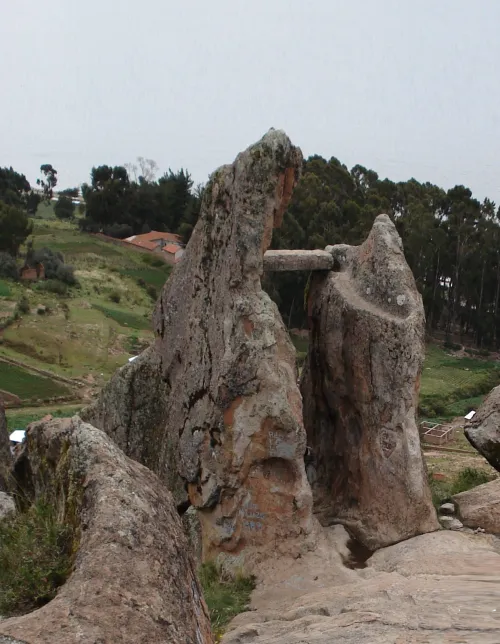
    After the crowds of the Calvario, this one is quiet. You climb a rocky path up Kesanani hill, about 600 meters south of the center, and the reward at the top is a stark stone lintel: two parallel pillars carrying a single horizontal slab, balanced against the rocks. The Spanish called it the Horca del Inca, the Inca's gallows, and got it completely wrong. The real name is Pachataka, Aymara for the place where time is measured, and that is what it was: a pre-Inca astronomical observatory used to track the solstices, lunar movements, and eclipses. Bolivian physicists date it to roughly 1764 BC, the Chiripa culture, which makes it far older than the Incas anyone associates it with. It is open daily 08:00 to 18:00 and entry is around Bs 10. The scramble up takes effort, but the silence, the old stone, and the lake view make it worth the detour. Head back down toward the plaza, retracing the route into the center of town.

    Hours
    Daily 08:00-18:00
    Price
    Bs 10 (approx; source: AllTrails visitor reports + TripAdvisor 2026)
  5. 5

    Museo del Poncho

    Missing required field: waypoints[4].image

    Finish back at the square, indoors and at ground level, which your legs will appreciate. This small museum is dedicated to the Andean poncho and the textile traditions of Lake Titicaca, and it does one thing well: it shows the poncho as more than a garment. The weavings on display, much of it male ceremonial attire, mark identity, social rank, and authority, and once you have seen the patterns up close you start spotting them on people around town. Entry is Bs. 15 and it is open 10:30 to 17:00, so plan the loop so you reach it before late afternoon rather than after a sunset on the Calvario. It is a short visit, twenty minutes is plenty, but it is a good quiet counterpoint to the religious weight of the basilica and a calm way to close the walk. From here the plaza and the lakeshore are a two-minute stroll, which is where you want to be for grilled trout as the light goes.

How Long Does This Walking Tour Really Take?

On paper this is a 3.6 km stroll you could clear in under two hours, but the altitude changes the math. Realistically it is three to four hours: give Cerro Calvario a full hour with the climb and the view, another hour for the Horca del Inca scramble, and twenty to thirty minutes each for the basilica and the museum.

The walking itself is short, around 3.6 km, but budget closer to three or four hours because of the altitude and the two climbs. Cerro Calvario is the time sink: the staircase is slow going, and you will want to linger at the top, so give it a full hour by itself, more if you stay for sunset. The Horca del Inca adds another good hour with the up-and-down scramble. The basilica and the museum are quick, twenty to thirty minutes each.

For a break, the lakeside at the bottom of town is the move. The string of food stalls along the beach grills fresh Titicaca trout (trucha) to order, served with rice and potatoes for a handful of bolivianos, and the tables look straight out over the water. Do that before or after the Calvario, not in the middle, since climbing on a full stomach at this altitude is miserable. For a lighter stop mid-walk, any of the cafes on the plaza will pour you a hot api con pastel, a thick purple maize drink with a fried pastry, which is exactly the sugar hit you want before the stairs.

Full Route, Shorter Walk or Two-Day Version?

The loop is designed to be walked in one go, climbing while you are fresh and saving the Calvario for late-afternoon light. But the altitude and the two hills mean not everyone wants all five stops in one push, so here are three ways to take it.

The Short Version

Skip the far hill, keep the highlights

Stops 1, 2, 3 and 5, around 2 km and 2–2.5 hours

Cut Horca del Inca, the two longest legs (1.2 km up and 1.6 km back), and you still get the plaza, the basilica, the Calvario sunset view and the poncho museum. This is the version for a half-day stopover or if the thin air is winning.

The Two-Part Split

Town first, hills at your own pace

Part A stops 1, 2 and 5 near the plaza; Part B the climbs at stops 3 and 4

Do the flat, indoor stops first, plaza, basilica and museum, then tackle Cerro Calvario and Horca del Inca separately when you have the breath and the light. Splitting the climbs off keeps you from stacking two hard ascents back to back at 3,812 meters.

You can walk it in reverse, starting at the Museo del Poncho and finishing at the basilica, but the recommended direction earns its keep: it puts Cerro Calvario near the end so you climb it in late-afternoon light and watch the sun drop into Lake Titicaca from the summit, then finishes flat and indoors.

Is This Copacabana Walking Tour Right for You?

This is a short but steep loop at high altitude, more about pacing than distance. It suits some travellers perfectly and needs adapting for others, so read the fit before you set off.

A good fit if you…

  • Travellers with half a day in Copacabana who want the town, not just the church
  • Anyone who enjoys a viewpoint climb and does not mind rough stone stairs
  • History and culture fans drawn to a pre-Inca observatory and Andean textiles
  • Independent walkers who prefer setting their own oxygen-starved pace

Adapt the route if you…

  • You have just arrived and are not acclimatized: do the flat stops first and delay the climbs
  • You struggle with stairs or loose rock: skip Horca del Inca and keep the paved route
  • It has just rained: save the Calvario and Horca paths, which turn slick, for a dry window
  • You only have an hour: stick to the plaza, the basilica and one quick Calvario look

Tickets & Skip-the-Line in Copacabana

There are no real ticket lines in Copacabana, the whole loop is essentially free open space, but two stops charge a small entry in bolivianos. Bring cash, since neither takes cards, and mind the opening hours so you do not arrive after they close.

Basilica of Our Lady of Copacabana (Basílica de Nuestra Señora de Copacabana)Free entry, a donation is the polite move. Open daily 07:00 to 18:00, but the upstairs chapel with the exvotos and the original image usually only opens from around 14:00, so an afternoon visit sees the full thing. official ticket site ↗
Pachat'aqa (Pachataka)Entry is around Bs 10, paid in cash at the site. Open daily 08:00 to 18:00. It is a rocky scramble up Kesanani hill, so allow time and bring shoes with grip.
Museo del PonchoEntry Bs 15, cash only. Open 10:30 to 17:00, so reach it before late afternoon rather than after a Calvario sunset. Twenty minutes is plenty for the visit.
Everything elsePlaza 2 de Febrero and Cerro Calvario are free, open-air public spaces with no gates and no tickets, open around the clock.
Optional upgrade
+2
The same 5-stop route,
now with navigation and a guide.
Optional AI experience

You already have the route.
The AI guide brings it to life.

Standing on Plaza 2 de Febrero with the white basilica in front of you? Let the guide walk you through it in your ear, from the car-blessing on the steps to the right moment to start up Cerro Calvario for sunset. Press start and it talks you stop by stop, all the way to the lake.

Livenavigation13languagesAnyquestionYourinterests
Open this route with the AI guide

Try it in your browser · No app or download required

Tips for Walking in Copacabana

  • Buses from La Paz drop you near the lakeshore and the plaza is a five-minute walk uphill. Arrive by early afternoon so you can climb Cerro Calvario for the 17:00-18:00 sunset and still get the museum (closes 17:00) and basilica (closes 18:00) the same day.
  • The Calvario steps and the Horca del Inca path are rough stone and loose rock, often dusty, sometimes slick after rain. Wear real shoes with grip, not sandals, and take the climbs slowly because the thin air will catch you off guard.
  • There are no reliable public restrooms on the hills. Use the toilets at a plaza cafe or restaurant before you start the Calvario climb, and carry a few coins since some charge a small fee.
  • Eat the grilled trout at the lakeside food stalls below the plaza. A full plate of trucha with rice and potato runs a few bolivianos, far cheaper than the tourist restaurants, and the lake view is free.
  • For the classic shot, climb Cerro Calvario in the late afternoon and face northeast from the summit: the white basilica, the red-tiled town, and Lake Titicaca all line up, and the low sun lights the water just before it sets.

Why Walk This Route?

Copacabana is small, and that is exactly why you walk it. The whole town sits on a saddle of land between two hills on the Bolivian shore of Lake Titicaca, at 3,812 meters, and you can cross the center in fifteen minutes. The catch is the altitude. Everything here happens uphill, and your lungs will remind you of it on the first staircase. So the trick is not distance, it is pacing, and a loop that hits the basilica, the two hills, and the lakeshore in the right order so you climb when you are fresh and watch the sunset when you are done.

This route does that. It starts on the main plaza in front of the white basilica, the reason the town exists, then sends you up Cerro Calvario for the postcard view, over to the pre-Inca stone observatory on the southern hill, and back to a textile museum on the square. Most people roll through Copacabana in half a day on their way to Isla del Sol and miss everything except the church. That is the mistake. The town itself, the pilgrim energy, the miniature houses for sale on the Calvario steps, the trout grilled lakeside, is the actual experience.

Walk it yourself and you go at your own oxygen-starved pace, stop for an api con pastel when you need sugar, and time the climb for golden hour. No bus, no schedule, no waiting for a group of twelve to take the same photo. Just you, a steep town, and the highest navigable lake in the world below.

Common Questions

Is Copacabana safe to walk around?

Yes, it is a small pilgrimage town and the center is calm and friendly, even after dark on the plaza. The real risk here is not crime but altitude: at 3,812 meters, soroche (altitude sickness) is common, so go slow, drink water and coca tea, and do not push the climbs if you feel dizzy or short of breath. Keep an eye on your bag in the crowded weekend market and at the bus drop-off, the usual basics, and you are fine.

What if it rains during my Copacabana tour?

Rain turns the Calvario steps and the Horca del Inca path slick, so save the hills for a dry window. The good indoor option on this route is the Basílica de Nuestra Señora de Copacabana (open until 18:00, free), where you can spend time in the nave and, after 14:00, the chapel with the exvotos. The Museo del Poncho (open 10:30 to 17:00, Bs. 15) is the other dry stop right on the plaza. Tuck into a cafe for an api and wait it out: mountain weather here usually clears fast.

What's the best time of day for this walking tour?

Start in the early-to-mid afternoon. That lets you do the basilica and the Horca del Inca while the museum is still open, then save Cerro Calvario for last and climb it in the late afternoon, which is exactly when locals go to watch the sun set over Lake Titicaca from the summit. Mornings are colder and the basilica's upper chapel only opens around 14:00, so afternoon simply works better for this loop.

Take this route with you

Open this exact tour with navigation and your personal AI guide.

Start GPS Navigation + AI Guide
AI Tourguide
Researched and curated by the AI Tourguide teamWe plan and quality-check every route, then research and verify the opening hours, prices, and practical tips for each stop along it.
▶ Open route with AI guideNavigation, stories and your questions