Self-Guided Walking Tour in Copenhagen

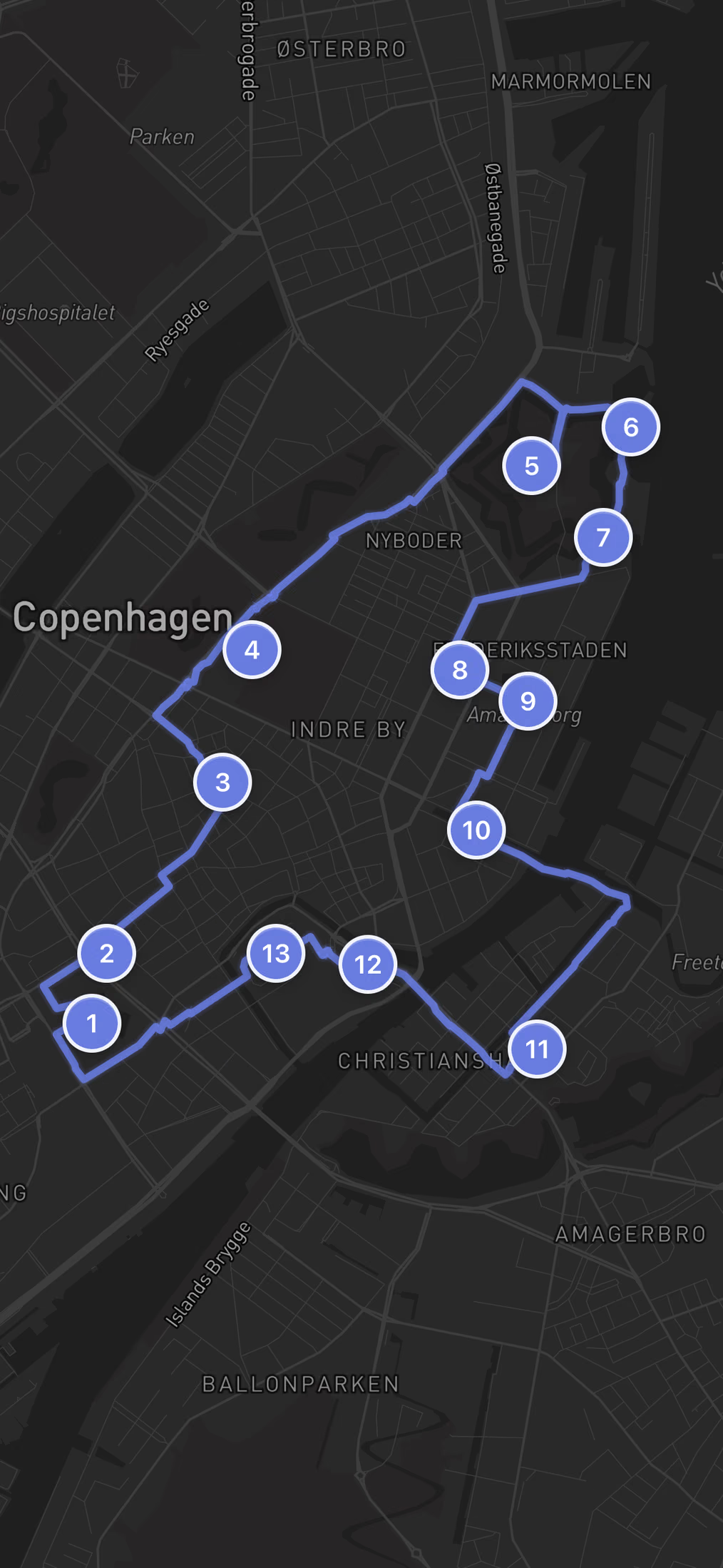
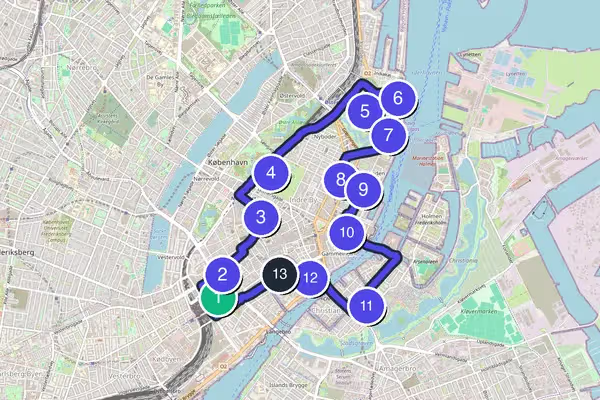
A self-guided walking route through central Copenhagen: 13 stops over 11.4 km, starting at Tivoli Gardens beside the central station and ending at Christiansborg Palace on Slotsholmen. This page gives you the map, walking time for every leg, real prices and opening hours, and shorter versions if you have less time.

13 Stops11.4 km~4 hours walking5–6 hours with stops
What you get with AI Tourguide
Full GPS navigationInteractive AI guidePersonalized to youWorks in your browser
Try this tour with Alex

Copenhagen Walking Tour at a Glance

This route is built for walkers who want the whole royal and harbor core of Copenhagen in one day without a guide setting the pace. You follow it in order from Tivoli to Christiansborg, and every paid interior along the way is optional. You decide at each entrance whether to go in, linger, or keep moving. The outdoor walk stands on its own.

StartTivoli Gardens (Tivoli)
FinishChristiansborg Palace (Christiansborg Slot)
Route typeA large clockwise loop that heads north from the central station, up to the harbor and the Little Mermaid, then curves back south through Frederiksstaden and Christianshavn to finish on Slotsholmen, a ten-minute walk from where you began. Almost no backtracking.
Realistic timePure walking is about 2.5 hours for the 11.4 km. Add ten to fifteen minutes at each of the 13 stops and you reach roughly 4.3 hours, and most people take 5 to 6 hours once they go inside anything.
DifficultyEasy underfoot. Copenhagen is almost perfectly flat, so there is not a single hill on the route, though you cross several canals and one harbor bridge, and the waterfront stretches near the Little Mermaid catch the full Oresund wind.
Cost to followFollowing the outdoor route costs nothing, and most of the 13 stops are free. The paid interiors are all optional: Tivoli 155 DKK, Rosenborg Castle 130 DKK, Amalienborg Museum 120 DKK, the Christiansborg combo 180 DKK, Round Tower 40 DKK, Church of Our Saviour tower 65 DKK.
Best for:

First-time visitors who want to see the royal palaces, the fortress, the Little Mermaid, and Nyhavn in a single logical loop, and who like deciding for themselves which doors are worth the ticket.

The Route

Free Walking Tour Map of Copenhagen

13 stops11.4 kmabout 4 hours
Loading the interactive map…The complete walking route will appear here.
Want the route to guide you while you walk?Open the route with navigation and a personal guide for the history, stories and questions that matter to you.
Open route + AI guide

The 13 stops along this route

  1. Tivoli Gardens (Tivoli) in Copenhagen, stop 1 on the self-guided walking tour
    1Tivoli Gardens (Tivoli)
  2. Copenhagen City Hall (Københavns Rådhus) in Copenhagen, stop 2 on the self-guided walking tour
    2Copenhagen City Hall (Københavns Rådhus)
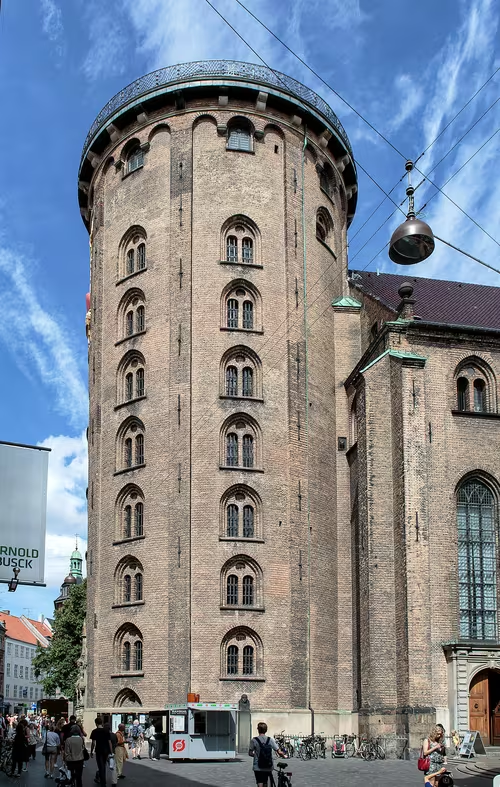
  3. Rundetaarn (Rundetårn) in Copenhagen, stop 3 on the self-guided walking tour
    3Rundetaarn (Rundetårn)
  4. Rosenborg Castle (Rosenborg Slot) in Copenhagen, stop 4 on the self-guided walking tour
    4Rosenborg Castle (Rosenborg Slot)
  5. Kastellet in Copenhagen, stop 5 on the self-guided walking tour
    5Kastellet
  6. The Little Mermaid (Den lille Havfrue) in Copenhagen, stop 6 on the self-guided walking tour
    6The Little Mermaid (Den lille Havfrue)
  7. Gefion Fountain (Gefionspringvandet) in Copenhagen, stop 7 on the self-guided walking tour
    7Gefion Fountain (Gefionspringvandet)
  8. Frederik's Church (Marmorkirken) in Copenhagen, stop 8 on the self-guided walking tour
    8Frederik's Church (Marmorkirken)
  9. Amalienborg in Copenhagen, stop 9 on the self-guided walking tour
    9Amalienborg
  10. Nyhavn in Copenhagen, stop 10 on the self-guided walking tour
    10Nyhavn
  11. Church of Our Saviour (Vor Frelsers Kirke) in Copenhagen, stop 11 on the self-guided walking tour
    11Church of Our Saviour (Vor Frelsers Kirke)
  12. Børsen in Copenhagen, stop 12 on the self-guided walking tour
    12Børsen
  13. Christiansborg Palace (Christiansborg Slot) in Copenhagen, stop 13 on the self-guided walking tour
    13Christiansborg Palace (Christiansborg Slot)
  14. That's the complete route.

    If you want more than the map and text, add live navigation and a conversational AI guide while you walk.

    Open route + AI guide
    You made it
Stop 1 of 13
Swipe →

Your Copenhagen Walking Tour, Stop by Stop

  1. 1

    Tivoli Gardens (Tivoli)

    Tivoli Gardens (Tivoli) in Copenhagen, stop 1 on the self-guided walking tour

    You start directly across Vesterbrogade from Copenhagen Central Station, where the ornate entrance arch of Tivoli Gardens faces the street. The park opened on August 15, 1843, making it the world's second-oldest amusement park. Adult admission costs 155 DKK, which gets you through the gates but not onto the rides. Inside, the Rutschebanen is the draw: a wooden roller coaster built in 1914 that still requires a human brakeman riding every single car to control the speed manually. The park pulled 4.25 million visitors in 2024. Hours shift with the seasons, roughly 11am to midnight in summer. Tivoli also opens for separate Halloween and Christmas seasons with completely different decorations. If you are just passing through on a morning walk, the garden architecture and the Chinese-style pagoda are visible from just inside the gate. Evening visits, when thousands of colored lights come on, are a different experience entirely.
    Hours
    11am-midnight (varies seasonally, check website)
    Price
    155 DKK
  2. 2

    Copenhagen City Hall (Københavns Rådhus)

    Copenhagen City Hall (Københavns Rådhus) in Copenhagen, stop 2 on the self-guided walking tour

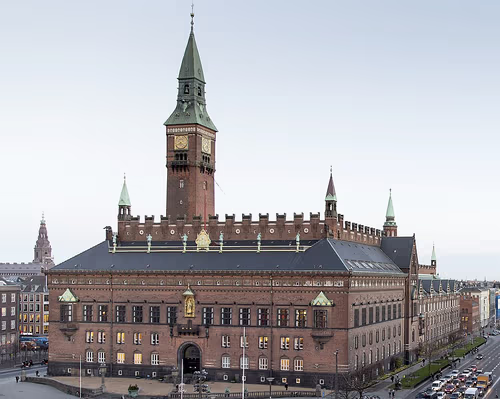
    Cross the street and you are on Radhuspladsen, the city's largest public square. The City Hall fills its western edge: red brick, Neo-Renaissance, completed in 1905. Martin Nyrop designed it after the Palazzo Pubblico in Siena, and you can see the resemblance in the arched windows and the square tower. That tower reaches 105.6 meters, making it the tallest point in central Copenhagen. Step inside (free) and find Jens Olsen's World Clock on the ground floor. This astronomical instrument has 15,448 moving parts, calculates calendar dates spanning 570,000 years, and tracks planetary positions with frightening accuracy. Olsen worked on it for 27 years and died before it was finished. Tower tours run at set times for a small fee. Out in the square, look for the bronze Hans Christian Andersen statue on a bench, gazing toward Tivoli. He lived on Nyhavn, which you will reach in about two hours.

    Hours
    Mon-Fri: 9:00 AM – 4:00 PM | Sat: 9:30 AM – 1:00 PM | Sun: Closed
    Price
    Free (hall); 30 DKK (tower tour)
    Website
    kk.dk ↗
  3. 3

    Rundetaarn (Rundetårn)

    Rundetaarn (Rundetårn) in Copenhagen, stop 3 on the self-guided walking tour

    Walk north along Stroget, the pedestrian boulevard, and turn onto Kobmagergade. The Round Tower appears like a squat brick cylinder wedged between shopfronts. Christian IV built it in 1642 as an astronomical observatory, and its defining feature is inside: no stairs anywhere. A 209-meter spiral ramp wide enough for a horse-drawn carriage winds to the top. Tsar Peter the Great allegedly rode up on horseback in 1716. Admission is free. The ramp takes about five minutes at an easy pace, and halfway up a glass floor panel lets you peer straight down the hollow core, which is more unnerving than it sounds. The observation platform at 34.8 meters gives a clean view over Copenhagen's copper-green rooftops. On winter evenings the university opens the rooftop observatory for public stargazing sessions. Open daily 10am to 6pm. The tower gets crowded after 11am, so your timing on this route should put you here before the rush.

    Hours
    Daily: 10:00 AM – 6:00 PM
    Price
    40 DKK
  4. 4

    Rosenborg Castle (Rosenborg Slot)

    Rosenborg Castle (Rosenborg Slot) in Copenhagen, stop 4 on the self-guided walking tour

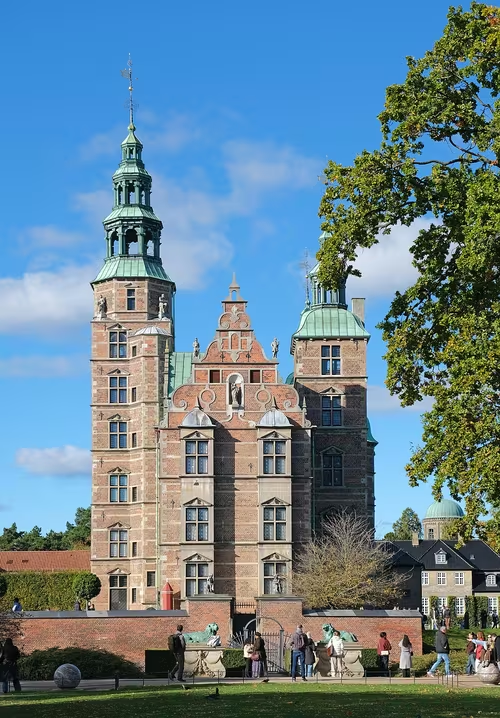
    Continue north through the university quarter and enter Kongens Have (the King's Garden), Copenhagen's oldest royal park. Rosenborg Castle sits at its center, a compact Dutch Renaissance building with stepped gables and a green copper roof. Christian IV built it between 1606 and 1634 as a summer residence, and it now houses the Danish Crown Jewels in the basement treasury. Three life-sized silver lions guard the 17th-century Coronation Chairs upstairs. The Knights' Hall ceiling alone justifies the admission, which runs around 130 DKK (check current prices, as they adjust seasonally). Open Tuesday through Sunday 10am to 4pm, closed Mondays. The surrounding garden is free and full of locals on lunch breaks, especially in summer when every bench and grass patch is occupied. Walk to the castle's southern side for the best angle: the full facade reflected in the moat. Before leaving, note the entrance to Torvehallerne food market two blocks east on Israels Plads, a good lunch option if your legs need a break.

    Hours
    Mon: Closed | Tue-Sun: 10:00 AM – 4:00 PM
    Price
    130 DKK
  5. 5

    Kastellet

    Kastellet in Copenhagen, stop 5 on the self-guided walking tour

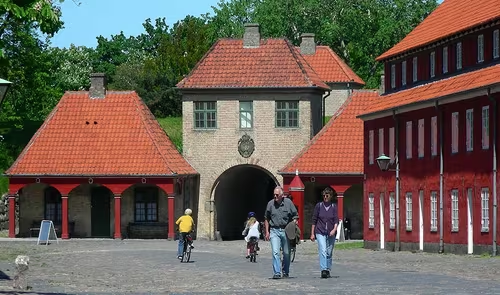
    Head northeast through Oster Anlaeg park, cross Groenningen, and enter Kastellet through the southern King's Gate. This pentagonal star-shaped fortress was completed in 1665 and remains an active military installation. The Danish Defence Intelligence Service works inside these walls. That does not stop anyone from walking through: the ramparts are open daily 6am to 8pm, and the atmosphere is closer to a public park than a garrison. An 1847 windmill stands on one bastion, red-painted barracks line the interior lanes, and geese patrol the moat. A full loop along the star-shaped earthen walls takes about 20 minutes and gives elevated views in every direction: harbor cranes to the north, church spires to the south, the Oresund strait to the east. This is Copenhagen stripped of its tourist packaging. Joggers, dog walkers, the occasional soldier in uniform. No gift shops, no guided tours, no entry fee.

    Hours
    Daily: 6:00 AM – 8:00 PM
    Price
    Free
  6. 6

    The Little Mermaid (Den lille Havfrue)

    The Little Mermaid (Den lille Havfrue) in Copenhagen, stop 6 on the self-guided walking tour

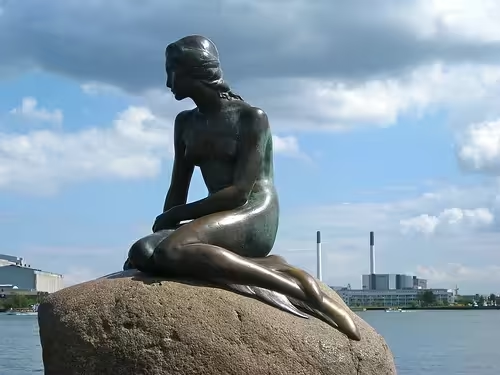
    Exit Kastellet through the northeast Norgesporten gate and follow the waterfront path along Langelinie. The Little Mermaid sits on a boulder at the harbor's edge, and she is smaller than you expect. At 1.25 meters tall, she barely clears the rocks around her. Unveiled on August 23, 1913, the bronze statue was a gift from brewer Carl Jacobsen, founder of the Carlsberg fortune. Sculptor Edvard Eriksen used ballerina Ellen Price as the face model but his own wife Eline for the body, because Price refused to pose nude. The statue has been decapitated twice, lost an arm, and been blown off her rock with explosives over the decades. Each time she gets repaired and put back. Free, open 24/7. Arrive before 9am to beat the cruise ship bus crowds that descend after 10:30. For the best photo, move to the rocks slightly to her left and shoot toward the harbor rather than out to open water.

    Hours
    Open 24/7
    Price
    Free
  7. 7

    Gefion Fountain (Gefionspringvandet)

    Gefion Fountain (Gefionspringvandet) in Copenhagen, stop 7 on the self-guided walking tour

    Walk south back toward Kastellet and you will find the Gefion Fountain in a small park between the fortress walls and the harbor. Anders Bundgaard completed this in 1908 for the Carlsberg Foundation's 50th anniversary. The sculpture shows the Norse goddess Gefion driving four massive oxen as she plows the island of Zealand out of Sweden, a scene from the Prose Edda. It is Copenhagen's largest monument, and far more dramatic than most visitors expect: water crashes down rocky tiers, the oxen strain forward with visible effort, and spray catches the light. Functions as a wishing well if you want to toss a coin. Free, visible anytime. The adjacent St. Alban's Church, a small English Gothic Revival building from 1887, is a quiet five-minute detour. From here you walk south into Frederiksstaden, the 18th-century royal district laid out on a strict grid.

    Hours
    Open 24/7
    Price
    Free
  8. 8

    Frederik's Church (Marmorkirken)

    Frederik's Church (Marmorkirken) in Copenhagen, stop 8 on the self-guided walking tour

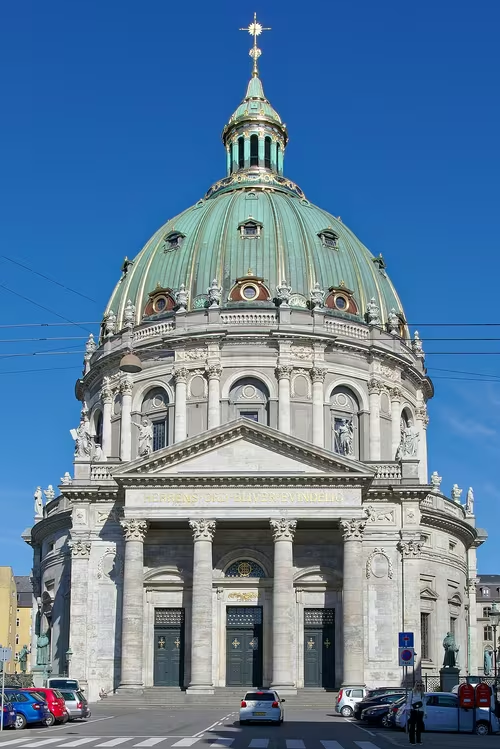
    Walk south along Bredgade and the dome announces itself long before you reach the entrance. Officially Frederik's Church, the Marble Church has the largest church dome in Scandinavia: 31 meters across, supported by 12 columns. Construction began in 1749 using expensive Norwegian marble, then stalled in 1770 when the money ran out. The building sat as a roofless ruin for 125 years until financier C.F. Tietgen funded its completion in 1894, this time with cheaper Danish marble. Free to enter. Hours: Monday through Thursday 10am to 5pm, Friday noon to 5pm, Saturday 10am to 5pm, Sunday 1pm to 5pm. The interior is restrained compared to southern European churches, but stand under the dome's center and look straight up. The sense of scale is immediate. You can climb to the dome's external balcony for a small fee (check at the entrance) for harbor views. Outside, Frederiksgade runs in a straight line toward Amalienborg, and the dome frames the street perfectly when you look back.

    Hours
    Mon-Thu: 10:00 AM – 5:00 PM | Fri: 12:00 – 5:00 PM | Sat: 10:00 AM – 5:00 PM | Sun: 1:00 – 5:00 PM
    Price
    Free
  9. 9

    Amalienborg

    Amalienborg in Copenhagen, stop 9 on the self-guided walking tour

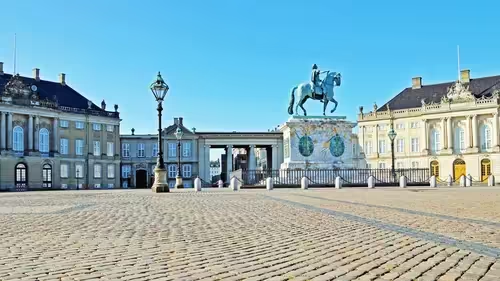
    Walk down Frederiksgade and you enter the octagonal courtyard of Amalienborg, the Danish royal family's primary residence since 1794. Four nearly identical Rococo palaces surround the cobblestoned square, built in the 1750s for Copenhagen's noble families. The royals moved in after Christiansborg burned and simply stayed. When the monarch is home, a flag flies from the roof. The Royal Life Guards perform the changing of the guard ceremony here at noon every day. The march starts at Rosenborg Castle (which you passed two hours ago) at 11:30am and crosses the city, so time your arrival if you want to see it. The Amalienborg Museum in one palace costs 120 DKK and covers royal life from the 1800s onward. From the waterfront side of the square, look east across the harbor: the Copenhagen Opera House sits on direct axis with the palace, an alignment the architect A.P. Moller insisted on.

    Hours
    Tue-Sun 10am-4pm (closed Mondays)
    Price
    120 DKK (museum)
  10. 10

    Nyhavn

    Nyhavn in Copenhagen, stop 10 on the self-guided walking tour

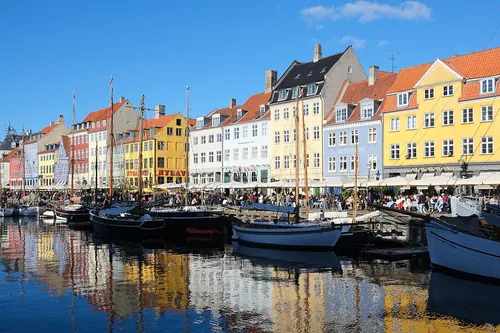
    Head south on Amaliegade and turn right toward the canal. The row of painted townhouses along Nyhavn is Copenhagen's most recognized image, and it earns that status. The canal was dug between 1671 and 1673 by Swedish prisoners of war to link the city to the sea. Hans Christian Andersen lived at No. 20 in 1835, where he wrote his first fairy tales, and later at No. 67. The oldest house still standing is No. 9, from 1681. The sunny northeastern side is packed with outdoor restaurant seating, and the prices reflect the real estate. A beer at a canal-side table runs 80 to 100 DKK. Locals buy a Tuborg from a nearby kiosk for 25 DKK and sit on the quay edge instead. For better food, walk one block back from the waterfront. Canal boat tours depart from the harbor end and cost around 100 DKK for a one-hour loop past most waterfront sights. Free to walk, open always.

    Hours
    Open 24/7
    Price
    Free
  11. 11

    Church of Our Saviour (Vor Frelsers Kirke)

    Church of Our Saviour (Vor Frelsers Kirke) in Copenhagen, stop 11 on the self-guided walking tour

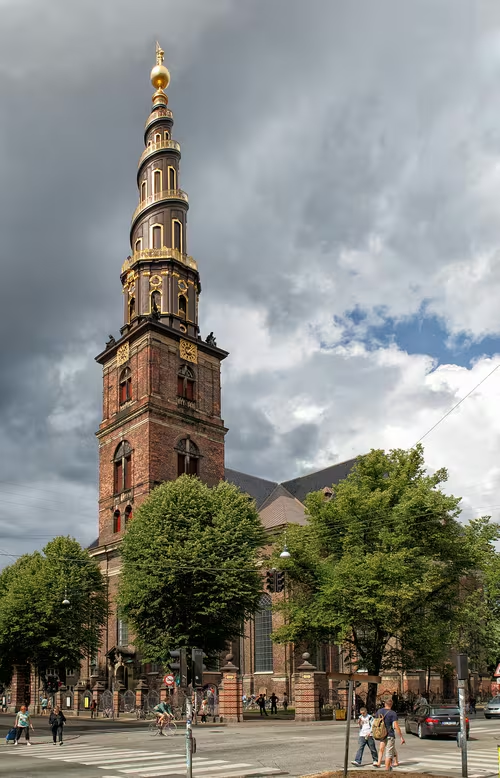
    Cross the Inderhavnsbroen pedestrian bridge into Christianshavn and walk south along Sankt Annae Gade. The Church of Our Saviour's golden spiral spire twists 90 meters above the rooftops, visible from half the city. The external staircase has 400 steps that narrow progressively; the final stretch is barely shoulder-width, fully exposed to the wind, with only a thin railing between you and a long drop. The view from the top is the best in Copenhagen: the city grid laid flat below, Oresund Bridge on the horizon, wind turbines spinning offshore. Admission to the tower costs around 65 DKK (check current prices). The church nave is free. Inside, look for the carved organ facade from 1698 and the elaborate Baroque altarpiece by Nicodemus Tessin. Open daily 11am to 3:30pm, though the tower closes in high winds. A popular local legend says the architect threw himself from the spire when he saw it spiraled the wrong direction. Not true. He died in bed, years later.

    Hours
    Daily: 11:00 AM – 3:30 PM
    Price
    65 DKK
  12. 12

    Børsen

    Børsen in Copenhagen, stop 12 on the self-guided walking tour

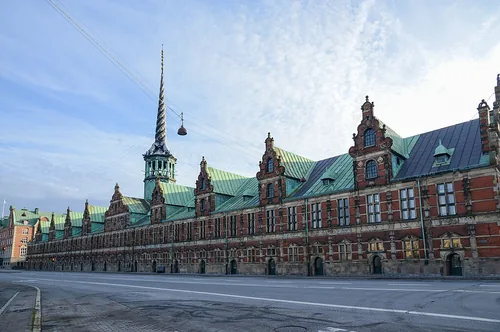
    Cross back to Slotsholmen island via Torvegade and the Knippelsbro bridge area. On your right stands Borsen, or what remains of it. Completed in 1640 under Christian IV, this was Europe's oldest stock exchange building still in use. Its signature was a 56-meter spire formed by four intertwined dragon tails. On April 16, 2024, fire broke out during renovation. The scaffolding caught, the dragon spire collapsed, and much of the interior was destroyed. The building now sits behind construction barriers, wrapped in protective sheeting. You cannot enter. Walk along the fence and read the informational panels about the reconstruction effort. Three centuries of Baltic storms, two world wars, and a German occupation could not bring this building down. A renovation project did. Copenhagen has committed to a full rebuild, so check progress when you visit.

    Hours
    Not open to public
    Price
    Not available
  13. 13

    Christiansborg Palace (Christiansborg Slot)

    Christiansborg Palace (Christiansborg Slot) in Copenhagen, stop 13 on the self-guided walking tour

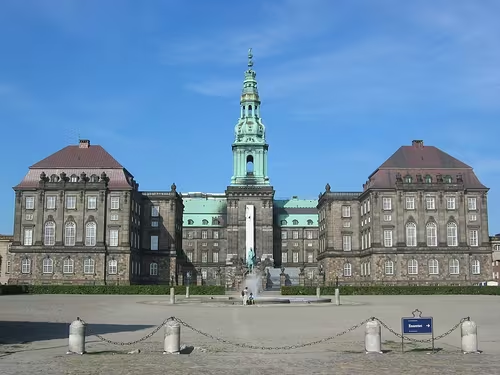
    Your final stop is a two-minute walk from Borsen, still on Slotsholmen. Christiansborg Palace is the only building on earth that houses a nation's parliament, supreme court, and prime minister's office under one roof. The Danish royal family uses several wings for state banquets and official receptions. This is the third palace on this exact site. The first two burned. In the basement, stone foundations from Bishop Absalon's original 1167 fortress are exposed and walkable, the structure that effectively founded Copenhagen as a city. Upstairs, the Royal Reception Rooms display enormous tapestries illustrating 1,000 years of Danish history. A combo ticket covering all sections costs 180 DKK. Open Tuesday through Sunday, 10am to 5pm, closed Mondays. The palace tower is free to enter and offers what might be the best viewpoint in the city, partly because you can see the Round Tower and every church spire you visited today from up there. End your walk here. The central station is a 10-minute stroll west.

    Hours
    Mon: Closed | Tue-Sun: 10:00 AM – 5:00 PM
    Price
    180 DKK (combo)

How Long Does This Walking Tour Really Take?

Budget 5 to 6 hours to do this route justice. The 11.4 km of walking is only about 2.5 hours on flat ground, but Tivoli alone wants 45 minutes if you enter, Rosenborg takes 30 to 45 for the treasury, and the Church of Our Saviour spire climb runs 20 minutes up and down before you even reach the view.

Pure walking time for the 11.4 km route is around 2.5 hours. Add 10 to 15 minutes per stop and you reach the stated 4.3 hours. In practice, most people take 5 to 6 hours once they go inside Rosenborg Castle, climb the Church of Our Saviour spire, and sit down for a beer at Nyhavn.

Stops that eat time: Tivoli Gardens needs 45 minutes minimum if you enter (and two to three hours if you ride anything). Rosenborg Castle takes 30 to 45 minutes for the treasury and the Knights' Hall. The Church of Our Saviour spire climb is 20 minutes up and down plus time at the top. Everything else can be absorbed in 10 minutes if you are moving. For a lunch break, the stretch between Rosenborg and Kastellet passes near Torvehallerne market on Israels Plads, where Hallernes Smorrebrod serves proper open-faced sandwiches from about 65 DKK. In the afternoon, Cafe Wilder on Wildersgade in Christianshavn (between Nyhavn and the Church of Our Saviour) does strong coffee and cardamom pastries. Plan your start so you reach Amalienborg around noon for the changing of the guard.

Full Route, Shorter Walk or Two-Day Version?

You do not have to walk all 13 stops. The route splits cleanly into a northern half and a harbor half, and the longest single leg is the 2 km stretch up to Kastellet, so here are three ways to run it depending on your time and legs.

Central core

The city center without the harbor detours

Stops 1 to 4, then 8 to 10 and 12 to 13, about 6 km and 3 hours

Cuts the two longest legs: the 2 km haul to Kastellet and the 1.4 km crossing to Christianshavn. You keep Tivoli, City Hall, the Round Tower and Rosenborg, then drop straight down to the Marble Church, Amalienborg, Nyhavn, Borsen and Christiansborg. You miss the Little Mermaid, but you keep every palace and the best canal view.

Two-day split

Royal north on day one, harbor south on day two

Day one stops 1 to 7, day two stops 8 to 13, roughly 3 hours each

Split at Gefion Fountain. Day one climbs from Tivoli through the Round Tower, Rosenborg and out to Kastellet, the Little Mermaid and Gefion. Day two picks up at the Marble Church and runs through Amalienborg, Nyhavn, the Church of Our Saviour spire and Slotsholmen. This is the relaxed version, with time to actually enter the castles.

You can walk it in reverse, from Christiansborg back to Tivoli, but the given direction is the easier one. You arrive straight into Tivoli across the street from the central station, save the long open harbor legs for the morning before the Oresund wind and cruise-ship crowds build, and finish at Christiansborg only ten minutes from the station and the metro.

Is This Copenhagen Walking Tour Right for You?

This is a flat, long, but genuinely easy walk that covers a lot of ground. It suits some travelers better than others, so here is who it fits and how to bend it to your day.

A good fit if you…

  • First-time visitors who want the palaces, the fortress, the Little Mermaid and Nyhavn in one coherent loop
  • Walkers comfortable with 11.4 km on flat pavement over the course of a day
  • People who prefer choosing their own interiors rather than paying one fixed guided-tour price
  • Photographers who want early, empty light at the Little Mermaid and along the Nyhavn canal

Adapt the route if you…

  • You have only half a day: take the central-core version and skip the harbor detours
  • You are traveling with small children or tire easily: split it across two days at Gefion Fountain
  • You want the changing of the guard: start around 9am so you reach Amalienborg by noon
  • The weather turns: the Round Tower, Rosenborg, the Marble Church and Christiansborg all let you wait out a shower indoors

Tickets & Skip-the-Line in Copenhagen

Most of this route is free and outdoors, so tickets only matter at a handful of stops.

Tivoli Gardens (Tivoli)155 DKK gets you through the gates but not onto the rides. Open roughly 11am to midnight in summer, though hours shift seasonally, so check before you go.
Copenhagen City Hall (Københavns Rådhus)The hall itself is free (Mon-Fri 9am-4pm, Sat 9:30am-1pm, closed Sun); the tower tour is a separate 30 DKK.
Rundetaarn (Rundetårn)40 DKK, open daily 10am to 6pm. It gets crowded after 11am, so this route deliberately puts you here early.
Rosenborg Castle (Rosenborg Slot)130 DKK for the Crown Jewels and Knights' Hall. Tue-Sun 10am-4pm, closed Mondays. The surrounding King's Garden is free.
AmalienborgThe courtyard and the noon changing of the guard are free; the palace museum is 120 DKK, Tue-Sun 10am-4pm, closed Mondays.
Church of Our Saviour (Vor Frelsers Kirke)The nave is free; the 400-step twisting spire climb costs 65 DKK, open daily 11am to 3:30pm and closed in high winds.
Christiansborg Palace (Christiansborg Slot)180 DKK combo covers the Royal Reception Rooms and the ruins beneath. Tue-Sun 10am-5pm, closed Mondays. The palace tower is free and gives the best city view.
Everything else is freeKastellet, the Little Mermaid, the Gefion Fountain, the Marble Church and Nyhavn cost nothing to visit. Børsen is closed behind construction fencing after the 2024 fire and cannot be entered.
Optional upgrade
+9
The same 13-stop route,
now with navigation and a guide.
Optional AI experience

You already have the route.
The AI guide brings it to life.

Standing by Tivoli Gardens next to Copenhagen Central Station? Open AI Tourguide in your browser, no app and no download, and a voice guide walks the whole route with you, greeting you, telling the story from the Round Tower to Kastellet and the Little Mermaid and asking what you want to see so it adapts as you go. A real conversation, not a recording. Start with 100 free credits.

Livenavigation13languagesAnyquestionYourinterests
Open this route with the AI guide

Try it in your browser · No app or download required

Tips for Walking in Copenhagen

  • Start at Copenhagen Central Station (Kobenhavn H). Metro lines M3 and M4 stop here, along with regional S-trains from the airport (13 minutes, 36 DKK or free with Copenhagen Card). The Tivoli entrance is directly across Vesterbrogade.
  • The Copenhagen Card costs 479 DKK for 24 hours and covers Tivoli, Rosenborg Castle, Christiansborg, canal boat tours, and all public transport. If you plan to enter three or more paid attractions on this route, it pays for itself.
  • Best Nyhavn photo: stand on the southern quay (the shaded side) and shoot across the canal toward the colored facades on the sunny northeastern side. Morning light before 9am gives clean illumination with almost no people.
  • Stop at Sankt Peders Bageri on Sankt Pedersstraede near the Round Tower for a cinnamon snail (kanelsnegl) at around 35 DKK. It is one of the oldest bakeries in Copenhagen and far better than anything on the Nyhavn waterfront.
  • Bring a wind-resistant layer no matter the season. The Langelinie waterfront near the Little Mermaid and the Church of Our Saviour spire are fully exposed to the Oresund strait wind, which picks up sharply even on warm days.

Where to Eat Along the Route

Copenhagen's best food is almost never where the tour crowds gather. Skip the waterfront restaurants along Nyhavn (generic food at prices inflated 25 to 40 percent above equivalent places five minutes away), the overpriced stalls inside Tivoli, and the chain dining along Strøget. Walk a few blocks off the postcard and the quality jumps while the bill drops.

  • Torvehallerne, the covered market near Nørreport, sits right on your route between Rosenborg Castle and Kastellet. Fifty-plus vendors at every price point, genuinely where Copenhageners eat, and reliably fair value for smørrebrød, coffee and fresh produce.
  • Vesterbro and the Meatpacking District (Kødbyen), just west behind Central Station where the walk begins, is the city's food and nightlife hub. Everything from craft-beer BBQ to seafood to tacos in converted slaughterhouse halls.
  • Christianshavn, which you cross near the Church of Our Saviour, trades tourist bustle for quiet canal-side gems and a couple of serious kitchens tucked into historic buildings.
  • Nørrebro, a short detour north of the Round Tower and Rosenborg, is the multicultural, hipster-heavy quarter packed with world-class pizza, burgers and ethnic eats at local prices.
John's Hotdog Deli⌖A cart right outside Central Station where the tour starts, widely called the hotdog king of Copenhagen. Order a classic Danish dog with remoulade, pickles and crispy onions before you even reach Tivoli.
Hallernes Smørrebrød (Torvehallerne)⌖Proper open-faced rye sandwiches from around 65 DKK inside the market, directly on your route near Rosenborg. The ideal walk-in lunch break, no reservation needed.
Restaurant Schønnemann⌖A smørrebrød institution since 1877, a short step off Strøget. Lunch only and almost always fully booked, so reserve ahead. If it is full, Restaurant Kronborg nearby serves the same tradition and stays open into the evening.
Kødbyens Fiskebar⌖The consensus best seafood in the Meatpacking District, a rough-industrial room with a great outdoor patio. A splurge (the bill climbs fast), so book a table if you want dinner after the walk.

Do not eat at the Nyhavn waterfront restaurants: the view is the product and the food is a secondary, overpriced afterthought, and steer clear of the theatrical "Viking banquet" dinners (400 to 700 DKK) that have nothing to do with real Danish food.

Tourist Traps to Avoid in Copenhagen

Copenhagen is one of Europe's most honest cities, so genuine scams are rare. The real risks are passive price traps and a couple of transit and street-game catches worth knowing.

  • Validate your Metro or train ticket at the yellow machine before boarding. Holding a ticket is not enough, and inspectors hand out a flat 750 DKK fine with no excuses accepted.
  • Ignore the card and cup games run on Strøget. It is street gambling, not entertainment, and people lose up to 500 DKK in seconds trying to guess the card.
  • Never walk in the bright blue bike lanes. They look like part of the pavement but sit slightly lower, and stepping into one is the fastest way to anger a cyclist.
  • Skip bottled water entirely: Copenhagen tap water is safe, excellent and free everywhere. Carry a reusable bottle.
  • Book canal cruises at the main Nyhavn or Gammel Strand piers from established operators, not from someone approaching you on the dock offering a cheaper trip.
  • Do not walk far to the Little Mermaid expecting a grand monument. At 1.25 meters she is smaller than every photo suggests, though on this route she is a free, quick stop rather than a special trip.

Why Walk This Route?

This Copenhagen walking tour covers 13 stops across 11.4 km, and you should plan roughly 4.3 hours to complete it at a comfortable pace. The route starts at Tivoli Gardens beside the central station and ends at Christiansborg Palace on Slotsholmen island, threading through royal districts, a 17th-century fortress, and the canal-side streets of Christianshavn. Copenhagen is almost perfectly flat. You will not climb a single hill, though you will cross several canals and one harbor bridge.

Most of these 13 stops are free. The paid attractions (Tivoli at 155 DKK, Amalienborg Museum at 120 DKK, Christiansborg at 180 DKK for the combo ticket) are all optional, and you can decide at each entrance whether the queue justifies going in. Almost every Copenhagener speaks English fluently, so asking for directions is never awkward. Street signs are clear, bike lanes are painted bright blue, and pedestrian crossings outnumber car lanes in the city center.

One practical note: Copenhagen runs on cards and mobile payments. Many cafes and kiosks no longer accept cash at all. Keep a Visa or Mastercard handy for coffee stops and museum tickets along the way.

Common Questions

Is Copenhagen safe to walk around?

Copenhagen consistently ranks among Europe's safest capitals. This entire route passes through well-lit, well-trafficked areas day and night. Pickpocketing is rare but possible on Stroget (the pedestrian street between City Hall and the Round Tower) and at Nyhavn in peak summer. Christianshavn, near the Church of Our Saviour, borders Freetown Christiania, which operates under its own rules but is generally safe for visitors during the day. Use normal city awareness and you will have no problems.

What if it rains during my Copenhagen tour?

Rain is standard Copenhagen weather from October through March, and it shows up unpredictably in summer too. The route has reliable indoor shelter at multiple points: the Round Tower, Rosenborg Castle, the Marble Church, and Christiansborg Palace all let you wait out a shower. Danes do not cancel plans for drizzle, and the city actually photographs well in the rain: wet cobblestones reflect the colored facades, and the tourist crowds thin immediately. Pack a compact umbrella or a light rain jacket and keep walking.

What's the best time of day for this walking tour?

Start between 9am and 10am. This puts you at the Little Mermaid before the cruise ship buses arrive (they descend after 10:30am), gets you to Amalienborg around noon for the changing of the guard, and leaves the afternoon open for Nyhavn, the Church of Our Saviour climb, and Christiansborg. In June and July, Copenhagen has daylight until nearly 10pm, so even a noon start works. In December and January, sunset comes as early as 3:30pm, which makes a 9am start essential to finish in natural light.

Take this route with you

Open this exact tour with navigation and your personal AI guide.

Start GPS Navigation + AI Guide
AI Tourguide
Researched and curated by the AI Tourguide teamWe plan and quality-check every route, then research and verify the opening hours, prices, and practical tips for each stop along it.
▶ Open route with AI guideNavigation, stories and your questions