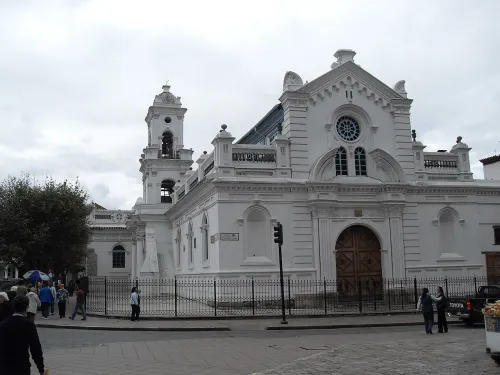
Self-Guided Walking Tour in Cuenca, Ecuador

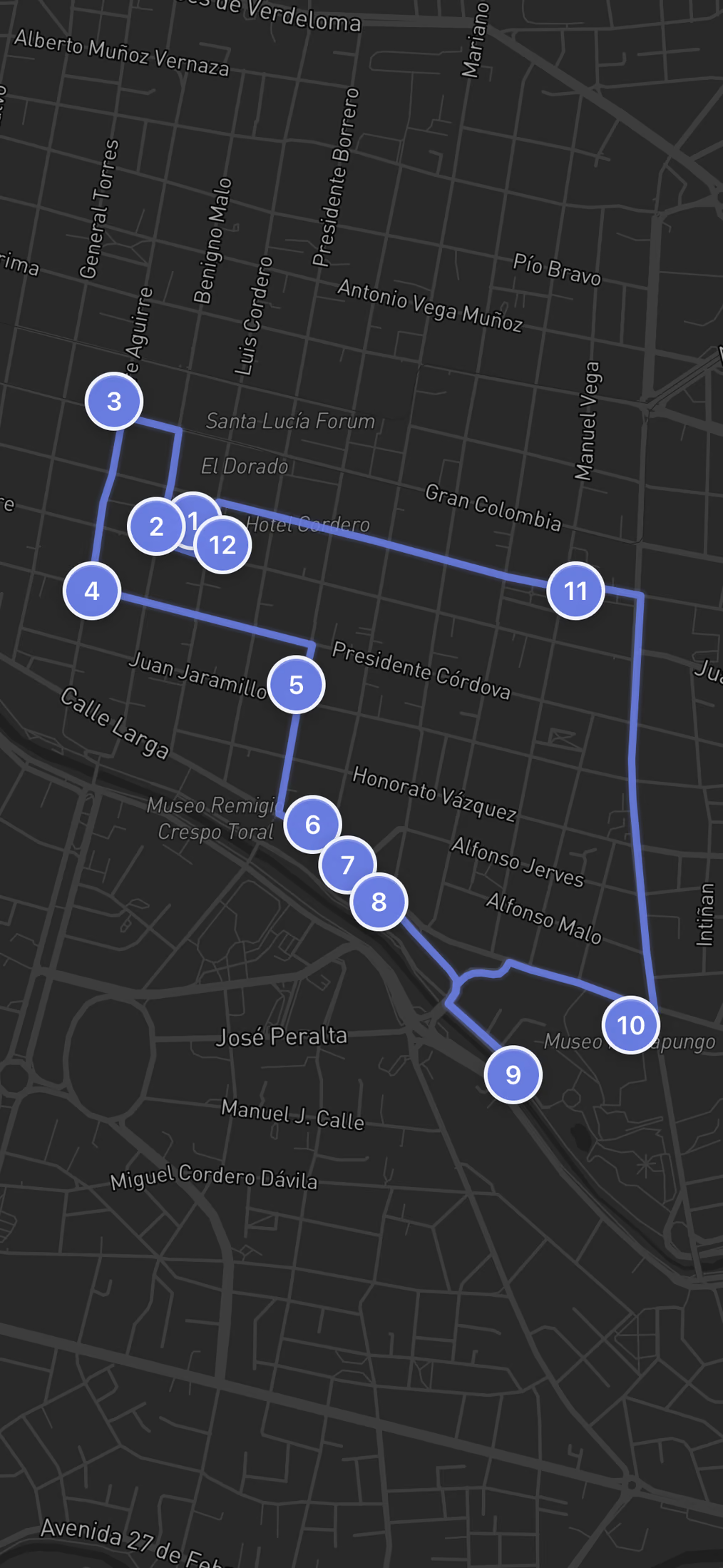
A 4.9 km loop through Cuenca's historic center, starting on Parque Calderón and closing at the Old Cathedral, linking 12 stops: both cathedrals, the colonial churches, the best museums, the Río Tomebamba, and the Inca ruins at Pumapungo. This page gives you the map, per-leg walking times, real prices and opening hours, and shorter versions.

12 Stops4.9 km~3 hours walking4–5 hours with stops
What you get with AI Tourguide
Full GPS navigationInteractive AI guidePersonalized to youWorks in your browser
Try this tour with Alex

Cuenca, Ecuador Walking Tour at a Glance

This route is designed for anyone who wants to see the real Cuenca on foot without a group or a fixed schedule. The historic center is flat and gridded, the New Cathedral's domes are visible almost everywhere as a landmark, and every interior on the route is optional. You decide which museums and churches you go inside and which you simply admire from the street.

StartParque Calderón (Plaza Abdón Calderón)
FinishOld Cathedral of Cuenca (Catedral Vieja de Cuenca)
Route typeA clockwise loop through the historic center that runs south and east down to the Río Tomebamba and Pumapungo, then swings back north and west to close where it began at Parque Calderón, with almost no backtracking.
Realistic timeWalking alone is barely an hour across 4.9 km. With outdoor stops and photos it is two to three hours; go inside the museums at Pumapungo and Las Culturas Aborígenes and you are looking at four to five hours.
DifficultyEasy in distance at 4.9 km, but the surface is cobblestone and uneven stone sidewalk, and there is a real descent down El Barranco to the river, so it earns a moderate rating for footing rather than length.
Cost to followFollowing the outdoor route is free. Interiors cost extra: the cathedral cupola tour is $2, the Conceptas and Culturas Aborígenes museums $4 each, Todos Santos $2, and the Old Cathedral $1. Pumapungo and its ruins are free.
Best for:

First-time visitors who want the famous skyline, the riverbank, the free national museum, and the craft markets connected in one logical line instead of hitting the same three churches and missing Pumapungo.

The Route

Free Walking Tour Map of Cuenca, Ecuador

12 stops4.9 kmabout 3 hours
Loading the interactive map…The complete walking route will appear here.
Want the route to guide you while you walk?Open the route with navigation and a personal guide for the history, stories and questions that matter to you.
Open route + AI guide

The 12 stops along this route

  1. Parque Calderón (Plaza Abdón Calderón) in Cuenca, Ecuador, stop 1 on the self-guided walking tour
    1Parque Calderón (Plaza Abdón Calderón)
  2. New Cathedral of Cuenca (Catedral de la Inmaculada Concepción de Cuenca) in Cuenca, Ecuador, stop 2 on the self-guided walking tour
    2New Cathedral of Cuenca (Catedral de la Inmaculada Concepción de Cuenca)
  3. Saint Dominic Church in Cuenca, Ecuador, stop 3 on the self-guided walking tour
    3Saint Dominic Church
  4. Iglesia de San Francisco, Cuenca (Iglesia y plazoleta de San Francisco, Cuenca) in Cuenca, Ecuador, stop 4 on the self-guided walking tour
    4Iglesia de San Francisco, Cuenca (Iglesia y plazoleta de San Francisco, Cuenca)
  5. Museo del Monasterio de las Conceptas in Cuenca, Ecuador, stop 5 on the self-guided walking tour
    5Museo del Monasterio de las Conceptas
  6. Museo de las Culturas Aborígenes in Cuenca, Ecuador, stop 6 on the self-guided walking tour
    6Museo de las Culturas Aborígenes
  7. Iglesia de Todos Santos, Cuenca (Iglesia de Todos Santos) in Cuenca, Ecuador, stop 7 on the self-guided walking tour
    7Iglesia de Todos Santos, Cuenca (Iglesia de Todos Santos)
  8. Puente Roto in Cuenca, Ecuador, stop 8 on the self-guided walking tour
    8Puente Roto
  9. Pumapunku, Ecuador (Parque arqueológico de Pumapungo) in Cuenca, Ecuador, stop 9 on the self-guided walking tour
    9Pumapunku, Ecuador (Parque arqueológico de Pumapungo)
  10. Museo Pumapungo in Cuenca, Ecuador, stop 10 on the self-guided walking tour
    10Museo Pumapungo
  11. Church San Blas (Iglesia de San Blas) in Cuenca, Ecuador, stop 11 on the self-guided walking tour
    11Church San Blas (Iglesia de San Blas)
  12. Old Cathedral of Cuenca (Catedral Vieja de Cuenca) in Cuenca, Ecuador, stop 12 on the self-guided walking tour
    12Old Cathedral of Cuenca (Catedral Vieja de Cuenca)
  13. That's the complete route.

    If you want more than the map and text, add live navigation and a conversational AI guide while you walk.

    Open route + AI guide
    You made it
Stop 1 of 12
Swipe →

Your Cuenca, Ecuador Walking Tour, Stop by Stop

  1. 1

    Parque Calderón (Plaza Abdón Calderón)

    Parque Calderón (Plaza Abdón Calderón) in Cuenca, Ecuador, stop 1 on the self-guided walking tour

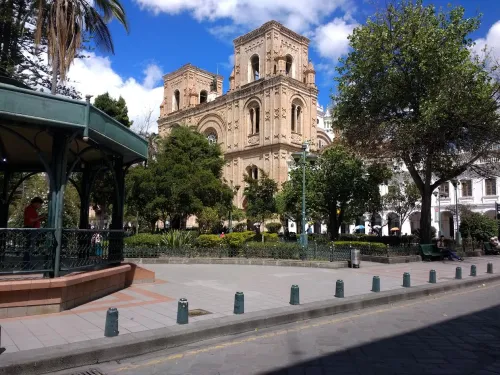
    Start in the middle of everything. This square is the literal and emotional center of Cuenca, ringed by tall pines that locals keep clipped into neat columns and busy from early morning with shoeshiners, old men reading newspapers, and pigeons. In the center stands the bronze monument to Abdón Calderón, inaugurated on 24 May 1931 and cast by the European sculptor Carlos Mayer. The square has worn other names over the years, including Plaza de Armas, before settling on Calderón in 1920. It is free and open around the clock, so there is no rush and nothing to buy. Sit on a bench for a few minutes and orient yourself: the two cathedrals face each other across the plaza, government buildings line the other sides. Walk to the south side of the square, toward the unmistakable blue domes, to reach the New Cathedral.
    Hours
    Open 24/7
    Price
    Free (public plaza)
  2. 2

    New Cathedral of Cuenca (Catedral de la Inmaculada Concepción de Cuenca)

    New Cathedral of Cuenca (Catedral de la Inmaculada Concepción de Cuenca) in Cuenca, Ecuador, stop 2 on the self-guided walking tour

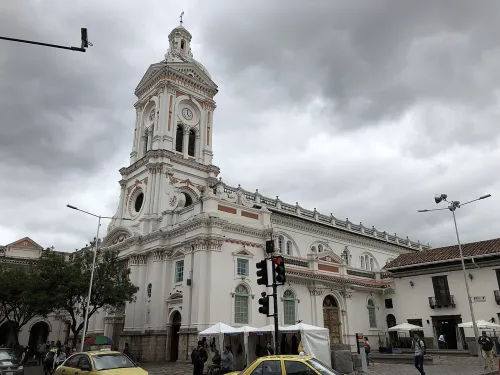
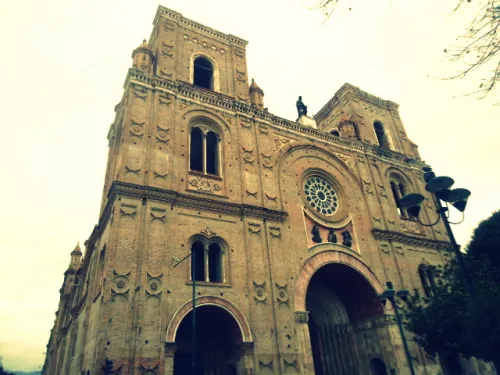
    The blue-and-white tiled domes are the symbol of Cuenca, and up close they are bigger than photos suggest. Construction began in 1885 and dragged on for roughly a century, finishing in the 1980s, which is why the design borrows from Romanesque, Gothic, and Renaissance ideas all at once. The plans by Juan Bautista Stiehle called for 105 meters of length and a central dome 53 meters high. The interior holds around 8,000 people. Look at the two front towers: they were meant to carry domes too, but the foundations could not take the weight, so they stay stubbornly flat. Entry to the nave is free. For $2 you can climb the cupola tour for a rooftop view over the red roofs, which is worth it on a clear morning. Leave by the square and head north on Padre Aguirre toward the twin towers of Santo Domingo.

    Hours
    Mon-Thu: 6:30 AM – 3:45 PM | Fri: 6:30 AM – 12:45 PM | Sat: 6:30 AM – 2:00 AM | Sun: 6:30 AM – 1:45 PM, 7:00 – 8:45 PM
    Price
    Free entry to the nave; cupulas (domes) tour $2 USD
  3. 3

    Saint Dominic Church

    Saint Dominic Church in Cuenca, Ecuador, stop 3 on the self-guided walking tour

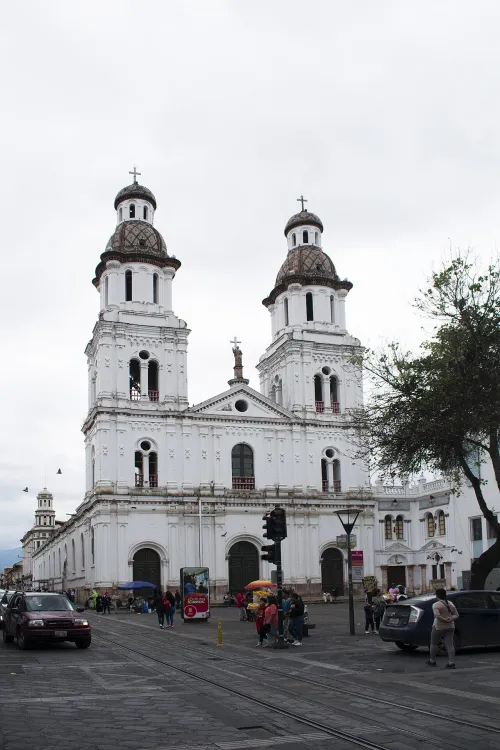
    After the scale of the cathedral, this Dominican church feels intimate and older. Two matching towers frame a painted interior worth stepping inside for. The Dominicans, alongside the Franciscans you will pass later, ran the religious instruction of the region's Indigenous communities during the colonial era, so these are not just pretty buildings, they are where a lot of the city's early history happened. Entry to the church is free. Hours are tight and shift by day: mornings are your safe bet, roughly 7:30 to 11:00 most days, with Thursday staying open into the evening. The terrace and convent tours may charge separately if offered. Do not plan a long stop here, ten minutes does it. From the church, walk south down Padre Aguirre and you will come out at Plaza San Francisco, with its craft stalls and the next church on the far side.

    Hours
    Mon-Wed: 7:30 – 11:00 AM | Thu: 7:30 AM – 7:00 PM | Fri-Sat: 7:30 – 11:00 AM | Sun: 7:30 AM – 12:00 PM
    Price
    Free (entrada gratuita; tours guiados de terraza/convento pueden cobrar)
  4. 4

    Iglesia de San Francisco, Cuenca (Iglesia y plazoleta de San Francisco, Cuenca)

    Iglesia de San Francisco, Cuenca (Iglesia y plazoleta de San Francisco, Cuenca) in Cuenca, Ecuador, stop 4 on the self-guided walking tour

    The plaza in front of this one is half the reason to come. Plaza San Francisco is a working craft market: stalls of woven blankets, ponchos, and the toquilla-straw hats that the world wrongly calls Panama hats but are actually made here in the Cuenca region. The church and convent sit on the calle Padre Aguirre and Presidente Córdova corner, and the parish has openly struggled to maintain the old structure, leaning on the city for help. That honesty is part of its character. Entry is free, and the inside is open weekdays from 9:30 to 5:00, closed weekends, so time it for a weekday if you want to see the interior. Spend your energy on the market stalls and the haggling. From the plaza, cut southeast a couple of blocks toward Hermano Miguel and Presidente Córdova to find the cloistered convent museum.

    Hours
    Mon-Fri: 9:30 AM – 5:00 PM | Sat-Sun: Closed
    Price
    Free (templo activo de culto, entrada sin costo)
  5. 5

    Museo del Monasterio de las Conceptas

    Museo del Monasterio de las Conceptas in Cuenca, Ecuador, stop 5 on the self-guided walking tour

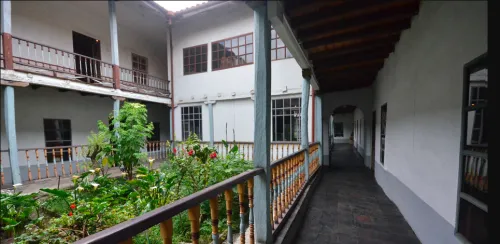
    This is a quieter stop, and a real one. The museum sits inside a cloistered convent that began life in 1561 as a community of nuns and still functions partly as one, which is why the courtyard behind the thick white walls feels so removed from the street noise. Inside you get religious paintings, colonial-era objects, and the kind of slow, dim rooms that reward fifteen minutes of actual looking. Adult entry is $4, children $2, or a $5 combo for an adult plus child. It is open Monday to Saturday, 10:00 to 5:00, and closed Sundays, so do not save it for the end of a Sunday walk. If colonial religious art is not your thing, you can skip the interior and just admire the facade. Continue south toward Calle Larga, the long street that runs along the top of the river escarpment, and turn east to the next museum.

    Hours
    Mon-Sat: 10:00 AM – 5:00 PM | Sun: Closed
    Price
    USD 4 (adulto; niño $2; combo adulto+niño $5)
  6. 6

    Museo de las Culturas Aborígenes

    Museo de las Culturas Aborígenes in Cuenca, Ecuador, stop 6 on the self-guided walking tour

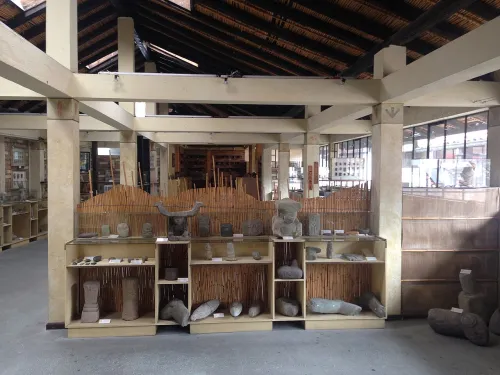
    This private museum is small from the street and much deeper than it looks. It occupies an old muleteers' inn, and the single collection runs to more than 5,000 archaeological pieces spanning from the Paleolithic and Neolithic eras all the way to the Inca. If you only have time for one pre-Columbian collection in Cuenca and want it dense and well labeled, this is the one. Adult entry is $4, students $2. Hours are Monday to Friday 9:00 to 5:30, and Saturday 9:30 to 2:00. Give it forty minutes. There is usually a small cafe attached if you need a coffee and a sit-down at this point in the walk. From here you are right at the edge of the river escarpment, El Barranco, so step out and walk down toward Calle Larga's eastern end to reach one of the city's oldest churches.

    Hours
    Mo-Fr 09:00-17:30; Sa 09:30-14:00
    Price
    USD 4 (adulto; estudiante $2)
  7. 7

    Iglesia de Todos Santos, Cuenca (Iglesia de Todos Santos)

    Iglesia de Todos Santos, Cuenca (Iglesia de Todos Santos) in Cuenca, Ecuador, stop 7 on the self-guided walking tour

    Perched above El Barranco, the steep escarpment that drops to the river, this is one of the oldest churches in Cuenca and the spot where the view starts to open up. Below it the ground falls away to the Río Tomebamba and the hanging houses built into the slope. The church itself is modest, a single Catholic church on the south edge of the colonial grid, but the setting is what sells it. A guided visit is $2 for adults, $1.50 for seniors, $0.50 for children, with a full visit around $4. It is open Tuesday to Saturday, 8:00 to 5:00, and closed Mondays and Sundays, which catches a lot of people out, so plan around it. Even closed, the terrace views are free. From the church, follow the path down the escarpment toward the river to reach the broken bridge.

    Hours
    Mon: Closed | Tue-Sat: 8:00 AM – 5:00 PM | Sun: Closed
    Price
    USD 2 (adulto visita guiada; mayor $1.50; niño $0.50; visita completa $4)
  8. 8

    Puente Roto

    Puente Roto in Cuenca, Ecuador, stop 8 on the self-guided walking tour

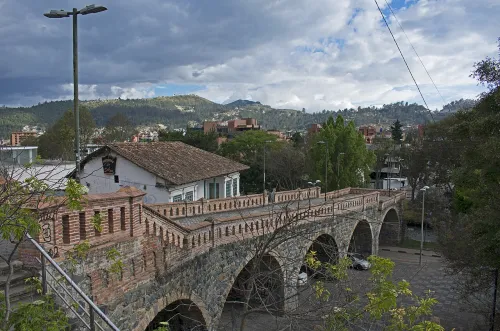
    The name means broken bridge, and that is exactly what it is: a stone bridge over the Río Tomebamba that a flood tore apart and that was never rebuilt, leaving a stub jutting out over the water. Instead of demolishing it the city turned it into an open-air gallery, so on weekends you will find painters and craft sellers spread along the stub and the riverbank. It is free and open any time. This is the best low-effort photo of the whole walk: the river, the willows, and the hanging houses of El Barranco above. Come in late afternoon when the light goes golden on the white facades. Sit on the wall for a while, the river noise is the antidote to the church-hopping you have been doing. When you are ready, follow the riverside path east along the Tomebamba, a flat and pleasant walk, toward the ruins at Pumapungo.

    Hours
    Open 24/7
    Price
    Free
  9. 9

    Pumapunku, Ecuador (Parque arqueológico de Pumapungo)

    Pumapunku, Ecuador (Parque arqueológico de Pumapungo) in Cuenca, Ecuador, stop 9 on the self-guided walking tour

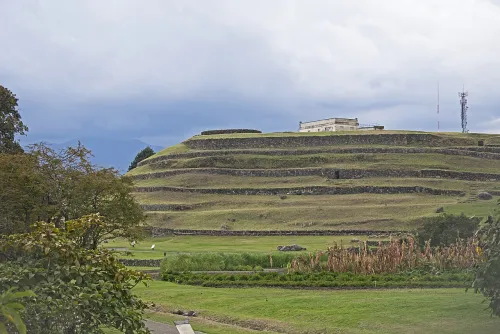
    This is the original Cuenca, or rather Tomebamba, the Inca city built over the older Cañari settlement. The archaeological park covers about four hectares of stone foundations, terraced gardens, and an ethnobotanical garden, all built from volcanic rock. The Cañari held this ground until Túpac Yupanqui's conquest, then the Inca turned it into a military stronghold, and it was destroyed during the Inca civil war even before the Spanish arrived. Walking the terraces gives you the layout of a vanished city in a way no museum case can. Entry is free. It is open Tuesday to Friday 8:00 to 5:00, and weekends 10:00 to 4:00, closed Mondays. There is also a bird rescue center on the grounds. Give it a solid half hour. The museum building sits right beside the ruins, a short walk uphill, so head there next.

    Hours
    Mon: Closed | Tue-Fri: 8:00 AM – 5:00 PM | Sat-Sun: 10:00 AM – 4:00 PM
    Price
    Free (acceso libre y gratuito)
  10. 10

    Museo Pumapungo

    Museo Pumapungo in Cuenca, Ecuador, stop 10 on the self-guided walking tour

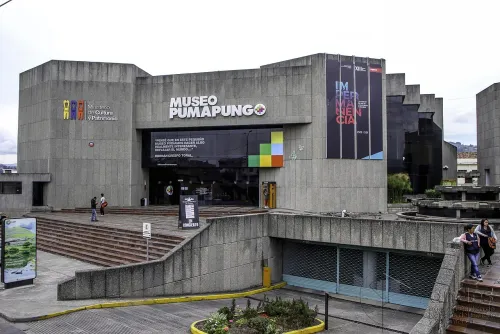
    The big one, and it is free. This is the national museum for the region, run by the Ministry of Culture, and it packs anthropology, archaeology, and ethnography into one building beside the ruins. The headline draw for most visitors is the ethnography hall and its Tsantsas exhibit, the shrunken heads of the Shuar people, displayed with their ritual context explained. There are also full-scale recreations of Ecuador's regional cultures, a documentary library, a theater, and rotating temporary shows. Hours are Tuesday to Friday 9:00 to 5:00, and weekends 10:00 to 4:00. Budget an hour, more if you read everything. For a free national museum this is unusually good, and it is the natural high point to end the eastward leg of the walk. From here, head back northwest along Avenida Huayna Cápac and into the streets toward the San Blas square.

    Hours
    Tu-Fr 09:00-17:00; Sa-Su 10:00-16:00
    Price
    Free (acceso libre y gratuito)
  11. 11

    Church San Blas (Iglesia de San Blas)

    Church San Blas (Iglesia de San Blas) in Cuenca, Ecuador, stop 11 on the self-guided walking tour

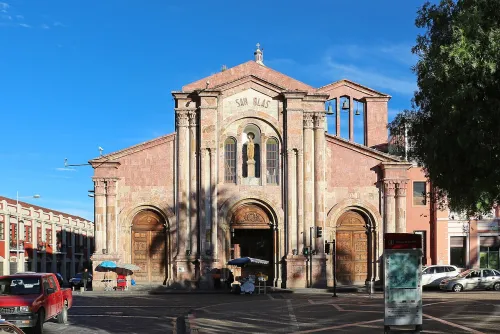
    San Blas anchors its own square at the eastern edge of the old center, and it has a distinction worth knowing: it is the only cross-plan stone church in Cuenca, a Latin-cross floor plan you can read in the shape of the building itself. The square around it is a genuine local neighborhood plaza rather than a tourist set piece, which makes it a good place to feel the everyday rhythm of the city. The church is free and open daily for Mass, with the parish office keeping morning and afternoon hours on weekdays, so you can usually step inside between services. Ten minutes covers it. After the museums this is a lighter, quieter stop, almost a palate cleanser before you head back to the core. Walk west along Simón Bolívar or Gran Colombia and you will arrive back at Parque Calderón and the Old Cathedral that closes the loop.

    Hours
    Church open daily for Mass (Mon-Fri 07:00, Sat 19:00, Sun 07:00/08:00/09:00); parish office Mon-Sat 08:00-12:00, 15:00-18:00
    Price
    Free
  12. 12

    Old Cathedral of Cuenca (Catedral Vieja de Cuenca)

    Old Cathedral of Cuenca (Catedral Vieja de Cuenca) in Cuenca, Ecuador, stop 12 on the self-guided walking tour

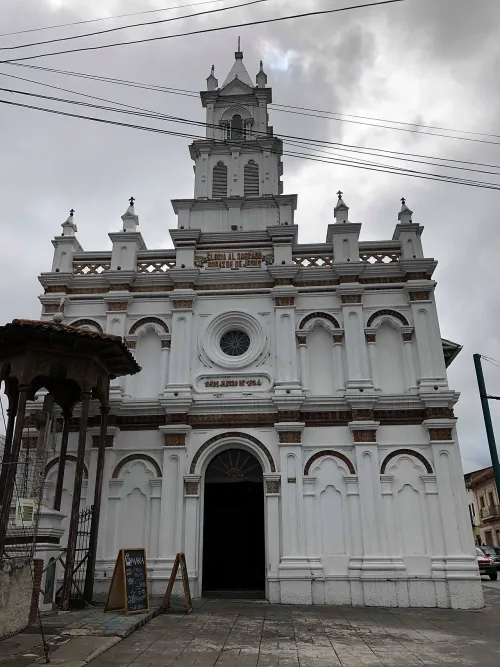
    You finish where you started, facing the New Cathedral across Parque Calderón, but this time looking at the older one. Construction of the Old Cathedral began in the mid-16th century, and it was the main Spanish place of worship through the colonial period. Today it works as the Museo de Arte Religioso, a museum of religious art known for its many altars. Its rarity is the bellows organ inside, the only one of its kind in the city, now out of service but still in place at the back of the building. As part of the historic center it shares the UNESCO World Heritage status the city earned in 1999. Adult entry is $1, and it is open daily 6:00 to 5:00. It is a fitting last stop: small, old, and full of the history that the rest of the walk has been building toward. Step back out onto Parque Calderón and you have closed the loop.

    Hours
    Daily: 6:00 AM – 5:00 PM
    Price
    $1 USD (adult; source: cultura.cuenca.gob.ec museo-catedral-vieja 2026)

How Long Does This Walking Tour Really Take?

Plan four to five hours if you go inside the museums, or about two and a half if you stick to facades and views. Museo Pumapungo alone eats an hour, the Culturas Aborígenes collection another forty minutes, and the archaeological park wants a slow half hour among the terraces. Everything else is a ten-to-fifteen-minute stop.

Plan for roughly four to five hours if you go inside the museums, or about two and a half if you stick to facades and views. The two stops that genuinely eat time are Museo Pumapungo, where an hour disappears fast, and the Museo de las Culturas Aborígenes at around forty minutes. The archaeological park next to Pumapungo wants another half hour of slow walking through the terraces. Everything else is a ten-to-fifteen-minute stop.

The natural break point is the river. After the museums on Calle Larga, the stretch from Iglesia de Todos Santos down to Puente Roto is where you should slow down, sit on the wall above the Río Tomebamba, and let the church-hopping wear off. There are cafes and small restaurants strung along Calle Larga right above El Barranco where you can grab a coffee or an almuerzo, the cheap fixed-price lunch most Ecuadorian places serve, before the longer riverside walk out to Pumapungo. If you want a bench instead, the benches under the clipped pines back at Parque Calderón are the best people-watching seat in the city for a mid-walk rest.

Full Route, Shorter Walk or Two-Day Version?

The full loop is 4.9 km and works as one continuous line, but you can shorten it or split it depending on how much time and energy you have. Here are three ways to walk it, all using the same stop order so you never have to rethink the direction.

The Center Short

The compact core without the long eastern legs

Stops 1 to 8, then straight back, about 2.5 km, 2–3 hours

Cut the two longest legs, the 470 m walk out to Pumapungo and the 960 m stretch to San Blas, and turn back at Puente Roto. You still get both cathedrals, the churches, the craft markets, the museums on Calle Larga, and the best river view. Ideal on a short afternoon or a first day at altitude.

The Two-Day Split

Colonial core one day, river and ruins the next

Day 1 stops 1 to 7; Day 2 stops 8 to 12, each half a day

Split at the river escarpment. Day one covers Parque Calderón, both cathedrals, the churches and the two Calle Larga museums at an easy pace. Day two starts fresh at Puente Roto, walks the flat riverside path out to Pumapungo, and loops back through San Blas. The gentlest way to do it if the altitude is slowing you down.

You can walk it in reverse, starting at the Old Cathedral and ending at Parque Calderón, but the given direction is better: it keeps the churches and busy squares in the fresher first half and saves the river views at Puente Roto and the slower ruins at Pumapungo for the back half, when you will want to sit down and take your time.

Is This Cuenca, Ecuador Walking Tour Right for You?

This is one of the easiest cities in the Andes to walk on your own, but the altitude and the footing make it worth checking that the route matches your day. Here is who it suits and how to bend it if it does not.

A good fit if you…

  • Walkers comfortable with 4.9 km on cobblestones plus one real descent to the river, spread over a relaxed half day.
  • People who care about pre-Columbian and colonial history and want dense, well-labeled museums like Pumapungo and Las Culturas Aborígenes.
  • Photographers chasing the blue domes and the hanging houses of El Barranco, especially in the golden late-afternoon light at Puente Roto.
  • Budget travelers happy to pay only a few dollars of museum entry and put the rest toward an almuerzo along Calle Larga.

Adapt the route if you…

  • You just arrived at 2,560 meters and feel the altitude: take the Center Short version and skip the long legs out to Pumapungo and San Blas.
  • You are walking on a Monday: Pumapungo's ruins, Todos Santos, and several churches keep reduced or closed hours, so lean on the free museum and the plazas.
  • You have trouble with uneven ground: stay on Calle Larga above El Barranco and admire the river from the top rather than descending to Puente Roto.
  • You only want the highlights: do stops 1, 2, 8, 9, and 10 for the domes, the river, the ruins, and the national museum, and skip the rest.

Tickets & Skip-the-Line in Cuenca, Ecuador

Nothing on this route needs advance booking; these are small museums and churches you pay for at the door in cash. Here is what each paid interior costs and when it is open, so you can budget and time your stops rather than stand in a queue.

New Cathedral of Cuenca (Catedral de la Inmaculada Concepción de Cuenca)The nave is free. The cupola (dome) tour up to the rooftop is $2, worth it on a clear morning. Nave hours are broadly Mon-Thu 6:30 AM to 3:45 PM, shorter on Fri and Sun; pay at the entrance.
Museo del Monasterio de las ConceptasAdult $4, child $2, or a $5 combo for one adult plus one child. Open Monday to Saturday 10:00 AM to 5:00 PM, closed Sunday, so do not save it for a Sunday walk.
Museo de las Culturas AborígenesAdult $4, student $2. Open Monday to Friday 9:00 AM to 5:30 PM and Saturday 9:30 AM to 2:00 PM. More than 5,000 pre-Columbian pieces; give it about forty minutes.
Iglesia de Todos Santos, Cuenca (Iglesia de Todos Santos)Guided visit $2 for adults, $1.50 for seniors, $0.50 for children, full visit around $4. Open Tuesday to Saturday 8:00 AM to 5:00 PM, closed Monday and Sunday. Even when closed the terrace views over the river are free.
Old Cathedral of Cuenca (Catedral Vieja de Cuenca)Adult entry $1, open daily 6:00 AM to 5:00 PM. Now the Museo de Arte Religioso, known for its many altars and a one-of-a-kind bellows organ. Pay at the door. official ticket site ↗
Pumapunku, Ecuador (Parque arqueológico de Pumapungo)Free entry to the Inca-Cañari archaeological park. Open Tuesday to Friday 8:00 AM to 5:00 PM and weekends 10:00 AM to 4:00 PM, closed Monday. No ticket needed. official ticket site ↗
Museo PumapungoFree entry to the national museum. Open Tuesday to Friday 9:00 AM to 5:00 PM and weekends 10:00 AM to 4:00 PM. Budget about an hour; the ethnography hall and Tsantsas exhibit are the draw.
Everything elseParque Calderón, Iglesia de Santo Domingo, Iglesia y Convento de San Francisco, Puente Roto, and Iglesia y Parque de San Blas are free open spaces and active churches with no entry charge; just mind local Mass and church hours.
Optional upgrade
+8
The same 12-stop route,
now with navigation and a guide.
Optional AI experience

You already have the route.
The AI guide brings it to life.

Standing under the blue domes of the New Cathedral on Parque Calderón right now? Let the AI guide walk you through this whole loop, talking you from the cathedral down to the Río Tomebamba and the Inca ruins at Pumapungo, telling you the history of each stop as you reach it and answering whatever you ask along the way. It is self-guided and free to start, so just press play and start walking.

Livenavigation13languagesAnyquestionYourinterests
Open this route with the AI guide

Try it in your browser · No app or download required

Tips for Walking in Cuenca, Ecuador

  • Timing and altitude: Cuenca sits at about 2,560 meters, so the first day your legs and lungs will feel it. Start this loop around 9:00 in the morning when the museums open and the light is good, take the river section slow, and drink more water than you think you need.
  • Terrain and shoes: the historic center is cobblestone and uneven stone sidewalks, with a real descent down El Barranco to the river. Wear shoes with grip, not flat-soled sneakers, especially if it has rained, and watch the narrow high curbs at intersections.
  • Restrooms: the Museo Pumapungo has clean public restrooms and it is free to enter, so plan your stop there as your midpoint break. Cafes along Calle Larga will also let you use theirs if you buy a coffee.
  • Food and drink: stop for an almuerzo, the set lunch of soup, a main, and juice, at one of the small places along Calle Larga, usually around $3 to $4. For something local, try a mote pillo or a humita from a market stall in Plaza San Francisco.
  • Photo: the best shot of the city is from Puente Roto in late afternoon, facing back up at the hanging houses and the New Cathedral's domes catching the low golden light over the Río Tomebamba.

Why Walk This Route?

Cuenca is one of those rare cities where the walking is the point. The historic center is flat, gridded, and small enough to cross on foot in twenty minutes, with red-tiled roofs, marble facades, and church domes packed into a few dozen blocks that UNESCO named a World Heritage Site in 1999. You do not need a taxi here. You do not really need a map either, because the blue-and-white domes of the New Cathedral are visible from almost everywhere and pull you back toward the center whenever you get turned around. At roughly 2,560 meters of altitude, the air is thin and the light is sharp, which is why the colors look so saturated in photos.

This route runs about 4.9 km and ties together the things that actually matter: the main square, the two cathedrals facing each other across it, a cluster of colonial churches, the best museums, and then a swing down to the Río Tomebamba and the Inca-Cañari ruins at Pumapungo before looping back through San Blas. It is built as a loop, so you end up near where you started. I have ordered it to save you backtracking and to put the river views and ruins in the back half, when you will want a slower pace.

Why walk this instead of just wandering? Because Cuenca rewards a route. Wander randomly and you will hit the same three churches and miss Pumapungo entirely, which is a long block too far east for most people to stumble onto. Follow this and you get the famous skyline, the riverbank, the free national museum, and the craft markets in one continuous line.

Common Questions

Is Cuenca, Ecuador safe to walk around?

The historic center is one of the safer urban areas in Ecuador and this whole loop is fine to walk in daylight. Use normal city sense: keep your phone and camera close in the crowded craft markets of Plaza San Francisco and on the riverside paths, and do not flash valuables. After dark, stick to the well-lit central streets and take a taxi to Pumapungo or San Blas rather than walking the quieter edges. The most common annoyance is petty pickpocketing in crowds, not violent crime. Agree on the fare or insist on the meter with taxis.

What if it rains during my Cuenca, Ecuador tour?

Cuenca's weather flips fast, so a downpour usually passes within an hour. When it hits, duck into the indoor stops: Museo Pumapungo is free and large enough to wait out a storm, the Museo de las Culturas Aborígenes and the Conceptas convent museum are both covered, and the two cathedrals give you shelter and something to see. The cobblestones and the El Barranco descent get slippery, so save the river and Puente Roto for after it clears.

What's the best time of day for this walking tour?

Start at 9:00 in the morning. The museums open, Parque Calderón is lively but not crowded, and the morning light is clean for photos of the domes. Doing it this way also lands you at Puente Roto and the river in the late afternoon, when the light turns golden on the white facades. Avoid Mondays, when Pumapungo's ruins, the Conceptas museum's Sunday closure aside, and several churches keep reduced or closed hours.

Take this route with you

Open this exact tour with navigation and your personal AI guide.

Start GPS Navigation + AI Guide
AI Tourguide
Researched and curated by the AI Tourguide teamWe plan and quality-check every route, then research and verify the opening hours, prices, and practical tips for each stop along it.
▶ Open route with AI guideNavigation, stories and your questions