
Self-Guided Walking Tour in Dinant

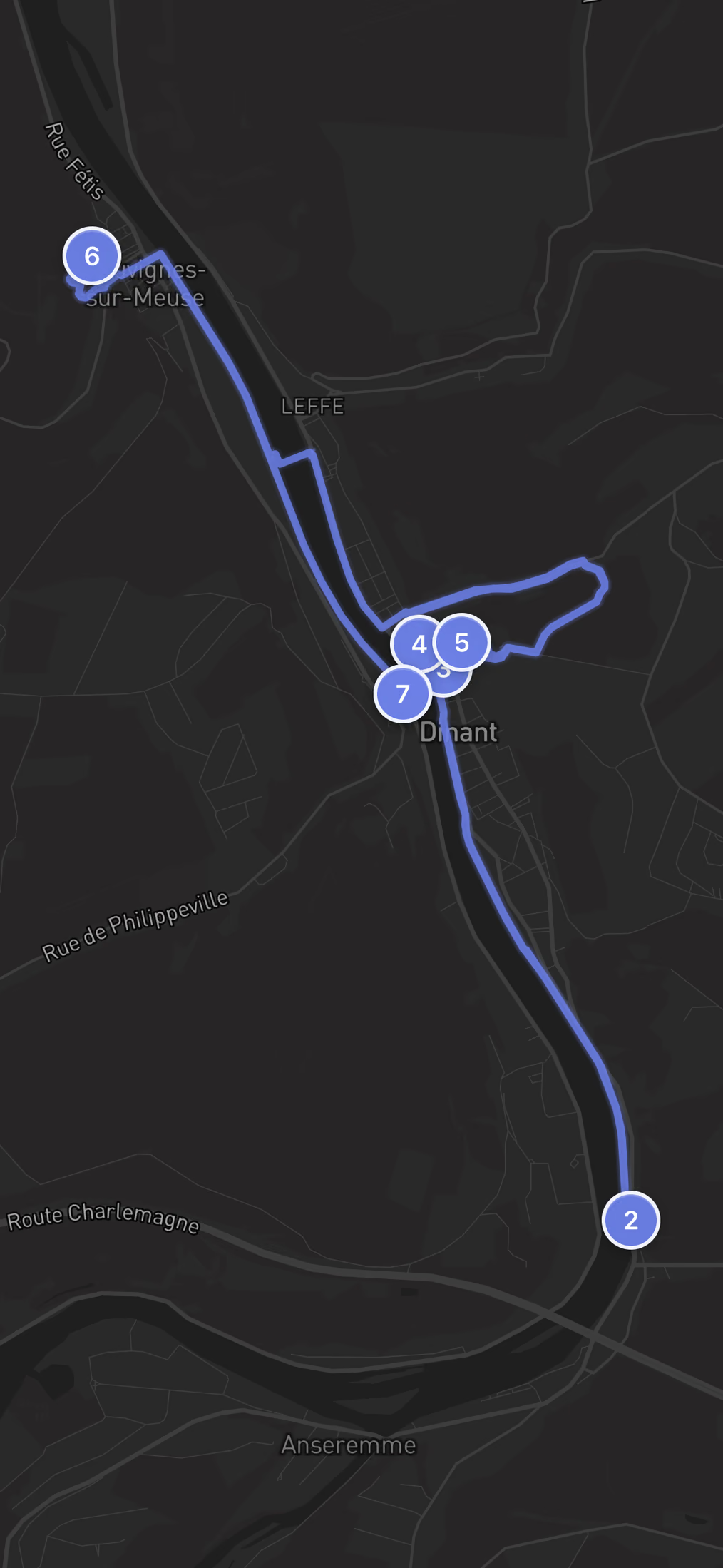
A riverside loop through Dinant, from the Charles de Gaulle Bridge past the Rocher Bayard, the bulb-spired Collégiale, the Adolphe Sax house, the cliff-top Citadelle and the Crèvecœur ruins, then back to where you started. Seven stops in all. This page gives you the map, per-leg walking times, real prices and hours, and a shorter version.

7 Stops11.5 km~4 hours walking4–4.5 hours with stops
What you get with AI Tourguide
Full GPS navigationInteractive AI guidePersonalized to youWorks in your browser
Try this tour with Alex

Dinant Walking Tour at a Glance

This route is built for anyone who wants Dinant on foot, the only way that makes sense in a town wedged 300 metres wide between the Meuse and a cliff wall. It links all seven sights on one loop, and every interior is optional: you decide at each stop whether to go in, climb, or just look. Six of the seven stops are free and outdoors, so the whole thing is genuinely self-guided.

StartCharles de Gaulle Bridge (Statue de Charles-de-Gaulle)
FinishCharles de Gaulle Bridge (Statue de Charles-de-Gaulle)
Route typeA there-and-back loop that starts and ends at the same bridge, running south first, then doubling back through the centre and up to the citadel, then out north across the river and back.
Realistic timeAbout 2 hours 45 minutes of pure walking over 11.5 km, or a realistic half-day of 4 to 4.5 hours once you add the Citadelle and the two quick indoor stops.
DifficultyModerate. The riverside stretches are flat and easy, but the day includes 408 stone steps up the citadel cliff and a steep, partly unpaved climb to the Crèvecœur ruins above Bouvignes.
Cost to followFollowing the route costs nothing, and six of the seven stops are free. The only paid interior is the Citadelle at €14, and that ticket includes the cable car up.
Best for:

Travellers who like a compact town they can read on foot, with river, church, fortress and a good story at every stop, and who don't mind two real climbs.

The Route

Free Walking Tour Map of Dinant

7 stops11.5 kmabout 4 hours
Loading the interactive map…The complete walking route will appear here.
Want the route to guide you while you walk?Open the route with navigation and a personal guide for the history, stories and questions that matter to you.
Open route + AI guide

The 7 stops along this route

  1. Charles de Gaulle Bridge (Statue de Charles-de-Gaulle) in Dinant, stop 1 on the self-guided walking tour
    1Charles de Gaulle Bridge (Statue de Charles-de-Gaulle)
  2. Rocher Bayard in Dinant, stop 2 on the self-guided walking tour
    2Rocher Bayard
  3. Collegiate Church of Our Lady of Dinant (Collégiale Notre-Dame de Dinant) in Dinant, stop 3 on the self-guided walking tour
    3Collegiate Church of Our Lady of Dinant (Collégiale Notre-Dame de Dinant)
  4. Maison de Monsieur Sax in Dinant, stop 4 on the self-guided walking tour
    4Maison de Monsieur Sax
  5. Citadel of Dinant (Citadelle de Dinant) in Dinant, stop 5 on the self-guided walking tour
    5Citadel of Dinant (Citadelle de Dinant)
  6. Crèvecœur Castle (Château de Crèvecœur) in Dinant, stop 6 on the self-guided walking tour
    6Crèvecœur Castle (Château de Crèvecœur)
  7. Charles de Gaulle Bridge (Statue de Charles-de-Gaulle) in Dinant, stop 7 on the self-guided walking tour
    7Charles de Gaulle Bridge (Statue de Charles-de-Gaulle)
  8. That's the complete route.

    If you want more than the map and text, add live navigation and a conversational AI guide while you walk.

    Open route + AI guide
    You made it
Stop 1 of 7
Swipe →

Your Dinant Walking Tour, Stop by Stop

  1. 1

    Charles de Gaulle Bridge (Statue de Charles-de-Gaulle)

    Charles de Gaulle Bridge (Statue de Charles-de-Gaulle) in Dinant, stop 1 on the self-guided walking tour

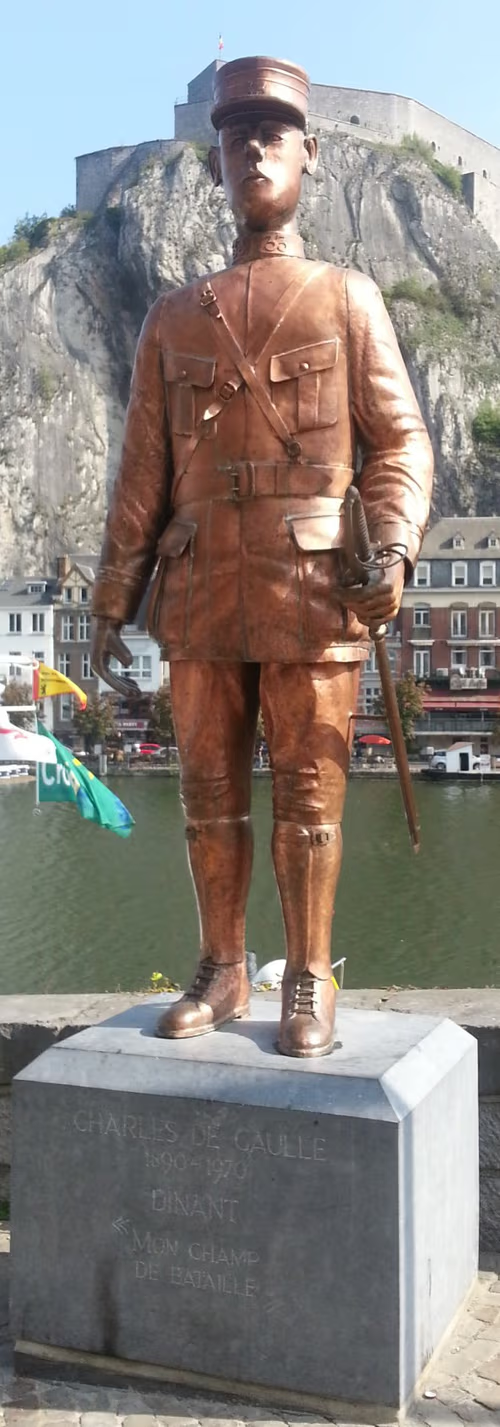
    Start where everyone arrives. The bridge sits right beside Dinant station and crosses the Meuse straight at the cliff wall, so your first view is the full postcard: green river, the bulb-spired Collégiale, and the Citadelle perched above it. The railing is lined with painted saxophones, one per country, a nod to local-born Adolphe Sax. It is open access and free, always. The bridge is named after Charles de Gaulle because he was wounded near here as a young officer in August 1914, during the German sack of the town. Tip: walk to the middle of the span before you do anything else and look south down the river. That alignment of church spire and fortress is the single best free photo in Dinant, and morning light hits it head-on. Then come back to the right bank and head downstream along the water toward the rock needle.

    Hours
    Always open
    Price
    Free
  2. 2

    Rocher Bayard

    Rocher Bayard in Dinant, stop 2 on the self-guided walking tour

    The riverside road narrows and then you see it: a freestanding rock needle, around forty metres tall, split clean from the cliff with a road running through the gap. This is the Rocher Bayard, on the right bank between Dinant and Anseremme. Local legend ties it to the four sons of Aymon and their giant horse Bayard, said to have cleaved the rock with one kick of its hoof. The gap is real-world less romantic: it was widened on Louis XIV's orders in the 17th century so troops could pass. Open access, free, 24/7. It is a quick stop, five minutes, but the scale only registers when a car drives through and looks tiny beside it. Tip: cross to the far side of the road for the photo so you get the full height with the cliff behind it, not just the slot. Then turn around and walk back upstream toward the town centre and the church.

    Hours
    Open 24/7
    Price
    Free
  3. 3

    Collegiate Church of Our Lady of Dinant (Collégiale Notre-Dame de Dinant)

    Collegiate Church of Our Lady of Dinant (Collégiale Notre-Dame de Dinant) in Dinant, stop 3 on the self-guided walking tour

    Back in the centre, the Collégiale plants itself between the cliff and the river with that unmistakable pear-shaped bulb on its tower. The original Romanesque church collapsed when part of the cliff gave way, and it was rebuilt in the 13th century in Mosan Gothic, the style that spread through the old Liège region. Inside, look up at the stained glass: the rose window above the choir is one of the largest in Belgium. Open daily 9:00 to 18:00, free entry. Give it ten to fifteen minutes. It is calm, dim, and a good cool-down after the riverside walk. Tip: stand outside on Place Reine Astrid and frame the tower with the citadel cliff rising directly behind it, the two stacked landmarks in one shot. The cable-car station and the start of the citadel steps are just to the right of the church, which is exactly where you go next.

    Hours
    Daily: 9:00 AM – 6:00 PM
    Price
    Free
  4. 4

    Maison de Monsieur Sax

    Maison de Monsieur Sax in Dinant, stop 4 on the self-guided walking tour

    A few steps along Rue Adolphe Sax brings you to the house where, in 1814, the inventor of the saxophone was born. The Maison de Monsieur Sax is a small interpretation centre, not a grand museum, and that is fine: it tells his story with instruments, screens, and a wall of giant saxophone sculptures out front that everyone photographs. Open daily 9:00 to 19:00, and entry is free, which makes it an easy yes. Budget fifteen to twenty minutes. Sax also invented the saxhorn and reshaped the brass band, and the displays make the point that he died nearly broke despite all of it. Tip: the bronze statue of Adolphe Sax sitting on a bench outside is the better photo than the interior, and you can sit beside him. From here the church and the foot of the citadel climb are right next to each other, so head back toward the cliff.

    Hours
    Daily: 9:00 AM - 7:00 PM
    Price
    Free
  5. 5

    Citadel of Dinant (Citadelle de Dinant)

    Citadel of Dinant (Citadelle de Dinant) in Dinant, stop 5 on the self-guided walking tour

    Now you go up. The Citadelle sits about a hundred metres above the river, and you reach it three ways: the cable car, the road, or 408 stone steps carved into the cliff beside the church. The current fortress was built in 1818 under Dutch rule as part of the Wellington Barrier against France, on the site of a Vauban fort and, before that, a medieval castle from 1051. Admission is €14, which covers the museum, the underground galleries, and the views. Hours are April to September 10:00 to 18:00, and October to March 10:00 to 16:30. The interior is worth the ticket for the WWI and weapons rooms and a guillotine, plus the terrace view straight down onto the bulb spire. Give it an hour. Tip: the €14 ticket includes the cable car, so ride up to save your legs and walk the 408 steps down for the river views. Back at river level, cross the bridge to the left bank and head north.

    Hours
    April–September: 10:00 AM – 6:00 PM | October–March: 10:00 AM – 4:30 PM
    Price
    €14
  6. 6

    Crèvecœur Castle (Château de Crèvecœur)

    Crèvecœur Castle (Château de Crèvecœur) in Dinant, stop 6 on the self-guided walking tour

    The longest leg of the walk takes you north along the left bank to the village of Bouvignes-sur-Meuse, where the ruins of Château de Crèvecœur crown the hill above the rooftops. Only fragments of the 12th-century fortress survive, but the climb up through the village is the point. From the top you get a wide, quiet view back over the Meuse with almost no other tourists, a real contrast to the citadel crowds. Open access, free, 24/7. The name means heartbreak, tied to the 1554 siege when French troops took the stronghold and, by legend, three women threw themselves from the tower rather than surrender. Give it twenty minutes plus the climb. Tip: the path up from the village is steep and unpaved in places, so this is the stop where you are glad you wore proper shoes. When you are done, retrace the riverbank south to return to the bridge.

    Hours
    Open 24/7
    Price
    Free
  7. 7

    Charles de Gaulle Bridge (Statue de Charles-de-Gaulle)

    Charles de Gaulle Bridge (Statue de Charles-de-Gaulle) in Dinant, stop 7 on the self-guided walking tour

    The loop closes back at the Charles de Gaulle Bridge where you began, and the return is the reward. After the long quiet stretch from Bouvignes, the riverside fills again with cafés and the saxophone-lined railing, and the Citadelle you climbed earlier now reads differently against the late-afternoon light. Open access, free, always. The station is right here, so the timing is convenient if you are catching a train back to Namur. Tip: end the day at one of the riverbank terraces on the right bank just south of the bridge and order a couque de Dinant, the rock-hard honey biscuit the town is known for. Do not bite it, suck on it or dunk it in coffee, because it is genuinely tooth-breaking and that is the joke locals are in on. Then walk the last few metres back to the platform.

    Hours
    Always open
    Price
    Free

How Long Does This Walking Tour Really Take?

The walking alone is about 2 hours 45 minutes across 11.5 km, most of it flat riverside. Add the two quick free interiors and you're near three and a half hours. Give the Citadelle a full hour for the galleries and terrace, and the whole loop lands at a realistic half-day of 4 to 4.5 hours.

The full loop is about 11.5 km with roughly 2 hours 45 minutes of walking, and the long northern leg to the Crèvecœur ruins is what pushes the distance up. Add the Citadelle climb and museum, and you are looking at a realistic half-day, around 4 to 4.5 hours total. The Citadelle is where you slow down: give it a full hour for the galleries and the terrace. The Sax house and the Collégiale are fifteen minutes each. If you want a break, the riverbank terraces on Place Reine Astrid near the church are the natural midpoint, or pause on a bench at the foot of the citadel steps before deciding whether to climb or take the cable car. If you are short on time, skip the Crèvecœur leg and you cut the walk to a comfortable two hours.

Full Route, Shorter Walk or Two-Day Version?

The full loop is one continuous line, but the long northern leg out to the Crèvecœur ruins is what stretches the distance. Depending on your time and legs, you can walk all of it, trim the far end, or split it into two easy halves.

The Short Version

The Central Core Without the Long Leg

Stops 1 to 5, then straight back to the bridge, roughly 2 hours plus the Citadelle

Cut the 3.6 km leg out to the Crèvecœur ruins and the return, which is the single longest stretch of the walk. You keep the river, the rock needle, the church, Sax and the Citadelle, and finish the walking in about two comfortable hours.

The Easy Split

Two Short Outings Around the Centre

Day one stops 1 to 5, day two the Crèvecœur leg (stops 5 to 7)

Do the central stops and the Citadelle first, ending back at the bridge. Save the long, quiet northern walk to Bouvignes and the Crèvecœur ruins for a second outing, when your legs are fresh for the steep, unpaved climb up through the village.

You can walk the loop either way, but starting at the Charles de Gaulle Bridge and heading south first is the smoother order. It saves the two climbs, the citadel steps and the Crèvecœur path, for the second half once you're warmed up, and it leaves the café-lined riverbank by the bridge as your finish.

Is This Dinant Walking Tour Right for You?

This is a compact half-day loop with easy riverside walking broken up by two real climbs. It suits some travellers better than others, so here's who it's built for and how to bend it if that's not quite you.

A good fit if you…

  • Walkers happy with 11.5 km over a half-day, most of it flat along the Meuse
  • Anyone who wants river, church, cliff-top fortress and the Sax story in one tight loop
  • Travellers arriving by train, since the station sits right at the start and end bridge
  • People who don't mind 408 stone steps and a steep path for the best views

Adapt the route if you…

  • You want to avoid the long walk: drop the Crèvecœur leg and finish in about two hours
  • You'd rather not climb: the Citadelle cable car is included in the €14 ticket, so skip the 408 steps
  • You're short on daylight: split the loop across two outings around the centre
  • You want to view the Crèvecœur ruins without the climb: look up at them from the riverbank below

Tickets & Skip-the-Line in Dinant

Only one stop on this route costs money, the Citadelle. Everything else is free open access, so there's very little to book ahead in Dinant. Here's the ticket picture stop by stop.

Citadel of Dinant (Citadelle de Dinant)Admission is €14, which covers the museum, the underground galleries, the terrace views and the cable car up, so there's no separate charge for the ride. Open April to September 10:00 to 18:00 and October to March 10:00 to 16:30; the cable car stops when the site closes, so don't leave the climb for the very end of the day.
Maison de Monsieur SaxEntry is free, so there's nothing to book. Open daily 9:00 to 19:00. It's a small interpretation centre about Adolphe Sax, easy to fit in on the way to the citadel. official ticket site ↗
Collegiate Church of Our Lady of Dinant (Collégiale Notre-Dame de Dinant)Free entry, no ticket needed. Open daily 9:00 to 18:00, a calm indoor stop and good shelter if it rains.
Everything elseThe Charles de Gaulle Bridge, the Rocher Bayard and the Crèvecœur Tower Ruins are all free, open 24/7 outdoor spaces with nothing to book or pay.
Optional upgrade
+3
The same 7-stop route,
now with navigation and a guide.
Optional AI experience

You already have the route.
The AI guide brings it to life.

Standing on the Charles de Gaulle Bridge with the saxophone railing in front of you? Start the AI Tourguide and let a voice-first guide walk the loop with you, telling the story of Adolphe Sax, the 1914 massacre, and the four sons of Aymon as you reach each spot. It talks with you, answers what you ask, and remembers where you have already been.

Livenavigation13languagesAnyquestionYourinterests
Open this route with the AI guide

Try it in your browser · No app or download required

Tips for Walking in Dinant

  • Arrive by train: Dinant station sits right at the Charles de Gaulle Bridge, and trains from Namur take about 30 minutes and run roughly twice an hour. Start the loop the moment you step off the platform.
  • Wear proper shoes. The 408 citadel steps are stone and uneven, and the climb to the Crèvecœur ruins above Bouvignes is steep and unpaved in places. Trainers minimum, not sandals.
  • Restrooms are at the Citadelle (inside the visitor area, with your €14 ticket) and at the tourist office on Avenue Cadoux near the bridge. There is little in between, so plan around those two.
  • Buy a couque de Dinant from a riverside bakery and do not bite it: this honey biscuit is famously hard, so dunk it in coffee or suck on it. Expect to pay a few euros for one.
  • For the best photo, stand at the middle of the Charles de Gaulle Bridge in the morning and shoot south: the bulb spire of the Collégiale and the Citadelle line up, lit head-on by the early sun.
  • The €14 Citadelle ticket includes the cable car, so ride up and walk the 408 steps down. You save your legs for the Crèvecœur climb and get the river views on the way down.
  • Check the Citadelle hours before you climb: 10:00 to 18:00 April to September, 10:00 to 16:30 October to March. The cable car stops running with the site, so do not leave it for the very end of the day.

Why Walk This Route?

Dinant is a town squeezed onto a thin strip between the river Meuse and a wall of grey cliffs, and that geography is exactly why you walk it instead of driving through. The whole place is maybe 300 metres wide at points. The cathedral, the citadel cliff, the rock spire, and the saxophone museum sit close enough together that a car would just get stuck on the one-way riverside roads. On foot you read the town the way it was built: river first, church second, fortress on top, defensive ruins guarding the approaches.

This route is a loop that starts and ends at the Charles de Gaulle Bridge next to the train station, so it works whether you arrive by rail from Namur or park near the river. It pulls you south first to the dramatic Rocher Bayard rock needle, doubles back through the centre for the Collégiale and the Sax house, sends you up to the Citadelle above the rooftops, then crosses the river north toward the Crèvecœur ruins above Bouvignes before returning. The full loop is long because two of the stops sit at opposite ends of town.

Do it as a half-day. The two paid or vertical stops, the Citadelle and the climb, are where your time and money go. Everything else is free, outdoor, and quick. Skip nothing here, because Dinant has exactly seven things worth your attention and they are all on this line.

Common Questions

Is Dinant safe to walk around?

Yes, very. Dinant is a small, calm Belgian town with low crime, and the route stays on well-used riverside roads and village streets. The only real hazards are physical: the 408 citadel steps and the steep, sometimes muddy path up to the Crèvecœur ruins. Watch traffic where the road passes through the gap at Rocher Bayard, since cars share that narrow slot.

What if it rains during my Dinant tour?

Duck into the two indoor stops. The Collégiale Notre-Dame is open daily 9:00 to 18:00 and free, and the Maison de Monsieur Sax is open 9:00 to 19:00 and also free. The Citadelle has covered museum galleries and underground passages, so €14 buys you shelter and history at once. Skip the Crèvecœur climb in heavy rain, as the unpaved path gets slippery.

What's the best time of day for this walking tour?

Start around 9:30 to 10:00. The morning sun lights the church-and-citadel view from the bridge head-on, the Citadelle opens at 10:00, and you finish the long Crèvecœur leg before the afternoon fades. Starting this early also means the citadel cable car and steps are quiet before tour groups arrive around midday.

How long does the Dinant walking tour take?

Plan a half-day, around 4 to 4.5 hours. The walking itself is about 2 hours 45 minutes over 11.5 km, and the Citadelle adds an hour. If you drop the northern Crèvecœur leg, the whole thing tightens to roughly two hours.

Do I need to pay to enter the attractions?

Almost everything is free: the bridge, Rocher Bayard, the Collégiale, the Sax house, and the Crèvecœur ruins all have free, open access. The single paid stop is the Citadelle at €14, and that price includes the cable car ride up.

Can I do this tour without climbing the steps?

Yes. The Citadelle has a cable car included in the €14 ticket, so you never have to take the 408 steps if you prefer not to. The Crèvecœur ruins do require a steep walk up through Bouvignes, but you can admire them from the riverbank below and skip the climb.

Take this route with you

Open this exact tour with navigation and your personal AI guide.

Start GPS Navigation + AI Guide
AI Tourguide
Researched and curated by the AI Tourguide teamWe plan and quality-check every route, then research and verify the opening hours, prices, and practical tips for each stop along it.
▶ Open route with AI guideNavigation, stories and your questions