
Self-Guided Walking Tour in Fez

A 7-stop, 3.5 km walk through the car-free heart of Fes el-Bali, from the Al Attarine Madrasa to the University of Karaouine. This page gives you the full map, per-leg walking times, real admission prices and opening hours, and shorter versions when the alleys and the heat catch up with you.

7 Stops3.5 km~2 hours walking3–3.5 hours with stops
What you get with AI Tourguide
Full GPS navigationInteractive AI guidePersonalized to youWorks in your browser
Try this tour with Alex

Fez Walking Tour at a Glance

This route is built for anyone who wants to walk the Fes medina under their own steam rather than tail a 15-person group through alleys barely wide enough for two. Every interior is optional: you can pay into the two madrasas or just admire the squares, gates and craft workshops, which cost nothing. The point is to give you a sensible thread through 9,000 alleyways and let you decide where to linger.

StartAl-Attarine Madrasa (Médersa Al-Attarine)
FinishUniversity of al-Qarawiyyin (Université Al Quaraouiyine)
Route typeA roughly linear west-to-east walk, not a loop. You start high on the western edge at the madrasas near Boujloud Gate, then work steadily east and downhill through the craft squares to the tannery and the university, so you rarely double back on yourself.
Realistic timeThe raw walking time for 3.5 km is only about 45 minutes, but nobody moves at normal pace here. With the two madrasas, the tannery terraces and the copper square, plan on 3 to 3.5 hours end to end.
DifficultyEasy on distance at 3.5 km, but the surface is polished stone that is often wet and sometimes steeply sloped, with donkey traffic and constant crowds. Shoes with real grip matter far more than fitness here.
Cost to followThe walk itself is free. The only paid interiors are the Al Attarine Madrasa and the Bou Inania Madrasa at 30 MAD each. The Chouara Tannery is free but a tip is expected for terrace access, and the Karaouine is free from the doorway only.
Best for:

Independent walkers who want the medina's madrasas, craft squares and tannery at their own pace, and are comfortable getting briefly turned around in a genuinely disorienting old town.

The Route

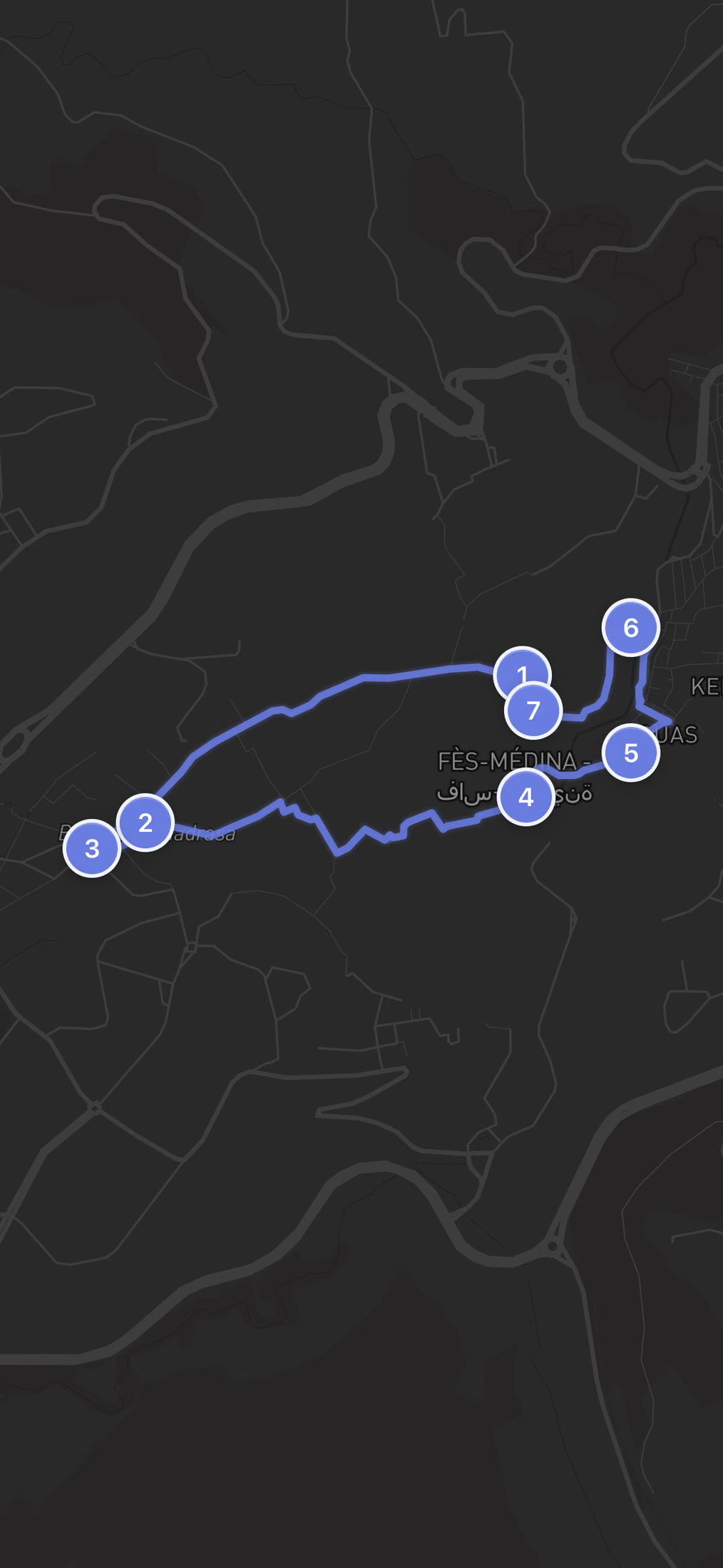
Free Walking Tour Map of Fez

7 stops3.5 kmabout 2 hours
Loading the interactive map…The complete walking route will appear here.
Want the route to guide you while you walk?Open the route with navigation and a personal guide for the history, stories and questions that matter to you.
Open route + AI guide

The 7 stops along this route

  1. Al-Attarine Madrasa (Médersa Al-Attarine) in Fez, stop 1 on the self-guided walking tour
    1Al-Attarine Madrasa (Médersa Al-Attarine)
  2. Bou Inania Madrasa (Médersa Bou Inania) in Fez, stop 2 on the self-guided walking tour
    2Bou Inania Madrasa (Médersa Bou Inania)
  3. Bab Bou Jeloud in Fez, stop 3 on the self-guided walking tour
    3Bab Bou Jeloud
  4. Place Nejjarine in Fez, stop 4 on the self-guided walking tour
    4Place Nejjarine
  5. Place Seffarine in Fez, stop 5 on the self-guided walking tour
    5Place Seffarine
  6. Chouara Tannery (Tannerie Chouara) in Fez, stop 6 on the self-guided walking tour
    6Chouara Tannery (Tannerie Chouara)
  7. University of al-Qarawiyyin (Université Al Quaraouiyine) in Fez, stop 7 on the self-guided walking tour
    7University of al-Qarawiyyin (Université Al Quaraouiyine)
  8. That's the complete route.

    If you want more than the map and text, add live navigation and a conversational AI guide while you walk.

    Open route + AI guide
    You made it
Stop 1 of 7
Swipe →

Your Fez Walking Tour, Stop by Stop

  1. 1

    Al-Attarine Madrasa (Médersa Al-Attarine)

    Al-Attarine Madrasa (Médersa Al-Attarine) in Fez, stop 1 on the self-guided walking tour

    You enter from the spice souk, Souk el-Attarine, through a small doorway that gives no hint of what waits inside. Then the courtyard opens: a marble floor, a central fountain, and every visible surface covered in zellij tilework, carved cedar, and sculpted plaster dating to 1325. Sultan Abu Said Othman commissioned this madrasa, and the original 14th-century tile patterns have never been replaced. The space is small, maybe 15 by 15 meters, which makes the decorative density feel overwhelming in the best sense. Look up at the cedar lintels above the second-floor student cells. They are 700 years old and still sharply defined. Open daily 10:00 AM to 5:00 PM. Admission is collected at the door. Mornings before 11:00 are quieter and the courtyard light is at its most dramatic. Spend 15 to 20 minutes studying the three-layer decoration system: zellij on the bottom, carved plaster in the middle, cedar wood at the top. This formula repeats at every madrasa in Fes, but Al Attarine does it best.

    Hours
    Daily: 10:00 AM – 5:00 PM
    Price
    30 MAD
  2. 2

    Bou Inania Madrasa (Médersa Bou Inania)

    Bou Inania Madrasa (Médersa Bou Inania) in Fez, stop 2 on the self-guided walking tour

    You spot the minaret first, rising above the roofline of Talaa Kebira, the medina's main downhill artery. Bou Inania is the only madrasa in Fes that doubled as a Friday mosque, and the only one with its own minaret. Built between 1350 and 1355, the scale is immediately larger than Al Attarine: a wider courtyard, a functioning ablution fountain, and walls layered with the same three-material system but at grander proportions. Before you enter, look across the narrow street at the Dar al-Magana, a 14th-century water clock built into the wall. The bronze bowls and wooden beams of the mechanism are still visible, though nobody alive has been able to reconstruct how it worked. Open daily 9:00 AM to 5:00 PM. Admission at the door. Spend 20 minutes here. The carved plaster panels inside are among the finest surviving examples of Marinid-era decoration in Morocco.

    Hours
    Daily: 9:00 AM – 5:00 PM
    Price
    30 MAD
  3. 3

    Bab Bou Jeloud

    Bab Bou Jeloud in Fez, stop 3 on the self-guided walking tour

    The three arches appear at the end of the street, framing the Bou Inania minaret behind you. Walk through and turn around. The exterior tiles are blue, the color of Fes. The interior tiles are green, the color of Islam. Most visitors assume this gate is medieval. It is not. The French built it in 1913 to replace a much smaller 12th-century stone entrance. The original was functional. This version was designed to photograph well, and it does. Free to visit, open at all hours. Spend five minutes here. Take your photos from Place Pacha el-Baghdadi on the outside, where the full triple arch fills the frame. The square has cafes with rooftop terraces where you can see the gate from above, which is the better angle. Now head back into the medina through the alleys toward Place Nejjarine.

    Hours
    Always open
    Price
    Free
  4. 4

    Place Nejjarine

    Place Nejjarine in Fez, stop 4 on the self-guided walking tour

    The square announces itself with the sound of running water. At its center stands an 18th-century mosaic fountain sheltered under a carved cedar wood canopy, one of the finest examples of zellij tilework in the entire medina. Behind it rises the Fondouk Nejjarine, a caravanserai dating from 1711 that once housed traveling merchants and their goods. The fondouk was restored in the 1990s and now operates as the Museum of Wooden Arts and Crafts across three floors. The rooftop terrace offers one of the best elevated views of the medina's roofline, a maze of satellite dishes, minarets, and laundry lines stretching to the hills. Budget 20 minutes if you enter the museum, or five minutes to admire the fountain and the square's proportions. The carpenters' souk (nejjarine means carpenters) surrounds the square, and the smell of fresh cedar shavings mixes with the fountain water.

  5. 5

    Place Seffarine

    Place Seffarine in Fez, stop 5 on the self-guided walking tour

    You hear Place Seffarine before you see it. The rhythmic clanging of hammers on copper and brass has echoed across this triangular square since the 14th century, making it the oldest continuously active metalworking quarter in Fes. Coppersmiths still sit cross-legged on the ground, hammering massive cauldrons, trays, and cooking pots by hand using techniques unchanged for centuries. The square is small, shaded by a single large plane tree, and bounded on one side by the wall of the Karaouine Library. There is nothing to pay and no hours to observe. Pull up a low stool at the edge and watch the craftsmen work. The noise is part of the experience. This is the medina at its most authentic: a working square that exists for its residents, not for visitors. The coppersmiths will largely ignore you unless you ask about their work, in which case they are happy to explain the process.

    Hours
    Daily: 7:00 AM – 8:00 PM
    Price
    Free
  6. 6

    Chouara Tannery (Tannerie Chouara)

    Chouara Tannery (Tannerie Chouara) in Fez, stop 6 on the self-guided walking tour

    You smell it before you see it. The combination of pigeon droppings, quicklime, and raw hides hits about two blocks out. Leather shop owners along the approach will offer you sprigs of fresh mint to hold under your nose. Take them. They will also offer to lead you to their rooftop terrace for a view of the tannery pits below. This is how Chouara works for visitors: you view it from above, from the leather shops on the second and third floors. There is no official entrance or ticket. The shop owners expect you to browse their goods afterward, but you are not obligated to buy. The view is genuinely striking: over 1,000 stone pits filled with dyes made from poppy flowers, saffron, indigo, and henna, with workers knee-deep in the vats. Operating since the 11th century. Open daily 9:00 AM to 7:00 PM. Go before noon when the workers are most active and the light hits the pits directly. Budget 20 to 30 minutes between the viewing terraces and browsing.

    Hours
    Daily: 9:00 AM – 7:00 PM
    Price
    Free (tip expected for terrace access)
  7. 7

    University of al-Qarawiyyin (Université Al Quaraouiyine)

    University of al-Qarawiyyin (Université Al Quaraouiyine) in Fez, stop 7 on the self-guided walking tour

    Founded in 859 AD by Fatima al-Fihri, this is the oldest continuously operating degree-granting university in the world according to UNESCO and the Guinness Book of Records. You can see the courtyard through the open doors, but non-Muslims cannot enter the mosque or prayer hall. Stand at the main entrance on the north side and look through: the courtyard has a marble fountain, and the far wall is covered in zellij that predates anything you saw at the madrasas. The attached library, restored in 2016, holds a 9th-century Quran and a 12th-century original manuscript by Ibn Rushd (Averroes), but access requires special permission. Open daily 8:15 AM to 9:55 PM, though viewing is limited to the doorways. Free. Spend 10 minutes here. The scale of what this institution represents, over 1,100 years of continuous scholarship, becomes tangible when you stand at the threshold and look at tiles that scholars have walked past for a millennium.

    Hours
    Daily: 8:15 AM – 9:55 PM
    Price
    Free (exterior only; non-Muslims cannot enter)
    Website
    uaq.ma ↗

How Long Does This Walking Tour Really Take?

The 3.5 km of walking is barely 45 minutes on paper, but the two madrasas deserve 15 to 20 minutes each, the tannery terraces 20 to 30, and the copper square as long as the hammering holds you. Budget 3 to 3.5 hours total, and start early so you reach the tannery before midday.

The raw walking time for the 3.5 km route is about 45 minutes, but nobody walks the Fes medina at a normal pace. Alleys narrow to shoulder width, donkeys loaded with goods have the right of way, and you will stop to stare at things. Plan for 3 to 3.5 hours total with time inside the madrasas and at the tannery. Al Attarine and Bou Inania each deserve 15 to 20 minutes if the decorative details interest you. Chouara Tannery is worth 20 to 30 minutes between viewing terraces and browsing leather goods. The University of Karaouine is a 10-minute stop since interior access is restricted. For a break, Cafe Clock on Derb el-Magana near Bou Inania has a rooftop terrace, decent coffee, and a camel burger that has become a Fes institution.

Full Route, Shorter Walk or Two-Day Version?

The full walk is seven stops, but the medina rewards editing. Here are three ways to run it, depending on how much time and heat tolerance you have, all using the same stop numbers you'll see on the map.

The Short Version

Madrasas and crafts, minus the gate detour

Stops 1, 2, then 4–7, skipping the westward loop out to Boujloud Gate. About 2.3 km and roughly 2 hours.

Cutting Boujloud Gate saves the long 1,200 m walk back east from the western edge. You still get both madrasas up top and the whole eastern craft cluster: Nejjarine, Seffarine, the tannery and the Karaouine. The best option if the heat or your legs are limited.

The Two-Part Split

Madrasas one day, crafts the next

Day one: stops 1–3 (the madrasas and Boujloud Gate). Day two: stops 4–7 (the craft squares, tannery and university). Roughly 90 minutes each.

Fes deserves more than one pass, and splitting at the gate is a natural break point. Do the architectural half around the Talaa Kebira first, then come back on a separate morning for the working medina, hitting the tannery before noon on the second day.

You can walk this in reverse, starting at the University of Karaouine and finishing at the Al Attarine Madrasa. The given direction is recommended because it puts you at the Chouara Tannery before midday, when the workers are most active and the heat has not yet sharpened the smell, and because entering from the Rcif side on the east means you end up back among the madrasas rather than deep in the working souks.

Is This Fez Walking Tour Right for You?

The Fes medina is not a hard walk in distance, but it is a demanding one in orientation and footing. Here is who this route suits and how to bend it to your day.

A good fit if you…

  • Independent walkers who want to set their own pace inside the madrasas rather than move on when a group leader says so.
  • Travellers interested in craft and architecture: zellij tilework, carved cedar, coppersmithing and the tannery process up close.
  • Anyone comfortable with a genuinely disorienting old town, where streets dead-end, loop and change names without warning.
  • Photographers, since the light on the tannery pits and the triple arch of Boujloud Gate is best worked without a schedule.

Adapt the route if you…

  • If the heat is heavy, run the short version, skip the Boujloud Gate detour and start at opening time to reach the tannery early.
  • If polished, sloping stone is a problem underfoot, wear grippy shoes and take the downhill east-to-west flow slowly.
  • If the tannery smell is a concern, keep the mint sprigs the shop owners hand you and stick to the upper viewing terraces.
  • If you only have a morning, drop the madrasa interiors and admire the courtyards from the doorways to save time and dirhams.

Tickets & Skip-the-Line in Fez

There is no online booking for the medina's sights, and no real queue to skip. Admission is collected in cash at the door, so carry small dirham notes. Here is what each paid or timed stop actually costs and when it is open.

Al-Attarine Madrasa (Médersa Al-Attarine)Admission 30 MAD, paid in cash at the door. Open daily 10:00 AM to 5:00 PM. There is no ticket booth online, so bring small notes; arriving before 11:00 means quieter courtyards and better light.
Bou Inania Madrasa (Médersa Bou Inania)Admission 30 MAD, paid in cash at the door. Open daily 9:00 AM to 5:00 PM. Note it can close to visitors during Friday prayers, since it doubles as a working mosque.
Chouara Tannery (Tannerie Chouara)Free to view, but a tip is expected for access to a shop's rooftop terrace, and the owners will show you their leather goods afterward. Open daily 9:00 AM to 7:00 PM; go before noon for the most active pits. official ticket site ↗
University of al-Qarawiyyin (Université Al Quaraouiyine)Free, but non-Muslims can only look in from the doorways; the mosque and prayer hall are closed to visitors. Viewable daily 8:15 AM to 9:55 PM.
Everything elseBoujloud Gate, Place Nejjarine and Place Seffarine are free, open public spaces with nothing to pay and no set hours, though the coppersmiths of Seffarine are liveliest during working daytime hours.
Optional upgrade
+3
The same 7-stop route,
now with navigation and a guide.
Optional AI experience

You already have the route.
The AI guide brings it to life.

Standing near Boujloud Gate wondering which alley leads deeper into the medina? Open AI Tourguide in your browser, nothing to download, and a voice guide walks the whole route to the Chouara Tannery with you, telling the story behind the Al Attarine and Bou Inania madrasas, asking what you want to see and adapting as you thread the alleyways. A real conversation built into the walk, not a recording. Start with 100 free credits.

Livenavigation13languagesAnyquestionYourinterests
Open this route with the AI guide

Try it in your browser · No app or download required

Tips for Walking in Fez

  • Start at Al Attarine by 10:00 AM when it opens, entering the medina from Rcif Square on the east side. Rcif is a short petit taxi ride from the Ville Nouvelle. Starting from the east lets you hit the tannery before noon when workers are most active and the heat has not yet intensified the smell.
  • Wear shoes with real grip. The medina streets are polished stone, often wet from shop owners washing their storefronts or from donkey traffic. Some slopes are steep enough that smooth soles will slide. Sandals are a bad idea on this route.
  • When someone tells you a street is closed or offers to show you a shortcut, decline firmly with 'la shukran' (no thank you) and keep walking. Streets in the medina do not close. This is the most common tout approach in Fes.
  • For lunch, Cafe Clock on Derb el-Magana serves its famous camel burger and mint tea on a rooftop terrace with medina views. For something quick, the stalls near Boujloud Gate sell msemen flatbread with honey for a few dirhams.
  • The best photo on this route is from a third-floor leather shop terrace overlooking Chouara Tannery. Go between 10:00 and 11:00 AM when the sun lights the dye pits directly and workers are moving between vats. The shop owners will let you photograph from their terrace before showing you their leather goods.

Why Walk This Route?

This walking tour through the Fes medina covers 7 stops across 3.5 km in about 1.8 hours, threading through the largest car-free urban zone in the world. Over 9,000 alleyways connect the mosques, madrasas, tanneries, and workshops of Fes el-Bali, most of them too narrow for anything wider than a donkey. You start at Al Attarine Madrasa while morning light floods the courtyard, continue to the only madrasa in Fes with its own minaret, pass through the blue-tiled gate that every photograph of the city features, cross two historic craft squares, watch tanners work in 11th-century dye pits, and finish at the oldest continuously operating university in the world. The order matters: hitting the tannery before midday keeps the smell manageable, and finishing near Boujloud Gate puts you close to the food stalls for lunch. Download your offline map before entering. Phone signal inside the medina is unreliable.

Common Questions

Will I get lost in the medina without a guide?

Probably, at least briefly. The medina has over 9,000 alleyways, streets dead-end without warning, and local signage is sparse. But getting temporarily turned around is not the same as being dangerously lost. The medina is bounded by walls and main arteries. If you lose the route, head downhill, which leads toward the center and the main thoroughfares. Save your map for offline use before entering. Phone signal is unreliable once you are two alleys deep.

Is the tannery smell really that bad?

Yes, in summer. The stone pits use pigeon droppings and quicklime to strip hides, and the smell carries several blocks in hot weather. Take the mint sprigs offered by shop owners along the approach. The viewing terraces on the upper floors catch less of the smell than street level. Morning visits before noon are more bearable than afternoon. In winter months, the smell is noticeably milder.

What is the best time of year to visit Fes?

March to May and September to November offer the best walking weather, with daytime temperatures between 20 and 28 degrees Celsius. Summer (June to August) regularly exceeds 38 degrees, and the medina's narrow alleys trap heat. The tannery smell also intensifies sharply in the heat. Winter (December to February) is mild but brings rain, which makes the polished stone streets slippery. Ramadan dates shift annually, and during Ramadan many food stalls and cafes close during daylight hours.

Take this route with you

Open this exact tour with navigation and your personal AI guide.

Start GPS Navigation + AI Guide
AI Tourguide
Researched and curated by the AI Tourguide teamWe plan and quality-check every route, then research and verify the opening hours, prices, and practical tips for each stop along it.
▶ Open route with AI guideNavigation, stories and your questions