
Self-Guided Walking Tour in Fribourg

14 Stops 4.8 km ~3.0 hours
Try This Tour
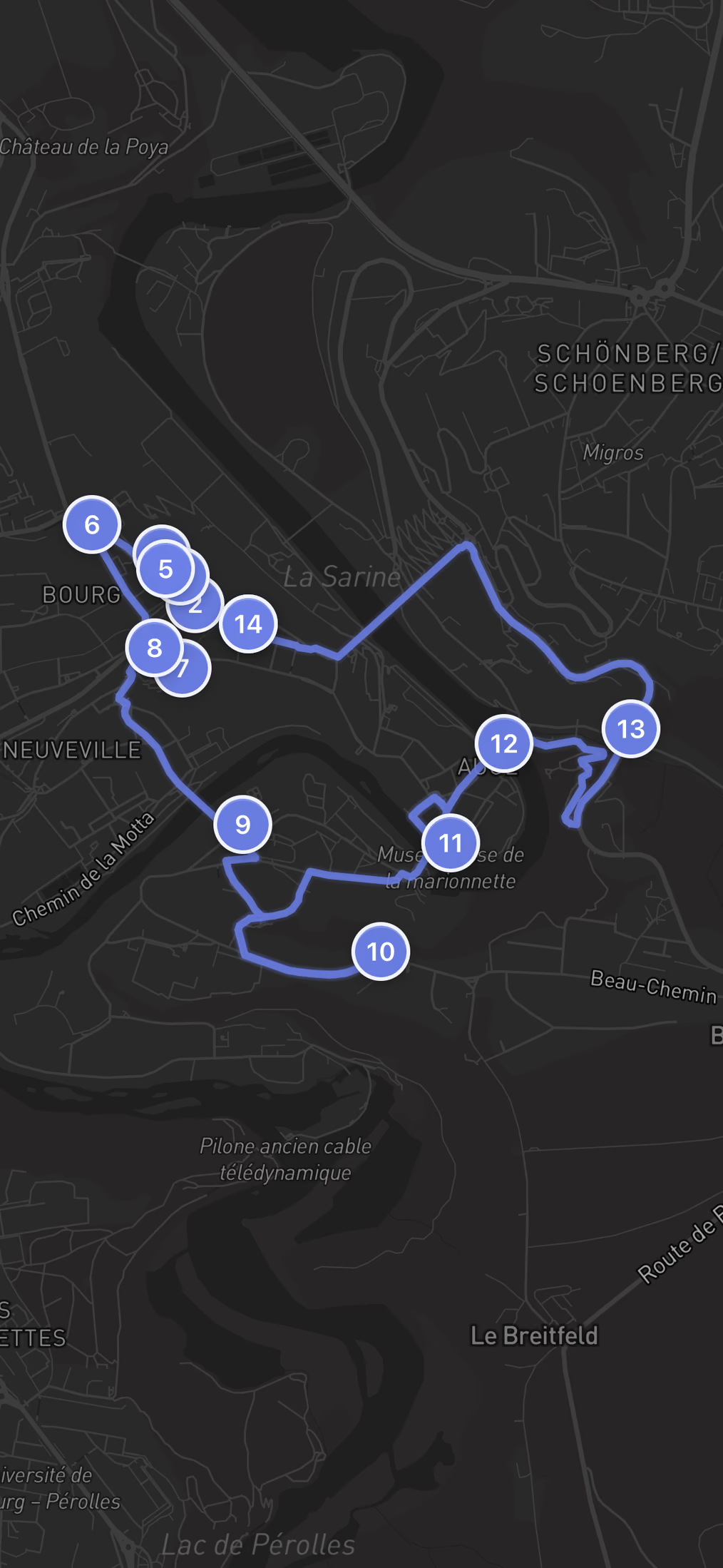
Walking tour route map of Fribourg
Try This Tour

Why Walk Fribourg? A Self-Guided Tour

Fribourg is built on a rock loop in the Sarine, and that single fact shapes everything about walking here. The medieval upper town sits high on a sandstone spur; the old Basse-Ville crouches 50 metres below along the river, wrapped on three sides by water. You do not stroll across Fribourg, you climb up and drop down through it. That is exactly why a planned route beats wandering. Get the order wrong and you waste your legs hauling back up the same slope twice. This loop solves it: see the high town first, ride the funicular down for free of effort, then walk the riverbank and let one easy climb bring you home.

The other thing that makes this town strange and good is the language line. Fribourg sits right on the Röstigraben, the invisible border between French- and German-speaking Switzerland. Street signs, menus and the people around you flip between the two without warning. Locals call the place Fribourg and Freiburg in the same breath, and the canton's name, Üechtland, is the old marker that distinguished it from the other Freiburg in Germany. You hear the mix everywhere on this walk.

This route is a 4.8 km loop that starts and ends at the cathedral. It threads the Gothic upper town, the museums clustered around the Cordeliers, the medieval bridges of the Basse-Ville, and the Lorette terrace, which is the one viewpoint that puts the whole old town in a single frame. You can do it in an afternoon. The honest selling point of Fribourg is that almost none of the headline sights cost money, and the few museums that do charge run 5 to 10 CHF, which in Switzerland is close to free.

The Route: 14 Stops

Swipe through images or scroll names below

Scroll to explore →
1. Cathédrale Saint-Nicolas
2. Funiculaire de Fribourg
3. Église des Cordeliers
4. Basilique Notre-Dame
5. Espace Jean Tinguely - Niki de Saint Phalle
6. Musée d'Art et d'Histoire
7. Hôtel de Ville de Fribourg
8. Marché de la Place de l'Hôtel de Ville
9. Saint-Jean
10. Lorette / Chapelle de Lorette
11. Musée suisse de la marionnette
12. Pont de Berne
13. Pont du Gottéron
14. Cathédrale Saint-Nicolas

Route Map

Tap to load interactive map
AI Tourguide
Walk this exact route with a private AI guide.
Full GPS navigation, interactive stories, and a guide that answers all your questions. A private guide experience for just €5/hour.
Try This Tour

Your Fribourg Walking Tour, Stop by Stop

  1. 1

    Cathédrale Saint-Nicolas

    Cathédrale Saint-Nicolas in Fribourg, stop 1 on the self-guided walking tour

    Start here because you cannot miss it. The Gothic tower is the highest thing in town and you will use it to orient yourself all day. The cathedral is built in the gothique rayonnant style on a rock spur that drops 50 metres straight to the Sarine, and since 1924 it has been the seat of the diocese of Lausanne, Geneva and Fribourg. Step inside and look up at the modern stained glass by the Polish artist Józef Mehoffer, made between 1896 and 1936; it is the reason art people make a detour to Fribourg. Entry to the church is free, open Monday to Saturday 7:30 AM to 7:00 PM and Sunday and holidays 9:00 AM to 9:30 PM. If you have the legs, the tower climb gives the best aerial view of the river loop; it charges a small fee separate from the free nave, so check at the entrance. Concrete tip: come in the morning when low sun lights the Mehoffer windows on the north side. From the main door, walk west across the square toward the funicular station.

    Hours
    Mon-Sat: 7:30 AM - 7:00 PM | Sun-Holidays: 9:00 AM - 9:30 PM
    Price
    Free

    2-minute walk

  2. 2

    Funiculaire de Fribourg

    Funiculaire de Fribourg, stop 2 on the self-guided walking tour

    This is a sight you ride, not just look at. The Funiculaire de Fribourg has run since 1899 and it is one of the last funiculars in the world powered by water ballast, except the water here is the city's own wastewater from the upper neighbourhoods. The top car fills its tank, gravity pulls it down, and that hauls the lower car up. No motor, no electricity, just sewage and physics. The line is short, roughly 170 metres of track dropping about 50 metres, and it lands you in the Pertuis at the edge of the Auge quarter, which is precisely where you want to be next. Official hours and the exact fare change with the season, so check the TPF site for current times and price before you set off; it is cheap and tickets sell at the station. Practical note: do not climb down on foot to save a franc, the point is the ride and the faint smell is part of the story. Ride it down, then walk a few minutes to the Cordeliers church.

    Hours
    UNKNOWN_NEEDS_MANUAL
    Price
    UNKNOWN_NEEDS_MANUAL

    3-minute walk

  3. 3

    Église des Cordeliers

    Église des Cordeliers in Fribourg, stop 3 on the self-guided walking tour

    After the novelty of the funicular, this is where Fribourg gets quietly serious. The Église des Cordeliers was built by the Franciscans, once nicknamed cordeliers after the three-knotted cord they wore as a sign of their vows. It came through a 17-year restoration that finished in 2005, and it holds more medieval art than its plain exterior suggests: three Gothic altarpieces, sixty-six choir stalls dating from around 1300, and a wall of paintings and sculpture. The retables alone are worth the stop, especially the carved one behind the altar. Entry is free, and it is open daily, though hours vary; you can call +41 26 347 11 60 to confirm visiting times. Tip: this church sits in the same small block as three museums, so treat the next four stops as one cluster rather than separate walks. Step back outside and the Basilique Notre-Dame is right next door.

    Hours
    Daily (contact +41 26 347 11 60 for specific visiting hours)
    Price
    Free

    1-minute walk

  4. 4

    Basilique Notre-Dame

    Basilique Notre-Dame in Fribourg, stop 4 on the self-guided walking tour

    A few steps from the Cordeliers stands the oldest Marian church in town. The Basilique Notre-Dame is dedicated to Notre-Dame and was raised to the rank of minor basilica in 1932 by Pope Pius XI. It belongs to the same diocese as the cathedral, but the mood inside is different: smaller, older in feel, and usually empty of crowds, which makes it a calm place to sit for a few minutes. Entry is free, open daily 9 AM to 5 PM. Do not rush past the interior just because the cathedral up the hill is grander; the painted ceiling and the quiet here are the point. Tip: this is a good moment to regroup before the museum block, since the upper-town square around the Cordeliers is easier for finding cafés and facilities than the river quarter below. From the basilica, the Espace Tinguely is a few metres on.

    Hours
    Daily 9 AM - 5 PM
    Price
    Free

    1-minute walk

  5. 5

    Espace Jean Tinguely - Niki de Saint Phalle

    Espace Jean Tinguely - Niki de Saint Phalle in Fribourg, stop 5 on the self-guided walking tour

    Here the walk snaps from the Middle Ages into the 20th century in the space of one street. Jean Tinguely was Fribourg's most famous artist, the man who built kinetic machine-sculptures that whir, clank and self-destruct, and this space pairs his work with that of Niki de Saint Phalle, his partner, known for her huge, bright Nanas figures. It sits in a former trolleybus depot, which suits the industrial racket of the machines perfectly. After a morning of Gothic stone, the contrast is the reason to come. Open Tuesday to Sunday 11:00 AM to 5:00 PM, admission 10 CHF. Allow 30 to 45 minutes; it is small but you will stand watching the machines longer than you expect. Tip: ask staff when the larger motorised pieces are switched on, since a still Tinguely is only half the experience. The Musée d'Art et d'Histoire is a short walk west.

    Hours
    Tue-Sun: 11:00 AM - 5:00 PM
    Price
    10.00 CHF

    3-minute walk

  6. 6

    Musée d'Art et d'Histoire

    Musée d'Art et d'Histoire in Fribourg, stop 6 on the self-guided walking tour

    This is the city's main museum and the one that ties the whole walk together. It lives in the Hôtel Ratzé, a Renaissance patrician mansion from 1581, and inside you get the long version of everything you have been looking at outside: medieval religious sculpture pulled from local churches, and a set of painted panels by Hans Fries, the leading Fribourg painter of the late 15th century. There is also a sculpture garden with Tinguely and Saint Phalle works, so it bookends the previous stop. Open Tuesday to Sunday 11:00 AM to 6:00 PM, with late opening Thursday until 8:00 PM, admission 10 CHF. Budget an hour if medieval art interests you, less if it does not. Tip: pairing this with the Espace Tinguely is the smart way to spend a rainy afternoon, since both are indoors and a few minutes apart. From here, head south back toward the spine of the upper town and the Hôtel de Ville.

    Hours
    Tue-Sun: 11:00 AM - 5:00 PM
    Price
    10.00 CHF

    4-minute walk

  7. 7

    Hôtel de Ville de Fribourg

    Hôtel de Ville de Fribourg, stop 7 on the self-guided walking tour

    Walk back to the top of the old town and you reach the political heart of Fribourg. The Hôtel de Ville is a late-Gothic town hall built between 1501 and 1522, with an outside staircase and a clock tower that anchor the square named after it. Next to it grows a linden tree planted in 1488 to mark the canton's part in the Swiss victory at the Battle of Murten; the tree you see is a replacement, but the spot and the story are real. The building still houses the cantonal parliament, so you admire it from outside; the square is always open and free. Tip: stand at the foot of the staircase and look up the slope to frame the cathedral tower behind the town hall, a cleaner shot than from the cathedral square itself. The market, when it runs, spreads out right in front of you.

    Hours
    Always Open
    Price
    Free

    1-minute walk

  8. 8

    Marché de la Place de l'Hôtel de Ville

    If you time it right, this square stops being a quiet plaza and turns into the best food stop on the route. The market runs Wednesday and Saturday mornings directly in front of the town hall, with local vegetables, Gruyère cheese from the nearby valleys, and Cuchaule, the saffron-yellow brioche that is a Fribourg speciality. It is free to wander and the right place to assemble a picnic for the river stretch ahead. Buy a wedge of Gruyère and a piece of Cuchaule and you have lunch for a few francs, which on a Swiss budget is a small miracle. Tip: come before 11 AM, since stalls start packing up around midday and the best cheese goes early. If you are here on any other day, the square is still worth crossing for the architecture, but skip ahead to Saint-Jean. From the square, head downhill toward the southern end of the upper town.

    Hours
    Always Open
    Price
    Free

    5-minute walk

  9. 9

    Saint-Jean

    Saint-Jean in Fribourg, stop 9 on the self-guided walking tour

    The route now starts its descent toward the river, and Saint-Jean marks the turn. This church is medieval in origin and was reworked in the 18th century, which is why a plain old shell holds a lighter, later interior. Its history is tied to the neighbouring commandery of the Knights Hospitaller of the Order of Saint John of Jerusalem, the religious-military order that ran a hospital and refuge here. It is one of the less-visited churches on the walk, which is exactly its appeal: you will likely have it to yourself. Entry is free, open daily 9 AM to 5 PM. Keep it short, five minutes inside is enough. Tip: this is the point where the streets steepen and the pavement turns to older cobbles, so this is your cue to check your footing before the climb up to Lorette. From here, the path winds up to the Lorette terrace.

    Hours
    Daily 9 AM - 5 PM
    Price
    Free

    4-minute walk

  10. 10

    Lorette / Chapelle de Lorette

    Lorette / Chapelle de Lorette in Fribourg, stop 10 on the self-guided walking tour

    This is the view everyone comes for, and the one stop where you should slow right down. The Chapelle de Lorette is a small pilgrimage chapel from 1647, built to copy the Santa Casa di Loreto in Italy, and it sits on a rock terrace above the bend in the Sarine. The chapel itself is modest; the terrace in front is the prize. From here the whole medieval upper town lines up in one frame: the cathedral tower, the tiled roofs stacked down the slope, the river curling below. This is the postcard shot of Fribourg, no exaggeration. The chapel is free, open daily 9 AM to 5 PM. Tip: aim for late afternoon when the sun is behind you and lights the cathedral face-on; midday flattens it and morning leaves the town in shade. Sit on the wall, eat the Cuchaule you bought at the market, and take your time. When you are ready, head down toward the marionette museum.

    Hours
    Daily 9 AM - 5 PM
    Price
    Free

    3-minute walk

  11. 11

    Musée suisse de la marionnette

    Musée suisse de la marionnette in Fribourg, stop 11 on the self-guided walking tour

    On the way down into the Basse-Ville you pass something genuinely one of a kind in Switzerland. The Musée suisse de la marionnette holds over 4,000 puppets and marionettes, set inside a medieval house in the Auge quarter. It is small, odd, and a good 20-minute stop, especially if you are walking with children who have run low on patience for churches. Open Wednesday to Sunday 11:00 AM to 5:00 PM, admission 5 CHF, which makes it the cheapest ticket on the whole route. Tip: it is closed Monday and Tuesday, so if those are your days in town, skip it and spend the time on the bridges instead. Check the schedule on marionnette.ch, as the museum sometimes runs actual puppet shows. From here you drop the last stretch to the river and the wooden bridge.

    Hours
    We-Su 11:00-17:00
    Price
    5.00 CHF

    3-minute walk

  12. 12

    Pont de Berne

    Pont de Berne in Fribourg, stop 12 on the self-guided walking tour

    Down at river level, the Pont de Berne is the oldest bridge still standing in Fribourg and the postcard you cross rather than photograph from afar. It is a covered wooden bridge over the Sarine, dark timber overhead, planks underfoot, the river running fast below. For centuries this was the main crossing on the road to Bern, which is where the name comes from. It is always open and free to walk. Stop halfway, look upriver at the city walls climbing the far bank, and you understand instantly why Fribourg was built where it was: the water was the defence. Tip: the light inside the bridge is dim and the open ends are bright, so for a photo, shoot a person framed in the far archway rather than the timber interior, which comes out muddy. Once across, follow the riverbank a few minutes upstream to the Gottéron bridge.

    Hours
    Always open
    Price
    Free

    4-minute walk

  13. 13

    Pont du Gottéron

    Pont du Gottéron in Fribourg, stop 13 on the self-guided walking tour

    The last stop is a quieter, wilder one, where the Basse-Ville meets the gorge. The Pont du Gottéron is a road bridge over the Gottéron stream, the side valley that cuts down to join the Sarine here, and it marks the edge of town where the cobbles give way to woods and the start of the Gottéron gorge walk. This is not a museum piece, it is a working bridge, but the setting is the draw: steep green slopes, the stream below, and the old quarter behind you. It is open and free. Tip: if you have an extra hour and decent shoes, the marked trail up the Gottéron gorge from here is the best short hike in Fribourg, a cool ravine walk that few day-trippers ever find. Otherwise, turn back: from here the route climbs the slope and the cathedral tower guides you home to where you started.

    Hours
    UNKNOWN_NEEDS_RESCUE
    Price
    UNKNOWN_NEEDS_RESCUE

    Loop back to the cathedral to finish

  14. 14

    Cathédrale Saint-Nicolas

    Cathédrale Saint-Nicolas in Fribourg, stop 14 on the self-guided walking tour

    Start here because you cannot miss it. The Gothic tower is the highest thing in town and you will use it to orient yourself all day. The cathedral is built in the gothique rayonnant style on a rock spur that drops 50 metres straight to the Sarine, and since 1924 it has been the seat of the diocese of Lausanne, Geneva and Fribourg. Step inside and look up at the modern stained glass by the Polish artist Józef Mehoffer, made between 1896 and 1936; it is the reason art people make a detour to Fribourg. Entry to the church is free, open Monday to Saturday 7:30 AM to 7:00 PM and Sunday and holidays 9:00 AM to 9:30 PM. If you have the legs, the tower climb gives the best aerial view of the river loop; it charges a small fee separate from the free nave, so check at the entrance. Concrete tip: come in the morning when low sun lights the Mehoffer windows on the north side. From the main door, walk west across the square toward the funicular station.

    Hours
    Mon-Sat: 7:30 AM - 7:00 PM | Sun-Holidays: 9:00 AM - 9:30 PM
    Price
    Free
AI Tourguide
Walk this exact route with a private AI guide.
Full GPS navigation, interactive stories, and a guide that answers all your questions. A private guide experience for just €5/hour.
Try This Tour

Self-Guided Tour vs. Group Tour in Fribourg

Self-guided is the obvious call in Fribourg, and not by a small margin. The headline sights, the cathedral, both bridges, the town hall, the Lorette terrace, are all free, and the four museums on the route charge between 5 and 10 CHF each. You could walk this entire loop and pay nothing if you skip the museums, or do all four for under 35 CHF. A guided group walking tour of the old town typically runs in the region of 20 to 30 CHF per person where offered, and a private guide in Switzerland will not start under 150 CHF for a couple of hours. For a town this small and this easy to read, that is hard to justify.

What you lose going alone is the context. Fribourg's story is genuinely tangled: the language border running through it, the wastewater funicular, the role of the bridges in defending a town wrapped in a river loop, the Mehoffer windows. Standing in front of these things without that background, you see pretty stone and miss why it matters. That is the real trade-off, not the money.

My honest verdict: do it self-guided and solve the context problem another way. Read the stop notes above before you go, or use a guide that talks to you as you walk. The route itself needs no escort. It is short, well signposted, and you have the cathedral tower as a constant compass. Save the franc you would spend on a group tour and put it toward a wedge of Gruyère at the Saturday market.

Group Tour AI Self-Guided
Price €25–€50 per person €5/hour or €20 all-inclusive
Flexibility Fixed schedule Start anytime, skip stops
Languages 1–2 languages 11 languages
Pace Group pace Your own pace

How Long Does This Fribourg Tour Take?

Our route covers 4.8 km with 14 stops and takes approximately 3.0 hours at a relaxed pace.

The full loop is 4.8 km. Pure walking time is roughly an hour and three quarters, but the realistic total with stops is about three hours, and that climbs to four or five if you go into all four museums. The stops that deserve real time are the cathedral interior, the Lorette terrace, and whichever one or two museums match your taste; the churches and bridges are five to ten minute visits each. The natural break is the Place de l'Hôtel-de-Ville at the halfway mark: on a Wednesday or Saturday morning the market there is your lunch, and any other day there are cafés on and around the square. The other good pause is the wall in front of the Lorette chapel, with the whole old town laid out below, which is the spot to sit and eat whatever you picked up at the market.

Tips for Walking in Fribourg

  • Timing and transport: Fribourg's main train station (Gare de Fribourg/Freiburg) is a short walk from the cathedral, with fast trains from Bern (about 25 minutes) and Lausanne (about 45 minutes). Start at the cathedral and walk the loop clockwise as written so the funicular carries you down rather than making you climb.
  • Terrain and shoes: this is a steep, cobbled town with a 50-metre height difference between the upper town and the Basse-Ville. The lanes around Saint-Jean and the Auge quarter are old uneven stone. Wear proper walking shoes, not smooth soles, especially in wet weather when the cobbles get slick.
  • Restrooms: the easiest facilities on the route are in the upper town around the Cordeliers and the museum block, so use them there before you drop into the Basse-Ville, where public toilets are scarce.
  • Food and drink: at the Wednesday or Saturday morning market on the Place de l'Hôtel-de-Ville, buy a wedge of Gruyère and a piece of Cuchaule, the saffron brioche; a full picnic lunch comes to just a few francs, cheap by Swiss standards.
  • Photo: the single best shot of Fribourg is from the terrace in front of the Lorette chapel, facing north toward the upper town. Go in late afternoon so the sun is behind you and lights the cathedral tower and the stacked roofs head-on.
  • Money: most of this walk is free. Carry only about 30 to 35 CHF if you plan to enter all four museums, and note the marionette museum at 5 CHF is the cheapest ticket while the Espace Tinguely and Musée d'Art et d'Histoire are 10 CHF each.
  • Closing days: the Espace Tinguely and Musée d'Art et d'Histoire are closed Monday, and the marionette museum is closed Monday and Tuesday. If you visit early in the week, plan around the open churches and bridges instead.
AI Tourguide
Walk this exact route with a private AI guide.
Full GPS navigation, interactive stories, and a guide that answers all your questions. A private guide experience for just €5/hour.
Try This Tour

AI Audio Guide for This Tour

Standing under the cathedral tower wondering what you are actually looking at? AI Tourguide is a voice-first guide built right into this walk: it greets you, tells you the story of the spot you are standing on, asks what you are into, and shapes the rest of the route around your answers as you go. Not an audioguide reading a script, and not a question-and-answer bot, an actual conversation that walks with you from the cathedral down through the funicular and along the river to Lorette. Start it in your browser, no download, and let it do the talking while you keep your own pace.

AI Audio Guide Stories, history and fun facts narrated as you walk. No earpiece rental needed.
GPS Navigation Turn-by-turn directions so you never get lost between stops.
Ask Anything Curious about a building you pass? Ask your AI guide on the spot.
11 Languages Switch language anytime. No separate tour needed.
Try This Tour

Common Questions

Is Fribourg safe to walk around?

Yes, very. Fribourg is a small, calm Swiss town with low crime, and the whole route is fine to walk day or evening. The only real hazards are physical: steep cobbled lanes that get slippery in rain, and the unfenced river and gorge edges down in the Basse-Ville, so watch your footing rather than your wallet. There are no notable tourist scams here.

What if it rains during my Fribourg tour?

You have good indoor options clustered close together. The Espace Jean Tinguely (10 CHF) and the Musée d'Art et d'Histoire (10 CHF) are a few minutes apart in the upper town, the marionette museum (5 CHF) is small and dry, and the cathedral, Notre-Dame and Cordeliers churches are all free and roofed. Do the museum block while it pours and save the Lorette viewpoint and bridges for a clear spell.

What's the best time of day for this walking tour?

Start in the morning, around 9 to 10 AM, so you catch the Mehoffer windows in the cathedral lit by low sun and, on Wednesday or Saturday, the market in full swing. Time the walk so you reach the Lorette terrace in the late afternoon, when the sun is behind you and lights the old town for the best photo. That sequencing also means the museums are open through the middle of your day.

Do I need to speak French or German in Fribourg?

No. Fribourg sits on the language border, so French and German are both everywhere and locals switch easily; signs and menus often appear in both. English is widely understood in shops, cafés and at the museums, so you will manage fine with it. Knowing the town as both Fribourg and Freiburg helps you read the signs without confusion.

How long does the Fribourg walking tour take?

Plan about three hours for the 4.8 km loop with short stops at the churches, bridges and the Lorette viewpoint. Pure walking is under two hours, but if you go into all four museums it stretches to four or five hours. It is comfortably an afternoon, or a half-day if you take it slowly.

Is the funicular worth riding?

Yes, ride it. The Funiculaire de Fribourg has run on water ballast since 1899 and is one of the last of its kind in the world, powered by the city's own wastewater. It is cheap, it saves you a steep descent into the Basse-Ville, and it is a genuine sight in itself, not just transport. Check current hours and fare on the TPF site before you go.

Do I need to book the walking tour in advance?

No booking needed. This self-guided tour is available anytime. Open the route on your phone and start walking. The AI audio guide works instantly, no reservation required.

What languages is the audio guide available in?

The AI audio guide is available in 11 languages: English, German, French, Spanish, Italian, Japanese, Chinese, Portuguese, Danish, Norwegian, and Swedish.

Can I skip stops or change the route?

Yes. Skip any stop, spend extra time at places you like, or start the route from any point. You can also ask the AI to suggest a shorter route.
AI Tourguide
Curated by AI Tourguide GPS-verified routes, reviewed and updated regularly.
Last verified June 2026
▶ Try This Tour No app · try it instantly from your couch