Self-Guided Walking Tour in Geneva

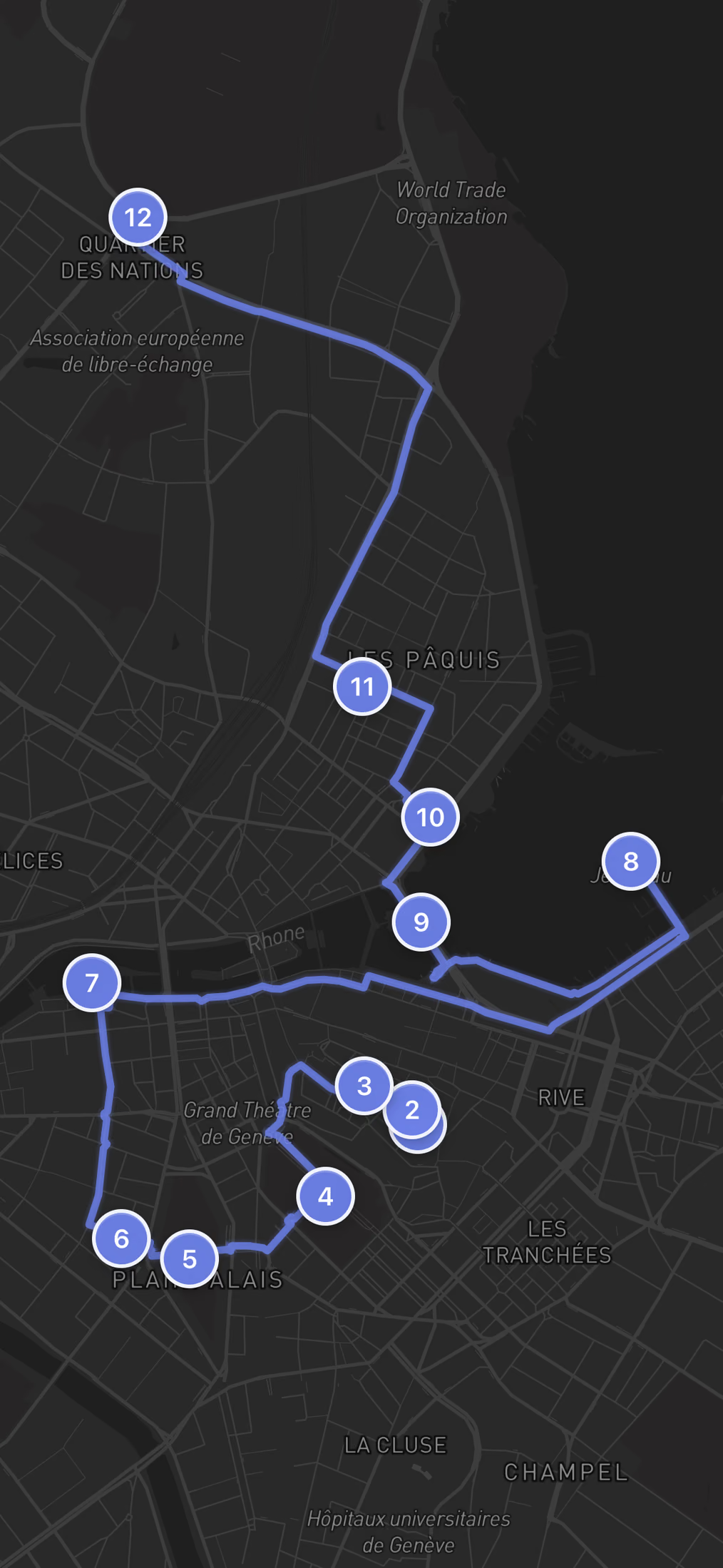
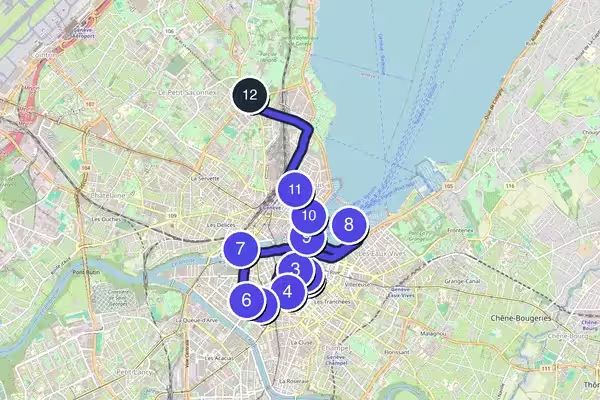
A 12-stop, 8.4 km route from St-Pierre Cathedral at the top of the medieval old town down to the lake and out to the Broken Chair by the UN. This page gives you the full map, walking time for every leg, real prices and opening hours for each stop, and shorter versions if you want to stop early.

12 Stops8.4 km~4 hours walkingHalf to full day with stops
What you get with AI Tourguide
Full GPS navigationInteractive AI guidePersonalized to youWorks in your browser
Try this tour with Alex

Geneva Walking Tour at a Glance

This route is built for anyone who wants Geneva's two faces, the old religious republic on the hill and the modern diplomatic city on the lake, in one clean line. Every interior is optional: the cathedral nave and all the outdoor stops are free, and you decide at each museum door whether to go in. You walk it at your own speed, no group, no guide waiting.

StartSt. Pierre Cathedral (Cathédrale Saint-Pierre de Genève)
FinishBroken Chair
Route typeA point-to-point walk, not a loop. It runs broadly north: down the Left Bank old town, across the Rhone once at the Pont du Mont-Blanc, then up the Right Bank lakeshore. Almost no backtracking.
Realistic timePure walking is roughly 2.5 to 3 hours across 8.4 km. With two or three museums and a proper sit by the lake, plan a comfortable half to full day.
DifficultyModerate. The old town around the cathedral is steep cobblestone, then the lakefront quays are long flat stretches. At 8.4 km end to end it is a real walk, not a stroll.
Cost to followThe outdoor route is free. Only three museums charge: the Museum of the Reformation at CHF 13, the Patek Philippe Museum at CHF 10, and the Barbier-Mueller Museum at CHF 13 for adults.
Best for:

Walkers who want history, world-class watch and tribal-art museums, and the lakefront in one route, and who are happy to cover 8.4 km on foot rather than hop between sights.

The Route

Free Walking Tour Map of Geneva

12 stops8.4 kmabout 4 hours
Loading the interactive map…The complete walking route will appear here.
Want the route to guide you while you walk?Open the route with navigation and a personal guide for the history, stories and questions that matter to you.
Open route + AI guide

The 12 stops along this route

  1. St. Pierre Cathedral (Cathédrale Saint-Pierre de Genève) in Geneva, stop 1 on the self-guided walking tour
    1St. Pierre Cathedral (Cathédrale Saint-Pierre de Genève)
  2. International Museum of the Reformation (Musée international de la Réforme) in Geneva, stop 2 on the self-guided walking tour
    2International Museum of the Reformation (Musée international de la Réforme)
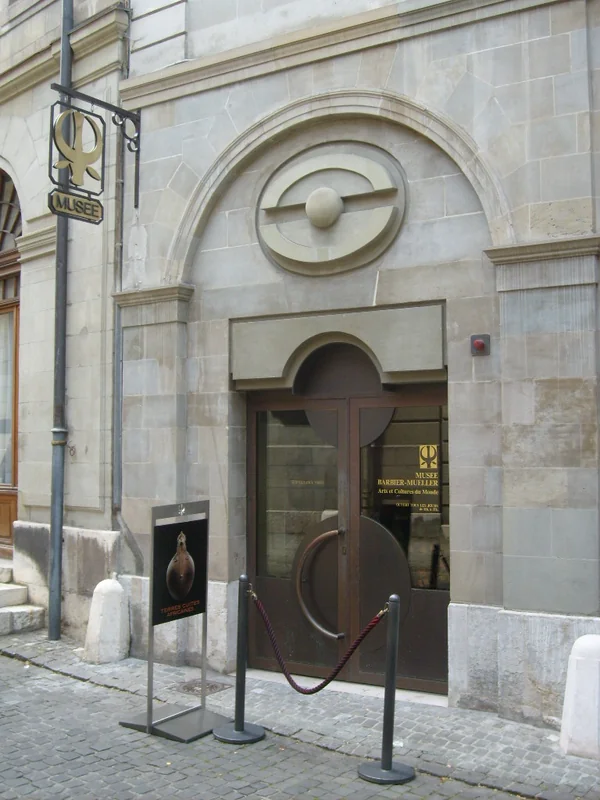
  3. Barbier-Mueller Museum (Musée Barbier-Mueller) in Geneva, stop 3 on the self-guided walking tour
    3Barbier-Mueller Museum (Musée Barbier-Mueller)
  4. Parc des Bastions in Geneva, stop 4 on the self-guided walking tour
    4Parc des Bastions
  5. Plaine de Plainpalais in Geneva, stop 5 on the self-guided walking tour
    5Plaine de Plainpalais
  6. Patek Philippe Museum (Musée Patek Philippe) in Geneva, stop 6 on the self-guided walking tour
    6Patek Philippe Museum (Musée Patek Philippe)
  7. Bâtiment des Forces motrices in Geneva, stop 7 on the self-guided walking tour
    7Bâtiment des Forces motrices
  8. Jet d'Eau (Jet d'eau de Genève) in Geneva, stop 8 on the self-guided walking tour
    8Jet d'Eau (Jet d'eau de Genève)
  9. Mont Blanc Bridge (Pont du Mont-Blanc) in Geneva, stop 9 on the self-guided walking tour
    9Mont Blanc Bridge (Pont du Mont-Blanc)
  10. Brunswick Monument (Monument Brunswick) in Geneva, stop 10 on the self-guided walking tour
    10Brunswick Monument (Monument Brunswick)
  11. Bains des Pâquis in Geneva, stop 11 on the self-guided walking tour
    11Bains des Pâquis
  12. Broken Chair in Geneva, stop 12 on the self-guided walking tour
    12Broken Chair
  13. That's the complete route.

    If you want more than the map and text, add live navigation and a conversational AI guide while you walk.

    Open route + AI guide
    You made it
Stop 1 of 12
Swipe →

Your Geneva Walking Tour, Stop by Stop

  1. 1

    St. Pierre Cathedral (Cathédrale Saint-Pierre de Genève)

    St. Pierre Cathedral (Cathédrale Saint-Pierre de Genève) in Geneva, stop 1 on the self-guided walking tour

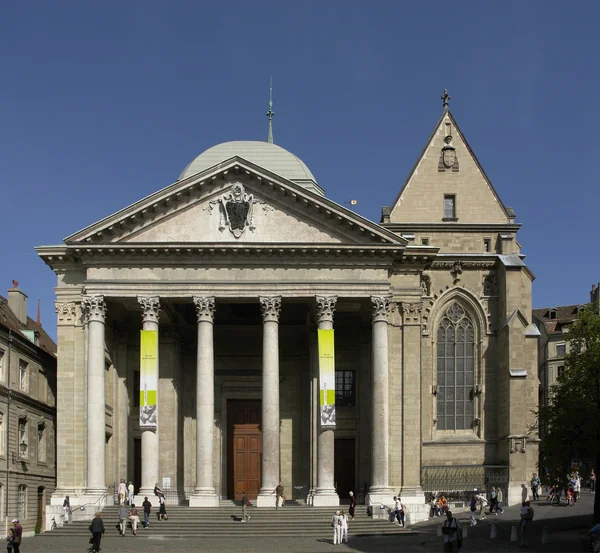
    You climb up through the cobbled lanes of the old town and the cathedral appears at the top, fronted by an odd neo-classical portico bolted onto a Gothic body. This has been Geneva's main Protestant church since 1535, and for a thousand years before that the seat of the city's bishop. Inside it is famously bare. The Reformation stripped out the statues and gold, so what you get is clean stone, Calvin's wooden chair, and a strange calm. Entry to the nave is free, open Monday to Friday 11:00 to 17:00, Saturday 10:00 to 17:30, Sunday 12:00 to 17:30. The real reason to come is the towers. Climb the 157 steps up the north and south towers for the best rooftop view in Geneva, lake on one side, red old-town roofs below. Do this first thing before your legs are tired and before the midday crowd forms on the narrow spiral stairs. The archaeological site beneath the cathedral is a separate ticket and easy to skip on a first visit.
    Hours
    Always open
    Price
    Free
  2. 2

    International Museum of the Reformation (Musée international de la Réforme)

    International Museum of the Reformation (Musée international de la Réforme) in Geneva, stop 2 on the self-guided walking tour

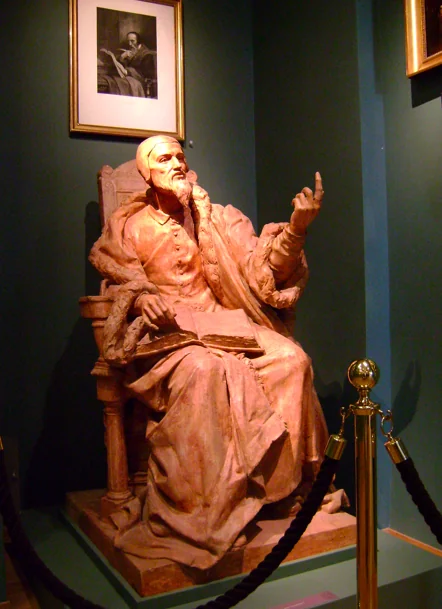
    Step out of the cathedral and the museum is right next door, in the Maison Mallet, a 1723 patrician house built on the spot where Geneva voted to adopt the Reformation on 21 May 1536. That is the whole point here: this is ground zero for Calvinism, the movement that turned Geneva into a strict Protestant republic and shaped the city for centuries. Fourteen rooms walk you through it with manuscripts, old bibles, portraits and caricatures, plus a few rooms for temporary shows. It reopened in April 2023 after a long renovation, so the displays are modern and well captioned in English. Open Tuesday to Sunday 10:00 to 17:00, closed Mondays. Admission is CHF 13 for adults, CHF 10 seniors, CHF 8 students, CHF 25 for a family. If you only do one indoor stop on the hill, this is the one that explains why Geneva is the way it is. Budget about 45 minutes.

    Hours
    Tu-Su 10:00-17:00
    Price
    CHF 13 (adults); CHF 10 (seniors); CHF 8 (students); CHF 25 (family)
  3. 3

    Barbier-Mueller Museum (Musée Barbier-Mueller)

    Barbier-Mueller Museum (Musée Barbier-Mueller) in Geneva, stop 3 on the self-guided walking tour

    A short walk along the quiet upper lanes brings you to rue Jean-Calvin 10, a small private museum that almost nobody outside Geneva knows about. Founded in 1977, it holds several thousand pieces of tribal and classical antiquity art: sculptures, textiles and ornaments from across Africa, Oceania, Asia and the ancient Mediterranean. The collection is huge, but the space is small, so what you see is a rotating, beautifully lit selection rather than everything at once. It feels more like a serious collector's house than a public museum, which is exactly the charm. Open daily 11:00 to 17:00, admission CHF 13 for adults, CHF 8 to 10 for students and seniors, free for children. It is a good rainy-hour option and rarely busy, so you will often have a room to yourself. If tribal art does nothing for you, this is the easiest stop on the route to skip. The building itself and the lane are worth the two-minute look regardless.

    Hours
    11:00-17:00
    Price
    CHF 13 (adults); CHF 8–10 (students/seniors); free for children
  4. 4

    Parc des Bastions

    Parc des Bastions in Geneva, stop 4 on the self-guided walking tour

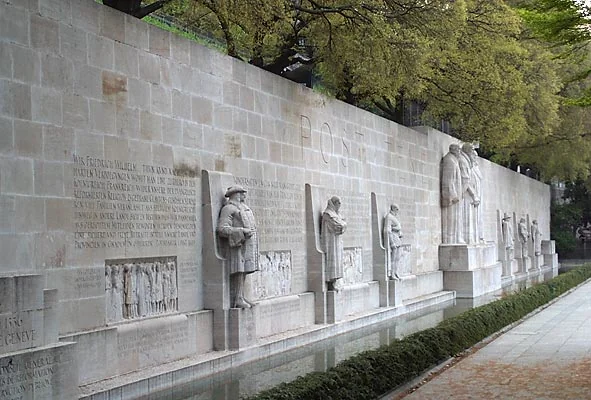
    Walk down off the hill and the old town opens into Geneva's most-loved park, laid out where the city's old fortifications once stood. Two things draw people here. Along the back wall runs the Reformation Wall, a 100-metre stone monument with four giant figures of Calvin, Farel, Bèze and Knox staring out over the lawn. In front of it, locals play on the park's permanent giant chessboards, and you can usually watch a serious game or join one if a set is free. The park is also the front garden of the University of Geneva, founded by Calvin in 1559, so it fills with students. Open 24/7 and free. Grab a coffee at the kiosk near the main gate and sit a while, this is the natural halfway breather of the upper half of the walk. The tree-lined main alley is dead straight and frames the wall perfectly for a photo. Spring and autumn afternoons are best, when the light hits the statues.

    Hours
    Open 24/7
    Price
    Free
  5. 5

    Plaine de Plainpalais

    Plaine de Plainpalais in Geneva, stop 5 on the self-guided walking tour

    Leaving the park, you cross into a completely different Geneva: a vast open gravel esplanade of 78,135 square metres that locals just call la Plaine. There is no pretty fountain or facade here. What makes it worth timing is the market. On Tuesday, Friday and Sunday mornings it fills with one of the best fruit, vegetable and flower markets in the city, and on Wednesday and Saturday it turns into a big flea market where Genevans sell off everything from watches to vinyl. Come on a market day and this dusty square is alive; come on an empty afternoon and it is just gravel and skateboarders. Open access, always free. The surrounding streets in Plainpalais are where Geneva actually eats, with cheaper, more interesting restaurants than the old town. This is your best lunch stop on the route. If you hit it mid-week with no market on, do not linger, the museums on the next stretch are the draw.

    Hours
    Always open
    Price
    Free
  6. 6

    Patek Philippe Museum (Musée Patek Philippe)

    Patek Philippe Museum (Musée Patek Philippe) in Geneva, stop 6 on the self-guided walking tour

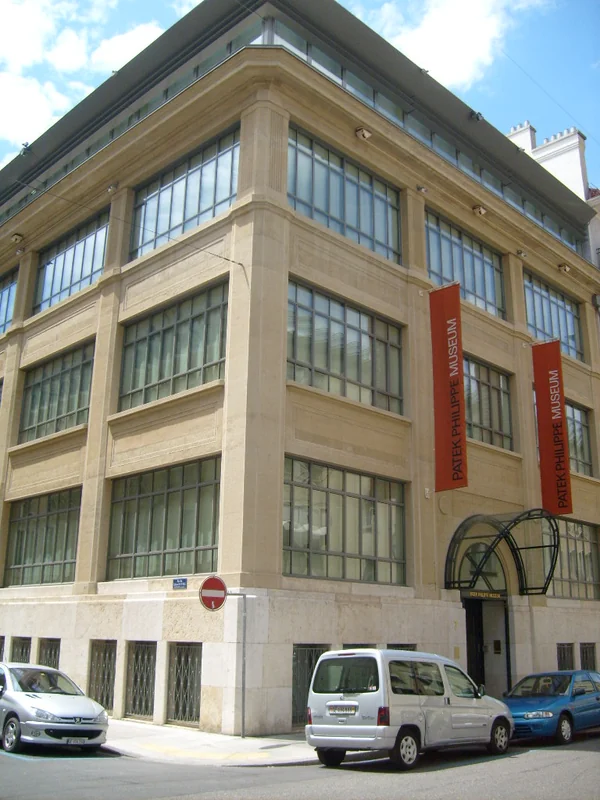
    On the far side of Plainpalais sits the building that justifies Geneva's reputation as the world capital of watchmaking. The Patek Philippe Museum is a private collection in a restored 1920s workshop, four floors covering 500 years of watches and enamel miniatures, including the company's own masterpieces and some of the earliest pocket watches ever made. Even if you do not care about watches, the craftsmanship at this level is genuinely jaw-dropping. The catch is the hours: open Tuesday to Friday 14:00 to 18:00 and Saturday 10:00 to 18:00 only, closed Sunday and Monday. Plan around that, it trips up a lot of visitors. Admission is CHF 10 for adults, CHF 7 for students and seniors, free for under-18s, which is remarkable value for what is inside. Free guided tours run on Saturday afternoons and are worth catching. Give it at least an hour. This is the indoor highlight of the lower half of the walk.

    Hours
    Tue-Fri: 2:00 PM - 6:00 PM | Sat: 10:00 AM - 6:00 PM
    Price
    CHF 10 (adults); CHF 7 (students/seniors); free for under 18
  7. 7

    Bâtiment des Forces motrices

    Bâtiment des Forces motrices in Geneva, stop 7 on the self-guided walking tour

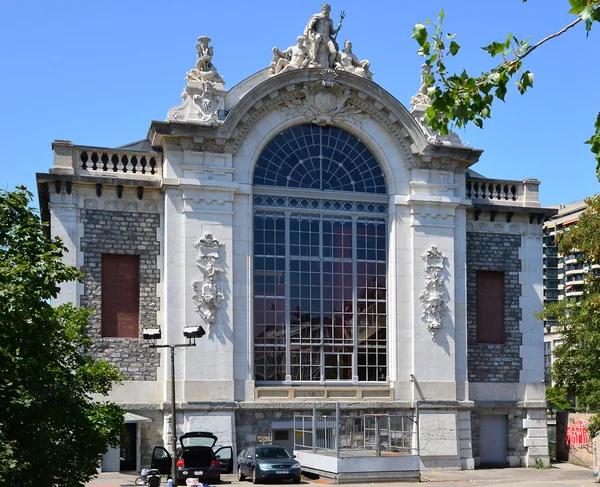
    The walk now heads down toward the Rhône, and on a spit of land in the middle of the river stands a long brick industrial hall with arched windows. This was Geneva's hydraulic power station, the Usine de la Coulouvrenière, built in 1886 to pump the city's water. When it was made redundant it was converted in 1997 into a concert and theatre hall, now the salle Théodore Turrettini. There is nothing to tour inside during the day, so this is a look-and-photograph stop unless you catch a show. Hours and prices depend entirely on the programme, with tickets typically CHF 20 to 60 or more; check bfm.ch for what is on. The reason to stop is the setting. Standing on the bridges around it you get the Rhône splitting around the building and rushing out of the lake, the cleanest water you will see in any European city centre. It is a quick stop. Take the photo and move on toward the lake.

    Hours
    Open during events; check bfm.ch for show schedule
    Price
    Varies by event (typically CHF 20–60+)
    Website
    bfm.ch ↗
  8. 8

    Jet d'Eau (Jet d'eau de Genève)

    Jet d'Eau (Jet d'eau de Genève) in Geneva, stop 8 on the self-guided walking tour

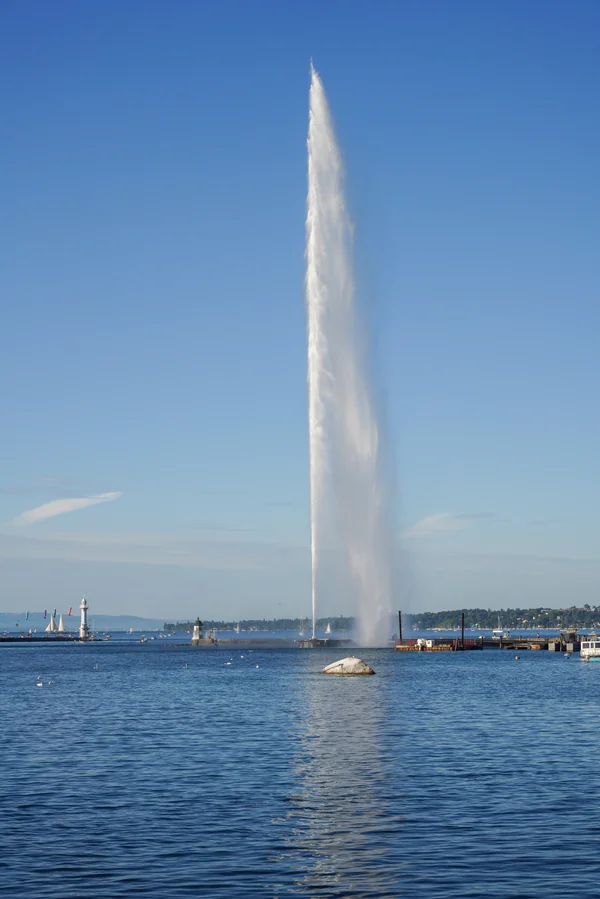
    Now the long stretch along the water pays off. You follow the lakefront and the Jet d'Eau comes into view, Geneva's emblem, a single column of water blasting 140 metres straight up out of the harbour. It pumps 500 litres a second at around 200 km/h, and on a windy day the spray drifts halfway across the bay. There has been a jet here since 1891; the current one dates to 1951. It runs daily, weather permitting, roughly 10:00 to 23:15 from March to October with shorter winter hours, and it is switched off in strong wind. Free, of course. The trick most people miss: walk out along the stone jetty to the base of the jet itself. You get soaked if the wind turns, but standing under that much falling water is the experience, not the postcard view from the shore. Bring a light jacket. Late afternoon, when it is lit by low sun, is the photo. After dark it is floodlit and worth a second look.

    Hours
    Daily, weather permitting (Mar-Oct: ~10 AM-11:15 PM, shorter winter hours)
    Price
    Free
  9. 9

    Mont Blanc Bridge (Pont du Mont-Blanc)

    Mont Blanc Bridge (Pont du Mont-Blanc) in Geneva, stop 9 on the self-guided walking tour

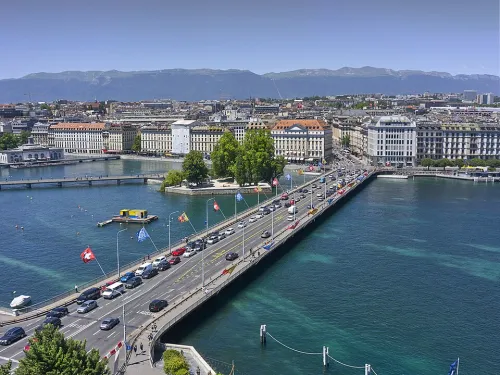
    From the jetty you walk back and cross the Rhône on the Pont du Mont-Blanc, the bridge that links the two halves of Geneva right where the lake narrows into the river. It is a working road bridge, not a sight in itself, but the view from the middle is one of the best free panoramas in the city. Upstream you get the full lake with the Jet d'Eau behind you; on a clear day Mont Blanc itself floats on the horizon to the south-east, which is how the bridge got its name. Downstream the Rhône rushes out an unreal turquoise blue. It is always open and free. The bridge is usually strung with flags of the cantons, which makes a clean foreground for a lake shot. Cross to the Right Bank and turn right along the quay. The traffic is heavy, so use the lake-side pavement and keep the water on your shoulder as you head north toward the next stop.

    Hours
    Always open
    Price
    Free
  10. 10

    Brunswick Monument (Monument Brunswick)

    Brunswick Monument (Monument Brunswick) in Geneva, stop 10 on the self-guided walking tour

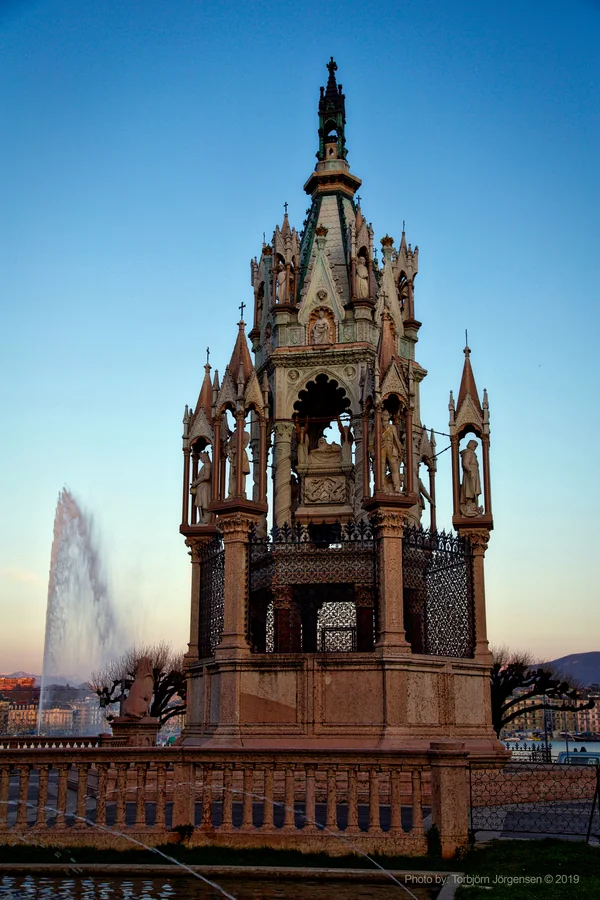
    A few minutes along the Right Bank quay you reach a startling sight on the lakefront: a tall, ornate neo-Gothic stone canopy that looks like it was lifted off a cathedral roof. This is the tomb of Charles II, Duke of Brunswick, an exiled aristocrat who died in Geneva in 1873 and left his entire fortune to the city on the condition that it build him a grand mausoleum modelled on the Scaliger tombs in Verona. The city took the money and delivered. It is pure 19th-century theatre, gilded and over the top, and completely out of place against the modern lakefront, which is exactly why it is fun. Always open, free, viewed from outside only. This is a good natural cut-off point: you have now seen the core of Geneva, and the last two stops are a longer walk out toward the lido and the UN. If your feet are done, end here. If not, keep going north along the quay.

    Hours
    Always open
    Price
    Free
  11. 11

    Bains des Pâquis

    Bains des Pâquis in Geneva, stop 11 on the self-guided walking tour

    Keep heading north and a long concrete jetty reaches out into the lake. This is Bains des Pâquis, a public lido that is one of Geneva's true institutions, used year-round by everyone from office workers on lunch break to old-timers doing laps. In summer it is a swimming and sunbathing platform with a small beach; in winter it runs a sauna and hammam and people still plunge into the cold lake. The on-site buvette is famous for cheap, generous food, and the fondue here in the cold months is a Geneva ritual worth queuing for. The baths are open daily 09:00 to 20:30 and entry to the jetty is free; the sauna and certain facilities carry a small extra charge, so check at the entrance. This is the most local stop on the whole route and the best place to actually sit, eat and watch the city relax. From here the lighthouse at the jetty's end frames the Jet d'Eau across the water for a classic shot.

    Hours
    Daily: 9:00 AM – 8:30 PM
    Price
    Free (public water baths/beach)
  12. 12

    Broken Chair

    Broken Chair in Geneva, stop 12 on the self-guided walking tour

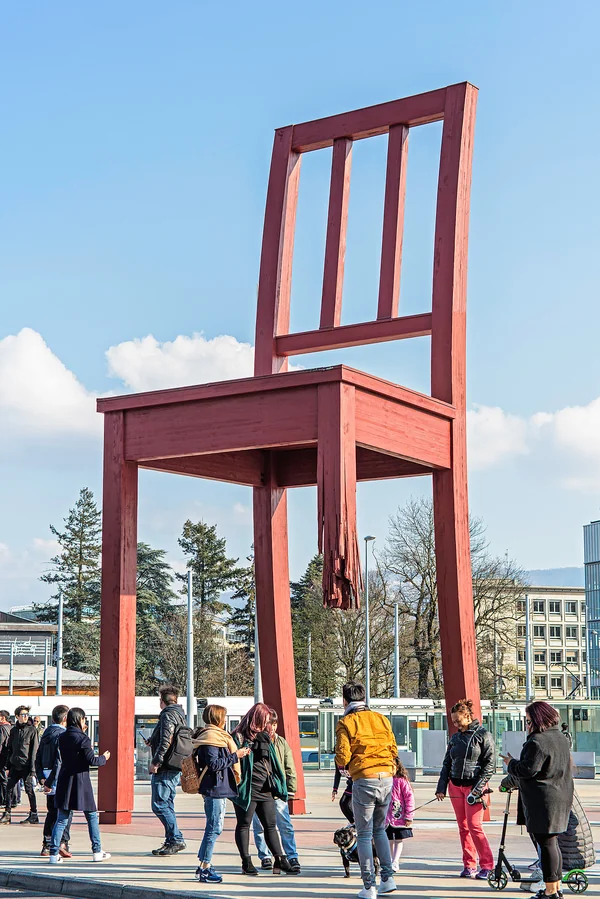
    The final stretch leaves the lake and climbs to the Place des Nations, the square in front of the United Nations European headquarters, and the walk ends on a deliberately jarring note. Towering 12 metres over the square is the Broken Chair, a giant wooden chair standing on three legs with the fourth violently splintered off. Swiss artist Daniel Berset built it in 1997 as a protest against landmines, placed directly opposite the UN to confront the diplomats arriving for disarmament talks. It was meant to be temporary and has stayed ever since, apart from a break between 2005 and 2007. Standing under it, you feel how big it is and why it works. Open 24/7, free. This is the modern, diplomatic Geneva, a fitting bookend to the Reformation old town where you started. From here the UN itself and the Red Cross Museum are a short walk if you have energy left, or take a tram from Place des Nations straight back to the centre.

    Hours
    Open 24/7
    Price
    Free (public sculpture)

How Long Does This Walking Tour Really Take?

The 8.4 km walking alone takes about 2.5 to 3 hours. Add the outdoor stops and photo time and you are closer to four; add the Reformation and Patek Philippe museums and a lakeside meal and it becomes a genuine full day. The two longest legs, Patek Philippe to the river and Bains des Paquis out to the Broken Chair, are where you spend real time.

The route is 8.4 km and the pure walking time is roughly 2.5 to 3 hours at an unhurried pace. With museum stops and a proper sit-down at the lake, plan a comfortable half to full day. The hungry stretches for time are the museums: budget about 45 minutes for the Museum of the Reformation and at least an hour for the Patek Philippe Museum if you go in. The two longest connecting walks are Patek Philippe to the river, and Bains des Pâquis out to the Broken Chair, so save energy for those. The best built-in break is Parc des Bastions, where the kiosk by the main gate has coffee and benches under the trees, roughly the halfway point of the old-town half. The second, better break is Bains des Pâquis near the end: eat at the buvette, sit on the jetty, and watch the Jet d'Eau before the final push to the UN. If your feet give out, the Brunswick Monument is a clean stopping point with the core of the city behind you and an easy tram or short walk back to the station.

Full Route, Shorter Walk or Two-Day Version?

The full route is one continuous line from the cathedral to the UN, but it splits cleanly if you have less time or want to spread it over two days. Here are three ways to walk it, using the real stop numbers and leg times.

The Short Version

Old town to Jet d'Eau, ending at the Brunswick Monument

Stops 1 to 10, about 6.4 km, roughly two to three hours of walking

Stop at the Brunswick Monument and you have still seen the cathedral, the Reformation, the museums and the Jet d'Eau, the heart of Geneva. This cuts the two longest legs at the end, the 24-minute walk out to Bains des Paquis and the 24-minute climb to the Broken Chair, which is the whole difference in length.

The Two-Day Split

Old town one day, lakefront the next

Day one stops 1 to 6, day two stops 7 to 12, split at the Patek Philippe Museum

Do the Left Bank hill first: cathedral, the two museums, Parc des Bastions, Plainpalais and Patek Philippe, an easy morning. On a second day pick up at the Batiment des Forces Motrices and run the water: the Jet d'Eau, both bridges, Bains des Paquis and the Broken Chair. Splits the two longest walking legs across two fresher pairs of legs.

You can walk it in reverse, from the Broken Chair up to St-Pierre Cathedral, but the given direction is better: you climb the cathedral towers first while your legs are fresh, walk downhill through the old town, and finish flat along the lake rather than facing the steep cobbles at the end.

Is This Geneva Walking Tour Right for You?

This is a real 8.4 km walk with a steep cobbled start and a long flat lakefront finish. It rewards anyone who likes covering a city on foot and mixing history with museums, and it adapts easily if you want to go shorter or slower.

A good fit if you…

  • Walkers comfortable with 8.4 km and a steep cobblestone climb up to the cathedral at the start
  • History travelers who want the Calvin and Reformation story where it actually happened
  • Anyone into watchmaking or tribal art, with the Patek Philippe and Barbier-Mueller museums both on the line
  • Visitors who want the free lakefront highlights, the Jet d'Eau, Bains des Paquis and the Broken Chair, in one route

Adapt the route if you…

  • Tight on time: end at the Brunswick Monument (stop 10) and skip the long final legs to the lido and the UN
  • Traveling with kids or tired feet: cut the museums, keep the parks, the Jet d'Eau and Bains des Paquis
  • Rainy day: lean on the three museums and the free cathedral nave, save the lakefront for a dry window
  • Watch the weekday clock: the Patek Philippe Museum only opens at 14:00 Tuesday to Friday, so start the hill early

Tickets & Skip-the-Line in Geneva

Most of this route is free open space with nothing to book. Only three museums charge admission, and one event venue depends on its show schedule. Here is what actually costs money and when it is open, so you can time your day around it.

International Museum of the Reformation (Musée international de la Réforme)CHF 13 for adults, CHF 10 seniors, CHF 8 students, CHF 25 for a family. Open Tuesday to Sunday 10:00 to 17:00, closed Mondays. No timed tickets needed; just walk in. official ticket site ↗
Barbier-Mueller Museum (Musée Barbier-Mueller)CHF 13 for adults, CHF 8 to 10 for students and seniors, free for children. Open daily 11:00 to 17:00. Small and rarely busy, so no need to book ahead. official ticket site ↗
Patek Philippe Museum (Musée Patek Philippe)CHF 10 for adults, CHF 7 for students and seniors, free for under-18s, excellent value. Watch the hours: Tuesday to Friday 14:00 to 18:00 and Saturday 10:00 to 18:00 only, closed Sunday and Monday. No website in our data, so buy at the door.
Bâtiment des Forces motricesA concert and theatre hall with nothing to tour during the day; it is a look-and-photograph stop unless you catch a show. Prices vary by event, typically CHF 20 to 60 or more. Check the schedule before you go. official ticket site ↗
Everything elseThe cathedral nave, Parc des Bastions, Plaine de Plainpalais, the Jet d'Eau, the Pont du Mont-Blanc, the Brunswick Monument, the Bains des Paquis jetty and the Broken Chair are all free open spaces with nothing to book.
Optional upgrade
+8
The same 12-stop route,
now with navigation and a guide.
Optional AI experience

You already have the route.
The AI guide brings it to life.

Standing under the towers of St-Pierre or out on the Jet d'Eau jetty? Let the AI Tourguide walk this route with you. It is a voice-first guide that talks as you go, greeting you, telling the story of Calvin's Geneva and the Broken Chair, asking what you want to see next and remembering your answers. Like having a Geneva friend in your ear the whole way down to the lake.

Livenavigation13languagesAnyquestionYourinterests
Open this route with the AI guide

Try it in your browser · No app or download required

Tips for Walking in Geneva

  • Start at St-Pierre Cathedral early, around 10:00, and climb the towers first. The 157-step spiral stairs are tight and get congested by midday, and the rooftop view is clearest in morning light.
  • Time Plainpalais for a market day if you can. Fruit and flower market runs Tuesday, Friday and Sunday mornings; the big flea market is Wednesday and Saturday. Off-market, the square is just empty gravel.
  • Wear proper shoes. The old town around the cathedral is steep cobblestone, and the lakefront quays are long flat stretches. You will cover 8.4 km, so this is not a sandals walk.
  • Clean public toilets are inside Parc des Bastions near the main entrance and at Bains des Pâquis. The old-town lanes have almost none, so go at the park.
  • Eat in Plainpalais, not the old town. The streets around the Plaine have cheaper, better restaurants than the tourist spots up the hill. At Bains des Pâquis the buvette does generous cheap plates and winter fondue.
  • Tap water is excellent and free everywhere in Geneva. Carry a bottle and refill at the public fountains rather than buying water, which is expensive here.
  • For the Jet d'Eau photo, walk out onto the jetty in late afternoon with the low sun behind you, or come back after dark when it is floodlit. Expect spray if the wind shifts.

Why Walk This Route?

Geneva looks like a banking city from the lakefront, all glass and quiet money. The good stuff hides above it, in a compact medieval old town stacked on a hill where Calvin once preached and the streets are too narrow for tour buses. This route starts at the top, at St-Pierre Cathedral, and walks downhill through reformation history, two world-class watch and tribal-art museums, the city's biggest park, and out to the lake where the famous water jet shoots 140 metres into the air. You finish at the United Nations end with a giant broken chair. It covers Geneva's two faces in one line: the old religious republic and the modern diplomatic one.

The reason to walk it rather than wander is geography. Geneva's sights sit on two banks split by the Rhône and the lake, and randomly crossing back and forth wastes a lot of time. This route does the Left Bank old town and Plainpalais first while your legs are fresh, then drops to the water, crosses the Pont du Mont-Blanc once, and runs the Right Bank lakeshore north. Almost no backtracking.

It is 8.4 km, which is longer than a typical old-town loop because the last two stops, Bains des Pâquis and the Broken Chair, sit out toward the lake and the UN. Both are worth it, but you can cut the walk short at the Brunswick Monument and still have seen the heart of the city. Most stops outdoors are free. The museums charge between CHF 10 and 13, which by Geneva standards is almost nothing.

Common Questions

Is Geneva safe to walk around?

Yes, Geneva is one of the safest cities in Europe and this whole route is comfortable to walk solo, including after dark on the main lakefront. The only area to stay alert is around the Pâquis district behind the train station, which has some nightlife and street activity at night; it is fine to pass through but keep an eye on your bag. The usual pickpocket caution applies on crowded trams and at the markets on Plainpalais. There are no notable tourist scams here.

What if it rains during my Geneva tour?

This route has good indoor cover. The Museum of the Reformation, the Patek Philippe Museum and the Barbier-Mueller Museum together can fill a wet half-day, and St-Pierre Cathedral's nave is free to shelter in. The Bains des Pâquis runs an indoor sauna and hammam in cold and wet weather. Save the lakefront, Jet d'Eau and Broken Chair for any dry window, since those stops are entirely outdoors.

What's the best time of day for this walking tour?

Start at 10:00. That gets you up the cathedral towers before the midday crush, puts you in Plainpalais near the lunch hour, and lands you at the Jet d'Eau and lakefront in late afternoon when the light is best and the water jet is lit by low sun. It also means the Patek Philippe Museum, which only opens at 14:00 on weekdays, is open by the time you reach it.

How long does the Geneva Historic Walk take?

The walking itself is about 2.5 to 3 hours across 8.4 km. Add the museums and a lakeside break and a realistic total is a half to full day. If you skip the indoor stops and the final leg to the Broken Chair, you can do the core old-town-to-lakefront section in around two hours.

Do I need to pay for the stops on this walk?

Most are free: the cathedral nave, all the parks, Plainpalais, the Jet d'Eau, both bridges, the Brunswick Monument, the Bains des Pâquis jetty and the Broken Chair cost nothing. Only the three museums charge: the Museum of the Reformation is CHF 13, Patek Philippe CHF 10, and Barbier-Mueller CHF 13 for adults, with reductions for students and seniors.

Can I shorten the route if I'm short on time?

Yes. End at the Brunswick Monument and you will have seen the cathedral, the Reformation history, the old-town park, the museums and the Jet d'Eau, which is the heart of Geneva. The last two stops, Bains des Pâquis and the Broken Chair, add a longer walk north toward the UN and are optional extras for anyone with extra time or energy.

Take this route with you

Open this exact tour with navigation and your personal AI guide.

Start GPS Navigation + AI Guide
AI Tourguide
Researched and curated by the AI Tourguide teamWe plan and quality-check every route, then research and verify the opening hours, prices, and practical tips for each stop along it.
▶ Open route with AI guideNavigation, stories and your questions