Self-Guided Walking Tour in Guayaquil

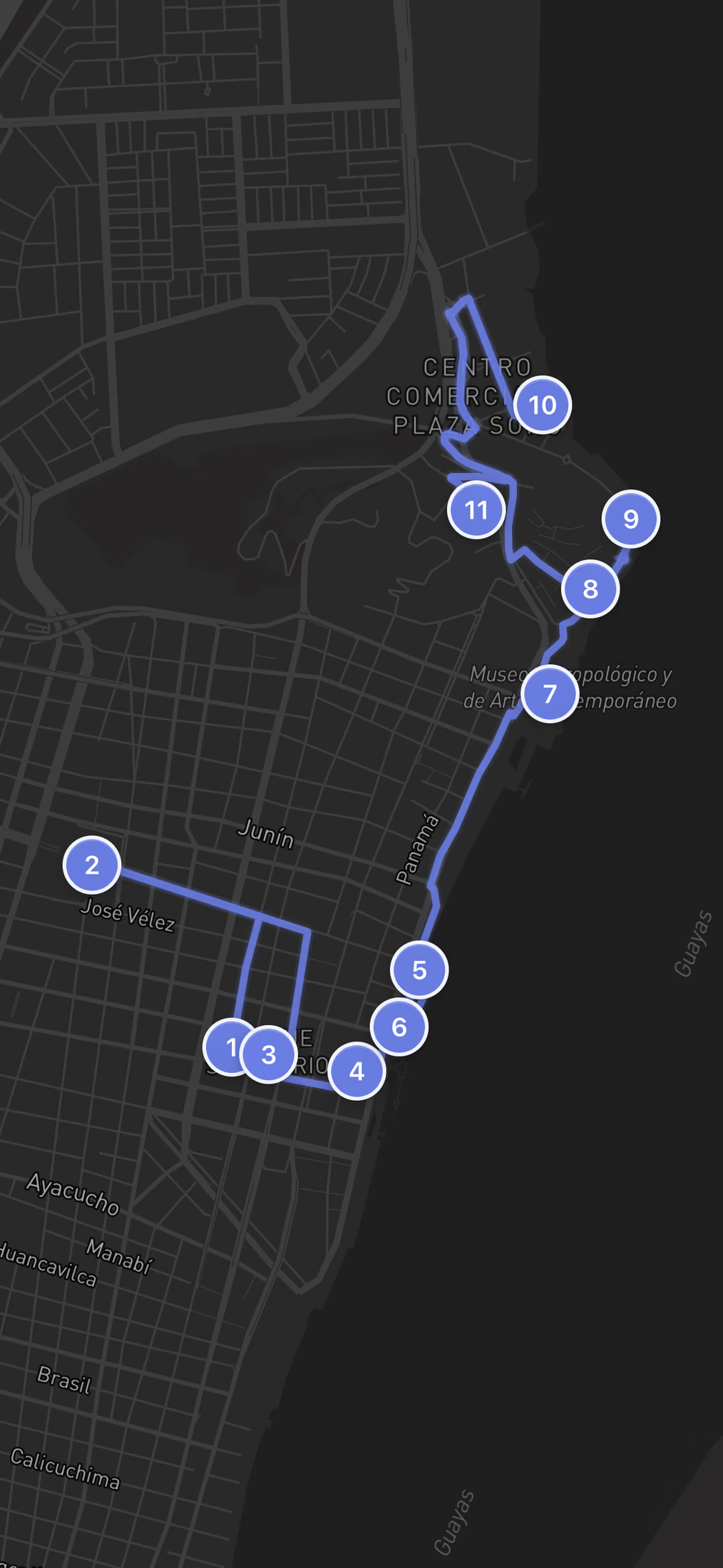
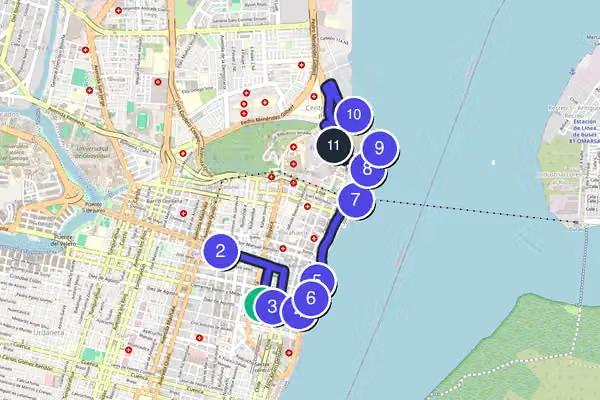
A point-to-point walk through central Guayaquil, from the Metropolitan Cathedral and the iguana park up the Malecon 2000 to the painted staircase of Cerro Santa Ana. Eleven stops across roughly 8 km. This page gives you the map, per-leg walking times, real opening hours and prices, and shorter versions.

11 Stops8.2 km~3 hours walking3–4 hours with stops
What you get with AI Tourguide
Full GPS navigationInteractive AI guidePersonalized to youWorks in your browser
Try this tour with Alex

Guayaquil Walking Tour at a Glance

This route is built for travelers who have an afternoon in Guayaquil before the Galapagos flight and want the real historic core without a taxi between stops. It runs point to point along the riverfront, and every interior on the way is optional. You set the pace, linger at the iguanas or push straight for the hill, and the page carries the facts so you don't have to guess.

StartGuayaquil Metropolitan Cathedral (Catedral Metropolitana de Guayaquil)
FinishSanta Ana Hill (Cerro Santa Ana)
Route typeA point-to-point walk that trends north along the Guayas River, with one short inland detour to Parque Centenario near the start and almost no backtracking after you reach the Malecon.
Realistic timeThe pure walking adds up to under two hours across roughly 8 km, but the iguana park, the MAAC museum, and the staircase pull it to three or four hours at an unhurried pace.
DifficultyEasy to moderate. The downtown half is flat and paved, then the finish is 444 numbered steps up Cerro Santa Ana plus the cobbles of Las Penas, which is where it gets tiring.
Cost to followFollowing the route outdoors is effectively free. The only paid option is the cathedral's optional $3 guided "Destino de Luz" tour; every other stop, the parks, the Malecon, the MAAC, the clock tower, and the staircase, costs nothing.
Best for:

Travelers with half a day who want the founding heart of Guayaquil, from colonial barrio to riverfront towers, done entirely on foot at their own pace.

The Route

Free Walking Tour Map of Guayaquil

11 stops8.2 kmabout 3 hours
Loading the interactive map…The complete walking route will appear here.
Want the route to guide you while you walk?Open the route with navigation and a personal guide for the history, stories and questions that matter to you.
Open route + AI guide

The 11 stops along this route

  1. Guayaquil Metropolitan Cathedral (Catedral Metropolitana de Guayaquil) in Guayaquil, stop 1 on the self-guided walking tour
    1Guayaquil Metropolitan Cathedral (Catedral Metropolitana de Guayaquil)
  2. Parque Centenario de Guayaquil (Parque Centenario) in Guayaquil, stop 2 on the self-guided walking tour
    2Parque Centenario de Guayaquil (Parque Centenario)
  3. Parque seminario in Guayaquil, stop 3 on the self-guided walking tour
    3Parque seminario
  4. Palacio Municipal de Guayaquil (Palacio Municipal de Guayaqui) in Guayaquil, stop 4 on the self-guided walking tour
    4Palacio Municipal de Guayaquil (Palacio Municipal de Guayaqui)
  5. Hemiciclo de la Rotonda in Guayaquil, stop 5 on the self-guided walking tour
    5Hemiciclo de la Rotonda
  6. Malecón 2000 in Guayaquil, stop 6 on the self-guided walking tour
    6Malecón 2000
  7. Museo Antropologico y de Arte Contemporaneo (Museo Antropológico y de Arte Contemporáneo) in Guayaquil, stop 7 on the self-guided walking tour
    7Museo Antropologico y de Arte Contemporaneo (Museo Antropológico y de Arte Contemporáneo)
  8. Las Peñas in Guayaquil, stop 8 on the self-guided walking tour
    8Las Peñas
  9. Puerto Santa Ana in Guayaquil, stop 9 on the self-guided walking tour
    9Puerto Santa Ana
  10. Torre The Point in Guayaquil, stop 10 on the self-guided walking tour
    10Torre The Point
  11. Santa Ana Hill (Cerro Santa Ana) in Guayaquil, stop 11 on the self-guided walking tour
    11Santa Ana Hill (Cerro Santa Ana)
  12. That's the complete route.

    If you want more than the map and text, add live navigation and a conversational AI guide while you walk.

    Open route + AI guide
    You made it
Stop 1 of 11
Swipe →

Your Guayaquil Walking Tour, Stop by Stop

  1. 1

    Guayaquil Metropolitan Cathedral (Catedral Metropolitana de Guayaquil)

    Guayaquil Metropolitan Cathedral (Catedral Metropolitana de Guayaquil) in Guayaquil, stop 1 on the self-guided walking tour

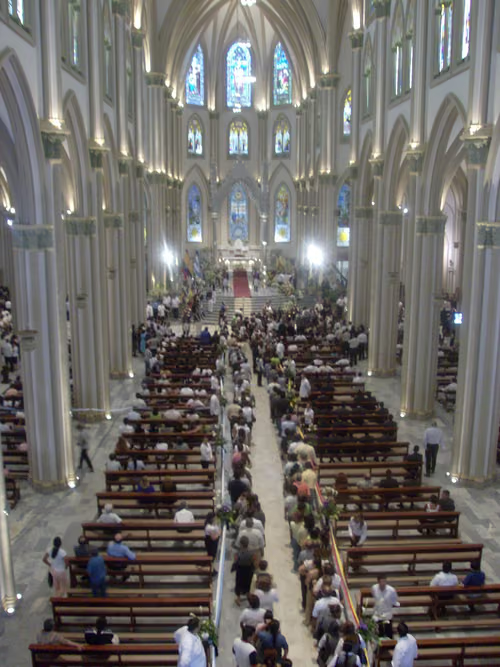
    The white neo-Gothic towers are the first thing that orients you downtown, rising over the trees of Parque Seminario. This is the mother church of the city, officially the Cathedral of San Pedro, originally built in wood around 1547 on what was then the main square and rebuilt in reinforced concrete in the 20th century in this Gothic style. The inside is cool, quiet, and high, a good reset before the heat of the day. It is open Monday to Saturday 7:20 AM to 6:00 PM and Sunday from 7:00 AM, and walking in to look around costs nothing. If you want the guided "Destino de Luz" tour it runs $3 for adults and $1.50 for children and seniors, but for most people a few minutes inside is plenty. When you come out the front doors, the park with the iguanas is directly across the pedestrian street, but first turn left and walk five minutes inland up toward Parque Centenario.
    Hours
    Mon-Sat: 7:20 AM – 6:00 PM | Sun: 7:00 AM – 6:00 PM
    Price
    USD $3 ("Destino de Luz" guided tour, adult; children/seniors $1.50)
  2. 2

    Parque Centenario de Guayaquil (Parque Centenario)

    Parque Centenario de Guayaquil (Parque Centenario) in Guayaquil, stop 2 on the self-guided walking tour

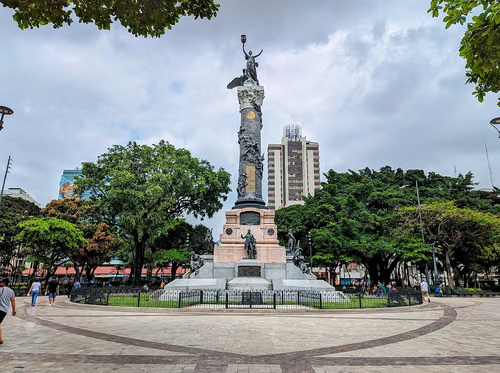
    This is the grand one, four full blocks of formal gardens straddling Avenida Nueve de Octubre, the city's main civic axis. The centerpiece is the Columna a los Proceres de la Independencia, a tall monument honoring the heroes of Guayaquil's 1820 independence, crowned with a bronze figure of Liberty. The whole square was inaugurated on October 7, 1920 to mark a hundred years since independence, and the statues kept arriving until 1937. It is free and open daily 8:00 AM to 7:00 PM. Sit on a bench in the shade for a moment, because the next stretch has less shade. This is the inland turning point of the walk. From here you double back toward the river, retracing toward the cathedral and then continuing one short block to Parque Seminario, the iguana park you spotted earlier.

    Hours
    Daily: 8:00 AM – 7:00 PM
    Price
    Free
  3. 3

    Parque seminario

    Parque seminario in Guayaquil, stop 3 on the self-guided walking tour

    You will hear people laughing before you understand why, and then you look down and there is a land iguana the size of a small dog sitting on the path, ignoring everyone. This small square facing the cathedral is genuinely full of them, around 350 by the city's 2017 count, draped over the railings, the lawn, and the lower branches of the trees. There is also a little pond with turtles and an equestrian statue of Simon Bolivar in the center, which is why locals also call it Parque Bolivar. It was inaugurated in 1895 and is free, open daily from 6:30 AM to 6:00 PM. Do not feed the iguanas and watch your bag straps. This is Guayaquil's most charming oddity and worth a real fifteen minutes. When you have had your fill, exit on the east side onto Calle Pichincha and walk three blocks down toward the river to reach the Palacio Municipal on the Malecon.

    Hours
    Daily: 6:30 AM – 6:00 PM
    Price
    Free
  4. 4

    Palacio Municipal de Guayaquil (Palacio Municipal de Guayaqui)

    Palacio Municipal de Guayaquil (Palacio Municipal de Guayaqui) in Guayaquil, stop 4 on the self-guided walking tour

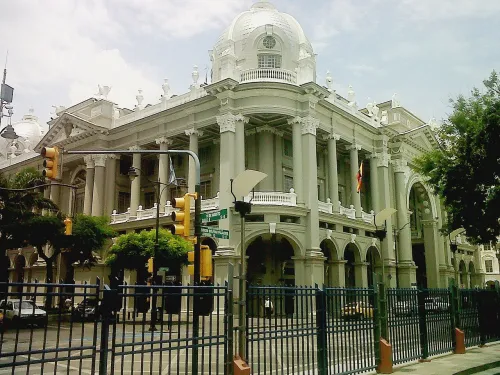
    Coming down toward the water you hit the most ornate building on the route, a gray Italianate pile of columns and arches that is the actual working city hall. It was built in 1921 by the architect Francesco Maccaferri on the spot where the old colonial council house stood until it was demolished in 1908. The covered passage that runs through the ground floor is open to walk through and worth a look up at the glass-roofed gallery inside. The building runs free guided "Museo Viviente" visits Tuesday to Sunday, and the offices keep weekday hours of 8:30 AM to 5:00 PM, closed on weekends. You do not need to go in to enjoy it, the facade from the Malecon side is the photograph. Step out the river side and you are on Malecon Simon Bolivar. Turn left and the semicircular monument a couple of minutes north is La Rotonda.

    Hours
    Mon-Fri: 8:30 AM – 5:00 PM | Sat-Sun: Closed
    Price
    Free (guided "Museo Viviente" visits free, Tue-Sun)
  5. 5

    Hemiciclo de la Rotonda

    Hemiciclo de la Rotonda in Guayaquil, stop 5 on the self-guided walking tour

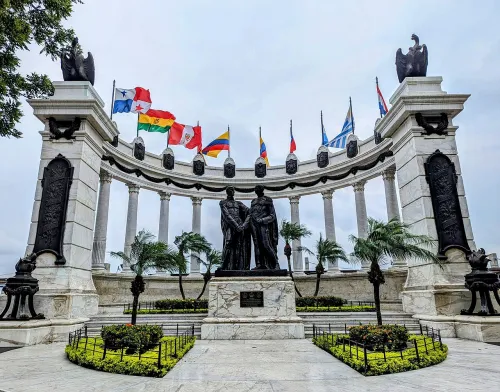
    The river opens up wide and brown beside you, and this curved colonnade of white marble columns is the postcard shot of the whole Malecon. At the center, two bronze figures shake hands: Simon Bolivar and Jose de San Martin, the two liberators of South America, marking their secret meeting in Guayaquil on July 26, 1822 to decide the continent's future. The monument was inaugurated in 1938 and stands right where Avenida Nueve de Octubre meets the river. It is an open-air monument, free, and floodlit at night. There is a famous acoustic trick here: have someone whisper at one end of the curve and you can hear them clearly at the other. This monument sits on the Malecon itself, so you are already standing on the next stop. Just keep walking north along the boardwalk.

    Hours
    Daily: 8:00 AM – 11:59 PM
    Price
    Free (open-air monument on Malecón 2000)
  6. 6

    Malecón 2000

    Malecón 2000 in Guayaquil, stop 6 on the self-guided walking tour

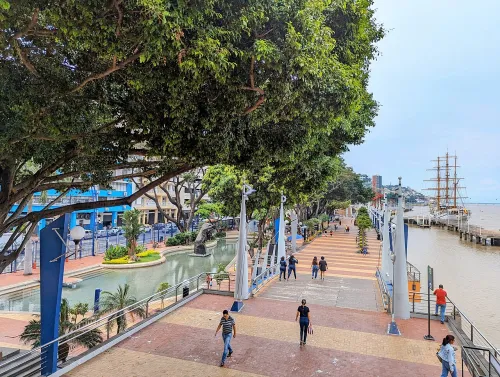
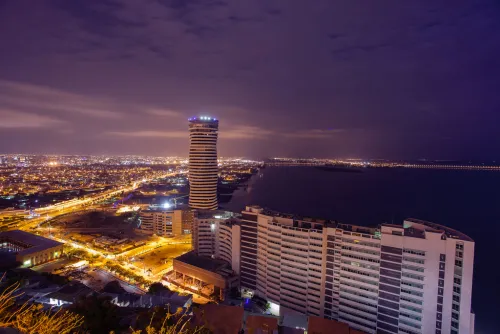
    This is the spine of the entire walk, a 2.5 km concrete boardwalk along the Guayas that the city rebuilt in the late 1990s under the name Malecon 2000. Before that the riverfront was a derelict edge of the old banking district. Now it strings together gardens, fountains, food courts, the Palacio de Cristal, restaurants, and South America's first IMAX cinema, with docks where you can board a river cruise. It is free and open 24/7, with security visible along its length, which makes it the one part of central Guayaquil that is comfortable to stroll without thinking about it. Use it as your through-line: shade trees, benches, public restrooms, and cold drinks all the way. Keep the river on your right and walk north. The boardwalk leads you straight to the modern museum building at its far end, the MAAC.

    Hours
    Open 24/7
    Price
    Free (public boardwalk/waterfront, no ticket desk)
  7. 7

    Museo Antropologico y de Arte Contemporaneo (Museo Antropológico y de Arte Contemporáneo)

    Museo Antropologico y de Arte Contemporaneo (Museo Antropológico y de Arte Contemporáneo) in Guayaquil, stop 7 on the self-guided walking tour

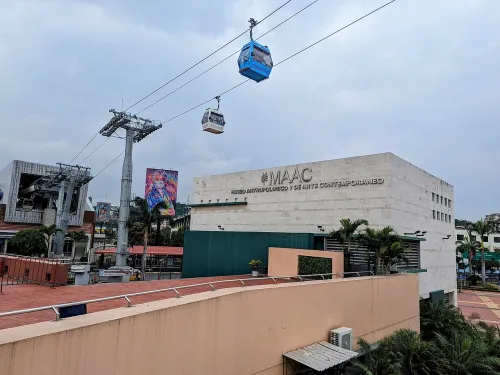
    At the north end of the boardwalk the architecture turns sharp and modern, and this low concrete museum is the cultural heavyweight of the riverfront. The collection is the reason to go in: around 50,000 archaeological pieces from pre-Columbian Ecuador and Latin America, plus more than 3,000 modern artworks, with the standout being the gold and ceramic work of coastal cultures that predate the Inca by thousands of years. Best part, admission is free. It is closed Mondays and otherwise open Tuesday to Sunday, 9:00 AM to 5:00 PM. Give it 45 minutes to an hour if the heat outside is brutal, since the air conditioning alone is a reason to linger. Coming out, you are at the threshold of the old city. Continue north and the boardwalk gives way to the cobbled lanes of Las Penas climbing the hill ahead.

    Hours
    Mon: Closed | Tue-Sun: 9:00 AM – 5:00 PM
    Price
    Free (entrada libre)
  8. 8

    Las Peñas

    Las Peñas in Guayaquil, stop 8 on the self-guided walking tour

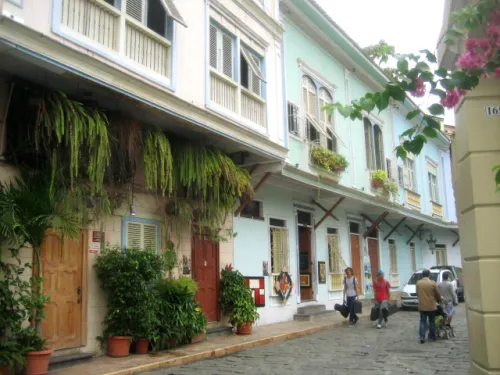
    The pavement changes under your feet to cobblestones and the buildings suddenly tilt uphill in bright blues, yellows, and reds. This is the oldest barrio in Guayaquil, the literal birthplace of the city on the lower slopes of Cerro Santa Ana. The heart of it is Calle Numa Pompilio Llona, a narrow cobbled lane named in 1912 and lined with wooden colonial houses, some over a hundred years old, many now small art galleries and bars. The neighborhood was declared a historic monument of the city on July 24, 1973 and national cultural heritage in 1982, then restored block by block in the 2000s. It is an open-air barrio, free to walk, best in daylight. Wander the lane to its end, then loop back to the foot of the painted staircase. From here you have a choice of two short riverside detours before the climb. First, drop to Puerto Santa Ana just downhill on the river side.

    Hours
    Open 24/7
    Price
    Free (open-air colonial barrio/neighborhood, no ticket desk)
  9. 9

    Puerto Santa Ana

    Puerto Santa Ana in Guayaquil, stop 9 on the self-guided walking tour

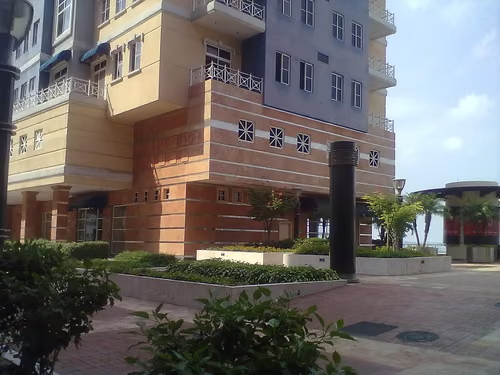
    Right at the base of the hill the mood flips from antique to glossy, a redeveloped riverfront of glass towers, cafes, and a clean little promenade along the Guayas. This is the upscale counterpoint to Las Penas, built since 2005 on four hectares of what used to be the Cerveceria Nacional brewery and a handful of old factories, with the first phase opening on April 15, 2007. The brewery's history survives in small museums tucked into the complex, and the riverwalk gives you the best ground-level views back at the hill and its painted houses. It is a public waterfront, free, open at any hour. This is the calm spot to grab a coffee or a cold beer before the staircase. When you are ready, walk back up toward Las Penas and follow the signs to the foot of the painted steps. Just before the climb, detour two minutes north along the river to the Moorish clock tower.

    Hours
    Open 24/7
    Price
    Free (public waterfront complex, no ticket desk)
  10. 10

    Torre The Point

    Torre The Point in Guayaquil, stop 10 on the self-guided walking tour

    A flash of something distinctly un-Ecuadorian on the riverfront: a slim tower with horseshoe arches and a green dome, built in a Moorish style and topped with a working clock. It is one of the city's definitional landmarks, sitting at the north end of the Malecon near the entrance to Las Penas, and it is free to enter. The catch is the schedule, which is tight: it opens only Thursday to Saturday, 10:00 AM to 5:00 PM, and is closed the rest of the week. If you hit it on an open day, climb up for a quick elevated look along the river. If the door is locked, no loss, it photographs best from the outside anyway against the water. This is the last flat stop. From here, walk back to the brightly painted arch at the bottom of Las Penas, where step number one of the climb up Cerro Santa Ana begins.

    Hours
    Mon-Wed: Closed | Thu-Sat: 10:00 AM – 5:00 PM | Sun: Closed
    Price
    Free
  11. 11

    Santa Ana Hill (Cerro Santa Ana)

    Santa Ana Hill (Cerro Santa Ana) in Guayaquil, stop 11 on the self-guided walking tour

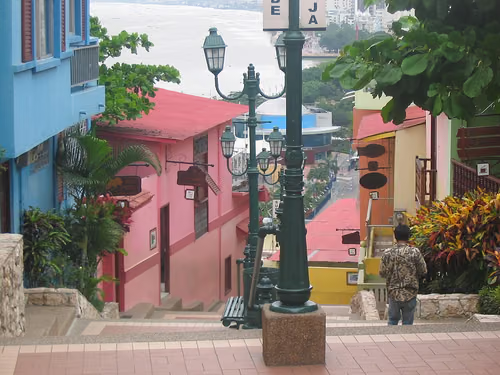
    Here is the climax, and your legs will know it. A painted staircase of 444 numbered steps zigzags up the hillside through tiers of small houses, cafes, and craft shops, each step marked so you can pace yourself. There is no ticket, it is open at any hour, and the houses get more colorful the higher you go. Near the top sits the chapel, inaugurated in 2002 as part of the hillside's restoration and dedicated to the Virgen de la Merced, with its hours running Monday to Friday and Sunday but closed Saturday. The reward at the summit is the lighthouse and the single best view in Guayaquil: the whole river, the towers of Puerto Santa Ana below, and the sprawl of the city behind. Go up in the late afternoon so you reach the top near sunset, then come down before full dark. This is where the walk ends, on the highest, oldest ground in the city.

    Hours
    Open 24/7
    Price
    Free (open-air hillside neighborhood/viewpoint, no ticket desk)

How Long Does This Walking Tour Really Take?

Under two hours of pure walking, but plan three to four hours in practice. Give the iguanas a real fifteen minutes, up to an hour inside the air-conditioned MAAC, and a full hour for the 444-step climb up Cerro Santa Ana, which is the single biggest time sink of the day.

Walking time is only part of it. The flat downtown section from the cathedral to the MAAC moves fast, but you will want to stop. Budget a real fifteen minutes for the iguanas at Parque Seminario, since photographing them is half the fun, and 45 minutes to an hour inside the MAAC if the heat is heavy and you like museums. The single biggest time sink is the very end: the 444 steps up Cerro Santa Ana are not a quick photo, they are a genuine climb with cafes and viewpoints that invite you to stop. Plan a full hour for the hill, more if you rest often.

For a break, the smartest spot is Puerto Santa Ana at the foot of the hill, where the cafes along the river promenade let you sit with a cold drink and look back at the painted houses before you tackle the climb. If you want to break earlier, the Malecon has shaded benches and food courts the whole length of the boardwalk. Allow three to four hours start to finish at an unhurried pace, and start in the afternoon so the staircase lands near sunset.

Full Route, Shorter Walk or Two-Day Version?

The full route is eleven stops over about 8 km, but it splits cleanly. Here are three ways to walk it depending on how much time and energy you have, using the real stop numbers and the per-leg distances from the map.

Riverfront Core

The Essential Malecon

Stops 1–8, about 5 km, 2–2.5 hours with stops

Drops the longer legs at the north end (the 2 km stretch to the clock tower and the climb) and ends at Las Penas. You still get the cathedral, the iguanas, La Rotonda, the boardwalk, the MAAC, and the painted barrio, all on flat ground.

Split in Two

Downtown Now, Hill Later

Day one stops 1–6, day two stops 7–11

Break at the Malecon around stop 6. Do the civic downtown and boardwalk on one visit, then return fresh for the MAAC, Las Penas, Puerto Santa Ana, the clock tower, and the staircase, which is the tiring half and rewards a rested pair of legs.

You can reverse it, starting at Cerro Santa Ana and finishing at the cathedral, but the given direction is better: you climb the 444 steps last, near sunset for the best light, and you save the tiring hill for the end rather than the start when the equator sun is at its worst.

Is This Guayaquil Walking Tour Right for You?

This is a flat downtown walk with a genuine climb bolted onto the end. Whether it suits you comes down to the staircase, the heat, and how you feel about central Guayaquil on foot.

A good fit if you…

  • Travelers with a spare afternoon before or after a Galapagos flight who want the city's historic core efficiently
  • Anyone who likes a riverfront walk where the Guayas does the navigation and the boardwalk is patrolled and comfortable
  • Photographers chasing La Rotonda's white columns in late light and the summit lighthouse view at sunset
  • People who want a nearly free city walk, since almost every stop costs nothing to enter

Adapt the route if you…

  • Stairs are a problem: end at Las Penas or Puerto Santa Ana and skip the 444-step climb up Cerro Santa Ana entirely
  • You're short on time: walk the Riverfront Core version, stops 1 to 8, and cut the long legs at the north end
  • It's the hot midday hours: start later around 2 or 3 PM and use the MAAC's air conditioning as a break
  • It's raining hard: duck into the MAAC, the cathedral, or the covered passage of the Palacio Municipal and save the painted steps until they dry, since they get slippery

Tickets & Skip-the-Line in Guayaquil

There is almost nothing to book on this route, which is the good news: the outdoor spine is free and open. Only a handful of stops have tickets or set opening days worth planning around, so here is what actually matters.

Guayaquil Metropolitan Cathedral (Catedral Metropolitana de Guayaquil)Walking in to look around is free. The optional guided "Destino de Luz" tour costs $3 for adults and $1.50 for children and seniors, and runs daily 09:00-19:00. General hours are Mon-Sat 7:20 AM to 6:00 PM, Sun from 7:00 AM. No booking needed; you can decide on the spot. official ticket site ↗
Palacio Municipal de Guayaquil (Palacio Municipal de Guayaqui)Free. Guided "Museo Viviente" visits are free and run Tuesday to Sunday; the working offices keep weekday hours of 8:30 AM to 5:00 PM and are closed on weekends. No ticket or booking, but time your visit for a weekday if you want inside.
Museo Antropologico y de Arte Contemporaneo (Museo Antropológico y de Arte Contemporáneo)Free admission. Closed Mondays, otherwise open Tuesday to Sunday 9:00 AM to 5:00 PM. No ticket to buy; just arrive within hours. Handy as a free, air-conditioned break if the heat or rain hits.
Torre The PointFree to enter, but the schedule is tight: open only Thursday to Saturday, 10:00 AM to 5:00 PM, closed the rest of the week. If the door is locked it still photographs best from the outside, so don't build your day around it.
Everything elseParque Centenario, Parque Seminario (the iguanas), La Rotonda, the Malecon 2000, Las Penas, Puerto Santa Ana, and the Cerro Santa Ana staircase are all free open spaces with no ticket desk. Walk in any time.
Optional upgrade
+7
The same 11-stop route,
now with navigation and a guide.
Optional AI experience

You already have the route.
The AI guide brings it to life.

Standing at the cathedral or somewhere along the Malecon right now? Open the AI Tourguide and it will walk you stop by stop from Parque Seminario's iguanas all the way up the 444 steps of Cerro Santa Ana, telling you the story of each place as you reach it. No group, no schedule, just press start and go at your own pace.

Livenavigation13languagesAnyquestionYourinterests
Open this route with the AI guide

Try it in your browser · No app or download required

Tips for Walking in Guayaquil

  • Timing and transport: start downtown around 2:00 or 3:00 PM so you reach the top of Cerro Santa Ana near sunset. Get to the cathedral by taxi or a ride app rather than walking in from outlying areas. The Metrovia bus system runs through the center, but for a first visit, point-to-point rides to the start are simpler.
  • Terrain and shoes: the downtown half is flat and paved, but the finish is 444 staircase steps plus the cobblestones of Calle Numa Pompilio Llona in Las Penas. Wear real walking shoes, not sandals. The cobbles are uneven and the steps are steep enough to make smooth soles a bad idea.
  • Restrooms: use the public restrooms along the Malecon Simon Bolivar, which are clean, signposted, and spaced along the 2.5 km boardwalk. There is nothing reliable on the Cerro Santa Ana staircase itself, so go before you start the climb.
  • Food and drink: stop at a cafe in Puerto Santa Ana at the base of the hill for a coffee or a cold beer with a river view before the climb. On the steps themselves, the small cafes partway up sell cold drinks and beer, a welcome excuse to pause around step 200.
  • Photo: shoot La Rotonda from the boardwalk facing inland with the white columns catching late-afternoon light, and save your best shot for the lighthouse at the summit of Cerro Santa Ana, facing the river at sunset for the full sweep of the Guayas and the towers below.

Why Walk This Route?

Most people fly into Guayaquil only to leave for the Galapagos the next morning, and that is a mistake you can fix in one afternoon. The historic core is small, flat for most of the way, and the best parts are stitched together by a single riverfront boardwalk that the city spent serious money rebuilding in the 1990s. You can see the cathedral, a park full of free-roaming iguanas, the old colonial barrio, and a 444-step climb to a lighthouse, all on foot, without ever needing a taxi between stops.

This route runs the way the city actually unfolds. You start at the religious and civic center around Parque Seminario, make one short detour inland to the grandest square, then drop down to the Malecon and follow the Guayas River north. The river does the navigation for you. By the time you reach the painted houses of Las Penas and the staircase up Cerro Santa Ana, you have walked the whole timeline of the city, from the 1547 founding spot to the glass-and-steel towers of the new riverfront.

Wandering Guayaquil at random does not work well, because the blocks just inland from the Malecon get rough fast and there is little reason to be there. Stick to this line, the boardwalk and the hill, and you stay on the safe, walkable, genuinely interesting spine of the city. Total distance is about 8 km if you go to the very top, and almost all of the ticketed stuff on the way is free.

Common Questions

Is Guayaquil safe to walk around?

On this specific route, yes, with normal city caution. The Malecon Simon Bolivar is fenced, patrolled, and the safest stretch in the center. Las Penas, Puerto Santa Ana, and the Cerro Santa Ana staircase are well-policed tourist zones. The risk is in the blocks just inland from the boardwalk, which get rough quickly, so do not wander off the line into random downtown streets. Keep the walk to daylight and early evening, carry little cash, keep your phone out of sight on the inland streets, and watch bag straps near the iguanas. Take a registered taxi or ride app after dark rather than walking back.

What if it rains during my Guayaquil tour?

Rainy season runs roughly January to April and downpours come hard but short. Duck into the MAAC museum at the north end of the Malecon, which is free, air-conditioned, and easily good for an hour. The cathedral and the covered passage of the Palacio Municipal also give you dry cover downtown. The Malecon has roofed food courts and a shopping center along it. Save the Cerro Santa Ana climb for after the rain passes, because the painted steps get slippery when wet.

What's the best time of day for this walking tour?

Start in the early-to-mid afternoon, around 2:00 or 3:00 PM. Guayaquil sits almost on the equator, so midday sun is punishing and the flat downtown stretch has limited shade. Walking later means you cross the Malecon as the heat eases and reach the lighthouse atop Cerro Santa Ana right around sunset, which is the best light and the best view of the day. Just plan to start down the 444 steps before it gets fully dark.

Take this route with you

Open this exact tour with navigation and your personal AI guide.

Start GPS Navigation + AI Guide
AI Tourguide
Researched and curated by the AI Tourguide teamWe plan and quality-check every route, then research and verify the opening hours, prices, and practical tips for each stop along it.
▶ Open route with AI guideNavigation, stories and your questions