
Self-Guided Walking Tour in Hiroshima

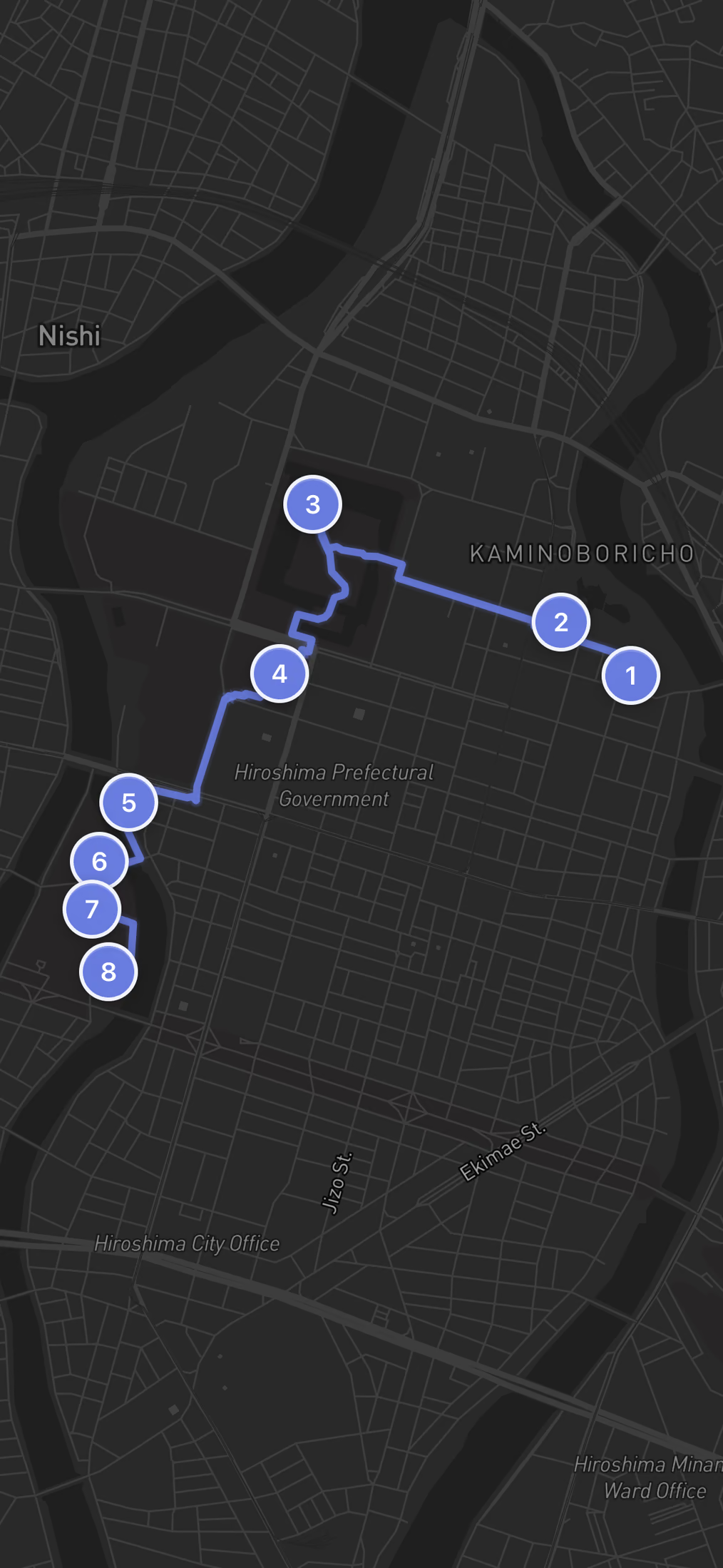
A self-guided route from Shukkeien Garden on the eastern edge of the center, through the castle district and two art museums, into Peace Memorial Park. Eight stops, 3.4 km, built so the heaviest history sits in the second half. This page gives you the map, per-leg walking times, and the real hours and prices for each stop.

8 Stops3.4 km~2 hours walking5–6 hours with stops
What you get with AI Tourguide
Full GPS navigationInteractive AI guidePersonalized to youWorks in your browser
Try this tour with Alex

Hiroshima Walking Tour at a Glance

This route is built for anyone who wants Hiroshima on their own terms rather than a group's 90-minute rush. Every interior on it is optional: you can do the full eight stops, skip the museums and walk the free outdoor sites, or linger for hours where it matters most. The point of walking it yourself is control over the emotional arc, from the calm of the garden to the memorials in the park.

StartShukkei-en (縮景園)
FinishHiroshima Peace Memorial Museum (広島平和記念資料館)
Route typeA point-to-point walk, not a loop. From Shukkeien Garden on the eastern edge it swings north-west to the castle, then runs steadily south through Chuo Park into Peace Memorial Park, with almost no backtracking.
Realistic timePure walking is only about 2 hours across the 3.4 km. With outdoor stops and photos, half a day. Add the two big interiors, the garden and the Peace Memorial Museum, and it becomes a full 5 to 6 hours.
DifficultyEasy and flat. Hiroshima sits on a river delta, so there are no hills on this route, and the Hiroden streetcar fills any gap if you tire. Paved paths and park walkways throughout, comfortable for most abilities.
Cost to followThe outdoor route is free: the A-Bomb Dome, the Cenotaph, the Children's Peace Monument and the entire park cost nothing. Only the interiors charge. Hiroshima Castle is JPY 370, the Peace Memorial Museum JPY 200, and the Prefectural Art Museum JPY 510.
Best for:

Travelers who want to sit with Hiroshima's history at their own pace, combine gardens and art with the peace memorials, and cover a compact, flat city center on foot in a single day.

The Route

Free Walking Tour Map of Hiroshima

8 stops3.4 kmabout 2 hours
Loading the interactive map…The complete walking route will appear here.
Want the route to guide you while you walk?Open the route with navigation and a personal guide for the history, stories and questions that matter to you.
Open route + AI guide

The 8 stops along this route

  1. Shukkei-en (縮景園) in Hiroshima, stop 1 on the self-guided walking tour
    1Shukkei-en (縮景園)
  2. Hiroshima Prefectural Art Museum (広島県立美術館) in Hiroshima, stop 2 on the self-guided walking tour
    2Hiroshima Prefectural Art Museum (広島県立美術館)
  3. Hiroshima Castle (広島城) in Hiroshima, stop 3 on the self-guided walking tour
    3Hiroshima Castle (広島城)
  4. Hiroshima Museum of Art (ひろしま美術館) in Hiroshima, stop 4 on the self-guided walking tour
    4Hiroshima Museum of Art (ひろしま美術館)
  5. Hiroshima Peace Memorial (原爆ドーム) in Hiroshima, stop 5 on the self-guided walking tour
    5Hiroshima Peace Memorial (原爆ドーム)
  6. Children's Peace Monument (原爆の子の像) in Hiroshima, stop 6 on the self-guided walking tour
    6Children's Peace Monument (原爆の子の像)
  7. Cenotaph for the A-Bomb Victims (原爆死没者慰霊碑) in Hiroshima, stop 7 on the self-guided walking tour
    7Cenotaph for the A-Bomb Victims (原爆死没者慰霊碑)
  8. Hiroshima Peace Memorial Museum (広島平和記念資料館) in Hiroshima, stop 8 on the self-guided walking tour
    8Hiroshima Peace Memorial Museum (広島平和記念資料館)
  9. That's the complete route.

    If you want more than the map and text, add live navigation and a conversational AI guide while you walk.

    Open route + AI guide
    You made it
Stop 1 of 8
Swipe →

Your Hiroshima Walking Tour, Stop by Stop

  1. 1

    Shukkei-en (縮景園)

    Shukkei-en (縮景園) in Hiroshima, stop 1 on the self-guided walking tour

    You begin at a place of deliberate beauty. Created in 1620 by tea master Ueda Soko for feudal lord Asano Nagaakira, this 4-hectare garden miniaturizes famous Chinese and Japanese landscapes around a central pond. The bomb destroyed it entirely in 1945. It was painstakingly restored and reopened by 1951. Stone bridges arc over narrow inlets, tea houses sit at the water's edge, and koi the size of your forearm drift through the pond. In early April, the cherry blossoms here are as good as anywhere in the city. In November, the maples turn red and orange. Open daily 9:00 AM to 5:00 PM. The tea house on the central island (Seifukan) serves matcha and a small sweet for around 500 JPY, and sitting there overlooking the water is one of the most peaceful moments on this entire route.

    Hours
    Daily: 9:00 AM – 5:00 PM
    Price
    R$350
  2. 2

    Hiroshima Prefectural Art Museum (広島県立美術館)

    Hiroshima Prefectural Art Museum (広島県立美術館) in Hiroshima, stop 2 on the self-guided walking tour

    Right next to Shukkeien Garden, this museum opened in 1968 and was rebuilt in 1996. The permanent collection covers three areas: art related to Hiroshima, Japanese and Asian art from the 20th century, and Western works including pieces by Dali, Picasso, and Hirayama Ikuo. Hirayama survived the bombing as a teenager and spent his career painting large-scale Silk Road landscapes. His works carry a quiet intensity that makes more sense once you know his story. Admission is 510 JPY. Closed Mondays. Open Tuesday to Sunday 9:00 AM to 5:00 PM, with extended hours until 7:00 PM on Fridays. Large glass windows on the ground floor let you see back into the garden you just walked through. The museum cafe overlooks Shukkeien, which is a nice touch.

    Hours
    Mon: Closed | Tue-Thu: 9:00 AM – 5:00 PM | Fri: 9:00 AM – 7:00 PM | Sat-Sun: 9:00 AM – 5:00 PM
    Price
    JPY 510
    Website
    hpam.jp ↗
  3. 3

    Hiroshima Castle (広島城)

    Hiroshima Castle (広島城) in Hiroshima, stop 3 on the self-guided walking tour

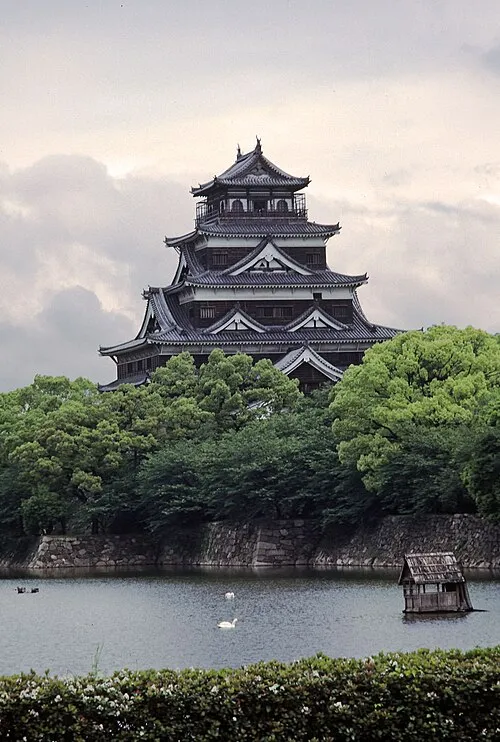
    About a 10-minute walk west, Hiroshima Castle sits on a flat river delta surrounded by a wide moat. Mori Terumoto built the original in the 1590s, making it one of Japan's few major flatland castles. It did not survive August 6, 1945. The current structure is a concrete reconstruction completed in 1958, built to look exactly like the original five-story tower. Inside, a history museum covers pre-war Hiroshima and samurai culture: construction details, daily life in the feudal era, armor and sword displays. The top floor has an observation deck with views over the city. Admission is 370 JPY. Open daily 9:00 AM to 5:00 PM. The castle grounds themselves are free and worth a walk for the moat, stone walls, and reconstructed gates.

    Hours
    Daily: 9:00 AM – 5:00 PM
    Price
    JPY 370
  4. 4

    Hiroshima Museum of Art (ひろしま美術館)

    Hiroshima Museum of Art (ひろしま美術館) in Hiroshima, stop 4 on the self-guided walking tour

    Set in Chuo Park between the castle and Peace Memorial Park, this small round museum was founded in 1978. The collection is focused on French Impressionism: Monet, Renoir, Degas, Cezanne, along with works by Picasso and Chagall. The white dome building sits in a garden, and stepping inside the circular gallery feels calm and contained. About 90 works in the permanent collection. You can see everything in under an hour. Admission is 300 JPY. Closed Mondays. Open Tuesday to Sunday 9:00 AM to 5:00 PM. After the weight of the peace-related sites ahead, or as a breath of air between the castle and the park, this museum serves as an emotional buffer. The garden outside is free and has a small cafe with outdoor seating that most tourists miss.

    Hours
    Mon: Closed | Tue-Sun: 9:00 AM – 5:00 PM
    Price
    JPY 1,100
  5. 5

    Hiroshima Peace Memorial (原爆ドーム)

    Hiroshima Peace Memorial (原爆ドーム) in Hiroshima, stop 5 on the self-guided walking tour

    This is the moment the walking tour shifts. The skeleton of the former Hiroshima Prefectural Industrial Promotion Hall stands exactly as it looked after August 6, 1945. Located 160 meters from the hypocenter, the building survived because the downward force of the explosion hit it almost vertically. Everything inside was destroyed instantly. The city chose to leave it standing while everything around was rebuilt. It became a UNESCO World Heritage Site in 1996. You cannot go inside. A fence surrounds it, and you view it from walkways along the Motoyasu River. At night, floodlights illuminate it from below, and the reflection on the river is striking. Open 24 hours, free. No ticket, no hours, no explanation needed. You stand in front of it and you understand.

    Hours
    Open 24/7
    Price
    Free (exterior only)
  6. 6

    Children's Peace Monument (原爆の子の像)

    Children's Peace Monument (原爆の子の像) in Hiroshima, stop 6 on the self-guided walking tour

    Near the northern end of Peace Memorial Park, this 9-meter bronze statue tells one of Hiroshima's most personal stories. Sadako Sasaki was two years old when the bomb fell. She seemed healthy for years, then developed leukemia at age 11. During her illness, she folded over a thousand paper cranes, following the Japanese belief that folding 1,000 cranes grants a wish. She died in 1955. Her classmates raised money for this monument, completed in 1958. Around the base, glass cases overflow with millions of colorful paper cranes sent from schools worldwide. The display changes constantly as new cranes arrive and old ones are recycled into notebooks sold in the museum shop. Free, open 24 hours. You can fold and leave your own crane here. Origami paper is sold at several shops near the park.

    Hours
    Open 24/7
    Price
    Free
  7. 7

    Cenotaph for the A-Bomb Victims (原爆死没者慰霊碑)

    Cenotaph for the A-Bomb Victims (原爆死没者慰霊碑) in Hiroshima, stop 7 on the self-guided walking tour

    Standing at the center of Peace Memorial Park's main axis, this arched concrete monument frames both the Flame of Peace and the A-Bomb Dome in a single sightline. Architect Kenzo Tange designed it in 1952, shaping it after ancient Japanese clay haniwa houses to provide shelter for the souls of the victims. Beneath it sits a stone chest containing the names of every known person killed by the bomb and its aftereffects, over 330,000 names as of recent years. The register grows annually. Every August 6, new names are added during the Peace Memorial Ceremony. The inscription reads: Let all the souls here rest in peace, for we shall not repeat the evil. Free, open 24 hours. Most visitors pause here quietly. This is the moment on the walking tour when the scale of what happened becomes personal.

    Hours
    Open 24/7
    Price
    Free
  8. 8

    Hiroshima Peace Memorial Museum (広島平和記念資料館)

    Hiroshima Peace Memorial Museum (広島平和記念資料館) in Hiroshima, stop 8 on the self-guided walking tour

    Your walking tour of Hiroshima ends at the most important museum in the city. Two long, elevated buildings at the southern end of the park hold over 20,000 artifacts from the bombing. The museum was completely renovated and reopened in 2019. The East Building covers the broader history and political context. The West Building is the one that stays with you: personal belongings of victims, a child's melted tricycle, a stopped wristwatch frozen at 8:15 AM. The museum does not lecture. It shows you what happened to individual people, and that approach is far more powerful than any statistic. Admission is 200 JPY. Open daily 7:30 AM to 7:00 PM. Arrive right at 7:30 AM opening. By 10:00 AM, large school groups arrive and the quiet atmosphere changes completely. Allow at least 90 minutes inside. The audio guide is available in multiple languages and worth getting.

    Hours
    Daily: 7:30 AM – 7:00 PM
    Price
    JPY 200

How Long Does This Walking Tour Really Take?

The 3.4 km is one of the shortest city routes you will walk, roughly 2 hours of pure movement. The Peace Memorial Museum alone deserves 90 minutes to 2 hours, and Shukkeien Garden rewards at least 45. Do it all properly and you are looking at 5 to 6 hours.

The walking distance is only 3.4 kilometers, making this one of the shortest city walking tours you will find. Pure walking time is about 2 hours. But the Peace Memorial Museum alone deserves 90 minutes to 2 hours, and Shukkeien Garden rewards at least 45 minutes. With all stops, plan for 5 to 6 hours.

The natural break point is the Hiroshima Museum of Art, roughly at the midpoint. The garden cafe there is a calm lunch spot. Take the break here, because once you cross into Peace Memorial Park, you will not want to stop for food. The second half of the route is emotionally absorbing, and having eaten and rested beforehand makes a real difference.

Full Route, Shorter Walk or Two-Day Version?

The full walk holds together as one emotional arc, but it is easy to trim or split. Here are three ways to run it depending on how much time you have and how much history you want in one sitting.

Short version

Castle and Peace Park core

Stops 3–8, Hiroshima Castle to the Peace Memorial Museum, about 3–4 hours.

Cuts the eastern garden detour and the 840 m leg back west, starting straight at Hiroshima Castle. You still get the castle, the Museum of Art buffer, and the full run of memorials. The tightest way to see the essentials in an afternoon.

Two-day split

Gardens and castle, then the park

Day one stops 1–4, day two stops 5–8, splitting at the Hiroshima Museum of Art.

Splits at the natural midpoint so the peace memorials get a fresh, unhurried morning of their own. Day one is gardens, castle and art; day two is the A-Bomb Dome, the monuments and the museum. Ideal if the history deserves undivided attention.

You can walk it in reverse, starting at the Peace Memorial Museum, and some travelers do this to reach the museum right at its 7:30 AM opening before the school groups arrive. The recommended direction from Shukkeien to the museum is deliberate though: it builds from calm to the heaviest content instead of front-loading it. Either way the Hiroden streetcar gets you back to your hotel.

Is This Hiroshima Walking Tour Right for You?

A flat, compact route with a strong emotional core. It suits some travelers perfectly and asks a little adaptation from others, so here is who it is built for and how to bend it.

A good fit if you…

  • Anyone comfortable on flat paved ground: 3.4 km total with no hills and streetcar backup the whole way.
  • Travelers who want gardens, art and history in one walk rather than the peace sites in isolation.
  • People who prefer setting their own pace at the Cenotaph and museum instead of a guide's fixed clock.
  • First-time visitors who want the emotional weight to build gradually toward Peace Memorial Park.

Adapt the route if you…

  • You have only an afternoon: run the short version from Hiroshima Castle, stops 3 to 8.
  • The history feels heavy in one go: use the two-day split and give the park its own morning.
  • You are traveling with children: fold and leave a paper crane at the Children's Peace Monument to make it tangible.
  • You want an early, quiet museum: reverse the order and reach the Peace Memorial Museum at its 7:30 AM opening.

Tickets & Skip-the-Line in Hiroshima

Most of this route is free and never needs a ticket. Only a handful of interiors charge, and none require advance booking. Here is what each paid stop costs and when it is open, so you can plan around opening hours rather than queues.

Shukkei-en (縮景園)Open daily 9:00 AM to 5:00 PM. A modest entry fee applies at the gate; buy on arrival. The Seifukan tea house on the central island serves matcha with a small sweet for around 500 JPY, worth it for the view over the pond.
Hiroshima Prefectural Art Museum (広島県立美術館)Admission JPY 510. Closed Mondays. Open Tuesday to Sunday 9:00 AM to 5:00 PM, with extended hours until 7:00 PM on Fridays. Tickets at the door, no advance booking needed.
Hiroshima Castle (広島城)Admission JPY 370 for the keep and history museum. Open daily 9:00 AM to 5:00 PM. The castle grounds, moat and gates are free to walk. Buy the ticket at the base of the tower. official ticket site ↗
Hiroshima Museum of Art (ひろしま美術館)Admission JPY 1,100. Closed Mondays. Open Tuesday to Sunday 9:00 AM to 5:00 PM. The garden and cafe outside are free. Pay at the entrance.
Hiroshima Peace Memorial Museum (広島平和記念資料館)Admission JPY 200, one of the best-value museums in Japan. Open daily 7:30 AM to 7:00 PM. Arrive right at 7:30 AM opening for quiet galleries before the 10:00 AM school groups. Buy on arrival; allow at least 90 minutes inside. official ticket site ↗
Everything elseThe A-Bomb Dome, the Children's Peace Monument, the Cenotaph for A-Bomb Victims and the whole of Peace Memorial Park are free, open-air and accessible 24 hours. No tickets, no hours to plan around.
Optional upgrade
+4
The same 8-stop route,
now with navigation and a guide.
Optional AI experience

You already have the route.
The AI guide brings it to life.

Standing near the A-Bomb Dome with Peace Memorial Park spread across the river? Open AI Tourguide in your browser, no app and no download, and a voice guide walks the whole route with you from the serene Shukkeien Garden through the memorials, telling the story along the way and asking how deep you want to go into the history. It listens and adapts the walk as you go, a real conversation, not a recording. Start with 100 free credits.

Livenavigation13languagesAnyquestionYourinterests
Open this route with the AI guide

Try it in your browser · No app or download required

Tips for Walking in Hiroshima

  • Buy a Hiroden streetcar one-day pass for 700 JPY. It covers all city tram lines and is cheaper than paying per ride if you take more than 3 trips. Useful for getting back to your hotel after the tour.
  • Arrive at the Peace Memorial Museum right at 7:30 AM opening if you want to reverse the route order. By 10:00 AM, school groups fill the galleries. The early morning slot gives you space to absorb what you are seeing.
  • The combined ticket for Hiroshima Castle and Shukkeien Garden saves money if you visit both. The garden is a 10-minute walk east from the castle.
  • Speak quietly at Peace Memorial Park. Take your shoes off when entering temples. Bow slightly when passing through a torii gate. These are basic courtesies that locals appreciate.
  • Come back to the A-Bomb Dome after dark. It is floodlit every evening, and the reflection on the Motoyasu River is something you will not forget. Far fewer people are around compared to daytime.

Why Walk This Route?

Hiroshima is a city that rebuilt itself from nothing, and walking it is the only way to feel that transformation properly. The distances are short, the terrain is flat, and the streetcar system fills any gaps. But the reason to walk is not logistics. It is the emotional arc of the route.

This self-guided walking tour of Hiroshima covers 3.4 kilometers across 8 stops over roughly 2 hours of walking. It begins at the serene Shukkeien Garden on the eastern edge of the city center, moves through the castle district and an art museum, then crosses into Peace Memorial Park where the memorials and museum document what happened on August 6, 1945, and what rose from the ashes. The route is designed so the heaviest emotional content sits in the second half, when your attention is sharpest.

Common Questions

Is Hiroshima safe to walk around?

Extremely safe. Hiroshima is a midsized Japanese city with very low crime rates. The streets are clean, well-lit, and easy to navigate. The biggest practical concern is the summer heat from June to September, when temperatures regularly exceed 30 degrees. Carry water and take breaks in the shade.

How long should I spend at the Peace Memorial Museum?

At least 90 minutes, ideally 2 hours. The renovated exhibits are detailed and personal. Rushing through in 45 minutes, as most guided tours do, means missing the individual stories that make this museum one of the most important in Japan. The audio guide adds context and is available in multiple languages.

Can I combine this walking tour with a day trip to Miyajima?

Yes, but do them on separate days. This walking tour plus museum time fills a full morning and early afternoon. Miyajima (Itsukushima Shrine) requires a train and ferry, about an hour each way, and deserves at least half a day on the island. Two full days in Hiroshima is the right amount of time.

Take this route with you

Open this exact tour with navigation and your personal AI guide.

Start GPS Navigation + AI Guide
AI Tourguide
Researched and curated by the AI Tourguide teamWe plan and quality-check every route, then research and verify the opening hours, prices, and practical tips for each stop along it.
▶ Open route with AI guideNavigation, stories and your questions