Self-Guided Walking Tour in La Paz

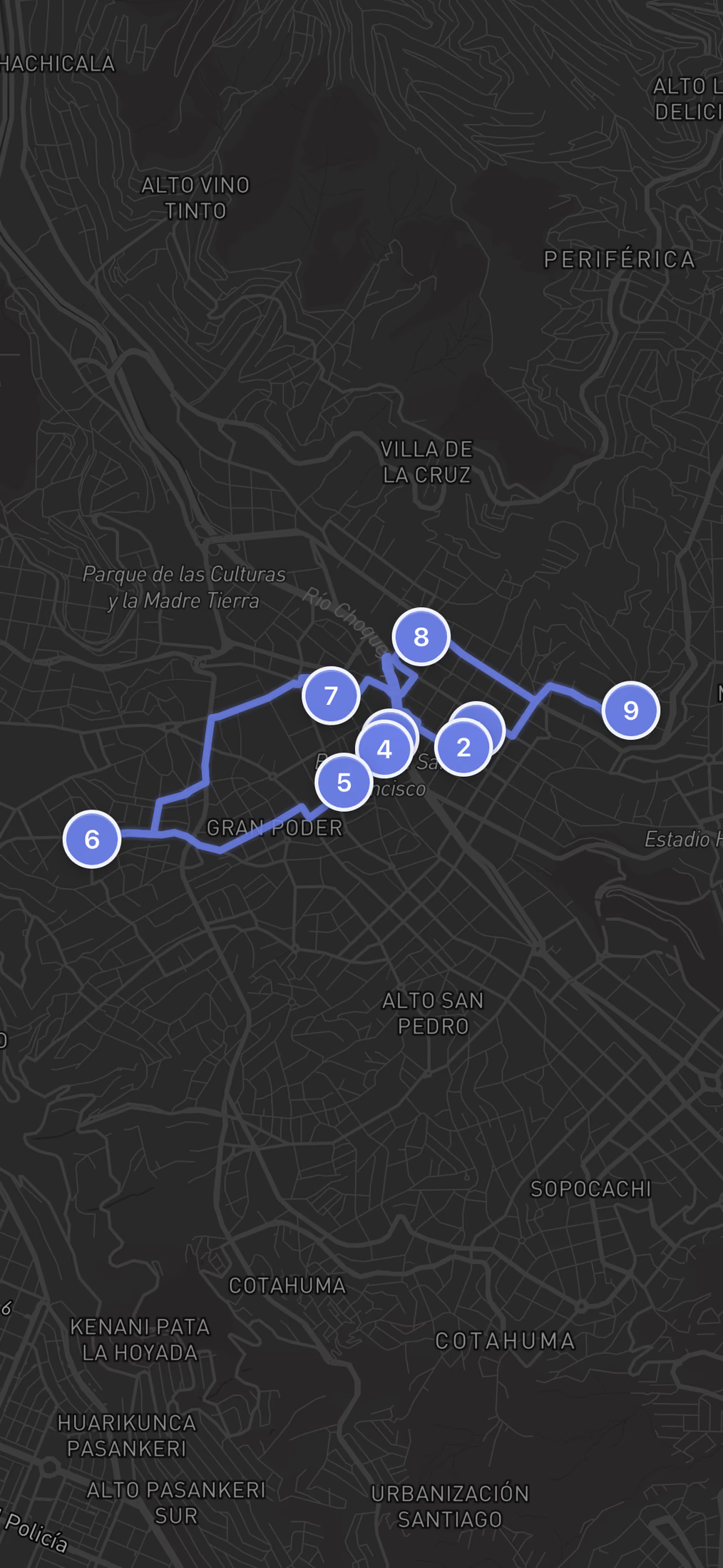
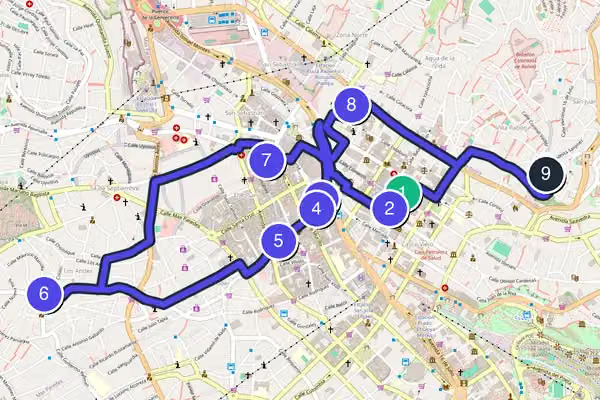
This route strings the historic core of La Paz into nine stops, from Plaza Murillo down through the market quarter to the Mirador de Killi Killi. The page gives you the map, per-leg walking times, real prices and opening hours, and shorter versions if the altitude wins.

9 Stops7.3 km~3 hours walking3–4 hours with stops
What you get with AI Tourguide
Full GPS navigationInteractive AI guidePersonalized to youWorks in your browser
Try this tour with Alex

La Paz Walking Tour at a Glance

This route is built for anyone who wants to see colonial La Paz on foot without a group or a clock. Every interior on it is optional. The plazas, the market streets, and the viewpoint are all free, and you decide which museum doors are worth a ticket.

StartPlaza Murillo
FinishMirador Killi Killi (Mirador Kili Kili)
Route typePoint to point with a market loop: you head west and downhill into the stalls, then swing north-east and climb back up, finishing east of where you started at a canyon viewpoint.
Realistic timeThree to four hours for all nine stops, longer if the market stalls and food counters pull you in.
DifficultyDemanding for the altitude more than the distance. Roughly 7.3 km on steep, uneven cobblestones at 3,650 meters, with two real climbs.
Cost to followThe outdoor route costs nothing. The only paid doors are the San Francisco museum at Bs 20 for foreigners and, if you want them, the Coca Museum and the Calle Jaén house-museums at around Bs 20 each.
Best for:

Travelers who have had a day to acclimatize and want to move at their own pace, stopping to breathe and to eat where locals eat.

The Route

Free Walking Tour Map of La Paz

9 stops7.3 kmabout 3 hours
Loading the interactive map…The complete walking route will appear here.
Want the route to guide you while you walk?Open the route with navigation and a personal guide for the history, stories and questions that matter to you.
Open route + AI guide

The 9 stops along this route

  1. Plaza Murillo in La Paz, stop 1 on the self-guided walking tour
    1Plaza Murillo
  2. Cathedral Basilica of Our Lady of Peace, La Paz (Catedral Basílica de Nuestra Señora de La Paz) in La Paz, stop 2 on the self-guided walking tour
    2Cathedral Basilica of Our Lady of Peace, La Paz (Catedral Basílica de Nuestra Señora de La Paz)
  3. Plaza San Francisco (Plaza Mayor de San Francisco) in La Paz, stop 3 on the self-guided walking tour
    3Plaza San Francisco (Plaza Mayor de San Francisco)
  4. Basilica of San Francisco, La Paz, Bolivia (Basílica de San Francisco) in La Paz, stop 4 on the self-guided walking tour
    4Basilica of San Francisco, La Paz, Bolivia (Basílica de San Francisco)
  5. Calle Sagárnaga in La Paz, stop 5 on the self-guided walking tour
    5Calle Sagárnaga
  6. The Witches' Market (Mercado de las Brujas) in La Paz, stop 6 on the self-guided walking tour
    6The Witches' Market (Mercado de las Brujas)
  7. Mercado Lanza in La Paz, stop 7 on the self-guided walking tour
    7Mercado Lanza
  8. Calle Jaén in La Paz, stop 8 on the self-guided walking tour
    8Calle Jaén
  9. Mirador Killi Killi (Mirador Kili Kili) in La Paz, stop 9 on the self-guided walking tour
    9Mirador Killi Killi (Mirador Kili Kili)
  10. That's the complete route.

    If you want more than the map and text, add live navigation and a conversational AI guide while you walk.

    Open route + AI guide
    You made it
Stop 1 of 9
Swipe →

Your La Paz Walking Tour, Stop by Stop

  1. 1

    Plaza Murillo

    Plaza Murillo in La Paz, stop 1 on the self-guided walking tour

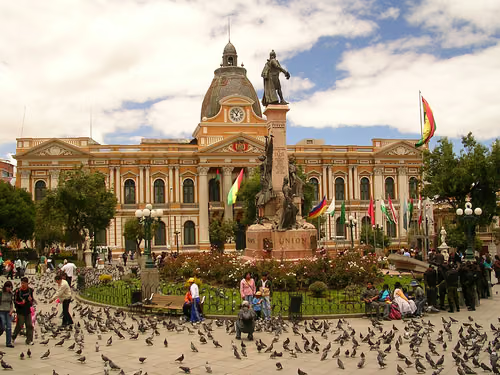
    Pigeons, shoeshine men, and the constant low hum of a square that runs the country. Plaza Murillo is the political center of Bolivia, sitting at 3,650 meters, and it has been the seat of executive power since the Federal War of 1899. Two buildings dominate it. The Palacio Quemado, the presidential palace, got its nickname (the Burned Palace) after a fire in 1875, and the current administration uses it again as the official seat of government. You cannot go inside, but the changing of the guard out front is worth catching. The square itself is free and open around the clock. Give it fifteen minutes to read the monument to Pedro Domingo Murillo in the center and watch ordinary La Paz life happen. Skip the pigeon feed the vendors push on you. Walk to the cathedral on the southwest corner, a few steps across the plaza.
    Hours
    Open 24/7
    Price
    free
  2. 2

    Cathedral Basilica of Our Lady of Peace, La Paz (Catedral Basílica de Nuestra Señora de La Paz)

    Cathedral Basilica of Our Lady of Peace, La Paz (Catedral Basílica de Nuestra Señora de La Paz) in La Paz, stop 2 on the self-guided walking tour

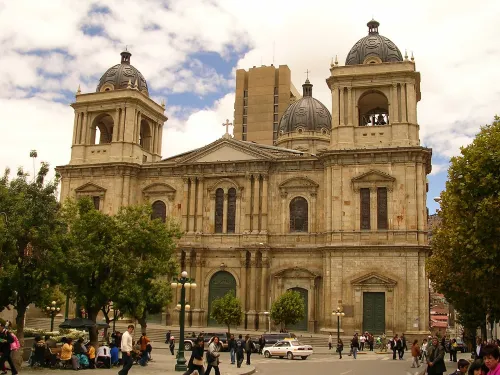
    Right beside the presidential palace, the cathedral fronts the plaza with a heavy neoclassical facade that looks like it was meant to outlast everything around it. It was built in 1835, with some baroque touches, by a team that included the architect Antonio Camponovo, and the interior opens into five naves. Step inside. It is free, it is an active church, and the cool dark space is a good place to catch your breath at this altitude. Open daily from 8 in the morning until 8 at night. Ten minutes is plenty unless a service is on, in which case linger quietly at the back. Keep your camera down during Mass. From the cathedral, head downhill on Calle Socabaya, then cut west toward Avenida Mariscal Santa Cruz. You feel the slope immediately. The next square sits a few blocks lower and a world away in atmosphere.

    Hours
    Daily: 8:00 AM – 8:00 PM
    Price
    Free (active religious temple, no admission)
  3. 3

    Plaza San Francisco (Plaza Mayor de San Francisco)

    Plaza San Francisco (Plaza Mayor de San Francisco) in La Paz, stop 3 on the self-guided walking tour

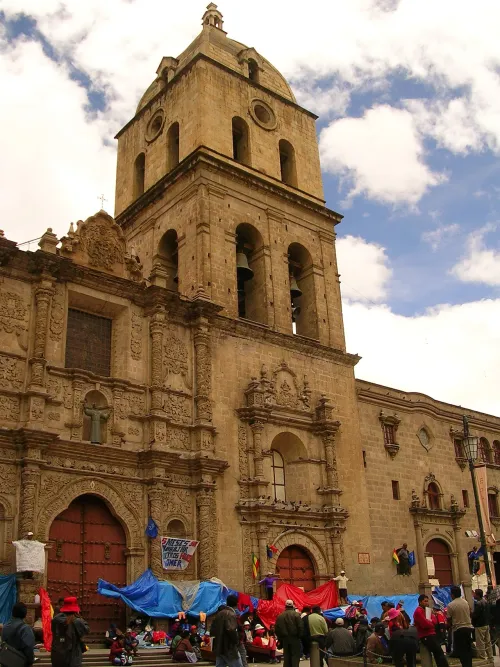
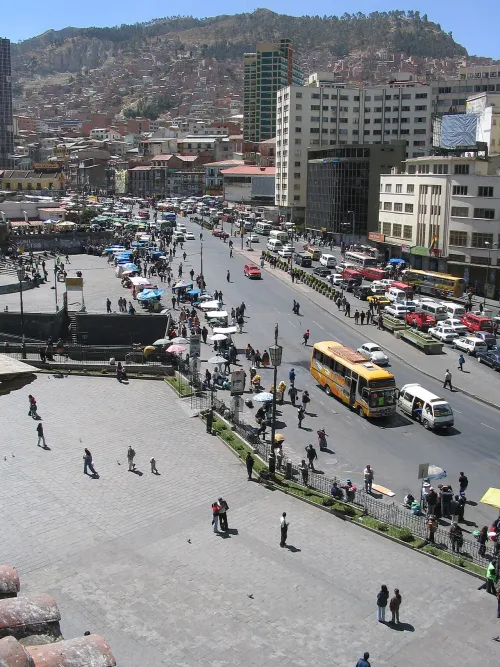
    After the formal stone calm of Plaza Murillo, this place hits different. The Plaza Mayor de San Francisco is the open-air living room of La Paz, the spot where protest marches gather, brass bands set up, and the colonial center collides with the indigenous upper city pouring down from above. It is a wide atrium spread out in front of the San Francisco basilica, free and open all the time, and it is loud in the best way. This is where you take the pulse of the city. Watch for marches; if one is happening, it is theatre, not danger, but keep your bag in front of you in the crowds. Ten minutes of people-watching, then turn to face the church that gives the square its name. The carved stone facade is already pulling your eye.

    Hours
    Open 24/7
    Price
    Free
  4. 4

    Basilica of San Francisco, La Paz, Bolivia (Basílica de San Francisco)

    Basilica of San Francisco, La Paz, Bolivia (Basílica de San Francisco) in La Paz, stop 4 on the self-guided walking tour

    The single greatest colonial monument in La Paz, and you can read its whole story in the facade. The stone is carved with a mix of Spanish baroque and Andean motifs, snakes, birds, masked faces, the work of indigenous craftsmen who slipped their own world into a Catholic church between the 16th and 18th centuries. The basilica honors Saint Francis of Assisi and anchors the old convent complex. The church itself is free to enter, but the real reward is the museum and the rooftop. The Centro Cultural Museo San Francisco costs Bs 20 for foreign adults and runs Monday to Saturday, 10 to 5, closed Sunday. The bell tower and rooftop access give you views over the plaza most visitors miss. Worth the ticket if you have an hour. From the right side of the church, the cobbles start climbing. That steep lane is Calle Sagárnaga, and the market quarter begins now.

    Hours
    Mon-Sat: 10:00 AM – 6:00 PM | Sun: Closed
    Price
    Bs 20 foreigners / Bs 10 nationals / Bs 5 children & seniors; under-14 free
  5. 5

    Calle Sagárnaga

    Calle Sagárnaga in La Paz, stop 5 on the self-guided walking tour

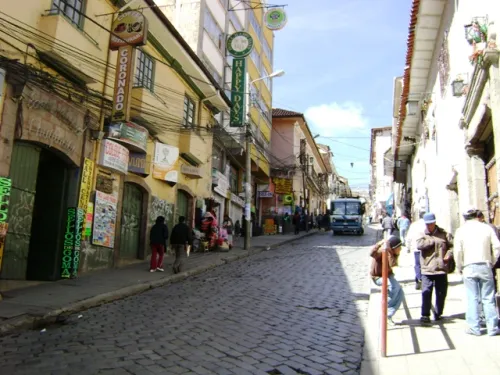
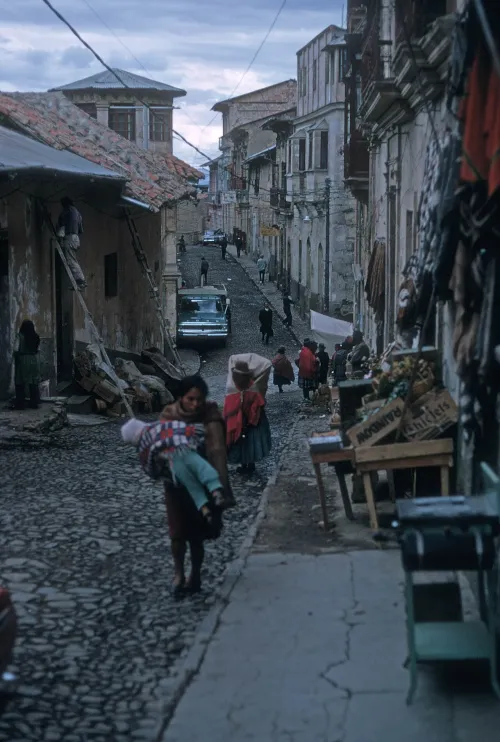
    The climb starts the moment you leave the basilica, and so does the selling. Calle Sagárnaga is the tourist artisan spine of La Paz, a steep cobbled street stacked with alpaca sweaters, woven textiles, silver, and ponchos, stall after stall up the hill. It runs through the old San Sebastián barrio and was laid out as part of the first European-style grid after the city was founded, named for a hero of the 1809 La Paz revolution. Open all day, free to walk. Yes, it is touristy. It is also the easiest place in the city to buy a real alpaca piece, and prices are negotiable, so do not pay the first number you hear. Anything synthetic feels slick; real alpaca is soft and slightly uneven. Walk uphill and let the side street pull you left into Calle Linares, where the stalls turn stranger.

    Hours
    Open 24/7 (public market street)
    Price
    Free
  6. 6

    The Witches' Market (Mercado de las Brujas)

    The Witches' Market (Mercado de las Brujas) in La Paz, stop 6 on the self-guided walking tour

    This is the strangest, most distinctive corner of La Paz, and it is not a show put on for tourists. The Witches' Market spreads along Calle Linares, a few cobbled blocks from San Francisco, where Aymara yatiri sell what the Andes actually use: dried frogs, medicinal plants like retama, amulets, talismans, powders for luck and fertility, and the dried llama foetuses that get buried under new houses as an offering to Pachamama, the earth mother. The yatiri are easy to spot in their black hats. Open daily from 9:30 in the morning until 10 at night, free to wander. Be respectful with your camera; ask before photographing the sellers, and expect a no on the ritual items. This is the cultural heart of the walk. Halfway along Linares sits the Museo de la Coca (Bs 20, open Monday to Saturday 10 to 7) if you want the story behind the coca leaf. From here, head back down toward the basilica and then north along Mariscal Santa Cruz to the covered market.

    Hours
    Daily: 9:30 AM – 10:00 PM
    Price
    Free (open-air street market)
  7. 7

    Mercado Lanza

    Mercado Lanza in La Paz, stop 7 on the self-guided walking tour

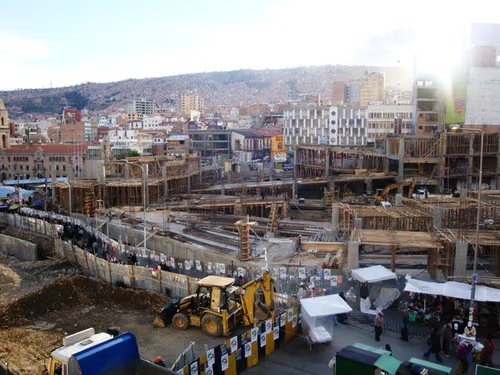
    Step out of the witch stalls and into a vertical hive of food. Mercado Lanza is the big covered market right beside Plaza San Francisco, a multi-level building put up between 2008 and 2010 to house more than a thousand traders. Inside it is fruit walls, juice counters, and rows of women ladling out api, a thick purple corn drink served hot with a fried pastel on the side. That is the paceño breakfast, and it costs a few bolivianos. The market runs roughly 6 in the morning to 8 at night, though stalls vary, and entry is free. This is the honest, everyday La Paz the postcards skip. Eat where the locals are eating and where the food is clearly hot and fresh. One of the four entrances connects directly from Plaza San Francisco, another by the elevated Pasarela Pérez Velasco. Refuel here, because the next stretch is the climb back up into the old town. Cut east and uphill toward Calle Jaén.

    Hours
    Mon-Sun 06:00-20:00 (varies by stall; source: Xtreme Foodies / TripAdvisor 2026)
    Price
    Free entry (food for purchase)
  8. 8

    Calle Jaén

    Calle Jaén in La Paz, stop 8 on the self-guided walking tour

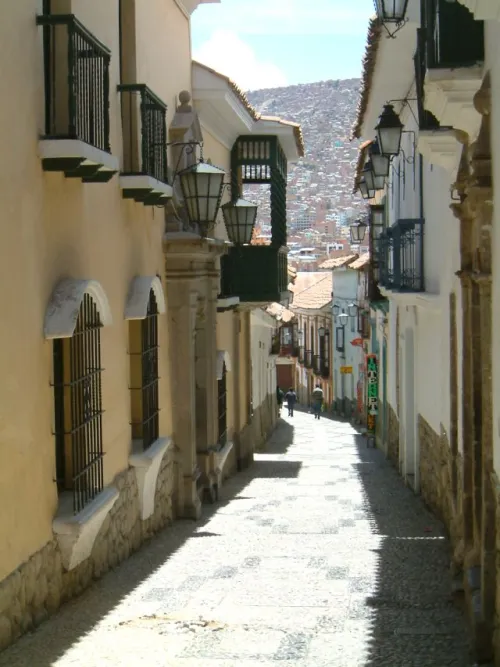
    After the noise and crush of the markets, this narrow lane is a held breath. Calle Jaén is the best-preserved colonial street in La Paz, just 100 meters of brightly painted whitewashed houses, wooden balconies, and original cobblestones, the one place where the colonial city survived in one piece. Back in the 16th century this was a llama and alpaca trading market called Cabracancha. Now it is bars, cafés, and a tight cluster of small house-museums. The Museo Casa de Murillo, home of the independence hero Pedro Domingo Murillo, sits here, alongside the Costumbrista Juan de Vargas and the Metales Preciosos. A joint ticket runs around Bs 20 for foreigners and covers several of them, but check days carefully: most close Monday and Sunday and shut for lunch midday. Even without paying a single entry, the street itself is the attraction. Walk it slowly, photograph the balconies, then climb north and east. The final ascent to the viewpoint begins.

    Hours
    Open 24/7 (street; individual museums keep their own hours)
    Price
    Free (public street; museums charge separately)
  9. 9

    Mirador Killi Killi (Mirador Kili Kili)

    Mirador Killi Killi (Mirador Kili Kili) in La Paz, stop 9 on the self-guided walking tour

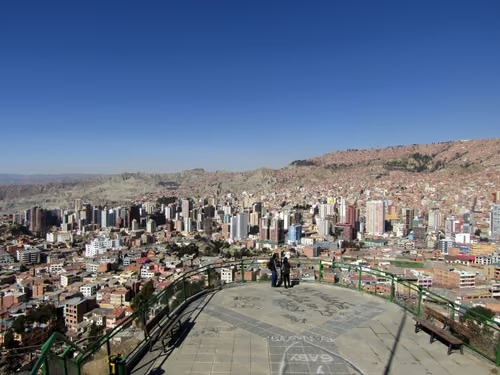
    The last climb is the hardest, and it is the reason you saved it for now that you are acclimatized. The path winds up a spur above the old town to the Mirador de Killi Killi, named for the kestrel that hunts these slopes. At the top the whole city detonates into view: a 360-degree panorama of La Paz spilling down its canyon in every direction, the brick of El Alto crawling up the far rim, and on a clear day the white wall of Illimani filling the sky behind it. Free, open around the clock, and the obvious climax of the walk. Come for sunset if you can, when the light turns the cliffs gold and the city lights start flickering on below. Bring a layer; the wind up here bites once the sun drops. This is where the walk ends and the city earns its name. Take your time, then catch a taxi back down rather than walking it in the dark.

    Hours
    Open 24/7
    Price
    Free (open-air public viewpoint/mirador)

How Long Does This Walking Tour Really Take?

Walking the 7.3 km alone is under two hours, but nobody does that here. With the outdoor stops you are at three hours, and with the San Francisco museum, the markets, and a slow finish at Killi Killi for sunset it stretches comfortably to four.

Plan on three to four hours for the full loop, and do not try to rush it. The walk is only about 7 kilometers, but at 3,650 meters every climb taxes you, and the stretch from Calle Jaén up to Killi Killi is a real ascent that will have you stopping. The market quarter is where time disappears: budget at least 45 minutes between Calle Sagárnaga, the Witches' Market, and Mercado Lanza, because the stalls and the food counters pull you in.

For a proper break, stop at Mercado Lanza halfway through and get a hot api with a pastel at one of the upstairs counters; it costs a few bolivianos and the warmth helps at altitude. If you want a quieter sit, the cafés on Calle Jaén are made for it, with tables tucked against the colonial walls. Save the bench at Killi Killi for last and time it for late afternoon so you finish with the city glowing below you.

Full Route, Shorter Walk or Two-Day Version?

The full loop is the richest way to do it, but the altitude and the two climbs mean not every traveler wants all nine stops in one go. Here are three ways to walk it.

Markets Short

Core and markets, skip the final climb

Stops 1 to 8, roughly 6 km, 2.5 to 3 hours

Everything from Plaza Murillo through the Witches' Market, Mercado Lanza, and colonial Calle Jaén, dropping only the steep 1.25 km climb up to Killi Killi. The kindest version on the lungs, and you can still taxi up for the view.

Two-Day Split

Split at Mercado Lanza across two mornings

Day one stops 1 to 6, day two stops 7 to 9, about 2 hours each

Day one runs the plazas and the market descent down to the Witches' Market. Day two starts fresh at Mercado Lanza, does Calle Jaén, and takes the climb to Killi Killi on rested legs. Best if you have just arrived at altitude.

You could walk it in reverse, but the given direction is the smart one. It saves the hardest climb, the ascent from Calle Jaén up to Mirador de Killi Killi, for the end when your legs and lungs have adjusted, and it delivers you to the best view in the city at the finish rather than the start.

Is This La Paz Walking Tour Right for You?

This is a route that rewards patience and punishes anyone in a hurry at altitude. Here is who it suits and how to bend it.

A good fit if you…

  • Walkers who have already spent a day at altitude and are breathing easy at 3,650 meters.
  • Anyone who wants free, self-paced sightseeing with optional museum stops rather than a fixed group tour.
  • Market lovers who want the Witches' Market, the textile stalls, and a working food hall in one stretch.
  • Photographers chasing the sunset panorama of the canyon and Illimani from Mirador de Killi Killi.

Adapt the route if you…

  • If you just arrived, split it across two mornings and let your body catch up before the climbs.
  • If the final ascent looks brutal, end at Calle Jaén and take a taxi up to Killi Killi instead of walking it.
  • If it rains, the cobblestones turn slick, so slow down and duck into Mercado Lanza or the house-museums until it passes.
  • If you want the cultural depth behind the rituals, add a local guide for the Witches' Market stretch and use this route for the structure.

Tickets & Skip-the-Line in La Paz

Almost nothing on this walk needs a ticket. Here is the one paid door worth planning around, plus a reminder of what stays free.

Basilica of San Francisco, La Paz, Bolivia (Basílica de San Francisco)Entry to the church itself is free. The Centro Cultural Museo San Francisco, with the rooftop and bell tower that are the real reason to go, charges Bs 20 for foreign adults, Bs 10 for Bolivians, Bs 5 for children and seniors, and is free for under-14s. Open Monday to Saturday, 10:00 to 18:00, closed Sunday. Buy at the door.
Everything elsePlaza Murillo, the cathedral, Plaza Mayor de San Francisco, Calle Sagárnaga, the Witches' Market, Mercado Lanza, Calle Jaén, and the Mirador de Killi Killi are all free open spaces with no admission. The small house-museums on Calle Jaén and the Coca Museum charge separately if you choose to go in.
Optional upgrade
+5
The same 9-stop route,
now with navigation and a guide.
Optional AI experience

You already have the route.
The AI guide brings it to life.

Standing in Plaza Murillo with the presidential palace in front of you and no idea what you are looking at? Let the AI guide walk you through the whole historic loop, from the carved facade of San Francisco to the rituals of the Witches' Market, talking you through each stop as you go and adjusting to your pace at altitude. It is free to start, runs in your browser, and keeps the conversation going all the way up to Killi Killi.

Livenavigation13languagesAnyquestionYourinterests
Open this route with the AI guide

Try it in your browser · No app or download required

Tips for Walking in La Paz

  • Altitude first: La Paz sits at 3,650 meters. Give yourself a full day to acclimatize before this walk, drink coca tea or chew the leaves (sold all over the markets), and walk slowly. Start the route mid-morning so you finish at Killi Killi near sunset.
  • Shoes and terrain: this is steep cobblestone the whole way, much of it uneven and slick when wet. Wear real walking shoes with grip, not flat-soled sneakers. The climbs out of the market quarter and up to Killi Killi are the toughest part.
  • Restrooms: public toilets are scarce, so use the ones inside Mercado Lanza (a couple of bolivianos, bring coins) or duck into a café on Calle Jaén. Carry small change and your own tissue; many baños charge and few stock paper.
  • Food and drink: get the classic paceño breakfast at Mercado Lanza, a hot api (purple corn drink) with a fried pastel, for a few bolivianos at the upstairs counters. Eat where the food is clearly hot and the line is local.
  • Photo: the best shot is from Mirador de Killi Killi at sunset, facing southeast toward Illimani with the whole city falling away below. On Calle Jaén, shoot the painted balconies in late morning when light reaches into the narrow lane.

Why Walk This Route?

La Paz is built into a canyon at 3,650 meters, and that single fact shapes everything about walking it. The city falls away beneath you in waves of brick, the air is thin enough that a flight of stairs leaves you breathing hard, and on a clear day the snow on Illimani hangs over the rooftops like a backdrop someone painted in. You cannot understand this place from a taxi window. The good stuff happens on the steep cobbled streets where market women sell coca leaves next to colonial churches, and the only way to see it is on foot.

This route is the historic core, done in the order that makes sense for your legs and your lungs. You start high at Plaza Murillo, the political heart of Bolivia, drift down through the great square at San Francisco, dive into the market quarter where the Witches' Market and the textile stalls cram into a few cobbled blocks, then climb back up to Calle Jaén, the one street where colonial La Paz survived intact. The finish is the viewpoint at Killi Killi, where the whole amphitheatre of the city opens up below you. It is roughly 7 kilometers, but the altitude and the climbs mean it feels longer.

Why walk it instead of wandering? Because La Paz is genuinely confusing on the ground. Streets change names, the slope disorients you, and the most interesting things are tucked into alleys you would never find by accident. This route threads them together in a logical loop, saves the hardest climb for last when you are acclimatized, and ends on the best view in the city. Take it slow. The mountain is not going anywhere.

Common Questions

Is La Paz safe to walk around?

The historic center on this route is fine to walk in daylight, with normal city caution. Keep your bag in front of you in the crowds around Plaza San Francisco and the markets, where pickpockets work. Only use official radio taxis or app rides, never unmarked street cabs, especially after dark. The walk up to Killi Killi is best done before dusk; take a taxi back down rather than descending on foot at night.

What if it rains during my La Paz tour?

Rain makes the cobblestones genuinely slippery, so slow down. The covered Mercado Lanza is the obvious shelter, full of hot food and dry stalls. The cathedral on Plaza Murillo, the San Francisco museum, and the Coca Museum on Calle Linares all give you indoor time, as do the Calle Jaén house-museums. Save Killi Killi for a clear spell; the viewpoint is pointless in low cloud.

What's the best time of day for this walking tour?

Start mid-morning, around 9 or 10, after the markets have opened and once you have had a day to adjust to the altitude. That timing lets you move through the busy market quarter before the afternoon crush and arrive at Mirador de Killi Killi in the late afternoon, ideally for sunset, when the light on the canyon and on Illimani is at its best.

Take this route with you

Open this exact tour with navigation and your personal AI guide.

Start GPS Navigation + AI Guide
AI Tourguide
Researched and curated by the AI Tourguide teamWe plan and quality-check every route, then research and verify the opening hours, prices, and practical tips for each stop along it.
▶ Open route with AI guideNavigation, stories and your questions