
Self-Guided Walking Tour in Luxembourg City

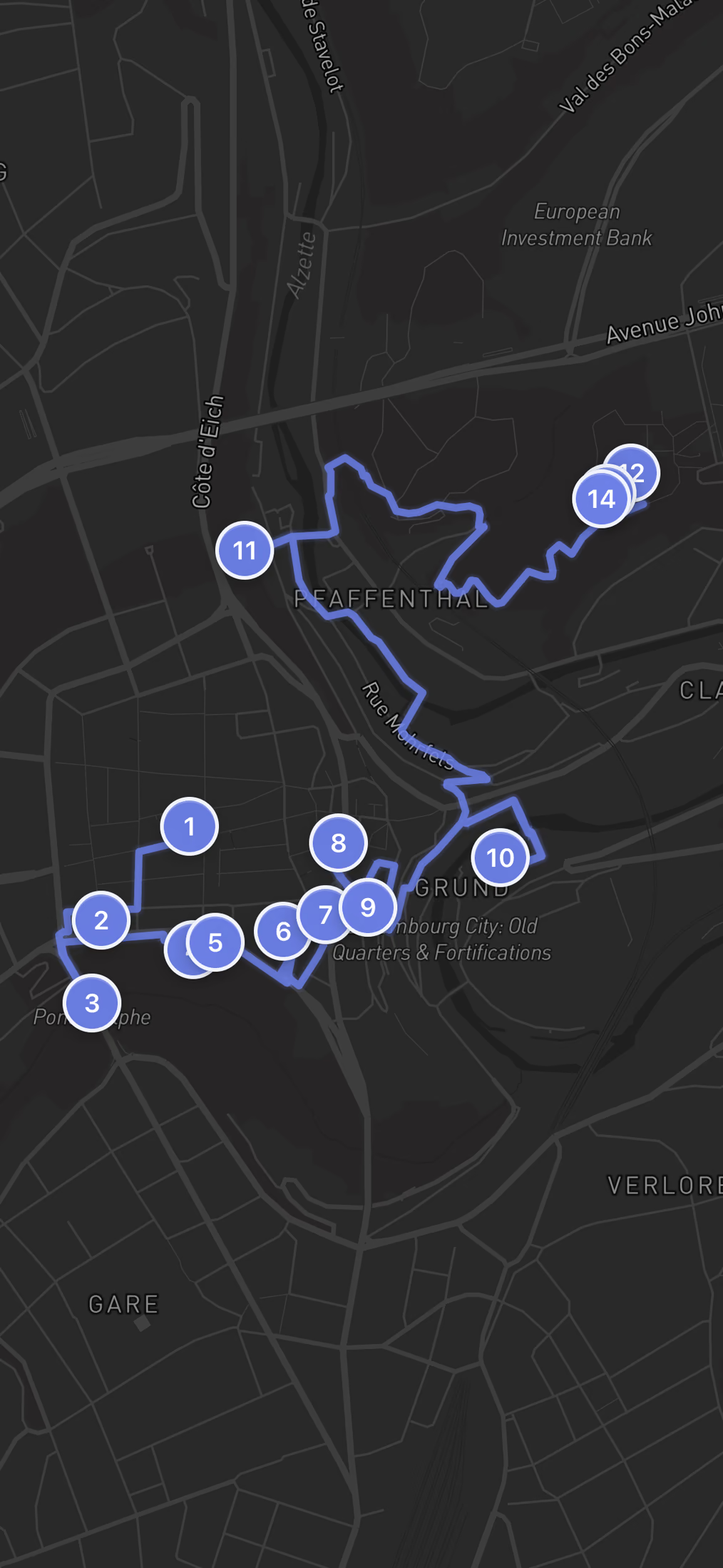
A self-guided route through Luxembourg City: 14 stops over 5.2 km, starting at Place d'Armes in the pedestrian old town and ending at the Kirchberg fortifications. This page gives you the full map, the walking time for every leg, real prices and opening hours, and shorter versions when you want to cut it down.

14 Stops5.2 km~3 hours walking3–4 hours with stops
What you get with AI Tourguide
Full GPS navigationInteractive AI guidePersonalized to youWorks in your browser
Try this tour with Alex

Luxembourg City Walking Tour at a Glance

This route is built for anyone who wants to see the real Luxembourg City on foot without a group or a fixed schedule. It strings together the 14 stops that actually matter, from the pedestrian heart to the Kirchberg forts, and every interior on it is optional. You decide which museums and casemates you step into and which you simply admire from the street, and the walk still makes sense either way.

StartPlace d'Armes
FinishMusée Dräi Eechelen
Route typeA point-to-point walk heading broadly north-east, from Place d'Armes across the old-town plateau, down into the Grund valley, then up to Kirchberg. It does not loop back, so it ends away from where you start, with the free tram waiting at the far end.
Realistic timePure walking is only about 1 hour 15 minutes, but the climbs and the descent into the Grund make that misleading. With short stops at the viewpoints and free sights, plan on 3 to 3.5 hours, and a full half-day if you go inside two or three attractions.
DifficultyModerate. The distance is a manageable 5.2 km, but this is a genuinely hilly city with cobbled lanes and steep stairs in and out of the Grund and Pfaffenthal valleys. The old town itself is flat and pedestrianized, and two free lifts spare you the worst climbs.
Cost to followThe outdoor route costs nothing: the squares, bridges, the Gëlle Fra, the cathedral, Neumünster Abbey, and the Pfaffenthal lift are all free. You only pay to go inside, and even then it's modest. The Pétrusse Casemates are €18, the City History Museum €5, Mudam €8, the Fort Thüngen museum around €7, and the palace interior €18 in summer.
Best for:

Independent walkers who want the UNESCO old town, the gorge views, and the fortress story at their own pace, and who don't mind stairs and elevation as the price of one of Europe's most dramatic capital walks.

The Route

Free Walking Tour Map of Luxembourg City

14 stops5.2 kmabout 3 hours
Loading the interactive map…The complete walking route will appear here.
Want the route to guide you while you walk?Open the route with navigation and a personal guide for the history, stories and questions that matter to you.
Open route + AI guide

The 14 stops along this route

  1. Place d'Armes in Luxembourg City, stop 1 on the self-guided walking tour
    1Place d'Armes
  2. Casino Luxembourg in Luxembourg City, stop 2 on the self-guided walking tour
    2Casino Luxembourg
  3. Adolphe Bridge (Pont Adolphe) in Luxembourg City, stop 3 on the self-guided walking tour
    3Adolphe Bridge (Pont Adolphe)
  4. Gëlle Fra (Monument du souvenir) in Luxembourg City, stop 4 on the self-guided walking tour
    4Gëlle Fra (Monument du souvenir)
  5. Pétrusse Casemates (Casemates de la Pétrusse) in Luxembourg City, stop 5 on the self-guided walking tour
    5Pétrusse Casemates (Casemates de la Pétrusse)
  6. Notre-Dame Cathedral (Cathédrale Notre-Dame de Luxembourg) in Luxembourg City, stop 6 on the self-guided walking tour
    6Notre-Dame Cathedral (Cathédrale Notre-Dame de Luxembourg)
  7. Place de Clairefontaine in Luxembourg City, stop 7 on the self-guided walking tour
    7Place de Clairefontaine
  8. Grand Ducal Palace (Palais grand-ducal) in Luxembourg City, stop 8 on the self-guided walking tour
    8Grand Ducal Palace (Palais grand-ducal)
  9. Luxembourg City History Museum (Musée d’histoire de la ville de Luxembourg) in Luxembourg City, stop 9 on the self-guided walking tour
    9Luxembourg City History Museum (Musée d’histoire de la ville de Luxembourg)
  10. Neumünster Abbey (Abbaye de Neumünster) in Luxembourg City, stop 10 on the self-guided walking tour
    10Neumünster Abbey (Abbaye de Neumünster)
  11. Pfaffenthal Panoramic Elevator (Ascenseur panoramique Pfaffenthal - Ville-Haute) in Luxembourg City, stop 11 on the self-guided walking tour
    11Pfaffenthal Panoramic Elevator (Ascenseur panoramique Pfaffenthal - Ville-Haute)
  12. Mudam (Musée d'Art moderne Grand-Duc-Jean) in Luxembourg City, stop 12 on the self-guided walking tour
    12Mudam (Musée d'Art moderne Grand-Duc-Jean)
  13. Fort Thüngen in Luxembourg City, stop 13 on the self-guided walking tour
    13Fort Thüngen
  14. Musée Dräi Eechelen in Luxembourg City, stop 14 on the self-guided walking tour
    14Musée Dräi Eechelen
  15. That's the complete route.

    If you want more than the map and text, add live navigation and a conversational AI guide while you walk.

    Open route + AI guide
    You made it
Stop 1 of 14
Swipe →

Your Luxembourg City Walking Tour, Stop by Stop

  1. 1

    Place d'Armes

    Place d'Armes in Luxembourg City, stop 1 on the self-guided walking tour

    Start where the locals start. Place d'Armes is the social living room of the old town, a paved square ringed with cafe terraces and shaded by lime trees that French troops planted back in the 1600s. The square was finished in 1671 and the nickname stuck: people call it the salon de la ville, the city's drawing room. It is always open and free to enter, part of the car-free pedestrian zone, so you get no traffic noise, just the bandstand kiosk, buskers in summer, and the Christmas market in December. Grab a coffee at one of the terraces before you move, because the next stretch involves stairs and you will want the legs warm. The Cercle Cité building on the square is the grand neoclassical one with the relief above the door. Practical tip: this is also the best orientation point in the city, so note where you are now, you will pass back near here. Public toilets sit just off the square if you need them before the walk proper begins.

    Hours
    Always open
    Price
    Free
  2. 2

    Casino Luxembourg

    Casino Luxembourg in Luxembourg City, stop 2 on the self-guided walking tour

    A two-minute stroll south brings you to a building that confuses people: it is called Casino but nobody gambles here. It opened in 1882 as the Casino Bourgeois, a club for the city's well-off, and in 1995 it was converted into a contemporary art forum. Today it runs rotating exhibitions of mostly Luxembourg and international contemporary work, and the entry is free. Hours are Monday, Wednesday, Friday to Sunday 11:00 to 19:00, with a late Thursday until 21:00, closed Tuesday. Whether you go in depends on your taste: this is genuinely contemporary, sometimes challenging, not classical art. If you have limited time and modern art is not your thing, the facade and a quick look at what is currently showing is enough, then carry on. If you do like it, the free admission makes a 30-minute browse an easy yes. Either way it is a useful marker on the way to the river gorge. Keep heading southwest toward the boulevard and the bridge ahead.

    Hours
    Mo, We, Fr-Su 11:00-19:00; Th 11:00-21:00
    Price
    Free
  3. 3

    Adolphe Bridge (Pont Adolphe)

    Adolphe Bridge (Pont Adolphe) in Luxembourg City, stop 3 on the self-guided walking tour

    The view opens up suddenly here, and it is the postcard one. The Adolphe Bridge arcs across the deep Pétrusse valley on a great stone double arch, and the green ravine drops away beneath you with the train station district on the far side. It carries the road and the modern tram, but the clever part is underneath: when the bridge was renovated, they slung a suspended walkway below the original deck for pedestrians and cyclists, billed as a world first. It is free and always open. Walk out a little way onto the bridge for the gorge view, then come back. Do not rush across to the other side unless you want the station quarter, because the route loops back into the old town. Photo tip: face northeast from the bridge for the cliff-edge old town stacked above the valley. Mornings give you softer light on the stone. From here you climb back up toward the Place de la Constitution and the golden statue you can already see catching the light.

    Hours
    Always open
    Price
    Free
  4. 4

    Gëlle Fra (Monument du souvenir)

    Gëlle Fra (Monument du souvenir) in Luxembourg City, stop 4 on the self-guided walking tour

    Back up on the plateau, the Place de la Constitution gives you the Gëlle Fra, the Golden Lady. A 21-meter granite obelisk carries a gilded bronze woman holding out a laurel wreath, the work of sculptor Claus Cito, unveiled in 1923. She honors the Luxembourgers who died serving in the two World Wars and the Korean War, and she carries a heavy local history: the Nazis tore the statue down in 1940 and she was only restored to her column decades later. The monument is free and always open. The square doubles as a viewpoint over the Pétrusse valley and the Adolphe Bridge you just crossed, so this is one of the best free panoramas in the city. Stand at the railing for the gorge, then turn to the obelisk for the figure against the sky. The entrance to the Pétrusse Casemates is right here on the same square, which is exactly where you go next.

    Hours
    Always open
    Price
    Free
  5. 5

    Pétrusse Casemates (Casemates de la Pétrusse)

    Pétrusse Casemates (Casemates de la Pétrusse) in Luxembourg City, stop 5 on the self-guided walking tour

    Right beneath your feet on Constitution Square, the cliff is hollow. The Pétrusse Casemates are a network of defensive tunnels and galleries carved into the rock, part of the fortress system that earned the old town its UNESCO status and once made Luxembourg the Gibraltar of the North. You descend into cool stone passages with gun openings looking out over the valley, a genuinely atmospheric look at how this rock was turned into a fortress. Admission is €18 for adults, €14.50 for seniors and students, and €9 for children aged 4 to 12. Hours are 9:45 to 17:00 Monday, Tuesday and Thursday to Sunday, with an early 15:00 close on Wednesday. Verdict: worth it if you want the fortress story up close and you have not booked the larger Bock Casemates elsewhere in town. It is dark, cool, and involves steps and low ceilings, so skip it if stairs are a problem. Allow 45 minutes to an hour. Bring a light layer, it stays cold underground year-round. Back on the surface, walk east toward the cathedral spires.

  6. 6

    Notre-Dame Cathedral (Cathédrale Notre-Dame de Luxembourg)

    Notre-Dame Cathedral (Cathédrale Notre-Dame de Luxembourg) in Luxembourg City, stop 6 on the self-guided walking tour

    The three dark spires of Notre-Dame rise just ahead as you come off Constitution Square. Built between 1613 and 1621 as the church of the Jesuit college, it only became a cathedral in 1870. The exterior is late Gothic with striking Renaissance touches around the doorway, and inside it is calmer and more vertical than you expect, with a much-venerated statue of Our Lady, Comforter of the Afflicted, the city's patron. Entry is free. Hours are Monday to Saturday 8:00 to 18:00 and Sunday 8:00 to 19:00. Go in: it takes ten minutes and the crypt holding members of the grand-ducal family is worth a look. If you visit during the Octave pilgrimage in spring, expect crowds and processions. Keep voices down, this is an active place of worship. Photo tip: the spires read best from a step back on the square outside rather than directly underneath. From the cathedral, a short walk east drops you onto a quiet little square most rushed visitors miss entirely.

    Hours
    Mon-Sat: 8:00 AM – 6:00 PM | Sun: 8:00 AM – 7:00 PM
    Price
    Free
  7. 7

    Place de Clairefontaine

    Place de Clairefontaine in Luxembourg City, stop 7 on the self-guided walking tour

    After the height and echo of the cathedral, this small square feels like an exhale. Place Clairefontaine sits tucked between Notre-Dame and the parliament building, redesigned in the late 1980s into a calm, tidy space that the city clearly cares about. The bronze statue at its center, placed here in 1990, honors Grand Duchess Charlotte, the much-loved monarch who became a symbol of national resistance during the Second World War. The Foreign Ministry and the prime minister's office sit on the square, so it is the quiet administrative heart rather than a tourist magnet. It is free and always open. There is not much to do here beyond sit on a bench, watch the flower beds, and let your legs recover before the next push. That is exactly its value on a long walking day. Take five minutes, then continue north a short distance to the palace, where you may catch a single guard standing watch outside.

    Hours
    Always open
    Price
    Free
  8. 8

    Grand Ducal Palace (Palais grand-ducal)

    Grand Ducal Palace (Palais grand-ducal) in Luxembourg City, stop 8 on the self-guided walking tour

    The Grand Ducal Palace announces itself with its ornate 16th-century Renaissance facade, all carved stone and turrets, set right on a narrow old-town street rather than behind grand gates. This is the town residence of the Grand Duke, head of state since 1890, and a single uniformed guard usually paces outside, which makes for the classic photo. The interior opens to the public only in summer, roughly mid-July to early September, with guided tours daily except Wednesdays, 10:00 to 17:00, lasting about 1 hour 15 minutes in Luxembourgish, French, English, or German. Tickets are €18 for adults, €9 for children 4 to 12, free under 4, and they sell out fast, so book ahead through the tourist office if you are here in season. Outside summer you only see the exterior, which is still the better photo anyway. Verdict: the facade and the guard are the real draw for most visitors. There is a monthly ceremonial changing of the guard if your timing is lucky. From the palace, head a minute south toward the city's history museum.

    Hours
    Summer tours only: mid-July to early September, daily (except Wednesdays), 10 AM - 5 PM. Tour duration: 1h 15m. Languages: Luxemburgish, French, English, German.
    Price
    Adults €18, Children (4-12) €9, Under 4 free
  9. 9

    Luxembourg City History Museum (Musée d’histoire de la ville de Luxembourg)

    Luxembourg City History Museum (Musée d’histoire de la ville de Luxembourg) in Luxembourg City, stop 9 on the self-guided walking tour

    On Rue du Saint-Esprit, the Lëtzebuerg City Museum tells the story of how this improbable city grew on its rock. Founded in 1996 inside a cluster of restored historic houses, it traces the urban and historical development of the capital across permanent and temporary exhibitions. The clever feature is a huge glass panoramic lift built into the cliff that carries you between floors with a valley view, which kids tend to love. Admission is a modest €5, and it is free on Thursday evenings from 18:00 to 21:00. Hours are Tuesday, Wednesday, Friday to Sunday 10:00 to 18:00, with a late Thursday until 20:00, closed Monday. Verdict: this is the single best stop for understanding the place you are walking through, and at €5 it is excellent value, so I would prioritize it over the modern-art museums if you only do one interior. Budget an hour. There are clean toilets and a small cafe inside, a good mid-walk break. From here you drop down into the Grund valley, the prettiest descent of the day.

    Hours
    Tu, We, Fr-Su 10:00-18:00; Th 10:00-20:00
    Price
    €5 (free Thu 6-9 PM)
  10. 10

    Neumünster Abbey (Abbaye de Neumünster)

    Neumünster Abbey (Abbaye de Neumünster) in Luxembourg City, stop 10 on the self-guided walking tour

    The walk down into the Grund is the reward here: steep cobbled lanes, old stone houses, and the Alzette river at the bottom of the gorge with the cliffs towering above you. Neumünster Abbey sits by the water, a former 17th-century Benedictine monastery that was rebuilt several times and even served as a prison and a barracks before becoming a cultural center in 1977. Today it hosts concerts, exhibitions, and a relaxed cafe in its courtyards. Entry to the grounds and courtyards is free and the site is always open, though exhibition and event access varies. Verdict: the building is pleasant but the real prize is simply being down in the valley looking back up at the fortifications. Wander the courtyards, then sit by the river. This is the natural lunch or coffee stop of the walk, so use the abbey cafe or a terrace in the Grund. Watch your footing: the descent and the cobbles down here are uneven and slick after rain. Next you head to the free panoramic lift that hauls you back up the cliff.

    Hours
    Always open
    Price
    Free
  11. 11

    Pfaffenthal Panoramic Elevator (Ascenseur panoramique Pfaffenthal - Ville-Haute)

    Pfaffenthal Panoramic Elevator (Ascenseur panoramique Pfaffenthal - Ville-Haute) in Luxembourg City, stop 11 on the self-guided walking tour

    This is the moment the city shows off, and it costs nothing. The Pfaffenthal Panoramic Lift is a glass elevator that runs up the cliff face, lifting you 71 meters from the Pfaffenthal valley floor to the Ville-Haute plateau in under 30 seconds, with a viewing platform at the top that hangs out over the gorge. The ride and the platform are completely free. It runs daily from 5:45 in the morning until 1:00 at night, so timing is rarely an issue. Verdict: do not skip this even if you are tired, it is one of the best free experiences in the city and saves your legs an exhausting climb out of the valley. The glass cabin and the platform deliver a sweeping view over the old fortifications, the viaducts, and the rooftops below. Photo tip: shoot from the platform looking back across the valley toward the old town, best in late-afternoon light when the stone glows. Mild vertigo warning for the glass floor and the height. From the top, walk toward the Kirchberg plateau and its modern museum quarter.

    Hours
    Daily: 5:45 AM – 1:00 AM
    Price
    Free
  12. 12

    Mudam (Musée d'Art moderne Grand-Duc-Jean)

    Mudam (Musée d'Art moderne Grand-Duc-Jean) in Luxembourg City, stop 12 on the self-guided walking tour

    The tone shifts completely out here on Kirchberg: glass, steel, and clean modern lines instead of medieval stone. Mudam, the Grand-Duke Jean Museum of Modern Art, is the architectural headline, a luminous building of glass and pale Magny limestone designed by I. M. Pei, the architect behind the Louvre Pyramid, and opened in 2006. It sits directly on the remains of an old Vauban fortress, so old and new literally overlap. Admission is €8, or €5 reduced, and free on Wednesdays from 18:00 to 21:00. Hours are Tuesday and Thursday to Sunday 10:00 to 18:00, with a late Wednesday until 21:00, closed Monday. Verdict: the building is worth seeing whether or not you go in, and the airy glass entrance hall and the cafe are accessible. Inside is firmly contemporary, so go if that is your taste and skip if it is not. Budget an hour if you enter. The light-filled cafe is a good place to rest. Right beside Mudam stand three stone towers you cannot miss, which are your next and final cluster of stops.

    Hours
    Tu, Th-Su 10:00-18:00; We 10:00-21:00
    Price
    €8 (€5 reduced, free Wed 6-9 PM)
    Website
    mudam.lu ↗
  13. 13

    Fort Thüngen

    Fort Thüngen in Luxembourg City, stop 13 on the self-guided walking tour

    Next to the sleek modern museum, three round stone towers topped with pointed caps poke up from a green park, and the contrast is the whole point. These are the surviving towers of Fort Thüngen, nicknamed the Three Acorns, Dräi Eechelen in Luxembourgish, after the acorn-shaped finials on the towers. The fort was built in 1732 on a redoubt laid out by the great military engineer Vauban, expanded in 1836, and largely demolished in the 1870s when Luxembourg was forced to dismantle its fortress. Only the three towers and the foundations remain, excavated in the 1990s. The surrounding Dräi Eechelen park is free, always open, and gives you fine views back toward the old town across the valley. The fort houses the Dräi Eechelen Museum, with entry around €7. Hours are Tuesday and Thursday to Sunday 10:00 to 18:00, with a late Wednesday until 20:00, closed Monday. Verdict: even if you skip the interior, walk around the towers and out into the park for the views. From here it is a few steps to the museum entrance inside the fort.

    Hours
    Mon: Closed | Tue: 10:00 AM – 6:00 PM | Wed: 10:00 AM – 8:00 PM | Thu-Sun: 10:00 AM – 6:00 PM
    Price
    €7 (part of Musée Dräi Eechelen complex)
  14. 14

    Musée Dräi Eechelen

    Musée Dräi Eechelen in Luxembourg City, stop 14 on the self-guided walking tour

    The final stop sits inside the restored Fort Thüngen itself, which makes it the most fitting place to end a fortress-city walk. The Dräi Eechelen Museum opened in 2012 in the fully restored 18th-century fort, and its permanent exhibition traces the history of Luxembourg from 1443 to 1903, the centuries when this rock was one of the most fought-over fortresses in Europe. After a whole day walking past casemates, ramparts, and ruined forts, this is where it all clicks into a single story. The best part: entry is free. Hours are Tuesday, Thursday to Sunday, and public holidays 10:00 to 18:00, with a late Wednesday until 20:00, closed Monday. Verdict: at no cost and inside the fort you have just circled, this is an easy yes to close the loop, give it 45 minutes to an hour. The thick-walled casemate rooms and the views from the ramparts are part of the experience. When you finish, the tram from Kirchberg runs straight back into the center, or retrace your steps to the panoramic lift for the descent.

    Hours
    Tue,Thu-Sun,PH: 10:00 AM - 6:00 PM | Wed: 10:00 AM - 8:00 PM
    Price
    Free

How Long Does This Walking Tour Really Take?

The full 5.2 km takes only around 1 hour 15 minutes of pure walking, but that number lies here because of the climbs and the drop into the Grund. With outdoor stops, plan on 3 to 3.5 hours. Add the Pétrusse Casemates, the City History Museum, and one more interior, and it easily becomes a full half-day or longer.

The full route is about 5.2 kilometers. Pure walking time is roughly 1 hour 15 minutes, but that number is misleading here because of the climbs, the descent into the Grund, and the stairs in and out of the valley. Build in the elevation. Realistically, with short stops at the viewpoints and the free sights, plan on 3 to 3.5 hours. If you go inside two or three of the paid attractions, this easily becomes a full half-day or longer.

The stops that deserve real time are the Pétrusse Casemates (45 to 60 minutes if you go down), the City History Museum (about an hour), and the Dräi Eechelen Museum (45 minutes). The single best place to break is the Grund valley at Neumünster Abbey: sit at the abbey cafe or a riverside terrace by the Alzette, look back up at the cliffs, and recover before the lift hauls you back up. Earlier in the walk, a coffee on a terrace at Place d'Armes is the classic start. If you only stop once, make it the Grund.

Full Route, Shorter Walk or Two-Day Version?

The full walk is compact but not flat, and the last third out to Kirchberg is where most of the distance sits. Depending on your legs and your time, you can do the whole thing, trim the long stretch to Kirchberg, or split it cleanly across two easier days. Here are three ways to run it.

Short version

Old town and the Grund only, stops 1–10

Stops 1–10, ending at Neumünster Abbey in the Grund. About 2.5 km of the walking and roughly 2 hours with stops.

This cuts the two long legs out to Kirchberg (the 1.2 km climb to the Pfaffenthal lift and the 1.3 km stretch to Mudam), which is where most of the distance and least of the medieval density sits. You still get every old-town highlight and finish down by the Alzette in the prettiest part of the city.

Two-day split

Old town one day, Kirchberg the next

Day one: stops 1–10 (old town and Grund). Day two: stops 11–14 (lifts and the Kirchberg forts). Each half is easy walking of well under 2 hours.

Split at the Pfaffenthal lift, the natural seam between the historic core and the modern quarter. Day one keeps you on the plateau and in the valley; day two starts with the free ride up the cliff and focuses on Mudam, Fort Thüngen, and the Dräi Eechelen Museum. Ideal if you're travelling with kids or want museum time without a marathon.

You can walk it in reverse, starting at Kirchberg off the tram and finishing in the old town, but the given direction is the better one. Starting at Place d'Armes eases you in on flat pedestrian streets, saves the big gorge views for when you've warmed up, and lets the free Pfaffenthal lift carry you up the cliff rather than forcing you to climb it. Ending at Kirchberg also puts you right on the free tram back into the centre.

Is This Luxembourg City Walking Tour Right for You?

This is a rewarding walk, but it asks something of your legs. Before you set off, here's who it suits best and how to bend it to your day so it still works for you.

A good fit if you…

  • Walkers who want a compact 5.2 km route packed with genuine landmarks rather than filler between sights.
  • Travellers on a budget: the outdoor route is free, most headline sights cost nothing, and even public transport across the country is free.
  • Anyone drawn to fortress and military history, from the Pétrusse Casemates to Fort Thüngen and the Dräi Eechelen Museum.
  • Photographers chasing dramatic elevation shots: the Adolphe Bridge, the Gëlle Fra viewpoint, and the Pfaffenthal lift platform over the gorge.

Adapt the route if you…

  • Stairs or steep cobbles are a problem: skip the descent into the Grund and the underground casemates, and lean on the two free lifts to move between levels.
  • You're short on time: run the short version (stops 1–10) and drop the Kirchberg cluster entirely.
  • You're visiting on a Monday: most museums here close, so keep it an outdoor walk and save the indoor stops for another day.
  • You only want one interior: make it the €5 City History Museum, the best-value indoor stop and the clearest way to understand the city you're walking through.

Tickets & Skip-the-Line in Luxembourg City

Most of this route is free open space, so there's very little you actually need to buy. Only a handful of interiors charge admission, and none of them usually require advance booking except the palace. Here's what each paid stop costs and when it's open, so you can decide on the spot.

Pétrusse Casemates (Casemates de la Pétrusse)€18 for adults, €14.50 for seniors and students, €9 for children aged 4 to 12. Open 9:45 to 17:00 Monday, Tuesday and Thursday to Sunday, with an early 15:00 close on Wednesday. Generally no advance ticket needed, though it can get busy in peak summer. Bring a light layer, it stays cold underground.
Grand Ducal Palace (Palais grand-ducal)The interior opens only in summer, roughly mid-July to early September, with guided tours daily except Wednesdays, 10:00 to 17:00, lasting about 1h 15m in Luxembourgish, French, English or German. €18 for adults, €9 for children 4 to 12, free under 4. These sell out fast, so book ahead through the tourist office if you're here in season.
Luxembourg City History Museum (Musée d’histoire de la ville de Luxembourg)Just €5, and free on Thursday evenings from 18:00 to 21:00. Open Tuesday, Wednesday, Friday to Sunday 10:00 to 18:00, with a late Thursday until 20:00, closed Monday. The best-value indoor stop on the walk, no booking needed. official ticket site ↗
Mudam (Musée d'Art moderne Grand-Duc-Jean)€8, or €5 reduced, and free on Wednesdays from 18:00 to 21:00. Open Tuesday and Thursday to Sunday 10:00 to 18:00, with a late Wednesday until 21:00, closed Monday. Walk up any time; the glass entrance hall and cafe are free to enter even if you don't buy a ticket. official ticket site ↗
Fort ThüngenAround €7 for the museum inside the fort (part of the Musée Dräi Eechelen complex). Open Tuesday and Thursday to Sunday 10:00 to 18:00, with a late Wednesday until 20:00, closed Monday. The surrounding park and the towers are free, so you can enjoy the views without paying.
Musée Dräi EechelenFree entry, inside the restored Fort Thüngen. Open Tuesday, Thursday to Sunday and public holidays 10:00 to 18:00, with a late Wednesday until 20:00, closed Monday. No ticket needed, an easy yes to close the walk. official ticket site ↗
Everything elsePlace d'Armes, the Casino Luxembourg forum (also free), the Adolphe Bridge, the Gëlle Fra, Notre-Dame Cathedral, Place Clairefontaine, the palace exterior, Neumünster Abbey, and the Pfaffenthal Panoramic Lift are all free open spaces or free to enter. No tickets, no queues.
Optional upgrade
+10
The same 14-stop route,
now with navigation and a guide.
Optional AI experience

You already have the route.
The AI guide brings it to life.

Standing on Place d'Armes wondering where to begin? Let the AI Tourguide walk this exact route with you. It is a voice-first guide built right into the tour: it greets you, starts telling the story of the cliff and the casemates as you go, asks what you are curious about, and remembers your answers to shape the rest of the walk around them. Not an audioguide reading facts at you, a real conversation as you climb from the Grund to Fort Thüngen, in your language, at your own pace.

Livenavigation13languagesAnyquestionYourinterests
Open this route with the AI guide

Try it in your browser · No app or download required

Tips for Walking in Luxembourg City

  • Timing and transport: all public transport in Luxembourg is completely free, including the tram and buses, so use the Kirchberg tram to get back into the center from the final stops instead of walking back. No ticket needed, just board.
  • Terrain and shoes: this is a hilly walk with cobbled lanes, steep stairs down into the Grund, and uneven historic paving. Wear proper walking shoes with grip, the cobbles in the Grund get slippery after rain. Skip heels entirely.
  • Restrooms: clean toilets and a cafe are inside the Luxembourg City History Museum on Rue du Saint-Esprit, the best mid-walk stop. There are also public toilets near Place d'Armes at the start.
  • Food and drink: the abbey cafe and the riverside terraces in the Grund are the natural lunch stop by the Alzette. For a quicker bite, the terraces around Place d'Armes serve coffee and light meals from morning on. Expect capital-city prices.
  • Photo: from the Pfaffenthal Panoramic Lift platform, face back across the valley toward the old town. Late afternoon light makes the fortress stone glow. The Gëlle Fra viewpoint over the Adolphe Bridge is the other must-shoot.
  • Free entry windows: the City History Museum is free Thursday 18:00 to 21:00, Mudam is free Wednesday 18:00 to 21:00. Time your visit to those evenings to see them at no cost.
  • Closed days: most museums on this route close on Monday, including Mudam, Fort Thüngen, and the Dräi Eechelen Museum. Do not plan an indoor-heavy version of this walk on a Monday.

Why Walk This Route?

Luxembourg City is built on a cliff, and that single fact shapes everything about walking it. The old town sits on a rock plateau, the rivers Alzette and Pétrusse cut deep gorges right through the middle, and the whole thing is stitched together by bridges, ramparts, and two free panoramic lifts. You cannot understand this place from a bus or a taxi. The drama is all in the elevation changes, the sudden views over green valleys 70 meters below, the medieval defensive tunnels carved straight into the cliff face. That is why a walk wins here.

This route covers the genuine essentials in about 5.2 kilometers, starting in the pedestrian heart at Place d'Armes and ending out at the Kirchberg fortifications. You hit the UNESCO-listed old town, the Pétrusse Casemates, Notre-Dame Cathedral, the Grand Ducal Palace, then drop down into the Grund valley for Neumünster Abbey before riding the free Pfaffenthal lift up to the modern museum quarter. It is compact but it is not flat. Expect real climbs and descents.

Most of the headline sights here are free, which is unusual. The cathedral, the bridges, the palace exterior, the Gëlle Fra, the abbey, and the panoramic lift cost nothing. You only pay if you go inside the casemates or the museums. That makes this an honest self-guided city. Do the walk, pick one or two interiors, skip the rest without guilt.

Common Questions

Is Luxembourg City safe to walk around?

Yes, it is one of the safest capitals in Europe, including the old town, the Grund, and Kirchberg, day and night. The usual common sense applies around the central station district late at night, which is a bit rougher than the rest, but the entire route in this tour stays in very safe, well-kept areas. There are no notable tourist scams here. The main hazard is physical: steep stairs and slick cobbles, not crime.

What if it rains during my Luxembourg City tour?

You have good indoor escapes built right into this route. Duck into Notre-Dame Cathedral, the Casino Luxembourg forum, the City History Museum, Mudam, or the Dräi Eechelen Museum to wait out a shower, several of them free. The Pétrusse Casemates are underground and unaffected by rain, though the entry steps get slippery. Skip the panoramic lift platform views in heavy rain since the whole point is the panorama, and save the Grund descent for a drier window because those cobbles are treacherous wet.

What's the best time of day for this walking tour?

Start mid-morning, around 9:30 or 10:00, so the museums are open and you reach the Grund and the panoramic lift in good afternoon light. The Gëlle Fra viewpoint and the lift platform are at their best in the late afternoon when the low sun warms the fortress stone. Avoid starting too late, because you want time in the valley before the museums close at 18:00. Early morning also means quieter cathedral and old-town streets for photos.

How much does this walking tour cost if I do it myself?

The walk itself is free, and so are most of the headline sights: the cathedral, the bridges, the Gëlle Fra, the abbey, the panoramic lift, and the Dräi Eechelen Museum. You only pay to go inside the Pétrusse Casemates (€18), the City History Museum (€5), Mudam (€8), the Fort Thüngen museum (around €7), or the palace in summer (€18). You can do a rich version of this tour for free or close to it. Public transport is also free across the whole country.

Is Luxembourg City walkable, given all the hills?

Yes, very, but it is genuinely hilly with sharp elevation changes between the upper town and the valleys. The two free public lifts, the Pfaffenthal Panoramic Lift and the elevator inside the City History Museum, exist precisely to spare your legs the worst climbs, so use them. The old town itself is flat and pedestrianized. The effort is in the descents into the Grund and Pfaffenthal, which the lifts then undo on the way back up.

Do I need to book anything in advance?

For the free sights, no. The one thing worth booking ahead is the Grand Ducal Palace interior, which only opens to guided tours from mid-July to early September and sells out, so reserve through the tourist office if you want inside. The Pétrusse Casemates can get busy in peak summer but generally do not require advance tickets. Everything else on this route you can simply walk up to.

Take this route with you

Open this exact tour with navigation and your personal AI guide.

Start GPS Navigation + AI Guide
AI Tourguide
Researched and curated by the AI Tourguide teamWe plan and quality-check every route, then research and verify the opening hours, prices, and practical tips for each stop along it.
▶ Open route with AI guideNavigation, stories and your questions