Self-Guided Walking Tour in Paramaribo

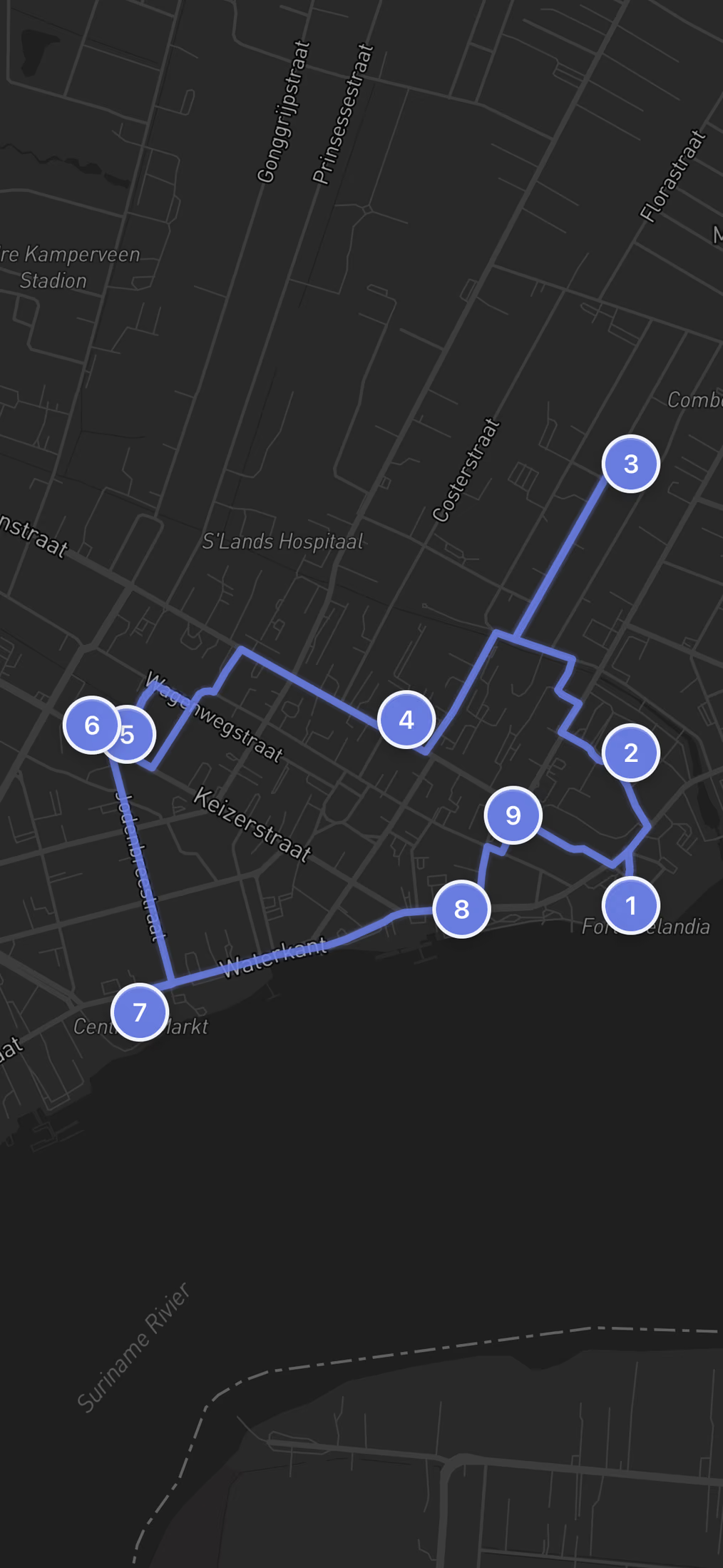
A 5.4 km loop through Paramaribo's historic centre, from Fort Zeelandia where the city was founded to Independence Square, taking in the wooden cathedral and the famous mosque-and-synagogue corner. Nine stops, no backtracking. This page gives you the map, walking time for every leg, real hours and prices, and shorter versions.

9 Stops5.4 km~2 hours walking4–5 hours with stops
What you get with AI Tourguide
Full GPS navigationInteractive AI guidePersonalized to youWorks in your browser
Try this tour with Alex

Paramaribo Walking Tour at a Glance

This route is built for anyone who wants Paramaribo's UNESCO-listed inner city on foot, at their own speed, without a group or a fixed clock. Every interior on the walk is optional: the outdoor loop stands on its own, and you decide which museum, church, mosque or synagogue is worth stepping into on the day. Self-guided means you set the pace and skip what you like.

StartFort Zeelandia
FinishOnafhankelijkheidsplein (Independence Square)
Route typeA compact loop that heads north from the fort, swings west through the religious quarter, then drops south to the market and river before curling back east to close near where you started. Almost no backtracking.
Realistic timeWalking alone is a little over two hours across 5.4 km. Add the outdoor stops and you are at three to four hours; with Fort Zeelandia's museum and a proper wander through the market, budget half a day.
DifficultyEasy and flat across 5.4 km, but the surfaces vary: smooth promenade on the Waterkant, then broken pavement, sandy verges and uneven ground around the market and older streets. Heat is the real challenge here, not the terrain.
Cost to followThe outdoor loop is free to walk end to end. Only two stops carry a real cost: Fort Zeelandia and the Surinaams Museum at SRD 25, and the Koto Museum, which asks a donation of roughly 50 to 100 SRD.
Best for:

Travellers who want the whole historic centre in one flat morning, like reading the story as they go, and would rather spend on the odd museum ticket than a guided group.

The Route

Free Walking Tour Map of Paramaribo

9 stops5.4 kmabout 2 hours
Loading the interactive map…The complete walking route will appear here.
Want the route to guide you while you walk?Open the route with navigation and a personal guide for the history, stories and questions that matter to you.
Open route + AI guide

The 9 stops along this route

  1. Fort Zeelandia in Paramaribo, stop 1 on the self-guided walking tour
    1Fort Zeelandia
  2. Garden of Palms (Palmentuin) in Paramaribo, stop 2 on the self-guided walking tour
    2Garden of Palms (Palmentuin)
  3. Koto Museum in Paramaribo, stop 3 on the self-guided walking tour
    3Koto Museum
  4. Saint Peter and Paul Cathedral (Sint-Petrus-en-Pauluskathedraal) in Paramaribo, stop 4 on the self-guided walking tour
    4Saint Peter and Paul Cathedral (Sint-Petrus-en-Pauluskathedraal)
  5. Neveh Shalom Synagogue (Synagoge Neve Shalom) in Paramaribo, stop 5 on the self-guided walking tour
    5Neveh Shalom Synagogue (Synagoge Neve Shalom)
  6. Mosque Keizerstraat (Moskee Keizerstraat) in Paramaribo, stop 6 on the self-guided walking tour
    6Mosque Keizerstraat (Moskee Keizerstraat)
  7. Centrale Markt in Paramaribo, stop 7 on the self-guided walking tour
    7Centrale Markt
  8. Waterkant in Paramaribo, stop 8 on the self-guided walking tour
    8Waterkant
  9. Onafhankelijkheidsplein (Independence Square) in Paramaribo, stop 9 on the self-guided walking tour
    9Onafhankelijkheidsplein (Independence Square)
  10. That's the complete route.

    If you want more than the map and text, add live navigation and a conversational AI guide while you walk.

    Open route + AI guide
    You made it
Stop 1 of 9
Swipe →

Your Paramaribo Walking Tour, Stop by Stop

  1. 1

    Fort Zeelandia

    Fort Zeelandia in Paramaribo, stop 1 on the self-guided walking tour

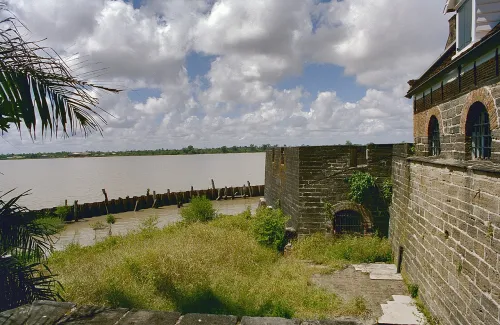
    Start where the whole city started. The fort sits low on the riverbank, brick walls facing the brown sweep of the Suriname River, with a statue of Queen Wilhelmina out front looking over the water. The English laid the first brick foundations around 1650; the Dutch took it in 1667 and renamed it Zeelandia after they chose to keep Suriname and its sugar instead of the colony that became New York. It later served as barracks and a prison. In 1982 fifteen government critics were tortured and shot inside these walls, the December murders, and Surinamers still talk about it. Since 1995 it has housed the Surinaams Museum, covering the colonial period, the country's many cultures and 20th-century art. Entry is SRD 25, open Tuesday to Friday 09:00 to 14:00 and Sunday 10:00 to 14:00, closed Saturday and Monday. Give it an hour. The courtyard has a cafe and a restaurant, Baka Foto, with an outdoor terrace. From the entrance, walk inland past the historic officers' houses and follow the riverside path north toward the palm garden.
    Hours
    Tu-F 09:00-14:00, Su 10:00-14:00 (closed Sa M)
    Price
    SRD 25 (adult standard; incl. Surinaams Museum)
  2. 2

    Garden of Palms (Palmentuin)

    Garden of Palms (Palmentuin) in Paramaribo, stop 2 on the self-guided walking tour

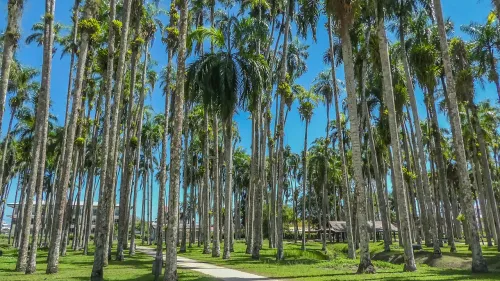
    After the weight of the fort, the palm garden is a relief. It opens up behind the Presidential Palace, a tall grid of royal palms planted on the orders of governor Cornelis van Aerssen van Sommelsdijck, who opened it to the public back in 1685. He was murdered by mutinous soldiers three years later, and the garden closed to the public until the early 20th century. There are a few statues among the trunks and a small playground. One small statue is of Ruben Klas, placed by parents whose son suffocated in a fridge, with an inscription urging people to watch their children. UNESCO funded a restoration after 2009 and the ministry has kept it up since. It is free and open daily 07:00 to 22:00. Come in the morning. By evening it draws a rougher crowd and locals avoid it after dark. Cut out the western side of the garden and head onto Prinsessestraat toward the Koto Museum.

    Hours
    Mo-Su 07:00-22:00
    Price
    Free
  3. 3

    Koto Museum

    Koto Museum in Paramaribo, stop 3 on the self-guided walking tour

    This one is small and easy to walk past, a house on Prinsessestraat rather than a grand building. It is built around the koto, the traditional dress of Creole women that took shape in Suriname and reached its peak after slavery ended. The koto is a whole language: the way the cloth is folded and the headscarf, the angisa, is tied carries meaning, sometimes a message or a mood. Spend twenty minutes here and the rest of the walk reads differently, because you start noticing the cultures stacked on top of each other everywhere else. Open Monday to Friday 10:00 to 17:00. There is no fixed price; a donation is asked, roughly 50 to 100 SRD. Worth it for the cultural depth you will not get from the colonial facades. From the museum, walk south and west along Gravenstraat toward the wooden cathedral, which you will spot by its twin towers long before you reach it.

    Hours
    Mo-Fr 10:00-17:00
    Price
    Donatie gevraagd (geen vast tarief; ~50-100 SRD volgens Evendo)
  4. 4

    Saint Peter and Paul Cathedral (Sint-Petrus-en-Pauluskathedraal)

    Saint Peter and Paul Cathedral (Sint-Petrus-en-Pauluskathedraal) in Paramaribo, stop 4 on the self-guided walking tour

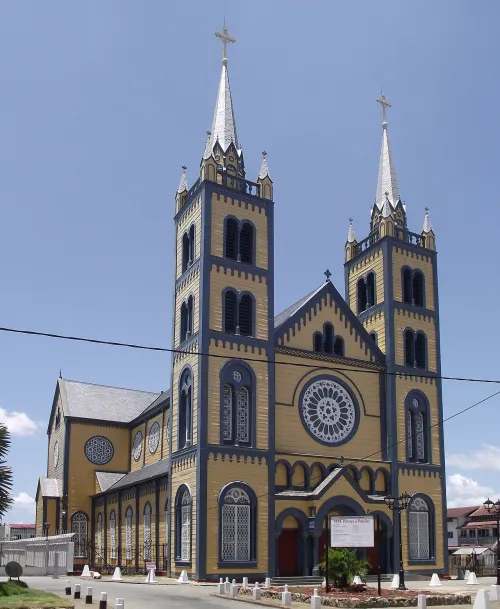
    You see the towers first, two of them, rising over the low wooden roofs. Up close the surprise lands: the entire thing is built of timber, inside and out, no stone, no brick. It went up between 1883 and 1887 and ranks among the largest wooden churches in South America, alongside St. George's in Georgetown. The interior is unpainted wood, cool and dim, the ceiling arching overhead like the hull of an upturned ship. Step inside even if you skip every other church on this trip. It was raised to a basilica in 2014 and forms part of the UNESCO-listed inner city. Entry is free, donations appreciated. Open Monday to Friday 06:00 to 13:30, Saturday 08:00 to 13:00, Sunday 08:30 to 12:00. Fifteen to twenty minutes is plenty unless a service is on. Leave by Henck Arronstraat and continue west on Keizerstraat. The next two stops are the reason most people put Paramaribo on their list.

    Hours
    Mo-Fr 06:00-13:30; Sa 08:00-13:00; Su 08:30-12:00
    Price
    Free (donations appreciated)
  5. 5

    Neveh Shalom Synagogue (Synagoge Neve Shalom)

    Neveh Shalom Synagogue (Synagoge Neve Shalom) in Paramaribo, stop 5 on the self-guided walking tour

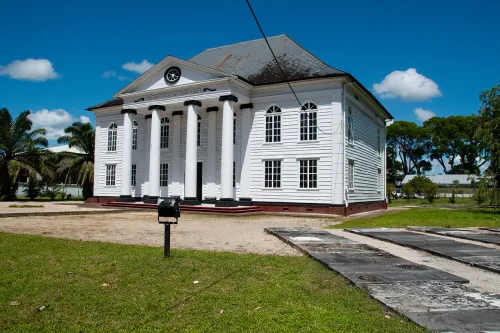
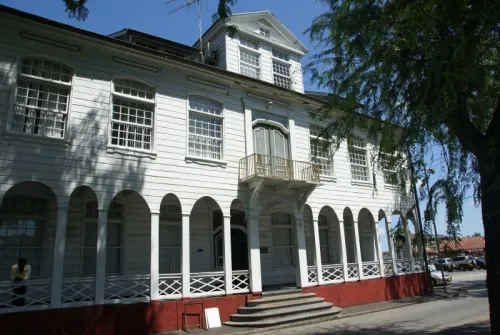
    Here is the corner everyone photographs. The wooden synagogue dates to 1842 and stands quietly on Keizerstraat, and right beside it, sharing a wall, is the mosque. The two congregations have been neighbours for generations, and that fact is held up around the world as a plain example of mutual respect between Islam and Judaism. Inside the synagogue grounds there is a small Jewish museum, a library, a mikvah from the 1870s, 18th-century gravestones and a souvenir shop. As of 2025 they were digitising around 100,000 historical documents on Jewish life in Suriname. Hours are tight and worth checking: Monday and Wednesday to Thursday 10:00 to 14:00, Friday evening 19:00 to 20:00, closed Tuesday and the weekend, and a visit is best arranged by appointment. Entry to the small museum is nominal. Stand on the street corner to take in both buildings at once, then walk the few steps next door to the mosque.

    Hours
    Mon: 10:00 AM – 2:00 PM | Tue: Closed | Wed-Thu: 10:00 AM – 2:00 PM | Fri: 7:00 – 8:00 PM | Sat-Sun: Closed
    Price
    Free (small museum entry ~nominal; visit by appointment)
  6. 6

    Mosque Keizerstraat (Moskee Keizerstraat)

    Mosque Keizerstraat (Moskee Keizerstraat) in Paramaribo, stop 6 on the self-guided walking tour

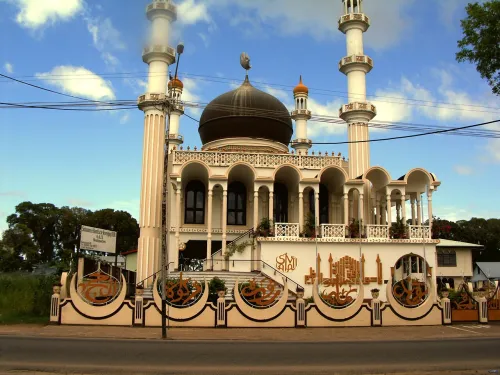
    Two steps and you are at the mosque, the other half of the famous pair. It is large, white and green, the headquarters of the Lahore Ahmadiyya movement in Suriname, owned by the Surinamese Islamic Association. A mosque has stood on this spot since 1932; the present one was designed by Surinamese architect Nazier Ataoellah and built between 1973 and 1984. The magic is not really either building alone but the sight of the two side by side, minaret and synagogue roof in the same frame, with the cathedral a few minutes back the way you came. Entry is free, and the mosque is open Monday to Friday around the clock, closed on weekends. Dress modestly and remove your shoes if you go in. After this you have seen the religious heart of the city, so it is time to drop down to where everyday life happens. Head south on Keizerstraat toward the river and the covered market.

    Hours
    Mon-Fri: Open 24 hours | Sat-Sun: Closed
    Price
    Free
  7. 7

    Centrale Markt

    Centrale Markt in Paramaribo, stop 7 on the self-guided walking tour

    The market hits you with noise and smell before you are through the door. This is the largest covered market in the Caribbean region, a two-storey hall on the Waterkant by the river, with stalls spilling out around it. Food is downstairs: meat, fish, tropical fruit you may not recognise, herbs and spices, plus dried goods and clothing and odds and ends upstairs. There are cheap food stalls if you are hungry. It is also the city's transit knot, the departure point for many town buses and the mooring for boats across the Suriname River, so it is busy and a little chaotic. Open Monday to Saturday 06:00 to 16:00, closed Sunday, and it thins out well before closing. Free to wander. Keep a hand on your bag and go early when it is freshest and coolest. Exit on the river side and turn left onto the Waterkant promenade.

    Hours
    Mon-Sat: 6:00 AM – 4:00 PM | Sun: Closed
    Price
    Free
  8. 8

    Waterkant

    Waterkant in Paramaribo, stop 8 on the self-guided walking tour

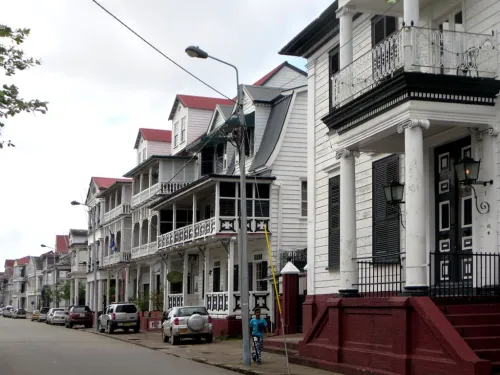
    Out of the market crush and onto the oldest street in Paramaribo. The Waterkant runs straight along the river quay, lined with the colourful wooden colonial warehouses that gave the city its postcard image. This stretch is a central piece of the UNESCO-listed inner city, and the look of it is the whole reason: tall shuttered facades on one side, the wide brown river and its ferry traffic on the other. There is nothing to pay and nothing to queue for; it is open all day and night. This is the easy, scenic part of the walk, a good place to slow down, grab a cold drink and watch boats cross to the far bank. Late afternoon light hits the warehouse fronts best. Stroll east along the quay with the river on your right and you will arrive at the broad green square that closes the loop.

    Hours
    Open 24/7
    Price
    Free
  9. 9

    Onafhankelijkheidsplein (Independence Square)

    Onafhankelijkheidsplein (Independence Square) in Paramaribo, stop 9 on the self-guided walking tour

    The walk ends on the civic centre of the country. Independence Square is a broad open green, framed on one side by the white colonial Presidential Palace and ringed by government buildings, including the 18th-century Huis Du Plessis at number 2, part of the UNESCO inner city. You cannot go inside the palace; viewing is from the square only, and the grounds behind it are the palm garden you walked through earlier, which ties the loop together neatly. The square is free and open at all hours. It is a calm place to finish, with benches and shade and the palace facade catching the light. From here the fort where you started is only a couple of minutes east, so the loop is complete and you are back near the river. If you have energy left, this is the spot to sit, take a last photo of the palace, and let the day's walking settle.

    Hours
    Open 24/7
    Price
    Free

How Long Does This Walking Tour Really Take?

The full loop is 5.4 km and takes a little over two hours of pure walking, but two stops swallow time: Fort Zeelandia, where the museum deserves a full hour, and the Centrale Markt, where half an hour vanishes just wandering. The cathedral, both religious buildings and the Koto Museum run fifteen to twenty minutes each, so a thorough visit is comfortably half a day.

Walking the full loop is around 5.4 km and takes a little over two hours at a steady pace, but you will want roughly half a day to do it properly with stops. The two places that swallow time are Fort Zeelandia, where the museum deserves a full hour, and the Centrale Markt, where it is easy to lose half an hour just wandering. The cathedral, both religious buildings and the Koto Museum are quick, fifteen to twenty minutes each.

Break in the middle or at the end. The courtyard cafe and the Baka Foto restaurant inside Fort Zeelandia, with its outdoor terrace, are a pleasant place to pause early on. For a later rest, the benches on the Waterkant promenade and the shaded edges of Independence Square are the two best free spots to sit with a cold drink and watch the river. Heat is the real factor here, not distance, so plan your sit-down breaks for the hottest part of the midday and keep moving in the cooler hours.

Full Route, Shorter Walk or Two-Day Version?

The nine stops are ordered to keep the river breeze at your back for the hot open stretches and to save the shadeless quay for later, cooler light. If the heat or your legs give out, here are three honest ways to run it.

Short version

The core, skipping the northern loop to the Koto Museum

Stops 1, 2, 4 to 9, around 4 km, two to three hours

Drop the two longest northern legs: after the Palmentuin, cut straight across to the cathedral instead of walking up to the Koto Museum and back. You lose the koto story but keep the fort, the palm garden, the famous religious corner, the market and the riverfront.

Two-part split

River and religion, on two easier passes

Part one: stops 1 to 4. Part two: stops 5 to 9. Around two hours each with a break

Split the loop at the cathedral. Do stops 1 to 4 in a cooler morning, break for heat and food, then pick up the mosque-and-synagogue corner, the market, the Waterkant and Independence Square later or the next day. Gentle on the legs and kind to the midday sun.

You can walk it backwards from Independence Square, but the given direction is the better one: it opens at the fort where the city was founded and keeps the shadeless Waterkant quay for late afternoon, when the light on the wooden warehouses is at its best rather than at its harshest.

Is This Paramaribo Walking Tour Right for You?

A flat 5.4 km loop through a small, signposted historic centre, this route suits most walkers. Here is who it fits best and how to bend it when it does not.

A good fit if you…

  • Walkers comfortable with a couple of hours on flat ground and mixed surfaces
  • Culture travellers who want the colonial, Creole, Jewish and Muslim layers in one go
  • Photographers after the mosque-and-synagogue corner and the colourful Waterkant warehouses
  • Anyone who would rather pay for one or two museum tickets than a full guided tour

Adapt the route if you…

  • Heat gets to you: use the two-part split and keep the open Waterkant stretch for later in the day
  • You have limited time: take the short version and skip the northern leg to the Koto Museum
  • You want interiors: check hours first, since the fort closes Monday and Saturday and the synagogue is best by appointment
  • You are travelling with young kids: the Palmentuin has a small playground, and the market makes a good short, shaded stop

Tickets & Skip-the-Line in Paramaribo

Only two stops on this walk cost anything, and neither needs advance booking. Everything else is a free open space you can walk into whenever it is open. Here is what to pay and when to turn up.

Fort ZeelandiaSRD 25 for an adult standard ticket, which includes the Surinaams Museum inside the fort. Open Tuesday to Friday 09:00 to 14:00 and Sunday 10:00 to 14:00, closed Saturday and Monday. No online booking, pay at the entrance, and give the museum a full hour.
Koto MuseumNo fixed price: a donation is asked, roughly 50 to 100 SRD. Open Monday to Friday 10:00 to 17:00. Small house on Prinsessestraat, easy to walk past, and worth twenty minutes for the story behind Creole dress. official ticket site ↗
Neveh Shalom Synagogue (Synagoge Neve Shalom)Free to see from the street; the small Jewish museum inside charges a nominal fee and a visit is best arranged by appointment. Open Monday and Wednesday to Thursday 10:00 to 14:00, Friday evening 19:00 to 20:00, closed Tuesday and the weekend. official ticket site ↗
Everything elseFree open spaces you can walk through anytime they are open: the Palmentuin (daily 07:00 to 22:00), St. Peter and Paul Cathedral, Moskee Keizerstraat, the Centrale Markt (Monday to Saturday, closed Sunday), the Waterkant and Onafhankelijkheidsplein. No tickets, no queues.
Optional upgrade
+5
The same 9-stop route,
now with navigation and a guide.
Optional AI experience

You already have the route.
The AI guide brings it to life.

Standing near Fort Zeelandia or the wooden cathedral with this list open on your phone? Let the AI Tourguide walk the loop with you, talking you from the fort through the palm garden to the mosque-and-synagogue corner and on to the riverfront. It is free to start, knows the route and the stories, and answers whatever you ask as you go.

Livenavigation13languagesAnyquestionYourinterests
Open this route with the AI guide

Try it in your browser · No app or download required

Tips for Walking in Paramaribo

  • Start by 08:00 from Fort Zeelandia. The fort opens Tuesday to Friday at 09:00, the market is freshest first thing, and the heat after 11:00 turns the open stretches brutal. Avoid Mondays and Saturdays, when the fort and museum are closed, and Sunday, when the market shuts.
  • Wear closed, comfortable shoes. The route mixes paved promenade on the Waterkant with broken pavements, sandy verges and uneven ground around the market and older streets. Nothing steep, but the surfaces are rough in places and puddle fast in a downpour.
  • Use the toilets and cafe inside Fort Zeelandia early in the walk, since clean public restrooms are scarce on this route. The courtyard cafe there is your most reliable stop before you set off into the old town.
  • For food, the cheap eateries inside and around the Centrale Markt are the local choice; try a roti or a bami from a stall. For a sit-down break with a view, Baka Foto in the Fort Zeelandia courtyard has a shaded terrace overlooking the river.
  • For the signature photo, stand on the Keizerstraat corner with the synagogue and mosque side by side and frame both buildings in one shot. Late afternoon light is kindest. The colourful Waterkant warehouses also shoot best in the soft light before sunset.

Why Walk This Route?

Paramaribo is one of those rare capitals where the whole historic centre fits inside a single morning's walk, and almost all of it is made of wood. The old town was painted onto the bank of the Suriname River by Dutch colonists, then rebuilt over and over by everyone who came after: enslaved Africans, indentured Javanese and Hindustani workers, Chinese traders, Sephardic Jews, Lebanese merchants. UNESCO put the inner city on the World Heritage list in 2002 and called it what locals already called it, the Wooden City. You feel that mix on every block. A neo-Gothic cathedral built entirely of timber sits a few minutes from a mosque and a synagogue that share a wall.

This route runs as a loop, so you start and finish near the river without backtracking. It opens at the fort where the city was founded, cuts through the royal palm garden behind the Presidential Palace, dips into the Creole and religious heart of town, then drops down to the market and the riverfront before closing on the grand civic square. Roughly 5.4 km in total. You could rush it in two hours, but the point of Paramaribo is not rushing.

Why walk it rather than wander? Because the good stuff is small and easy to miss. The synagogue next to the mosque looks like an ordinary corner unless someone points it out. The market is a maze. The best colonial facades are on streets tourists rarely turn down. Follow this order and you hit the highlights in the sensible direction, with the river breeze on your back for the hot stretch.

Common Questions

Is Paramaribo safe to walk around?

The historic centre is fine to walk during the day and this route sticks to busy, public areas. Keep your wits about you in the crowded Centrale Markt, where pickpockets work, and do not flash phones or cash. Avoid the Palmentuin after dark, when it draws a rougher crowd and locals stay away. As anywhere, do the walk in daylight and leave valuables at your accommodation.

What if it rains during my Paramaribo tour?

Suriname gets heavy tropical downpours that usually pass within an hour. Duck into the indoor stops to wait one out: the Surinaams Museum inside Fort Zeelandia, the wooden cathedral, the Koto Museum, or the two-storey covered hall of the Centrale Markt all keep you dry. The market in particular is a good rain shelter and a stop you wanted to make anyway.

What's the best time of day for this walking tour?

Early morning, starting around 08:00. The market is at its freshest, the light is soft for photos, and you cover the open, shadeless stretches along the Waterkant and Independence Square before the midday heat sets in. Time it so you reach Fort Zeelandia when the museum opens at 09:00 on a Tuesday through Friday.

Take this route with you

Open this exact tour with navigation and your personal AI guide.

Start GPS Navigation + AI Guide
AI Tourguide
Researched and curated by the AI Tourguide teamWe plan and quality-check every route, then research and verify the opening hours, prices, and practical tips for each stop along it.
▶ Open route with AI guideNavigation, stories and your questions