
Self-Guided Walking Tour in Pontresina

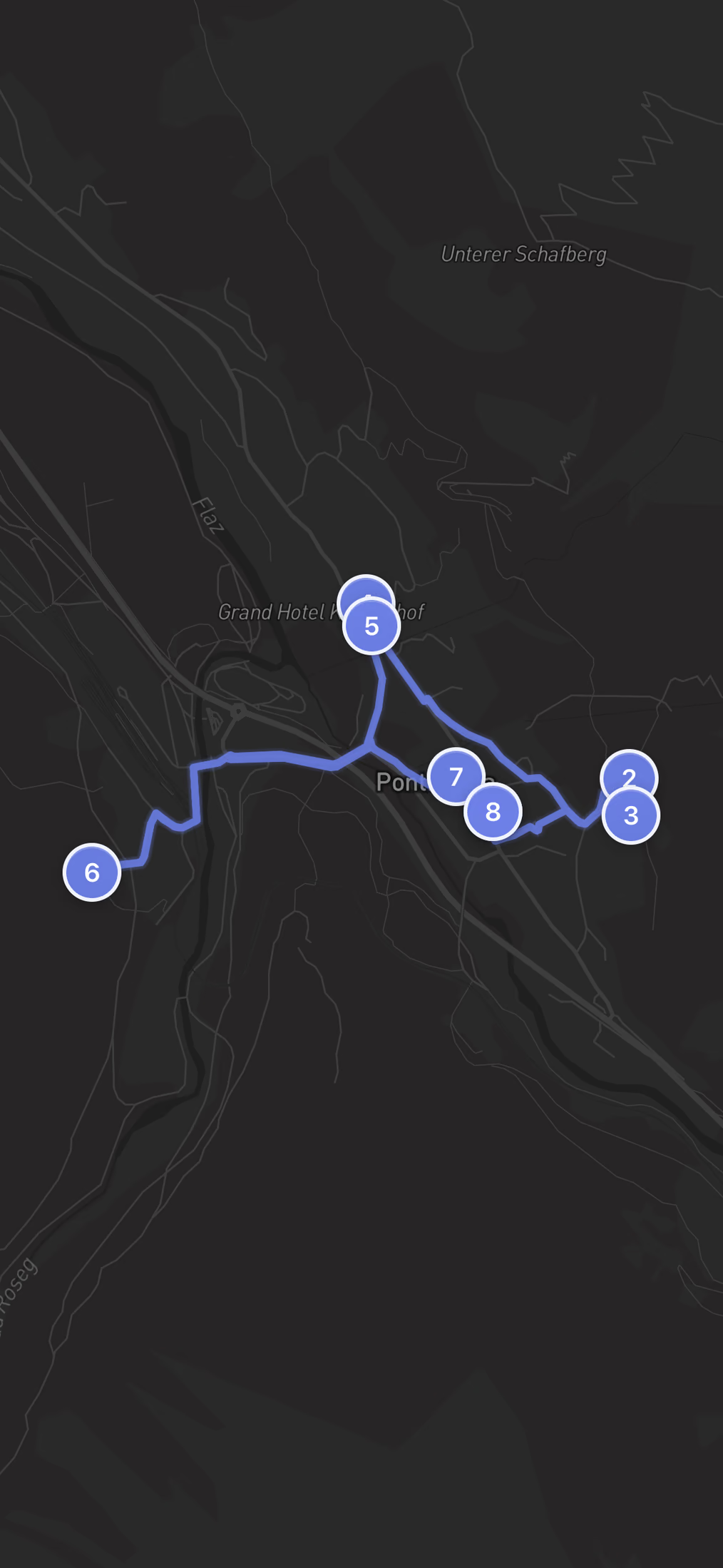
A self-guided 3.8 km walking loop of Pontresina, starting and ending at the Museum Alpin and linking eight stops from the Spaniola tower to the Chünetta ridge viewpoint and the gateway of the Val Roseg. The page gives you a map, per-leg walking times, real opening hours and prices, plus two shorter versions.

7 Stops3.8 km~2 hours walking2–3 hours with stops
What you get with AI Tourguide
Full GPS navigationInteractive AI guidePersonalized to youWorks in your browser
Try this tour with Alex

Pontresina Walking Tour at a Glance

This route is built for travellers who want to see Pontresina on foot rather than from a coach window: the village churches, the medieval tower, the best ridge view in town, and the doorway to the Val Roseg, all on one short loop. Every interior on the route is optional. You can skip the museums and churches and still get the views, or stretch the day into the Val Roseg if your legs are willing. Walk it solo, at your own pace, and pick the stops that actually interest you.

StartMuseum Alpin, Pontresina (Museum Alpin)
FinishSan Spiert
Route typeA loop of 3.8 km starting and ending at the Museum Alpin on the Via Maistra. The route climbs east first to Sta. Maria and the Spaniola tower above the village, swings north-west to San Niculò and the Chünetta ridge, drops south-west to the Val Roseg gateway, and returns east along the Via Maistra. Same start and end point, no backtracking along the same street.
Realistic timeRoughly an hour of walking, plus the two short climbs and the time the ridge deserves. A realistic total with church interiors, the viewpoint and short photo stops is two to three hours. Add a half-day if you decide to follow the Val Roseg beyond its gateway instead of treating it as a teaser.
Difficulty3.8 km with two short climbs: the lane up to Sta. Maria and the Spaniola tower in the first kilometre, and the path from behind San Niculò up to the Chünetta ridge later in the loop. Paths are packed earth and stone, the standard village surface in the Engadine, and they can be muddy or icy outside high summer. Sturdier shoes than city sneakers are the call here, and the ridge is exposed enough to feel cooler than the street below.
Cost to followThe outdoor route is free to walk, including Sta. Maria, the Spaniola tower, the Chünetta ridge, the gateway to the Val Roseg, and the two other churches on the loop. The only paid stop is the Museum Alpin at CHF 8 for adults and CHF 2 for children. The optional horse-drawn carriage into the Val Roseg costs about CHF 38 per person one way if you decide to ride rather than walk.
Best for:

Best for travellers with a free afternoon who want Engadine village churches, a medieval tower, and the classic Pontresina-to-Bernina ridge view all on one short walk that costs almost nothing to follow.

The Route

Free Walking Tour Map of Pontresina

7 stops3.8 kmabout 2 hours
Loading the interactive map…The complete walking route will appear here.
Want the route to guide you while you walk?Open the route with navigation and a personal guide for the history, stories and questions that matter to you.
Open route + AI guide

The 7 stops along this route

  1. Museum Alpin, Pontresina (Museum Alpin) in Pontresina, stop 1 on the self-guided walking tour
    1Museum Alpin, Pontresina (Museum Alpin)
  2. St. Maria, Pontresina (Sta. Maria) in Pontresina, stop 2 on the self-guided walking tour
    2St. Maria, Pontresina (Sta. Maria)
  3. Spaniola Castle (Burgturm Spaniola) in Pontresina, stop 3 on the self-guided walking tour
    3Spaniola Castle (Burgturm Spaniola)
  4. San Niculò in Pontresina, stop 4 on the self-guided walking tour
    4San Niculò
  5. Missing required field: waypoints[4].image
    5Chünetta Viewpoint
  6. Missing required field: waypoints[5].image
    6Val Roseg (gateway)
  7. San Spiert in Pontresina, stop 7 on the self-guided walking tour
    7San Spiert
  8. That's the complete route.

    If you want more than the map and text, add live navigation and a conversational AI guide while you walk.

    Open route + AI guide
    You made it
Stop 1 of 7
Swipe →

Your Pontresina Walking Tour, Stop by Stop

  1. 1

    Museum Alpin, Pontresina (Museum Alpin)

    Museum Alpin, Pontresina (Museum Alpin) in Pontresina, stop 1 on the self-guided walking tour

    Start where the village keeps its own story. The Museum Alpin sits on the Via Maistra inside the Chesa Delnon, a genuine 17th-century Engadine house with the deep funnel windows and painted facade that you will see repeated all along this walk. Inside, the permanent rooms cover a traditional Engadine home laid out as it was lived in, a reconstructed Swiss Alpine Club hut with its full kit, the history of hunting in Graubünden, the minerals of the Engadine, and the region's mining past. It is compact and old-fashioned in the best way, the kind of museum a village runs for itself. Admission is CHF 8 for adults and CHF 2 for children. Hours are the catch: it opens only Monday to Saturday from 3:30 to 6:00 PM, and closes Sunday. Tip: because of those hours, treat this as your end point rather than your literal first stop. Walk the loop first, then come back here in the late afternoon to step inside before it shuts at six.

    Hours
    Mon-Sat: 3:30 – 6:00 PM | Sun: Closed
    Price
    CHF 8 adults / CHF 2 children
  2. 2

    St. Maria, Pontresina (Sta. Maria)

    St. Maria, Pontresina (Sta. Maria) in Pontresina, stop 2 on the self-guided walking tour

    From the Via Maistra the lane climbs east and the village drops away below you. Sta. Maria stands above Pontresina on the rise toward the Spaniola tower, a low stone church that looks plain from outside and is the whole reason to make the climb. The walls inside carry medieval frescoes, the kind of painted biblical cycle that survives in only a handful of Engadine churches. This is the one stop on the loop where the interior is the point, so do go in rather than just photograph the exterior. Entry is free and the church is open daily from 9 AM to 5 PM. It is quiet up here, often empty, a real contrast to the busier village street you just left. Tip: the light inside is dim, so give your eyes a minute to adjust before you decide there is nothing to see. The frescoes emerge slowly from the gloom. From the churchyard you already get your first clean look across the rooftops to the peaks.

    Hours
    Daily 9 AM - 5 PM
    Price
    Free
  3. 3

    Spaniola Castle (Burgturm Spaniola)

    Spaniola Castle (Burgturm Spaniola) in Pontresina, stop 3 on the self-guided walking tour

    Step out of the church and the ruin is right there, a stub of medieval masonry on the knoll a moment's walk away. The Burgturm Spaniola is what is left of a fortified tower above the village, its purpose long argued over and its modern nickname, the Spaniolaturm, of unclear origin. A local chronicler noted around 1740 that the tower simply carried the name of the village. There is no interior to tour and nothing to pay: it is always open and free. What you come for is the position. The tower sits on the best natural balcony over Pontresina, with the Bernina range opening up behind the rooftops. Climb the few steps to the base, walk around it, and look back down the valley. Tip: this is the highest point of the early part of the loop, so catch your breath here and take the panorama photo now. The rest of the route is gentler, and the light on the glaciers is usually cleaner before midday.

    Hours
    Always open
    Price
    Free
  4. 4

    San Niculò

    San Niculò in Pontresina, stop 4 on the self-guided walking tour

    Come back down off the knoll and follow the path across the slope to the north end of the village, where San Niculò stands a little apart. This is the reformed parish church of Pontresina, Sankt Nikolaus in German, and it is under cantonal heritage protection. It makes a clean pair with Sta. Maria you saw earlier: one Catholic in feel and frescoed, this one the Protestant village church, simpler and squarer. The setting is the draw, perched with the valley falling away in front of it. Entry is free and it is open daily from 9 AM to 5 PM. Step inside for a few minutes, then linger in the churchyard, which is one of the calmest spots on the whole walk. Tip: this is the launch point for the climb to come, so refill your water and check your shoes here. The path up to the Chünetta viewpoint starts right behind the church and gets steeper than it looks from below.

    Hours
    Daily 9 AM - 5 PM
    Price
    Free
  5. 5

    Chünetta Viewpoint

    Missing required field: waypoints[4].image

    Now you earn the best view of the day. From behind San Niculò an easy but steady path climbs about fifteen minutes up the wooded ridge to the Chünetta. There is no gate, no ticket, and no opening hours: it is open ground, free, all year. The reward is the postcard frame of the Engadine, the full sweep across the rooftops of Pontresina to the Bernina massif and, below, the long tongues of the Roseg and Morteratsch glaciers. This is the shot people travel here for. If your legs are still good, walk another hundred metres along the same ridge to the Crast'Ota viewpoint for a slightly different angle. Tip: morning light puts the sun behind you and full on the glaciers, so this stop rewards an early start more than any other on the loop. Bring layers even in summer, because the ridge is exposed and noticeably cooler than the village. Sit a while on the rocks before you head back down.

  6. 6

    Val Roseg (gateway)

    Missing required field: waypoints[5].image

    Descend off the ridge and cross to the western edge of the village, where the road ends and the Val Roseg begins. This is the gateway to one of the great side valleys of Graubünden, a car-free wedge of forest, river, and meadow that runs back to the Roseg glacier. You can stand at the mouth of it for free and feel the temperature drop as the valley breathes out at you. The walk in is open 24/7 and costs nothing on foot or by bike. The famous alternative is the horse-drawn omnibus that runs daily on a published timetable in summer and winter to the Hotel Roseg Gletscher, around CHF 38 per person one way. Tip: do not commit to the full valley on this loop, it is a half-day in itself. Treat this stop as a teaser and a decision point: note the carriage stop and timetable here, then come back tomorrow with a full morning. The view up the valley from the gateway alone is worth the detour.

  7. 7

    San Spiert

    San Spiert in Pontresina, stop 7 on the self-guided walking tour

    Walk back into the village along the Via Maistra and the loop softens into a stroll. San Spiert, the Catholic Church of the Holy Spirit, sits set back a little from the main road in its own quarter, easy to miss if you are not looking for it. After two older village churches and a ruin, this one is the gentle, lived-in close to the religious thread of the walk: smaller in ambition, still worth the few minutes inside. Entry is free and it is open daily from 9 AM to 5 PM. Tip: this is your cue to check the clock. From here it is a short, flat walk back to the Museum Alpin, and if it is past 3:30 PM you can still catch the museum before it closes at six, which makes for a neat end to the loop. If you are early, this stretch of the Via Maistra has the village's cafes and bakeries, a good place to pause before the last stop.

    Hours
    Daily 9 AM - 5 PM
    Price
    Free

How Long Does This Walking Tour Really Take?

Roughly an hour of walking, plus the climbs and the time the ridge deserves. Plan for two to three hours with the church interiors, the Chünetta viewpoint, and short photo stops. The Museum Alpin opens only at 3:30 PM Monday to Saturday and is closed Sunday, so time your return around that window, or skip the interior on a Sunday.

The loop is 3.8 km. Pure walking time is a little over an hour, but the climbs to Spaniola and the Chünetta are genuine uphill, so budget more. A realistic total with church interiors, the ridge viewpoint, and photo stops is two to three hours. The two stops that deserve real time are the Chünetta viewpoint, where you will want to sit a while, and the Val Roseg gateway, which can swallow a whole extra half-day if you let it. The frescoes at Sta. Maria reward a slow look; the other churches are five minutes each. For a break, the Via Maistra near San Spiert has the village's bakeries and cafes, the natural spot to rest your legs before the final stretch. Crucially, plan around the Museum Alpin: it opens only at 3:30 PM, Monday to Saturday, and shuts at 6:00 PM. Start the loop by early afternoon, walk it in the good light, and time your return to the museum for late afternoon so you finish inside rather than at a locked door.

Full Route, Shorter Walk or Two-Day Version?

Three versions of the same loop, depending on how much time and leg you have. All three start at the Museum Alpin on the Via Maistra. If you only want the views, take the middle one. If you want the full church-and-tower story, take the long one. If you are planning around the museum's 3:30 PM opening, the long version is the one that lets you finish inside before closing.

Shorter loop

Spaniola, San Niculò, Chünetta

Stops 1, 2, 3, 4, 5, 7, 8, about 2 km less, 1.5–2 hours

Skips the long detour down to the Val Roseg gateway (legs 5 to 6 and 6 to 7), saving roughly two kilometres of walking. You still get the two climbs, the frescoes at Sta. Maria, the tower, and the Chünetta ridge view that people travel here for. The right choice if you want the highlights without the extra leg.

Two-day split

Village day, valley day

Day 1: stops 1 to 5. Day 2: Val Roseg, then stops 7 and 8.

Walk the village loop on day one, finishing at the Chünetta ridge. Save the Val Roseg for a separate morning with a full half-day to push up the valley, on foot or on the horse-drawn carriage, then loop back through San Spiert and the Museum Alpin after 3:30 PM.

The loop works in reverse, but the given direction is recommended for two reasons. The two climbs to the Spaniola tower and the Chünetta ridge come early, while your legs are still fresh, and the descent back through the village is the gentle part. The Museum Alpin also opens only at 3:30 PM Monday to Saturday, so ending there fits the natural late-afternoon finish. Reversing the loop means walking into that hours problem the wrong way round.

Is This Pontresina Walking Tour Right for You?

This is a village walk with two short climbs, not a mountain hike. It suits anyone comfortable on packed-earth paths and a few hundred metres of uphill. The questions below help you decide whether to take the full loop or one of the shorter versions, and what to change if the weather turns or your time is short.

A good fit if you…

  • Travellers with a free afternoon who want Engadine churches, a medieval tower, and the best ridge view in Pontresina on a single short walk
  • Visitors based in St. Moritz or Pontresina with a few hours to spare, since Pontresina station is about a ten-minute walk below the Via Maistra
  • Photographers chasing the classic Pontresina rooftop frame with the Bernina massif and the Roseg and Morteratsch glaciers behind it
  • Anyone curious about Engadine village architecture, sgraffito facades, and old painted churches that you can step into for free
  • Couples or solo walkers who like a mix of culture and an alpine viewpoint without committing to a full mountain hike

Adapt the route if you…

  • If you have less than two hours, take the shorter loop and skip the Val Roseg gateway detour to save about two kilometres
  • If it rains, drop the Chünetta ridge because it is exposed and slippery when wet, and keep to the churches and the Museum Alpin
  • If you are here on a Sunday, start in the morning for the best light, since the Museum Alpin is shut and the rest of the loop is a free outdoor walk
  • If fresh snow covers the high path, skip the climb to the Chünetta entirely and stay on the village streets and the lower churches
  • If you fall for the Val Roseg, save it for a full morning tomorrow with the horse-drawn carriage rather than rushing through on the loop

Tickets & Skip-the-Line in Pontresina

Ticket and opening-hours guidance for the Pontresina loop. Only one stop on the route charges for entry, and most of what makes the walk worthwhile is free and open daily. The main planning constraint is not money but the Museum Alpin's narrow afternoon-only hours.

Museum Alpin, Pontresina (Museum Alpin)The only paid stop on the loop: CHF 8 for adults, CHF 2 for children. Open Monday to Saturday from 3:30 to 6:00 PM only, and closed on Sundays. Plan the loop so you finish here in the late afternoon rather than starting. No need to book ahead; just arrive before 6:00 PM closing. official ticket site ↗
Val Roseg (gateway)Free to enter and hike, open 24/7 year-round on foot or by bike. The optional horse-drawn carriage from Pontresina to the Hotel Roseg Gletscher runs daily to a published timetable in summer and winter and costs about CHF 38 per person one way. Treat the gateway as a teaser for a separate half-day trip rather than committing on the loop itself. official ticket site ↗
San SpiertFree entry, open daily from 9 AM to 5 PM. The church sits set back from the Via Maistra in its own quarter and is easy to miss on the return leg of the loop. No booking needed, just walk in during opening hours. official ticket site ↗
St. Maria, Pontresina (Sta. Maria)Free entry, open daily from 9 AM to 5 PM. The interior frescoes are the reason to climb up here, and the light inside is dim, so give your eyes a minute to adjust before deciding there is nothing to see.
San NiculòFree entry, open daily from 9 AM to 5 PM. The reformed parish church of Pontresina, under cantonal heritage protection. Step inside for a few minutes and linger in the churchyard, which is one of the calmest spots on the walk.
Everything elseThe Burgturm Spaniola tower and the Chünetta Viewpoint are free open spaces, always accessible, with no gate, ticket, or opening hours. Plan around daylight and weather, not a timetable.
Optional upgrade
+3
The same 7-stop route,
now with navigation and a guide.
Optional AI experience

You already have the route.
The AI guide brings it to life.

Standing at the Chünetta viewpoint or by the old Spaniola tower and wishing someone could tell you what you are actually looking at? That is the gap the AI Tourguide fills. It is a voice-first guide built right into this walk that talks with you as you go, greeting you, telling the story of the frescoes in Sta. Maria or the founding of the Val Roseg, then asking what you want to hear more about and remembering your answer for the rest of the loop. You still choose your own pace, your own stops, and your own lunch on the Via Maistra. It is a real conversation in your ear, not an audioguide reading a script, and you can start it in your browser right where you are standing.

Livenavigation13languagesAnyquestionYourinterests
Open this route with the AI guide

Try it in your browser · No app or download required

Tips for Walking in Pontresina

  • Getting here: trains stop at Pontresina station on the Rhaetian Railway, about a ten-minute walk below the Via Maistra. From St. Moritz it is roughly fifteen minutes by train or PostBus, so this loop works easily as a day trip if you are based there.
  • Shoes: this is not a flat town. The climbs to the Spaniola tower and the Chünetta ridge are on packed earth and stone paths that can be muddy or icy outside high summer. Wear proper walking shoes, not city sneakers, and skip the ridge entirely if there is fresh snow.
  • Restrooms: there are no public toilets up on the ridge or at the church cluster. Use the facilities at the Pontresina station or in a Via Maistra cafe before you start the climb, because the next reliable option is back in the village.
  • Food and drink: the Via Maistra near San Spiert has the village bakeries. Order a slice of Engadiner Nusstorte, the regional caramel-walnut tart, with a coffee. Expect roughly CHF 6 to 9 for cake and CHF 5 or so for a coffee at Engadine prices.
  • Photo: the single best frame is from the Chünetta viewpoint, facing southwest across the rooftops to the Bernina massif and the Roseg and Morteratsch glaciers. Go in the morning so the sun is behind you and full on the ice.
  • Money: keep a little cash for the Museum Alpin (CHF 8) and the Val Roseg carriage (about CHF 38 one way). Cards work in shops and cafes, but small village counters can be cash-friendlier.
  • Season: the church interiors and viewpoints are best from late spring to autumn. In deep winter the high ridge path may be closed or snowbound, though the village churches and museum stay open on their normal hours.

Why Walk This Route?

Pontresina is small enough to walk in an afternoon and steep enough that the walk earns you a view at almost every turn. The village strings itself along one main road, the Via Maistra, with stone Engadine houses, their thick walls, deep window funnels, and sgraffito plaster decoration, packed tight against the slope. Behind them the Bernina massif and its glaciers fill the sky. This is not a place of grand monuments. It is a place of two old churches, a fortified tower, a tiny alpine museum, and the doorway to one of the finest valleys in Graubünden, all close enough to link on foot.

This route is a 3.8 km loop that starts and ends at the Museum Alpin on the Via Maistra. It climbs first to the cluster above the village, the Sta. Maria church and the Spaniola tower, where the frescoes and the medieval ruins sit side by side. Then it crosses to the reformed church San Niculò and the ridge above it for the Chünetta viewpoint, swings down to the gateway of the Val Roseg, and comes back through the village past San Spiert. Doing it on foot beats wandering because the order matters here: you want the climb done early while your legs are fresh, the glacier view in good light, and the flat village stretch saved for the end when you are ready to slow down.

A word on timing before you start. Most of what is worth seeing inside is free and open through the day, but the one ticketed stop, the Museum Alpin, only opens in the late afternoon. Read the duration note below before you set off so you do not arrive at a locked door.

Common Questions

Is Pontresina safe to walk around?

Yes. Pontresina is a small, low-crime Engadine resort village and there are no rough areas to avoid. The real hazards are natural, not human: the climbs to the Spaniola tower and the Chünetta ridge are steep and can be slippery when wet or icy, and the high ground is exposed. Watch your footing rather than your wallet, and turn back from the ridge in bad weather or fresh snow.

What if it rains during my Pontresina tour?

Skip the Chünetta ridge, which is exposed and slippery in rain, and shorten the loop to the indoor and sheltered stops. The two churches, San Niculò and San Spiert, and Sta. Maria with its frescoes are all free, open daily 9 AM to 5 PM, and give you cover. End at the Museum Alpin, the one fully indoor stop, open Monday to Saturday 3:30 to 6:00 PM for CHF 8.

What's the best time of day for this walking tour?

Start in the early afternoon. Morning gives the cleanest glacier light at the Chünetta viewpoint, but the Museum Alpin only opens at 3:30 PM, so an early-afternoon start lets you do the climb and the views first, then finish inside the museum before it closes at 6:00 PM. Sunday changes the plan: the museum is closed, so go in the morning for the light and treat the rest as a free outdoor loop.

How long does the Pontresina historic walk take?

The loop is 3.8 km. Pure walking is just over an hour, but with the two real climbs, the church interiors, and time on the Chünetta ridge, plan for two to three hours. Add a half-day if you decide to follow the Val Roseg properly rather than just standing at its gateway.

Do I need to pay for anything on this walk?

Almost nothing. The two churches, the Sta. Maria church, the Spaniola tower, the Chünetta viewpoint, and the entrance to the Val Roseg are all free. The only ticket on the loop is the Museum Alpin at CHF 8 for adults and CHF 2 for children. The optional Val Roseg horse-drawn carriage is about CHF 38 per person one way if you choose to ride it.

Take this route with you

Open this exact tour with navigation and your personal AI guide.

Start GPS Navigation + AI Guide
AI Tourguide
Researched and curated by the AI Tourguide teamWe plan and quality-check every route, then research and verify the opening hours, prices, and practical tips for each stop along it.
▶ Open route with AI guideNavigation, stories and your questions