Self-Guided Walking Tour in Potosí

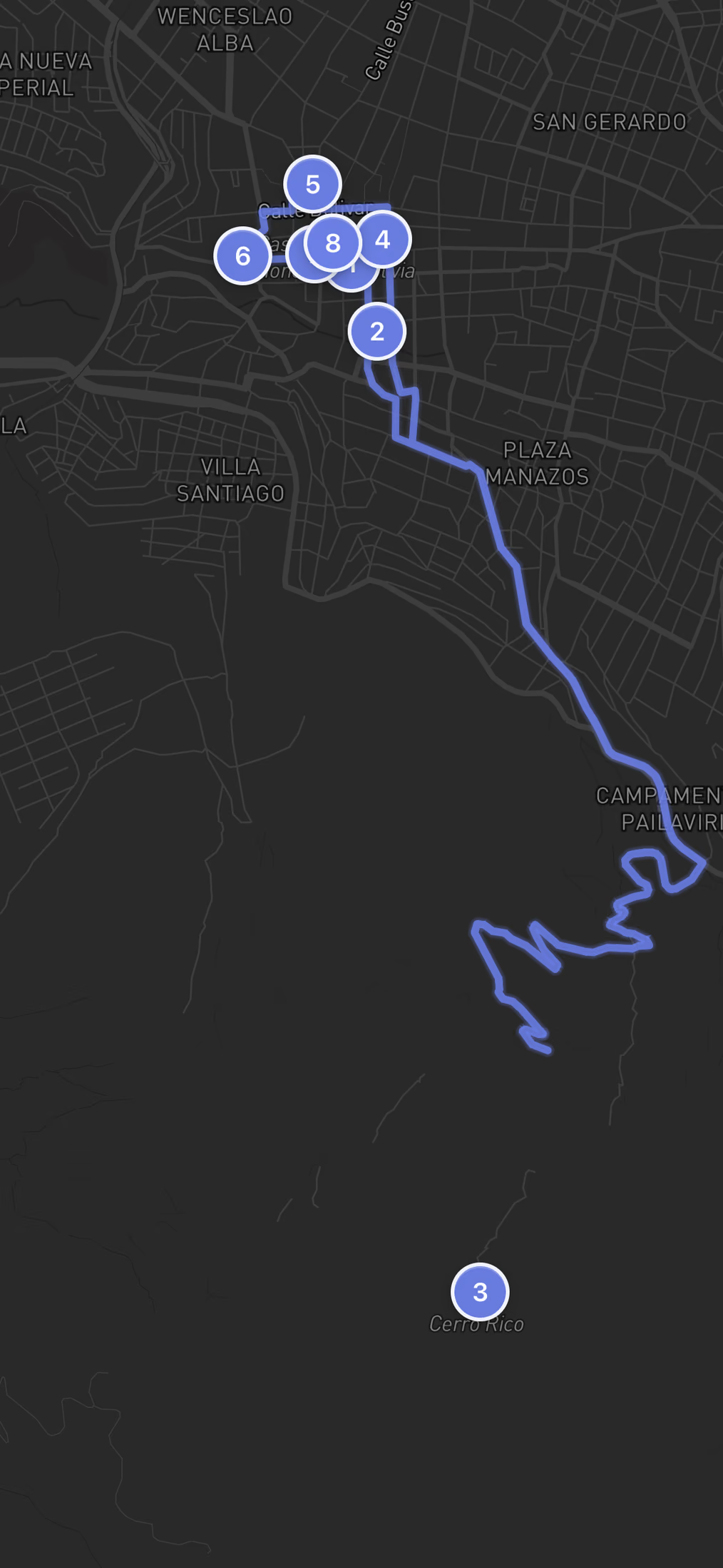
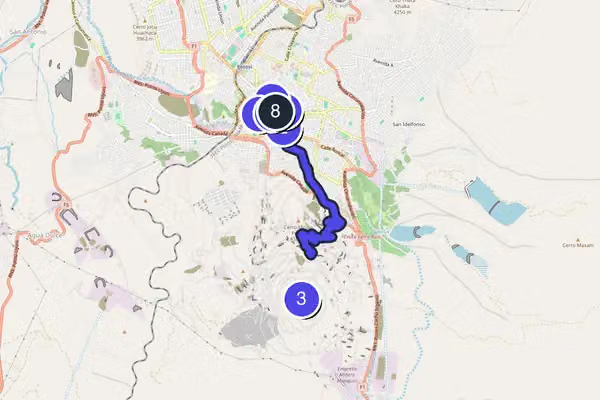
A compact loop through the highest silver city on earth, starting in the Plaza 10 de Noviembre and finishing inside the Royal Mint. Eight stops, roughly 11 km if you walk out to Cerro Rico itself. This page gives you the map, each leg's walking time, current ticket prices and hours, plus shorter versions that skip the long climb.
8 Stops10.9 km~4 hours walking4–5 hours with stops
What you get with AI Tourguide
Full GPS navigationInteractive AI guidePersonalized to youWorks in your browser
Try this tour with Alex

Potosí Walking Tour at a Glance

This route is built for the altitude, not against it. It's designed for travellers who want the colonial core, the postcard view of Cerro Rico, and the full silver story in one logical loop, without pointless climbing. Every interior is optional: the plaza, the mountain silhouette and the carved San Lorenzo portal cost nothing, and you decide which museums are worth a ticket. Self-guided means you set the pace, which up here matters more than anywhere.

StartPlaza 10 de Noviembre
FinishNational Mint of Bolivia (Casa de la Moneda de Bolivia)
Route typeAn out-and-back to Cerro Rico bolted onto a tight colonial loop: from the plaza you head south to the mountain, return north, then circle a compact cluster of churches and towers within a few blocks of where you started.
Realistic timeTwo to three hours of actual walking if you trek out to Cerro Rico and back, or well under an hour on foot if you view the mountain from the rooftop and stay in the core. Add interiors and you reach four to five hours.
DifficultyModerate, and the altitude is the real challenge, not the distance. You're above 4,000 metres on steep cobblestone streets, and the pull up to San Francisco is the steepest of the day. Two flights of stairs feel like ten up here, so pace slowly.
Cost to followThe outdoor route is free to walk. Paid interiors, all in bolivianos: San Francisco Bs 20, the cathedral Bs 20, San Lorenzo museum around Bs 40 for foreigners, Santa Teresa Bs 15, the Torre Bs 10, and the Casa Nacional de Moneda Bs 70 for foreigners.
Best for:

Travellers acclimatised enough to walk a hilly colonial centre slowly, who care about mining history, baroque architecture and framed mountain views rather than ticking off a fast checklist.

The Route

Free Walking Tour Map of Potosí

8 stops10.9 kmabout 4 hours
Loading the interactive map…The complete walking route will appear here.
Want the route to guide you while you walk?Open the route with navigation and a personal guide for the history, stories and questions that matter to you.
Open route + AI guide

The 8 stops along this route

  1. Plaza 10 de Noviembre in Potosí, stop 1 on the self-guided walking tour
    1Plaza 10 de Noviembre
  2. iglesia-y-convento-de-san-francisco (Iglesia – Convento de San Francisco) in Potosí, stop 2 on the self-guided walking tour
    2iglesia-y-convento-de-san-francisco (Iglesia – Convento de San Francisco)
  3. Cerro Rico in Potosí, stop 3 on the self-guided walking tour
    3Cerro Rico
  4. Cathedral Basilica of Our Lady of Peace, Potosí (Catedral Santiago Apostol de la ciudad de Potosí) in Potosí, stop 4 on the self-guided walking tour
    4Cathedral Basilica of Our Lady of Peace, Potosí (Catedral Santiago Apostol de la ciudad de Potosí)
  5. San Lorenzo Church, Potosí (Iglesia de San Lorenzo de Carangas) in Potosí, stop 5 on the self-guided walking tour
    5San Lorenzo Church, Potosí (Iglesia de San Lorenzo de Carangas)
  6. museo-y-convento-de-santa-teresa (Iglesia – Convento y Museo de Santa Teresa) in Potosí, stop 6 on the self-guided walking tour
    6museo-y-convento-de-santa-teresa (Iglesia – Convento y Museo de Santa Teresa)
  7. torre-de-la-compania-de-jesus (Torre de la Compañía) in Potosí, stop 7 on the self-guided walking tour
    7torre-de-la-compania-de-jesus (Torre de la Compañía)
  8. National Mint of Bolivia (Casa de la Moneda de Bolivia) in Potosí, stop 8 on the self-guided walking tour
    8National Mint of Bolivia (Casa de la Moneda de Bolivia)
  9. That's the complete route.

    If you want more than the map and text, add live navigation and a conversational AI guide while you walk.

    Open route + AI guide
    You made it
Stop 1 of 8
Swipe →

Your Potosí Walking Tour, Stop by Stop

  1. 1

    Plaza 10 de Noviembre

    Plaza 10 de Noviembre in Potosí, stop 1 on the self-guided walking tour

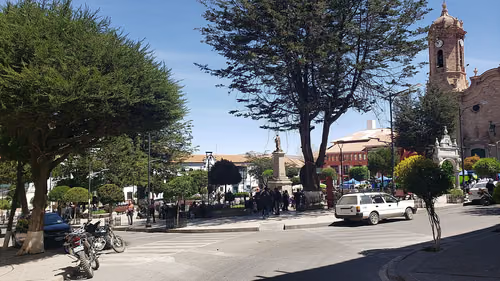
    Start where the city has always gathered. The Plaza 10 de Noviembre is the flat, tree-lined square at the centre of the colonial grid, and after the thin air of the surrounding streets it feels like a place to actually catch your breath. The cathedral closes off one side, government buildings ring the rest, and locals sit on the benches all day. It is free and open around the clock, which makes it the obvious meeting and orienting point. Spend ten minutes here doing nothing but adjusting to the altitude and reading the rooflines. You will pass back through this square more than once on the loop, so fix it in your memory. When you are ready, head south and slightly uphill toward the twin bell towers a couple of blocks away. That is San Francisco, and it is your first real climb.

    Hours
    Open 24/7
    Price
    Free
  2. 2

    iglesia-y-convento-de-san-francisco (Iglesia – Convento de San Francisco)

    iglesia-y-convento-de-san-francisco (Iglesia – Convento de San Francisco) in Potosí, stop 2 on the self-guided walking tour

    The twin towers tell you you have arrived before you read any sign. This is the oldest monastery in Bolivia, founded in 1547, the first religious order to settle in the city. The church itself is modest by design, but the reason you climb up here is the rooftop terrace. From the roof, Cerro Rico fills the southern horizon, the single best framed view of the silver mountain you will get on foot. Entry is Bs 20, and the rooftop access is what you are paying for, so do not skip it. Give this stop 30 to 40 minutes. One catch: it is closed on Sundays, and shuts midday on weekdays from noon to 2 PM, so time it around lunch. After you come down, walk back toward the plaza and keep your eyes on that mountain to the south. The next stop is the mountain itself.

    Hours
    Mon-Fri: 8:00 AM – 12:00 PM, 2:00 – 5:30 PM | Sat: 8:00 – 11:30 AM | Sun: Closed
    Price
    Bs 20
  3. 3

    Cerro Rico

    Cerro Rico in Potosí, stop 3 on the self-guided walking tour

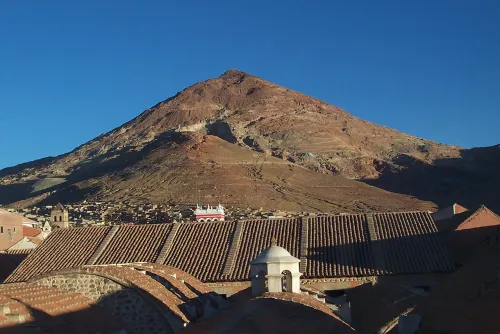
    You do not so much walk to Cerro Rico as constantly look at it. The cone rises to roughly 4,800 metres and dominates every southern view in the city. This is the reason Potosí exists. Between the 16th and 17th centuries, 80 percent of all the silver mined on the planet came out of this single mountain, enough to reshape the global money supply and fund empires. The Pailaviri mine inside it has worked continuously since 1545. The mountain is open-air and free to look at, and honestly the view from the San Francisco rooftop or the streets is the version most walkers want. Going inside is a different commitment: mine tours run with operators, depart around 8:45 AM and 1:30 PM daily, and last three to five hours in hot, tight, genuinely tough conditions. Decide in advance whether that is your trip. For the walk, bank the view and turn back north toward the cathedral on the plaza.

    Hours
    Mine tours depart ~8:45 AM & 1:30 PM daily (3-5h; cerro itself open-air daylit hours)
    Price
    Free
  4. 4

    Cathedral Basilica of Our Lady of Peace, Potosí (Catedral Santiago Apostol de la ciudad de Potosí)

    Cathedral Basilica of Our Lady of Peace, Potosí (Catedral Santiago Apostol de la ciudad de Potosí) in Potosí, stop 4 on the self-guided walking tour

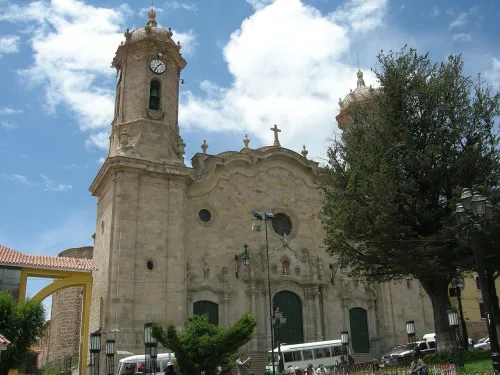
    Back at the plaza, the cathedral is the big stone facade you already noticed. It is younger than it looks. The original church here collapsed in 1807, and this neoclassical replacement was built between 1808 and 1838, designed by the Franciscan friar and architect Manuel de Sanahuja, who brought the neoclassical style to Potosí. Inside there are gold and silver religious relics, an organ donated by the tin baron Simón Patiño, and one wing that works as a museum of religious art. Entry is Bs 20. Worth 20 to 30 minutes if the museum interests you, less if you are churched out. It is closed on Sundays and shuts for lunch between noon and 2:30 PM. From the cathedral, walk a short block uphill and to the west. You are aiming for one carved stone doorway that art historians travel here to see.

    Hours
    Mon-Sat: 9:00 AM – 12:00 PM, 2:30 – 6:00 PM | Sun: Closed
    Price
    Bs 20
  5. 5

    San Lorenzo Church, Potosí (Iglesia de San Lorenzo de Carangas)

    San Lorenzo Church, Potosí (Iglesia de San Lorenzo de Carangas) in Potosí, stop 5 on the self-guided walking tour

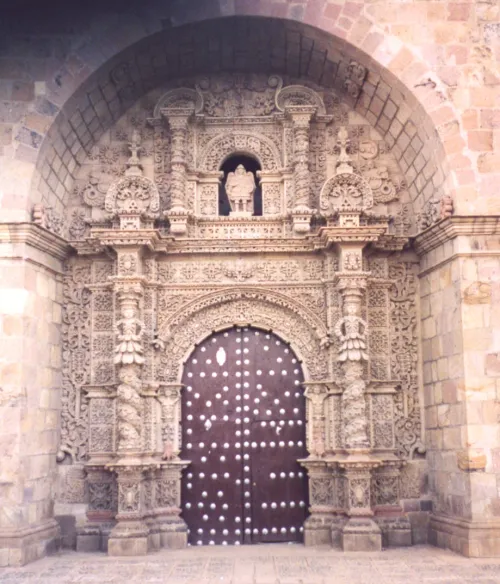
    Most people stop dead in front of San Lorenzo before they reach the door. The whole reason to come is the portal: a deeply carved stone doorway in the mestizo-baroque style, where Andean hands worked Indigenous motifs into European church design. It is one of the great pieces of colonial Andean stonework, and you can study it for free from the street. The building is a protected national monument. The interior functions as a museum, with entry around Bs 10 for Bolivians and roughly Bs 40 for foreigners, on the typical Potosí joint-ticket rate. Honestly, the facade is the headline; budget five minutes for the carving even if you skip the inside. It closes Sundays and breaks for lunch. From here, continue west and downhill a couple of blocks toward the quieter edge of the old core, where a Carmelite convent has stood since the 17th century.

    Hours
    Mon-Fri: 9:00 AM – 12:00 PM, 2:00 – 4:00 PM | Sat: 9:00 AM – 12:00 PM | Sun: Closed
    Price
    Bs 10 nationals / approx. Bs 40 foreigners (museum; typical Potosí joint-ticket rate)
  6. 6

    museo-y-convento-de-santa-teresa (Iglesia – Convento y Museo de Santa Teresa)

    museo-y-convento-de-santa-teresa (Iglesia – Convento y Museo de Santa Teresa) in Potosí, stop 6 on the self-guided walking tour

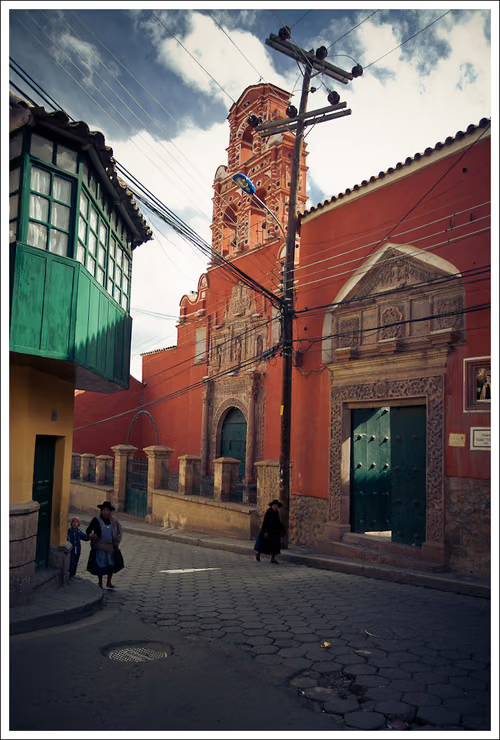
    The noise drops as you reach Santa Teresa on the western edge of the old town. This 17th-century Carmelite convent was declared a national monument in 1930, and a wall of it is now a museum of colonial religious art and cloistered life. This is the stop that surprises people. Behind the plain exterior is a collection of paintings, carvings, and the strange, vivid world of nuns who entered as girls and never left. Entry is Bs 15, and it works best as a guided visit, so give it 45 minutes to an hour. It is closed Sundays and breaks midday. After the hush of the cloister, walk back east toward the centre. You are heading for the most photographed silhouette in Potosí, a bell tower standing free against the sky near the Mint.

    Hours
    Mon-Sat: 9:00 AM – 12:30 PM, 2:30 – 6:00 PM | Sun: Closed
    Price
    Bs 15
  7. 7

    torre-de-la-compania-de-jesus (Torre de la Compañía)

    torre-de-la-compania-de-jesus (Torre de la Compañía) in Potosí, stop 7 on the self-guided walking tour

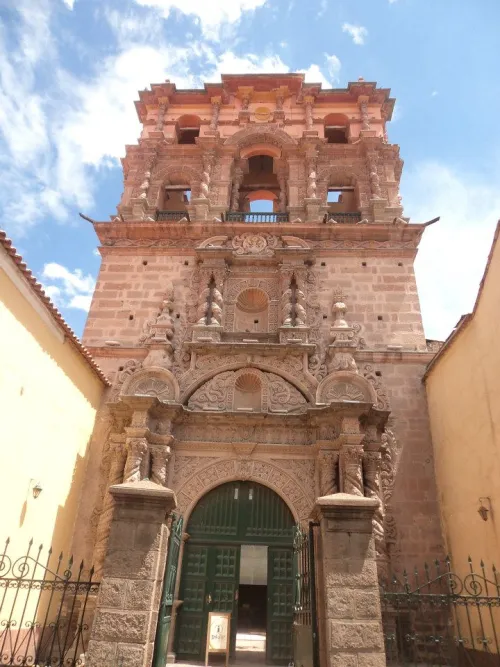
    You will recognise the Torre de la Compañía from a distance: a free-standing bell-gable built like a triumphal arch, five openings, thirty-two columns, three half-orange domes. It is the main 18th-century religious monument in Bolivia, all that really remains in prominence from the old Jesuit church near the Mint. The move here is to climb it. For Bs 10 you go up to the viewpoint and look out over the colonial roofscape with Cerro Rico behind it, the climbable counterpart to the San Francisco view from earlier. It keeps long hours, roughly 8 AM to 8 PM Monday to Saturday and 9 AM to 5 PM Sunday, so this is your reliable open option late in the day. Spend 20 minutes up top. When you come down, the last stop is right next door. Walk to the long, fortress-like building beside the tower.

    Hours
    M-Sa 08:00-20:00; Su 09:00-17:00
    Price
    Bs. 10
  8. 8

    National Mint of Bolivia (Casa de la Moneda de Bolivia)

    National Mint of Bolivia (Casa de la Moneda de Bolivia) in Potosí, stop 8 on the self-guided walking tour

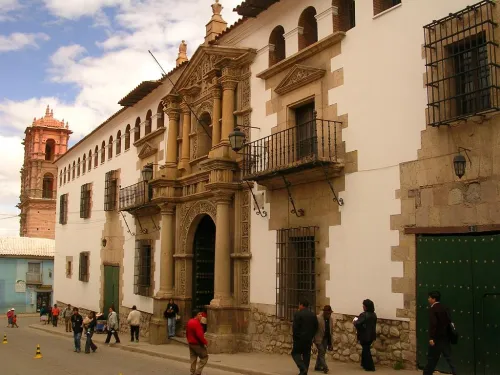
    End indoors, sitting down, with the whole story finally explained. The Casa Nacional de Moneda, the Royal Mint, is the single greatest museum in Potosí and the reason to save energy all day. The original Casa Real de Moneda was founded in 1572 by the viceroy Francisco de Toledo, and the surviving building is a vast complex of courtyards, original wooden coin presses, colonial paintings, and the laughing mask over the entrance that everyone photographs. This is where the mountain's silver became money. Entry for foreigners is Bs 70, and it is non-negotiable, the best ticket you will buy in the city. Visits are guided and run one to two hours, so leave time. It is open Monday to Friday 8:30 AM to 4:30 PM, and weekends 9 AM to 1 PM, with last entry well before closing, so do not arrive late. From here the plaza where you started is a two-minute walk back.

    Hours
    Mon-Fri: 8:30 AM – 4:30 PM | Sat-Sun: 9:00 AM – 1:00 PM
    Price
    Bs 70 (foreigners; nationals reduced)

How Long Does This Walking Tour Really Take?

Budget four to five hours for the full loop if you go inside everything, less if you skip a church or two. The two stops that genuinely need time are Santa Teresa, a 45-to-60-minute guided visit, and the Casa Nacional de Moneda, where the guided tour alone runs one to two hours. Neither should be rushed, and the altitude will slow you down regardless.

Budget four to five hours for the full loop if you go inside everything, less if you skip a church or two. The two stops that genuinely need time are Santa Teresa, which runs as a 45-to-60-minute guided visit, and the Casa Nacional de Moneda, where the guided tour alone is one to two hours. Do not rush either.

The altitude is the real clock here, not the distance. Take it slow on the climb up to San Francisco, which is the steepest pull of the day. The best place to break is the Plaza 10 de Noviembre itself: sit on a bench under the trees, let your heart rate settle, and watch the city go by before you tackle the next stretch. There are simple cafes and salteña stands around the plaza edges where you can grab a coffee or a coca tea, which locals swear by for the altitude. Take that break early and often rather than pushing through.

Full Route, Shorter Walk or Two-Day Version?

The full walk carries you out to the base of Cerro Rico and back, which is most of the 11 km. If your legs or the thin air aren't cooperating, you can cut that out-and-back entirely and still see the mountain framed from a rooftop. Three ways to run it, depending on your energy.

Core loop

Skip the long trek, keep the colonial centre

Stops 1, 2, then 4 to 8, under 2 km, 3–4 hours with interiors

Do the plaza and San Francisco, take the Cerro Rico view from the San Francisco rooftop instead of walking to it, then loop the tight cluster of churches, convents and towers around the plaza. Cuts roughly 9 km of climbing and altitude strain while keeping every genuine sight.

Two half-days

Split the walk over two mornings

Day one stops 1 to 3, day two stops 4 to 8, each a relaxed morning

On a first acclimatisation day, do the plaza, San Francisco and the walk toward Cerro Rico gently. Return the next morning fresher for the church-and-museum cluster, ending at the Casa Nacional de Moneda. The kindest option if you've just arrived at altitude.

You can run this in reverse, starting at the Casa Nacional de Moneda and ending in the plaza, but the given direction is better: it saves the heavy ticketed museums for the end so you spend your strongest hours outdoors, and it puts the steep climb to San Francisco early while your legs are fresh.

Is This Potosí Walking Tour Right for You?

This is a hilly, high-altitude walk through a compact colonial grid. Most of it is easy underfoot and short between stops once you're back in the core, but the elevation changes everything about how it feels. Here's who it suits and how to bend it.

A good fit if you…

  • History travellers who want the full silver-and-mint story told in the place it happened
  • Anyone who likes baroque and mestizo-baroque architecture, especially the carved San Lorenzo portal
  • Photographers after the framed Cerro Rico shot from the San Francisco or Torre viewpoints
  • Slow, deliberate walkers who'd rather sit on a plaza bench and acclimatise than race a checklist

Adapt the route if you…

  • You just arrived at altitude: take the two-half-days split and stop often for coca tea
  • Your legs are tired or the air is hard: skip the Cerro Rico walk and view it from the rooftop
  • It's Sunday or midday: churches close, so lead with the Mint and Torre, which keep longer hours
  • You want the mine interior: book that as a separate three-to-five-hour operator tour, not part of this walk

Tickets & Skip-the-Line in Potosí

Nothing here needs pre-booking. Potosí's museums sell tickets at the door, but hours are tight and most close on Sundays and for lunch, so timing matters more than queuing. All prices are in bolivianos (Bs), current for 2026. None of these stops publish an official booking website, so pay in cash on arrival.

iglesia-y-convento-de-san-francisco (Iglesia – Convento de San Francisco)Bs 20 at the door, and the rooftop terrace with the Cerro Rico view is what you're paying for. Open Mon-Fri 8:00 AM to 12:00 PM and 2:00 to 5:30 PM, Sat 8:00 to 11:30 AM, closed Sundays. Go before or after the midday break.
Cathedral Basilica of Our Lady of Peace, Potosí (Catedral Santiago Apostol de la ciudad de Potosí)Bs 20 for the museum wing of religious art. Open Mon-Sat 9:00 AM to 12:00 PM and 2:30 to 6:00 PM, closed Sundays. It shuts for lunch, so aim for mid-morning or late afternoon.
San Lorenzo Church, Potosí (Iglesia de San Lorenzo de Carangas)The famous carved portal is free to study from the street. The interior museum runs about Bs 10 for Bolivians and roughly Bs 40 for foreigners on the typical Potosí joint-ticket rate. Open Mon-Fri 9:00 AM to 12:00 PM and 2:00 to 4:00 PM, Sat 9:00 AM to 12:00 PM, closed Sundays.
museo-y-convento-de-santa-teresa (Iglesia – Convento y Museo de Santa Teresa)Bs 15, best done as a 45-to-60-minute guided visit of the Carmelite convent and its colonial art. Open Mon-Sat 9:00 AM to 12:30 PM and 2:30 to 6:00 PM, closed Sundays.
torre-de-la-compania-de-jesus (Torre de la Compañía)Bs 10 to climb to the viewpoint over the colonial roofscape with Cerro Rico behind it. The most reliable late-day option, open roughly 8:00 AM to 8:00 PM Mon-Sat and 9:00 AM to 5:00 PM Sunday.
National Mint of Bolivia (Casa de la Moneda de Bolivia)Bs 70 for foreigners, reduced for nationals, and the single best ticket in the city. Visits are guided and run one to two hours, so arrive early: open Mon-Fri 8:30 AM to 4:30 PM and Sat-Sun 9:00 AM to 1:00 PM, with last entry well before closing.
Everything elseThe Plaza 10 de Noviembre and Cerro Rico itself are free, open outdoor spaces with no ticket. You can view the silver mountain from the San Francisco rooftop or the streets for nothing; going inside the mine is a separate operator tour, not part of this walk.
Optional upgrade
+4
The same 8-stop route,
now with navigation and a guide.
Optional AI experience

You already have the route.
The AI guide brings it to life.

Standing in the Plaza 10 de Noviembre right now, or looking up at Cerro Rico from the streets? Open the AI Tourguide and it will walk this exact loop with you, talking you through each stop as you reach it. No booking, no group to wait for, just press start and go at your own altitude-friendly pace.

Livenavigation13languagesAnyquestionYourinterests
Open this route with the AI guide

Try it in your browser · No app or download required

Tips for Walking in Potosí

  • Timing: do this walk in the morning. Most churches and convents close Sundays and shut for lunch (roughly noon to 2 or 2:30 PM), so start by 9 AM, hit the indoor stops before lunch, and you will not get locked out.
  • Terrain and shoes: the colonial streets are steep cobblestone and uneven stone, and you are above 4,000 metres. Wear grippy shoes and walk slowly. Two flights of stairs will feel like ten at this altitude.
  • Restrooms: use the facilities inside the Casa Nacional de Moneda during your guided visit, the cleanest reliable option on the route. Cafes around the Plaza 10 de Noviembre are your other bet.
  • Food and drink: grab a salteña (the Bolivian baked empanada) from a stand near the plaza mid-morning, and order a coca tea, mate de coca, which locals use to ease the altitude. Both are cheap and exactly what this city runs on.
  • Photo: for the classic Cerro Rico shot, go up to the San Francisco rooftop terrace (Bs 20) and face south. Late afternoon light hits the mountain best. For the city roofscape, climb the Torre de la Compañía and shoot toward the mountain.

Why Walk This Route?

Potosí is a hard city to walk, and that is exactly why a planned route matters here. You are above 4,000 metres, higher than almost any city on earth at this size, and the silver mountain that built the place looms over every street. Two blocks uphill will leave you breathing like you ran a mile. Wandering randomly punishes you. A tight loop that hits the colonial core, banks the views, and saves the indoor heavyweights for when your legs are done is the smart way to see it.

This route is a compact loop. It starts in the main square, climbs briefly to the oldest monastery in Bolivia for the postcard view of Cerro Rico, then comes back down through the churches, convents, and towers packed into a few colonial blocks. The grand finale is the Royal Mint, the building that turned this mountain's silver into the coins that ran the Spanish empire. You end indoors, sitting down, learning the whole story in one place.

Why this beats a guidebook crawl: everything real is within a short radius of the plaza, the order minimises pointless climbing, and the heavy ticketed museums sit at the end so you spend your strongest hours outdoors. Potosí is small. The history is enormous. This walk gets you both without wrecking you on day one of altitude.

Common Questions

Is Potosí safe to walk around?

The colonial core around the Plaza 10 de Noviembre is fine to walk by day, and this whole loop stays in that compact, busy centre. Use normal city sense: keep your bag closed in crowds, do not flash valuables, and stick to lit main streets after dark. The bigger real risk here is not crime, it is the altitude, so pace yourself.

What if it rains during my Potosí tour?

Duck into the indoor stops, which is most of this route anyway. The Casa Nacional de Moneda is a one-to-two-hour guided visit entirely indoors, Santa Teresa runs nearly an hour inside, and the cathedral and San Francisco both have substantial interiors. You can easily fill a wet morning with the Mint and one convent and come back for the views another day.

What's the best time of day for this walking tour?

Start around 9 AM. The churches and convents open in the morning and close for lunch and on Sundays, so you want them done before noon. Mornings are also calmer for the altitude, and the afternoon light on Cerro Rico from the San Francisco rooftop is best if you save that view for the end of the loop.

Take this route with you

Open this exact tour with navigation and your personal AI guide.

Start GPS Navigation + AI Guide
AI Tourguide
Researched and curated by the AI Tourguide teamWe plan and quality-check every route, then research and verify the opening hours, prices, and practical tips for each stop along it.
▶ Open route with AI guideNavigation, stories and your questions