Self-Guided Walking Tour in Punta Arenas

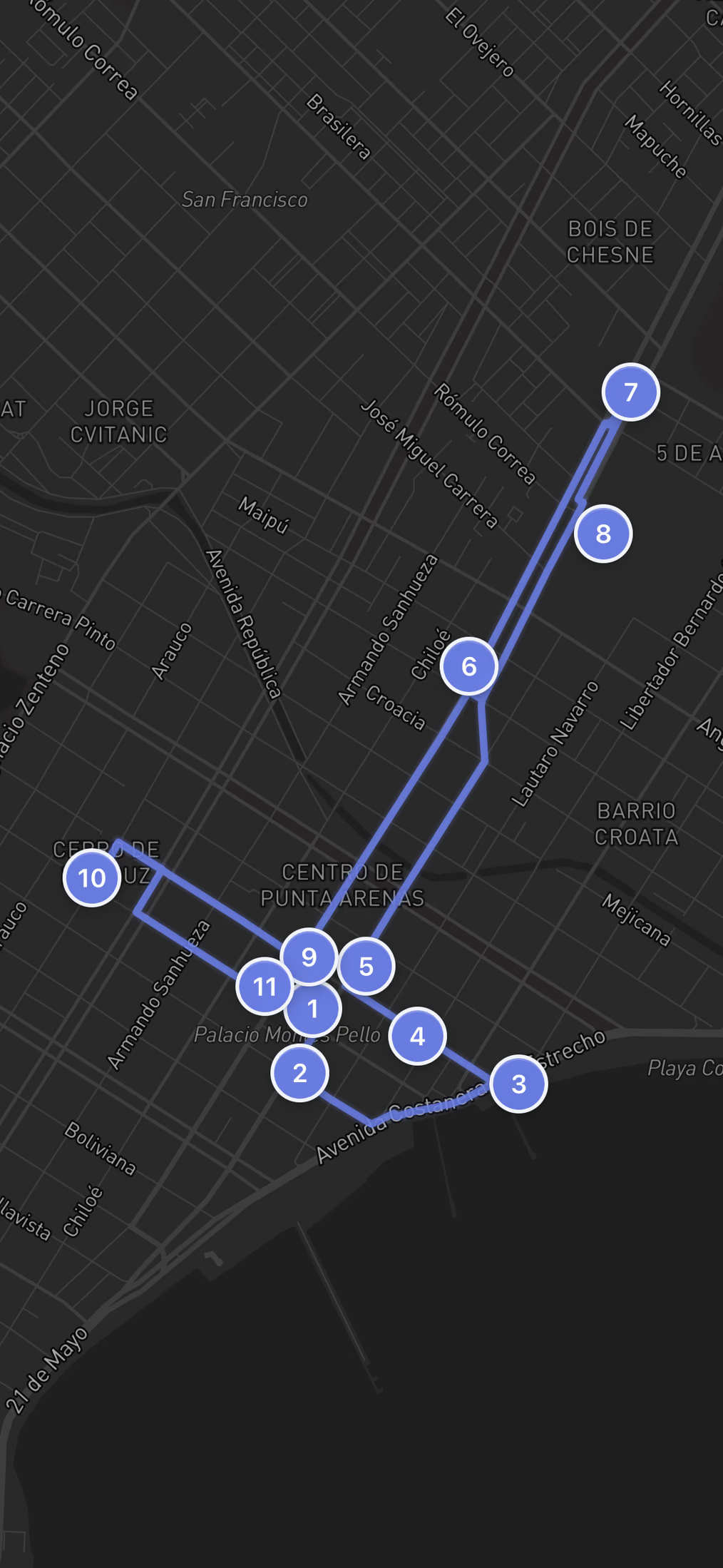
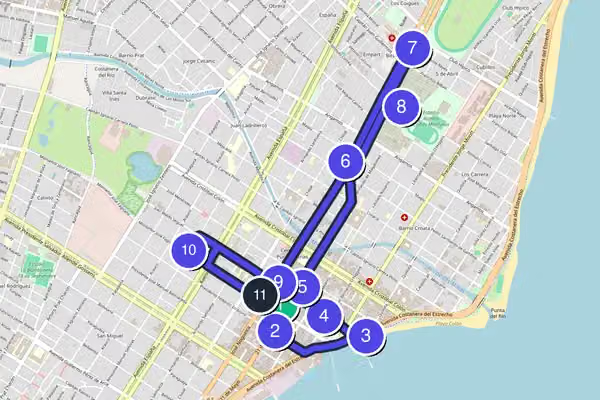
A self-guided loop through Punta Arenas: 11 stops over 6.2 km, starting and ending on Plaza Muñoz Gamero, taking in the wool-baron palaces, three free museums, the Strait of Magellan waterfront and the famous municipal cemetery. This page gives you the map, walking time for every leg, real prices and opening hours, and shorter versions.

11 Stops6.2 km~3 hours walking4–5 hours with stops
What you get with AI Tourguide
Full GPS navigationInteractive AI guidePersonalized to youWorks in your browser
Try this tour with Alex

Punta Arenas Walking Tour at a Glance

This route is built for anyone who wants the best of Punta Arenas on foot in an afternoon, without a group or a fixed departure time. It links 11 stops, and every interior on the list is optional: you can walk the whole loop for free and only pay to step inside the museums and mansions that interest you. You decide where to linger and what to skip.

StartPlaza Muñoz Gamero
FinishSacred Heart Cathedral, Punta Arenas (Catedral de Punta Arenas)
Route typeA closed loop, not a line. You start and finish on Plaza Muñoz Gamero. The walk drops east to the waterfront first, then pushes north up Avenida Bulnes to the cemetery, and comes back down through the historic core, so you never repeat the same blocks.
Realistic timeWalking the 6.2 km loop alone is roughly two hours. With the outdoor stops, the waterfront and the hilltop viewpoint, count on three. Add the museums and the cemetery and a full day runs four to five hours.
DifficultyEasy to moderate. The core around the plaza is flat, the total distance is a manageable 6.2 km, but the final climb to Cerro de la Cruz is genuinely steep and the cemetery avenues are gravel and uneven stone. The wind off the strait is constant and cold.
Cost to followThe outdoor route is free: the plaza, the waterfront, the cemetery and the viewpoint cost nothing, and two of the museums are free too. Paid interiors are the naval museum (about CLP 4.000), the Salesian museum (CLP 7.000, cash only) and the Sara Braun palace (about 1,000 pesos).
Best for:

Cruise passengers with a few hours ashore, travelers waiting on a Torres del Paine or Antarctic connection, and anyone drawn to Patagonian shipping history, wool-baron wealth and one of the world's most striking cemeteries.

The Route

Free Walking Tour Map of Punta Arenas

11 stops6.2 kmabout 3 hours
Loading the interactive map…The complete walking route will appear here.
Want the route to guide you while you walk?Open the route with navigation and a personal guide for the history, stories and questions that matter to you.
Open route + AI guide

The 11 stops along this route

  1. Plaza Muñoz Gamero in Punta Arenas, stop 1 on the self-guided walking tour
    1Plaza Muñoz Gamero
  2. Museo de la Inmigración Croata en Magallanes in Punta Arenas, stop 2 on the self-guided walking tour
    2Museo de la Inmigración Croata en Magallanes
  3. Missing required field: waypoints[2].image
    3Costanera del Estrecho de Magallanes
  4. Missing required field: waypoints[3].image
    4Museo Naval y Marítimo
  5. Regional museum of Magallanes (Museo Regional de Magallanes) in Punta Arenas, stop 5 on the self-guided walking tour
    5Regional museum of Magallanes (Museo Regional de Magallanes)
  6. Museo Salesiano Maggiorino Borgatello in Punta Arenas, stop 6 on the self-guided walking tour
    6Museo Salesiano Maggiorino Borgatello
  7. Monumento al Ovejero in Punta Arenas, stop 7 on the self-guided walking tour
    7Monumento al Ovejero
  8. Cemetery of Punta Arenas (Cementerio Municipal de Punta Arenas) in Punta Arenas, stop 8 on the self-guided walking tour
    8Cemetery of Punta Arenas (Cementerio Municipal de Punta Arenas)
  9. Palacio Sara Braun in Punta Arenas, stop 9 on the self-guided walking tour
    9Palacio Sara Braun
  10. Missing required field: waypoints[9].image
    10Cerro de la Cruz
  11. Sacred Heart Cathedral, Punta Arenas (Catedral de Punta Arenas) in Punta Arenas, stop 11 on the self-guided walking tour
    11Sacred Heart Cathedral, Punta Arenas (Catedral de Punta Arenas)
  12. That's the complete route.

    If you want more than the map and text, add live navigation and a conversational AI guide while you walk.

    Open route + AI guide
    You made it
Stop 1 of 11
Swipe →

Your Punta Arenas Walking Tour, Stop by Stop

  1. 1

    Plaza Muñoz Gamero

    Plaza Muñoz Gamero in Punta Arenas, stop 1 on the self-guided walking tour

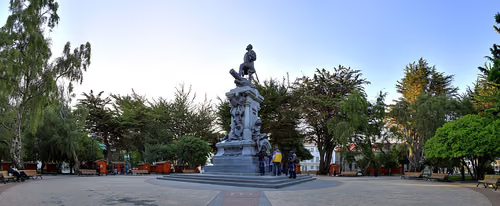
    Start in the middle of everything. This is the central square, also called the Plaza de Armas, ringed by tall Monterey cypress and the mansions the wool money built. At the center stands the bronze Magellan monument, unveiled in 1920, with the navigator up top and figures of the native Patagonian peoples below. There is a well-worn local tradition: kiss or touch the foot of the Tehuelche figure at the base and you are supposed to return to Punta Arenas one day. The toe is rubbed shiny from a century of believers. The plaza was declared a protected heritage zone in 1991, and you will notice the surrounding streets are lined with shops, cafes and restaurants, so it doubles as your supply base. Sit on a bench, get your bearings, and notice that almost every stop on this walk is visible or a short stroll from where you are standing. From here, walk one short block south toward the harbor side to reach the Croatian museum.

    Hours
    Open 24/7
    Price
    Free
  2. 2

    Museo de la Inmigración Croata en Magallanes

    Museo de la Inmigración Croata en Magallanes in Punta Arenas, stop 2 on the self-guided walking tour

    Right off the plaza, inside the Club Croata building, sits a small museum most visitors walk straight past. They shouldn't. A huge share of Punta Arenas families trace back to Croatia, mostly to the Dalmatian coast and the island of Brač, people who came south chasing sheep, gold and shipping work in the late 1800s. This private museum is dedicated to that whole story, and the best part is the price: it is free to the public. Give it fifteen or twenty minutes. It is not large, but it explains why you keep seeing surnames like Marić, Bonacić and Kusanović on shopfronts and street signs all over town, a detail that makes the rest of the city click into place. It pairs naturally with the wool-baron palaces you will see later, the other half of who built this place. When you are done, head one block downhill toward the water, along the streets dropping east, until you hit the shoreline promenade on the strait.

    Hours
    Open 24/7
    Price
    Free
  3. 3

    Costanera del Estrecho de Magallanes

    Missing required field: waypoints[2].image

    Here is the thing you actually came to the end of the world to feel. This is the waterfront promenade running along the Strait of Magellan itself, the passage Ferdinand Magellan sailed through in 1520 and the reason this whole city is here. Stand at the railing and that grey-blue water in front of you is the famous strait, with Tierra del Fuego somewhere across it. The wind is honest here, no buildings to block it, so zip up. There is no ticket and no closing time, just open shoreline, often with a few fishing boats and, if you are lucky, dolphins or a distant ship working the channel. It is the natural spot to walk before you climb up into town, which is exactly why we hit it now rather than at the end. Give it ten minutes to take photos and let the scale of the place register. Then turn back inland and walk a couple of blocks up toward the naval museum, set just back from the shore.

  4. 4

    Museo Naval y Marítimo

    Missing required field: waypoints[3].image

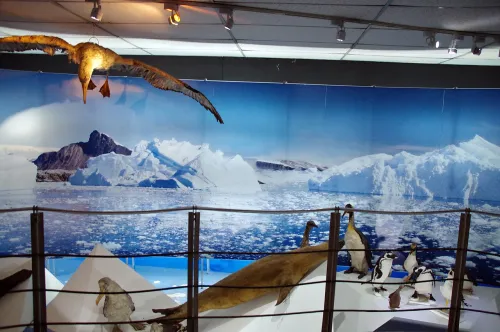
    A couple of blocks back from the water, the naval and maritime museum makes total sense right after you have stood on the strait. This is a navy-run museum about exactly what you just looked at: Magellan's voyage, the brutal art of rounding Cape Horn, the rescue of Ernest Shackleton's crew, and Chile's long history in Antarctic waters. There are ship models, instruments, and a recreated bridge you can stand on. Worth knowing before you go: it is closed Sunday and Monday, open Tuesday and Thursday through Saturday 10:00 to 16:00, and Wednesday 9:00 to 17:00. Entry is about CLP 4.000 for adults, CLP 1.000 for students and kids, so call it four US dollars. If you only do one paid museum and you are into ships and exploration, this is a strong pick over the bigger Salesian museum further north. Budget forty minutes. From the entrance, head back uphill toward the plaza and turn onto Calle Magallanes to reach the regional museum, one block off the square.

  5. 5

    Regional museum of Magallanes (Museo Regional de Magallanes)

    Regional museum of Magallanes (Museo Regional de Magallanes) in Punta Arenas, stop 5 on the self-guided walking tour

    One block off the plaza you reach the Braun-Menéndez palace, and this is where the wool money stops being an abstraction. Mauricio Braun, one of the richest men in Patagonia, built this 19th-century mansion, and the regional museum has kept the interiors more or less as they were: the gilded salons, the imported French furniture, the Chinese vases, the marble. You walk through the actual rooms a sheep-and-shipping dynasty lived in. The collection runs to around 1,800 objects tracing Magallanes from the 16th-century European arrival to the early 20th century. The building was declared a national monument in 1974. Best part: it is free, run by the national heritage service. Open Tuesday to Saturday, 10:00 to 12:30 and 15:00 to 17:30, so it shuts over the midday break like a lot of things here. Plan around that. Give it forty-five minutes. From the door, walk north up Calle Magallanes for a few blocks toward the Salesian museum, the start of your push uphill.

    Hours
    Tu-Sa 10:00–12:30 & 15:00–17:30
    Price
    Free (public museum, no entrance fee)
  6. 6

    Museo Salesiano Maggiorino Borgatello

    Museo Salesiano Maggiorino Borgatello in Punta Arenas, stop 6 on the self-guided walking tour

    A few blocks north of the plaza, the Salesian museum is the big one, and it is also the most divisive stop on this walk. Founded in 1893, it is one of the oldest museums in Chile, run by the Salesian missionary order, and it is dense: ethnography of the Selk'nam, Yaghan and other native peoples the missions encountered, plus Patagonian flora, fauna, fossils, and the regional oil and sheep industry. Some of it is genuinely moving, some of the old taxidermy and mission framing feels dated. It is the only stop here with a real price tag: CLP 7.000 for foreign adults, less for Chileans, seniors and students, free for children under 12, and it is cash only, so bring pesos. Closed Sunday and Monday; open Tuesday to Saturday 10:00 to 12:30 and 14:00 to 17:30. If you are short on time or already did the regional museum, you can skip it without guilt. If you have an hour and want the deepest single collection in the city, stay. From here keep heading north up Avenida Bulnes toward the shepherd monument.

    Hours
    Mon: Closed | Tue-Sat: 10:00 AM – 12:30 PM, 2:00 – 5:30 PM | Sun: Closed
    Price
    CLP 7.000 (adult general; nationals CLP 6.000; senior 60+ CLP 5.000; students CLP 3.000; teens 13-17 CLP 1.000; children under 12 free, cash only)
  7. 7

    Monumento al Ovejero

    Monumento al Ovejero in Punta Arenas, stop 7 on the self-guided walking tour

    Keep walking north and the city opens up onto Avenida Bulnes, where a bronze group of twelve life-size figures stands on the central median: a shepherd leaning into the wind, reins in one hand and a whip in the other, with his horse, dogs and sheep around him. This is the Monumento al Ovejero, and it is the city's tribute to the estancia culture, the vast sheep ranches that, along with shipping, made Magallanes rich. The first granite version went up in 1944; this bronze one replaced it in 1962 so it would last. Be honest with yourself about this stop: it is a monument on a traffic median, free and always open, and there is not much to do beyond a few photos and a moment to picture the open pampa it represents. Five minutes, tops. But it sits perfectly on your route, the northern turnaround of the loop, right before the stop most people actually come to this neighborhood for. Cross over and continue a short way to the cemetery gates, just east.

    Hours
    Open 24/7
    Price
    Free
  8. 8

    Cemetery of Punta Arenas (Cementerio Municipal de Punta Arenas)

    Cemetery of Punta Arenas (Cementerio Municipal de Punta Arenas) in Punta Arenas, stop 8 on the self-guided walking tour

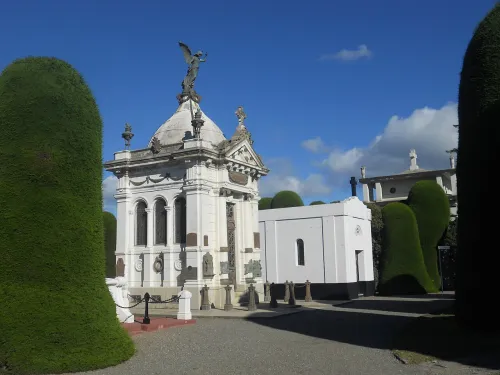
    This is the one. Officially the Cementerio Municipal Sara Braun, this four-hectare cemetery on Avenida Bulnes has landed on international lists of the ten most beautiful cemeteries in the world, and once you are inside you understand why. You enter through a grand portico donated by Sara Braun herself, and it opens onto avenues of cypress trimmed into tall green walls, dead straight, almost architectural. Walk them and you read the whole social order of the city in stone: the towering family mausoleums of the Brauns, Menéndez and Nogueiras at the front, then the immigrant sections, Croatian, British, with their own languages and symbols. There is a small shrine to the Indiecito, a folk figure locals leave offerings for. It was declared a national historic monument in 2012. Entry is free, open daily 8:00 to 19:00. Give it a full hour; it is quiet, walkable, and the most memorable place on this route. When you leave, head back south down Avenida Bulnes toward the center to reach the Sara Braun palace on the plaza.

    Hours
    Daily: 8:00 AM – 7:00 PM
    Price
    Free
  9. 9

    Palacio Sara Braun

    Palacio Sara Braun in Punta Arenas, stop 9 on the self-guided walking tour

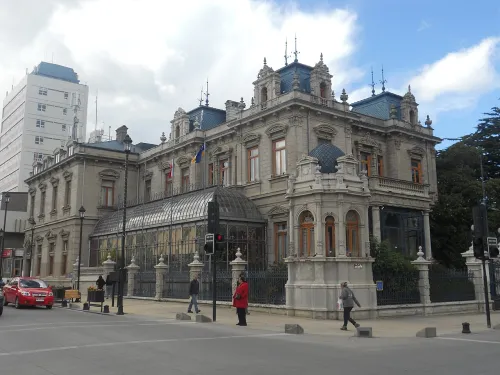
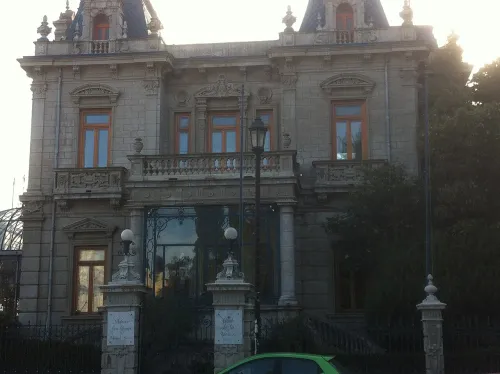
    Back at the plaza, on its northern side, stands the building everyone photographs: the Sara Braun palace. Built between 1895 and 1905 to a design by the French architect Numa Mayer, it was the home of José Nogueira and his wife Sara Braun, the family behind the Sociedad Explotadora de Tierra del Fuego, the sheep-and-land empire that ran much of the region. When Nogueira died, Sara became one of the most powerful figures in Patagonia, and this French neoclassical mansion was her statement. Today it holds a hotel and the Club de la Unión, and it was declared a historic monument in 1981. You can go inside and see the period rooms for about 1,000 pesos, a small fee well worth it to walk the salons where the city's wealth was concentrated. Open Monday to Saturday, mornings 10:00 to 12:45 and afternoons 15:30 to 19:00 except Mondays, closed Sunday. Thirty minutes inside is plenty. From the plaza's western corner, walk a few blocks uphill toward Cerro de la Cruz for the view.

    Hours
    Mon: 10:00 AM – 12:45 PM | Tue-Sat: 10:00 AM – 12:45 PM, 3:30 – 7:00 PM | Sun: Closed
    Price
    1000 pesos
  10. 10

    Cerro de la Cruz

    Missing required field: waypoints[9].image

    Now you climb. It is roughly a ten-minute uphill walk from the plaza, and the streets get steep near the top, but the payoff is the postcard everyone takes home. Cerro de la Cruz is the hillside viewpoint, the Hill of the Cross, and from the little terrace at the top you get the full panorama: the colored tin roofs of Punta Arenas stacked down the slope, the grid of streets running to the shore, and beyond it all the grey expanse of the Strait of Magellan, with Tierra del Fuego on the horizon on a clear day. It is free and open around the clock, though it is best in daylight and gets windy and exposed up here, so hold onto your hat. Spend fifteen minutes lining up the shot and just looking. This is the moment the whole geography of the place, the strait, the harbor, the city built to serve it, snaps together in one frame. From the viewpoint, walk back downhill toward the plaza and the cathedral on its western edge.

  11. 11

    Sacred Heart Cathedral, Punta Arenas (Catedral de Punta Arenas)

    Sacred Heart Cathedral, Punta Arenas (Catedral de Punta Arenas) in Punta Arenas, stop 11 on the self-guided walking tour

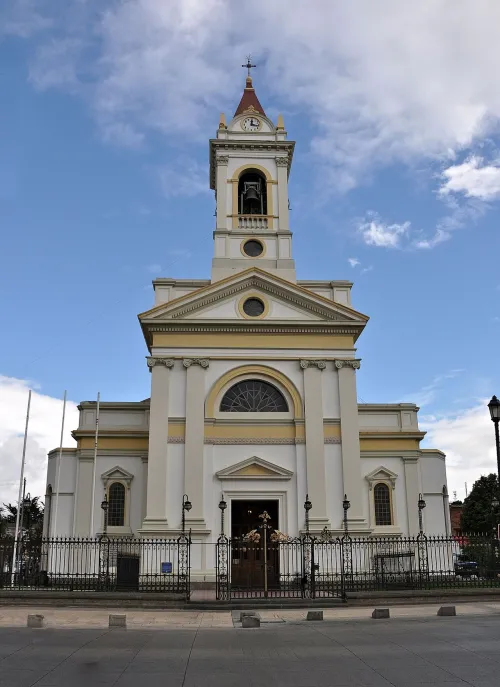
    End where you began, back at the plaza, in front of the cathedral. The Sacred Heart cathedral, the Parroquia del Sagrado Corazón de Jesús, is the main church of this southernmost diocese, an Ionic-style building with a Renaissance bell tower. Construction started on 28 December 1892 to plans drawn by the Salesian priest Juan Bernabé, which ties it neatly back to the Salesian museum you saw earlier, the same order that shaped so much of the city. Stepping inside is free, and after the wind on Cerro de la Cruz it is a calm, quiet place to finish. It is generally open around Mass times, so you have a good chance entering in the late afternoon or early evening; tower visits need advance arrangement. Give it ten minutes. Then you are back exactly where you started, on Plaza Muñoz Gamero, with the cafes and restaurants of the square right there to sit down, get a coffee or a pisco, and rest your legs.

    Hours
    Abierta diariamente alrededor de las misas (L-S 19:00; Lun-Vie también 07:30; Dom 10:00, 12:15 y 19:00)
    Price
    Free

How Long Does This Walking Tour Really Take?

Pure walking time around the 6.2 km loop is about two hours. Give the cemetery the full hour it deserves and read the panels in the two history museums, and the day stretches to four or five hours. The one mistake to avoid is rushing the cypress avenues of the cemetery.

Walking time around the 6.2 km loop is roughly two hours, but the stops are what set your day. Plan on four to five hours if you go inside the museums and give the cemetery the hour it deserves. The cemetery is the place to slow down: the cypress avenues and family mausoleums reward wandering, and rushing it is the one mistake to avoid. The two history museums, the regional Braun-Menéndez and the Salesian, each eat forty-five minutes to an hour if you read the panels.

Watch the midday gap. Several museums here close over lunch, the regional museum from 12:30 to 15:00 and the Salesian from 12:30 to 14:00, so the smart move is to do the free outdoor stops and the waterfront mid-day and save the indoor museums for when they reopen in the afternoon. For a proper break, the cafes and restaurants ringing Plaza Muñoz Gamero are right on your route at both the start and the end; grab a bench in the square under the cypress, or sit down for a coffee before the climb up Cerro de la Cruz. The plaza is the natural pause point because the loop passes through it twice.

Full Route, Shorter Walk or Two-Day Version?

The full walk is a single 6.2 km loop, but you do not have to do all of it. Here are three ways to run it depending on how much time, energy and wind tolerance you have, using the real stop numbers and per-leg distances.

Short core loop

The essentials without the long northern legs

Stops 1 to 5, then 9 and 11, about 3 km, 2–3 hours

Cuts the two longest northbound legs (stop 5 to 6 and the 1.35 km return from the cemetery) by skipping the Salesian museum, the shepherd monument and the cemetery. You keep the plaza, the Croatian and regional museums, the waterfront, the naval museum, the Sara Braun palace and the cathedral. Best when the wind is brutal or you only have a couple of hours ashore.

Two-half split

Break the loop at the regional museum

Part one stops 1 to 5; part two stops 6 to 11; split at stop 5

Split the walk in two around the midday museum closures. Do stops 1 to 5, the plaza, waterfront and core museums, in the morning, break for lunch on the square, then take the northern push, stops 6 to 11, up Avenida Bulnes to the cemetery, the palace, the viewpoint and the cathedral, in the afternoon when the indoor stops reopen.

You can walk it in reverse, cathedral first and cemetery last, but the given direction is recommended: it puts the exposed waterfront early and keeps the long northbound climb up Avenida Bulnes with the wind mostly at your back, then brings you gently downhill through the historic core to finish on Plaza Muñoz Gamero, where the cafes are.

Is This Punta Arenas Walking Tour Right for You?

This walk suits some travelers better than others. It is compact and mostly flat, but the wind, the one steep climb and the midday museum closures shape who will enjoy it and how they should adapt it.

A good fit if you…

  • History-minded travelers who want the Patagonian shipping, wool and immigration story told through real mansions, museums and graves
  • Cruise and expedition passengers with half a day ashore who want a walkable, self-paced route through the center
  • Budget travelers, since most of the loop, including the cemetery and two museums, is completely free
  • Photographers after the classic shot of colored tin roofs tumbling down toward the Strait of Magellan from Cerro de la Cruz

Adapt the route if you…

  • You have limited mobility: the plaza core is flat, but skip the steep final climb to Cerro de la Cruz and take it slow on the uneven cemetery paths
  • You only have two or three hours: use the short core loop and drop the northern stops around the cemetery
  • You are visiting on a Sunday or Monday: the naval museum is closed both days and the Salesian and regional museums close Sundays, so lean on the free outdoor stops
  • The wind is fierce: do the sheltered indoor stops and cut the exposed waterfront and hilltop, which lose their appeal in a gale

Tickets & Skip-the-Line in Punta Arenas

Punta Arenas has no timed-entry crush and no real queues, so this is less about skipping lines than about not arriving to a locked door. The key facts are opening days, the midday closures and which museums take cash only. Here is what to know before you set out.

Museo Naval y MarítimoAbout CLP 4.000 for adults (~USD 4), CLP 1.000 for students and children. Closed Monday and Sunday. Open Tuesday and Thursday to Saturday 10:00–16:00, Wednesday 9:00–17:00. Budget around 40 minutes. official ticket site ↗
Museo Salesiano Maggiorino BorgatelloCLP 7.000 for foreign adults; nationals CLP 6.000, seniors 60+ CLP 5.000, students CLP 3.000, teens 13–17 CLP 1.000, under 12 free. Cash only, so bring pesos. Closed Sunday and Monday; open Tuesday to Saturday 10:00–12:30 and 14:00–17:30.
Palacio Sara BraunAbout 1,000 pesos to walk the period rooms. Open Monday 10:00–12:45, Tuesday to Saturday 10:00–12:45 and 15:30–19:00, closed Sunday. Around 30 minutes inside is plenty.
Regional museum of Magallanes (Museo Regional de Magallanes)Free, run by the national heritage service. Open Tuesday to Saturday 10:00–12:30 and 15:00–17:30, so it shuts over the midday break. No ticket needed, just plan around the closure.
Everything elseThe plaza, the Croatian museum, the waterfront promenade, the shepherd monument, the municipal cemetery (daily 8:00–19:00), Cerro de la Cruz and the cathedral are all free open or public spaces. No tickets, no bookings.
Optional upgrade
+7
The same 11-stop route,
now with navigation and a guide.
Optional AI experience

You already have the route.
The AI guide brings it to life.

Standing by the Magellan monument on Plaza Muñoz Gamero right now? This whole loop starts at your feet. Tap to have a guide walk you through the wool-baron palaces, the cemetery and the strait as you go, free to try, so you get the story behind every mansion and mausoleum without a group or a schedule.

Livenavigation13languagesAnyquestionYourinterests
Open this route with the AI guide

Try it in your browser · No app or download required

Tips for Walking in Punta Arenas

  • Time the indoor stops around the midday closure: the regional Braun-Menéndez museum shuts 12:30 to 15:00 and the Salesian 12:30 to 14:00. Do the cemetery, waterfront and Cerro de la Cruz mid-day, save the museums for the afternoon reopening. The naval museum is closed Sunday and Monday entirely.
  • The core around the plaza is flat and easy, but the climb to Cerro de la Cruz is genuinely steep on the last stretch, and the avenues in the cemetery are gravel and uneven stone. Wear real walking shoes, not sandals. The wind off the strait is constant and cold even in summer, so bring a windproof layer regardless of the forecast.
  • There are clean public restrooms available inside the museums, and the cafes and restaurants right on Plaza Muñoz Gamero are your reliable bathroom stop both at the start and end of the loop. Use them before the long northbound stretch up Avenida Bulnes to the cemetery, where facilities are scarce.
  • Two of the paid museums, the Salesian and the regional, take cash only, and the Salesian charges CLP 7.000 for foreign adults, so carry Chilean pesos before you start. The cafes around the plaza are the place to refuel; a coffee and a sit-down before the Cerro de la Cruz climb is money well spent.
  • For the signature photo, climb Cerro de la Cruz and face east toward the water: you get the colored tin roofs of the city tumbling down toward the grey Strait of Magellan, best in clear daylight. For the Magellan monument shot, the plaza is good any time, but morning light hits the Sara Braun palace facade on the north side best.

Why Walk This Route?

Punta Arenas sits at the bottom of the world, on the Strait of Magellan, and the whole reason it exists is shipping. Before the Panama Canal opened in 1914, every vessel going between the Atlantic and Pacific had to round Cape Horn or thread this strait, and the families who controlled that traffic, the Brauns, the Nogueiras, the Menéndez clan, got staggeringly rich on wool and sea trade. That money is still standing. The center is small, flat for most of its length, and packed with French-style palaces, free museums, and one cemetery that international lists keep calling one of the most beautiful in the world. You can see the best of it on foot in an afternoon.

This route is a loop, not a line, and that matters here. The wind off the strait is constant and it can be brutal, so the walk is built to keep your back to it on the long northbound stretch up Avenida Bulnes and Avenida España toward the cemetery, then bring you back down through the historic core. You hit the waterfront early, before the climb, so you never backtrack. The plaza anchors everything: you start there and you end there, and most of the wool-baron mansions are within two blocks of it.

The full loop runs about 6.2 km. Nothing on this list is hard to find, but doing it in the right order saves you the worst of the wind and stops you from walking the same blocks twice. A few stops are genuinely worth paying for. Several of the best things in this city are completely free, including the cemetery and three of the museums. Here is exactly how to do it.

Common Questions

Is Punta Arenas safe to walk around?

Yes, the historic center on this route is calm and walkable, day and evening. It is a small, orderly city, not a place with a serious tourist-scam reputation. Use ordinary care with valuables around the plaza and the waterfront, watch your footing on the steep streets up to Cerro de la Cruz, and respect the wind, which can be strong enough near the strait to knock you off balance. The cemetery and museums are entirely safe; the main hazard here is weather, not crime.

What if it rains during my Punta Arenas tour?

Easy, because this route has real indoor options. Duck into the regional Braun-Menéndez museum or the Croatian museum, both free, or the Salesian and naval museums if you do not mind the fee. The Sara Braun palace and the cathedral are also indoor stops on the loop. Save Cerro de la Cruz and the waterfront for a break in the weather, since their whole point is the open view. The wind here often pushes rain through fast, so a downpour rarely lasts long.

What's the best time of day for this walking tour?

Start mid-morning, around 10:00, when the museums open. That lets you hit the free outdoor stops and the waterfront before the midday museum closures, then finish the indoor mansions and the cathedral in the afternoon when they reopen and when the late light is best for the Cerro de la Cruz panorama. Daylight hours run long in the southern summer and short in winter, so check sunset and finish the hilltop viewpoint while it is still light.

Take this route with you

Open this exact tour with navigation and your personal AI guide.

Start GPS Navigation + AI Guide
AI Tourguide
Researched and curated by the AI Tourguide teamWe plan and quality-check every route, then research and verify the opening hours, prices, and practical tips for each stop along it.
▶ Open route with AI guideNavigation, stories and your questions