Self-Guided Walking Tour in Quito

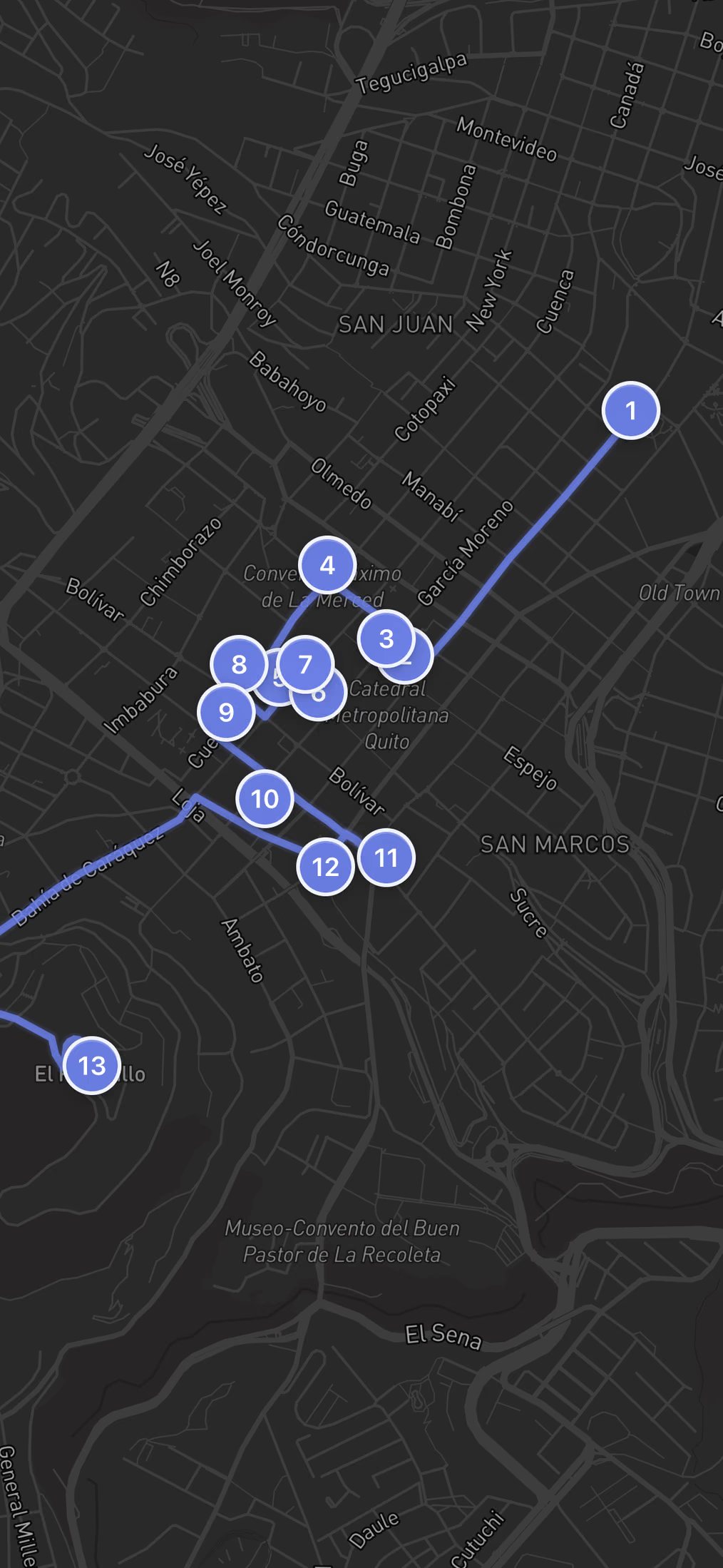
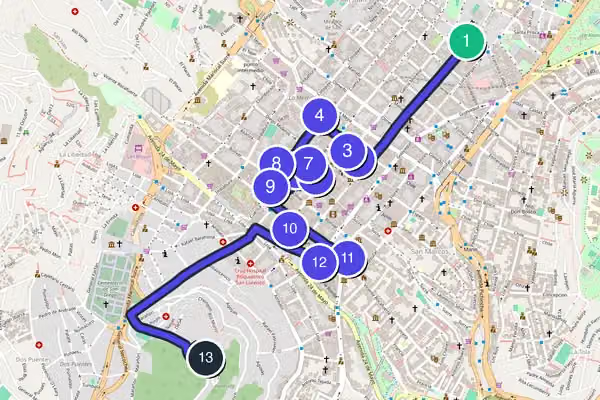
A near-straight 4.4 km line through Quito's historic center, 13 stops from the towering Basílica del Voto Nacional in the north down to the El Panecillo viewpoint in the south. This page gives you the full map, the walking time for every leg, real prices and opening hours for each church and museum, and shorter versions when the altitude wins.

13 Stops4.4 km~3 hours walking5–6 hours with stops
What you get with AI Tourguide
Full GPS navigationInteractive AI guidePersonalized to youWorks in your browser
Try this tour with Alex

Quito Walking Tour at a Glance

This route is built for anyone who wants Quito's centro histórico done properly, in order, without a group or a fixed clock. It threads the great churches, the main square, the presidential palace and three good museums into one downhill line. Every interior is optional: you can treat the whole thing as a free outdoor walk and step inside only where the ticket is worth it to you.

StartBasilica of the National Vow (Basílica del Voto Nacional)
FinishEl Panecillo
Route typeA point-to-point line running roughly north to south, starting high at the basilica and drifting mostly downhill through the center before one real climb at the very end. Almost no backtracking.
Realistic timeWalking alone is under two hours across 4.4 km, but a realistic visit with church and museum interiors runs five to six hours, a comfortable half-day at Quito's altitude.
DifficultyModerate. It is 4.4 km on uneven colonial cobblestones with steep, tilting streets, and you are doing all of it at 2,850 meters, where you tire faster than you expect. The final leg up El Panecillo is the one real hill.
Cost to followThe outdoor route, every plaza and street, costs nothing. Interiors are cheap and optional: the basilica is $2 ($4 to climb the towers), La Compañía $5, the cathedral full tour $4, San Francisco's museum $2, Casa del Alabado $6, the Museo de la Ciudad $4.
Best for:

Independent travellers who want the definitive old-town circuit with the history, the prices and the timing already worked out, and who would rather spend the guide money on church tickets and a good lunch.

The Route

Free Walking Tour Map of Quito

13 stops4.4 kmabout 3 hours
Loading the interactive map…The complete walking route will appear here.
Want the route to guide you while you walk?Open the route with navigation and a personal guide for the history, stories and questions that matter to you.
Open route + AI guide

The 13 stops along this route

  1. Basilica of the National Vow (Basílica del Voto Nacional) in Quito, stop 1 on the self-guided walking tour
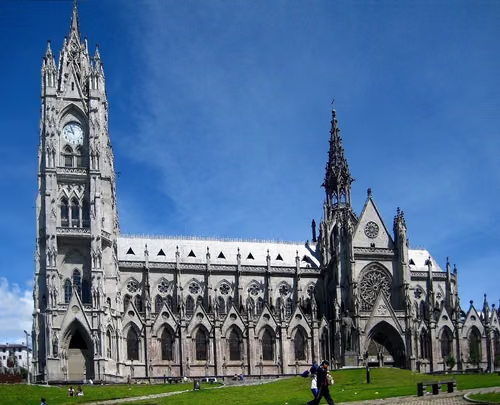
    1Basilica of the National Vow (Basílica del Voto Nacional)
  2. Monument to Independence (Monumento de la Independencia) in Quito, stop 2 on the self-guided walking tour
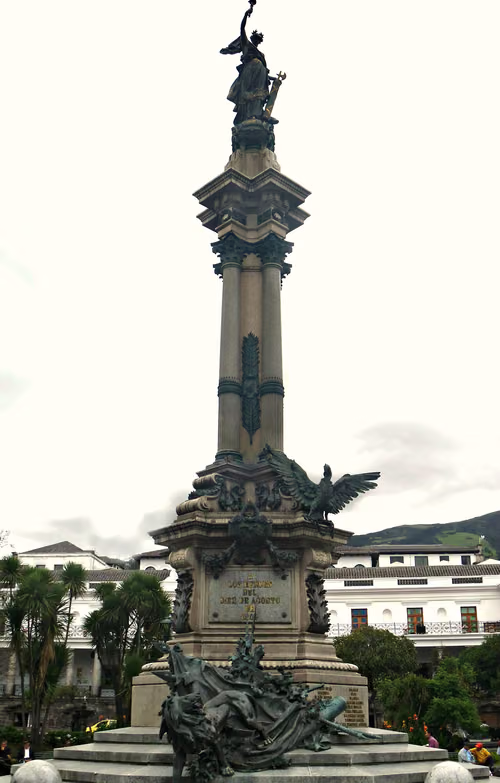
    2Monument to Independence (Monumento de la Independencia)
  3. Carondelet Palace (Palacio de Carondelet) in Quito, stop 3 on the self-guided walking tour
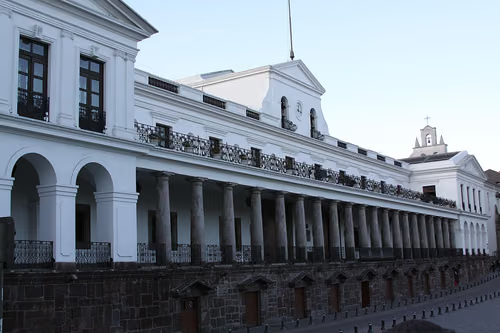
    3Carondelet Palace (Palacio de Carondelet)
  4. Basilica of La Merced (Basílica de Nuestra Señora de la Merced) in Quito, stop 4 on the self-guided walking tour
    4Basilica of La Merced (Basílica de Nuestra Señora de la Merced)
  5. Plaza de San Francisco in Quito, stop 5 on the self-guided walking tour
    5Plaza de San Francisco
  6. Church of the Society of Jesus (Iglesia de la Compañía) in Quito, stop 6 on the self-guided walking tour
    6Church of the Society of Jesus (Iglesia de la Compañía)
  7. Cathedral of Quito (Catedral Metropolitana de Quito) in Quito, stop 7 on the self-guided walking tour
    7Cathedral of Quito (Catedral Metropolitana de Quito)
  8. Church of Saint Frinci (Iglesia de San Francisco) in Quito, stop 8 on the self-guided walking tour
    8Church of Saint Frinci (Iglesia de San Francisco)
  9. Casa del Alabado Pre-Columbian Art Museum (Museo de Arte Precolombino Casa del Alabado) in Quito, stop 9 on the self-guided walking tour
    9Casa del Alabado Pre-Columbian Art Museum (Museo de Arte Precolombino Casa del Alabado)
  10. City Museum (Museo de la Ciudad) in Quito, stop 10 on the self-guided walking tour
    10City Museum (Museo de la Ciudad)
  11. Iglesia de Santo Domingo in Quito, stop 11 on the self-guided walking tour
    11Iglesia de Santo Domingo
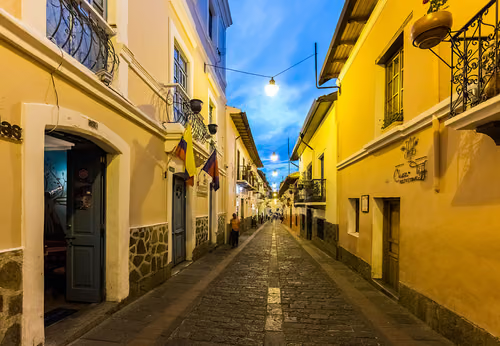
  12. La Ronda Street in Quito, stop 12 on the self-guided walking tour
    12La Ronda Street
  13. El Panecillo in Quito, stop 13 on the self-guided walking tour
    13El Panecillo
  14. That's the complete route.

    If you want more than the map and text, add live navigation and a conversational AI guide while you walk.

    Open route + AI guide
    You made it
Stop 1 of 13
Swipe →

Your Quito Walking Tour, Stop by Stop

  1. 1

    Basilica of the National Vow (Basílica del Voto Nacional)

    Basilica of the National Vow (Basílica del Voto Nacional) in Quito, stop 1 on the self-guided walking tour

    You see the spires from blocks away, two grey neo-Gothic towers that look like they were imported from medieval France and dropped onto a hill in the Andes. Construction began in 1892, and the towers reach 83 meters. Get close and look up at the gargoyles: instead of demons, the architects carved Galápagos tortoises, iguanas, and condors. That detail alone makes this worth the stop. Church entry is $2. The real reason to come is the climb, $4, which takes you up through the roofs, across a wooden plank bridge under the nave, and up steep ladders into the towers for the widest view of the old town you will get all day. There is a small cafe in the upper levels if your legs need a minute. Hours are daily 09:00 to 17:00. Do the climb first while you are fresh. From the basilica, head south down Calle Venezuela. The street tilts downhill and after about six blocks the rooftops open onto the main square.
    Hours
    Daily 09:00-17:00
    Price
    $2 for the church, $4 to climb the towers
  2. 2

    Monument to Independence (Monumento de la Independencia)

    Monument to Independence (Monumento de la Independencia) in Quito, stop 2 on the self-guided walking tour

    After the steep descent from the basilica, the street suddenly widens and you step into the Plaza Grande, the social heart of Quito. Locals on benches, shoeshine stands, pigeons, the occasional protest. At the center stands the Monumento a la Independencia, a column inaugurated in 1906 to honor the patriots who launched Ecuador's independence fight in 1809. This is the square everyone means when they say the old town. It is free, open around the clock, and it is the best place on the whole walk to just sit for ten minutes and watch the city be itself. The four sides of the plaza each hold a different power: the cathedral to the south, the presidential palace to the west, the city hall, and the archbishop's palace. You are about to visit several of them. The palace with the long white colonnade on the west side is your next stop, just steps across the plaza.

    Hours
    Open 24/7
    Price
    Free
  3. 3

    Carondelet Palace (Palacio de Carondelet)

    Carondelet Palace (Palacio de Carondelet) in Quito, stop 3 on the self-guided walking tour

    The long white colonnade on the western edge of the plaza is the seat of Ecuador's government and the official residence of the president. Soldiers in dress uniform stand at the entrance, and there is a changing of the guard ceremony on Mondays at midday that draws a crowd if you time it right. The building covers a full block, roughly 80 meters on each side. The smart move here is the free guided tour, which walks you through the state rooms and the Oswaldo Guayasamín mural inside. It is genuinely free, but you have to book ahead: email [email protected] about a day in advance. Visiting hours run Monday to Sunday 09:00 to 16:00. If you did not book, the colonnade and facade are still worth a slow look from the plaza. When you are done, leave the square heading west and slightly downhill toward a tall church tower a couple of blocks away.

    Hours
    Mo-Su 09:00-16:00
    Price
    Free (guided tours free, book 1 day ahead via [email protected])
  4. 4

    Basilica of La Merced (Basílica de Nuestra Señora de la Merced)

    Basilica of La Merced (Basílica de Nuestra Señora de la Merced) in Quito, stop 4 on the self-guided walking tour

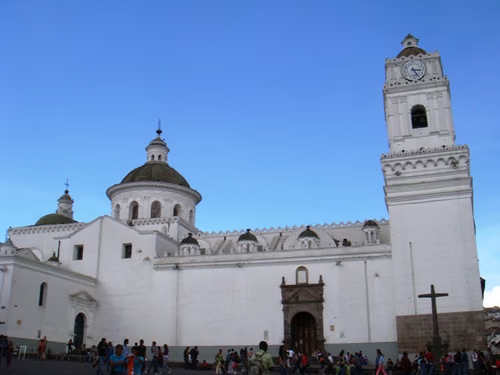
    A short detour off the main route, and worth it. La Merced is a white church with five domes and the tallest colonial tower in the old town, finished in 1736. The whole thing was consecrated in 1747. Step inside, it is free, and look up at the white-and-gold interior and the main altar carved by Bernardo de Legarda, one of the masters of the Quito School. The tower is decorated with both Inca and Arabic inscriptions, a strange and lovely mix you will not see anywhere else in the city. Church hours are Monday to Saturday 7:00 to 18:00 and Sunday 8:00 to 18:00. If you want to climb the tower for the view, a guided tour run by La Chulla Historia goes up at 10:00 for $15, which is steep for what it is unless you love a rooftop. From La Merced, walk south and downhill on Calle Mejía or Cuenca toward the largest open square in the historic center.

    Hours
    Mon-Sat: 7:00 AM – 6:00 PM | Sun: 8:00 AM – 6:00 PM
    Price
    Free (church entry); tower/cupola guided tour $15 (run by La Chulla Historia, 10:00 AM)
  5. 5

    Plaza de San Francisco

    Plaza de San Francisco in Quito, stop 5 on the self-guided walking tour

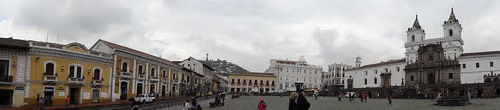
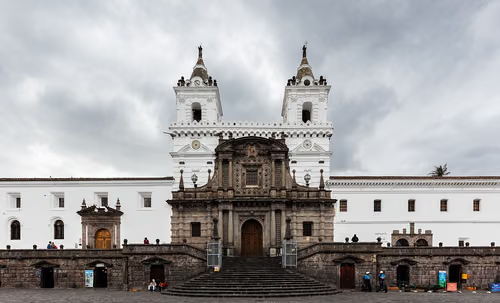
    The street empties out and the ground falls away into a vast sloping plain of cobblestones. This is the biggest square in the old town, 115 meters long and 75 wide, and it has been a gathering place since before the Spanish arrived, when its central fountain supplied the neighborhood with water for centuries. Across the far side rises the long white facade of the San Francisco church and monastery, with a famous concave-convex stone staircase sweeping up to its atrium. The plaza is wide open, free, and the angle of the cobbles plus the mountain behind makes it one of the great photo spots in Quito. Late afternoon light hits the church facade dead on. Take your time crossing it, the slope is real and the stones are uneven. Before you reach the church, there is a Baroque masterpiece one block east that you should not skip. Head that way first, toward the corner of García Moreno and Sucre.

    Hours
    Open 24/7 (public plaza)
    Price
    Free
  6. 6

    Church of the Society of Jesus (Iglesia de la Compañía)

    Church of the Society of Jesus (Iglesia de la Compañía) in Quito, stop 6 on the self-guided walking tour

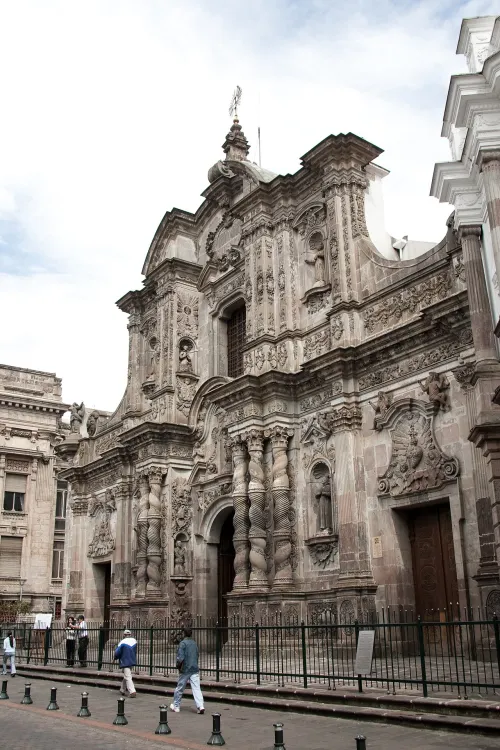
    From the outside, La Compañía is a wall of black volcanic stone carved into one of the most important Baroque facades in the Americas. Then you step through the door and the entire interior is covered in gold leaf, walls, ceilings, altars, columns, all of it gilded. People call it the most beautiful church in the Americas, and standing inside it is hard to argue. It cost the country a fortune in gold and survived a major fire, restored with help from the Getty Foundation. Entry is $5, plus $3 if you want to climb the cupola. Photos inside are restricted, so just look. Hours are Monday to Thursday 9:30 to 18:30, Friday until 17:30, Saturday until 16:00, and Sunday 12:30 to 16:00, so do not arrive on a Sunday morning expecting to get in. This is the single church most people travel to Quito to see. Spend twenty minutes here. When you leave, the cathedral is one block back toward the Plaza Grande.

    Hours
    Mon-Thu: 9:30 AM – 6:30 PM | Fri: 9:30 AM – 5:30 PM | Sat: 9:30 AM – 4:00 PM | Sun: 12:30 – 4:00 PM
    Price
    $5 for church, +$3 for cupola (Jan 2023)
  7. 7

    Cathedral of Quito (Catedral Metropolitana de Quito)

    Cathedral of Quito (Catedral Metropolitana de Quito) in Quito, stop 7 on the self-guided walking tour

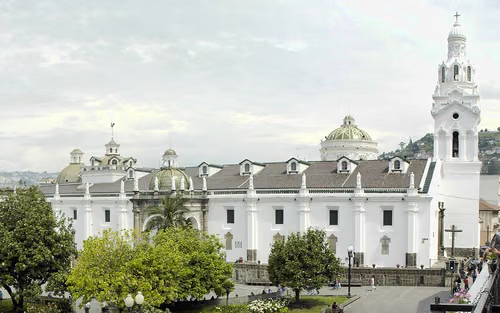
    After the blinding gold of La Compañía, the cathedral feels grounded and solemn, which is part of why it works to see them back to back. It fills the entire south side of the Plaza Grande, and that long flank with the small dome is the view of Quito that ends up on postcards, even though it is not the main entrance. This is the highest-ranking Catholic church in Ecuador, named Primada del Ecuador in 1995, and several national heroes are buried inside, including Antonio José de Sucre, the general who won Ecuador's independence. The crypt is the draw. Museum entry is $2, domes only $3, or the full tour with museum, domes, and crypt for $4. The $4 ticket is the one to get if you go in at all. Hours are Monday to Saturday 9:00 to 17:00 and Sunday 10:00 to 14:00. From here, walk back west across the foot of Plaza San Francisco to the great white facade you saw earlier.

    Hours
    Mon-Sat: 9:00 AM – 5:00 PM | Sun: 10:00 AM – 2:00 PM
    Price
    $2 museum; $3 domes only; $4 full tour (museum + domes; crypt included in tour) — per adult
  8. 8

    Church of Saint Frinci (Iglesia de San Francisco)

    Church of Saint Frinci (Iglesia de San Francisco) in Quito, stop 8 on the self-guided walking tour

    Now you climb that concave-convex staircase and reach the facade you have been looking at across the plaza. This is the oldest and largest colonial religious complex in the Americas, three and a half hectares of cloisters, churches, and courtyards, built over more than 150 years. They call it the Escorial of the New World. The church itself is free to enter, and the gilded interior is the place where the Quito School of art was actually born, with more than 3,500 colonial works inside. If you want to go deeper, the Museo Franciscano costs $2 for adults, $1 for students, and is free for seniors. Church hours are Monday to Saturday 7:00 to 12:00 and 15:00 to 17:30, and Sunday mornings 7:00 to 12:00, so it closes for a long lunch. After the scale and silence of San Francisco, the next stop is a small museum tucked just off the plaza's southwest corner, a complete change of pace.

    Hours
    Mon-Sat: 7:00 AM – 12:00 PM, 3:00 – 5:30 PM | Sun: 7:00 AM – 12:00 PM
    Price
    Free (church); Museo Franciscano $2 adults / $1 students / $0.50 children / free seniors
  9. 9

    Casa del Alabado Pre-Columbian Art Museum (Museo de Arte Precolombino Casa del Alabado)

    Casa del Alabado Pre-Columbian Art Museum (Museo de Arte Precolombino Casa del Alabado) in Quito, stop 9 on the self-guided walking tour

    Beside the plaza sits a restored colonial house, white walls and quiet courtyards, holding one of the best small museums in the city. Casa del Alabado is dedicated to pre-Columbian art, the work made on this land long before the Spanish or even the Inca. What sets it apart is the curation: objects are arranged by beauty and meaning rather than dry chronology, across 14 permanent rooms built around the idea of the human connection to nature and the apus, the mountain spirits. It is small enough to do properly in 45 minutes and a welcome break from churches. Entry is $6 for adults, $3 for students and seniors, free for children under 8, and bring cash because cards are not accepted. The last Wednesday of the month is free with a reservation. Hours are Wednesday to Sunday 09:00 to 17:00, so it is shut Monday and Tuesday. There is a small cafe inside if you need a sit-down. Leaving the museum, head south on García Moreno, the street now sloping gently downhill.

    Hours
    We-Su 09:00-17:00
    Price
    $6 adults / $3 students & seniors / free children under 8 (cash only; free last Wed of month by reservation)
  10. 10

    City Museum (Museo de la Ciudad)

    City Museum (Museo de la Ciudad) in Quito, stop 10 on the self-guided walking tour

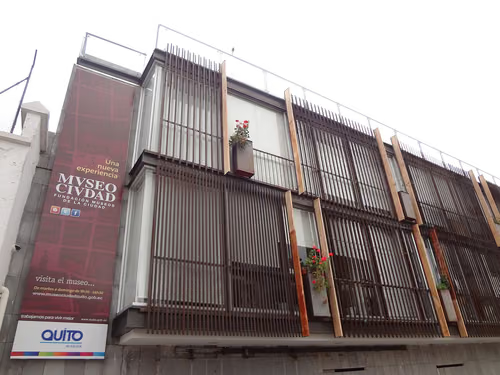
    Continuing south down García Moreno, you reach a long low colonial building that was the San Juan de Dios hospital, founded in 1565 and the oldest civil building in the city. Today it holds the Museo de la Ciudad, and this is the one museum on the walk that tells you how regular people actually lived. Two floors wrap around two quiet courtyards, with re-enacted scenes: a 16th-century hearth, a battle against the Spanish, the building of San Francisco. It is social history rather than gold and saints, and it lands better after a morning of churches. Entry is $4. Watch the hours, this place is closed Monday and Tuesday, open Wednesday and Sunday 09:30 to 16:30, Thursday and Friday until 18:00, and Saturday 11:00 to 18:00. Give it 45 minutes. From the museum, García Moreno continues downhill and curves toward a large plaza marking the southern edge of the colonial core.

    Hours
    Mo-Tu off; We,Su 09:30-16:30; Th-Fr 09:30-18:00; Sa 11:00-18:00
    Price
    $4 (Jan 2023)
  11. 11

    Iglesia de Santo Domingo

    Iglesia de Santo Domingo in Quito, stop 11 on the self-guided walking tour

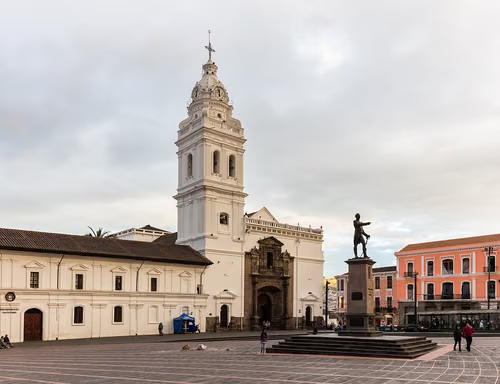
    The streets open into Plaza Santo Domingo, a broad square that marks where the tight colonial grid begins to loosen. The Dominican church and convent face the plaza along Calle Flores, and the square in front is a good spot to catch your breath before the final stretch. The church is free to enter. Inside, the small Museo Fray Pedro Bedón holds colonial religious art and costs $2 for foreign adults, $1 for nationals and students. Church hours are Monday to Saturday 8:00 to 13:00 and 14:00 to 17:00, and Sunday mornings 8:00 to 13:00. The plaza itself is the bigger draw, a lived-in public space rather than a tourist set piece, and in the late afternoon it fills with street performers. The next stop is one of the most charming corners in Quito, and it is right at the edge of this square. Walk to the southwest side toward a narrow cobbled lane sloping downhill.

    Hours
    Mon-Sat: 8:00 AM – 1:00 PM, 2:00 – 5:00 PM | Sun: 8:00 AM – 1:00 PM
    Price
    Free (church); Museo Fray Pedro Bedón $2 foreign adults / $1 national & students
  12. 12

    La Ronda Street

    La Ronda Street in Quito, stop 12 on the self-guided walking tour

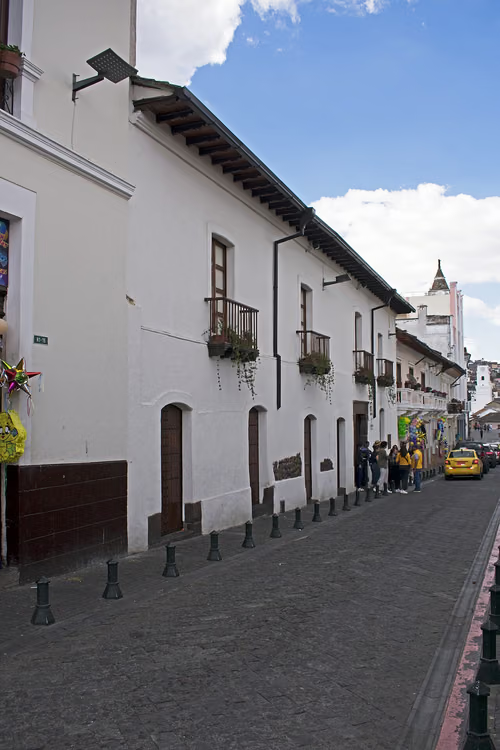
    Just off Plaza Santo Domingo, the city narrows into a single cobbled lane lined with low whitewashed houses, painted shutters, and tucked-away patios. La Ronda is the old town's most atmospheric street, restored in 2007 with the help of the residents who still live and work here. Now it is workshops, art galleries, and small cafes, all run by locals. Here is the honest timing advice, straight from the people who know it: come in the late afternoon. In the morning most shutters are closed and it feels half asleep. By 4 or 5pm the shops open, the cafes fill, and on weekends there is live music and cultural events. Order a canelazo, the hot cinnamon-and-sugarcane-spirit drink that is the local thing to warm up with at this altitude. The street is free and public, open all hours, though the shops keep their own. After La Ronda, there is one climb left, and it is the big one. The hill with the statue you have seen all day rises to the southwest.

    Hours
    Open 24/7 (public street; individual shops/galleries keep their own hours)
    Price
    Free (public street)
  13. 13

    El Panecillo

    El Panecillo in Quito, stop 13 on the self-guided walking tour

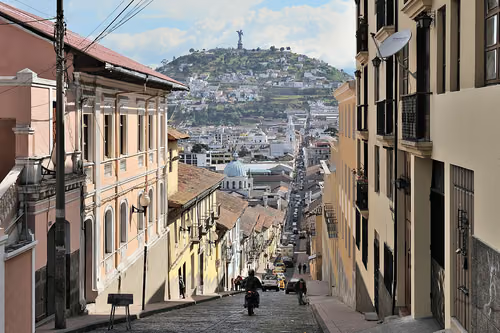
    This is the finale, and it earns the effort. El Panecillo is a natural hill rising to 3,000 meters, 200 meters above the rest of the city, crowned by a giant winged aluminium statue of the Virgin of Quito. From the top you get the definitive panorama: the whole old town laid out below, the colonial domes and red roofs, and the city stretching north and south between the mountains. It is the most visited spot in Quito for a reason. The hill and viewpoint are free and open around the clock, but here is the one piece of advice you must not ignore: the walking route up has a reputation for robberies, so do not climb it on foot. Take a taxi to the top, around $5 to $6 each way, and have it wait or arrange a pickup. Go in daylight, never after dark. The statue itself is based on a Quito School sculpture by Bernardo de Legarda, the same artist whose altar you saw back at La Merced. Stand at the railing, face north, and you can pick out every church you walked past today.

    Hours
    Open 24/7 (daylight recommended for safety)
    Price
    Free

How Long Does This Walking Tour Really Take?

Pure walking is under two hours, but the interiors are where the time goes. Give it a full half-day, five to six hours: La Compañía and the San Francisco complex deserve twenty to thirty minutes each, Casa del Alabado about 45, and the basilica tower climb eats another 30 to 40 minutes at the start.

Walking time alone is under two hours, but you will not want to rush this. Realistically, give it a full half-day, five to six hours, if you go inside the churches and museums. The single biggest time sinks are La Compañía and the San Francisco complex, each worth a proper twenty to thirty minutes inside, plus Casa del Alabado at about 45 minutes if pre-Columbian art interests you. The basilica climb at the start eats another 30 to 40 minutes on its own.

The natural place to break is the middle, around Plaza San Francisco or Plaza Santo Domingo. The Plaza Grande is the best bench in the city for people-watching with a shoeshine going beside you. For a proper sit-down with food, save it for Calle de La Ronda in the late afternoon: grab a table at one of the resident-run cafes and order a canelazo to take the edge off the cold air. Remember the altitude. At 2,850 meters you tire faster than you expect, so pace yourself, drink water, and do not be surprised if you need to stop more often than you would at home.

Full Route, Shorter Walk or Two-Day Version?

The order below runs the route as designed, north to south and downhill, so you reach El Panecillo for the best afternoon light. If you have less time or less energy for the altitude, two shorter versions cut the route at sensible points without losing the heart of the old town.

The Short Version

Old town core without the long climb

Stops 1–12, about 2.8 km, roughly 3–4 hours

Everything from the basilica down to Calle de La Ronda, cutting only the long final leg to El Panecillo (stop 13 is a 20-minute walk, and locals advise a taxi anyway). You still get all the churches, both big plazas and the museums, and you end with a canelazo on La Ronda instead of a hilltop.

Two-Day Split

Churches one day, museums the next

Day 1: stops 1–7 · Day 2: stops 8–13

Kinder on the lungs. Day one covers the basilica and the churches ringing the Plaza Grande (stops 1–7), ending at the cathedral. Day two picks up at San Francisco (stop 8) and works through Casa del Alabado, the Museo de la Ciudad, Santo Domingo, La Ronda and El Panecillo. Splits the altitude and the church-fatigue in half.

You can walk it south to north, but the given direction is the better one. Starting at the Basílica del Voto Nacional means the route runs mostly downhill through the center, saving the single real climb, El Panecillo, for a taxi at the end rather than a hard uphill slog on tired legs.

Is This Quito Walking Tour Right for You?

This is a compact, dense, downhill old-town walk at high altitude on rough cobbles. It rewards curiosity about colonial history and art far more than distance. Here is who it suits and how to bend it to your day.

A good fit if you…

  • Independent travellers who want a self-guided old town without a group or a fixed schedule
  • Anyone drawn to colonial churches, Baroque gold leaf and pre-Columbian art rather than long hikes
  • Photographers chasing plazas, church facades and the definitive city panorama from El Panecillo
  • Budget-minded visitors happy to pay a few dollars per interior instead of $20–30 for a group tour

Adapt the route if you…

  • The altitude hits hard: use the two-day split and rest on the benches of the Plaza Grande
  • You have half a day only: take the short version and stop at Calle de La Ronda
  • It is Monday or Tuesday: several museums are shut, so lean on the churches and the basilica climb
  • You are worried about safety: walk in daylight, keep valuables hidden, and take a taxi up El Panecillo

Tickets & Skip-the-Line in Quito

Quito's old town charges small, separate entry fees for the church interiors, towers and museums, and none of them need advance booking except the free presidential palace tour. Here is what each paid stop actually costs and when it opens, so you can decide on the spot which interiors are worth your time.

Basilica of the National Vow (Basílica del Voto Nacional)$2 for the church, $4 to climb the towers (the climb is the real reason to come). Open daily 09:00–17:00. Do the climb first while your legs are fresh.
Carondelet Palace (Palacio de Carondelet)Free, including the guided tour of the state rooms and the Guayasamín mural, but you must book about a day ahead by emailing [email protected]. Visiting hours Monday to Sunday 09:00–16:00; changing of the guard on Mondays at midday.
Basilica of La Merced (Basílica de Nuestra Señora de la Merced)Church entry is free (Mon to Sat 07:00–18:00, Sun 08:00–18:00). The tower and cupola guided tour, run by La Chulla Historia, goes up at 10:00 for $15, steep unless you love a rooftop view. official ticket site ↗
Church of the Society of Jesus (Iglesia de la Compañía)$5 for the church, plus $3 for the cupola. The gilded interior is the single church most people come to Quito to see. Open Mon to Thu 09:30–18:30, Fri until 17:30, Sat until 16:00, Sun 12:30–16:00, so do not arrive Sunday morning.
Cathedral of Quito (Catedral Metropolitana de Quito)$2 for the museum, $3 for the domes only, or $4 for the full tour with museum, domes and crypt, the ticket to get. Open Mon to Sat 09:00–17:00, Sun 10:00–14:00.
Church of Saint Frinci (Iglesia de San Francisco)The church is free (Mon to Sat 07:00–12:00 and 15:00–17:30, Sun 07:00–12:00, so it closes for a long lunch). The Museo Franciscano costs $2 adults, $1 students, $0.50 children, free for seniors. official ticket site ↗
Casa del Alabado Pre-Columbian Art Museum (Museo de Arte Precolombino Casa del Alabado)$6 adults, $3 students and seniors, free for children under 8. Cash only, no cards. Free on the last Wednesday of the month by reservation. Open Wed to Sun 09:00–17:00, shut Monday and Tuesday.
City Museum (Museo de la Ciudad)$4. Closed Monday and Tuesday; open Wed and Sun 09:30–16:30, Thu to Fri until 18:00, Sat 11:00–18:00. Budget about 45 minutes for the re-enacted scenes of daily life.
Iglesia de Santo DomingoThe church is free (Mon to Sat 08:00–13:00 and 14:00–17:00, Sun 08:00–13:00). The small Museo Fray Pedro Bedón inside costs $2 for foreign adults, $1 for nationals and students.
Everything elsePlaza de la Independencia, Plaza de San Francisco, Calle de La Ronda and El Panecillo are all free, open public spaces with no ticket desk. El Panecillo is best reached by taxi (around $5–6 each way) in daylight.
Optional upgrade
+9
The same 13-stop route,
now with navigation and a guide.
Optional AI experience

You already have the route.
The AI guide brings it to life.

Standing in the Plaza Grande with the cathedral on one side and the presidential palace on the other, it is easy to walk straight past the stories behind each facade. Let the AI guide ride along in your browser, talking you through each church and plaza as you reach it and answering whatever you wonder about next. It is free to start, no download, and it follows your route so you never have to bury your nose in a map on these cobbles.

Livenavigation13languagesAnyquestionYourinterests
Open this route with the AI guide

Try it in your browser · No app or download required

Tips for Walking in Quito

  • Timing: walk the route north to south in the morning so the museums are open (most shut Monday and Tuesday, La Compañía opens late on Sundays), then save Calle de La Ronda for the late afternoon when the shops and cafes actually open. Do El Panecillo last, always in daylight.
  • Terrain and shoes: this is cobblestones and real hills the whole way. The streets tilt steeply, the stones are uneven and slick when wet, and you are doing it at 2,850 meters. Wear proper walking shoes with grip, not sandals, and take the altitude seriously on day one.
  • Restrooms: the cleanest reliable stop is inside a paid museum. Casa del Alabado and the Museo de la Ciudad both have facilities, and there is a cafe in the upper levels of the Basílica del Voto Nacional. Use them when you can rather than counting on the plazas.
  • Food and drink: on Calle de La Ronda, order a canelazo, the hot sugarcane-spirit-and-cinnamon drink locals use to fight the cold, usually a couple of dollars. It is the right thing to drink at this altitude and in this part of town.
  • Photo: the classic shot of the cathedral and the old town is from the top of El Panecillo, facing north in the afternoon. For the churches themselves, the concave-convex staircase and white facade of San Francisco catch the best light from across the Plaza de San Francisco in late afternoon.

Why Walk This Route?

Quito's old town is a compact grid of narrow colonial streets, gilded churches, and stone plazas that sit at 2,850 meters above sea level. That altitude matters more than any guidebook lets on. The first day you arrive, your lungs will remind you that you are higher than most ski resorts, and the cobbled streets here run steeply up and down. This walk is built around that reality. It starts high, at the Basílica del Voto Nacional in the north, and drifts mostly downhill through the heart of the historic center before the one big climb at the very end.

The reason to follow this route rather than just wander: the old town packs nearly all its great churches, the presidential palace, the main square, and three good museums into about a square kilometer, and they line up almost in a straight line south. You can hit every important thing in roughly 4.4 kilometers of walking. Quito was one of the first two places UNESCO ever named a World Heritage Site, back in 1978, alongside Kraków, and it earned that for being the least-altered colonial core in Latin America. You are walking through 130-odd monumental buildings, founded in the 16th century on the ruins of an Inca city.

A word of honesty before you start: this is not a museum you stroll through with your guard down. The center is lively and rewarding by day and thins out fast after dark. Walk it in daylight, keep your phone in your pocket on the busier streets, and you will have one of the best walking days in South America.

Common Questions

Is Quito safe to walk around?

By day, the historic center is busy, policed, and fine to walk if you keep your phone and wallet out of sight and stay on the populated streets. After dark it empties out quickly and you should take a taxi instead of walking. The one spot to never do on foot is the climb up to El Panecillo, which has a real history of robberies. Take a $5 taxi to the top. Keep bags zipped and in front of you in crowded plazas.

What if it rains during my Quito tour?

Quito's weather flips fast, sun to downpour in minutes, so this route is built to duck indoors. String the interiors together: La Compañía, the cathedral with its crypt, the San Francisco complex, Casa del Alabado, and the Museo de la Ciudad are all roofed and close together. The basilica also has covered upper levels and a cafe. Carry a light rain jacket, since umbrellas are awkward on the narrow stairs and tower climbs.

What's the best time of day for this walking tour?

Start around 9am when the churches and museums open, which lets you do the basilica climb in cool morning light and get into La Compañía before the tour groups. Work south through the day, then hit Calle de La Ronda after 4pm when its shops and cafes come alive. Finish at El Panecillo in the afternoon for the clearest views, but get down before dusk.

Take this route with you

Open this exact tour with navigation and your personal AI guide.

Start GPS Navigation + AI Guide
AI Tourguide
Researched and curated by the AI Tourguide teamWe plan and quality-check every route, then research and verify the opening hours, prices, and practical tips for each stop along it.
▶ Open route with AI guideNavigation, stories and your questions