Self-Guided Walking Tour in Salta

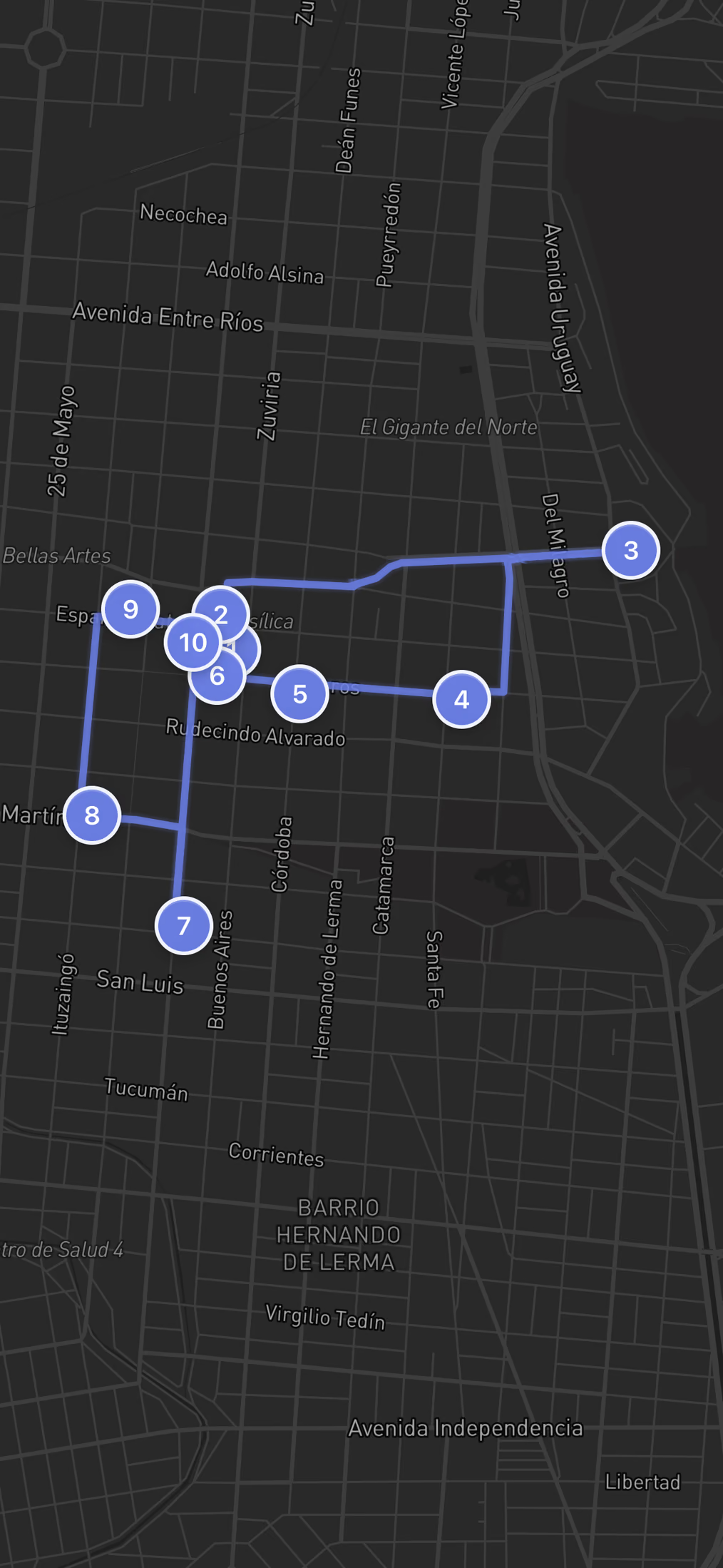
A self-guided loop through Salta's colonial old town, 10 stops over about 5.2 km, from Plaza 9 de Julio out to the Güemes monument and back through the churches, the Cabildo, the market, and the museums. This page gives you the map, per-leg walking times, real prices and hours, and shorter versions.

10 Stops5.2 km~3 hours walkingHalf a day with stops
What you get with AI Tourguide
Full GPS navigationInteractive AI guidePersonalized to youWorks in your browser
Try this tour with Alex

Salta Walking Tour at a Glance

This route is built for anyone who wants to see Salta's colonial center properly on foot, at their own pace, with every interior left optional. The old town is flat and laid out on a grid, so you can follow it in order or duck in and out as you like. Nearly every stop is free, and the two that cost money are both museums you can skip if you're only here for the streets and facades.

StartPlaza 9 de Julio
FinishMuseum of High Altitude Archaeology (Museo de Arqueología de Alta Montaña)
Route typeA compact loop around Plaza 9 de Julio with one out-and-back spur east to the Güemes monument at the foot of the hill, returning to the same square where it began.
Realistic timeAbout two and a half hours of pure walking across the 5.2 km, but realistically half a day once you factor in the churches, the Cabildo, the market, and the two museums.
DifficultyEasy and mostly flat on a smooth grid around the plaza, with one gentle uphill leg out toward the Güemes monument where the pavements get rougher; comfortable shoes are enough.
Cost to followFollowing the outdoor route is completely free. Only two stops charge admission: the Museo de Güemes at ARS 2.270 and the MAAM at ARS 16.000 for foreign visitors, ARS 8.000 for Argentines, and ARS 4.000 for Salta residents.
Best for:

Independent travelers who want colonial architecture, independence-war history, and a working market, all inside a walkable core where you genuinely cannot get lost.

The Route

Free Walking Tour Map of Salta

10 stops5.2 kmabout 3 hours
Loading the interactive map…The complete walking route will appear here.
Want the route to guide you while you walk?Open the route with navigation and a personal guide for the history, stories and questions that matter to you.
Open route + AI guide

The 10 stops along this route

  1. Plaza 9 de Julio in Salta, stop 1 on the self-guided walking tour
    1Plaza 9 de Julio
  2. Salta Cathedral (Catedral de Salta) in Salta, stop 2 on the self-guided walking tour
    2Salta Cathedral (Catedral de Salta)
  3. Güemes monument (Monumento a Güemes) in Salta, stop 3 on the self-guided walking tour
    3Güemes monument (Monumento a Güemes)
  4. Convento de San Bernardo in Salta, stop 4 on the self-guided walking tour
    4Convento de San Bernardo
  5. Basílica y Convento de San Francisco (Iglesia de San Francisco) in Salta, stop 5 on the self-guided walking tour
    5Basílica y Convento de San Francisco (Iglesia de San Francisco)
  6. History Museum of the North (Museo Histórico del Norte) in Salta, stop 6 on the self-guided walking tour
    6History Museum of the North (Museo Histórico del Norte)
  7. Iglesia Nuestra Señora de la Candelaria de la Viña (Iglesia de la Viña) in Salta, stop 7 on the self-guided walking tour
    7Iglesia Nuestra Señora de la Candelaria de la Viña (Iglesia de la Viña)
  8. Missing required field: waypoints[7].image
    8Mercado Municipal de Salta
  9. Güemes Museum (Museo Güemes) in Salta, stop 9 on the self-guided walking tour
    9Güemes Museum (Museo Güemes)
  10. Museum of High Altitude Archaeology (Museo de Arqueología de Alta Montaña) in Salta, stop 10 on the self-guided walking tour
    10Museum of High Altitude Archaeology (Museo de Arqueología de Alta Montaña)
  11. That's the complete route.

    If you want more than the map and text, add live navigation and a conversational AI guide while you walk.

    Open route + AI guide
    You made it
Stop 1 of 10
Swipe →

Your Salta Walking Tour, Stop by Stop

  1. 1

    Plaza 9 de Julio

    Plaza 9 de Julio in Salta, stop 1 on the self-guided walking tour

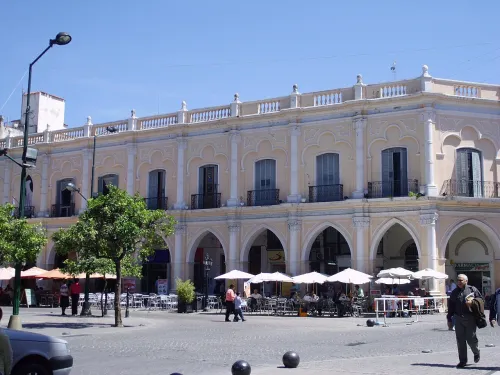
    Start under the arcades. The recova, the covered colonnade that wraps almost the entire square, is the thing locals are proudest of, and it has stayed nearly intact thanks to more than twenty heritage rulings passed mostly through the 1990s. Step into the middle and you are standing on the exact spot where the city was founded. The square is genuinely green, with over 250 trees and thousands of dwarf flowers planted in beds, so it is shady even at midday. Cafe tables fill the arcades on the cathedral side; this is where you grab a coffee and watch the city wake up. Almost every stop on this walk is visible or one block from here: the pink cathedral, the white Cabildo, the MAAM. Get your bearings now. Face the tall pink church on the north side and walk toward it; that is the cathedral, your next stop.
    Hours
    Open 24/7
    Price
    Free
  2. 2

    Salta Cathedral (Catedral de Salta)

    Salta Cathedral (Catedral de Salta) in Salta, stop 2 on the self-guided walking tour

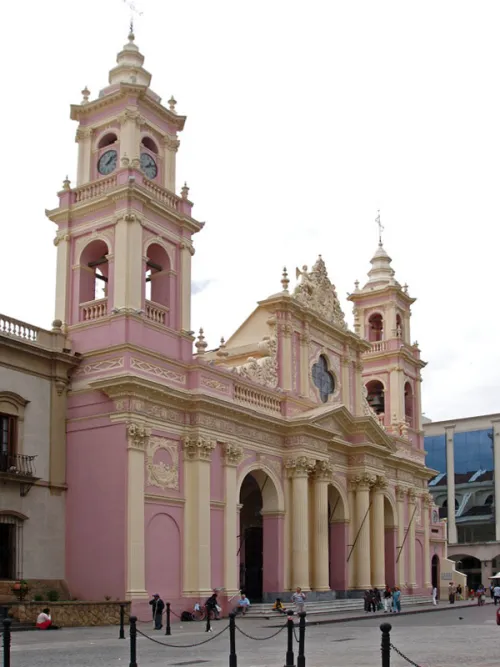
    Pink, white-trimmed, and impossible to miss, the cathedral fills the north side of the plaza. This is the second church on the site; the first was wrecked by an earthquake, and the current building dates from the second half of the 19th century. Inside it is heavily gilded and worth ten minutes even if you are not religious. It shelters the Señor y Virgen del Milagro, the images carried through the streets every September during the Milagro procession, one of the biggest religious events in northern Argentina. It was declared a National Historic Monument in 1941. Entry is free as it is an active church; just dress modestly and keep quiet if a service is on. Hours run roughly 6:30 in the morning to mid-afternoon, then again in the evening, so a closed-for-siesta door early afternoon is normal. From the cathedral steps, head east. You are walking the long straight leg toward the hill, about 15 minutes down toward Paseo Güemes.

    Hours
    Mon-Tue: 6:30 AM – 1:30 PM, 4:30 – 9:00 PM | Wed: 6:30 AM – 1:30 PM, 5:00 – 9:00 PM | Thu: 6:30 AM – 1:30 PM, 4:30 – 9:00 PM | Fri: 6:30 AM – 1:30 PM, 5:00 – 8:30 PM | Sat: 7:30 AM – 1:30 PM, 4:30 – 9:00 PM | Sun: 7:30 AM – 1:00 PM, 5:30 – 9:30 PM
    Price
    Free (active place of worship; guided "Experiencia Catedral" tours separately priced)
  3. 3

    Güemes monument (Monumento a Güemes)

    Güemes monument (Monumento a Güemes) in Salta, stop 3 on the self-guided walking tour

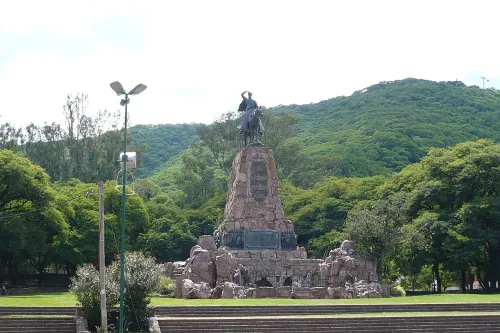
    You feel the hill before you see the monument. The streets tilt up, the trees thicken, and then a 25-meter pile of dark stone appears with a gaucho on horseback on top. This is General Martín Miguel de Güemes, the man who held the northern frontier during the wars of independence, and salteños treat him like a saint. The monument was built between 1920 and 1931 from rocks of more than 75 kg each, quarried straight out of the Cerro San Bernardo behind it. It stands at the foot of the hill where Güemes first fell from his horse, already shot, before dying days later. It is free and open all day. If you have the legs and the time, this is your jump-off for the hill: 1,070 steps lead up from near here, or the cable car climbs it in about eight minutes for around AR$20,000. Either way, turn back west now toward the center, walking down toward the convent on Caseros.

    Hours
    Open 24/7
    Price
    Free
  4. 4

    Convento de San Bernardo

    Convento de San Bernardo in Salta, stop 4 on the self-guided walking tour

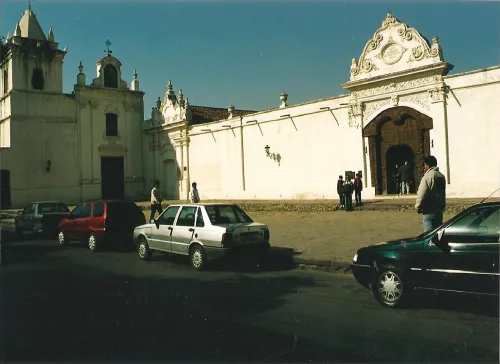
    After the open space of the monument, this stop is small and quiet, and that is the point. The white wall of the convent runs along the street, and the thing everyone comes for is the door: a carved algarrobo-wood doorway, dark and intricate, set into the plain facade. This is one of the oldest buildings in the whole city, put up at the end of the 16th or start of the 17th century, and it became a National Historic Monument in 1941. Here is the honest part: you cannot go in. It is an active cloistered Carmelite convent, a convento de clausura, so the nuns live behind that wall and the interior is closed to the public. You admire the door and the facade from the street, which takes about five minutes. There is a small shop selling rosaries and crafts the nuns make. Photograph the door, then continue west two blocks toward the ox-blood church tower you can already see, San Francisco.

    Hours
    Interior closed to public (active cloistered Carmelite convent); exterior/facade viewable anytime
    Price
    Free (exterior only; convento de clausura, small shop sells nun-made rosaries/crafts)
  5. 5

    Basílica y Convento de San Francisco (Iglesia de San Francisco)

    Basílica y Convento de San Francisco (Iglesia de San Francisco) in Salta, stop 5 on the self-guided walking tour

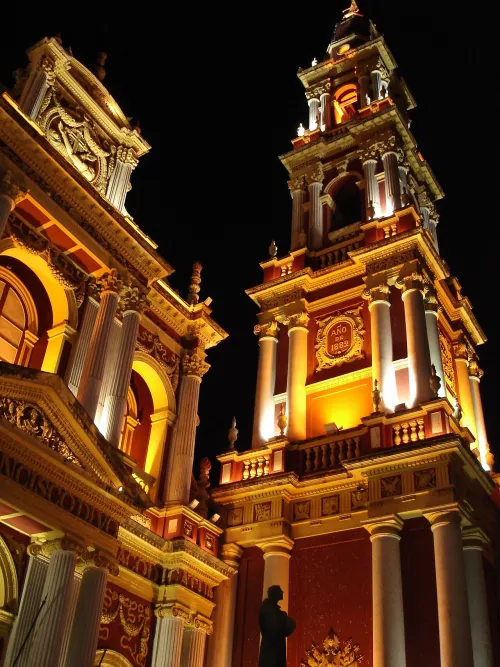
    This is the one you have seen on every postcard of Salta, and in person the color does not disappoint: deep ox-blood red walls trimmed in ochre and gold, with a tower that is one of the tallest church towers in South America. It sits at the corner of Caseros and Córdoba, just 100 meters from the main plaza. Salta is known for keeping its Spanish colonial center better than almost any city in Argentina, and this church is the proof. It was made a National Historic Monument in 1941 and a Minor Basilica in 1992. Entry is free, and guided tours run every half hour on weekdays between roughly 9:30 and 18:30, with the inside split by a long lunch break. If you happen to be here on the first or third Friday of the month, there are night tours, and the lit tower at dusk is the best photo in town. From the front door, walk the two blocks back to the plaza; the white colonnaded building on the west side is the Cabildo.

    Hours
    Mon-Fri 9:30-13:00 & 14:00-18:30 (guided tours every 30 min); night tours 1st & 3rd Fri of month
    Price
    Free
  6. 6

    History Museum of the North (Museo Histórico del Norte)

    History Museum of the North (Museo Histórico del Norte) in Salta, stop 6 on the self-guided walking tour

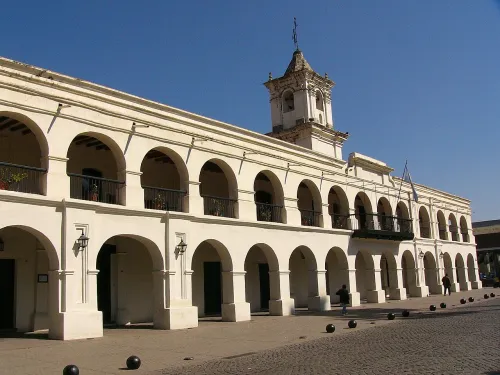
    Back on the plaza, the long white colonnaded building with two tiers of arches is the Cabildo, the old town hall from 1783. This is the best-preserved colonial cabildo in Argentina, and it is a big part of why people rank this square among the country's finest. Today it holds the Museo Histórico del Norte, which has run inside since 1949. Go in. Entry is free, and the upstairs balcony over the arches gives you the cleanest view across the plaza you will get all day. The capitulary room, with its linked timber chairs where the governor's advisors once sat, carries real weight in Argentine history, and the rest walks you from prehistoric times to the mid-20th century. One catch: it is closed Mondays, opens Tuesday to Friday 9 to 5, with shorter weekend hours, and the labels are Spanish only. Give it 30 to 45 minutes. Leaving the Cabildo, head south away from the plaza; you are walking about 12 minutes down toward La Viña church.

    Hours
    Mon: Closed | Tue-Fri: 9:00 AM – 5:00 PM | Sat: 2:00 – 6:00 PM | Sun: 10:00 AM – 2:00 PM
    Price
    Free (entrada libre y gratuita; visitas guiadas)
  7. 7

    Iglesia Nuestra Señora de la Candelaria de la Viña (Iglesia de la Viña)

    Iglesia Nuestra Señora de la Candelaria de la Viña (Iglesia de la Viña) in Salta, stop 7 on the self-guided walking tour

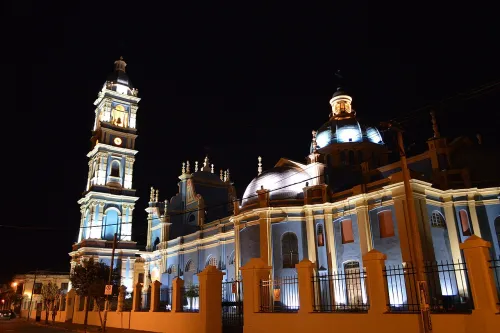
    The crowds thin out as you walk south, and that is the reward here. La Viña sits in a calmer residential stretch, away from the plaza tour buses, and its tall slim tower, 44 meters high, is one of the highest church towers in Argentina, second only to San Francisco's back in the center. The full name is the Iglesia de Nuestra Señora de la Candelaria de la Viña, built between 1873 and 1884 to house the Virgin of Candelaria. The neoclassical front is graceful and pale, a different mood from the loud red of San Francisco. It is a working parish church, so entry is free, but the hours are tight: Tuesday to Friday roughly 9 to 6:30, much shorter on Monday and the weekend, so check the door. Five to ten minutes inside is enough. From here, turn back toward the center and walk north a few blocks to the covered central market, where you will finally eat.

    Hours
    Mon: 11:30 AM – 12:30 PM | Tue-Fri: 9:00 AM – 6:30 PM | Sat: 9:00 AM – 12:30 PM, 5:30 – 7:00 PM | Sun: 9:00 AM – 1:00 PM
    Price
    Free (active parish church)
  8. 8

    Mercado Municipal de Salta

    Missing required field: waypoints[7].image

    You smell this stop before you reach it: fried dough, grilled meat, coriander, and stewed corn. The Mercado Municipal is the working central market, loud and packed with locals doing their shopping, not a polished tourist hall. This is where you eat. Order the empanadas salteñas, small and juicy and the local source of pride, and try a humita, a sweet-savory corn parcel steamed in its husk. A full lunch here costs a fraction of what the plaza cafes charge. The back stalls sell regional crafts and bags of spices if you want to take something home. There is no admission; it is a public market. Hours matter here: it runs Monday to Saturday from 8 in the morning until 2, then reopens 5:30 to 10 at night, and it is closed all day Sunday. Eat, then walk the few blocks back up toward the plaza for the last two stops, both within a block of where you started.

  9. 9

    Güemes Museum (Museo Güemes)

    Güemes Museum (Museo Güemes) in Salta, stop 9 on the self-guided walking tour

    By now you have seen the giant stone monument to Güemes out by the hill; this is where you actually learn who the man was. The museum sits in a colonial house near the plaza and tells his story through staged, immersive rooms rather than glass cases full of labels, which makes it land even if your Spanish is shaky. He was the gaucho commander who shielded the north during the independence wars, and the salteño identity is built around him, so this fills in the legend behind the statue. Admission is ARS 2,270 general, and entry is free on Sundays for salteños and residents with a DNI. It opens Tuesday to Sunday 11 to 19 and is closed Mondays. Budget about 45 minutes. When you come out, walk the last short block toward the plaza; the MAAM is right on the square and saves the most extraordinary thing in Salta for last.

    Hours
    Tu-Su,PH 11:00-19:00
    Price
    ARS 2.270 (general; free Sun for salteños/residents with DNI)
  10. 10

    Museum of High Altitude Archaeology (Museo de Arqueología de Alta Montaña)

    Museum of High Altitude Archaeology (Museo de Arqueología de Alta Montaña) in Salta, stop 10 on the self-guided walking tour

    End here, on the plaza, with the museum that draws people to Salta from across the world. The MAAM exists to protect, study, and show one find: the children of Llullaillaco, three Inca children sacrificed on a 6,700-meter volcano more than 500 years ago, near the peak of the Inca empire just before the Spanish arrived. The high cold preserved them so completely that they look asleep, not dead. The museum displays one mummy at a time, rotated and kept in a controlled freezing case, and it is a quiet, heavy, unforgettable thing to stand in front of. This is a real museum with real ethics, not a sideshow; treat it that way. Admission is ARS 16,000 for foreign visitors, ARS 8,000 for Argentines, and ARS 4,000 for Salta residents, with reduced rates for national seniors. It opens Tuesday to Sunday 11 to 18:30, closed Mondays. Give it a full hour. This is the right place to finish, back where you started, on Plaza 9 de Julio.

    Hours
    Tu-Su 11:00-18:30
    Price
    ARS 16.000 foreign visitors; ARS 8.000 Argentines; ARS 4.000 Salta residents; ARS 2.500 nat'l seniors

How Long Does This Walking Tour Really Take?

Pure walking runs about two and a half hours across the 5.2 km, but the two museums at the end are the time sink: give the MAAM a full hour and the Museo de Güemes around 45 minutes. Add the Cabildo, the churches, and a market lunch and you have a comfortable half day.

Pure walking is about two and a half hours across the 5.2 km, but plan on half a day if you go inside. The two stops that eat the most time are the museums at the end: give the MAAM a full hour and the Museo de Güemes about 45 minutes. The Cabildo deserves 30 to 45 minutes if you go upstairs to the balcony, and San Francisco's guided visit runs on a half-hourly cycle, so you may wait a few minutes for the next one. The churches and the convent door are quick, five to ten minutes each.

The natural break is the market, roughly two-thirds through. Sit down for empanadas salteñas and a humita at the Mercado Municipal before tackling the two museums, because they are heavy going and you want fuel and a rest first. If the market is shut (it closes Sundays and takes a long midday break from 2 to 5:30), grab a coffee under the arcades of Plaza 9 de Julio instead; the cathedral-side colonnade has shaded cafe tables and is the best people-watching spot in the city. A bench in the green center of the plaza, under the trees, is the free alternative when the heat peaks early afternoon.

Full Route, Shorter Walk or Two-Day Version?

The full route works as one continuous half day, but the ten stops split cleanly if you have less time or want to slow down. Here are three ways to walk it, all using the same numbered stops and per-leg times from the map above.

Short version

Skip the Güemes spur

Stops 1, 2, 4 through 10, about 3.5 km, roughly three hours

Cut the out-and-back to the Monumento a Güemes (stop 3), which is the longest detour at 1.16 km each way. You lose the big open-air monument and the hill jump-off, but keep the cathedral, the churches, the Cabildo, the market, and both museums in a tighter loop.

Two easy halves

Split at the market over two mornings

Day one stops 1 through 7, day two stops 8 through 10

Do the plaza, cathedral, Güemes monument, convents, San Francisco, Cabildo, and La Viña on the first morning, then come back for the market lunch, the Museo de Güemes, and the MAAM on the second. This keeps each day short and lets you give the two museums the attention they deserve.

You can walk it in reverse, starting at the MAAM and ending on Plaza 9 de Julio, but the given direction is better: you clear the open-air Güemes monument while the morning is still cool and save the air-conditioned museums for the hot early afternoon.

Is This Salta Walking Tour Right for You?

This is a short, flat city walk with a lot of history packed into a small grid. It suits some travelers better than others, so here is who it fits and how to bend it to your day.

A good fit if you…

  • Walkers who want a compact route under 6 km on flat, easy-to-follow streets
  • History travelers curious about Güemes, the independence wars, and colonial Salta
  • Anyone drawn to the MAAM and its Llullaillaco children, the reason many people come to Salta at all
  • Budget travelers, since almost every stop is free and your money goes on lunch and two museum tickets

Adapt the route if you…

  • You're short on time: drop the Güemes spur (stop 3) and walk the tighter three-hour loop
  • You're traveling with kids or want it gentle: split it over two mornings at the market
  • It's a Sunday: the market is closed all day, so plan lunch under the plaza arcades instead
  • You want the hill too: the Güemes monument is your jump-off for the 1,070 steps or the cable car up Cerro San Bernardo

Tickets & Skip-the-Line in Salta

Salta's colonial center is one of the cheapest walks you'll do in Argentina: almost every stop is a free church, plaza, or facade. Only two stops charge admission, and neither runs a timed-entry system, so there's no line to skip, just hours and prices worth knowing before you go.

Güemes Museum (Museo Güemes)Admission ARS 2.270 general, free on Sundays for salteños and residents with a DNI. Open Tuesday to Sunday 11:00-19:00, closed Mondays. No advance booking needed; buy at the door. Budget about 45 minutes. official ticket site ↗
Museum of High Altitude Archaeology (Museo de Arqueología de Alta Montaña)Admission ARS 16.000 for foreign visitors, ARS 8.000 for Argentines, ARS 4.000 for Salta residents, and ARS 2.500 for national seniors. Open Tuesday to Sunday 11:00-18:30, closed Mondays. Tickets are sold at the entrance on the plaza; give it a full hour.
Everything elseThe plaza, the cathedral, the Cabildo and its Museo Histórico del Norte, San Francisco, La Viña, the Convento de San Bernardo facade, and the Mercado Municipal are all free open spaces or active churches with no admission charge.
Optional upgrade
+6
The same 10-stop route,
now with navigation and a guide.
Optional AI experience

You already have the route.
The AI guide brings it to life.

Standing under the arcades on Plaza 9 de Julio with the pink cathedral in front of you? Start the AI Tourguide and it walks this exact loop with you, talking you through Güemes, the colonial grid, and the Llullaillaco children at the MAAM as you go. It is a real conversation in your ear, free to try, so you get the story behind every stop without paying for a guide or burying your face in a guidebook.

Livenavigation13languagesAnyquestionYourinterests
Open this route with the AI guide

Try it in your browser · No app or download required

Tips for Walking in Salta

  • Start the loop by 9 in the morning. You want the open-air Güemes monument and the hill while it is still cool, and you want to hit the museums (MAAM, Museo de Güemes, Cabildo) during the hot early afternoon when being indoors is a relief. Note the citywide siesta: many doors, including the cathedral's, close roughly 1:30 to 4:30.
  • The old center is flat and the grid is easy, but the leg out to the Monumento a Güemes climbs toward the hill, and if you tack on the 1,070 steps up Cerro San Bernardo you need real shoes. Pavements around the plaza are smooth; the streets toward the monument get rougher and steeper. Trainers, not sandals.
  • Cleanest free restrooms on the route are inside the Cabildo (Museo Histórico del Norte), which is free to enter, Tuesday to Sunday. The Mercado Municipal also has facilities during market hours. Use one of these rather than counting on the churches.
  • Eat at the Mercado Municipal, not the plaza cafes. Order empanadas salteñas (small, juicy, the local pride) and a humita (steamed corn parcel) for a fraction of the cafe price. The market runs Monday to Saturday, 8 to 2 and 5:30 to 10, closed Sundays.
  • Best photo is the tower of Iglesia y Convento San Francisco, the ox-blood-red church on Caseros and Córdoba. Shoot it at dusk when the facade is lit; stand on the opposite corner and frame the tower against the sky. If you are here on the first or third Friday of the month, the night tour makes it even better.

Why Walk This Route?

Salta is one of the few cities in Argentina that kept its colonial center almost whole, and that is exactly why it rewards walking instead of driving. The old town is flat, compact, and built on a grid, so you can string together the cathedral, two of the country's most important churches, the best-preserved town hall in Argentina, and a museum holding 500-year-old Inca mummies, all without ever needing a taxi. The arcaded main square ties it together. Wander on your own and you will see the pretty facades. Walk this route in order and you will understand why people call Salta "la linda," the pretty one.

This loop is about 5.2 km and runs roughly two and a half hours of pure walking, though you will want closer to half a day once you start going inside places. It starts on Plaza 9 de Julio, pushes east to the giant Güemes monument at the foot of Cerro San Bernardo, doubles back through the convents and churches, returns to the plaza for the Cabildo and the museums, then drops south to a working market for lunch. The reason to do it in this order is heat and crowds: you get the open-air monument done while the morning is still cool, and you save the air-conditioned museums for the hot middle of the day.

What makes this better than aimless wandering is that almost everything here is free. The cathedral, the Cabildo, San Francisco, La Viña, the convent facade, the plaza itself: none of them charge admission. The only two stops that cost money are both museums, and both are worth it. So this is a walk where your money goes on empanadas and a cable-car ticket, not on entry fees.

Common Questions

Is Salta safe to walk around?

The colonial center around Plaza 9 de Julio is safe to walk by day and busy into the evening, and this whole route stays inside that well-policed core. Use normal city sense: watch your bag in the crowded Mercado Municipal, keep your phone away on the quieter walk out to the Güemes monument, and do not flash cash. The walk south to La Viña passes calmer residential streets that are fine in daylight but emptier after dark, so do that leg before sunset.

What if it rains during my Salta tour?

Salta's wet season is the summer (roughly December to March), and rain tends to come as short heavy afternoon storms rather than all-day drizzle. If it hits, this route has plenty of indoor cover: duck into the MAAM (a full hour easily), the Museo de Güemes, the Cabildo's Museo Histórico del Norte, or the cathedral, all clustered on or near the plaza. The arcaded recova around Plaza 9 de Julio keeps you dry between them, and the Mercado Municipal is fully covered. You can wait out most storms without getting wet.

What's the best time of day for this walking tour?

Start around 9 in the morning. The open-air stretch to the Monumento a Güemes is far more pleasant before the midday heat, and the cathedral and churches are open in the morning before the siesta closures around 1:30. That timing also lands you at the Mercado Municipal for an early lunch, then the air-conditioned museums for the hot part of the afternoon. Save San Francisco's lit tower for the end, near dusk, for the best photo.

Take this route with you

Open this exact tour with navigation and your personal AI guide.

Start GPS Navigation + AI Guide
AI Tourguide
Researched and curated by the AI Tourguide teamWe plan and quality-check every route, then research and verify the opening hours, prices, and practical tips for each stop along it.
▶ Open route with AI guideNavigation, stories and your questions