Self-Guided Walking Tour in San Pedro de Atacama

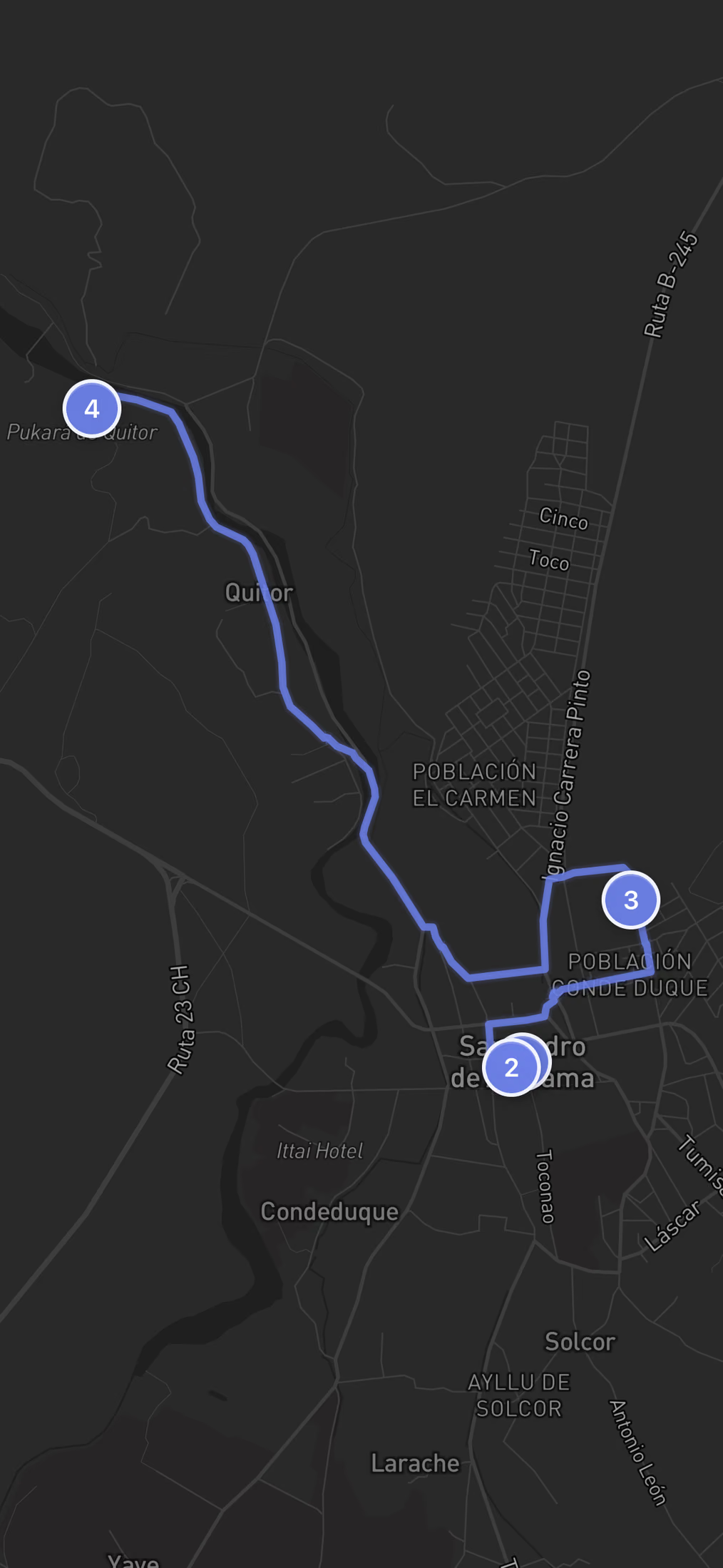
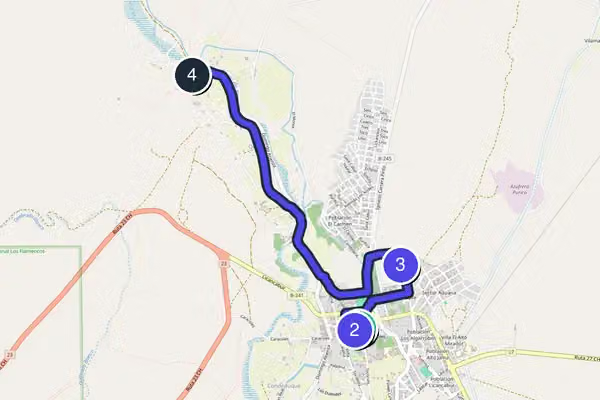
A four-stop route through the oasis town, starting in the shaded Plaza de Armas, into the white adobe church, through the Le Paige archaeological museum, then out along the river to the Pukará de Quitor fortress. This page gives you the map, the walking time for every leg, and the real prices and hours for the two paid stops, with a shorter in-town version if the heat wins.

4 Stops4.7 km~2 hours walking2.5–3 hours with stops
What you get with AI Tourguide
Full GPS navigationInteractive AI guidePersonalized to youWorks in your browser
Try this tour with Alex

San Pedro de Atacama Walking Tour at a Glance

This route is built for travelers who want to understand San Pedro on foot before the vans haul them off to the salt flats and geysers. It walks the town's core in the order that makes sense, plaza to church to museum to fortress, and every interior is optional: the outdoor route is free and you decide which of the two ticketed stops you actually go inside. Self-guided from the first step, at your own start time and your own pace.

StartPlaza de Armas de San Pedro de Atacama
FinishPukará de Quitor
Route typeA near-linear point-to-point heading broadly north and then north-west, from the central plaza out to Quitor on the edge of town, with no backtracking once you leave the museum.
Realistic timeWalking alone is only about an hour spread over 4.7 km; with the plaza, church and a proper museum visit plan two and a half to three hours, and closer to a relaxed half-day if you linger at the fortress.
DifficultyEasy to moderate: 4.7 km total on flat packed dirt and gravel through town, with one steep short climb up loose stone and sand at Quitor. The desert sun and roughly 2,400 m of altitude are the real effort, not the distance.
Cost to followFollowing the route on foot is free. Two stops charge admission: the Le Paige museum at CLP 2.000 adult, and the Pukará de Quitor fortress at CLP 4.000 adult. The plaza and the church cost nothing.
Best for:

Anyone who would rather learn the Atacameño story of this oasis on a self-paced morning walk than pay an agency to drive them three flat kilometers to Quitor and back.

The Route

Free Walking Tour Map of San Pedro de Atacama

4 stops4.7 kmabout 2 hours
Loading the interactive map…The complete walking route will appear here.
Want the route to guide you while you walk?Open the route with navigation and a personal guide for the history, stories and questions that matter to you.
Open route + AI guide

The 4 stops along this route

  1. Missing required field: waypoints[0].image
    1Plaza de Armas de San Pedro de Atacama
  2. Iglesia de San Pedro (atacama (Iglesia de San Pedro) in San Pedro de Atacama, stop 2 on the self-guided walking tour
    2Iglesia de San Pedro (atacama (Iglesia de San Pedro)
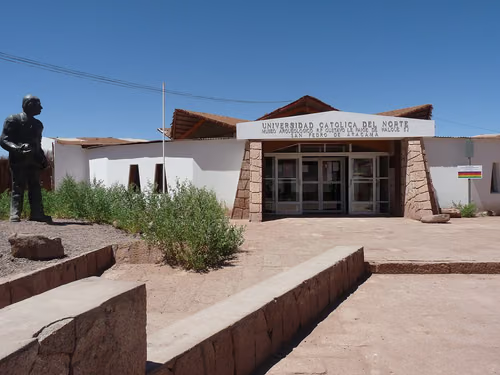
  3. R. P. Gustavo Le Paige Archaeological Museum (Museo Arqueológico R.P. Gustavo Le Paige) in San Pedro de Atacama, stop 3 on the self-guided walking tour
    3R. P. Gustavo Le Paige Archaeological Museum (Museo Arqueológico R.P. Gustavo Le Paige)
  4. Pukará de Quitor in San Pedro de Atacama, stop 4 on the self-guided walking tour
    4Pukará de Quitor
  5. That's the complete route.

    If you want more than the map and text, add live navigation and a conversational AI guide while you walk.

    Open route + AI guide
    You made it
Stop 1 of 4
Swipe →

Your San Pedro de Atacama Walking Tour, Stop by Stop

  1. 1

    Plaza de Armas de San Pedro de Atacama

    Missing required field: waypoints[0].image

    Start here, in the shade. After the glare of the surrounding desert, the plaza hits you like a cool room: dense pepper trees thrown over a square of packed dirt and benches, walled in on every side by low adobe buildings the color of the ground they sit on. This is the social engine of the whole oasis. Locals cross it constantly, dogs sleep under the trees, and everyone passes through it eventually. It is free and open around the clock, so there is no rush and nothing to buy. Take ten minutes on a bench to adjust. You are at roughly 2,400 m here, and the altitude is real. Get your bearings, drink some water, and notice how the town is built entirely from earth and timber, no concrete in sight. The whitewashed church sits on the southwest edge. Walk toward it across the square to your first interior.
  2. 2

    Iglesia de San Pedro (atacama (Iglesia de San Pedro)

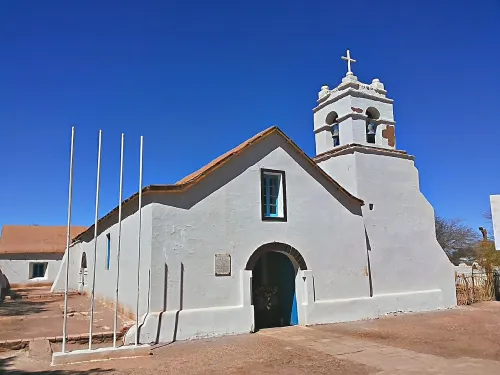
    Iglesia de San Pedro (atacama (Iglesia de San Pedro) in San Pedro de Atacama, stop 2 on the self-guided walking tour

    You cannot miss it. The church is the one bright white shape on the plaza, its thick adobe walls plastered smooth and topped with a roof of cactus wood and timber beams, the traditional desert building method. Step inside if the timing works. It is an active Catholic parish, free to enter with a donation box by the door, but the hours are tight: closed Monday and Sunday, open Tuesday to Saturday from 10:00 to 13:00 and again 15:00 to 20:00. Inside it is dim, cool, and plain, which is exactly the point. This is a working village church, not a cathedral. The patron is San Pedro, celebrated every 29 June with traditional dances that fill this plaza. Give yourself ten minutes inside, then come back out into the light. From the church, head northeast off the plaza toward Calle Padre Le Paige and the small museum a block away.

    Hours
    Mon: Closed | Tue-Sat: 10:00 AM – 1:00 PM, 3:00 – 8:00 PM | Sun: Closed
    Price
    Free (active Catholic parish; donations accepted)
  3. 3

    R. P. Gustavo Le Paige Archaeological Museum (Museo Arqueológico R.P. Gustavo Le Paige)

    R. P. Gustavo Le Paige Archaeological Museum (Museo Arqueológico R.P. Gustavo Le Paige) in San Pedro de Atacama, stop 3 on the self-guided walking tour

    A short block from the plaza you reach the museum, and this is the stop that makes the whole walk make sense. It carries the name of Gustavo Le Paige, a Jesuit priest who settled in San Pedro in 1955 and spent the rest of his life digging up and cataloguing the desert. He opened a first small museum in his own parish house in 1957; the institution behind it now holds close to 380,000 pieces of Atacameño culture, the largest collection of its kind. One honest heads-up: the famous well-preserved mummies were taken off display in 2007 at the request of the lickanantai people, whose ancestors they are, so do not come expecting them. Tickets are CLP 2.000 for adults, CLP 1.000 for students. Note the hours carefully: open Monday to Thursday 9:00 to 12:30 and 14:30 to 18:00, Friday until 17:00, and closed all weekend. Give it 45 minutes. Then walk back to the plaza and pick up the road heading north out of town toward the river and Quitor.

    Hours
    Mon-Thu: 9:00 AM – 12:30 PM, 2:30 – 6:00 PM | Fri: 9:00 AM – 12:30 PM, 1:00 – 5:00 PM | Sat-Sun: Closed
    Price
    CLP 2.000 adult / CLP 1.000 student
  4. 4

    Pukará de Quitor

    Pukará de Quitor in San Pedro de Atacama, stop 4 on the self-guided walking tour

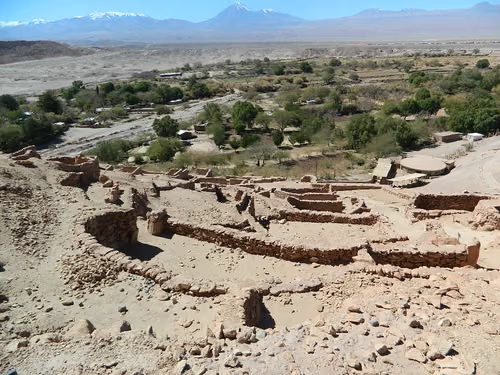
    This is the longest leg of the day and the reason you came. Follow the river road north out of town for about 3 km, the green ribbon of the San Pedro river on one side and bare rock walls on the other, until the fortress appears: pale stone terraces climbing an 80 m hillside, exactly where they have been since the 12th century. The Pukará de Quitor was built by the Atacameño people as a defensive stronghold against Aymara expansion, around 200 structures spread over roughly 24,000 m² of steep slope, all dry stone, now a national monument of Chile. Pay at the ticket desk on arrival: CLP 4.000 for adults, CLP 2.000 for students and seniors, open daily 8:00 to 17:00. Climb the marked path to the top. The reward is the view back down the valley over the oasis you just walked through, with the snow on the volcanoes behind it. Sit, drink the rest of your water, and take it in. This is where the walk ends and where it all comes together.

    Hours
    Daily: 8:00 AM – 5:00 PM
    Price
    CLP 4.000 adult / CLP 2.000 student & senior

How Long Does This Walking Tour Really Take?

Pure walking across the 4.7 km is barely an hour, but this is a route to slow down for: ten minutes each in the plaza and church, a full 45 minutes in the museum if it is open, and a good hour to climb Quitor, sit at the top and walk back. Call it two and a half to three hours moving, a relaxed half-day if you don't rush the fortress.

Plan for a relaxed half-day, roughly two and a half to three hours of actual moving and looking, more if you linger. The plaza and church are quick, ten minutes each. The museum deserves a proper 45 minutes if it is open. The big time sink is Quitor: budget the 3 km walk out, plus a good 45 minutes to an hour climbing and sitting at the top, plus the walk back. That is the half of the route that rewards slowness.

For a break, do it before you leave town rather than at the fortress, where there is nothing but the ticket desk. The cafes and juice spots cluster on Caracoles, the pedestrian-feeling main street one block north of the plaza. Grab a fresh mango juice and fill your water bottles there before the river road. At Quitor itself, the best rest is simply a flat rock near the top of the climb, looking back over the oasis. That view is your bench.

Full Route, Shorter Walk or Two-Day Version?

The route is short enough to do in one morning, but the last leg out to Quitor is by far the longest and does the most under a hot sun. Here are three ways to walk it depending on your energy, the heat, and how much time you have.

The In-Town Short Version

Core Oasis Without the Fortress

Stops 1–3 only, about 1.2 km, roughly 90 minutes

Skip the long, exposed 3.5 km leg to Quitor and keep the walk to the shaded town core: plaza, church, museum, all within a few blocks. Ideal if it is already midday, if the altitude is hitting hard, or if you are saving your legs for a desert excursion the same afternoon. You lose the fortress and its valley view but keep the story.

The Split Version

Town First, Quitor Fresh

Day/session one stops 1–3 in town, then stops 3–4 out to Quitor when rested

Do the plaza, church and museum as one easy loop around town, then tackle the 3.5 km walk out to Pukará de Quitor as a separate outing on a fresh, cool morning rather than tacking it onto the end. Best for anyone still adjusting to the altitude, or traveling with kids who won't want the museum and the climb in one push.

You can reverse it and start at Pukará de Quitor, but the given direction is the better one: it puts the plaza, church and museum first so you understand who built the fortress before you reach it, and it gets you climbing Quitor in the cooler morning rather than at midday. Ending at the fortress also means finishing on the valley view rather than in the dusty town center.

Is This San Pedro de Atacama Walking Tour Right for You?

This is a short, hot, high-altitude town walk with one real climb at the end. It suits some travelers far better than others, so here is who it is for and how to bend it if it isn't quite you.

A good fit if you…

  • Independent travelers who would rather set their own start time than join a fixed agency half-day tour to Quitor
  • Anyone who wants the Atacameño and Le Paige backstory, not just a stone wall and a photo stop
  • Walkers comfortable with 4.7 km on flat dirt roads plus one short steep climb on loose stone
  • Budget-minded visitors: the whole route with both admissions comes to well under CLP 7.000 per person

Adapt the route if you…

  • The altitude near 2,400 m is bothering you: use the In-Town Short Version and skip the Quitor climb
  • You are walking in the midday heat: do the shaded town core only, or split Quitor to a cool morning
  • You are short on time before a desert excursion: stick to stops 1–3, all within a few blocks
  • You have kids or tired legs: split the museum and the fortress into two separate outings

Tickets & Skip-the-Line in San Pedro de Atacama

There are no advance-ticket queues to beat in San Pedro de Atacama: both paid stops sell entry on the spot. What matters here is timing your visit around tight, unusual opening hours, especially the museum's weekend closure. Prices and hours below come straight from the tour's fact pack.

R. P. Gustavo Le Paige Archaeological Museum (Museo Arqueológico R.P. Gustavo Le Paige)CLP 2.000 adult, CLP 1.000 student, paid at the door. Open Mon to Thu 9:00 AM–12:30 PM and 2:30–6:00 PM, Fri 9:00 AM–12:30 PM and 1:00–5:00 PM, closed all weekend. Plan the walk on a weekday or you will find it shut. official ticket site ↗
Pukará de QuitorCLP 4.000 adult, CLP 2.000 student and senior, paid at the ticket desk on arrival. Open daily 8:00 AM–5:00 PM. Come early: the climb up the bare stone terraces is far more pleasant before the midday sun. official ticket site ↗
Iglesia de San Pedro (atacama (Iglesia de San Pedro)Free to enter, an active Catholic parish with a donation box by the door. Hours are tight: closed Monday and Sunday, open Tue to Sat 10:00 AM–1:00 PM and 3:00–8:00 PM. No ticket needed. official ticket site ↗
Everything elseThe Plaza de Armas is a free, open-air public square with no ticket and no set hours, open around the clock.
Optional upgrade
+1
The same 4-stop route,
now with navigation and a guide.
Optional AI experience

You already have the route.
The AI guide brings it to life.

Standing in the shade of the Plaza de Armas, not sure where to start? Press play and let the AI guide walk you from the plaza to the church, through the Le Paige museum, and out along the river to the Pukará de Quitor, telling you the Atacameño story as you go. Your pace, your start time, the desert history in your ear the whole way.

Livenavigation13languagesAnyquestionYourinterests
Open this route with the AI guide

Try it in your browser · No app or download required

Tips for Walking in San Pedro de Atacama

  • Start by 8:30 or 9:00 in the morning. The museum opens at 9:00, Quitor at 8:00, and you want to be climbing the fortress before the midday sun turns the bare stone into an oven. By early afternoon the river-road walk is brutal.
  • The whole town is packed dirt and loose gravel, and the path up Quitor is steep stone and sand. Wear closed shoes with grip, not sandals. The fortress climb is short but the surface is loose underfoot.
  • Use the restroom before you head north. There are public and cafe toilets around the plaza and on Caracoles, but once you start the 3 km walk to Quitor there is nothing until the ticket desk at the fortress entrance.
  • Stop on Caracoles, the main street one block north of the plaza, for a fresh fruit juice before the river walk. Mango or chirimoya, a few thousand pesos, and it doubles as your last chance to fill water bottles. The desert dries you out faster than you expect at altitude.
  • For the best photo, climb to the top terrace of Quitor and face back south down the valley. You get the pale stone ruins in the foreground, the green oasis below, and the volcanoes behind. Late morning light, before noon, keeps the long shadows on the stonework.

Why Walk This Route?

San Pedro de Atacama is tiny. The whole town is maybe ten dusty blocks of low adobe walls, and most people treat it as nothing more than a basecamp: somewhere to sleep between a sunrise geyser tour and an afternoon at the salt flats. That is a mistake. The town itself is one of the oldest continuously inhabited places in Chile, and walking its core on foot tells you more about who lived in this desert than any van full of tourists ever will.

This route is short, about 4.7 km in total, and it works because it goes in the right order. You start in the shaded plaza where the whole village still gathers, step into the white adobe church that has anchored that plaza for centuries, then duck into the archaeological museum that explains the people who built everything around you. Only then do you walk out of town, up along the river, to the pre-Inca stone fortress that guarded this oasis 800 years ago. History first, then the payoff with a view.

Do this in the morning before the desert heat sets in, and you will understand the place in a way that the day-trip crowds, hammering off to the lagoons at dawn, never do. Bring water, bring a hat, and do not rush the last stretch. The walk to the fortress is the whole point.

Common Questions

Is San Pedro de Atacama safe to walk around?

Yes, it is a small, calm village and the route here stays on the main streets and the well-used river road to Quitor. The real hazards are not crime but the environment: strong sun, dry air, and altitude around 2,400 m that climbs higher at the fortress. Carry water and a hat. The one thing to watch on the desert tours, not this walk, is overpriced or unlicensed agencies on Caracoles, so compare a couple before booking anything outside town.

What if it rains during my San Pedro de Atacama tour?

It almost never rains here. This is one of the driest places on Earth, so a wet day is genuinely rare. If you hit one of the occasional desert showers, the indoor option on this route is the Le Paige archaeological museum, which gives you a solid 45 minutes under a roof. The church interior is the other dry stop. Save the open walk to Quitor for clear weather, which is nearly every day.

What's the best time of day for this walking tour?

Early morning, starting around 8:30 to 9:00. The museum opens at 9:00 and the fortress at 8:00, and the temperature is bearable for the river walk before the sun is high. Crucially, mornings here are usually still and clear before the wind picks up in the afternoon. If you do it the other way and reach Quitor at midday, the bare stone radiates heat and the climb is far less pleasant.

Take this route with you

Open this exact tour with navigation and your personal AI guide.

Start GPS Navigation + AI Guide
AI Tourguide
Researched and curated by the AI Tourguide teamWe plan and quality-check every route, then research and verify the opening hours, prices, and practical tips for each stop along it.
▶ Open route with AI guideNavigation, stories and your questions